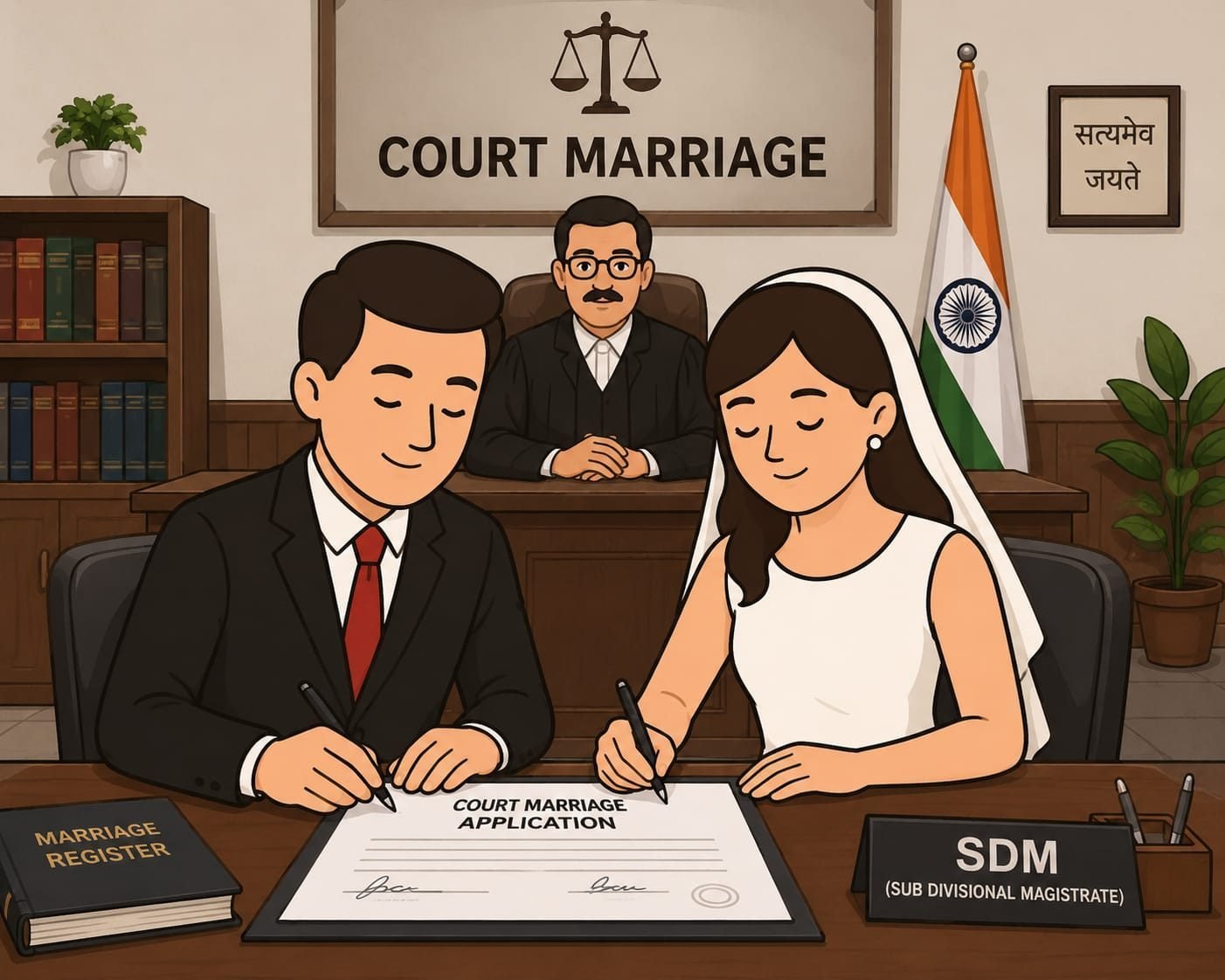
Quick answer: Punjabi Bagh, with its East and West blocks, Club Road, Madipur, Ramesh Nagar, Moti Nagar and the Kirti Nagar furniture market nearby, is one of west Delhi's wealthiest business neighbourhoods, and its weddings are planned like projects. Under Delhi's 2026 revenue map these addresses are in the West district, whose sub-divisions are Rajouri Garden, Janakpuri and Vikaspuri; the e-District portal allots the office by address. Two Hindus, Sikhs, Jains or Buddhists can have an Arya Samaj wedding and register it under the Hindu Marriage Act (combined ₹7,100); Sikh couples can register an Anand Karaj under Delhi's 2018 Rules; interfaith couples who do not want to convert use the Special Marriage Act. For business families the parts that need thought are money and property: what a prenuptial agreement can and cannot do in India, how the Special Marriage Act affects a Hindu undivided family, how to record the bride's stridhan, and what your banquet and vendor contracts actually say.
Key takeaways
- Punjabi Bagh is in the West district (Rajouri Garden, Janakpuri and Vikaspuri sub-divisions); the portal allots the office by address.
- Two Hindus: Arya Samaj wedding + Hindu Marriage Act registration (₹7,100 combined); Sikh couples can register an Anand Karaj under Delhi's 2018 Rules.
- A Hindu marrying a non-Hindu under the Special Marriage Act is severed from the HUF (s.19) and succession moves to the Indian Succession Act (s.21); s.21A excludes this where both are Hindus.
- Prenuptial agreements are not enforced in India as abroad – clear titles, properly recorded settlements, registered gift deeds and wills do the work.
- Record the bride's stridhan: bills in her name with HUID, a signed list and photographs. We never provide witnesses.
Last reviewed: 23 September 2026 · 37 min read
On this page
- Punjabi Bagh at a glance
- Punjabi Bagh under the 2026 map
- Which office registers your marriage
- The legal routes
- Arya Samaj + registration
- Sikh couples: Anand Karaj
- Special Marriage Act
- Business families and the HUF
- Prenuptial agreements in India
- Family settlements and gift deeds
- Recording the bride's stridhan
- Wills and nominations after the wedding
- Tax and money questions
- Two families, one file
- Banquet and vendor contracts
- Wedding insurance and cancellations
- NRI children and destination weddings
- Registering a wedding already held
- Inter-caste and interfaith couples
- Muslim couples
- Marrying quietly in a well-known family
- If your families oppose
- Second marriages and blended families
- Out-of-town guests and hotels
- Age
- Witnesses
- A three-month legal plan
- Documents checklist
- At the appointment
- What it costs
- Timeline
- Getting around
- Common mistakes
- After registration
- Five Punjabi Bagh situations
- Checklist
- One-minute summary
- How we help
- Questions and answers
Punjabi Bagh was laid out for families who rebuilt after 1947 and prospered: wide plots, tall houses, a club, and generations of businesses in trading, manufacturing, real estate and exports. Around it are Madipur and Ramesh Nagar, the workshops of Moti Nagar, and the furniture showrooms of Kirti Nagar, where a wedding's worth of furniture can be bought in an afternoon. The weddings themselves are held in the banquet halls along the Rohtak Road and the Ring Road, or at farmhouses further out, and they are planned months in advance by professionals.
What is often not planned is the legal side. Families spend weeks on the menu and minutes on the paperwork, and then discover that the certificate is needed for a visa, that a joint-family property question was never thought through, or that nobody kept the bills for the bride's jewellery. The questions we get from this belt are therefore less about how to marry and more about money, property and records: can we make a prenuptial agreement; what happens to the family business if our son marries under the Special Marriage Act; how do we record what we are giving our daughter; what does our banquet contract say if a date changes.
This guide covers all of it, alongside the ordinary process: routes, documents, timing, costs and the appointment. Where a question belongs with your own chartered accountant or lawyer, we say so rather than guessing on your behalf.
For the general Delhi process, see the complete Delhi court marriage guide. Nearby area guides: Rajouri Garden, Hari Nagar, Saraswati Vihar and Patel Nagar.
Punjabi Bagh at a Glance
| Item | Detail |
|---|---|
| District (from 1 January 2026) | West |
| Sub-divisions in the district | Rajouri Garden, Janakpuri, Vikaspuri |
| Areas | Punjabi Bagh East and West, Club Road, Madipur, Ramesh Nagar, Moti Nagar, Kirti Nagar, Paschim Vihar's edge |
| Metro | Green Line: Punjabi Bagh, Punjabi Bagh West, Madipur, Shivaji Park; Blue Line: Ramesh Nagar, Moti Nagar, Kirti Nagar |
| Known for | Business families, banquet halls, the Kirti Nagar furniture market, Moti Nagar industrial units |
| Typical questions | Property and HUF effects, prenuptial agreements, stridhan records, NRI children, quiet weddings in known families |
Punjabi Bagh Under the 2026 Revenue Map
From 1 January 2026, Delhi's revenue administration was reorganised into 13 districts and 39 sub-divisions. The West district has three sub-divisions: Rajouri Garden, Janakpuri and Vikaspuri. Punjabi Bagh addresses are most likely to be allotted to Rajouri Garden, with neighbouring colonies falling elsewhere according to the boundary. You do not choose the office; the portal allots it by the address you enter, and your appointment slip names it. Certificates issued before 2026 remain fully valid.
Which Office Registers Your Marriage?
Applications are filed on the Delhi e-District portal. For Hindu Marriage Act registration, the office can be the one for the place where the marriage was solemnised or where either spouse lives; for the Special Marriage Act, notice goes to the Marriage Officer of the district where at least one of you has lived for the past 30 days. A wedding at a banquet hall on the Ring Road with the family home in Punjabi Bagh gives you both options; we use whichever your documents support best.
The Legal Routes
| Your situation | Route | Waiting period | Our fee |
|---|---|---|---|
| Both Hindu, Sikh, Jain or Buddhist | Arya Samaj wedding + Hindu Marriage Act registration | Wedding same day | ₹5,100; ₹7,100 with registration |
| Big family wedding already held | Hindu Marriage Act registration | By appointment | ₹6,000 |
| Sikh couple after Anand Karaj | Delhi Anand Marriages Registration Rules, 2018, or HMA | By appointment | ₹6,000 |
| Different religions, no conversion | Special Marriage Act | 30 days' residence, then 30-day notice | ₹15,000 |
| NRI bride or groom | As above, planned around the visit, plus apostille | Same visit if documents are ready | ₹6,100; ₹30,000 with apostille and attestation |
| Both Muslim | Nikah + registration under the Delhi 2014 Order | Nikah same day | ₹5,000 / ₹6,000 |
| Certificate lost or wrong | Duplicate or correction | Days to weeks | ₹2,500 |
Government fees are extra at actual cost. Full list: fees.
Arya Samaj Wedding + Registration
For two Hindus, including Sikhs, Jains and Buddhists, the Arya Samaj route gives a complete, lawful ceremony in about an hour: havan, garlands, pheras and saptapadi, with the mandir certificate the same day. Families here often hold it in the morning, with the reception later in the season, or alongside the main function.
The mandir certificate proves the ceremony; the government certificate comes from Hindu Marriage Act registration on e-District, and that is the one banks, passport offices and foreign missions recognise. Our combined package is ₹7,100. The Supreme Court held in Dolly Rani (2024) that a Hindu marriage requires the essential ceremonies, so no paper substitutes for the wedding itself. See our Arya Samaj marriage page.
Sikh Couples: Anand Karaj
Many families here hold the Anand Karaj at a gurdwara, with the four laavan around the Guru Granth Sahib. Delhi notified the Delhi Anand Marriages Registration Rules, 2018, so the marriage can be registered as an Anand marriage; registration under the Hindu Marriage Act also remains available, and either certificate is valid proof. Bring the gurdwara's certificate, photographs of the laavan, both spouses' age proof, ID and address proof, and two witnesses. Tell us at the outset that yours is an Anand Karaj, so that the application is filed in the right category — it matters when the certificate is later used abroad.
Special Marriage Act
The Special Marriage Act, 1954 is the civil route for any two adults, whatever their religion, without conversion: 30 days' residence in the district before the notice, a 30-day public notice during which only legal objections count, then solemnisation before the Marriage Officer with three witnesses. Our full service is ₹15,000. For a business family the property effect matters, and it is explained next.
Business Families and the Hindu Undivided Family
Many houses here hold property and run businesses through a Hindu undivided family, with a karta, coparceners and an HUF PAN. Marriage interacts with that structure, and the interaction depends on which law you marry under.
| Marriage | Effect on the HUF | Succession |
|---|---|---|
| Two Hindus under the Hindu Marriage Act (including an Arya Samaj wedding or Anand Karaj) | No severance; the member remains a coparcener | Hindu Succession Act |
| Two Hindus under the Special Marriage Act | No severance: section 21A excludes sections 19 and 21 | Hindu Succession Act |
| A Hindu marrying a person of another religion under the Special Marriage Act | Section 19 treats the Hindu partner as severed from the undivided family from the date of the marriage | Section 21 applies the Indian Succession Act to the couple and their children |
Severance does not mean losing property. It means the person ceases to be a coparcener from the date of the marriage, and their share becomes separate property, as on a partition. Since Vineeta Sharma (2020), daughters are coparceners by birth exactly as sons are, so the same rule applies to a daughter who marries outside the faith under that Act.
What a family should do about it is straightforward: get the structure looked at by a chartered accountant and a lawyer before the wedding, record any partition or arrangement properly, and make wills. What it should not do is pressure a couple into a different marriage route to avoid a legal consequence that can be planned for.
Prenuptial Agreements in India: What Is and Is Not Possible
Families with substantial assets often ask for a prenuptial agreement, having seen them abroad. The honest position in India is this.
- A prenup is not specifically recognised under the Hindu Marriage Act or the Special Marriage Act. Indian courts have historically viewed agreements that anticipate the breakdown of a marriage with suspicion, and marriage is not treated as a purely contractual relationship.
- It is not automatically void either. Such an agreement may be looked at as evidence of what the parties intended, particularly about separate property, and courts have on occasion taken note of one. But no lawyer can promise that it will be enforced.
- Goa is different: the civil code applicable there recognises antenuptial agreements and regimes of property between spouses. That does not extend to Delhi.
- Muslim law is different in a useful way: conditions agreed in a nikahnama, such as a delegated right of divorce or an agreed mahr, are part of the contract of marriage and are given effect.
- What works better in practice: keeping the two families' assets clearly titled and documented; a partition or family arrangement recorded properly where an HUF is involved; gifts made by deed rather than by conversation; wills; and clear records of what the bride brings, which is hers regardless.
- What never works: an agreement that tries to waive maintenance for a wife or to bargain away a child's rights. Those obligations exist in law and cannot be contracted out of.
We are not a law firm and do not draft such agreements. What we do is tell families plainly what the law is, so that they take advice from their own lawyer before the wedding rather than after a dispute.
Family Settlements and Gift Deeds
Weddings in this belt are often the occasion for property arrangements: a floor promised to a son, a flat given to a daughter, a share in a firm adjusted. The difference between an arrangement that holds and one that becomes litigation is documentation.
- Family settlement: a bona fide settlement among family members to resolve claims is recognised by the courts, and the Supreme Court set out the principles long ago in Kale v. Deputy Director of Consolidation (1976). A memorandum that merely records a settlement already acted upon is treated differently from a document that itself creates rights in immovable property, which needs to be stamped and registered.
- Gift of immovable property must be by a registered deed, properly stamped, and accepted by the donee during the donor's lifetime. A promise at a wedding is not a gift.
- Gift of jewellery or money to the bride is effective on delivery, but write a list and keep receipts; that is what proves it later.
- Do not ask anyone to sign under pressure at the time of the wedding, least of all a daughter renouncing her share. A release has to be voluntary and properly executed, and a signature obtained amid wedding arrangements is easy to challenge.
- Tell both sides' advisers. Most disputes we hear about started with an arrangement that only one branch of the family knew about.
Recording the Bride's Stridhan
Everything given to the bride, by her parents, relatives, friends and the groom's family, before, at or after the wedding, is her stridhan: her absolute property. The Supreme Court held in Pratibha Rani (1985) that the husband and in-laws hold it only in trust and must return it on demand; refusal can amount to criminal breach of trust, and she can also claim it under the Protection of Women from Domestic Violence Act, 2005.
In families where the amounts are large, the practical work is proof:
- Bills in the bride's name for jewellery, with weight, purity and the six-digit HUID that hallmarked gold has carried since 2023.
- A signed list of gifts from both sides, prepared at or soon after the wedding; the Dowry Prohibition rules themselves contemplate lists of presents.
- Photographs of the jewellery and of the bride wearing it at the functions.
- Her own locker, or at least joint operation, rather than everything in the in-laws' locker.
- Her own copies of the list, bills and the marriage certificate, kept where she can reach them.
- Keep dowry out of it. Giving, taking or demanding dowry is an offence under the Dowry Prohibition Act, 1961; gifts freely given to the bride are lawful and should be recorded as hers.
Wills and Nominations After the Wedding
Marriage changes who the law treats as your closest family, and most households here have nominations dating from before it.
- Wills: make or revise them after the marriage. Without a will, succession law decides, which may not match your intention, particularly in a second marriage or where a business is involved.
- Nominations in bank accounts, demat accounts, insurance policies, provident fund and company records should be reviewed. A nominee holds for the legal heirs unless the law says otherwise; a will is what actually directs who takes.
- Partnership and company records: if a spouse joins a firm or holds shares, document it properly rather than informally.
- Locker and safe deposit: update the operating instructions and nominations.
- Keep the marriage certificate with these papers, because every one of these institutions will ask for it at the worst possible time.
Tax and Money Questions Families Ask
We are not tax advisers, and anything here should be checked with your chartered accountant. But three questions come up so often at Punjabi Bagh weddings that they are worth stating in outline.
- Gifts on marriage: Indian income-tax law treats gifts received by an individual on the occasion of their marriage differently from ordinary gifts, and gifts from specified relatives are treated differently again. The occasion and the relationship both matter, so keep a record of what was received, from whom and when.
- The bride's own money: what is given to her is hers. Where it is invested, income follows the law on clubbing between spouses, which is exactly why gifts and investments should be documented rather than mixed.
- A new HUF: a married couple can constitute a Hindu undivided family, and families often ask whether to do so at the wedding. That is a decision with tax and succession consequences; take advice rather than copying a cousin's arrangement.
What matters for our purposes is simpler: the records that support all of this — the marriage certificate, the gift list, the bills, the deeds — should exist, be consistent, and be kept where both spouses can reach them.
Two Families, One File
In arranged matches between business families, the paperwork is usually split between two sets of relatives, and things fall between them. A short division of labour prevents that:
- One person on each side is responsible for that side's documents: age proof, ID, address proof, photographs and, if applicable, a divorce decree or death certificate.
- One person overall is responsible for the ceremony record: the pandit's or gurdwara's certificate, the invitation and the photographs of the pheras or laavan.
- Two witnesses are named and told the likely appointment date before the functions begin.
- The couple keep their own set of everything, digitally, from the first day.
- One adviser — the family's CA or lawyer — is told about any property arrangement being contemplated, in advance.
It takes one conversation, and it is the difference between registering within a fortnight and chasing papers for six months.
Banquet and Vendor Contracts
A large wedding involves a dozen contracts: the banquet or farmhouse, caterer, decorator, photographer, band, makeup, travel and hotel rooms for guests. Families sign them quickly and read them never. A few things worth checking before you pay the advance:
- What is booked, exactly: date, hours, covered and open areas, number of guests included, and the rate for extra guests.
- The cancellation and postponement clause: how much is refundable, and what happens if you move the date by a week.
- Who pays for what in taxes, service charges and overtime; get the final number in writing, not a verbal "we will manage".
- Licences and permissions for music, fireworks where allowed, and parking; loud music at night is restricted, and neighbours do complain.
- The photographer's deliverables: when the album and raw files arrive. Ask for a handful of ceremony photographs on the wedding day itself, because registration needs them long before an album is ready.
- Payments: pay by traceable means and keep invoices. If a dispute arises, a consumer complaint is possible, and it will be built on your documents.
Wedding Insurance and Things Going Wrong
Wedding insurance is sold by several Indian insurers and typically covers cancellation or postponement for specified reasons, damage to property, public liability and sometimes loss of jewellery in transit, subject to the policy's own terms and exclusions. If you are spending heavily, read the policy rather than the brochure: what counts as a covered cancellation is narrower than families assume.
Whatever happens to the function, note that the marriage is a separate matter from the party. If a ceremony has been performed and the couple are married, a cancelled reception changes nothing legally. Conversely, a spectacular reception where no ceremony took place does not create a marriage. Keep the two apart in your mind, and get the ceremony and the registration right.
NRI Children and Destination Weddings
Many families here have children settled in Canada, the UK, the US, Australia or the Gulf, and the wedding is planned around a two or three-week visit, sometimes at a resort outside Delhi.
- Register in India before they fly back. Both spouses must attend the registration appointment; arranging it later is very difficult.
- Names must match the passports exactly on the certificate. Read it at the counter.
- Apostille or attestation follows: the Ministry of External Affairs apostilles for countries in the Hague Convention, including the UK, the US, Australia and, since 2024, Canada; the UAE has traditionally required embassy attestation.
- A wedding outside Delhi (Jaipur, Goa, Udaipur) is registered where it was solemnised or where a spouse resides, under that state's rules. Plan this before you book the venue, not after.
- A foreign-national spouse usually marries under the Special Marriage Act, often with a certificate of no impediment from their embassy.
- Evidence of a genuine relationship matters for a later spouse visa: photographs with both families, the invitation, communication records and joint arrangements. Keep them honestly; never manufacture them.
See our NRI marriage service, the apostille guide and our Model Town guide, which covers visa documentation in detail.
Registering a Wedding Already Held
Big weddings often go unregistered for months because everyone assumes someone else is handling it. Registration of an existing Hindu marriage needs the wedding card, photographs of the ceremony, a pandit's or mandir certificate where available, both spouses' age proof, ID and address proof, affidavits, and two witnesses who attended. Our fee is ₹6,000, and we can file within days of the function if you collect the ceremony photographs on the day. See our marriage registration service.
Inter-Caste and Interfaith Couples
An inter-caste marriage between two Hindus is lawful and needs no permission from anyone; where one spouse is from a Scheduled Caste and the other is not, the couple may be eligible for the ₹2.5 lakh incentive under the Dr. Ambedkar Scheme for Social Integration through Inter-Caste Marriages, subject to its current conditions, including registration under the Hindu Marriage Act and it being the first marriage of both.
Interfaith couples who do not want either partner to convert marry under the Special Marriage Act, with the property consequences described above. Conversion, if chosen, must be genuine; it never dissolves an existing marriage (Sarla Mudgal, 1995), and we do not conduct conversions arranged as a formality. See our inter-caste and inter-religion services.
Muslim Couples
Muslim families in and around this part of west Delhi marry by nikah: two adults free to marry, free consent, mahr, and the proposal and acceptance before witnesses. Our own Qazi reads nikahs with nikahnama and certificate for ₹5,000. Delhi law requires registration under the Delhi (Compulsory Registration of Marriage) Order, 2014 within 60 days, with a ₹500 fee for the next 60 days and a ₹1,000 penalty after that. Register under that Order rather than the Special Marriage Act, which would move succession to the Indian Succession Act; the Delhi High Court directed online registration of Muslim marriages under the 2014 Order in Faizan Ayubi (2024). Conditions agreed in the nikahnama, including mahr and a delegated right of divorce, are part of the contract and should be recorded carefully. See our nikah registration service.
Marrying Quietly in a Well-Known Family
In a neighbourhood where families are known to each other, some couples want the opposite of a big wedding: a lawful marriage with nobody watching, either because the families disagree or simply because they want privacy.
- The ceremony can be small: the couple, the priest and two witnesses, in about an hour.
- Hindu Marriage Act registration notifies nobody. The Special Marriage Act, by contrast, requires a 30-day public notice, which is why two Hindus who want privacy usually take the Arya Samaj route.
- Your witnesses are your choice: friends or colleagues are as good as relatives.
- Keep your own copies of every document, in your own email, not in a family cupboard.
- We do not discuss your case with anyone, including relatives who call us.
If Your Families Oppose
Adults may marry by choice. The Supreme Court directed protection for inter-caste and inter-religion couples in Lata Singh (2006), held in Shakti Vahini (2018) that no family or community body may interfere with the marriage of consenting adults, and in Shafin Jahan (2018) that the choice of a partner is part of personal liberty. Delhi Police has special cells for threatened couples and the Delhi High Court can order protection. Keep documents with you, leave copies with a friend, choose supportive witnesses, register promptly, record threats, and call 112 in an emergency or 181 for the women's helpline. See our love marriage service and the love marriage rights guide.
Second Marriages and Blended Families
A divorced or widowed person may remarry once the earlier marriage has ended: a certified copy of the final decree for Hindus and Christians, or a talaqnama, khulanama or decree plus iddat for Muslims, or the former spouse's death certificate. A stamp-paper or panchayat "divorce" does not end a Hindu marriage except where a recognised custom applies and is proved. Where there are children and property from a first marriage, deal with guardianship, school records, nominations and a will at the same time as the wedding, and take advice; a step-parent has no automatic legal authority over a child, and existing court orders continue until varied.
Out-of-Town Guests, Hotels and Practicalities
A Punjabi Bagh wedding usually brings relatives from Punjab, Haryana, Mumbai and abroad, and families block hotel rooms along the Ring Road and in west Delhi. Two small legal points are worth knowing.
- Hotels record every guest's identity and foreign nationals' details are reported as the law requires; make sure visiting relatives carry their passports and visas, and keep copies.
- A hotel is not a residence. It cannot be used as address proof for registration, nor for the Special Marriage Act's 30-day residence requirement, however long the booking.
- Unmarried adults sharing a room break no law; the Madras High Court said so plainly in 2019. Hotels may still have their own ID rules.
- Transport and parking: agree with the venue what parking is included, because guests' cars on the Ring Road are the complaint neighbours remember.
- If an NRI guest is also the groom, plan the registration appointment around the guest list, not after it: the people you need as witnesses are often the first to leave.
Age
The groom must be at least 21 and the bride 18 on the wedding day, shown by a Class 10 certificate, birth certificate or passport; Aadhaar is identity proof, not reliable age proof. We never conduct a marriage where either party is under age. See the marriage age guide.
Witnesses
Two witnesses for Hindu Marriage Act or Anand registration, three for the Special Marriage Act, and for a nikah as the school followed requires. They bring photo ID and address proof and must actually know you. In big weddings, the relatives who would be ideal witnesses often fly out the next morning: fix two people who will still be in Delhi on the appointment day.
We do not provide witnesses. A person who does not know you is not a real witness. Bring your own. See the witness requirements guide.
A Three-Month Legal Plan for a Big Wedding
Families here book venues six months ahead and leave the legal side to the last fortnight. Reverse that, and nothing goes wrong.
- Three months out: both sides collect age proof, photo ID and address proof for the couple, and check every spelling and date against the passports. Any duplicate certificate or name affidavit is ordered now. If either partner was married before, the certified decree or death certificate is put in the file.
- Ten weeks out: the route is settled — Arya Samaj plus registration, Anand Karaj plus registration, or the Special Marriage Act — and, where the Special Marriage Act applies, the 30 days' residence and the notice are diarised backwards from the wedding date.
- Eight weeks out: the family's chartered accountant and lawyer are told of any property arrangement contemplated, so that a partition, settlement or gift deed is drawn properly rather than improvised.
- Four weeks out: two witnesses are named and told the likely appointment date; the couple are told what to bring on the wedding day.
- The wedding day: the pandit's or gurdwara's certificate is signed, a handful of ceremony photographs are taken aside, and the invitation is kept.
- Within a week: the affidavits are sworn and the application filed online.
- Within a month: the appointment attended, the certificate read at the counter, attested copies made, wills and nominations updated, and the stridhan list signed and copied.
Every step is short. What ruins the timeline is discovering in the last week that a school certificate is missing, or that the only two available witnesses left for Toronto on Monday.
Documents Checklist
| Document | Who | Notes |
|---|---|---|
| Age proof | Both | Class 10 certificate, birth certificate or passport |
| Photo ID | Both | Aadhaar, voter ID, passport, driving licence or PAN |
| Address proof | At least one in Delhi; 30 days' residence for SMA | Aadhaar, voter ID, electricity bill, passport, bank statement, rent agreement with tenant verification |
| Photographs | Both | Passport size, plus clear photographs of the pheras or laavan |
| Ceremony proof | For registration | Arya Samaj or mandir certificate, gurdwara certificate, nikahnama, wedding card, venue address |
| Affidavits | Both | Age, marital status, nationality; one-and-same-person where names differ |
| Divorce decree or death certificate | If married before | Certified copy |
| Passport and visa | NRI or foreign partner | Plus a no-impediment certificate where the country issues one |
| Witnesses' ID and address proof | Each witness | Two for HMA, three for SMA |
Full list: documents required for court marriage in Delhi.
At the Appointment
Both spouses and the witnesses attend the office named on the slip with all originals. The officer compares originals with the uploads, confirms identity, and asks simple questions: when and where you married, who performed the ceremony, whether either was married before, and whether you married of your own will. Witnesses say how they know you. If everything is in order, you sign the register and the certificate is issued, often digitally, the same day or within a few days. Read every entry before leaving: names, dates of birth, parents' names, date and place.
What It Costs
| Service | Our fee |
|---|---|
| Arya Samaj marriage (same day) | ₹5,100 |
| Arya Samaj + registration combined | ₹7,100 |
| Registration of an existing marriage or Anand marriage | ₹6,000 |
| Court marriage (advocate assisted) | ₹6,100 |
| Inter-religion marriage | ₹10,000 |
| Special Marriage Act, full process | ₹15,000 |
| NRI registration with apostille and embassy attestation | ₹30,000 |
| Marriage certificate, duplicate or correction | ₹2,500 |
Government fees, e-stamp and notary charges at actual cost; Tatkal, where available, adds ₹10,000 in government fee. Full list: fees.
Timeline
| Route | Typical time |
|---|---|
| Arya Samaj wedding or nikah | Same day once documents are ready |
| Registration after a family wedding | File within days; appointment as allotted |
| Special Marriage Act | 30 days' residence, 30 days' notice, then solemnisation |
| Apostille for NRI couples | Several working days after the certificate |
Getting Around
The Green Line serves Punjabi Bagh, Punjabi Bagh West, Madipur and Shivaji Park, and the Blue Line covers Ramesh Nagar, Moti Nagar and Kirti Nagar. The Punjabi Bagh junction and Ring Road are slow in the peaks and slower in wedding season, so take morning appointments and ask your witnesses to travel by metro. Pickup and drop within Delhi NCR is ₹1,500.
Common Mistakes
- Nobody collecting ceremony photographs on the wedding day, so registration waits months for an album.
- Witnesses who fly out before the appointment.
- Choosing a marriage route to dodge a property consequence instead of planning the structure properly.
- Believing a prenuptial agreement will be enforced in Delhi as it would be abroad.
- Promising property verbally instead of by a registered deed.
- Asking a daughter to sign a release at her own wedding.
- No bills or list for the bride's jewellery.
- Signing banquet contracts unread, then discovering the cancellation terms.
- Aadhaar as the only age proof.
- Leaving the certificate unchecked and finding a wrong spelling at the visa stage.
After Registration
- Keep several attested copies and digital copies with both spouses.
- Update Aadhaar, bank and demat nominations, insurance and, where employed, HR records.
- Make or revise wills; review HUF and firm records with your adviser.
- File the stridhan list, bills and photographs with the family papers, with a copy for the bride.
- For NRI couples, apostille or attestation, then the visa application.
- Diarise anything time-bound: insurance windows to add a spouse, scheme applications, visa deadlines.
Five Punjabi Bagh Situations
The son who married under the Special Marriage Act
A family with an HUF holding two properties learnt, a week before the notice was filed, that section 19 would sever their son from the undivided family because his fiancée was not Hindu. Nothing about the marriage changed. Their chartered accountant and lawyer restructured the holdings, a partition was recorded properly, and both spouses made wills. The wedding went ahead as planned.
The prenuptial agreement from abroad
An NRI groom arrived with a prenuptial agreement drafted in his country of residence and wanted it signed before the ceremony. We explained that Indian courts do not treat such agreements as binding in the way he expected, and that no service could promise otherwise. The families instead documented the assets each side was bringing, made wills, and kept the bride's stridhan list separate.
The jewellery with no bills
A bride's family gave her jewellery worth a great deal, bought over two years from different shops, with no consolidated record. Four years later, when the marriage broke down, recovering it took far longer than it should have. Now we tell every family: bills in her name, HUID noted, a signed list, photographs, and her own copies.
The reception that moved by a week
A banquet booking was moved because of a death in the family. The contract allowed a change of date within a season at a fee, which the family had never read but which saved them a large sum. The ceremony itself had already been performed and registered, so the marriage was unaffected by the change.
The quiet morning wedding
A couple from two well-known families in the area married at an Arya Samaj mandir at eight in the morning, with two college friends as witnesses, and registered within the month. The families were told a fortnight later and the reception was held in the next season.
Checklist
- ☐ Route chosen, with the property effect understood before the notice or the wedding
- ☐ Age proof for both: Class 10, birth certificate or passport
- ☐ Address proof; 30 days' residence for the Special Marriage Act
- ☐ Two witnesses who will still be in Delhi on the appointment day
- ☐ Ceremony photographs and the pandit's or gurdwara's certificate collected on the day
- ☐ Registration filed within days of the wedding
- ☐ Certificate checked at the counter against both passports
- ☐ Stridhan list, bills with HUID, photographs — copies with the bride
- ☐ Wills, nominations, HUF and firm records reviewed with your adviser
- ☐ Apostille planned if the certificate will be used abroad
One-Minute Summary
- Punjabi Bagh is in the West district; the portal allots the office among Rajouri Garden, Janakpuri and Vikaspuri by address.
- Two Hindus: Arya Samaj wedding plus Hindu Marriage Act registration, ₹7,100 combined; Sikhs can register an Anand Karaj under Delhi's 2018 Rules.
- A Hindu marrying a non-Hindu under the Special Marriage Act is severed from the undivided family; two Hindus under that Act are not.
- Prenuptial agreements are not enforced in India as they are abroad; clear titles, recorded settlements, registered gift deeds and wills do the work instead.
- Record the bride's stridhan with bills, HUID and a signed list — it is her property in law.
- Read the banquet and vendor contracts, and keep the ceremony separate from the party in your mind.
- We never provide witnesses and never marry anyone under age.
How We Help
We check documents on WhatsApp, explain the route and its property consequences in plain words before anything is filed, conduct Arya Samaj weddings and nikahs at the time that suits your function, register weddings already held, file Special Marriage Act notices, obtain duplicates and corrections, and arrange apostille or attestation for couples going abroad. Where the question is about your business structure or a family settlement, we tell you to take your own adviser's opinion rather than guessing. Everything is confidential, including from relatives who call us.
Arya Samaj wedding + government registration – ₹7,100
Ceremony with our pandit, certificate and complete SDM registration · Arya Samaj only ₹5,100 · registration of a family wedding ₹6,000 · Special Marriage Act ₹15,000.
Book Arya Samaj + Registration – ₹7,100 →Also: Marriage registration · NRI marriage · Court marriage
Questions and Answers: Court Marriage for Punjabi Bagh Couples
Sources and Official References
Facts in this guide were checked against the following primary sources. Government procedures and office allocations change, so confirm current details on the official portal before applying.
- Delhi e-District – official online application portal
- Revenue Department, Delhi – notification dated 25 December 2025 creating 39 sub-divisions and 13 areas
- The Hindu Marriage Act, 1955 – India Code
- The Special Marriage Act, 1954 – India Code
- Sikhs in Delhi now have their own marriage rules (Delhi Anand Marriages Registration Rules, 2018) – The Week
- Kale v. Deputy Director of Consolidation, Supreme Court, 1976 (family settlements) – Indian Kanoon
- Pratibha Rani v. Suraj Kumar, Supreme Court, 1985 (stridhan) – Indian Kanoon
- Dowry Prohibition Act, 1961 – Indian Kanoon
- Sale of hallmarked gold jewellery without six-digit HUID prohibited (2023) – Business Standard
- The Delhi (Compulsory Registration of Marriage) Order, 2014 – Revenue Department, Delhi
- Hague Apostille Convention – status table – HCCH
- Lata Singh v. State of U.P., Supreme Court, 2006 – Indian Kanoon
- Shakti Vahini v. Union of India, Supreme Court, 2018 – Indian Kanoon
- Sarla Mudgal v. Union of India, Supreme Court, 1995 – Indian Kanoon
This guide is general information, not legal advice for your specific case. Call +91 8376863962 for advice on your situation.
Related Articles
🌳 Court Marriage in Rajouri Garden
West district guide.
Read →🏙️ Court Marriage in Hari Nagar
West Delhi guide.
Read →🏛️ Court Marriage in Patel Nagar
Service records and CGHS.
Read →✈️ Court Marriage in Model Town
Spouse visas and apostille.
Read →🏛️ Court Marriage in Mehrauli
Farmhouse weddings.
Read →⚖️ SMA vs HMA
Which Act suits you.
Read →📘 NRI Marriage & Apostille
Visa-ready certificate.
Read →📄 Documents Required
Full documents list.
Read →👥 Witness Requirements
Who can be a witness.
Read →🏛️ Court Marriage in Delhi
The complete Delhi guide.
Read →