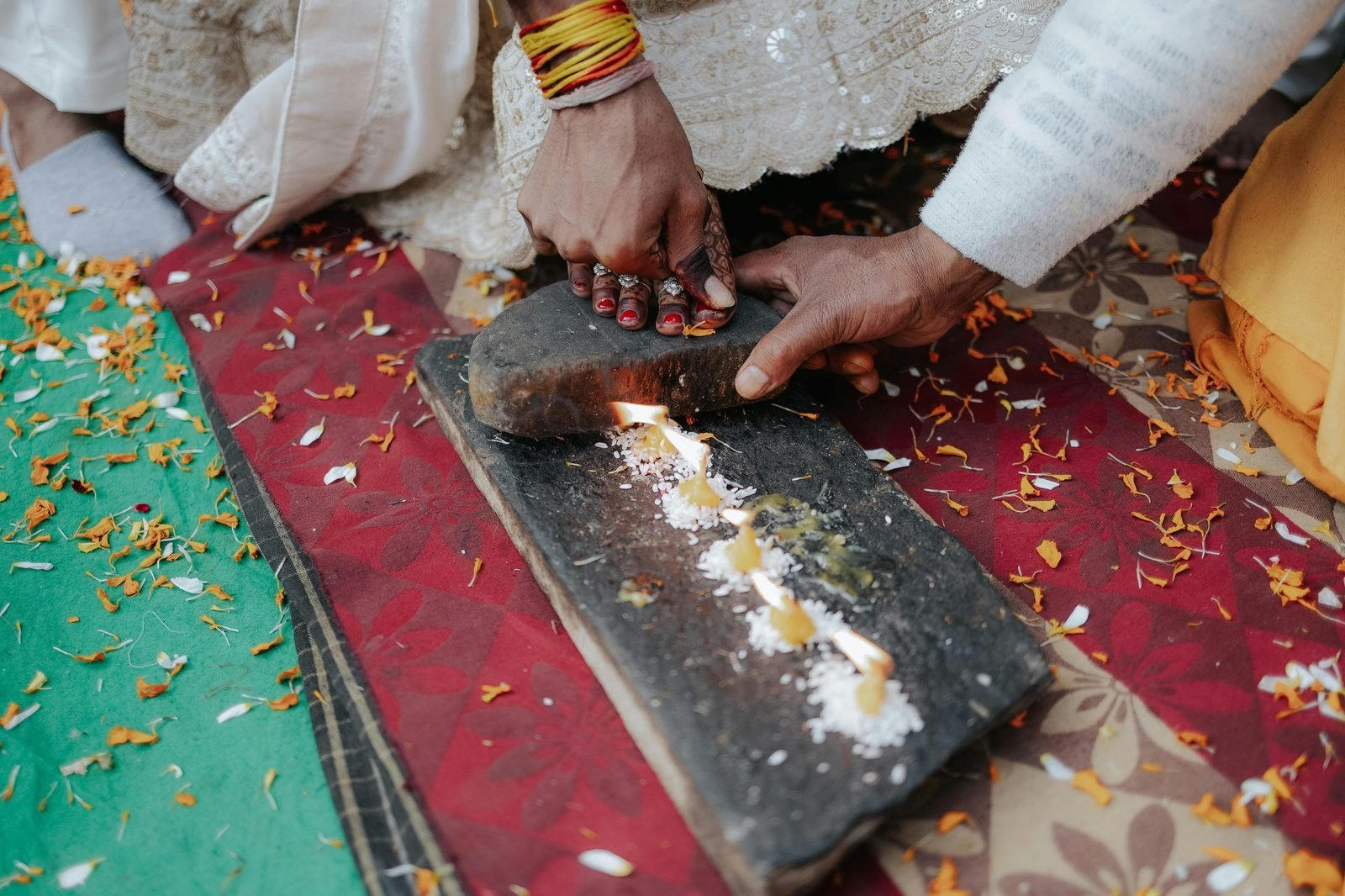
Getting Married in Dwarka Sector 6 the Simple Way
Dwarka is a planned sub-city — neat sectors, wide roads, apartment societies and a young, mobile crowd. The couples we meet from Sector 6 tend to be settled professionals, working pairs juggling office timings, and families who value doing things by the book. What almost all of them share is a wish to marry without turning it into a month-long project. That is precisely where this service earns its place.
We have walked couples from right across the Dwarka belt through their wedding day — a software professional near the Sector 6 market, a nurse working long hospital shifts, a pair from Dwarka Mor who wanted the matter closed quickly and quietly. A vedic court marriage in Dwarka Sector 6 gives each of them the same reassurance: a heartfelt Vedic ceremony around the sacred fire, and behind it a legally registered marriage that stays solid on paper for years to come.
Everything you need to understand is on this page, written the way a friend in the field would explain it — what a vedic marriage actually is, who can apply, which documents to keep handy, how the timeline plays out, and the small errors that cost couples time. Read at your own speed. If you would rather just ask, one call to +91 8376863962 connects you to a consultant who knows the Dwarka sectors inside out.
📍 Dwarka Sector 6 Service Snapshot: Same day Vedic Arya Samaj ceremony • Court marriage & SDM registration • Love, inter-caste, inter-religion & NRI couples welcome • Pandit arranged • Full document support • Certificate assistance • Total privacy • First consultation free
The Quick Picture — What You End Up With
Two things constantly get mixed up: the wedding and the certificate. They are not the same, and knowing that from the start spares you a lot of confusion. Here is the snapshot before the detail.
| Point | In Plain Words |
|---|
| What it is | A same day Vedic Arya Samaj wedding plus legal registration support |
| Where | For couples in Dwarka Sector 6 and the surrounding sectors and colonies |
| Ceremony time | Done in one day, usually within a couple of hours |
| Certificates | Vedic certificate the same day, government certificate after registration |
| Who it fits | Working couples, students, love, inter-caste, inter-religion and NRI couples |
| Handled by us | Pandit, forms, affidavits and SDM registration (you bring two witnesses who know you) |
What Is Vedic Court Marriage? (Direct Answer)
Vedic court marriage is a single service that combines two steps. First comes the Vedic Arya Samaj wedding — Sanskrit mantras, the havan fire and the traditional vows exchanged before witnesses. Then comes government registration, which converts that ceremony into a legally recognised marriage with an official certificate. In Dwarka Sector 6, one team runs both ends so the ritual and the paperwork line up cleanly.
Who Can Apply? (Direct Answer)
Any couple where the groom is 21 or older and the bride is 18 or older, both single or lawfully free to remarry, both of sound mind, and both marrying of their own free will. Whether you belong to Sector 6, Palam, Uttam Nagar or Najafgarh, the same conditions apply. Caste is never an obstacle, and inter-religion couples have a clear and lawful path of their own.
How Fast Can It Be Done? (Direct Answer)
The Vedic ceremony and its certificate can be completed the same day once your papers are ready. Registering that marriage at the SDM office generally takes a few working days afterward. A pure court marriage under the Special Marriage Act needs about 30 to 45 days, since the law fixes a compulsory 30-day notice. We always share the honest timeline for your particular situation.
Why Dwarka Couples Choose Us
In this line of work, trust is quiet but powerful. It shows the moment a couple who felt tangled in procedure walks out married, relaxed and holding a valid certificate. Because we deal with Dwarka couples all the time, we already know which document the SDM office will ask for, how the south-west Delhi sub-division runs, and how to keep a file moving rather than gathering dust.
Beyond the mechanics, people remember being dealt with fairly. We never push you into snap decisions or slip charges into the fine print. You get a plain explanation, a straight quote, and a person who actually answers the phone. That is why couples from Dwarka Mor, Palam, Sagarpur and Janakpuri keep pointing their friends and cousins in our direction.
Benefits of Doing It This Way in Dwarka
- One team, start to finish. Ceremony, witnesses, affidavits and registration are coordinated together, so you are not piecing the process from scattered corners.
- Fast where possible, careful where it counts. The Vedic rites happen same day, while the legal side is still done properly so your certificate holds up down the line.
- Tuned to Dwarka. We understand the Dwarka SDM setup, which saves you wrong turns and repeat trips.
- Privacy as standard. For love couples, your matter stays strictly between you and us.
- Honest words. If your case really needs the court route and cannot be same day, we tell you plainly rather than over-promising.
- Every couple welcome. Inter-caste, inter-religion, NRI, outstation — each has a defined path we know well.
Eligibility at a Glance
Before we begin, let us make sure you qualify. The rules here are reasonable, and most couples clear them without trouble. Here they are, plainly set out.
| Condition | What Is Needed |
|---|
| Groom's age | 21 years or above, with valid proof |
| Bride's age | 18 years or above, with valid proof |
| Current status | Single, or divorced with decree, or widowed with death certificate |
| Mental soundness | Both able to give free, informed consent |
| Willingness | The marriage must be completely voluntary |
| Relationship | Not within prohibited degrees under the law |
| Witnesses | Two adults with valid photo identity |
Documents to Keep Ready
Clean paperwork is what turns a registration smooth instead of slow. Keep the originals plus one clear set of photocopies together in a folder. Here is the standard list for both partners.
| Document | Why It Is Needed | Whose |
|---|
| Aadhaar card | Identity | Bride & Groom |
| Birth certificate / 10th marksheet / passport | Age & date of birth | Bride & Groom |
| Passport size photographs | Records & certificate | Bride & Groom |
| Address proof (Aadhaar, voter ID, bill) | Residence | Bride & Groom |
| Two witnesses with ID | Legal requirement | Both sides |
| Divorce decree (if applicable) | Proof of free status | Divorced applicant |
| Spouse's death certificate (if applicable) | Proof of free status | Widow / widower |
| Passport + visa / OCI (NRI or foreign) | Nationality & status | NRI / foreign national |
If a paper is missing, or your name appears differently across documents, there is no need to worry. These are everyday hiccups, usually fixed with a simple affidavit. Point it out on the first call and we will arrange the correction in advance.
The Full Process, Step by Step
Here is exactly how a Vedic court marriage unfolds for a couple in Dwarka Sector 6, from your first message to holding the final certificate.
- First chat. You get in touch with a few basics. We check ages, status and documents, then suggest the route — Vedic Arya Samaj, Special Marriage Act, or registering an existing marriage.
- Paper review. We go through your documents ahead of time so nothing is missing on the day. Any affidavit or correction is arranged beforehand.
- Fix the slot. We set a time that works for you, your partner and your two witnesses.
- Vedic ceremony. The pandit conducts the wedding with mantras, the havan and the vows. You receive the Vedic Arya Samaj certificate the same day.
- Registration. We take your case to the SDM office for the government marriage certificate, guiding the forms and signatures.
- Certificate handed over. You collect your legal marriage certificate, ready for visa, bank, passport, name change and every official need.
How Long Each Route Takes
| Route | Ceremony | Certificate |
|---|
| Vedic Arya Samaj marriage | Same day | Vedic certificate same day |
| Vedic marriage + SDM registration | Same day ceremony | Government certificate in a few working days |
| Court marriage (Special Marriage Act) | After the 30-day notice | About 30 to 45 days in total |
| Registering an existing marriage | Already done | Usually a short window |
Fees — Told Straight
The honest answer to "what will it cost" is that it depends. It shifts with the service you pick, how many documents and affidavits are involved, and whether you add registration or attestation for use abroad. Government charges are separate and set by the office, not by us.
Rather than toss out a random figure, we would sooner understand your case in a two-minute call and then give you a clean, all-in number with nothing hidden waiting at the end. You will know what you are paying, and why, before you agree to anything.
| Service | What It Covers | How We Price It |
|---|
| Vedic Arya Samaj marriage | Pandit, ceremony, Vedic certificate | Quoted after a short call |
| Court marriage help | Special Marriage Act filing & guidance | Quoted after a short call |
| Marriage registration | SDM paperwork & certificate | Govt fee + service, shared upfront |
| NRI / attestation / apostille | Extra documentation for abroad | Depends on scope, quoted clearly |
💡 Our word on money: No pressure, no surprise charges, and a written quote before we begin. If a cheaper route serves you just as well, we will point you to it.
📍 Book Your Dwarka Sector 6 Marriage
Free consultation • Easy from all Dwarka sectors • Same day Vedic rites • Certificate help
The Law Behind Your Marriage
It helps to know which law your marriage stands on, because that is what governs the timeline. Indian marriages are recognised under a handful of key statutes, and we work with each of them.
- Hindu Marriage Act 1955. Governs marriages between two Hindus, including the Vedic Arya Samaj ceremony. This is what makes a valid same day religious marriage possible.
- Arya Samaj Marriage Validation Act 1937. Specifically recognises marriages solemnised in the Arya Samaj tradition, giving the Vedic rites their legal footing.
- Special Marriage Act 1954. A civil law under which any two adults may marry regardless of religion. Its 30-day notice is why a purely court marriage can never be same day.
Worth stressing once more: the ceremony and the registration are two separate steps. The Vedic certificate confirms the marriage happened. The government certificate from the SDM office is the one banks, passport offices and embassies actually demand. For any official purpose, that second certificate is the one you want — and we make sure it lands in your hands.
The Vedic Ceremony, in Plain Terms
Many couples have never watched an Arya Samaj wedding closely and wonder what it involves. It is pleasingly simple and free of heavy ritual cost. The pandit lights the sacred havan fire, chants Vedic mantras, and leads the couple through the core vows and the pheras around the fire. There are no idols and no elaborate demands — the entire focus is on the promises the two of you make. Within a couple of hours you are married in the fullest traditional sense, and you leave with the Vedic marriage certificate in hand. It is dignified, meaningful and quick, which is exactly why so many Dwarka families prefer it.
Same Day Marriage — What Is Genuinely Possible
When people say "same day marriage" they usually imagine the whole affair sealed in an afternoon. The honest position is this: the Vedic Arya Samaj ceremony truly can be completed in a single day, and you receive its certificate that day. What cannot be squeezed into a day is the court registration under the Special Marriage Act, because that law fixes a 30-day notice nobody can waive. So we deliver the ceremony same day and then move your registration as quickly as the rules honestly allow. For most couples in a hurry, that combination is exactly what they came looking for.
Court Marriage Assistance
Some couples prefer the court path under the Special Marriage Act, often because it works cleanly for partners of different religions or those who want a purely civil marriage. We manage the notice filing, the documentation and the coordination with the office so the 30-day window passes smoothly. Every stage is explained before it happens, and we keep you updated as your date approaches. It is slower than the Vedic route, but for the right couple it is precisely the correct choice.
Marriage Registration Assistance
Registration is where many couples come unstuck when they try it alone — a form filled wrong, a witness ID that does not match, a missed appointment. We take that whole load off your shoulders. Whether your marriage was Vedic, temple-based or through Arya Samaj, we build your file correctly and steer you through the SDM office so the government certificate comes through without repeated visits. If you recently married in Dwarka and only need the certificate, this is the service to ask about.
Love Marriage — Quiet, Safe, Legal
Love marriages are the ones we handle with the greatest care, because the couple is often anxious and simply wants things done quietly and correctly. If the two of you have decided, we offer a safe, respectful and fully confidential process. Nothing is disclosed to families or anyone else. We arrange the ceremony and the registration (you bring your own witnesses), so that by the end you are legally married with a certificate in hand. Many couples across the Dwarka sectors have begun married life this way — without conflict and without fear.
Inter-Caste Marriage
Inter-caste marriage is fully legal in India, and no couple needs anyone's permission to marry across castes. Two Hindus of different castes can marry through the Vedic Arya Samaj ceremony under the Hindu Marriage Act, or opt for the Special Marriage Act if they prefer. No caste certificate is ever required, and your marriage certificate looks like any other. If your families support you, wonderful — we simply handle the formalities. If they are not yet convinced, we keep everything private and steady, and many couples find a settled, legal marriage smooths the road with time.
Inter-Religion Marriage
When partners follow different faiths, two clear routes exist. The first is the Special Marriage Act, where you marry as a civil union with neither person changing religion. The second is Shuddhi Sanskar, where one partner formally embraces the Arya Samaj tradition before a Vedic ceremony. Neither is complicated once someone walks you through it, and neither is anything to fear. We lay out both options with their timelines and trade-offs so you can pick what suits you as a couple. Whichever you choose, the outcome is a valid, registrable marriage.
NRI Marriage Assistance
NRI and foreign-national couples are a regular part of who we serve, often flying into Delhi with a narrow window. We plan around your travel so the ceremony and paperwork slot neatly into your visit. Alongside the usual documents you will need a valid passport, your visa or OCI card, and proof of single status. Where the certificate must be used abroad — for a spouse visa or recognition in another country — we arrange MEA apostille or embassy attestation. If one partner lives in Dwarka and the other is arriving from overseas, we make sure both sides are fully covered.
Tatkal Marriage — When Time Is Short
Life does not always spare you a whole month. A visa interview lands, a job posting arrives, or a family situation needs the marriage settled quickly. For genuinely urgent cases we look at every lawful way to speed up your registration, including the same day Vedic route followed by prompt certificate processing. We will never sell you a false tatkal promise — instead we assess your real case and tell you the fastest honest path available. For many Dwarka couples racing a deadline, that clarity is a relief in itself.
Areas We Cover Around Dwarka Sector 6
Dwarka Sector 6 sits in the heart of the Dwarka sub-city, so we naturally serve the whole cluster of sectors and nearby colonies. If you live in any of these, reaching us is easy.
| Area | Position Relative to Sector 6 |
|---|
| Dwarka Sector 5 & 7 | Adjacent sectors, minutes away |
| Dwarka Sector 10, 11, 12 | Very close, short drive |
| Dwarka Mor | Nearby, metro connected |
| Ramphal Chowk | Close by |
| Palam | Short drive |
| Sagarpur & Bindapur | Nearby |
| Uttam Nagar | Short drive |
| Janakpuri & Vikaspuri | Reachable, north side |
| Najafgarh & Kakrola | Nearby, south-west |
| Nawada | Close by |
Vedic Marriage vs Court Marriage — Side by Side
| Feature | Vedic Arya Samaj Marriage | Court Marriage (SMA) |
|---|
| Nature | Religious Vedic ceremony | Civil legal process |
| Law | Hindu Marriage Act 1955 | Special Marriage Act 1954 |
| Ceremony speed | Same day | After 30-day notice |
| Religion | Both Hindu (or after Shuddhi) | Any religion, no conversion |
| Notice period | None | 30 days compulsory |
| First certificate | Vedic certificate | Government certificate |
| Best suited to | Couples wanting a quick traditional wedding | Inter-religion & civil-only couples |
Marriage Types We Handle
| Type | Who It Suits | Same Day Ceremony |
|---|
| Vedic Arya Samaj marriage | Hindu couples wanting a quick traditional wedding | Yes |
| Love marriage | Couples marrying by choice, privately | Yes (Vedic route) |
| Inter-caste marriage | Hindus of different castes | Yes |
| Inter-religion marriage | Partners of different faiths | Via Shuddhi or SMA |
| NRI marriage | NRI / foreign-national couples | Yes, planned around travel |
| Court marriage | Couples wanting civil registration | No (30-day notice) |
| Marriage registration | Already-married couples needing a certificate | Depends on case |
Mistakes Couples Often Make
A lot of stress is avoidable. Here are the slips we see most, so you can dodge them from the start.
- Mismatched names. A different spelling on Aadhaar versus your marksheet can hold up registration. Check it early.
- Expecting court marriage to be same day. The Special Marriage Act needs a 30-day notice. Only the Vedic ceremony is truly same day.
- Stopping at the Vedic certificate. On its own it is not enough for visa or bank work. You also need the government certificate.
- Witnesses without proper ID. Both witnesses must carry valid photo identity, or the process pauses.
- Forgetting age proof. Both partners must show clear date-of-birth documents. A vague photocopy will not cut it.
- Trusting gossip over the law. Inter-caste and inter-religion marriages are legal. Do not let rumours scare you off your rights.
Handy Tips Before the Day
- Keep one tidy set of photocopies plus all originals together in a single folder.
- Confirm both witnesses in advance and remind them to carry their ID on the day.
- Tell us early about any special circumstance — divorce, widowhood, NRI status or a tight deadline.
- If the certificate is for a visa, mention the country so the apostille is planned right.
- Ask for the complete quote in writing so you know the total before starting.
- Do not leave it to the final week if you have a fixed date; a small buffer removes all the panic.
A Few Real Situations From Around Dwarka
Names and details are changed for privacy, but these cases are very typical of what we handle.
The IT couple from Sector 6. Both worked demanding tech jobs with barely a shared day off. We reviewed their documents over WhatsApp in advance, kept the ceremony ready, and they married with their Vedic certificate the same afternoon. Registration followed within days, and neither burned precious leave.
The inter-caste pair from Dwarka Mor. They were uneasy about how relatives might react and wanted things done discreetly. We arranged a private ceremony (the couple brought friends who know them as witnesses), completed the paperwork calmly, and guided their registration. Weeks later they told us the settled, legal marriage gave them the confidence to open up to their families.
The NRI bride on a short visit. With her groom's family in Palam and only twelve days in India, timing decided everything. We mapped the ceremony, registration and apostille around her flights so she flew back with a certificate ready for use abroad.
Why Couples Trust Us — Experience You Can Feel
Handling marriages is not something we took up recently. It rests on years of sitting with couples through every kind of moment — the joyful, the urgent, the delicate. That experience means little surprises us, and that calm passes on to you on what can be a tense day. We know the statutes, we know the offices, and we know how to keep your matter moving forward rather than stalling.
More than the mechanics, people remember how they were treated: honest answers, a fair price, complete discretion, and someone who follows through. When couples from Dwarka, Palam, Uttam Nagar and Najafgarh recommend us to their friends, it is because they felt safe and respected from the first call to the final certificate. Guarding that trust matters more to us than anything else.
🔱 Ready to Begin?
Talk to a real consultant today. Honest advice, a clear plan, and total privacy.
Custom Is Part of the Law, Not an Exception to It
Dwarka is one of the least north-Indian parts of north India. Sector 6 and the sectors around it are full of families who came from Tamil Nadu, Andhra, Telangana, Karnataka, Kerala, West Bengal, Odisha, Maharashtra and the north-east for a job and stayed. And a great many of them are told, somewhere in the process of getting married in Delhi, something about their own marriage that is simply wrong.
The commonest version is this: a cousin marriage is illegal in India. For most north-Indian Hindu families that is broadly right. For a great many families from the south it is not, and the Hindu Marriage Act says so on its face.
Two of the five conditions in Section 5 carry a saving clause, and the saving clause is the whole point:
| Condition | What it says | The saving |
|---|
| Section 5(iv) | The parties are not within the degrees of prohibited relationship | "unless the custom or usage governing each of them permits of a marriage between the two" |
| Section 5(v) | The parties are not sapindas of each other | "unless the custom or usage governing each of them permits of a marriage between the two" |
So the rule is not "these marriages are forbidden". The rule is "these marriages are forbidden unless the custom governing each of you permits them." A marriage that would be void for a family in Rohtak can be entirely valid for a family in Madurai, and both statements are the same statute.
Read the words "each of them" carefully, because this is where couples get it wrong. The custom must govern both parties, not one. Where one partner's community practises cross-cousin marriage and the other's does not, the saving does not apply merely because one side is comfortable with it. If that is your situation, say so in the first conversation — it is exactly the kind of thing that is easy to deal with in advance and very unpleasant to discover later.
What the Act Means by "Custom"
This is not a loose word in the statute. Section 3(a) defines it, and the definition is demanding:
A custom or usage is a rule which, having been continuously and uniformly observed for a long time, has obtained the force of law among Hindus in any local area, tribe, community, group or family — provided that the rule is certain and not unreasonable or opposed to public policy, and, in the case of a rule applicable only to a family, that it has not been discontinued by the family.
Four things follow from that, and they matter more than any general talk about tradition.
| What the definition requires | What it means in practice |
|---|
| Continuous and uniform observance for a long time | Not something one branch of the family started recently. It is the settled practice of the community or the family, over generations. |
| The force of law among Hindus in a local area, tribe, community, group or family | Custom can be as wide as a region or as narrow as one family. A family custom is expressly recognised — which surprises people who assume it has to be a whole community. |
| Certain, not unreasonable, not opposed to public policy | A vague or shifting practice will not qualify, and nothing contrary to public policy can be saved by calling it custom. |
| Not discontinued, where it is a family rule | A family that stopped following a practice two generations ago cannot revive it for one marriage. |
And the honest part. Whether a custom exists is a question of fact. It is not written down in the Act, there is no government list of permitted customs, and nobody — including us — can certify one for you. In the ordinary case nobody asks: the registering office is looking at your ages, your identity, your residence and your marital status, not at your grandmother's village. The custom question becomes live only if the marriage is contested later, and then it is proved the way any fact is proved — by evidence of the practice, not by assertion.
So what should a couple in this position actually do? Two things, both free, both taking an afternoon.
One, write it down while the people who know it are alive. A simple signed statement from the eldest members of both families, setting out that the practice is and has long been followed in that community or family, with examples of earlier marriages of the same kind and roughly when they took place. Keep it with your marriage papers. It is not a legal certificate and we will not pretend it is one — it is contemporaneous evidence, which is worth a great deal more than the same account reconstructed from memory twenty years later.
Two, keep the evidence of the earlier marriages themselves. Invitation cards, photographs, certificates of the previous generation's marriages of the same degree. This is the single most useful thing a family can hand a court, and the single most commonly thrown away.
Sapinda, in Plain Language
Since the saving clause is about sapinda relationship, it is worth knowing what is actually being saved — because a lot of people use the word without knowing what it counts.
Section 3(f) sets the limits by generations of ascent, counting the person themselves as the first:
| Line | Generations of ascent included |
|---|
| Through the mother | Three |
| Through the father | Five |
Two people are sapindas of each other if one is a lineal ascendant of the other within those limits, or if they have a common lineal ascendant who is within those limits of both. That is the whole of it. The asymmetry — three on the mother's side, five on the father's — is the part nobody expects, and it is why two people can be sapindas through one line and not the other.
Degrees of prohibited relationship under Section 3(g) is a separate and narrower list: lineal ascendants and descendants; the wife or husband of a lineal ascendant or descendant; the wife of a brother, or of a father's or mother's brother, or of a grandparent's brother; and brother and sister, uncle and niece, aunt and nephew, or the children of a brother and sister or of two brothers or two sisters. Both lists are subject to the same saving: unless the custom governing each of them permits.
Where we stop. We are not a law firm and we do not certify customs. What we do is ask the question early, tell you plainly when your situation turns on it, and — where it clearly does — say that this is a question for an advocate before the wedding rather than an argument after it. That conversation costs you nothing here. A marriage arranged around a custom that turns out not to satisfy Section 3(a) is not a paperwork problem; it goes to whether there is a marriage at all.
Whose Ceremony? What Section 7 Actually Says
The other thing families from outside the Hindi belt are told wrongly is that a marriage in Delhi has to be performed a particular way — usually whichever way the person saying it performs them.
Section 7(1) is short and generous: a Hindu marriage may be solemnised in accordance with the customary rites and ceremonies of either party thereto. Either party. Not both, not the groom's, not the locally usual one. A Tamil Brahmin ceremony, a Bengali bibaho, a Telugu or Kannada ceremony, a Malayali kalyanam, a Marathi or Odia ceremony, a north-eastern community's own rites — each is a lawful solemnisation of a Hindu marriage in Delhi, performed by whoever your family would have performing it.
Section 7(2) then adds the rule people half-remember: where the rites include the saptapadi — the taking of seven steps by the bride and groom jointly before the sacred fire — the marriage becomes complete and binding when the seventh step is taken. Note the conditional. Saptapadi is decisive where the ceremony includes it; it is not a universal requirement imposed on ceremonies that never had it.
What that means for you here. The ceremony we perform is the Arya Samaj Vedic one — havan, the vows, saptapadi — and it is complete, valid and same-day. Many couples from the south and east take it precisely because it is short, dignified and does not attempt to imitate a tradition that is not ours to perform. But if your family's own rites matter to you, you are not choosing between them and a valid marriage: you can have the family ceremony performed by your own priest in your own way, and come to us for the registration, which is the part that produces the document. Nobody has to give anything up.
| What you want | What to take | Fee |
|---|
| A short, valid, same-day ceremony and the mandir certificate | Arya Samaj marriage, ceremony only | ₹5,100 |
| The same, finished with the government certificate | Arya Samaj + court marriage | ₹7,100 |
| Your own family's ceremony, performed by your own priest — and the legal record afterwards | Hindu Marriage Act registration of a marriage already solemnised | ₹6,000 |
| Your own ceremony, and you would rather we managed the whole registration end to end | Marriage registration, full service | ₹12,000 |
If you take the third or fourth row, keep the things that show the ceremony happened: photographs with the witnesses visible, the invitation, and the priest's details. That is what a registration application is built on, and it is far easier to hand over three months after the wedding than three years after it.
When Your Documents Are Not in Hindi or English
The second thing that slows a Dwarka couple down has nothing to do with law. It is that one or both of you holds a birth certificate, a school record or a land document issued in Tamil, Telugu, Kannada, Malayalam, Bengali, Odia, Marathi, Gurmukhi, Urdu or Assamese — and a Delhi office reads Hindi and English.
This is ordinary and entirely solvable. It is also the commonest reason a file here comes back a second time, purely because nobody mentioned it at the start.
| Situation | What to do |
|---|
| A document issued only in a regional script | Get a certified translation into English or Hindi, attached to a photocopy of the original, and carry the original as well. Keep the translator's details on the translation. |
| A document that is bilingual (many state certificates are) | Nothing needed. Point out the English portion rather than assuming it will be found. |
| The document is fine but your name is spelt differently on it | This, not the script, is the real problem. See the next section — fix it before you file, not at the counter. |
| The certificate will later go abroad | The translation usually has to accompany the document through the apostille chain too. Say so early, because it changes the order of steps. |
Ask us before paying for a translation. Not everything needs one. A document that is already bilingual does not, and for some purposes the office will accept the original with the relevant entries pointed out. Translation is one of the small charges that gets applied to every document in a file when it was needed for one.
Names: Initials, No Surname, and Three Spellings of the Same Person
Of everything on this page, this is the item that costs Dwarka couples the most time and the least attention.
The three patterns we see constantly:
One — initials. A name recorded as R. Karthik on one document, Karthik R on another, Ramanathan Karthik on a third, and the initial expanded differently again on a fourth. All four are the same person and every one of them is genuine. An office reading them side by side is entitled to ask which is the name.
Two — no surname at all. Perfectly normal in much of south India, and it is not a defect. Forms that insist on a surname are the problem, not you. The answer is to decide, once, how the name will be written where a form demands two fields, and to write it that way every single time — including on the affidavit, which is where it becomes the certificate.
Three — transliteration drift. The same name arriving in Roman script as Chatterjee and Chattopadhyay, Krishnan and Krishnamurthy, Sreejith and Srijit, Reddy and Reddi. Nothing was done wrong; the name was written down by different people in different decades.
The rule, and it is the whole answer: pick the spelling on your strongest identity document, and use it character for character everywhere else — on the affidavit, on the application, on the certificate. Do not improve it, do not expand an initial that is not expanded there, do not add a surname that is not there. You are not choosing the most correct version of your name. You are choosing one version, so that every document you hold for the next sixty years says the same thing.
And read the affidavit before you sign it. Four fields, every time: your name, your father's name, your date of birth, and the date and place of the marriage. What the affidavit says becomes what the certificate says, and a correction afterwards is slower and more annoying than a duplicate.
When Both Families Are a Flight Away
Almost every couple in these sectors is in this position, and it changes three practical things.
Witnesses. Two for the Arya Samaj ceremony and for registration under the Hindu Marriage Act; three for solemnisation under the Special Marriage Act. Each must be an adult, present at the marriage, genuinely known to you both, and carrying an original photo identity — a home-state Aadhaar is perfectly good. What is not required: a relative, a Delhi resident, a property owner, or anybody's parent. A flatmate, a colleague, a neighbour in the society, a friend from your own home state — all fine. We do not supply witnesses, at any price, because a stranger cannot honestly sign that he was present at your marriage and knows you both, and that defect sits quietly in your papers for decades.
Timing around travel. The ceremony can be arranged for a date your parents can fly in for; the SDM appointment cannot, because it is allotted by the office's load. Plan the family visit around the ceremony, not around the appointment, and tell us early if a parent's return ticket is the constraint — we will file as early as possible, but nobody can promise a date in advance and anybody who does is guessing.
The Special Marriage Act point, if that is your route. Where a party is not permanently resident in the Marriage Officer's district, a copy of the notice goes for display to the district where that party is permanently resident. For two people who both came to Delhi for work and whose permanent residence is elsewhere, that means two copies going out to two home districts at the same time, for thirty days. For a couple who are both Hindu, Sikh, Jain or Buddhist, the Hindu Marriage Act route — ceremony under Section 7, registration under Section 8 — carries no notice and no display anywhere. Our Dwarka Sector 12 page works through that in full.
Which Office Handles Dwarka Sector 6
Delhi's revenue map was reorganised with effect from 1 January 2026 and the city now has thirteen districts and thirty-nine sub-divisions. Dwarka sits in the south-west belt under that structure.
We do not print one office name here, because the e-District portal allocates the office by your exact address and two sectors can go differently. Certificates issued before 1 January 2026 remain fully valid; the reorganisation affects only where a new application goes and which office now holds the records for a certified copy, a correction, or verification before an apostille.
Two more local points worth saying plainly. "Court marriage" does not happen at the Dwarka court complex — registration is done by the SDM and a civil marriage by the Marriage Officer, neither of whom is a judge. And the Haryana line runs closer than people think: Gurugram, Palam Vihar, Bajghera and the far side of the Expressway are a different state, with a different portal and a different set of offices, however short the drive. A Delhi office cannot take a Special Marriage Act notice on a Gurugram address. If one of you lives across that line, say so in the first conversation.
Dwarka Sector 6 and the Sectors Around It
| Area | What couples there usually ask us |
|---|
| Sector 6, Sector 5, Sector 7 | Whether their own community's ceremony is valid in Delhi; society-flat address proof |
| Sector 10, Sector 11, Sector 12 | Which office covers them after the 2026 reorganisation |
| Sector 3, Sector 4, Sector 9 | Documents in a regional script, and names spelt three ways |
| Sector 18, Sector 19, Sector 22, Sector 23 | Fitting two appointments around office hours and parents' travel dates |
| Palam, Sagarpur, Dabri, Mahavir Enclave | Address proof in unwritten tenancies |
| Najafgarh, Bijwasan, Kapashera | Whether the address is Delhi or Haryana — check before filing |
| Gurugram, Palam Vihar, Bajghera | Haryana — a different state and portal; a Delhi office cannot take an SMA notice on that address |
| Uttam Nagar, Janakpuri, Vikaspuri | Couples marrying quickly, and pre-marriage document checks |
The law is identical across every Delhi entry in that table. What differs is which part of your file is likely to be the awkward one — and in these sectors, more often than anywhere else in the city, it is a name that three documents cannot agree on.
What It Costs, Published
The same figure everywhere on this website. No surcharge for community, language, caste, religion, urgency or distance — and we mention community and language here deliberately, because a couple whose documents are in another script is exactly the couple who gets quoted extra by somebody.
| Service | Fee | What it covers |
|---|
| Arya Samaj marriage, ceremony only | ₹5,100 | Pandit, havan, saptapadi, mandir certificate, same day |
| Love / inter-caste marriage, same day | ₹5,100 | Confidential ceremony and certificate |
| Hindu Marriage Act SDM registration | ₹6,000 | Registration of a marriage already solemnised — the row for a couple who had their own family ceremony |
| Court marriage, advocate assisted | ₹6,100 | Drafting, affidavits, filing, appointment |
| Arya Samaj + court marriage, combined | ₹7,100 | Ceremony and registration together — nothing left to follow up later |
| Hindu–Muslim / inter-religion marriage | ₹10,000 | Shuddhi or Special Marriage Act route with certificate |
| Marriage registration, full service | ₹12,000 | End-to-end managed registration |
| Special Marriage Act marriage | ₹15,000 | Full process including the 30-day statutory notice |
| NRI marriage + MEA apostille | ₹20,000 | Marriage, registration and the apostille chain |
| Court marriage + High Court protection (Premium) | ₹56,000 | Full court marriage and documentation plus a protection petition filed by an advocate, with follow-up |
| Duplicate certificate | ₹2,500 | Lost or damaged |
| Government statutory fee | ₹100 / ₹200 / ₹15 | ₹100 Hindu Marriage Act registration, ₹200 requisite fee under the 2014 Order, ₹15 Special Marriage Act solemnisation — paid to government, not to us |
Not included, and told to you before you pay: the government statutory fee, notary charges of ₹100–₹200 per affidavit, any late-registration fee, MEA apostille and embassy attestation where the certificate goes abroad, certified translation where a document genuinely needs one, and optional photography, video and transport. The full list with worked total-cost examples is on the fees page.
The translation charge is the one to watch. It applies per document and only to documents that actually need it. If you are quoted a translation charge for your whole file when two documents are already bilingual, ask which ones are being translated and why. The government's own charges in this process are in hundreds, not thousands — the registration statutory fee is ₹100–₹200 and a notary is ₹100–₹200 per affidavit.
What we will not take money for, ever: witnesses; a shortened statutory notice; a certificate for a ceremony that did not happen; a guaranteed court outcome; a marriage below the legal age; a marriage while an earlier one subsists; or a certificate that a custom exists, which is not ours to give.
Tell Us Where You Are Both From, in the First Call
Most pages end by asking for your documents. This one asks for something else first, because on this page it is the thing that decides the route: where each of you is from, and what relationship, if any, the two families already have.
Then the usual: your religions, whether either of you has been married before, where each of you actually lives and what your documents say about it, whether either of you is across the Haryana line, whether your documents are in a script a Delhi office does not read, and whether your names are spelt the same way on all of them.
Call +91 8376863962. Hindi or English. If your family's ceremony has already happened somewhere else and you only need the legal record, say that at the start — it is a different and usually simpler job than the one people assume they are calling about.
Frequently Asked Questions — Dwarka Sector 6 Marriage
What does vedic court marriage in Dwarka Sector 6 mean?▼
It means two things joined into one service: a Vedic Arya Samaj wedding performed with mantras and the sacred fire, followed by legal registration. Couples in Dwarka Sector 6 get the traditional ceremony plus an official marriage certificate the law accepts everywhere.
Is a Vedic Arya Samaj marriage valid in court?▼
Yes. It holds under the Hindu Marriage Act 1955 and the Arya Samaj Marriage Validation Act 1937. Once you register it at the SDM office, you receive the government certificate that banks, passport offices and embassies rely on.
Can we finish the ceremony in one day here?▼
Yes, the Vedic ceremony wraps up in a single day when your documents and two witnesses are ready. Only the civil court marriage under the Special Marriage Act cannot be same day, since it needs a fixed 30-day notice.
Who qualifies to marry from Dwarka Sector 6?▼
A groom aged 21 or more and a bride aged 18 or more, both single or free to remarry, both mentally sound, both willing. Couples from Dwarka, Dwarka Mor, Palam and Uttam Nagar apply with these conditions regularly.
What documents will we need?▼
Aadhaar, an age proof such as a birth certificate or 10th marksheet, passport photos and address proof for both partners, plus two witnesses with ID. Divorcees bring the decree; widowed applicants bring the death certificate.
Are two witnesses compulsory?▼
Yes. Two adult witnesses carrying valid photo ID are required for both the ceremony and the registration. They can be friends or relatives. Witnesses must be people who know you personally; we do not provide witnesses.
Can different-caste couples marry in Dwarka?▼
Yes, fully. Inter-caste marriage is legal throughout India. Two Hindus of different castes marry through the Vedic Arya Samaj ceremony or the Special Marriage Act. No caste certificate is ever requested at any point.
What is the route for inter-religion couples?▼
There are two. The Special Marriage Act allows partners of different faiths to marry without conversion, or one partner takes Shuddhi before a Vedic ceremony. We set out both paths plainly so you choose comfortably.
Do you support NRI couples in Dwarka?▼
Yes. NRI and foreign-national couples are welcome. Besides the standard papers they carry a passport, valid visa or OCI, and single-status proof. We arrange apostille and attestation when the certificate is meant for use abroad.
What happens once the ceremony is over?▼
You get the Vedic certificate the same day. Then we register the marriage at the SDM office, which issues the official government marriage certificate used for visa, bank, passport and name-change needs.
How is Vedic marriage different from court marriage?▼
Vedic marriage is a religious ceremony under the Hindu Marriage Act, done same day. Court marriage is a civil process under the Special Marriage Act with a 30-day notice. Plenty of Dwarka couples do the Vedic wedding first, then register.
How much total time does it take?▼
The Vedic ceremony and certificate are same day. Registration after it usually takes a few working days. A direct court marriage under the Special Marriage Act takes roughly 30 to 45 days because of the notice period.
Do we need a Dwarka address to apply?▼
The Vedic ceremony carries no residence rule. For registration one partner usually needs a Delhi address proof. If you live in Dwarka Sector 6 or a nearby sector, your local address proof works without any issue.
What is your tatkal marriage certificate help?▼
Tatkal means moving the registration paperwork faster wherever the rules allow, handy for urgent visa or travel deadlines. We study your exact case and give you a realistic timeline before you commit to anything.
Is a love marriage handled privately?▼
Yes. Every love marriage is treated with complete discretion. Nothing is shared with families or outsiders. Many couples across Dwarka and its sectors pick us precisely because the process stays quiet, calm and respectful.
What will it cost in Dwarka Sector 6?▼
It varies with the service, the documents involved and any add-ons such as registration or attestation. We share a clear all-in quote after a short call. Government charges are separate and fixed by the office itself.
Can a marriage that already happened be registered?▼
Yes. If you already married by a Vedic, temple or Arya Samaj ceremony, we register it and obtain the government certificate. Bring your existing marriage proof, IDs, photos and two witnesses to finish it.
Do you help with certificates for abroad?▼
Yes. We assist with the official certificate and, where needed, MEA apostille or embassy attestation for spouse visas and overseas use. NRI couples and those relocating abroad ask for this often.
Which nearby areas do you cover?▼
We serve couples across south-west Delhi including all Dwarka sectors, Dwarka Mor, Ramphal Chowk, Palam, Sagarpur, Bindapur, Uttam Nagar, Janakpuri, Vikaspuri, Najafgarh, Kakrola and Nawada.
What is the legal age to marry?▼
The groom must be at least 21 and the bride at least 18. Age is confirmed with a birth certificate, 10th marksheet, passport or Aadhaar. Marriage below these ages is not permitted under Indian law.
Do both partners have to be present?▼
Yes. Both the bride and groom must attend in person for the Vedic ceremony and for signing at registration, and the two witnesses must be there too. We pick a time that suits everyone.
How do we get started from Dwarka Sector 6?▼
Call or WhatsApp with your basic details. We check your documents, suggest the right route, share the timeline and cost, and book your slot. From Dwarka Sector 6 the whole thing is quick and easy to arrange.
Is a cousin marriage legal in India?▼
It depends on the custom governing both families. Sections 5(iv) and 5(v) of the Hindu Marriage Act forbid marriages within the degrees of prohibited relationship and between sapindas — but each condition ends with the words "unless the custom or usage governing each of them permits of a marriage between the two".
So the same marriage can be valid for one family and void for another?▼
Yes, and that is the statute, not a loophole. A marriage that would be void for a family with no such custom can be entirely valid for a family whose custom permits it.
Does the custom have to govern both of us?▼
Yes. The Act says "each of them". Where one partner's community practises such a marriage and the other's does not, the saving does not apply. Tell us at the first conversation if that is your situation.
What does the Act mean by custom?▼
Section 3(a): a rule which, having been continuously and uniformly observed for a long time, has obtained the force of law among Hindus in any local area, tribe, community, group or family — provided it is certain, not unreasonable, not opposed to public policy, and, if it is a family rule, has not been discontinued by the family.
Can a custom belong to just one family?▼
Yes. The definition expressly covers a rule observed by a family, not only by a region or community. The extra condition for a family rule is that it must not have been discontinued.
Is there an official list of permitted customs?▼
No. There is no government list, no registry and no certificate. Whether a custom exists is a question of fact, proved by evidence of the practice.
Will the registering office ask us about custom?▼
Usually not. The office is looking at your ages, identity, residence and marital status. The custom question becomes live only if the marriage is contested later.
Then why does it matter?▼
Because if it is ever contested, the question is decided on evidence, and evidence gathered twenty years later is far weaker than evidence gathered now.
How do we record a custom while we can?▼
A simple signed statement from the eldest members of both families setting out that the practice has long been followed, with examples of earlier marriages of the same kind and roughly when they took place. Keep it with your marriage papers.
Is that statement a legal certificate?▼
No, and we will not pretend it is. It is contemporaneous evidence, which is worth a great deal more than the same account reconstructed from memory decades later.
What else should we keep?▼
Evidence of the earlier marriages themselves — invitation cards, photographs, the previous generation's certificates for marriages of the same degree. It is the most useful thing a family can produce and the most commonly thrown away.
Do you certify customs?▼
No, and we will not take money for it. We ask the question early, tell you plainly when your situation turns on it, and say when it is a question for an advocate before the wedding rather than an argument after it.
What exactly is a sapinda relationship?▼
Section 3(f) counts generations of ascent, including the person themselves as the first: three through the mother, five through the father. Two people are sapindas if one is a lineal ascendant of the other within those limits, or if they share a common lineal ascendant within those limits.
Why three on the mother's side and five on the father's?▼
That is how the Act is written, and the asymmetry is the part nobody expects — it is why two people can be sapindas through one line and not the other.
What are the degrees of prohibited relationship?▼
A separate and narrower list in Section 3(g): lineal ascendants and descendants; the spouse of a lineal ascendant or descendant; the wife of a brother, or of a father's or mother's brother, or of a grandparent's brother; and brother and sister, uncle and niece, aunt and nephew, or the children of a brother and sister or of two brothers or two sisters.
Does the custom saving apply to both lists?▼
Yes. Both Section 5(iv) and Section 5(v) carry the same words about the custom or usage governing each of them.
Is gotra a legal condition?▼
No. Gotra appears nowhere in the Hindu Marriage Act. Our inter-caste marriage page deals with that in full.
Must a Hindu marriage in Delhi be performed a particular way?▼
No. Section 7(1) says a Hindu marriage may be solemnised in accordance with the customary rites and ceremonies of either party thereto — either party, not both and not the locally usual one.
Is a Tamil, Telugu, Kannada, Malayali, Bengali, Odia or Marathi ceremony valid in Delhi?▼
Yes. Each is a lawful solemnisation of a Hindu marriage under Section 7(1), performed by whoever your family would have performing it.
Is saptapadi compulsory?▼
Only where the rites include it. Section 7(2) says that where the ceremony includes the saptapadi, the marriage becomes complete and binding when the seventh step is taken. It is not imposed on ceremonies that never had it.
Can we have our own family ceremony and still register in Delhi?▼
Yes, and many couples here do. Have the ceremony performed by your own priest in your own way, then register the marriage under the Hindu Marriage Act — ₹6,000, or ₹12,000 if you would rather we managed it end to end.
What should we keep from our own ceremony for the registration?▼
Photographs with the witnesses visible, the invitation, and the priest's details. Easier to hand over three months after the wedding than three years after it.
Why do so many couples here take the Arya Samaj ceremony instead?▼
Because it is short, dignified, same day, and does not attempt to imitate a tradition that is not ours to perform. It is a choice, not a requirement.
Our documents are in a regional script. Is that a problem?▼
It is ordinary and solvable. A certified translation into English or Hindi, attached to a photocopy, with the original carried as well. It is the commonest reason a file here comes back a second time, purely because nobody mentioned it at the start.
Some of our certificates are bilingual. Do they need translating?▼
No. Point out the English portion rather than assuming it will be found.
Should we translate everything to be safe?▼
No — ask first. Translation is charged per document and is one of the small fees that gets applied to a whole file when it was needed for one or two items.
Does the translation matter if the certificate goes abroad?▼
Yes, and it usually has to accompany the document through the apostille chain, which changes the order of the steps. Say so early.
My name is written with an initial on some documents and expanded on others. What do we do?▼
Pick the spelling on your strongest identity document and use it character for character everywhere — affidavit, application, certificate. Do not expand an initial that is not expanded there.
I have no surname. Is that a problem?▼
Not at all, and it is not a defect. Forms that insist on a surname are the problem. Decide once how the name will be written where a form demands two fields, and write it that way every single time.
Our name is transliterated differently on different documents. Why?▼
Because it was written down by different people in different decades. Nothing was done wrong — but you still have to choose one version and use it consistently from now on.
Which version of my name should I choose?▼
Not the most correct one. One version — the one on your strongest identity document — so that every document you hold for the next sixty years says the same thing.
What should we check on the affidavit?▼
Four fields, every time: your name, your father's name, your date of birth, and the date and place of the marriage. What the affidavit says becomes what the certificate says.
Is a correction harder than a duplicate?▼
Yes, noticeably. A duplicate reissues what the register already says; a correction changes it. Read before you sign.
Who can be our witnesses when both families are far away?▼
Any adult who was present, genuinely knows you both, and carries an original photo identity. A flatmate, a colleague, a society neighbour, a friend from your home state. A home-state Aadhaar is perfectly good.
How many witnesses do we need?▼
Two for the Arya Samaj ceremony and for Hindu Marriage Act registration; three for solemnisation under the Special Marriage Act.
Do witnesses have to be relatives or Delhi residents?▼
No. Not a relative, not a Delhi resident, not a property owner, not anybody's parent.
Will you provide witnesses?▼
No, at any price. A stranger cannot honestly sign that he was present at your marriage and knows you both, and that defect sits quietly in your papers for decades.
Our parents are flying in. Can you fix the appointment around their dates?▼
The ceremony, yes. The SDM appointment, no — it is allotted by the office's load. Plan the family visit around the ceremony, and tell us early if a return ticket is the constraint.
We both moved to Delhi for work. Does that affect the Special Marriage Act route?▼
Yes. Where a party is not permanently resident in the Marriage Officer's district, a copy of the notice goes for display to the district where that party is permanently resident — so for two migrant partners, two copies go to two home districts for thirty days.
Is there a route without that?▼
For a couple who are both Hindu, Sikh, Jain or Buddhist, yes: a ceremony under Section 7 and registration under Section 8 carry no notice and no display anywhere. Our Dwarka Sector 12 page works through it in full.
Which office covers Dwarka Sector 6?▼
The e-District portal allocates it by exact address under the reorganised 2026 structure of thirteen districts and thirty-nine sub-divisions. Two sectors can go differently, so we check rather than print one name.
Is our pre-2026 certificate still valid?▼
Yes, completely. The reorganisation affects only where a new application goes and which office now holds the records for a certified copy, a correction or verification before an apostille.
Does court marriage happen at the Dwarka court complex?▼
No. Registration is done by the SDM and a civil marriage by the Marriage Officer, neither of whom is a judge.
One of us lives in Gurugram. Does that matter?▼
Yes. Gurugram, Palam Vihar and Bajghera are Haryana — a different state, portal and set of offices, however short the drive. A Delhi office cannot take a Special Marriage Act notice on a Gurugram address.
Do you charge more for couples from outside north India?▼
No. No surcharge for community, language, caste, religion, urgency or distance — and we say it plainly because a couple whose documents are in another script is exactly the couple who gets quoted extra by somebody.
How much are the government's own charges?▼
Hundreds, not thousands. The registration statutory fee is ₹100–₹200 and a notary is ₹100–₹200 per affidavit.
What should we say in the first phone call?▼
Where each of you is from, and what relationship if any the two families already have. Then religions, previous marriages, where each of you lives, the Haryana question, the script your documents are in, and whether your names match across them.
Our ceremony already happened in our home state. What now?▼
Say that at the start — it is a different and usually simpler job. You are validly married; what you need is the registration, and the papers from the ceremony are what it is built on.
Can a marriage be registered years after the ceremony?▼
Yes, while both spouses are living, though proof has to be rebuilt and a late fee applies. After a spouse dies, registration becomes impossible — which is the real reason not to leave it.
Conclusion — Married Properly, Without the Struggle
Marriage should open a new chapter, not turn into a wrestling match with paperwork. For couples in Dwarka Sector 6 and across the sub-city, a vedic court marriage brings together the two things that matter most — a meaningful Vedic ceremony you can complete quickly, and a legal certificate that stands firm wherever you present it. Whether you are a love couple wanting privacy, an inter-caste or inter-religion pair standing by your choice, or an NRI couple working against a flight date, there is a lawful, dignified path built for you.
The single most useful step is to ask. One honest conversation settles more than days of worrying. Tell us your situation and we will tell you what is possible, how long it will take, and what it will cost — no pressure, no jargon, no judgment. When you are ready, we take care of the rest with the care your day deserves.
Call To Action
If you are in Dwarka Sector 6, Dwarka Mor, Palam, Uttam Nagar, Najafgarh or anywhere nearby and you want your marriage done the right way, reach out today. Pick up the phone or send a WhatsApp message — a real consultant will answer and walk you through your options. Your marriage, handled with honesty, speed and complete privacy. Call +91 8376863962 now for your free consultation.
Explore More