Home›Marriage Process
📋 Step by Step
Marriage Process Step-by-Step
Initial Call to Final Certificate — full journey explained. Documents, Ceremony, Registration timeline.
Initial Call to Final Certificate — full journey explained. Documents, Ceremony, Registration timeline.
Our service process is simple and transparent. Step-by-step what to expect.
Call +91 8376863962 or WhatsApp. Our consultant replies in 15 minutes. Free consultation, understand case, suggest best option, fees quote, documents checklist.
Arrange Aadhar, 10th Marksheet, Photos, Address Proof, Affidavits, Witnesses.
WhatsApp documents to us — we verify, identify missing items, confirm date, take advance ₹1,000-2,000.
Arrive at Mandir Delhi (Kashmiri Gate) on confirmed date. Morning 10 AM-12 PM ideal. Bride + Groom + 2 Witnesses with all originals.
Mandir staff verify originals — 15-20 minutes.
Full Arya Samaj ceremony with Pandit Ji — Mangalacharan, Havan, Kanyadan, Saptapadi (7 Pheras), Sindoor + Mangalsutra, Ashirvad.
Immediately after ceremony — Marriage Certificate issued with 4 copies, Pandit Ji signature + Mandir seal.
Our legal team files Form-A application at SDM Office.
SDM staff verify all documents.
30-45 minutes process. Both parties + 2 witnesses. Personal interview with SDM, signatures on register.
SDM-signed Government Marriage Certificate issued — 2 copies, multi-language, pickup or home delivery.
For Visa deadline, urgent cases — ₹6,100 fees, express documents, priority SDM appointment, same day Mandir + 3-7 day Govt Certificate.
Online pre-consultation, document Apostille, airport pickup, hotel booking, 3-day complete process, MEA Apostille, Embassy attestation.
Day 1: Notice Filing | Day 1-30: Public Notice | Day 31: Marriage Solemnization | Day 31: Government Certificate.
Every process page on the internet starts at "gather your documents". That is the wrong first step. The right first step is finding out whether the marriage can lawfully happen at all, because that question decides everything after it and because getting it wrong is the only mistake on this page that cannot be fixed later.
Before we take a rupee from anybody, we run the same five checks. You can run them yourself tonight, in about ten minutes, with the documents in your drawer.
Check one — age, from a document, not from memory. The groom must have completed twenty-one years and the bride eighteen, and the proof must be a document the office will accept: Aadhaar, passport, PAN carrying a date of birth, a birth certificate, or a school leaving certificate. Look at the actual date printed on it. If two documents disagree — and they disagree more often than you would believe, particularly where a school admission date was entered approximately — that disagreement has to be resolved before anything else happens, not on the morning of the wedding.
Check two — marital status, with paper. If either of you was married before, the previous marriage must have ended. A decree of divorce, and the decree must be final: if an appeal period is still running or an appeal is pending, the position is not settled. If the previous spouse died, the death certificate. An affidavit saying "I am unmarried" is not a substitute for a decree, and no honest service will accept one where a previous marriage is known.
Check three — relationship. Are you within the degrees of prohibited relationship, or sapindas of each other? For the overwhelming majority of couples the answer is obviously no and the check takes a second. For the small number who are related, it matters, and a custom permitting the marriage has to be identified rather than assumed.
Check four — consent, genuinely. Both parties must be capable of giving valid consent and must be giving it freely. We talk to both of you, separately if anything about the conversation suggests we should. This is not a formality. A marriage performed under pressure is voidable, and we would rather be the people who noticed.
Check five — which law applies to you. If both of you are Hindu, Sikh, Jain or Buddhist, the Hindu Marriage Act, 1955 is available and so is the same-day route. If one of you is not, that Act is not available for this marriage and the process is a different one from step one onwards.
If a check fails, the process stops here and we tell you why. We have turned away couples whose documents did not add up, and we will do it again. A marriage that collapses in a courtroom in six years costs you incomparably more than a wasted afternoon today.
The evening before your appointment, you send photographs of everything on WhatsApp. This step is free, takes us twenty minutes, and is the single highest-value thing in the entire process. Here is exactly what we are looking at, so you can look first.
| Document | What we check | Why it fails |
|---|---|---|
| Aadhaar | Name spelling, date of birth, current address, whether the photograph is recognisable | Address is three houses ago; name spelled differently from the passport; only a year of birth shown instead of a full date |
| PAN | Name and date of birth | Father's name or spelling differs from other documents |
| Passport | Validity, name, date of birth, address page | Expired; surname and given name split differently from every other document |
| Voter ID | Address and name | Old address; name in a regional spelling |
| Birth certificate | Name entered, parents' names, date | Issued before a name was given, so it reads "Baby of …" |
| School leaving certificate | Date of birth | Contradicts Aadhaar — very common, and it must be reconciled |
| Divorce decree | That it is final, the case number, the court, the date | Decree granted but appeal period still running; only an order sheet available, not the decree |
| Death certificate of a previous spouse | Name, date, issuing authority | A hospital slip offered instead of the municipal certificate |
| Photographs | Recent, passport size, plain background, enough of them | Two brought instead of eight; a selfie printed at a shop |
| Witness identity | Original plus copy, adult, actually attending | Copy brought without the original; witness "will come later" |
| Foreign national papers | Passport, visa, marital-status evidence the office will take | Tourist visa where the office expects something else; no no-impediment certificate |
Two patterns account for most of what we catch. The first is spelling drift — a name that has quietly become three different names across three documents over fifteen years. Decide tonight which spelling is the real one, which is normally whatever your primary identity document says, and use it everywhere from now on, including on the affidavit. The second is a stale address. Where a route depends on residence, an Aadhaar carrying a flat you left in 2021 is not evidence that you live in that district now.
This is the process most of our couples follow, so we will describe it at the level of what actually happens in the room.
Arrival and verification. You come with your two witnesses. Originals are checked against the copies you sent. Anything that does not match is dealt with now, before anyone lights anything.
Drafting. The affidavits are prepared: date of birth, marital status, and a statement that the marriage is by free will and consent. Names are written exactly as they appear on your primary identity document. You read them before you sign. If a spelling is wrong on the affidavit it will be wrong on the certificate, and wrong on the certificate means a correction application later.
The ceremony itself. The havan kund is prepared and the fire lit. The pandit conducts the Vedic rites: invocation, the offerings into the fire, the vows exchanged between you, and then saptapadi — the seven steps taken together around the fire. Section 7 of the Hindu Marriage Act says that where the rites include saptapadi, the marriage becomes complete and binding when the seventh step is taken. That is the legal moment. Everything after it is recording, not creating.
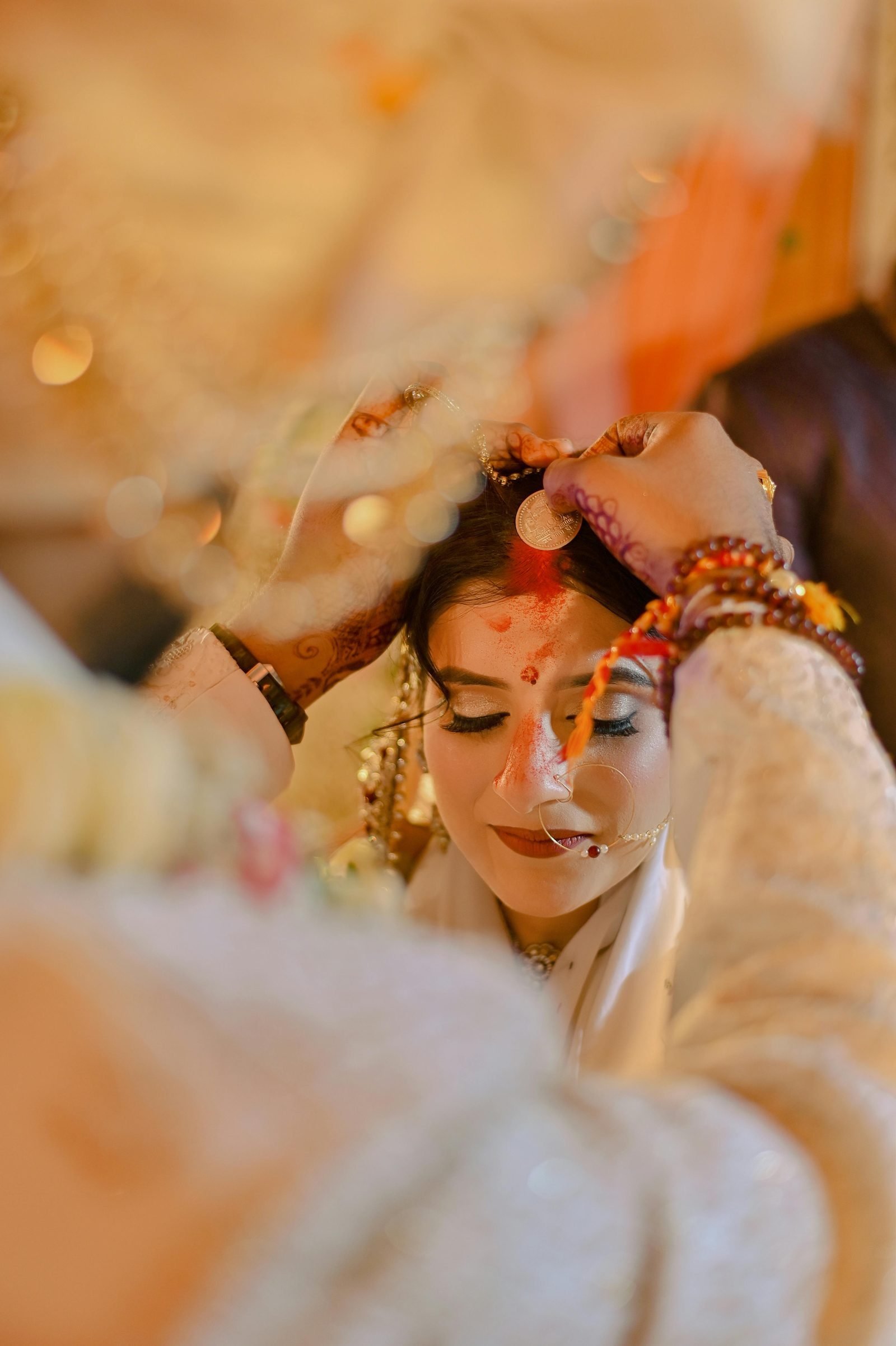
Garlands are exchanged. Sindoor and mangalsutra if you want them; many couples do, some do not, and neither choice affects validity. The whole thing runs forty-five minutes to an hour at an unhurried pace, and you are free to photograph all of it.
The register. The marriage is entered in the institution's marriage register. Both of you sign, both witnesses sign, and the officiating priest signs. This register entry is the thing that matters most in the long run — more than the certificate in your hand, because if you ever lose the certificate, it is an attested extract from this register, quoting the entry number, that proves the marriage.
The certificate. Issued the same day, carrying your names, the date, the place and the witnesses.
Write down the entry number and the date of the register entry, and keep them somewhere that is not the same folder as the certificate. Couples who do this and later lose the certificate solve the problem in a week. Couples who do not can spend months.
Registration is a separate process from the ceremony, with its own steps, its own office and its own failure points. Section 8 of the Hindu Marriage Act provides for entries to be made in a Hindu Marriage Register so that marriages can be proved conveniently, and the Supreme Court in Seema v. Ashwani Kumar directed every state to make registration compulsory. Delhi's own order governs how it is done here.
Step one — establishing which office. Jurisdiction turns on where the marriage was solemnised, or where a party resides. In Delhi this maps to a sub-division, and each sub-division has its SDM. Getting the office right at the start avoids the most tedious possible outcome, which is being told at the counter that your file belongs somewhere else.
Step two — the application. The application is prepared with your details, the date and place of the marriage, both sets of documents, the joint photograph, and the witness details. The mandir certificate goes in as proof that the ceremony took place.
Step three — affidavits. Affidavits covering date of birth, marital status, the fact of the marriage and its date, and in some cases residence. These are drafted, sworn and attested.
Step four — filing and appointment. The application is filed and an appointment date is allotted. In Delhi this runs through the e-District system, and the date depends on the office's load rather than on anything we or you can accelerate.
Step five — the appointment itself. Both spouses attend, with the witnesses, carrying every original. This is not a formality; it is the step where the SDM satisfies himself that the marriage actually happened between these two people. More on what actually gets asked below.
Step six — the certificate. Once the SDM is satisfied, the entry is made in the register and the certificate is issued. This is the document that banks, insurers, the passport office and embassies want.
Couples worry about this step more than any other, usually because nobody has told them what it involves. It is short and it is not an interrogation, but it is a check, and it goes better when you know what is being checked.
Who must be present: both spouses and the witnesses, physically. Not a representative, not a relative with a letter, not one spouse with the other on a video call.
What is examined: the originals of everything filed as a copy. Identity, date of birth, address, the mandir certificate, the affidavits, the photographs.
What is typically asked: when and where the marriage took place; who performed it; whether these two witnesses were present; how the witnesses know you; whether either of you was married before; your current address. Answer plainly. The commonest avoidable problem is a couple giving slightly different answers about the date or the place because one of them is nervous and guessing — so agree the facts beforehand, not because you are inventing them but because people under pressure misremember.
What causes a file to be returned: an original missing; a witness who did not attend; a name on the affidavit that does not match the identity document; an address that does not support the jurisdiction claimed; a previous marriage disclosed without the decree; photographs that do not match the people standing there.
What it is not: it is not a test of your relationship, nobody is entitled to comment on your castes or religions, and no official is entitled to ask for your parents' consent or a caste certificate. If anything like that happens, tell us the same day.
The Special Marriage Act, 1954 is the civil route. It is the only route for a couple where one party is not Hindu, Sikh, Jain or Buddhist and neither wishes to convert, and it is available to anybody who simply wants a civil marriage. Its process is entirely different in shape from the other two, and the difference is time.
Day minus thirty and earlier — residence. Notice is given to the Marriage Officer of a district where at least one of you has resided for at least thirty days immediately before giving it. That is a real requirement with real evidence behind it, and a hotel or guest-house stay is not residence. Only one of you needs to satisfy it.
Day 0 — the notice of intended marriage. Written notice in the prescribed form, signed by both of you, filed with the Marriage Officer.
Day 0 — entry and publication. The Marriage Officer keeps the notice in the Marriage Notice Book and affixes a copy in a conspicuous place in his office. If either of you is not permanently resident within his district, he also sends a copy to the Marriage Officer of the district where that party is permanently resident, for display there. This is the provision that decides whether this route is usable for a couple marrying without family knowledge, and it is worth reading twice.
Days 1 to 30 — the objection window. Any person may object, but only on the ground that the marriage would contravene one of the conditions in Section 4 of the Act: a living spouse, incapacity to consent, the ages of twenty-one and eighteen, or the prohibited degrees. Disapproval is not a ground. Caste is not a ground. Religion is not a ground. A family's unhappiness is not a ground.
Day 31 onwards — solemnisation. If no objection is made, the marriage may be solemnised. Both of you and three witnesses appear before the Marriage Officer and sign the declaration in the prescribed form. There is no religious ceremony. The Marriage Officer then enters the certificate in the Marriage Certificate Book, and that entry, signed by the parties and the three witnesses, is conclusive evidence of the marriage.
The thirty days cannot be shortened. Not for a fee, not through a contact, not in an emergency, not by anyone. It is in the statute. Any offer of a five-day or ten-day Special Marriage Act marriage is an offer of a forged document.
Most couples never see an objection. Because those who do are frightened by it, here is what the process actually looks like.
The objection must be on a Section 4 ground. Nothing else is admissible. An objection that amounts to "her family does not agree" or "they are of different castes" is not an objection the Act recognises.
The Marriage Officer inquires. He is required to inquire into the objection and to decide it, and the Act sets a thirty-day outer limit for that inquiry. For the purpose of the inquiry he has the powers of a civil court — summoning witnesses, examining them on oath, requiring documents.
If the objection is upheld, the marriage is not solemnised, and there is an appeal to the district court, to be filed within thirty days. The district court's decision on that appeal is final and the Marriage Officer acts on it.
If the objection is frivolous and not made in good faith, the Marriage Officer may award costs against the objector, payable to the parties. It is not a large sum, but it exists, and it is worth knowing that the Act itself anticipates people objecting out of spite.
What you should do if it happens: tell us immediately and do not engage with the objector. An objection is answered on the record, with documents, through the Marriage Officer. It is not answered by arguing with a relative on the phone.
A very large share of our registration work is for couples who married long ago — sometimes decades ago — and are now facing a bank, a pension office, a hospital or a visa application that wants proof.
The good news: registration remains possible however long ago the marriage took place, as long as both spouses are alive. There is no cut-off after which the door closes.
The late fee: the Delhi order provides for a fee where registration is late — ₹500 for the second sixty days after the marriage and ₹1,000 after that. Confirm the current figures on the e-District portal before you plan around them.
The real work is proof. The office needs to be satisfied the marriage happened. Ranked by how much weight they carry:
| Evidence | Weight | Notes |
|---|---|---|
| Attested extract from the solemnising institution's register, quoting the entry number | Strongest | Worth the effort of obtaining. Ask the institution in writing. |
| Original mandir or institution certificate | Strong | Better still with the register extract alongside it |
| Wedding invitation card | Supporting | Dated, with both names and families |
| Wedding photographs with the witnesses in them | Supporting | Helpful where the same witnesses will attend |
| Documents naming a spouse — passport, employer, insurance, ration card | Supporting | Shows the marriage was held out publicly over time |
| Children's birth certificates naming both parents | Supporting | Useful where the marriage is old |
| Affidavits of both spouses and the witnesses | Required | Not sufficient on their own |
The witness problem. After twenty years the original witnesses may have moved, or died. Where that is the case, say so plainly and bring what you have — the register extract matters more here than anywhere else. What you must not do is produce two strangers and describe them as the witnesses to a wedding in 1998.
The absolute limit. Once a spouse has died, the marriage can no longer be registered. A certified copy of an existing record can still be obtained if the marriage was registered during their lifetime, but a new registration is not possible. Couples who have been meaning to get round to this for years should treat that sentence as the reason to do it this month.
Couples marry in one place and live in another constantly, and the question of where to register causes more confusion than any other jurisdictional point.
The rule in shape: registration is done where the marriage was solemnised, or where a party resides, depending on which limb the rules give you. This means a couple who married at a mandir in Delhi can normally be registered in Delhi even with no Delhi residence, because the solemnisation happened here. It also means a couple who married in their home town and now live in Delhi may be able to register here on the residence limb.
The NCR trap. Gurugram and Faridabad are Haryana, running on the Haryana Compulsory Registration of Marriages Act, 2008 through the state's own portal. Noida and Ghaziabad are Uttar Pradesh, running on the UP Marriage Registration Rules, 2017 through igrsup.gov.in, with an Aadhaar-OTP verification step that stalls applications where an old mobile number is still linked. Different Acts, different portals, different fees. A metro line crossing a boundary does not move the boundary — the state line between Delhi and Faridabad sits at Badarpur regardless of where the Violet Line goes, and Kaushambi is Uttar Pradesh even though Anand Vihar ISBT is a two-minute walk away and is Delhi. We keep a separate page for each of the four cities.
What not to do. Do not create a Delhi address for the purpose. A rent agreement produced for a file, a relative's address you have never lived at, a hotel bill described as residence — these put a defect into your certificate. Nobody will notice at the counter. It surfaces the day a visa officer lines your documents up beside each other, or the day somebody has a reason to contest the marriage.
The nikah and its registration are two steps, exactly as the ceremony and registration are for a Hindu marriage, and the same confusion arises — couples hold a nikahnama and believe they are registered.
The nikah. Performed by a Qazi in the presence of witnesses, with the offer and acceptance, the mehr agreed and recorded, and the nikahnama drawn up and signed. Our service arranges the Qazi, the witnesses' formalities and the nikahnama the same day.
The registration. The nikah is then registered with the government under the Delhi order so that a government certificate is issued. This is the document that works for a passport, a visa, a bank or an insurer — a nikahnama alone is frequently not enough for them, and an Urdu nikahnama without a certified translation is a recurring obstacle.
Where couples get stuck: a nikahnama that is lost; one written in Urdu with no translation; a nikah performed years ago by a Qazi who cannot now be traced; or spellings on the nikahnama that do not match anybody's Aadhaar. All of these have routes through them, and all of them are easier the earlier they are addressed.
For interfaith couples who do not wish to convert, the Special Marriage Act route is available and its process is the one set out above, thirty-day notice and all.
If your certificate is going to be used outside India, it needs authentication, and the chain has more links than most couples expect. Each link takes its own time and they cannot be done in parallel.
| Step | What happens | Typical time |
|---|---|---|
| 1. Registration | The government marriage certificate is issued | Appointment dependent |
| 2. State-level authentication | The issuing state authenticates the certificate before it goes to the centre. The first step differs for a Delhi certificate and a Haryana or UP one. | Days |
| 3. MEA apostille | The Ministry of External Affairs affixes the apostille | Typically one to two weeks |
| 4. Embassy attestation | Required by some countries on top of the apostille; not required by countries party to the Hague Convention for apostille purposes | Days to weeks |
| 5. Translation | Where the destination country requires the document in its own language | Days |
Three things that go wrong here. First, couples start the chain two weeks before a flight and discover it needed six. Second, the certificate goes into the chain with a spelling that does not match the passport, and the mismatch is then baked into an apostilled document that is far harder to fix than an ordinary one. Third, the original is what travels through the chain, so plan for being without it for a few weeks.
Plan backwards from the departure date, not forwards from today. Our NRI marriage page sets out the whole sequence with the visa timeline mapped onto it.
People use these words interchangeably. The offices do not, and the difference decides how long you wait.
A duplicate is another copy of a record that already exists and is correct. The process is: identify the register entry, apply with the supporting affidavit, and the copy is issued. It goes quickly when you can quote the registration number, the date and the office, and slowly when you cannot, because then somebody has to find the entry.
A correction changes what the record says — a misspelled name, a wrong date, a wrong father's name. This is a longer process, because the office is being asked to alter an official record and needs to be satisfied by documents that the existing entry is wrong and the proposed entry is right. What decides it is what your other documents show, not what you tell them.
A name change after marriage is a third thing altogether and is not a correction. The certificate correctly records the name you had at the time. Changing your name afterwards is done by affidavit, newspaper publication where required, and gazette notification, and then flows into Aadhaar, PAN, bank and passport — it does not mean rewriting the marriage certificate.
The full detail for all three is on the marriage certificate page.
Not theoretical risks. These are the twelve things that, in our experience, actually cost couples time and money.
One — a date of birth that two documents disagree about. Discovered on the morning, it stops everything. Discovered a week earlier, it is an administrative task.
Two — a divorce decree that is not yet final. Get written confirmation of the position from the advocate who handled it, including whether any appeal period has run out.
Three — a witness who does not come. The appointment cannot proceed without them. Confirm with both witnesses the night before, and have a third person in reserve if you can.
Four — a name spelled differently on the affidavit than on the Aadhaar. Read the affidavit before you sign it. It takes ninety seconds and saves a correction application.
Five — an address that does not support the jurisdiction claimed. Resolve this before filing, not at the counter.
Six — assuming the mandir certificate is the government certificate. The single most expensive misunderstanding in this trade, and the one couples discover years later at a passport office.
Seven — starting the apostille chain too late. Six weeks, not two.
Eight — believing the thirty-day notice can be shortened. It cannot, and money paid to someone who says otherwise is money gone.
Nine — using paid witnesses. It creates a defect that lies dormant until the worst possible moment. We do not supply them and you should be wary of anyone who does.
Ten — losing the certificate without having noted the registration number. Three facts written on a separate piece of paper — number, date, office — turn a months-long search into a week.
Eleven — going quiet when a family complaint has been made. A file that grows for three weeks in your absence is worse than a statement given early on your own terms.
Twelve — registering the same marriage twice. It happens when a couple registers in two places to be safe. It is not safe; it creates two records that can contradict each other. Register once, properly.
For a proportion of our couples the marriage process runs alongside a second process, and it helps to see both timelines at once.
Before the marriage. Scan every important document to an account only you control. Note the police station with jurisdiction over where you will be staying. Tell one person you genuinely trust where you are. Keep both phones charged. Take your own documents, your own clothes and your own things — and not disputed jewellery, because an argument about what was in a cupboard becomes a theft complaint very easily in the first week.
On the day. The ceremony process is exactly the process described above; nothing about it changes. What changes is that we make sure you leave with the certificate in your hand rather than collecting it later.
If a complaint is made. The usual forms are a missing-person report, a kidnapping allegation, an age allegation, or a theft allegation. The first two do not stand where an adult married by choice, and the Supreme Court has quashed such proceedings repeatedly. The age allegation is the one that can cause real difficulty, which is why the age check is step zero of this whole page. Contact an advocate the same day; do not go silent.
If a protection petition is needed. The process is: the advocate drafts a writ petition before the High Court with proof of age, proof of marriage and a specific account of the threat — who said what, when, by what means, and whether anything was reported. Notice issues. In a clear case the Court passes a direction to the concerned Station House Officer to look into the representation and provide protection as warranted. The order is then served on the station.
What that process delivers and what it does not. It puts the local station on notice and creates accountability, which in most cases is the entire practical benefit and a real one. It is not a bodyguard and it is not a guarantee. Courts have also become wary of petitions filed with no genuine threat, so the petition has to be truthful and specific — vagueness gets petitions dismissed with observations.
The ₹56,000 Premium package covers the full court marriage and documentation together with a protection petition drafted and filed before the High Court by an advocate, and follow-up on the order. It is for couples in genuine danger. If your situation does not call for it, we will say so and you will pay ₹7,100 instead.
Every route in one place, with honest numbers. Where a figure depends on an office rather than on us, we have said so instead of inventing a duration.
| Process | Time | What controls it |
|---|---|---|
| Document pre-check | Same evening | How quickly you send the photographs |
| Arya Samaj ceremony + mandir certificate | Same day, about three hours on site | Documents ready, witnesses present |
| HMA registration — filing to appointment | Appointment dependent | The SDM office's load |
| HMA registration — appointment to certificate | Short, once the SDM is satisfied | Whether anything was returned for correction |
| Special Marriage Act — residence | 30 days before notice | Statutory |
| Special Marriage Act — notice to solemnisation | 30 days | Statutory. Cannot be shortened. |
| Objection inquiry, if one is made | Up to 30 days, then a 30-day appeal window | Statutory |
| Registering a marriage from years ago | Appointment dependent, plus late fee | Quality of your proof, especially a register extract |
| Duplicate certificate | Weeks | Whether you can quote the registration number |
| Correction to a certificate | Longer than a duplicate | What your supporting documents show |
| State authentication + MEA apostille | Typically one to two weeks | MEA processing |
| Embassy attestation on top | Days to weeks | The embassy concerned |
| Protection petition — filing to first order | Days in a genuinely urgent case | Court listing and the quality of the petition |
Print this, or keep it open on a phone.
Week before: check both dates of birth against documents · confirm any previous marriage is legally over, with paper · pick one spelling of each name and note it · check whether your address proof is current · ask two people who know you to be witnesses and tell them the date · send photographs of everything to us for the pre-check.
Night before: confirm with both witnesses · charge both phones · put every original in one folder · scan everything to an account only you control · agree between yourselves the plain facts — date, place, who is performing the ceremony — so nobody is guessing under pressure.
On the day: arrive with time in hand · read the affidavits before signing them · check the spelling of both names on everything you sign · take your own photographs · collect the certificate · write down the register entry number and date.
Week after: file for registration if it is not already in hand · start any name change · then Aadhaar, PAN, bank, passport · then insurance nominations, employer records and provident fund · if the certificate is going abroad, start the apostille chain immediately.
Every process on this page begins in the same place — a conversation in which you tell us your ages, your religions, whether either of you has been married before, which documents you actually hold, where each of you actually lives, and any deadline that is already fixed. From that we can tell you which route applies, what it costs, how long it takes, and what could go wrong in your particular case.
Call +91 8376863962. Hindi or English. The call is free and there is no obligation, and where the honest answer is a smaller package than you were expecting to buy, that is the answer you will get.
All-India steps and state differences.
Read →How many, who can be, what to bring.
Read →Apply online step by step.
Read →Which route is right for you.
Read →Full process, documents, fees and timeline.
Read →Required list.
Read →Pricing.
Read →Vedic details.
Read →SDM steps.
Read →Old marriage.
Read →Which office, the 60-day rule, real government fees.
Read →Old marriage, the penalty, and what proof works.
Read →Wrong name or date on the certificate — what actually fixes it.
Read →The four clocks, who must attend, and planning backwards.
Read →Two or three, who qualifies, and what a witness signs.
Read →Common questions.
Read →Expert articles on every marriage topic — read before you decide
Complete 2026 process from notice to certificate.
Read Article →Full checklist — Aadhaar, affidavits, witnesses.
Read Article →Transparent breakdown — official + service costs.
Read Article →Your rights, family pressure, police protection.
Read Article →Apostille, Embassy NOC, spouse visa explained.
Read Article →Honest truth about Arya Samaj same-day option.
Read Article →