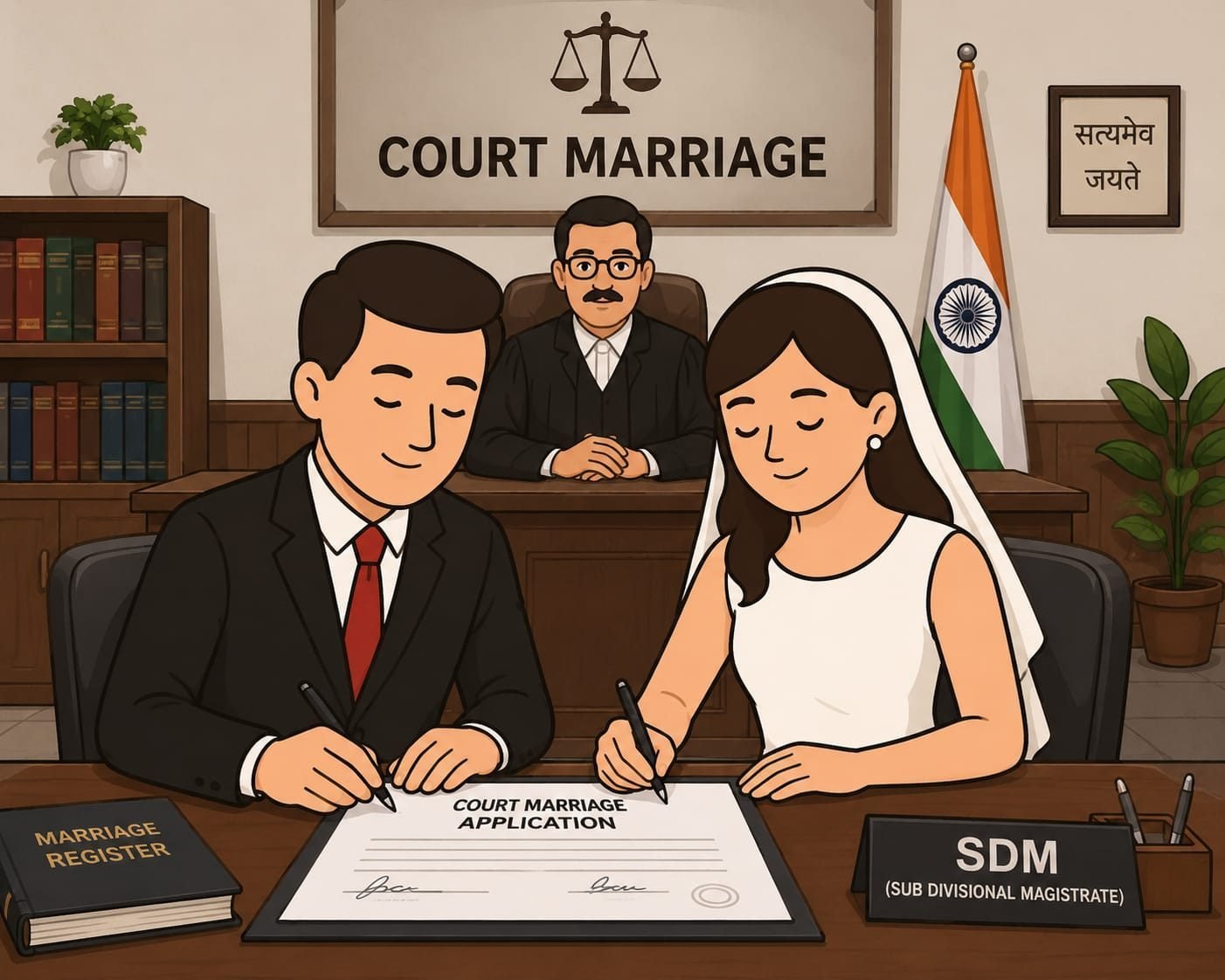
Quick answer: Rohini is Delhi's largest planned township — thirty-odd sectors of DDA flats, cooperative societies and plotted colonies, with Prashant Vihar, Pitampura and Rithala around it. Under Delhi's 2026 revenue map, Rohini is one of three sub-divisions of the North West district (with Kirari and Nangloi Jat); the e-District portal allots the office by address. Two Hindus, Sikhs, Jains or Buddhists can have an Arya Samaj wedding and register it under the Hindu Marriage Act; interfaith couples who do not want to convert use the Special Marriage Act; Muslim couples register a nikah under the Delhi 2014 Order. Because Rohini households often span three generations, this guide also covers the questions the rest of the internet skips: remarriage later in life, what the Senior Citizens Act means when property is gifted to children, marriage and capacity where a family member has a disability, and what same-sex couples can and cannot do in India today. Marriage registration: ₹6,000.
Key takeaways
- Rohini is one of three sub-divisions of the North West district from 1 January 2026, with Kirari and Nangloi Jat.
- Register an old marriage now: after a spouse dies, registration is no longer possible and the marriage must be proved by other evidence.
- There is no upper age limit on marriage and adult children's consent is not required; widows and widowers should ask the pension office in writing first.
- If a flat is transferred to a child, record the maintenance and residence condition in the deed — section 23 of the Senior Citizens Act turns on it (Sudesh Chhikara, 2022).
- Capacity means understanding and consent, not a diagnosis; same-sex marriage is not recognised in India after Supriyo (2023). We never provide witnesses.
Last reviewed: 23 September 2026 · 37 min read
On this page
- Rohini at a glance
- Rohini under the 2026 map
- Which office registers your marriage
- The legal routes
- Arya Samaj + registration
- Special Marriage Act
- Registering a wedding already held
- DDA flats and society paperwork
- Documents when one partner is elderly
- Three generations, one flat
- When the children live abroad
- Marrying later in life
- Widows, widowers and pensions
- The Senior Citizens Act and gifted property
- Parents living with a married child
- Marriage, consent and capacity
- Couples with a disability
- Same-sex couples: where the law stands
- What unmarried partners can still do
- Muslim couples
- Adding a spouse to medical cover
- Inter-caste and interfaith couples
- Young couples and renters
- If your families oppose
- Age
- Witnesses
- Documents checklist
- At the appointment
- What it costs
- Timeline
- Getting around
- Common mistakes
- After registration
- Five Rohini situations
- Checklist
- One-minute summary
- How we help
- Questions and answers
Rohini was built in blocks and pockets, sector by sector, from the 1980s onwards, and the families who moved in then are now in their seventies. Their children are married with children of their own, some in the same flat, some two sectors away, some in Canada. That is the texture of the place: a township where the questions about marriage come from every generation at once.
A young couple in Sector 24 wants to marry quietly and register quickly. A widow in Sector 8 has been asked by her children not to remarry, and wants to know what the law says. A father in Prashant Vihar is being asked to transfer a flat to a son at the time of his wedding, and has heard that a gift can be undone if he is not looked after. A family with a son who has a disability wants to know whether he can marry and what "capacity" means. Two women who have lived together for a decade want to know what is possible for them in India.
This guide answers all of those alongside the ordinary process — routes, documents, timing and costs — and it is honest where the law does not give people what they hoped for. Nothing here needs a lawyer to read, though a few of the steps are worth taking one for, and we say which.
For the general Delhi process, see the complete Delhi court marriage guide. Nearby area guides: Saraswati Vihar, Model Town, Kanjhawala and Narela.
Rohini at a Glance
| Item | Detail |
|---|---|
| District (from 1 January 2026) | North West |
| Sub-divisions in the district | Rohini, Kirari, Nangloi Jat |
| Areas | Rohini sectors 1–34, Prashant Vihar, Pitampura's edge, Rithala, Budh Vihar, Begumpur, Vijay Vihar |
| Metro | Red Line: Rithala, Rohini East and West, Pitampura, Kohat Enclave; Rohini Sector 18, Sector 11 and Sector 13 on the Grey/branch corridors nearby |
| Known for | DDA flats and cooperative societies, schools and coaching, the district court complex, parks and markets |
| Typical questions | Society and flat address proof, remarriage later in life, gifted property and the Senior Citizens Act, capacity and disability, same-sex couples' options |
Rohini Under the 2026 Revenue Map
From 1 January 2026, Delhi's revenue administration was reorganised into 13 districts and 39 sub-divisions. The North West district has three sub-divisions: Rohini, Kirari and Nangloi Jat. Rohini keeps a sub-division in its own name and covers the sectors and nearby colonies, while addresses towards Kirari or Nangloi are allotted accordingly. The portal decides by address and your appointment slip names the office. Certificates issued before 2026 remain fully valid.
Which Office Registers Your Marriage?
Applications are filed on the Delhi e-District portal. For Hindu Marriage Act registration, the office can be the one for the place where the marriage was solemnised or where either spouse lives; for the Special Marriage Act, notice goes to the Marriage Officer of the district where at least one of you has lived for the past 30 days. The Rohini court complex plays no part in registration: courts decide disputes, the SDM registers marriages.
The Legal Routes
| Your situation | Route | Waiting period | Our fee |
|---|---|---|---|
| Wedding already held, not registered | Hindu Marriage Act registration | By appointment | ₹6,000 |
| Both Hindu, Sikh, Jain or Buddhist, marrying now | Arya Samaj wedding + HMA registration | Wedding same day | ₹5,100; ₹7,100 with registration |
| Different religions, no conversion | Special Marriage Act | 30 days' residence, then 30-day notice | ₹15,000 |
| Widow or widower remarrying | Any route, with the death certificate of the former spouse | As per route | As per route |
| Divorced person remarrying | Any route, with the certified final decree | As per route | As per route |
| Both Muslim | Nikah + registration under the Delhi 2014 Order | Nikah same day | ₹5,000 / ₹6,000 |
| Sikh couple after Anand Karaj | Delhi Anand Marriages Registration Rules, 2018, or HMA | By appointment | ₹6,000 |
Government fees are extra at actual cost. Full list: fees.
Arya Samaj Wedding + Registration
For two Hindus, including Sikhs, Jains and Buddhists, the Arya Samaj route is a complete, lawful ceremony in about an hour: havan, garlands, pheras and saptapadi, with the mandir certificate the same day. The government certificate comes from Hindu Marriage Act registration on e-District, and that is the one banks, passport offices, societies and pension offices recognise. Our combined package is ₹7,100, the ceremony alone ₹5,100. The Supreme Court held in Dolly Rani (2024) that a Hindu marriage requires the essential ceremonies, so no certificate substitutes for the wedding. See our Arya Samaj marriage page.
Special Marriage Act
The Special Marriage Act, 1954 is the civil route for any two adults of any religion, without conversion: 30 days' residence in the district before the notice, a 30-day public notice during which only legal objections count, then solemnisation before the Marriage Officer with three witnesses. Our full service is ₹15,000. Where a Hindu, Sikh, Jain or Buddhist marries a person of another religion under this Act, section 19 severs the Hindu partner from the undivided family and section 21 applies the Indian Succession Act; section 21A excludes those effects where both parties are Hindus. See the SMA vs HMA guide.
Registering a Wedding Already Held
An unregistered Hindu marriage can be registered at any time with proof: the wedding card, ceremony photographs, a pandit's or mandir certificate where available, both spouses' age proof, ID and address proof, affidavits, and two witnesses who attended or have long known you as a married couple. Our fee is ₹6,000. For marriages from the 1980s and 1990s — common in these sectors — children's birth certificates, passports naming both parents, a ration card and society records all help. See our marriage registration service.
One limit worth knowing early: registration is not possible after a spouse has died. The marriage must then be proved by other evidence in whatever claim needs it, which is slower and less certain. If you have been married for decades without a certificate, do it this month.
DDA Flats and Society Paperwork
Most households here live in DDA flats, cooperative group housing societies or builder floors on plotted land, and the paperwork worries people more than it should. For marriage registration the registrar wants proof of residence, not ownership.
- Aadhaar with the flat address is the simplest proof; update it before applying if it shows an older address.
- Voter ID, passport or bank statement with the current address.
- Electricity or water bill in a parent's or owner's name, with a ration card, family ID or affidavit showing the relationship.
- Allotment, possession or society maintenance records support the file but do not replace a current residence proof.
- Tenants: a written rent agreement with police tenant verification.
- Write the address exactly as your documents show it — sector, pocket, block, flat number and floor — and keep it identical across the application, affidavits and ceremony certificate.
Separately, after the marriage, tell the society office so that the spouse's name is on the flat's records for gate passes, parking and correspondence, and update the nomination in the society's records where one exists. That is a society formality, not a legal requirement of the marriage.
Documents When One Partner Is Elderly
People who were born in the 1940s, 1950s and 1960s often have no birth certificate and no clear school record, and the family assumes registration will be impossible. It is not; the proof is simply different.
- Passport is the strongest single document, since it carries a date of birth already accepted by the government.
- Class 10 certificate where it exists; duplicates can be obtained from most boards.
- PPO, service book extract or an employer's record for a retired person, which carries the date of birth the government has used for a career.
- Voter ID, Aadhaar and PAN as identity and address, with the usual caution that Aadhaar alone is not a strong age proof.
- Affidavit explaining differences, where documents disagree, stating which is correct and why.
- Medical age certificate from a government doctor in the rare case where nothing else exists.
For an older couple, we assemble the file first and only then fix the ceremony date, so that nobody is asked to travel twice.
Three Generations, One Flat: Getting Ahead of the Friction
The disputes that reach tribunals and courts from townships like this one are rarely about law at the start. They are about unwritten expectations. A short conversation at the time of a wedding, and four documents, prevent most of them.
- Who owns what, written down. The flat's title, any loan, and who is paying the instalments. If a child is contributing to a parent's flat, record it; if a parent is funding a child's purchase, record whether it is a gift or a loan.
- Who lives where, and on what terms. If a floor is being given for the couple to use, say whether it is a gift, a licence to occupy, or a transfer with conditions.
- Care and expenses. What the household contributes to the parents' expenses and medical cover, and who takes responsibility in an emergency.
- Wills on both sides. Parents and the married couple should each have one. It is the cheapest legal document anyone will ever buy and the one that prevents the most litigation.
Where a property transfer is part of the arrangement, the deed should record the maintenance condition, as explained above, and be drawn by a lawyer rather than copied from a form found online.
When the Children Live Abroad
Many flats in these sectors are now occupied by a couple in their seventies whose children are in North America, Australia or the Gulf. Marriage paperwork intersects with that in a few practical ways:
- A wedding planned around a visit should have its documents checked weeks earlier, so that the ceremony and registration both fit inside the trip; both spouses must attend the appointment.
- Apostille or attestation of a certificate for use abroad takes several working days after issue, so do not leave it to the last day of a visit.
- A power of attorney for property matters should be drawn narrowly and revocably, with advice; a general power of attorney handed over casually is how families lose control of a flat.
- Nominations and wills should be reviewed when children move abroad, since succession across countries is slower and costlier without them.
- Keep scanned copies of the marriage certificate, wills and property papers where both the parents and a trusted child can reach them.
Marrying Later in Life
Second marriages in one's fifties, sixties and seventies are more common in Delhi than families admit, and there is no legal obstacle to them. Age is a minimum, not a maximum: once both parties are adults and free to marry, the law does not care whether they are twenty-five or seventy-five.
- Proof that the earlier marriage ended: a certified copy of the final divorce decree, or the former spouse's death certificate.
- The same routes apply: an Arya Samaj wedding with registration, the Special Marriage Act, or a nikah with registration under the 2014 Order.
- Children's consent is not required. Adult children have no legal say in a parent's marriage, however strongly they feel.
- Witnesses can be friends, neighbours or the couple's own adult children, if they are supportive.
- Register it. A later-life marriage is exactly the one that will be questioned after a death, so the certificate matters more, not less.
- Plan the money side deliberately: wills, nominations, and clarity about what each brings, especially where there are children from earlier marriages.
We conduct such weddings regularly and the documents are no more complicated than for a first marriage.
Widows, Widowers and Pensions
The commonest worry is money: will a remarriage stop a pension?
- Family pension rules deal with remarriage, and they differ between central and state service, the railways, PSUs and private schemes, with specific provisions for a childless widow. Do not rely on what a neighbour says: ask your pension disbursing authority, in writing where possible, before the wedding.
- A widow's own property is hers. Remarriage does not take away what she already inherited or owns.
- Under the Hindu Succession Act, a widow inherits as a Class I heir on her husband's death; that vested share is hers thereafter.
- Update nominations and records after the remarriage: bank, insurance, society, medical scheme.
- Make a will, particularly where there are children from the first marriage, so that nobody has to guess later.
- Keep the first spouse's death certificate with the new marriage papers; both documents will be asked for together.
The Senior Citizens Act and Gifted Property
Weddings are often the moment when a parent transfers a flat or a share of one to a child. Parents in these sectors ask, sensibly, what happens if they are not looked after afterwards. The Maintenance and Welfare of Parents and Senior Citizens Act, 2007 is the answer, and its detail matters.
- Maintenance: parents and senior citizens can apply to a tribunal for maintenance from children or, in some cases, relatives. The procedure is meant to be simple and quick.
- Section 23: where a senior citizen has transferred property by gift or otherwise subject to the condition that the transferee will provide basic amenities and physical needs, and the transferee refuses, the transfer can be declared void by the tribunal.
- The condition matters. In Sudesh Chhikara v. Ramti Devi (2022), the Supreme Court held that a transfer can be set aside under section 23 only where it was subject to such a condition; a bare gift with nothing attached is harder to undo. In a 2025 judgment the Court read the section purposively in favour of a senior citizen whose son failed to look after her.
- So, if you are transferring property, say so in the deed. A clause recording the obligation to maintain and care for the parent, and to allow them to live in the property, is the difference between a protected parent and a hopeful one.
- Eviction is not automatic. Where a daughter-in-law claims a right of residence under the Protection of Women from Domestic Violence Act, 2005, courts balance both statutes; the Supreme Court considered this in S. Vanitha (2020).
- Take advice before signing anything at a wedding. A deed executed in the middle of wedding arrangements, without advice, is the one that causes litigation.
None of this is a reason to distrust your children. It is a reason to write down what everyone intends, which is what good families do anyway.
Parents Living With a Married Child
Three generations in one flat is normal here, and the friction is usually about space and money rather than law. A few points that help:
- Ownership does not change on marriage. A flat in a parent's name stays in the parent's name; a daughter-in-law does not acquire ownership by marrying into the house.
- A right of residence is different from ownership. Under the Domestic Violence Act, a wife has a right to reside in the shared household, which the Supreme Court held in Satish Chander Ahuja (2020) can include a house owned by the in-laws, without making her the owner.
- Senior citizens have their own protections, as above, and tribunals can order maintenance and, in appropriate cases, deal with property transferred conditionally.
- Write down arrangements about contributions to expenses, renovations paid for by a child, and who will live where. Most family disputes we hear about began as an unwritten understanding.
- Wills prevent more quarrels than any agreement. Every adult with property should have one.
Marriage, Consent and Capacity
A marriage rests on the free consent of two people who are capable of giving it. Families sometimes ask us to marry a person who cannot understand what is happening, or who is being pushed. We do not, and the law does not support it.
- Consent must be free. A marriage brought about by force or by fraud as to a material fact is voidable under the Hindu Marriage Act, and the petition is time-limited.
- Capacity is a condition: the Act requires that neither party be incapable of giving valid consent because of unsoundness of mind, or suffer from a mental disorder of such a kind or extent as to be unfit for marriage and the procreation of children. That language is dated; what it means in practice is that the person must understand and freely agree.
- A diagnosis is not a disqualification. Very many people with mental-health conditions, intellectual disabilities or neurological conditions marry, with understanding and support. The question is understanding and consent, not a label.
- Nobody can consent on another adult's behalf. A parent, guardian or doctor cannot supply the consent of the person marrying.
- If capacity is genuinely in doubt, take medical and legal advice before, not after. A marriage performed where consent was not possible harms the person it was supposed to help.
- We will decline where the person marrying cannot tell us themselves, in their own words, that they wish to marry.
Couples With a Disability
There is no bar in Indian law on a person with a disability marrying, and the Rights of Persons with Disabilities Act, 2016 requires equal treatment and, where needed, reasonable accommodation and support in exercising legal capacity. In practice:
- Accessibility at the ceremony and the office: tell us in advance and we will plan the venue, timing and, where possible, ground-floor access; ask at the registration office for assistance.
- Communication: a person who communicates through sign language, writing or an interpreter is giving consent as validly as anyone else. Arrange an interpreter you trust rather than relying on a stranger.
- Support, not substitution: the 2016 Act speaks of support in exercising legal capacity. Family can help someone understand and decide; family cannot decide for them.
- Guardianship: limited guardianship provisions exist under the 2016 Act, and separate guardianship arrangements under the National Trust Act, 1999 for certain conditions. These are about support and protection, and they do not make another person's marriage decision.
- Documents: a disability certificate is not required to marry or to register. Bring the usual age, identity and address documents.
- Dignity: we ask the couple, privately and directly, whether they wish to marry — exactly as we do at every wedding.
Same-Sex Couples: Where the Law Stands
We are asked this often enough to answer it plainly and without pretence. In Supriyo v. Union of India (2023), a Constitution Bench of the Supreme Court declined to recognise same-sex marriage under the Special Marriage Act or otherwise, holding that any such change is for Parliament; a review petition was dismissed in January 2025. The Court did note the government's statement that a committee would examine entitlements for same-sex couples.
So, as things stand in India today:
- A same-sex marriage cannot be solemnised or registered under the Hindu Marriage Act, the Special Marriage Act or any other Indian marriage law, and no service can lawfully do it. Anyone offering a "certificate" for one is selling a document that is worthless and will expose you to worse.
- Being in a same-sex relationship is not a crime. The Supreme Court read down section 377 in Navtej Singh Johar (2018); consenting adults have the right to their relationships and to live together.
- The Court in Supriyo recognised the reality of such relationships even while leaving the law to Parliament, and its directions and observations on police protection and non-harassment are relied on by couples.
- Protection is available if a couple is threatened or confined by a family: the police, and a habeas corpus or protection petition in the High Court, which same-sex couples have used successfully.
We will not take money for something we cannot deliver, and we will not pretend otherwise; where a couple asks, we say exactly this and point to what is possible instead.
What Unmarried Partners Can Still Do
Whether a couple is same-sex, or opposite-sex and not marrying, or waiting for a divorce to become final, some protections can be built with ordinary documents. None of these creates a marriage, and each should be drawn by a lawyer.
- A will, which is the single most important document, since without one the law's default heirs take everything.
- Nominations in bank accounts, insurance, provident fund and demat accounts, and a jointly held account or property where that is intended.
- A power of attorney for property and financial matters, drawn narrowly and revocably.
- Written instructions about medical decisions, and telling the hospital and family who the person wants consulted; hospitals follow their own rules and next-of-kin practice, so clarity in advance helps.
- Records of shared expenses and contributions to any property, since a dispute later turns on documents.
- Tenancy in joint names where you rent together.
For opposite-sex couples living together, our live-in relationship guide sets out what the law does and does not give, and there is no live-in registration in Delhi.
Muslim Couples
Muslim families in Begumpur, Budh Vihar and the colonies around the sectors marry by nikah: two adults free to marry, free consent, mahr, and the proposal and acceptance before witnesses. Our own Qazi reads nikahs with nikahnama and certificate for ₹5,000. Delhi law requires registration under the Delhi (Compulsory Registration of Marriage) Order, 2014 within 60 days, with a ₹500 fee for the next 60 days and a ₹1,000 penalty after that. Register under that Order rather than the Special Marriage Act, which would move succession to the Indian Succession Act; the Delhi High Court directed online registration of Muslim marriages under the 2014 Order in Faizan Ayubi (2024). A widow or divorced woman must have completed her iddat, and should bring the death certificate, talaqnama, khulanama or decree. See our nikah registration service.
Adding a Spouse to Medical Cover
In a township with many retired households and many salaried ones, medical cover is the benefit that is most often out of date. After a marriage:
- Employees: add the spouse to the employer's group mediclaim within the window the policy allows, which is often only a few weeks, and to CGHS or a departmental scheme where you are covered.
- Retired government employees: a pensioner's card covers the spouse; make sure the record shows the current spouse, and intimate a marriage after retirement to the pension disbursing authority.
- Private health insurance: tell the insurer; a spouse can usually be added at renewal, and waiting periods start from when they are added.
- Elderly couples: keep a shared list of medicines, allergies, doctors and emergency contacts, and give a copy to a neighbour or family member nearby.
- Documents: every one of these asks for the marriage certificate, which is one more reason to register promptly.
Inter-Caste and Interfaith Couples
An inter-caste marriage between two Hindus is lawful and needs no permission; where one spouse is from a Scheduled Caste and the other is not, the couple may be eligible for the ₹2.5 lakh incentive under the Dr. Ambedkar Scheme for Social Integration through Inter-Caste Marriages, subject to its current conditions, including registration under the Hindu Marriage Act. Interfaith couples who do not want either partner to convert use the Special Marriage Act; conversion, if chosen, must be genuine and never dissolves an existing marriage (Sarla Mudgal, 1995). See our inter-caste and inter-religion services.
Young Couples and Renters
- Address proof: a written rent agreement with police tenant verification, or Aadhaar updated to the Delhi address; one spouse's proof is enough for registration.
- Privacy: Hindu Marriage Act registration notifies nobody; the Special Marriage Act requires a 30-day public notice, which is why two Hindus who need privacy usually take the Arya Samaj route.
- Witnesses: friends, flatmates or colleagues who know you both.
- Work: we schedule ceremonies early in the morning or on weekly offs and take first-slot appointments.
- Tell your families when it is safe to, and register promptly either way.
If Your Families Oppose
Adults may marry by choice. The Supreme Court directed protection for inter-caste and inter-religion couples in Lata Singh (2006), held in Shakti Vahini (2018) that no family or community body may interfere with the marriage of consenting adults, and in Shafin Jahan (2018) that the choice of a partner is part of personal liberty. Delhi Police has special cells for threatened couples and the Delhi High Court can order protection. Keep documents with you, leave copies with a friend, choose supportive witnesses, register promptly, record threats, and call 112 in an emergency or 181 for the women's helpline. See our love marriage service and the love marriage rights guide.
Age
The groom must be at least 21 and the bride 18 on the wedding day, shown by a Class 10 certificate, birth certificate or passport; Aadhaar is identity proof, not reliable age proof. We never conduct a marriage where either party is under age. See the marriage age guide.
Witnesses
Two witnesses for Hindu Marriage Act or Anand registration, three for the Special Marriage Act, and for a nikah as the school followed requires. They bring photo ID and address proof and must actually know you.
We do not provide witnesses. A person who does not know you is not a real witness. Bring your own. See the witness requirements guide.
Documents Checklist
| Document | Who | Notes |
|---|---|---|
| Age proof | Both | Class 10 certificate, birth certificate or passport |
| Photo ID | Both | Aadhaar, voter ID, passport, driving licence or PAN |
| Address proof | At least one in Delhi; 30 days' residence for SMA | Aadhaar, voter ID, bill with relationship proof, rent agreement with tenant verification |
| Photographs | Both | Passport size, plus ceremony photographs for registration |
| Ceremony proof | For registration | Arya Samaj or mandir certificate, gurdwara certificate, nikahnama, wedding card |
| Affidavits | Both | Age, marital status, nationality; one-and-same-person where names differ |
| Death certificate | If widowed | Of the former spouse |
| Divorce decree | If divorced | Certified copy of the final decree |
| Witnesses' ID and address proof | Each witness | Two for HMA, three for SMA |
Full list: documents required for court marriage in Delhi.
At the Appointment
Both spouses and the witnesses attend the office named on the slip with all originals. The officer compares originals with the uploads, confirms identity, and asks simple questions: when and where you married, who performed the ceremony, whether either was married before, and whether you married of your own will. Witnesses say how they know you. If everything is in order, you sign the register and the certificate is issued, often digitally, the same day or within a few days. Read every entry before leaving; for an older couple, check the dates of birth especially, because they will be copied into pension and society records.
What It Costs
| Service | Our fee |
|---|---|
| Marriage registration (existing marriage) | ₹6,000 |
| Arya Samaj marriage (same day) | ₹5,100 |
| Arya Samaj + registration combined | ₹7,100 |
| Court marriage (advocate assisted) | ₹6,100 |
| Inter-religion marriage | ₹10,000 |
| Special Marriage Act, full process | ₹15,000 |
| Muslim nikah / nikah registration | ₹5,000 / ₹6,000 |
| Marriage certificate, duplicate or correction | ₹2,500 |
Government fees, e-stamp and notary charges at actual cost. Full list: fees.
Timeline
| Route | Typical time |
|---|---|
| Arya Samaj wedding or nikah | Same day once documents are ready |
| Hindu Marriage Act registration | Depends on the appointment; Tatkal faster where available |
| Special Marriage Act | 30 days' residence, 30 days' notice, then solemnisation |
| Duplicate or correction of a certificate | Days to a few weeks |
Getting Around
The Red Line runs through the township with Rithala, Rohini East and West, Pitampura and Kohat Enclave, and the branch corridor serves the inner sectors. Distances inside Rohini are longer than they look on a map, so allow time between a sector address and the office, and ask elderly relatives to travel in the morning rather than the afternoon heat. Pickup and drop within Delhi NCR is ₹1,500, which many families use for a senior citizen attending an appointment.
Common Mistakes
- Waiting decades to register, then finding registration impossible after a spouse's death.
- Assuming adult children must consent to a parent's remarriage.
- Transferring a flat at a wedding with no condition recorded, and hoping section 23 will help later.
- Relying on a neighbour's version of pension rules instead of asking the pension office.
- Treating a diagnosis as a disqualification, or, worse, marrying off someone who cannot consent.
- Paying anyone who offers a same-sex "marriage certificate" in India.
- Aadhaar as the only age proof.
- Witnesses who cannot attend the appointment.
- Not reading the certificate at the counter.
After Registration
- Check the certificate, make attested copies and keep digital copies with both spouses.
- Update Aadhaar, bank and insurance nominations, medical cover and, where employed, HR records.
- Tell the society office so the spouse is on the flat's records.
- Make or revise wills, especially in a later-life or second marriage.
- Where property was transferred, keep the deed with the condition recorded, and a copy with the senior citizen.
- Keep the first spouse's death certificate or divorce decree filed with the new certificate.
Five Rohini Situations
The marriage from 1991
A couple married in 1991 in a Rohini sector with four hundred guests and never registered. In 2026 a property mutation needed proof. With the wedding card, photographs, their children's birth certificates and two neighbours who had attended, the marriage was registered in a single appointment. Their advice to the block: do not wait thirty-five years.
The widow who remarried at sixty-one
A widow in Sector 8 wanted to remarry a widower from the same block. Her children objected. She asked her pension office in writing about the effect on her family pension, brought her husband's death certificate, and married at an Arya Samaj mandir with two friends as witnesses. The marriage was registered within the month and she made a will the same week.
The flat gifted at the wedding
A father planned to gift a floor to his son at the time of his marriage. We told him what we tell everyone: put the maintenance and residence condition in the deed, and take a lawyer's advice. He did. Two years later, when the relationship soured, the recorded condition was what protected him.
The couple who asked us about capacity
A family wanted to arrange a marriage for a son with an intellectual disability. We met him. He could tell us, in his own words, that he wanted to marry his fiancée, whom he had known for two years, and she said the same. The wedding took place with both families present, and an interpreter for one set of grandparents. Another family, a month later, asked us to marry a relative who could not say what was happening; we declined.
The two women in Sector 13
A couple who had lived together for eleven years asked whether we could marry them. We explained that Indian law does not allow it, and that anyone claiming otherwise would be giving them a worthless document. We told them what is possible: wills, nominations, a joint account, a power of attorney, a joint tenancy, and clear written instructions about medical decisions, drawn by a lawyer. They left with a plan rather than a promise.
Checklist
- ☐ Route chosen: Arya Samaj + HMA, SMA, nikah + 2014 Order, or registration of an existing marriage
- ☐ Age proof for both: Class 10, birth certificate or passport
- ☐ Flat address proof; society records noted for updating afterwards
- ☐ Death certificate or certified final decree, where either was married before
- ☐ Pension office asked in writing, for a widow or widower remarrying
- ☐ Any property transfer drafted with the maintenance condition recorded, with advice
- ☐ Consent confirmed directly with both partners
- ☐ Two witnesses with ID, available on a working day
- ☐ Certificate read at the counter, copies made
- ☐ Wills, nominations and society records updated afterwards
One-Minute Summary
- Rohini is one of three sub-divisions of the North West district from 1 January 2026.
- Register an old marriage now: after a spouse dies, registration is no longer possible.
- There is no upper age limit on marriage, and adult children's consent is not required.
- Ask the pension office in writing before a widow or widower remarries.
- If property is transferred to a child, record the maintenance condition in the deed — section 23 of the Senior Citizens Act turns on it.
- Capacity means understanding and consent, not a diagnosis; nobody can consent for another adult.
- Same-sex marriage is not recognised in India after Supriyo (2023); wills, nominations and powers of attorney are what a couple can put in place.
- We never provide witnesses and never marry anyone under age.
How We Help
We check documents on WhatsApp, register marriages performed decades ago, conduct Arya Samaj weddings and nikahs at times that suit older family members, file Special Marriage Act notices, and obtain duplicates and corrections. We speak to both partners ourselves before any ceremony. Where a question belongs to a pension office, a tribunal or a lawyer, we say so instead of guessing, and we decline anything we cannot lawfully do. Everything is confidential.
Marriage registration for Rohini families – ₹6,000
Register a marriage from any year · Arya Samaj + registration ₹7,100 · nikah registration ₹6,000 · duplicates and corrections ₹2,500.
Book Marriage Registration – ₹6,000 →Also: Arya Samaj marriage · Certificate & duplicates · Court marriage
Questions and Answers: Court Marriage for Rohini Couples
Sources and Official References
Facts in this guide were checked against the following primary sources. Government procedures and office allocations change, so confirm current details on the official portal before applying.
- Delhi e-District – official online application portal
- Revenue Department, Delhi – notification dated 25 December 2025 creating 39 sub-divisions and 13 areas
- The Hindu Marriage Act, 1955 – India Code
- The Special Marriage Act, 1954 – India Code
- The Maintenance and Welfare of Parents and Senior Citizens Act, 2007 – India Code
- Sudesh Chhikara v. Ramti Devi, Supreme Court, 2022 (section 23 requires a condition) – LiveLaw
- Supreme Court quashes a gift deed for non-compliance with maintenance obligations (2025) – SCC Online
- The Rights of Persons with Disabilities Act, 2016 – India Code
- Supriyo v. Union of India, Supreme Court, 2023 (same-sex marriage) – Supreme Court Observer
- Navtej Singh Johar v. Union of India, Supreme Court, 2018 – Indian Kanoon
- The Delhi (Compulsory Registration of Marriage) Order, 2014 – Revenue Department, Delhi
- Lata Singh v. State of U.P., Supreme Court, 2006 – Indian Kanoon
- Shakti Vahini v. Union of India, Supreme Court, 2018 – Indian Kanoon
- Sarla Mudgal v. Union of India, Supreme Court, 1995 – Indian Kanoon
This guide is general information, not legal advice for your specific case. Call +91 8376863962 for advice on your situation.
Related Articles
🏥 Sarita Vihar & the Hospital Belt
What the certificate does at an admission desk — consent, organ donation, insurance and next of kin.
Read →🏙️ Court Marriage in Saraswati Vihar
North West Delhi guide.
Read →✈️ Court Marriage in Model Town
Spouse visas and apostille.
Read →🏭 Court Marriage in Narela
ESIC, EPF and factory families.
Read →🏛️ Court Marriage in Patel Nagar
Service records and pensions.
Read →🏠 Live-in Relationship Law
What the law gives, and does not.
Read →⚖️ SMA vs HMA
Which Act suits you.
Read →📄 Documents Required
Full documents list.
Read →📅 Marriage Age Limit
21 and 18 explained.
Read →👥 Witness Requirements
Who can be a witness.
Read →🏛️ Court Marriage in Delhi
The complete Delhi guide.
Read →🏡 Yamuna Vihar: GPA Houses and Widows
Property papers, succession and the certificate.
Read →