Home›FAQs
❓ All Questions Answered
Frequently Asked Questions
Common questions about Arya Samaj Court Marriage Delhi answered in detail. Legal, Process, Fees, Documents, NRI, Love Marriage topics.
Common questions about Arya Samaj Court Marriage Delhi answered in detail. Legal, Process, Fees, Documents, NRI, Love Marriage topics.
These are the eight questions that come up in the first two minutes of almost every call we take. They are here at the top because a surprising number of couples spend weeks worrying about one of them, and the answer takes a sentence.
A note on how this page is written. Most FAQ pages on marriage websites answer in five words and leave you no better off. We have tried to answer properly, including where the honest answer is "that depends" or "no, and here is why nobody can". Where a question deserves a whole page, there is a link to it. If your question is not here, ring the number at the bottom — that conversation is free and we do not use it to sell you a bigger package.
Section 5 of the Hindu Marriage Act lists five conditions and no more: no living spouse, capacity to give valid consent, the groom twenty-one and the bride eighteen, not within the prohibited degrees, and not sapindas of each other. That is the complete list, and we check every couple against it before taking any money.
What is not on the list is worth saying out loud, because so many couples arrive apologetic about one of them: caste, sub-caste, gotra, community, village, income, education, the agreement of horoscopes, the approval of a panchayat, and the consent of parents. None of these is a legal condition of marriage in India, and no office is entitled to demand them.
Almost every unhappy conversation in this trade begins with a promise about speed. So here is the shape of it: the ceremony is fast, registration depends on an office, and the Special Marriage Act has a statutory wait that nothing and nobody can shorten.
The thirty-day notice under the Special Marriage Act is not a queue, a backlog, or an administrative habit. It is Section 6 and Section 7 of the Act: the Marriage Officer enters your notice in the Marriage Notice Book, affixes a copy in a conspicuous place in his office, and where a party is permanently resident elsewhere, sends a copy to that district for display there. Thirty days must pass for objections. There is no fee, no contact and no emergency that changes this.
This section exists because witnesses are the question we are asked most often and the one where our answer disappoints roughly one caller in three.
A witness signs a document stating that he was personally present at your marriage and knows who you are. That is a statement of fact, and a stranger arranged by an agent cannot honestly make it. What paid witnesses produce is a marriage with a defect sitting dormant inside it — until a succession dispute, a maintenance case, or a consulate that telephones the witness named on your certificate and finds a man who has never heard of you.
Our prices are published, they are the same for everybody, and they do not move because of your caste, your religion, your urgency, or how worried you sounded on the phone. The full breakdown, including five worked total-cost examples, is on the fees page.
Before you pay anybody in this trade — us included — ask three questions: what is the total, what is not included, and which government fees are extra. An honest service answers all three in under a minute, in writing if you want it. Vagueness on any of them is itself the answer.
A large share of the people who ring this number are not asking a legal question. They are asking whether they will be safe. We would rather be concrete than reassuring, so this section says what usually happens and what actually helps.
In Delhi and the districts around it, the most common family response to a marriage they oppose is not violence. It is a complaint at a police station — framed as a missing person, a kidnapping, an age allegation, or a theft of jewellery. Three of those four do not stand where two adults married by choice with correct documents. The fourth, the age allegation, is decided on documents, which is exactly why we check ages before we discuss anything else.
The certificate is the beginning of a short administrative list, and the order you do it in decides whether it takes a fortnight or three months.
The order that works: marriage certificate first, because everything else asks for it; then a name change if there is one; then Aadhaar, then PAN, then bank accounts, then passport, then insurance nominations, employer records, provident fund, driving licence and voter ID. Passport last of that group, because it is the strictest and the most likely to reject an application where documents disagree with one another.
A very large share of our registration work is for people who married long ago and are now facing a bank, a pension office, a hospital or a visa application that wants proof. The good news is that the door is open. The one piece of bad news is absolute, and it is at the end of this paragraph: registration remains possible however long ago the marriage took place, as long as both spouses are alive — but once a spouse has died, the marriage can never be registered.
The three jobs people confuse with each other — a duplicate, a correction, and a name change — are separate, and they differ in price and in how long they take. The full detail is on the marriage certificate page.
A nikah and its registration are two separate steps, and the confusion between them mirrors exactly the confusion Hindu couples have between the mandir certificate and the government certificate. The nikahnama records the nikah. The government certificate is what an institution acts on.
A short section, and the most useful one on the page. Every item here is something we are asked for regularly and refuse every time. If you are comparing services, these are the questions to put to whoever else you are speaking to — the answers will tell you a great deal.
These are not straw men. Every one of them has been said to us, in earnest, by somebody who had been told it by a relative, a neighbour, or another marriage service. Correcting them is most of what a first conversation consists of.
"Court marriage means going to a court and standing before a judge." No court marries anybody and no judge is involved. "Court marriage" is everyday shorthand for a civil marriage under the Special Marriage Act, or for registration of a marriage with the SDM. The word court in the phrase is a habit, not a place you will visit.
"The certificate is what makes you married." The ceremony makes you married. Under Section 7 of the Hindu Marriage Act the marriage is complete and binding at the seventh step of saptapadi, and the Supreme Court held in 2024 that a certificate proves nothing where no ceremony took place. The certificate proves the marriage; it does not perform it.
"The mandir certificate is the government certificate." It is not, and this single confusion costs couples more than anything else on this page. Institutions want the SDM certificate.
"If we are not registered, we are not really married." Also wrong, in the opposite direction. An unregistered marriage is a valid marriage. It is simply a marriage you will have to prove with evidence and argument rather than with a document, at a moment when you would much rather have the document.
"A good agent can get the thirty-day notice reduced." Nobody can. It is in the statute. Every rupee paid for this buys nothing or a forgery.
"Inter-caste marriage needs special permission." Caste appears nowhere in the Hindu Marriage Act. There is no permission to seek, no certificate to produce, and no extra fee to pay.
"Same-gotra marriage is illegal." Gotra is not mentioned in the Act. What the Act bars is prohibited degrees and sapinda relationship, which are defined by counting actual generations, not by a shared clan name.
"Our parents can have the marriage cancelled." A valid marriage can be dissolved only by a competent court in a proceeding to which both spouses are parties. Parents are not parties, a panchayat is not a court, and disapproval is not a ground.
"We are from Noida, so Delhi rules apply because it is all NCR." Registration runs on state law. Noida and Ghaziabad are Uttar Pradesh; Gurugram and Faridabad are Haryana. Different Acts, different portals, different fees. A Delhi office cannot take a Special Marriage Act notice on a Noida address.
"A ten-year separation is as good as a divorce." It is not. Only a decree ends a marriage, and a second marriage during a subsisting first one is void and an offence.
"We can register later, there is no hurry." There is no deadline while both spouses are alive, which is true and reassuring — but the moment a spouse dies, registration becomes permanently impossible. Couples who put it off for thirty years sometimes find that out at the worst possible time.
"Buying the most expensive package is the safest choice." It is not. The ₹56,000 Premium is right for couples facing real threats and wrong for everyone else, and courts have themselves criticised protection petitions filed with no genuine threat. Paying more does not buy more safety; it buys a petition you did not need.
You will meet these words on this website, at an office, and in whatever a relative forwards you. Here is what each actually means, in one or two sentences.
Solemnisation. The performing of the marriage itself — the ceremony, or in a civil marriage the signing of the declaration before the Marriage Officer. It is the act that creates the marriage, as distinct from registering it afterwards.
Saptapadi. The seven steps taken together around the sacred fire in a Vedic ceremony. Where the customary rites include it, the marriage becomes complete and binding at the seventh step. That is the legal moment you became married.
Havan. The sacred fire, and the offerings made into it, around which the Vedic rites are conducted.
Prohibited degrees of relationship. A list in Section 3 of the Hindu Marriage Act of relationships too close for marriage — lineal ascendants and descendants, a brother's widow, an uncle and niece, children of two brothers, and so on. A marriage within them is void unless a custom governing one party permits it.
Sapinda. A relationship defined by counting generations — three upwards through the mother and five through the father, counting the person as the first. Two sapindas may not marry, again unless a custom permits it.
Gotra. A lineage marker used in some Hindu communities. It carries social weight in parts of north India and no legal weight at all under the Hindu Marriage Act.
Notice of intended marriage. The written notice given to the Marriage Officer under the Special Marriage Act, entered in the Marriage Notice Book and publicly displayed for thirty days, with a copy sent to each party's permanent-residence district.
Marriage Officer. The officer appointed under the Special Marriage Act who receives the notice, decides any objection, solemnises the marriage and enters the certificate. Not a judge.
SDM. Sub-Divisional Magistrate — the officer with whom a marriage is registered in Delhi under the Hindu Marriage Act, and whose office issues the government certificate.
e-District. The Delhi government's online portal through which registration applications are filed and appointments allotted. Haryana and Uttar Pradesh run their own separate portals.
Marriage register and entry number. The book in which a marriage is recorded, and the number of your entry in it. If you lose your certificate, an attested extract from the register quoting that number is the strongest proof you can produce. Write the number down.
Void and voidable. A void marriage is treated in law as never having been a valid marriage at all — for example one where a spouse from an earlier marriage was still living. A voidable marriage is valid until a court sets it aside at the instance of one party, for example where consent was obtained by force or fraud.
Decree. The formal order of a court that ends or annuls a marriage. A decree of divorce ends a valid marriage; a decree of nullity declares one void or annuls a voidable one. An order sheet, a petition copy or a settlement on stamp paper is none of these.
Affidavit. A written statement sworn on oath before an authorised person. What it says becomes what your certificate says, which is why you should read it before signing.
Streedhan. Property given to a woman at or around her marriage, which is hers. A useful legal concept, and a poor reason to carry disputed jewellery out of a house on the day you leave it.
Writ petition. A petition to a High Court or the Supreme Court seeking a direction, for example the protection petition a married couple facing threats may file.
Quashing petition. A petition asking the High Court to set aside criminal proceedings — the remedy where a family has procured an FIR that does not stand.
Habeas corpus. Literally a direction to produce a person before the court. Parents sometimes use it to try to have an adult daughter brought back; the Supreme Court has made clear it cannot be used to hand an adult woman to her parents against her wishes.
Apostille. A certification affixed by the Ministry of External Affairs that makes an Indian public document acceptable in countries party to the Hague Convention. It goes on the original, and the chain before and after it is sequential.
Attestation. Further certification by the embassy of the destination country, required by some countries on top of the apostille and not by others.
Nikahnama. The written record of a nikah, signed by the parties and the witnesses, recording the mehr. It proves the nikah; it is not the government certificate.
Mehr. The amount or property settled on the bride in a Muslim marriage, agreed and recorded at the nikah.
Shuddhi. The Arya Samaj rite of conversion to the Hindu fold. Legally recognised, historically significant, and never something to undertake merely as a paperwork shortcut — particularly given the conversion laws now in force in several states.
Tatkal. Priority handling. In this field it means the steps that can be prioritised are prioritised. It does not and cannot mean a shortened statutory notice.
This page now runs to well over a hundred answers and it still will not cover every situation, because the situations people arrive with are genuinely varied — a decree from a court in another state, a passport in a maiden name, a wedding in 1994 nobody wrote down, a visa interview in eleven days, a family that has started making phone calls.
Ring +91 8376863962 and describe it. Tell us your ages, your religions, whether either of you has been married before, which documents you actually hold, where each of you actually lives, and any date that is already fixed. Ten minutes usually settles the whole plan — which route, what it costs, how long it takes, and what could go wrong in your particular case.
The call is free, we answer in Hindi or English, and if the honest answer is that you need less than you thought, that is the answer you will get.
Everything above this point is answered in a line or two. This section, and the four that follow it, answer the same subjects properly — because "how does SDM registration actually work" is not a one-line question, and every couple who gets it wrong loses a morning or a fortnight to something that was written down all along.
The figures here come from the Delhi Revenue Department's own marriage-registration page and from the Delhi (Compulsory Registration of Marriage) Order, 2014. Where the two differ, or where an office works to a different current schedule, ask at the counter and ask for the receipt — and whatever the office charges is what you pay. We keep no part of any government fee.
The Sub-Divisional Magistrate is a revenue officer of the Delhi government, and in a marriage he wears one of two hats depending on which Act you are on.
Under the Hindu Marriage Act he is the Registrar: your marriage has already happened — at a mandir, at home, in your village — and he records it in a government register. He does not marry you and he does not judge whether the ceremony was pretty. He checks that the parties are who they say they are, that they were eligible, and that a marriage was in fact solemnised.
Under the Special Marriage Act he acts as the Marriage Officer: there the marriage itself happens in front of him, after the thirty-day notice, and he solemnises as well as registers.
Under the 2014 Order, the SDM is not the only officer who can do this — the Order gives concurrent jurisdiction to the Sub-Divisional Magistrate, the Additional District Magistrate and the District Magistrate. In practice your application goes to the SDM your address falls under, and the ADM or DM appear only where the Order gives them a specific power, such as remitting a penalty.
The Revenue Department's own instruction is that the application goes "to the office of Sub-Divisional Magistrate in whose jurisdiction any of the husband or wife resides" — note any, which means either spouse's residence opens the door, not both.
Delhi's own separate rule adds a second route for Hindu Marriage Act registration: the marriage may be registered where it was solemnised as well as where a party resides. That second limb is what rescues couples who cannot prove a Delhi address at all — if the ceremony happened at a Delhi mandir, that is a basis.
Which physical office your address falls under is decided by the e-District portal from your exact address, and since the reorganisation of 1 January 2026 Delhi has thirteen districts and thirty-nine sub-divisions. Two addresses two hundred metres apart can land in different sub-divisions, which is why no website — including this one — can honestly print one office name against a whole colony.
Yes, and it is the number most couples have never heard. Under Order 4(a) of the 2014 Order, the marriage is to be reported for registration within sixty days, excluding the day on which the final ceremony of marriage is solemnised.
Miss it and nothing catastrophic happens — but the Order has its own machinery for it. Order 6 allows the marriage officer to condone a delay of up to a further sixty days on payment of an additional fee of five hundred rupees. Order 7 provides a penalty of one thousand rupees for non-registration, which the Additional District Magistrate or District Magistrate may remit.
Two things follow, and both matter. First, the amount does not grow year by year — a marriage from 2009 and a marriage from last year face the same structure, so the fee is never the reason to keep postponing. Second, a delayed registration is still a registration. Couples who assume they have "missed the chance" and stop are the ones we meet twenty years later with a real problem.
Far less than people expect, and this is the single most useful thing on this page.
| Item | Amount | Source |
|---|---|---|
| Registration under the Hindu Marriage Act | ₹100, deposited with the Marriage Clerk | Delhi Revenue Department's marriage-registration page |
| Requisite fee under the 2014 Order | ₹200 | Order 4(b) |
| Solemnisation under the Special Marriage Act | ₹15, deposited with the cashier of the District | Delhi Revenue Department's marriage-registration page |
| Condonation of delay (up to a further 60 days) | ₹500 additional fee | Order 6 |
| Penalty for non-registration | ₹1,000, remittable by the ADM or DM | Order 7 |
| Notary attestation of an affidavit | ₹100–₹200 per affidavit | ordinary market rate, not a government fee |
So the government's own side of this is in tens and hundreds of rupees, not thousands. Read that sentence twice, because it is the sentence that protects you. If anybody — an agent, a tout outside a court complex, a "contact" who knows someone — tells you the office needs thousands to "process", "move" or "clear" your file, ask two questions: which rule requires it, and can I have a receipt. Almost every one of those conversations ends there.
What legitimately costs more is service — drafting, checking, filing, attending, following up, and fixing whatever the file throws up. That is what our published fees on the fees page are for, and they are the same for everyone.
The Revenue Department states the department's own service norms plainly: under the Hindu Marriage Act the matter is dealt with "normally within 15 days", and under the Special Marriage Act "normally within 60 days" — the longer figure being unsurprising, because the SMA has a thirty-day notice inside it before anything else can happen.
"Normally" is doing real work in both sentences. The appointment date itself is allotted by the office's load and nobody can promise you a date in advance; anyone who does is guessing, and the guess is free for them and expensive for you. What genuinely moves the needle is a file that does not come back — correct documents, matching spellings, both witnesses with originals, and honesty about any earlier marriage.
The Revenue Department's page specifies 9.30 a.m. to 1.00 p.m. on any working day for the marriage-registration counter. That is a morning window, not a whole day, and it is the reason we tell every couple to treat the appointment as a morning commitment for four people — both spouses and both witnesses — rather than something to squeeze in after lunch.
No — and the 2014 Order says so in terms. Order 8 provides that "Registration of marriage under this order will not tantamount to validity of marriage."
This one clause answers a whole family of questions. A marriage is created by the ceremony — under Section 7 of the Hindu Marriage Act, at the seventh step of saptapadi where the rites include it. Registration records that marriage. So:
An unregistered marriage is not an invalid marriage. If the ceremony happened properly, you are married, and you have been married since that day.
A registered marriage is not automatically a valid one. If there was no ceremony at all, or a party already had a living spouse, or a party was below the legal age, the entry in the register does not cure any of it. This is precisely why the Supreme Court in 2024 held that where no ceremony took place, a certificate proves nothing and the registration can be set aside.
And that is the honest reason to register anyway. Not because it makes you married — it does not — but because it is the only thing that lets you prove you are married to a bank, a passport office, an embassy, an insurer, a pension office or a hospital.
Under the 2014 Order it is two witnesses "who shall certify to the solemnisation" of the marriage — Order 4(d). Under the Special Marriage Act, the Revenue Department's page states that both parties along with three witnesses are required.
The Revenue Department also lists, for Hindu Marriage Act registration, an attestation route involving a Gazetted Officer who attended the marriage. Couples hear that and panic, assuming they need to produce an officer. In practice the requirement is about attestation of the affidavit and the identification of the parties, and offices differ in what they will accept — so ask before you arrange anything, and do not let anybody sell you a "gazetted officer" as a service. We do not supply one, just as we do not supply witnesses.
Less drama than people expect, and more paper. Identity — both parties, originals. Age — the documentary proof, because age is the one thing that can be attacked years later by anybody. Residence — the basis on which this office has jurisdiction. Proof that a marriage was solemnised — the affidavits, the photographs, the mandir certificate or priest's certificate, and the invitation card if there is one. Marital status — whether either party has a living spouse, and the decree or death certificate where there was an earlier marriage. And the witnesses, present, with originals, signing there.
What he is not doing is assessing your relationship, asking about caste, or requiring anybody's parents. Consent of parents is not one of the five conditions in Section 5 of the Hindu Marriage Act, and caste does not appear in that Act at all.
He can decline to proceed on a defective file, and that is not the same thing as a refusal on the merits. The usual reasons are ordinary: a name that does not match across documents, a missing original, a witness who did not attend, an earlier marriage disclosed without a decree, or a residence that does not fall in that sub-division. Every one of those is fixable, and fixing the thing is the remedy — not escalating.
Where a requirement genuinely has no basis in law — a caste certificate, a parent's consent letter, a gotra clearance — the answer is different, and there is a calm ladder to climb that starts with asking which provision the requirement comes from. Our Mayur Vihar Phase 2 page sets that ladder out in full, including how to use the Right to Information Act to get a written answer with statutory timelines.
Both, in sequence, and confusing the two is the commonest reason a couple thinks the process is "stuck". The application is made on the Delhi government's e-District portal: you create an account, fill the form, upload the documents, pay, and receive an appointment. The appointment itself is physical — both spouses and the witnesses attend the SDM's office with all originals. Nobody can attend for you, and there is no proxy, power of attorney or video-call registration in India.
So "online marriage registration in Delhi" is real and it is also only half the process. Anyone advertising a fully online marriage is describing something that does not exist.
One — the ceremony, if it has not already happened. Under the Hindu Marriage Act you must be married before you can register; registration records a marriage, it does not create one.
Two — the affidavits. Prepared, sworn and attested. This is where the content of your future certificate is decided, so it is the step to slow down on rather than speed up.
Three — the e-District account and the form. Names exactly as on your identity documents, dates exactly as on the strongest record, address as it appears on the proof you are going to produce.
Four — the uploads. Identity, age, address, photographs, ceremony proof, and the decree or death certificate where there was an earlier marriage.
Five — the fee and the appointment. The portal allots the date; the office's load decides it.
Six — the appointment. Both spouses, both witnesses, all originals, in the morning window.
Seven — the entry and the certificate. The marriage is entered in the register and the certificate is a copy of that entry.
A name typed differently from the document. An initial expanded here and not there; a surname present on one and absent on another; two English spellings of the same name. The portal does not know which is right — the office does, when it compares.
An address that does not match the proof being uploaded. If the Aadhaar says one thing and the form says another, the jurisdiction itself comes into question.
Uploads that are unreadable. A photograph of a document at an angle, in poor light, with a thumb across a corner. Scan flat, or photograph on a flat surface in daylight.
A date of birth that two documents disagree about. This is not a portal problem and it will not pass at the counter either. It has to be resolved first.
Assuming the appointment can be chosen. It is allotted.
Before the entry is made, a mistake in the application is an inconvenience — it is corrected and the file moves on. After the entry is made in the register, it becomes a different animal. A duplicate simply re-issues what the register already says, so it is relatively quick; a correction has to change what the register says, so it needs evidence, takes longer, and in some cases cannot be done at the counter at all.
Which is why the single most valuable habit on this page is this: read the affidavit before you sign it, and check four fields — your name, your father's name, your date of birth, and the date and place of the marriage. What the affidavit says becomes what the certificate says, and you will hold that certificate for sixty years.
No. A couple with matching documents, a clear address proof and no complications can do the whole thing themselves, and we will say so on the phone if that is your situation — it costs us the booking and we are at peace with it.
What a service is genuinely for is the file that will otherwise come back: an address in somebody else's name, a name spelt three ways, a previous marriage, a ceremony from fifteen years ago with no paperwork, a couple split across the Delhi–UP or Delhi–Haryana line, or a deadline at the far end that everything has to be planned backwards from. Pay for the difficulty, not for the typing.
The word is used very loosely in this trade, so here is the careful version. Nothing shortens a statutory period. The Special Marriage Act's thirty-day notice is the law and no scheme, fee or contact shortens it by a day. What can sometimes move faster is the registration side of a marriage that has already been solemnised — and whether it can, on your file, on that week, is a question of fact rather than of money.
So when we are asked for tatkal we ask two questions back: what is your actual deadline, and what do your documents look like? If an ordinary appointment will meet the deadline, we say so and you keep the difference. If it will not, we prepare for the faster route honestly, including telling you where it may not work. The one thing we will not do is take money for speed that does not exist.
First, check it against the department's own norm — the Revenue Department states these are dealt with normally within 15 days under the Hindu Marriage Act and normally within 60 days under the Special Marriage Act, and a statutory notice period inside the SMA is not a delay, it is the law running.
Second, if it is genuinely beyond that, there is an escalation ladder that costs nothing: ask at the counter which stage it is at, ask in writing, ask the officer above the counter, file a dated written representation with an acknowledgment, use the departmental grievance route, and — last — file an RTI, which compels a written answer within statutory timelines. The full ladder, with the RTI timelines, is on our Mayur Vihar Phase 2 page.
And the honest counterweight: an appointment date allotted by load is not a delay, and a file returned because a document was missing is the office doing its job.
The Hindu Marriage Act, 1955 applies where both parties are Hindu, Sikh, Jain or Buddhist. The marriage is created by a ceremony — Section 7 — and then registered under Section 8. There is no public notice at any stage.
The Special Marriage Act, 1954 is a civil route open to any two persons whatever their religion, and it does not need a ceremony at all. The marriage is solemnised by the Marriage Officer after a thirty-day public notice, in the presence of three witnesses.
They are different in kind, not in quality. Both produce a government certificate of equal standing. What differs is the route, the notice, the number of witnesses, the time, and — for some families — the succession consequences.
No — and this is the single most expensive misunderstanding on this subject. A great many couples are told, or assume, that "court marriage" means the Special Marriage Act and that it is somehow more official. It is not more official. For two Hindu, Sikh, Jain or Buddhist parties, a ceremony under Section 7 followed by registration under Section 8 produces a government certificate that a bank, a passport office or an embassy treats identically — with no thirty-day notice, no public display, and two witnesses instead of three.
We say this even though it costs us the difference between ₹15,000 and ₹7,100 every time, because a couple who paid double for a slower and less private route works it out eventually.
Under the Special Marriage Act, notice of the intended marriage is given to the Marriage Officer, entered in the Marriage Notice Book, and displayed publicly at the office for thirty days, during which any person may object on the grounds the Act allows.
There is a further limb that surprises migrant couples: where a party is not permanently resident in the Marriage Officer's district, a copy of the notice is sent for display to the district where that party is permanently resident. So for two people who both moved to Delhi for work, two copies go out to two home districts at the same time — the two towns where the two families are known.
That is not a reason to avoid the Act where it is the right route. It is a reason to know, before you file, exactly what the Act does.
An objection is only good if it says the marriage would breach one of the conditions in Section 4 of the Act — a living spouse, incapacity to consent, being under age, or being within the degrees of prohibited relationship. "Her family disapproves", "he is from another caste", "we had other plans" are not objections in law, whatever the tone in which they are delivered.
Where an objection is made, the Marriage Officer inquires and decides, and the Act contemplates that being done within thirty days. His decision can be appealed to the district court within the time the Act allows, and the Act also provides for costs where an objection was frivolous or vexatious. In practice the great majority of objections in this city are social pressure wearing a legal costume, and they do not survive the first question: which condition in Section 4 do you say is breached?
For some families, yes, and it is the part nobody mentions until later. Under Section 19, a marriage under the Act by a member of an undivided family professing the Hindu, Buddhist, Sikh or Jaina religion is deemed to effect his severance from that family, and Section 21 shifts succession to the Indian Succession Act, 1925.
But Section 21A disapplies both where the marriage is between two persons who both profess the Hindu, Buddhist, Sikh or Jaina religion. So an inter-caste Hindu couple is saved — 21A is written by religion, not caste — and anybody telling such a couple that court marriage cuts them out of family property has it backwards. An inter-religion couple is not saved, and for a member of a joint family business that is a real consequence to take advice on before notice is given, never a reason to convert. The Daryaganj page works through this in full.
| You are | Route | Notice | Witnesses | Our fee |
|---|---|---|---|---|
| Both Hindu / Sikh / Jain / Buddhist, any castes | Ceremony under HMA s.7 + registration under s.8 | None | Two | ₹7,100 |
| Already married by ceremony, want the certificate | Registration under HMA s.8 | None | Two | ₹6,000 |
| Different religions, neither converting | Special Marriage Act | 30 days, displayed | Three | ₹15,000 |
| Different religions, considering shuddhi | Shuddhi then HMA route | None | Two | ₹10,000 |
| Marriage solemnised abroad | Do not remarry — authenticate it there | — | — | — |
If your row is the last one, read our NRI marriage page before doing anything else. Two marriage records with two different dates contradict each other for the rest of your life.
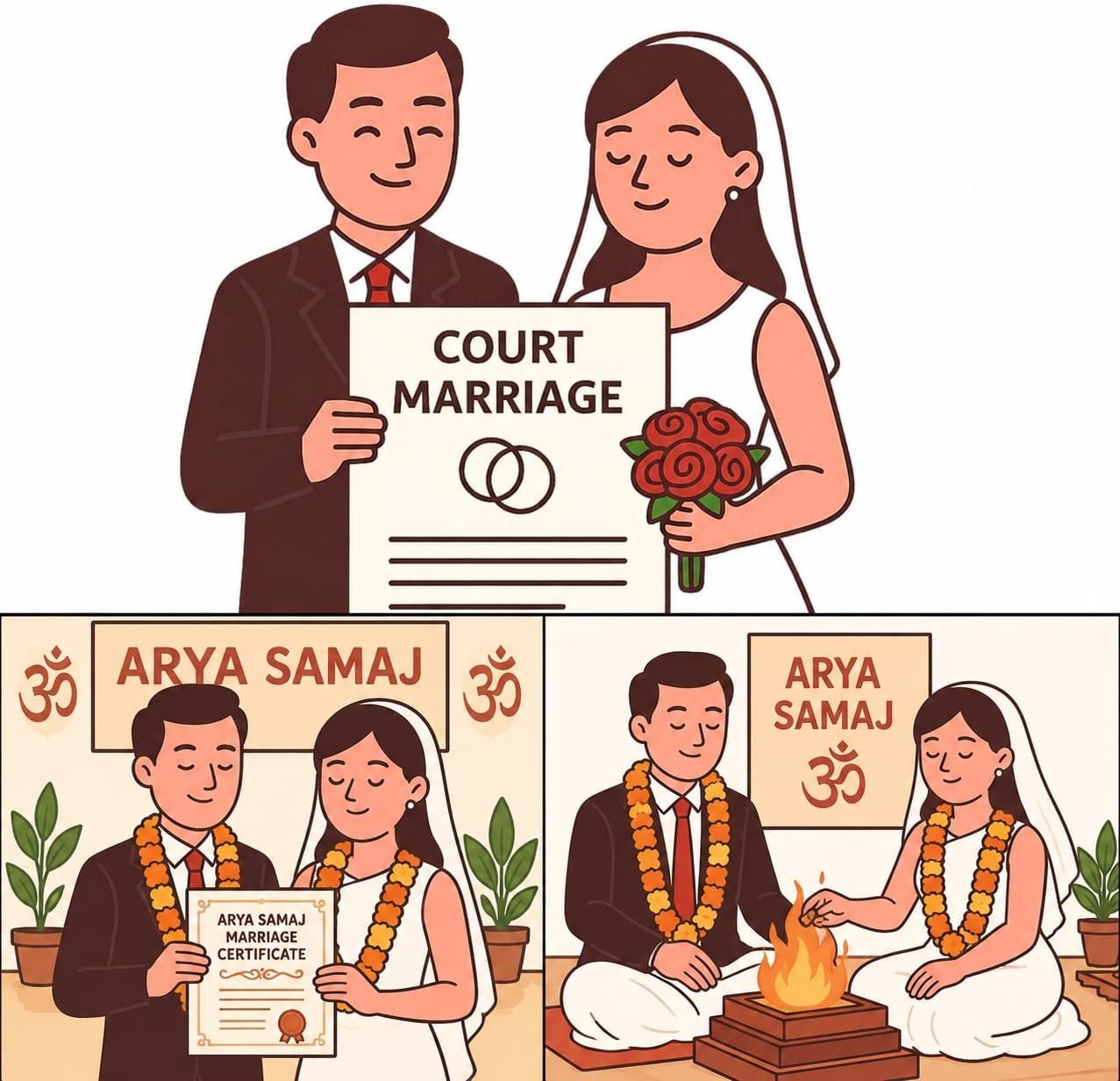
No, and the phrase causes more confusion than any other in this business. An Arya Samaj marriage is a ceremony — Vedic rites, havan, saptapadi — performed at a mandir, and it creates the marriage under Section 7 of the Hindu Marriage Act. A "court marriage", as people use the phrase, means the government registration, which is done by the SDM, who is not a judge and does not sit in a court.
So "Arya Samaj court marriage" is not one thing. It is two things bought together: the ceremony that makes you married, and the registration that lets you prove it. That is exactly what our ₹7,100 package is, and why it exists as a single line on the fees page.
The Revenue Department's list for Hindu Marriage Act registration is unglamorous and specific, and it maps onto an Arya Samaj wedding neatly: an application form signed by both husband and wife; separate affidavits in the prescribed format from each; self-attested proof of age and of residence; passport-size photographs, two each, plus photographs of the ceremony; the marriage invitation card, if available; and, where the marriage was solemnised at a religious place, a priest's certificate.
Read that last one again, because it is what the mandir certificate is for. It is not the document a bank will accept — it is the document that proves to the Registrar that a ceremony took place, so that he can make the entry. The mandir certificate is an input to the registration, not a substitute for it.
Yes, and take more than you think. The department's own list asks for them, and they do a second job years later if the marriage is ever questioned: photographs with the witnesses visible in them are far more useful than two people alone in front of a fire. Keep the invitation card too, even if it was a quiet wedding with eight people — it is on the list, it costs nothing to keep, and it is the sort of thing nobody can reconstruct afterwards.
You can, and you will be validly married the whole time — but the 2014 Order's clock is running. Order 4(a) gives sixty days from the ceremony; beyond that, Order 6 allows condonation of a further sixty days on an additional ₹500, and Order 7 provides a ₹1,000 penalty for non-registration, remittable by the ADM or DM.
None of that makes late registration impossible — we register marriages from the 1990s — and the amounts do not compound. But the practical case for doing it in the same week is not the fee. It is that the witnesses are still findable, the photographs are still on somebody's phone, and both of you remember the date of the ceremony to the day. Every one of those decays.
Completely. Section 7(1) says a Hindu marriage may be solemnised in accordance with the customary rites and ceremonies of either party — either, not both, and not whichever form is locally usual. A Tamil, Telugu, Kannada, Malayali, Bengali, Odia, Marathi or north-eastern ceremony performed by your own priest is a lawful solemnisation in Delhi, and it registers under Section 8 exactly like any other.
Section 7(2) then adds the rule people half-remember: where the rites include the saptapadi, the marriage is complete and binding at the seventh step. That is conditional — it is not a requirement imposed on ceremonies that never had saptapadi.
If that is your situation, the row you want on the fee list is ₹6,000 — registration of a marriage already solemnised, not the combined package. Our Dwarka Sector 6 page goes through this, and through documents in regional scripts, in detail.
For the fact of being married, yes — the ceremony did that, and no piece of paper is doing the work. For anything institutional, no. A bank opening a joint account, a passport office adding a spouse's name, an embassy assessing a visa, an insurer paying a claim, a pension office adding a spouse, a hospital recognising next of kin — all of them are asking for the government certificate, because that is the one they can verify against a register.
And abroad it is absolute: a mandir certificate cannot be apostilled and does not travel. That is why an NRI file has no ₹5,100 option at all.
Three different pockets, and the confusion between them is what lets people be overcharged.
| What it covers | Typical amount | |
|---|---|---|
| The government | The statutory registration fee, and any condonation fee or penalty where there has been delay | Tens and hundreds — ₹100 (HMA, Revenue Department), ₹200 (Order 4(b)), ₹15 (SMA solemnisation), plus ₹500 condonation or ₹1,000 penalty only where applicable |
| Third parties | Notary attestation, e-stamp value, certified translation, MEA apostille (about ₹50 per page government fee), embassy attestation, photography | ₹100–₹200 per affidavit for a notary; the rest only if your file needs it |
| Us | Telling you the honest route before you pay, drafting and checking, the ceremony where that is your route, filing at the correct office, attending, following up, and taking up any baseless demand through our advocate | The published figures on the fees page — the same for everyone |
The only one of those three that a service can inflate without you noticing is the first. Which is why the sentence to memorise is: the government's own charge here is in tens and hundreds, not thousands — ask which rule, and ask for the receipt.
Three ordinary situations, worked through. These are illustrations, not quotations — your file decides.
A Delhi couple, both Hindu, documents in order, marrying this month. Our combined Arya Samaj plus court marriage package at ₹7,100; the statutory registration fee; a notary at ₹100–₹200 per affidavit. No condonation, because they are inside the sixty days. No translation, no apostille. The overwhelming majority of the cost is the service, and the government's part is a rounding error.
A couple registering a mandir marriage from 2011. Registration of an already-solemnised marriage at ₹6,000, or ₹12,000 where the proof has to be rebuilt from scratch; the statutory fee; notary; and the delay machinery — ₹500 condonation or the ₹1,000 penalty as the case may be, which does not grow with the years. What costs more here is not money but effort: finding the register extract, the photographs and the witnesses.
A couple with a spouse visa at the far end. The ₹7,100 package or the NRI tier; the statutory fee; notary; then the authentication chain — state authentication where required, MEA apostille (about ₹50 per page government fee) for a Hague Convention country or MEA attestation plus that country's embassy where it is not; and certified translation where the destination asks for one. Two to six weeks for the chain, more with a translation — which is why this file is planned backwards from the flight, not forwards from the wedding.
The government statutory fee. Notary charges of ₹100–₹200 per affidavit. Any late-registration or condonation amount. MEA apostille and embassy attestation where the certificate goes abroad. Certified translation. And optional extras — photography, video, garlands, decoration, transport.
Every one of those is on the fees page with worked examples, and every one of them should be said to you on the phone, before you travel. Ask for the total on WhatsApp. It takes one minute and it is the cheapest protection available in this whole process.
Not usually by fraud — by omission, and by timing. A figure is quoted on the phone for one component. You arrive, dressed, with your witnesses who took the morning off, and the rest appears: the registration is separate, the affidavits are extra, the photographs are extra, the "office expenses" are extra. At that point walking out costs you the day, the witnesses' goodwill and the family's questions, so almost nobody walks out. The leverage is the moment, not the money.
The defence is entirely mechanical and it happens before you leave home: get the total and the not-included list in writing on WhatsApp. A service that will not put its own price in writing has told you something important for free.
Often, yes — and we will tell you so. A couple with matching documents, a clean Delhi address proof, no earlier marriage and no deadline can file on e-District and attend the appointment without anybody's help. The government's own charge is small and the portal is usable.
What you are buying when you do pay is the file not coming back, and someone to take it up when something has no basis. If none of the difficulties apply to you, keep the money. We would rather say that on a free call than take a booking for typing.
No — none of them, ever. Not for a same-day request, not for an address at the far end of the city, not for an inter-caste or inter-religion couple, not for a couple from outside Delhi, and not for an NRI. The NRI tiers are higher only because they contain real apostille and embassy work, not because of who is asking.
And there are things we will not take money for at any price: witnesses; a shortened statutory notice; a certificate for a ceremony that did not happen; a back-dated document; a guaranteed court or visa outcome; a marriage below the legal age; or a marriage while an earlier one subsists.
Short answers to the things people type into a search box at eleven at night. The long versions of most of these are in the five sections above; the pages linked at the end of this list go further still.
This site is large on purpose — a marriage file has a dozen moving parts and each one deserves proper treatment rather than a paragraph. If you know which part you are stuck on, go straight there.
| You want to know about | Go to |
|---|---|
| The Vedic ceremony, saptapadi, the Arya Marriage Validation Act 1937, ₹5,100 vs ₹7,100 | Arya Samaj Marriage |
| The Special Marriage Act in full — the thirty-day notice, objections, three witnesses, severance and succession | Court Marriage & the Special Marriage Act |
| Registration itself — HMA s.8, the Delhi rule, proving an old marriage, tatkal, duplicate vs correction | Marriage Registration |
| The certificate as an object — duplicate, correction, apostille, fake certificates, what to check the day you get it | Certificate, Duplicate & Correction |
| Family opposition, the judgments, protection petitions, what happens when a family goes to the police | Love Marriage & Protection |
| Caste is not in the Act, gotra has no standing, prohibited degrees and sapinda, the Ambedkar scheme stated honestly | Inter-Caste Marriage |
| Two religions — SMA without conversion vs shuddhi, and the state conversion laws that follow your home state | Inter-Religion Marriage |
| Apostille, embassy attestation, spouse visas, OCI, and why a mandir certificate does not travel | NRI Marriage & Apostille |
| Every document, and the substitute that works when one is missing or two disagree | Documents Required |
| The process end to end, and the twelve places it breaks | The Complete Process |
| Every price, what is not included, and worked total-cost examples | Complete Fee List |
| A marriage from years ago that was never registered — the penalty, who can remit it, and what proof works | Late Marriage Registration Delhi |
| A name, date of birth or marriage date printed wrong on the certificate — what is a correction, what is a duplicate, and what proof the office needs | Marriage Certificate Correction Delhi |
| Getting an appointment date, the four clocks that run at once, who must physically attend, and how to plan backwards from a visa interview or a flight | Marriage Registration Appointment Delhi |
| Who can be a witness, two or three, what a witness is actually signing, what he must bring — and why witnesses are never supplied for a fee | Witnesses for Marriage Registration Delhi |
| SDM registration end to end — which office, the 60-day rule, the appointment, what the government charges | SDM Marriage Registration Delhi |
| An office asking for something with no basis — the escalation ladder and the RTI timelines | Mayur Vihar Phase 2 |
| How to check whether a mandir is genuine before you go, and what "registered" really means | Arya Samaj Mandir Near Me |
| Which state your registration belongs in — Delhi, Uttar Pradesh or Haryana | Venue Guide, Delhi NCR |
| Nikah, nikahnama, mahr, and Muslim marriage registration | Muslim Nikah, Delhi |
| The same material in Hindi | हिंदी गाइड |
Every figure and every clause on this page is from a primary source, and we would rather name them than ask you to take our word for it.
Delhi Revenue Department, marriage-registration page — the ₹100 Hindu Marriage Act fee deposited with the Marriage Clerk, the ₹15 Special Marriage Act solemnisation fee deposited with the cashier of the District, the document lists, the three witnesses under the SMA, the 9.30 a.m. to 1.00 p.m. counter hours, the "normally within 15 days" and "normally within 60 days" service norms, and the instruction that the application goes to the SDM in whose jurisdiction any of the husband or wife resides.
The Delhi (Compulsory Registration of Marriage) Order, 2014 — Order 4(a) sixty days excluding the day of the final ceremony; Order 4(b) the requisite fee of two hundred rupees; Order 4(d) two witnesses who certify to the solemnisation; Order 6 condonation of a further sixty days on an additional five hundred rupees; Order 7 a penalty of one thousand rupees, remittable by the ADM or DM; Order 8 that registration under the Order "will not tantamount to validity of marriage"; and Orders 3 and 5 on concurrent jurisdiction.
The Hindu Marriage Act, 1955 — Section 5 (the five conditions), Section 7 (customary rites of either party; saptapadi), Section 8 (registration), Section 11 (void marriages), Section 12 (voidable marriages).
The Special Marriage Act, 1954 — the notice and its display, Section 4 (conditions and therefore the only valid grounds of objection), and Sections 19, 21 and 21A on severance and succession.
The Arya Marriage Validation Act, 1937.
A note on figures. Government fees and office practice change, and different offices work to their current schedule. Where a figure here differs from what you are told at the counter, the counter is what you pay — and you should get a receipt for it. Nothing on this page is a substitute for advice from an advocate on your own facts, and we are a marriage service, not a law firm.
Then it is probably a question about your file rather than about the law, and those are answered faster on the phone than by any page. Tell us your ages and what your documents say about them, your religions, whether either of you has been married before, where each of you actually lives and what your papers show, whether either of you is across the Uttar Pradesh or Haryana line, and whether anything is going on at home.
Call or WhatsApp +91 8376863962. Hindi or English. The call is free, nobody will push you, and if the honest answer is that you should fix a document first or wait a few months, that is what you will hear.
All-India steps and state differences.
Read →How many, who can be, what to bring.
Read →Section-by-section legal comparison.
Read →Which route is right for you.
Read →Marriage guide.
Read →SMA details.
Read →Confidential.
Read →Required list.
Read →Pricing.
Read →Free consultation.
Read →Expert articles on every marriage topic — read before you decide
Complete 2026 process from notice to certificate.
Read Article →Full checklist — Aadhaar, affidavits, witnesses.
Read Article →Transparent breakdown — official + service costs.
Read Article →Your rights, family pressure, police protection.
Read Article →Apostille, Embassy NOC, spouse visa explained.
Read Article →Honest truth about Arya Samaj same-day option.
Read Article →