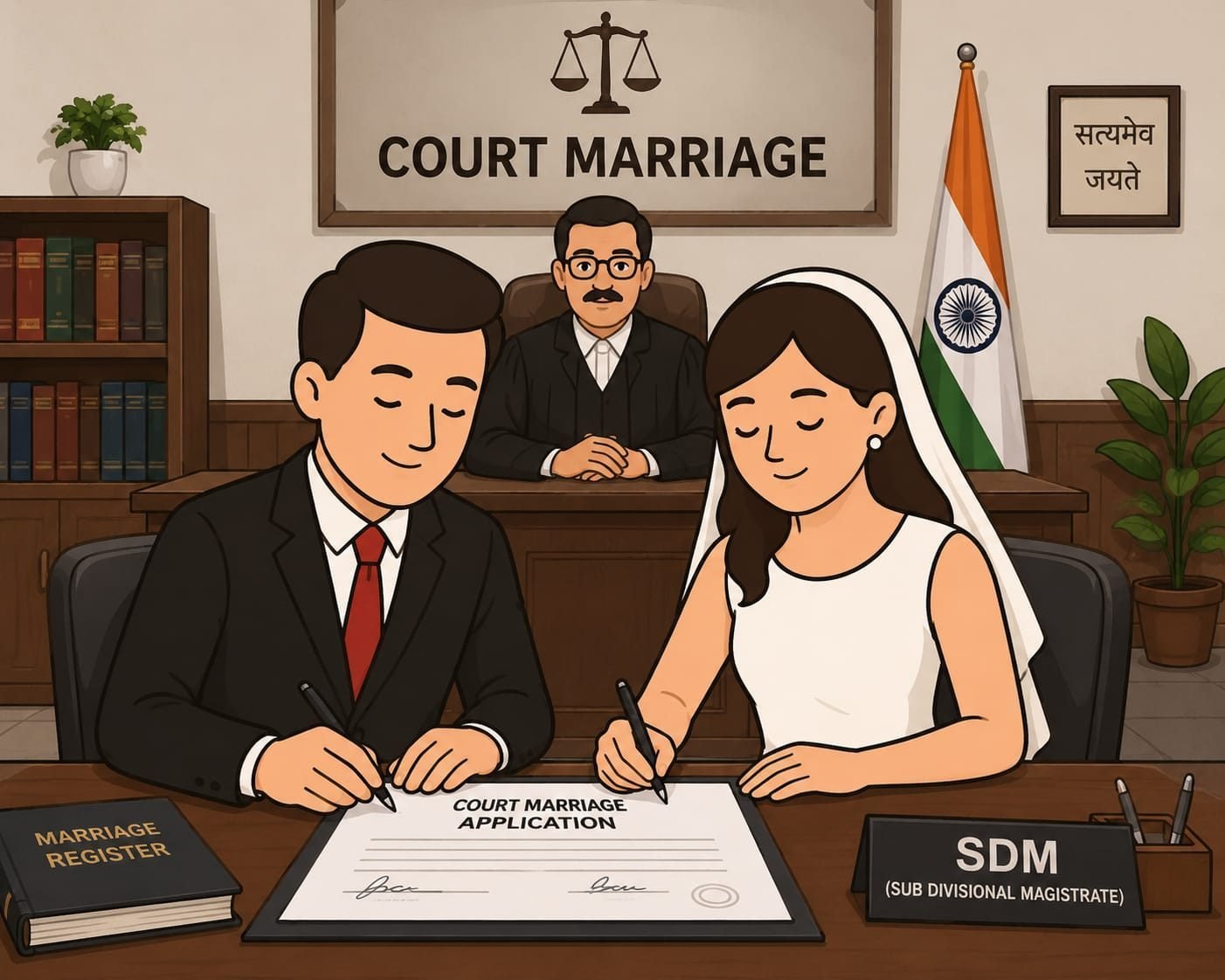
Quick answer: Saket is where South Delhi's salaried city lives — the blocks behind Select Citywalk, Pushp Vihar, Malviya Nagar, Khirki, Said-ul-Ajaib and Sheikh Sarai — and the couples who come to us from here are usually two working people in their late twenties or thirties, both employed, both with their own bank accounts, PF numbers and passports. Under Delhi's 2026 revenue map Saket falls in the South district (sub-divisions Chhatarpur, Malviya Nagar, Deoli and Mehrauli); the e-District portal allots the office by address and your slip names it. Two Hindus, Sikhs, Jains or Buddhists can have an Arya Samaj wedding and register it under the Hindu Marriage Act; couples who keep different faiths use the Special Marriage Act; a nikah is registered under the Delhi 2014 Order. What this guide does that no other one does is answer the second half of the question — do I have to change my surname (no), how would I if I wanted to, and what has to be updated at work, at the bank, on the lease and on the passport once the certificate is in hand. Court marriage: ₹6,100.
Key takeaways
- Saket is in the South district under the 2026 map (sub-divisions Chhatarpur, Malviya Nagar, Deoli, Mehrauli); e-District allots your office by address — read the slip.
- No law in India requires a woman to change her surname on marriage. It is a choice, and a half-done change is worse than either option.
- If you do change it: affidavit → newspaper notices → Gazette notification, and only then Aadhaar → PAN → bank → employer → passport. Your degree will keep the old name for ever.
- The only real deadline is your employer’s group-insurance window after marriage — commonly 30 days. Everything else can wait a month.
- EPF and gratuity nominations made before marriage lapse when you marry; file fresh ones. There is no joint income tax return in India.
- A marriage is not registered at Saket District Court. The Special Marriage Act 30-day notice cannot be shortened. We never provide witnesses.
Last reviewed: 23 September 2026 · 39 min read
On this page
- Saket at a glance
- Saket under the 2026 map
- Which office registers your marriage
- What Saket District Court does not do
- The legal routes
- Arya Samaj + registration
- Special Marriage Act
- Registering a wedding already held
- Do you have to change your surname?
- Keeping your own name, without friction
- If you do want to change it: the real sequence
- Degrees, licences and the name you cannot change
- Passport: spouse name and re-issue
- The update order that saves you three months
- Your employer: the 30-day window
- Nominations that lapse the day you marry
- Tax: there is no joint return in India
- Joint accounts, cards and loans
- Adding a spouse to a rented flat
- Police tenant verification
- When the two of you live in different cities
- Dependent visas and a transfer abroad
- Why the certificate matters in a hospital
- Marrying quietly in South Delhi
- If your families oppose
- Age
- Witnesses
- Documents checklist
- At the appointment
- What it costs
- Timeline
- Getting there
- Common mistakes
- Six Saket situations
- Checklist
- One-minute summary
- How we help
- Questions and answers
Saket at a Glance
Saket is a particular kind of Delhi neighbourhood: DDA blocks and builder floors rented by people who did not grow up in them, three malls, a cluster of hospitals, a big court complex, and a working population that commutes on the Yellow and Magenta lines to Gurgaon, Nehru Place, Aerocity and Noida. Malviya Nagar, Khirki Extension, Said-ul-Ajaib, Sheikh Sarai, Pushp Vihar and Hauz Rani sit around it, and a large share of the flats in all of them are rented.
The couples who come to us from here have a very recognisable profile. Both are working. Both are past the age where anybody is telling them what to do. The wedding itself is usually small — sometimes just the registration — and the questions they actually have are almost never about the ceremony. They are about what happens to their names, their records and their paperwork afterwards: at work, at the bank, on the lease, on the passport, and at the airport when two people with different surnames travel together.
That is the gap this guide fills. The registration part is the easy half and we cover it properly. The second half — the part every couple discovers three weeks later, usually at the worst moment — is where most of this page goes.
| Question | Short answer |
|---|---|
| Which district is Saket in? | South district, whose sub-divisions from 1 January 2026 are Chhatarpur, Malviya Nagar, Deoli and Mehrauli. The e-District portal allots the office by your address — read the slip. |
| Does the wife have to change her surname? | No. No law in India requires it. It is a choice, and either choice is completely normal. See the surname section. |
| Is marriage registered at Saket District Court? | No. Registration happens at the SDM / Registrar of Marriages. See what the court does not do. |
| Can we file a joint income tax return? | No — India has no joint return. Each spouse files separately, always. See tax. |
| Do you provide witnesses? | No. Never. Your own people, with their own original ID. See witnesses. |
| What does it cost? | Court marriage ₹6,100; marriage registration ₹6,000; Arya Samaj with registration ₹7,100; Special Marriage Act ₹15,000; duplicates and corrections ₹2,500. Government charges separate and itemised. |
Saket Under the 2026 Revenue Map
From 1 January 2026, Delhi's revenue administration was reorganised into 13 districts and 39 sub-divisions. The South district now has four sub-divisions: Chhatarpur, Malviya Nagar, Deoli and Mehrauli.
Saket itself is not the name of a sub-division. Addresses in and around Saket are allotted to the sub-division that covers them, and for most Saket addresses that is Malviya Nagar — but the boundary runs through this part of the city in ways that are not obvious from a map, and Said-ul-Ajaib, Khirki and the Chhatarpur side can go differently.
Nothing about your rights changed on 1 January. Certificates issued before 2026 are completely valid and nothing needs re-registering. Only the allocation of offices changed, and guides still naming the old "South East" or pre-2026 arrangement for this area are out of date.
Which Office Registers Your Marriage?
- The SDM / Registrar of Marriages registers a marriage under the Hindu Marriage Act, 1955 or the Delhi (Compulsory Registration of Marriage) Order, 2014. This is the office that issues the certificate almost everyone actually needs.
- The Marriage Officer handles the Special Marriage Act, 1954 — notice, thirty-day display, objections, solemnisation and certificate.
- The Arya Samaj mandir performs the wedding ceremony and issues its own certificate, which records the ceremony. It is not a government marriage certificate and no bank, passport office or embassy treats it as one.
Jurisdiction follows where you reside. For a Saket couple that is usually straightforward, because the rented flat has a lease and the Aadhaar has been updated — but if one of you has only recently moved to Delhi for a job, read the lease section before you apply, because a lease in a flatmate's name is not address proof for you.
What Saket District Court Does — and Does Not Do
People say "court marriage" and then drive to the Saket District Court complex. It is worth being clear about this, because it wastes a lot of people's time.
A court does not perform or register marriages. A marriage is registered by the SDM or the Registrar of Marriages, and a Special Marriage Act marriage is solemnised before the Marriage Officer. The phrase "court marriage" is everyday shorthand for a civil registration, not a description of the building it happens in. Our Preet Vihar guide takes that misunderstanding apart in detail.
What the Saket court complex does handle is the matrimonial side that comes later or before — divorce, maintenance, custody, protection under the Domestic Violence Act, and so on, through the family courts. Those are advocate matters. We are not a law firm and we do not appear anywhere; where a matter needs an advocate, it goes to an independent advocate in their own name.
The one practical overlap: if either of you has a previous marriage, what you need for registration is the certified copy of the final decree, not a pending case number. A hearing date is not a decree, and an office will not treat it as one.
The Legal Routes for a Saket Couple
| Your situation | Route | Time | Our fee |
|---|---|---|---|
| Both Hindu, Sikh, Jain or Buddhist; want a ceremony and the certificate quickly | Arya Samaj ceremony, then registration under the Hindu Marriage Act, 1955 | Ceremony same day; registration usually same or next day | ₹7,100 |
| Already married by ceremony; you only need the certificate | Registration under the Hindu Marriage Act or the Delhi 2014 Order | Usually one appointment | ₹6,000 |
| Straightforward civil registration with full documentation support | Court marriage assistance | Depends on the route chosen | ₹6,100 |
| Different faiths and neither will convert; or you simply want a civil marriage | Special Marriage Act, 1954 | 30 days' notice minimum | ₹15,000 |
| Muslim couple, nikah performed or to be performed | Nikah, then registration under the Delhi 2014 Order | Usually one appointment after the nikah | ₹6,000 |
For a working couple the real choice is usually between two of these: the Arya Samaj route if you both qualify and want it done inside a week, or the Special Marriage Act if you are of different faiths, or if a civil marriage is simply what you want. Both produce the same government certificate at the end.
Arya Samaj Wedding Plus Registration
An Arya Samaj wedding is a Vedic ceremony performed by a pandit — havan, vows, pheras. The Arya Marriage Validation Act, 1937 recognises the validity of a marriage solemnised in that form between persons professing the Arya Samaj faith, and the ceremony is available to Hindus, Sikhs, Jains and Buddhists. The mandir issues its certificate the same day.
That certificate proves the ceremony. The document your employer's HR, your bank, the passport office and any embassy will ask for is the one issued after registration under the Hindu Marriage Act, 1955 at the SDM office, which is a separate application with its own forms, fee and appointment.
For two people with jobs, the practical shape of it is: documents checked over a few days without taking leave, ceremony on a morning you have blocked out, registration appointment soon after. One day off each, not four.
The Special Marriage Act, Step by Step
The Special Marriage Act, 1954 is a civil marriage. Nobody converts, nobody performs a religious ceremony, and the marriage is valid regardless of what either family believes. It is the correct route for a couple of different faiths who intend to keep them, and it is equally open to a same-faith couple who simply want a civil marriage — a choice a growing number of Saket couples make deliberately.
- Residence. At least one of you must have resided in the district for at least 30 days before the notice is given.
- Notice in writing to the Marriage Officer of the district.
- Public display for 30 days. A requirement of the Act. Nobody can lawfully shorten or hide it — not for a fee, not for an urgency, not through any contact.
- Objections may be filed within those thirty days, but only on a ground the Act recognises: a party under age, a living spouse, a prohibited degree of relationship. Family disapproval is not a legal objection.
- Solemnisation before the Marriage Officer with three witnesses.
- Certificate issued and signed.
Budget about sixty days end to end. One point that matters specifically for working couples: the thirty-day clock starts when the notice is actually given, not when you decide, and the notice will not be accepted until the documents are right. If you are planning leave around this, plan it around the solemnisation date, not the date you started thinking about it.
A second point worth knowing before you choose this route: the Special Marriage Act brings its own succession consequences, which are set out in the Act itself. If that matters to your family's property arrangements, ask an advocate before you file — not after. Our SMA versus HMA guide compares the two.
Registering a Wedding Already Held
Very common here: a wedding in another city two years ago, both partners moved to Delhi for work, and now something needs the certificate. That is straightforward.
What helps: the wedding invitation card, ceremony photographs, a certificate from the mandir, pandit or qazi where one can be obtained, age and identity proof for both, current address proof, affidavits from both spouses stating the date and place of the marriage, and two witnesses who actually know you as a married couple.
You do not have to register in the city where the wedding happened. Registration follows residence, so a couple married in Bhopal or Coimbatore and now living in Saket can register in Delhi. Under the Delhi 2014 Order late registration attracts ₹500 for the second sixty days and a ₹1,000 penalty after that, with registration still possible. Our fee for this is ₹6,000.
Do You Have to Change Your Surname?
We say this at the start because of what actually happens in the room. A couple comes in, the registration is done, and somebody's aunt then explains that "the papers will not work" unless the surname is changed. That is not true, and the confusion costs women months of unnecessary running about between offices.
Three separate things get muddled together, so let us separate them:
| What people say | What is actually true |
|---|---|
| "You have to change your surname after marriage." | No. It is entirely optional, for a woman or a man. |
| "Your documents won't match if you don't." | They will match perfectly, because you have not changed anything. Mismatches are caused by partial changes — a new name on some documents and the old one on others. |
| "Adding your husband's name to your passport is compulsory." | No. It is optional. Many married people never do it. |
| "The marriage certificate will have your new name." | No. The certificate records the names as they stand at the time of the marriage, from your identity documents. |
The one thing that genuinely causes trouble is a half-done change: a new surname on the bank account and the old one on the PAN, or a new name on Aadhaar and the old one on the degree certificate, with nothing linking them. That is the state to avoid — and the way to avoid it is to decide once, either way, and then be consistent.
Keeping Your Own Name, Without Friction
If you keep your maiden name, nothing needs to change on any of your documents. What people occasionally run into is a human being — at an airline counter, a hospital reception, a school admission desk, a hotel — who is surprised that two people travelling or living together have different surnames.
The fix is trivial, and it is the same fix in every case: carry a copy of the marriage certificate, digitally at minimum.
- Keep a clear photograph of the certificate on both your phones, and a PDF in each of your emails. This single step resolves ninety per cent of these situations in under a minute.
- Digital storage. A marriage certificate issued through Delhi's e-District system can usually be kept in DigiLocker, which is accepted as a valid document holder. Set it up once.
- Two or three attested hard copies, kept in different places — not all in the same file in the same flat.
- Hospitals and schools: where a form asks for the relationship, the certificate is the answer. See why the certificate matters in a hospital.
- Travelling together: different surnames on two tickets is completely ordinary and is not questioned by airlines. Immigration in some countries may ask about the relationship on a dependent or spouse visa, which is precisely what the certificate is for.
A note for men, because it is asked less often but does arise: a husband may also take his wife's surname, or the couple may both adopt a hyphenated or combined surname. The procedure is exactly the same as below. The law does not care which of you changes a name.
If You Do Want to Change It: the Real Sequence
A name change in India is not done by telling people. It is done by creating a public record of the change and then carrying that record to every institution. There are three steps to create the record, and then the updates.
- Affidavit. A sworn affidavit on stamp paper, stating your old name, your new name, the reason (marriage), and that both refer to one person. Notarised.
- Newspaper advertisement. A short notice published in two newspapers — conventionally one English and one in the regional language. Keep the original pages, not just a photo.
- Gazette of India notification. The change is published in the Gazette through the Department of Publication. This is the document that institutions treat as conclusive, and it is the one worth having even though the first two steps alone will satisfy some offices.
Then the updates, in the order given in the next section. Do not start updating institutions before the Gazette notification exists, or you will create exactly the half-changed state described above.
Fees and current procedure for the Gazette are published by the Department of Publication; the affidavit and advertisement are done locally. We do not do name-change work ourselves and we do not charge for advice about it — but we do tell every couple this sequence, because getting it wrong is expensive in time and nobody warns them.
Degrees, Licences and the Name You Cannot Change
This is the part that surprises professionals, and it is worth knowing before you start.
A university will generally not reissue a degree certificate in a new name. Your degree, your marksheets, your professional qualification, your medical or bar registration, your CA membership, your school certificates — most of these were issued in the name you held at the time, and most issuing bodies will not change them. Some will add an endorsement; many will not do even that.
This is normal and it is not a problem, provided you handle it the right way:
- Keep the Gazette notification permanently. It is the bridge between the name on your degree and the name on your Aadhaar, and you will produce it for the rest of your working life — at every new employer, every background check, every visa application.
- Keep the affidavit and the newspaper cuttings with it, in the same folder and in the same email.
- Tell a new employer at the start, at the background-verification stage, rather than letting a checking agency raise it as a discrepancy. It is a one-line explanation with one attachment; left unexplained it becomes a flag.
- Do not get a degree "corrected" by anybody who offers to. An altered certificate is far worse than a genuine one in an old name.
Some people decide, on seeing this list, that keeping their name is simply less work. That is a perfectly good reason, and it is worth knowing before you begin rather than halfway through.
Passport: Spouse Name, and What Actually Requires a Re-Issue
Two different things are routinely confused here, and they have different consequences.
| What you want | What it involves |
|---|---|
| Add your spouse's name to your passport, keeping your own name unchanged | Optional. Done through a re-issue application with the marriage certificate. Your passport number changes; the old passport is cancelled and returned. |
| Change your own name on the passport after marriage | Also a re-issue, with the marriage certificate and, where the change is a full name change rather than a straightforward post-marriage surname change, the supporting record from the sequence above. |
| Neither — keep everything as it is | Nothing to do. Your passport stays valid exactly as issued. |
Four practical warnings, learned from couples who called us in a panic:
- A re-issue changes your passport number. If you hold a valid visa in the old passport, check that country's rules on transferring or carrying it before you apply, and do not do it three weeks before you travel.
- Plan it around your travel, not your wedding. Appointment availability at the Delhi RPO and the Passport Seva Kendras varies, and the police verification step takes its own time.
- The name on your ticket must match the passport you travel on. This catches people who change the passport but book on the old name, or the reverse.
- Requirements change. Check the current document list on passportindia.gov.in before you assemble anything — not on a forum, and not from a page written two years ago, including this one.
If the reason you are doing any of this is an onward spouse visa, read our apostille and visa guide first. The order in which you do the passport, the apostille and the visa application matters more than people expect.
The Update Order That Saves You Three Months
Whether or not you change a name, a set of records has to be updated after marriage. Couples usually do them in a random order, hit a wall, and start again. There is a correct order, because each institution wants proof from the one above it.
| # | Do this | Why it comes here |
|---|---|---|
| 1 | Marriage certificate in hand, with two or three attested copies and a digital copy on both phones | Everything below asks for it |
| 2 | Gazette notification — only if you are changing a name | Institutions below will ask for it, and some will not accept the certificate alone |
| 3 | Aadhaar — name and, if you have moved in together, address | Aadhaar is the document nearly every other update is checked against |
| 4 | PAN — correction application | Banks and your employer reconcile PAN against Aadhaar |
| 5 | Bank KYC — name, address, and the nomination | Needs the updated Aadhaar and PAN to go through cleanly |
| 6 | Employer / HR — records, insurance, EPF, gratuity and other nominations | Most employers have a 30-day window from the event — see below |
| 7 | Passport re-issue, if you want one | Needs the certificate and, for a name change, the Gazette; changes your passport number |
| 8 | Insurance, investments, demat, credit cards, driving licence, voter ID, lease | All are easier once Aadhaar and PAN already agree |
Your Employer: the 30-Day Window
Tell HR in the first week. Not because they need to know your business, but because several things are time-bound and a few of them are worth real money.
- Group health insurance. Adding a spouse is normally allowed within a defined window after marriage — often thirty days — and otherwise only at the next annual renewal. This is the single most expensive thing to forget, because a gap in cover is a gap you only notice in an emergency. Ask HR for the exact window in writing.
- EPF nomination (Form 2). A nomination made before marriage in favour of a parent or sibling becomes invalid on marriage under the scheme's rules, and a fresh nomination in favour of family has to be filed. This is not optional housekeeping; it decides who receives the money without a fight.
- Gratuity nomination (Form F). The same logic applies. File a fresh one.
- EPS / pension family particulars. Update so your spouse is on record.
- ESOP or RSU nominee. Startups and MNCs around Saket, Nehru Place and Gurgaon hand out equity freely and almost nobody updates the nominee. Check your plan's nomination and beneficiary provisions.
- Emergency contact and next of kin. A five-second change that matters enormously on the one day it is used.
- Name and bank details in payroll, if you have changed either. Salary going to an account whose KYC name no longer matches is a predictable month-end problem.
- Background verification. If you changed your name, keep the Gazette handy for your next employer's checks.
If you work in a firm covered by ESIC rather than group insurance, the family particulars have to be updated there instead, or your spouse cannot get treatment on your card. Our Narela guide deals with ESIC and EPF in more depth.
The Nominations That Lapse the Day You Marry
Separately from your employer, go through every place your money sits. Make one list, once, and clear it in an evening.
- Bank accounts, fixed deposits, recurring deposits — each has a nomination field.
- Mutual funds and demat account — nomination or opt-out is required by the regulator; check that yours is current rather than assuming it is.
- Life insurance, term cover, ULIPs — an old nomination in a parent's favour is a frequent source of family conflict after a death.
- PPF, NPS, post office schemes, Sukanya accounts.
- Health insurance you bought yourself, as distinct from the employer's cover.
- Loan protection or credit-card insurance, if you hold any.
- Locker and safe deposit nominations.
Tax: There Is No Joint Return in India
This comes up in almost every conversation with a salaried couple, usually because somebody has watched an American film.
India has no joint income tax return. Each spouse files their own return, on their own PAN, on their own income, before and after marriage alike. Marriage does not merge your incomes, does not create a joint filing status, and does not by itself change either person's tax slab.
Three things that are true and are worth knowing:
- Clubbing of income. Where one spouse transfers money or an asset to the other without adequate consideration and the recipient earns income from it, that income is generally clubbed back into the transferor's hands under the clubbing provisions of the Income-tax Act. In plain terms: you cannot move an investment into your spouse's name purely to shift the tax. This catches well-meaning couples constantly.
- A gift between spouses is not itself taxable as income in the recipient's hands — but see the clubbing point above for what happens to the income it then earns.
- Two people can claim separately on a jointly owned property and a joint loan, each to the extent of their own share and their own repayment — which is the genuine reason many couples buy jointly. The detail depends on ownership share, who actually pays, and the current provisions.
This is general information and not tax advice. We are a documentation service, not accountants. Before you restructure anything, ask a chartered accountant about your own numbers — it is one consultation and it is cheaper than a notice.
Joint Accounts, Cards and Loans
Four myths and what is actually the case:
| Common belief | Reality |
|---|---|
| "We have to open a joint account now." | You do not have to do anything. A joint account is a convenience, opened when you want one. A marriage certificate is usually not even required — the bank's ordinary KYC is. |
| "My spouse's loan is now my liability." | No. You are liable for a loan only if you signed it — as borrower, co-borrower or guarantor. Marriage alone does not make you liable for your spouse's debts. |
| "A joint home loan means we each get the full deduction." | Each co-owner may claim to the extent of their own share and their own repayment. It is not doubled for free, and the arrangement has to be real. |
| "An add-on credit card builds my spouse's credit score." | An add-on card is on the primary holder's account. Building an independent credit history generally needs a card or loan in that person's own name. |
What is genuinely worth doing: update the nomination on every account, update KYC if a name or address has changed, and — if you are planning to buy — have the conversation about whose name the property will be in before the booking, not at registration. Names on a sale deed are hard to change afterwards and the stamp duty consequences of trying are unpleasant.
One more, specific to this part of Delhi: several banks want a registered rent agreement rather than an eleven-month notarised one for address updates. If you are about to renew a lease anyway, ask for a registered one — it makes the next three years of paperwork easier.
Adding a Spouse to a Rented Flat
Most Saket couples live in a rented builder floor or DDA flat, and one of you is moving into the other's place. A few things are worth getting right, because a lease is the address proof everything else leans on.
- Marriage does not add your spouse to the lease. A tenancy is a contract with the landlord. Your spouse becomes a tenant only when the agreement says so.
- Tell the landlord and get it in writing. Either a fresh agreement in both names at the next renewal, or a short addendum signed by all three of you. A landlord who agrees verbally and denies it later leaves the non-named spouse with no standing at all.
- A lease in your flatmate's name is not address proof for you. This catches people who have lived in Delhi for years. If you need address proof and the lease is not in your name, get on the next agreement, and in the meantime use an Aadhaar update, a bank statement or a utility connection.
- Prefer a registered agreement to an eleven-month notarised one where the landlord will agree. It is stronger evidence, several banks insist on it, and it costs less than the argument it prevents.
- Keep the rent receipts and pay by bank transfer. If you claim HRA, your employer will want the receipts and, above the threshold, the landlord's PAN — ask for it at signing, not in January when payroll asks.
- Society or RWA formalities. Some buildings want an intimation or an NOC when the occupants change. It is usually a formality; it becomes a problem only when nobody told them.
Police Tenant Verification
Delhi Police runs an online tenant verification facility, and landlords in this part of the city routinely ask for it. When a spouse moves in, the occupant details change, so the verification should be refreshed.
It is the landlord's process to initiate, and it is in your interest too: a verified tenancy is one more independent record that you live where you say you live — which is exactly what an SDM office, a bank and a passport police verification each want to establish, separately, over the next few months. Ask your landlord to update it when your spouse moves in, and keep the acknowledgement.
Do not pay a person on the street to "get verification done". It is an ordinary process and there is nothing to expedite.
When the Two of You Live in Different Cities
A very Saket situation: one partner in Delhi, the other posted to Bengaluru, Pune, Hyderabad or Dubai, with a wedding to arrange between two calendars.
What actually works:
- Decide the route first, then book flights. The Arya Samaj plus registration route can be done inside a short trip. The Special Marriage Act cannot — it needs the notice, thirty days, and then a second appearance for solemnisation, so it needs two trips for the partner who is away.
- The thirty-day residence is satisfied by the partner who lives here. The one who is away does not need to relocate for a month.
- Documents travel ahead of people. Send scans early, get everything checked, and let the visiting partner carry only originals.
- Do not book a non-refundable ticket around an appointment slot that has not been confirmed. Slots move.
- If one partner is abroad, factor in the passport, any leave approval, and the fact that some documents may need attestation. Read the NRI marriage guide before booking anything.
Dependent Visas and a Transfer Abroad
A large share of the couples who register with us in this part of Delhi are doing it because one of them has an offer, a transfer or an admission abroad. If that is you, the sequence matters and doing it out of order costs weeks.
- Register the marriage and get the certificate. Nothing downstream works without it.
- Check what the destination country actually requires — an apostille, or embassy attestation, or a certified translation, or all three. This differs by country and changes.
- Apostille or attestation of the certificate, through the prescribed process, before you submit anything.
- Passport re-issue, if you have decided on a spouse-name or name change — and note that this changes your passport number, so do it before the visa application rather than after.
- Then the visa application.
Two practical notes. India joined the Apostille Convention long ago, and several major destinations have joined more recently — Canada in 2024, Saudi Arabia in 2022 — which changes the route for those countries; the UAE still runs on embassy attestation. And a spouse visa officer is generally looking for a genuine relationship, so keep the ordinary evidence of your life together: the lease in both names, joint photographs, tickets, the shared bank account if you have one. The full route is in our apostille and visa guide.
We do not provide immigration or visa services and nothing here is advice on immigration consequences — that is a matter for a qualified adviser or the destination country's own guidance.
Why the Certificate Matters in a Hospital
Saket has a cluster of large hospitals, and this is the situation nobody plans for.
When a person is admitted unconscious or for a procedure requiring consent, the hospital looks for next of kin. A spouse is the obvious person — but a hospital administrator faced with two different surnames and no document is not being obstructive when they hesitate; they are protecting themselves. A registered marriage, and a copy of the certificate on your phone, settles it in seconds.
The same is true of an insurance claim on a spouse's policy, a body handover, a police formality after an accident, and a bank locker. None of these are pleasant to think about, and all of them are far worse to sort out at two in the morning without a document.
This, more than any romantic or bureaucratic reason, is why we tell couples who have had a ceremony but never registered to go and register. The ceremony is what you remember. The certificate is what the world acts on.
Marrying Quietly in South Delhi
Plenty of couples here marry without a large wedding — sometimes because both of them prefer it, sometimes because one family is not on board yet, sometimes because they simply do not want to spend fifteen lakh rupees on a hall.
What is genuinely private and what is not:
- Registration under the Hindu Marriage Act after an Arya Samaj ceremony does not involve any public notice.
- A nikah registered under the Delhi 2014 Order does not either.
- The Special Marriage Act does — thirty days of public display, which cannot be shortened or hidden by anybody. If that is a problem, the first question is whether another route is lawfully open to you; very often it is.
- The register itself is a public record once the marriage is registered. That is inherent to registration and no service can change it.
- What we control, we keep confidential. We do not call families, we do not confirm to any caller that you are our client, and we do not discuss one couple with another. Tell us at the start if there is a number or a name to be careful about and it goes on your file. Our Privacy Policy sets it out in full.
If Your Families Oppose
Being thirty and financially independent does not make family opposition easy, and in South Delhi it often takes a quieter form than elsewhere — not threats, but pressure, emotional ultimatums, a relative turning up at an office, or an objection filed to run the clock down.
- Two consenting adults may marry. The Supreme Court has said so repeatedly. Under the Special Marriage Act, disapproval is not a ground of objection at all.
- An objection must be on a legal ground — a party under age, a living spouse, a prohibited degree. The Marriage Officer inquires into it. A false objection delays; it does not defeat.
- Protection is available if you fear for your safety: a petition to the High Court, and the police have a duty to act. The women's helpline is 181 and the emergency number is 112.
- Keep evidence. Save messages, note dates, and keep copies of your documents outside the flat — with a friend, or in your own email.
- Do not let anybody hold your originals. Not a relative, not a "family friend" who offers to keep them safe.
Read our Kanjhawala guide for a full safety plan; it is written for a different setting but the steps are the same.
Age
Under the Prohibition of Child Marriage Act, 2006 the minimum age is 21 for the groom and 18 for the bride. We do not arrange, document or register a marriage below that, in any circumstances, for any family, at any price, and we do not proceed where a document appears to have been altered. This rarely arises with couples from this area, and the rule is absolute regardless.
Witnesses
A witness must be an adult who genuinely knows you, carries original photo identity and address proof, and is physically present. An Arya Samaj ceremony needs two. Registration at the SDM office needs witnesses at the appointment. The Special Marriage Act needs three at solemnisation.
For a working couple this is usually a colleague, a flatmate, a cousin or a close friend — and the practical advice is simply to ask early and confirm the night before. A witness who arrives without an original ID, or who realises at 9 a.m. that they have a stand-up at 10, sends everybody home. Our witness guide has the detail.
A borrowed or paid witness is a false statement to a public authority. It exposes you and the witness, and it leaves the record open to challenge years later — typically during a visa or a claim, which for this group is exactly when it hurts most.
Documents Checklist
| Document | Who | Notes |
|---|---|---|
| Age proof — birth certificate, matriculation certificate, passport, or Aadhaar/PAN showing date of birth | Both | Passport is usually the cleanest for this group |
| Identity proof — Aadhaar, passport, voter ID, driving licence | Both | Originals at the appointment |
| Address proof of current residence — Aadhaar, lease, utility connection, bank statement | Both | A lease in a flatmate's name is not proof for you; see the lease section |
| Passport-size photographs | Both | Recent; carry spares |
| Ceremony proof — mandir certificate, nikahnama, photographs, wedding card | — | Where the marriage has already been solemnised |
| Certified copy of the final divorce decree, or death certificate of a former spouse | Where applicable | A pending case is not a decree |
| Affidavits in the prescribed form | Both | Correct stamp paper, properly notarised |
| Two witnesses with original ID (three for the Special Marriage Act) | — | Your own people |
Carry originals plus one clear photocopy set, and photograph every document on your own phone before handing anything across a counter.
At the Appointment
- Both parties in person. Witnesses with original ID. No exceptions, no proxies.
- Reach early. Take the morning off properly rather than trying to slot it between calls — a half-attended appointment is how documents get missed.
- Answer what is asked, simply. There is no advantage in volunteering extra material.
- Check the certificate before you leave the counter — both names and their exact spellings, both fathers' names, the date of marriage, the place, both dates of birth. A correction made on the spot takes a minute; the same correction two years later takes weeks, a fresh application and, if you have meanwhile updated eight other records from the wrong version, considerably more.
- Photograph the certificate, email it to yourself and your spouse, and add it to DigiLocker if it is available for your certificate.
What It Costs
| Service | Our fee |
|---|---|
| Court marriage assistance | ₹6,100 |
| Marriage registration | ₹6,000 |
| Arya Samaj marriage with registration | ₹7,100 |
| Nikah registration | ₹6,000 |
| Special Marriage Act (full process, 30-day notice) | ₹15,000 |
| Duplicate certificate or correction | ₹2,500 |
Government and other pass-through charges — registration and notice fees, stamp paper, notary, photographs, courier — are separate, are paid at the rate the office charges on the day, and appear separately on your receipt. We confirm one written figure before we begin and we do not add to it afterwards. The full position is in our Terms & Conditions and Refund & Cancellation Policy.
Name change, Gazette notification, passport re-issue and the record updates in this guide are your own to do and are not part of our fee. We explain the sequence at no charge because getting it wrong is the expensive part.
Timeline
| Step | Realistic time |
|---|---|
| Arya Samaj ceremony and mandir certificate | Same day |
| Registration under the Hindu Marriage Act | Often same or next day; depends on office and slot |
| Registering a wedding held earlier | Usually one appointment once evidence is assembled |
| Special Marriage Act | About 60 days, of which 30 are the statutory notice |
| Gazette name-change notification | Allow several weeks after the affidavit and advertisements |
| Aadhaar and PAN updates | Two to four weeks, done in that order |
| Passport re-issue | Depends on appointment availability and police verification — never plan it against near-term travel |
Getting There
Saket and Malviya Nagar are both on the Yellow Line, and the Magenta Line adds Hauz Khas and the IIT side; between them almost everything in this guide is reachable without a car. Morning peak into and out of the Press Enclave Road and Sheikh Sarai stretch is genuinely bad, so leave earlier than the map suggests.
Parking around the courts and the malls is the usual South Delhi problem. If you are bringing witnesses who are taking leave from work, put them on the Metro and meet at the station — it removes the single most common reason people arrive late.
Common Mistakes
- Assuming a surname change is compulsory. It is not, and half-doing one is worse than not doing it.
- Updating institutions before the Gazette notification exists, creating a mismatch that then has to be unpicked.
- Missing the employer's 30-day insurance window. The only genuine deadline on the whole list.
- Forgetting the EPF and gratuity nominations, which lapse on marriage.
- Applying for a passport re-issue three weeks before international travel, without checking what a new passport number does to a live visa.
- Assuming a joint tax return exists. It does not.
- Moving an investment into a spouse's name to save tax, without knowing about clubbing.
- Treating the Arya Samaj mandir certificate as the government certificate.
- Using a lease in a flatmate's name as your address proof.
- Planning a Special Marriage Act wedding around one short trip when it needs two.
- Leaving the counter without reading the certificate.
- Treating a pending divorce case as a decree.
Six Saket Situations
1. The consultant who nearly missed the window. Married on a Saturday, back on a client site on Monday, HR told on the following month's payroll form. The group insurance window had closed and his wife could not be added until the next renewal eleven months later. Nothing about the marriage was wrong; one email in the first week would have prevented it.
2. "My degree says Sharma and my Aadhaar says Mehta." She changed her surname after marriage, updated Aadhaar, PAN and the bank, and then discovered her university would not reissue the degree. The fix was not to fight the university — it was to keep the Gazette notification permanently and hand it over at every background check. It is now the first attachment in her job applications.
3. The passport number that broke a visa. Re-issue applied for to add a spouse name, new passport number issued, and a live long-term visa sitting in the cancelled book. Sorted out, but only after a postponed trip. Check the destination country's rule before the re-issue.
4. Two cities, one Special Marriage Act. He is in Delhi, she is posted in Pune. They booked one four-day trip, then learned the Act needs the notice and a return for solemnisation thirty days later. Replanned into two short trips, with the residence condition satisfied by the partner living here.
5. Married in 2019, never registered. A ceremony in Jaipur, both now working in Saket, and a Canadian spouse-visa application that stopped dead. Registered in Delhi on the strength of the wedding card, photographs, affidavits and two witnesses who had attended — then apostilled. A year of drift resolved in one appointment plus the attestation.
6. Different surnames at a hospital reception. He was admitted after an accident; she was asked to establish that she was his wife before anything could be signed. The certificate was in a drawer at home. It is now a PDF in both their emails, and that is the whole lesson.
Checklist
- Route decided, and leave planned around the right date.
- Address proof valid for each of you — not a lease in somebody else's name.
- Age proof, ID, photographs, photocopies, and a photo of everything on your phone.
- Decree or death certificate, where an earlier marriage ended.
- Witnesses confirmed — two, or three for the Special Marriage Act — with original ID.
- Appointment slot noted, office named on the slip.
- Surname decision made before you start updating anything.
- Diary note for week one: HR, insurance window, EPF and gratuity nominations.
- Written quotation from us, and a receipt for anything paid.
One-Minute Summary
Saket sits in the South district under the 2026 map, whose sub-divisions are Chhatarpur, Malviya Nagar, Deoli and Mehrauli — apply on e-District and let the portal allot your office. Two Hindus, Sikhs, Jains or Buddhists can marry by Arya Samaj ceremony and register under the Hindu Marriage Act in about two days; couples of different faiths, and anyone who prefers a civil marriage, use the Special Marriage Act with its thirty-day public notice that nobody can shorten. A marriage is not registered at Saket District Court. No law requires a woman to change her surname; if you choose to, do the affidavit, the newspaper notices and the Gazette first, then update Aadhaar, PAN, bank, employer and passport in that order — and expect your degree to keep the old name for ever. The only real deadline is your employer's 30-day insurance window, and the quiet trap is the EPF and gratuity nominations that lapse the day you marry. There is no joint tax return in India. We never provide witnesses. Court marriage ₹6,100.
How We Help a Saket Couple
We do the documentation and the coordination. The ceremony is performed by the Arya Samaj pandit, and anything needing an advocate is done by an independent advocate in their own name. We are not a law firm, we do not practise law, and we are not accountants or immigration advisers — where a question belongs with an advocate, a chartered accountant or a visa adviser, we say so rather than guessing.
What that looks like for two people with jobs:
- a first call that tells you which route actually fits your situation and how many days off it will really cost;
- documents checked and spellings verified before submission, not at the counter;
- forms prepared and the appointment arranged around your calendar;
- one written figure for our own work, government charges itemised separately, a receipt for everything;
- the full post-marriage sequence explained — surname, Gazette, Aadhaar, PAN, bank, HR, passport — in the right order, at no extra charge, because the order is where people lose months;
- complete confidentiality: we do not call families and we do not confirm to anybody that you are our client.
And two things we will not do at any price: provide witnesses, or touch a marriage where either party is under age.
Court marriage for Saket couples – ₹6,100
Marriage registration ₹6,000 · Arya Samaj + registration ₹7,100 · Special Marriage Act ₹15,000 · duplicates and corrections ₹2,500.
Book Court Marriage – ₹6,100 →Also: Marriage registration · Certificate & duplicates · Arya Samaj marriage
Questions and Answers: Court Marriage for Saket Couples
Sources and Official References
Facts in this guide were checked against the following primary sources. Government procedures and office allocations change, so confirm current details on the official portal before applying.
- Delhi e-District – official online application portal
- Passport Seva – re-issue, spouse name and document advisor
- Department of Publication – Gazette of India notifications
- UIDAI – Aadhaar name and address update
- Income Tax Department – e-filing portal
- EPFO – member services and nomination
- ESIC – insured person services
- Hindu Marriage Act, 1955
- Special Marriage Act, 1954
- DigiLocker
- Delhi Police – citizen services
- Ministry of External Affairs – apostille and attestation
- National Consumer Helpline
- National Cyber Crime Reporting Portal
This guide is general information, not legal advice for your specific case. Call +91 8376863962 for advice on your situation.
Related Articles
📜 Saraswati Vihar & Old Certificates
The sub-division that no longer exists — and why your old certificate is still valid. Duplicates and corrections.
Read →🏥 Court Marriage in Hauz Khas
Doctors, researchers and expat couples.
Read →🌲 Court Marriage in Mehrauli
Farmhouse weddings and gotra rules.
Read →🏙️ Court Marriage in Kalkaji
South East Delhi guide.
Read →⚖️ Court Marriage in Preet Vihar
What "court marriage" really means.
Read →✈️ Apostille & Spouse Visa
Using the certificate abroad.
Read →⚖️ SMA vs HMA
Which Act suits you.
Read →🌎 NRI Marriage Guide
When one partner is abroad.
Read →👥 Witness Requirements
Who can be a witness.
Read →📄 Documents Required
The full documents list.
Read →🏛️ Court Marriage in Delhi
The complete Delhi guide.
Read →🏠 Vasant Vihar: The People Who Work There
Registering with no Delhi address and one day off.
Read →👶 Vivek Vihar: Adoption, IVF and Surrogacy
The certificate CARA and clinics ask for.
Read →