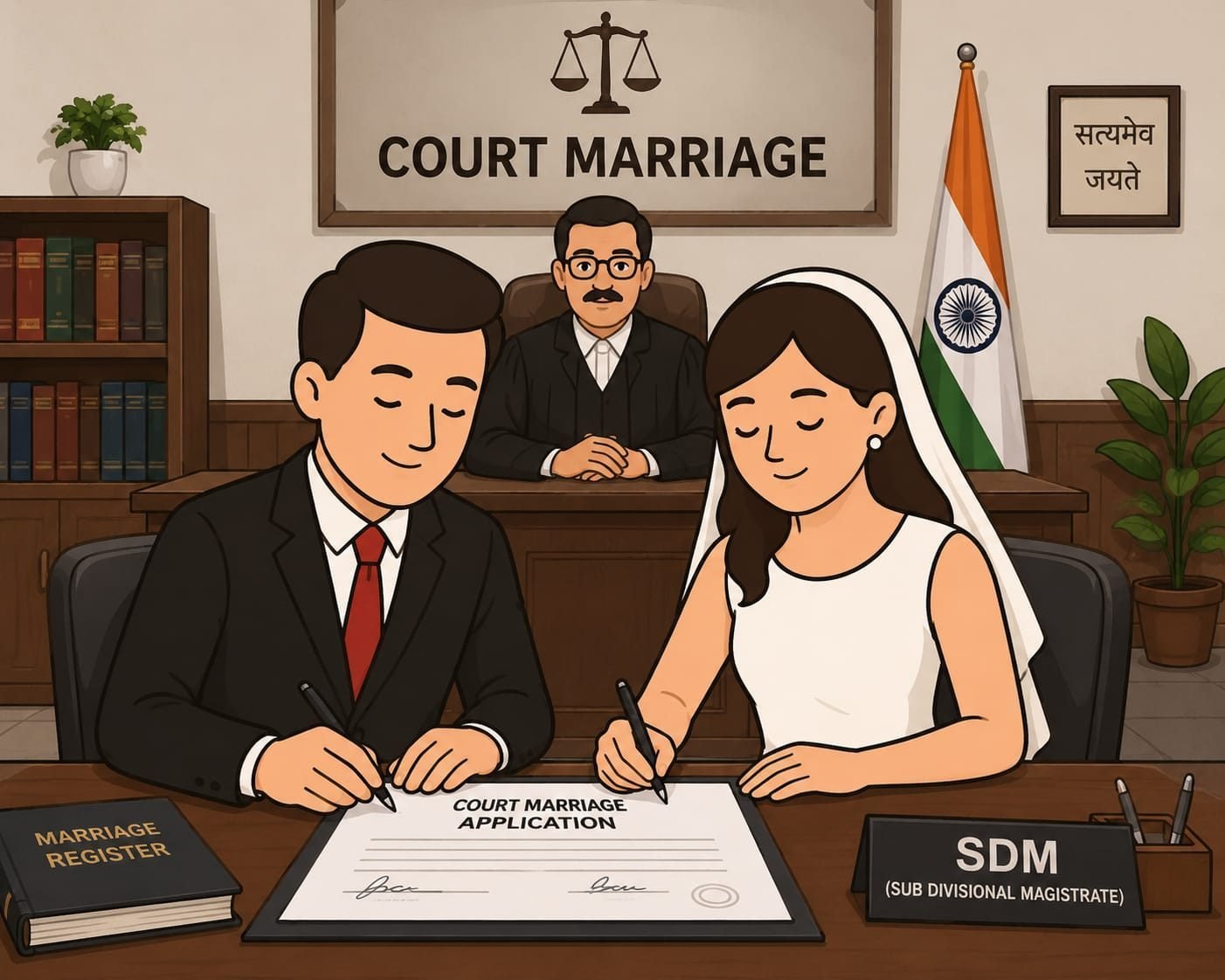
Quick answer: Karol Bagh, with Old and New Rajinder Nagar, Beadonpura, Regharpura, Dev Nagar, Bapa Nagar and the Pusa Road side, is Delhi's great wedding-shopping market and one of its busiest student neighbourhoods. Under Delhi's 2026 revenue map, Karol Bagh is one of the two sub-divisions of the Central district (the other is Patel Nagar). Two Hindus, Sikhs, Jains or Buddhists can have an Arya Samaj wedding the same day and register it under the Hindu Marriage Act on e-District; Sikh couples can instead register their Anand Karaj under the Delhi Anand Marriages Registration Rules, 2018. Couples of different religions who do not want to convert use the Special Marriage Act, with a 30-day notice. Students living in PGs, traders' families with joint-family property, inter-caste couples who may qualify for the ₹2.5 lakh Dr. Ambedkar incentive, and families from other states staying in Karol Bagh's hotels each have particular points to watch, covered below. Arya Samaj wedding + registration: ₹7,100.
Key takeaways
- From 1 January 2026 Karol Bagh is one of two sub-divisions of the Central district (with Patel Nagar); e-District allots the office by address.
- Hindu, Sikh, Jain and Buddhist couples: same-day Arya Samaj wedding + Hindu Marriage Act registration (₹7,100); Sikhs can register an Anand Karaj under Delhi's 2018 Rules.
- A Hindu marrying a non-Hindu under the Special Marriage Act is severed from the joint family (s.19); two Hindus under the SMA are not (s.21A).
- PG students prove residence with a rent agreement, tenant verification or updated Aadhaar – never a hotel address.
- Keep jewellery bills with HUID and a signed stridhan list; inter-caste couples may qualify for the ₹2.5 lakh Ambedkar incentive. We never provide witnesses.
Last reviewed: 22 September 2026 · 37 min read
On this page
- Karol Bagh at a glance
- Karol Bagh under the 2026 map
- Which office registers your marriage
- The legal routes
- Arya Samaj + registration
- Sikh couples: Anand Karaj registration
- Special Marriage Act
- Students and aspirants in Rajinder Nagar
- Address proof for PG and hostel residents
- Marriage and your exam or service records
- Traders' families and joint property
- SMA and the Hindu undivided family
- Wedding shopping and stridhan records
- Inter-caste couples and the ₹2.5 lakh incentive
- Tamil and South Indian families
- Families staying in hotels
- NRI weddings in Karol Bagh
- If your families oppose
- Age
- Witnesses
- Registering an old wedding
- Jain and Buddhist families
- Second marriages
- Documents checklist
- At the appointment
- Planning around the wedding season
- What it costs
- Timeline
- Getting around
- Common mistakes
- After registration
- Five Karol Bagh situations
- Checklist
- One-minute summary
- How we help
- Questions and answers
For most Delhi families, Karol Bagh is where a wedding begins, long before anyone thinks about a certificate. The lehenga comes from Ajmal Khan Road, the jewellery from the shops around Bank Street and Arya Samaj Road, the television and mixer-grinder for the new home from Ghaffar Market, the invitation cards from the printers of Beadonpura, and relatives from out of town stay in the hotels that line the lanes towards Pusa Road. Every day, thousands of brides-to-be and their mothers walk these streets with lists in their hands.
Karol Bagh is also home. After Partition, thousands of Punjabi families rebuilt their lives here, and their children and grandchildren now run the shops and live above them. Older communities in Beadonpura and Regharpura, South Indian families who came with central government jobs and settled near Pusa Road, and the long-established Sikh and Jain families of the area all live within a few kilometres. Just across Pusa Road, Old and New Rajinder Nagar have become India's best-known civil services coaching hub, with tens of thousands of young people from every state living in PGs and rented rooms, preparing for exams, and sometimes meeting the person they will marry.
These different lives bring different questions when it comes to marriage. A student wants to know whether a PG rent agreement is enough for registration, and whether marriage affects a government job application. A trader's son marrying a woman of another faith wants to understand what the Special Marriage Act does to the family business. A Sikh family wants to register under the Anand Marriage law. An inter-caste couple has heard about a government incentive. A bride's mother wants to know how to keep proof of her daughter's jewellery. This guide answers each of them.
For the general Delhi process, see our complete Delhi court marriage guide. Nearby area guides: Patel Nagar, Rajouri Garden, Civil Lines and Sadar Bazar.
Karol Bagh at a Glance
| Item | Detail |
|---|---|
| District (from 1 January 2026) | Central |
| Sub-divisions in the district | Karol Bagh and Patel Nagar |
| Neighbourhoods | Karol Bagh, Old and New Rajinder Nagar, Beadonpura, Regharpura, Dev Nagar, Bapa Nagar, Naiwala, Prasad Nagar, Jhandewalan, Pusa Road |
| Metro | Blue Line: Karol Bagh, Rajendra Place and Jhandewalan stations |
| Known for | Wedding and bridal shopping, jewellery, electronics, hotels, civil services coaching |
| Typical questions | Students' address proof, Sikh Anand Karaj registration, inter-religion marriage and family business, stridhan, inter-caste incentive, out-of-town and NRI families |
Karol Bagh Under the 2026 Revenue Map
From 1 January 2026, Delhi's revenue administration was reorganised into 13 districts and 39 sub-divisions. The Sub-Divisional Magistrate (SDM) acts as Registrar of Marriages for Hindu Marriage Act registrations, so the map matters. The new Central district has two sub-divisions: Karol Bagh and Patel Nagar. Karol Bagh keeps a sub-division in its own name, and most addresses in Karol Bagh, Beadonpura, Regharpura and Dev Nagar will be allotted to it; addresses in Rajinder Nagar and towards Patel Nagar may be allotted to the Patel Nagar sub-division depending on the exact boundary. Certificates issued before 2026 remain fully valid.
Which Office Registers Your Marriage?
You apply on the Delhi e-District portal, and the system allots the office by the address you enter. For Hindu Marriage Act registration, the office can be where the marriage was performed or where either spouse lives. For the Special Marriage Act, notice is given in the district where at least one of you has lived for the past 30 days. Your appointment slip names the office. Couples who marry at an Arya Samaj mandir in Karol Bagh but live elsewhere in Delhi can usually register at the office for either spouse's address instead.
The Legal Routes for a Karol Bagh Couple
| Your situation | Route | Waiting period | Our fee |
|---|---|---|---|
| Both Hindu, Sikh, Jain or Buddhist, want to marry now | Arya Samaj wedding + Hindu Marriage Act registration | Wedding same day; registration by appointment | ₹7,100 combined |
| Arya Samaj wedding only | Same-day Vedic wedding and mandir certificate | Same day | ₹5,100 |
| Already married by Hindu rites, not registered | Hindu Marriage Act registration | By appointment | ₹6,000 |
| Sikh couple after Anand Karaj | Registration under the Delhi Anand Marriages Registration Rules, 2018, or under the Hindu Marriage Act | By appointment | ₹6,000 |
| Different religions, no conversion | Special Marriage Act | 30-day notice | ₹15,000 |
| Court marriage with advocate assistance | SMA or SDM registration with drafting | Depends on route | ₹6,100 |
| Inter-religion marriage | SMA, or a genuine voluntary conversion route | Depends on route | ₹10,000 |
Government fees are extra at actual cost; Tatkal registration, where available, adds ₹10,000. Full list: fees.
Arya Samaj Wedding + Registration
For two Hindus, including Sikhs, Jains and Buddhists, who count as Hindus under the Hindu Marriage Act, the fastest complete route is an Arya Samaj wedding followed by registration. The ceremony is short: havan, the exchange of garlands, the pheras and saptapadi, the seven steps which under section 7 of the Hindu Marriage Act complete the marriage. Both families can attend, or the couple can come with just their witnesses. The mandir certificate is issued the same day.
The mandir certificate proves that the ceremony took place, but it is not a government certificate. For a passport, spouse visa, bank, government records or legal protection, register the marriage under the Hindu Marriage Act on e-District. Our combined service (₹7,100) covers the wedding, the affidavits, the online application, the appointment and preparation for it. See our Arya Samaj marriage page.
Remember the Supreme Court's warning in Dolly Rani v. Manish Kumar Chanchal (2024): a Hindu marriage needs the essential ceremonies. A certificate obtained without a real ceremony does not create a marriage. An Arya Samaj wedding properly performed does.
Sikh Couples: Anand Karaj Registration
Many Sikh families in Karol Bagh, Dev Nagar and nearby areas hold the Anand Karaj at a gurdwara, with the four laavan around the Guru Granth Sahib. For decades such marriages were registered under the Hindu Marriage Act, because Sikhs are treated as Hindus for its purposes. The Anand Marriage Act, 1909, amended in 2012, allows states to frame rules for registering Anand Karaj marriages, and Delhi notified the Delhi Anand Marriages Registration Rules, 2018 in February 2018. Sikh couples in Delhi can now register their marriage specifically as an Anand marriage.
- The Anand Karaj is the marriage; registration records it.
- Bring the gurdwara's certificate, photographs of the laavan, age proof, ID and address proof of both spouses, and witnesses with ID.
- Couples who prefer can still register under the Hindu Marriage Act; either certificate is valid proof of marriage.
- If one partner is not Sikh and the couple want a civil marriage without any religious ceremony, the Special Marriage Act is the route.
Tell us at the start that yours is an Anand Karaj, so the application is filed in the right category.
Special Marriage Act: Any Two Adults
The Special Marriage Act, 1954 is the civil route for any two adults, whatever their religion, without conversion. You file notice online to the Marriage Officer of the district where at least one of you has lived for the last 30 days; the notice is displayed for 30 days, during which objections may be raised only on legal grounds (age, an existing spouse, unsoundness of mind, prohibited relationship); and after the 30 days the marriage is solemnised before the Marriage Officer and three witnesses. Our full service is ₹15,000. See inter-religion marriage and the SMA vs HMA guide.
For Karol Bagh's business families, the Special Marriage Act has consequences for joint-family property that are worth understanding before choosing it. These are explained in the section on the Hindu undivided family below.
Students and Aspirants in Rajinder Nagar
Old and New Rajinder Nagar, with Karol Bagh and Patel Nagar around them, hold one of the largest concentrations of students in India. Young people from Bihar, Uttar Pradesh, Rajasthan, Madhya Pradesh, Odisha, the North East and the South come here to prepare for the civil services and other competitive exams, often for several years. They share PGs and small flats, study in the same libraries, and some of them fall in love. When they decide to marry, often before telling their families or while their families disagree, their questions are practical.
- Can we marry in Delhi when our homes are in other states? Yes. An Arya Samaj wedding can be performed in Delhi regardless of where you come from. Registration in Delhi needs a Delhi connection: the wedding performed in Delhi (for Hindu Marriage Act registration), or Delhi residence of at least one of you. Special Marriage Act notice needs 30 days' residence in the district.
- Do our parents have to agree? No. Adults can marry by choice: the groom must be 21 and the bride 18. Many students prefer to tell their families, and we encourage honest conversations, but the law does not require parental consent.
- Will marriage affect our preparation or exam? Marriage does not bar you from any exam. Update your marital status honestly in future applications, as the forms ask for it.
- Is it confidential? Yes. We do not share your details with anyone.
If your families are opposed, read the section on family opposition below and our guide to love marriage legal rights.
Address Proof for PG and Hostel Residents
Most students here have an Aadhaar card with their home address and no bill in their own name. That is a common problem and a solvable one.
| Proof | How to get it | Notes |
|---|---|---|
| Rent or PG agreement | Ask the owner for a written agreement, ideally registered or notarised | Include the owner's ID and address proof |
| Police tenant verification receipt | Completed online with Delhi Police by the owner or tenant | Strongly supports residence, and is legally required anyway |
| Aadhaar address update | Update online or at an Aadhaar centre with the rent agreement | Takes some days; then your Aadhaar is Delhi address proof |
| Bank account address | Update your bank address to the Delhi one | A bank statement then becomes address proof |
| The other partner's proof | If one of you has a solid Delhi address | One spouse's Delhi address is enough for registration |
For Special Marriage Act notice, you must genuinely have lived in the district for 30 days. Do not create a false address; a false declaration can invalidate the process and is an offence.
Marriage and Your Exam or Service Records
Aspirants who later join government service often ask how marriage interacts with their records. A few general points:
- Application forms for many exams ask for marital status. Answer truthfully on the date you fill the form.
- Government servants' conduct rules commonly prohibit a government servant from marrying a person who has a living spouse, and require intimation of marriage to a foreign national. Read the rules that apply to your service.
- Name change: a woman who takes her husband's surname can keep her maiden name in her service and exam records, or change it with the marriage certificate and, where required, a gazette notification. Consistency matters; many women keep their original name to avoid mismatches with their certificates.
- Spouse details in service records, pension nomination, medical schemes (such as CGHS for central employees) and posting requests for couples all need a marriage certificate.
A registered marriage makes each of these simple. An unregistered marriage can become a problem years later, when the certificate is suddenly needed for a nomination or transfer.
Traders' Families and Joint Property
Karol Bagh is a city of family businesses. A father and his sons run the shop together, the family owns the building, and the property and business may be held as a Hindu undivided family (HUF). When a son or daughter marries, the new spouse joins that family's life, and the marriage route can have legal consequences for property.
- A marriage under the Hindu Marriage Act (including an Arya Samaj wedding) between two Hindus has no effect on either spouse's place in the joint family.
- A marriage under the Special Marriage Act between two Hindus (including Sikhs, Jains and Buddhists) also has no effect, because section 21A of the Act excludes the severance and succession provisions in that case.
- A marriage under the Special Marriage Act between a Hindu and a non-Hindu is different: section 19 treats it as severing the Hindu partner from the undivided family, and section 21 applies the Indian Succession Act to the succession of the couple's property.
None of this makes an interfaith marriage wrong; it simply means the family should understand the effect in advance and arrange its business and property sensibly, for example by clear partnership deeds, wills and nominations. A chartered accountant or property lawyer can help plan this.
The Special Marriage Act and the Hindu Undivided Family, Explained
Severance from the undivided family under section 19 does not mean the person loses property overnight or is cut off from the family. It means the person ceases to be a coparcener in the undivided family from the date of the marriage, and their share becomes their separate property, as on a partition. Since the Supreme Court's judgment in Vineeta Sharma (2020), daughters are coparceners by birth in the same way as sons, so the rule affects daughters who marry outside the faith under the Act in the same way as sons.
Section 21 then says that succession to the property of a person married under the Act, and of their children, is governed by the Indian Succession Act rather than the Hindu Succession Act. In practice, this changes who inherits if someone dies without a will. A will made by each spouse removes most uncertainty. We explain these points to every interfaith couple choosing the Special Marriage Act, so the choice is informed.
Wedding Shopping and Stridhan Records
Every bride who shops in Karol Bagh is building her stridhan: the jewellery, clothes, utensils, cash and other gifts given to her before, at or after the wedding by her parents, relatives, the groom's family and friends. Under Hindu law, stridhan is the woman's absolute property. The Supreme Court held long ago in Pratibha Rani (1985) that the husband and in-laws hold it only in trust, and must return it on demand. Refusing to return it can be criminal breach of trust, and a wife can claim it under the Protection of Women from Domestic Violence Act, 2005 as well.
The problem in practice is proof. Years later, if a marriage fails, families struggle to show what was given, and who has it. The shops of Karol Bagh make proof easy, if you ask for it:
- Take a proper bill for every piece of jewellery, in the bride's name where possible, showing weight, purity and price.
- Check the hallmark. Since 2023, hallmarked gold jewellery must carry a six-digit HUID code from the Bureau of Indian Standards. Note the HUID on the list; it identifies each piece.
- Make a stridhan list of all gifts, with approximate value, and ask both families to sign it at or after the wedding. Many families now do this as a matter of course.
- Photograph the jewellery and gifts, and the bride wearing them at the wedding.
- Keep the bride's copies of bills and the list with her own papers, not only in the in-laws' locker.
- Bank locker: if jewellery is kept in a locker, the bride should be a joint holder or have her own.
Stridhan is not dowry. Dowry means property given in connection with the marriage as consideration for it, usually on demand. Giving, taking or demanding dowry is an offence under the Dowry Prohibition Act, 1961, while gifts freely given to the bride are lawful and should be listed. The Act itself requires lists of presents to be maintained.
Inter-Caste Couples and the ₹2.5 Lakh Incentive
Inter-caste marriages are common among the students and young professionals of the area, and families from Beadonpura, Regharpura and elsewhere in Karol Bagh know well how much caste still matters in many homes. The law fully protects inter-caste marriage: an Arya Samaj wedding and Hindu Marriage Act registration are available to any two Hindus regardless of caste, and the Supreme Court has directed protection for inter-caste couples (Lata Singh, 2006; Shakti Vahini, 2018).
The Government of India also encourages such marriages through the Dr. Ambedkar Scheme for Social Integration through Inter-Caste Marriages, run by the Dr. Ambedkar Foundation. Its headline incentive is ₹2.5 lakh. As generally described, the scheme applies where one spouse belongs to a Scheduled Caste and the other does not, the marriage is registered under the Hindu Marriage Act, it is the first marriage of both, and the application is made within a set period after the marriage, with the required recommendation. Conditions and procedures change, so check the current guidelines on the Foundation's website before applying. Several states also run their own inter-caste marriage incentives.
A registered marriage is essential for any such scheme. We register the marriage correctly and can guide you on the documents the scheme asks for, including caste certificates. See our inter-caste marriage service and the inter-caste marriage legal guide.
Tamil and South Indian Families
Around Pusa Road and in the older government colonies nearby, Tamil, Malayali, Telugu and Kannada families have lived for generations, with their own temples, associations and schools. Their children marry within their communities and, increasingly, marry North Indians they meet at college or work.
- A marriage performed with South Indian customary rites, such as the tying of the thali or mangalsutra and the saptapadi, is a valid Hindu marriage and can be registered under the Hindu Marriage Act.
- When families from two regions disagree about which ceremony to perform, some couples choose a short Arya Samaj wedding, which is valid for all Hindus, and hold family celebrations separately.
- Name formats differ: many Tamil names use an initial for the father's name instead of a surname. Use the name exactly as in the passport or Class 10 certificate, and file a one-and-same-person affidavit if other documents show it differently.
- For marriages performed in Tamil Nadu or Kerala, registration can be done there under the state's own registration law, or in Delhi on the basis of Delhi residence. One registration is enough.
Families Staying in Karol Bagh Hotels
Karol Bagh has hundreds of hotels, and many families from other states or abroad stay in them during weddings. Couples sometimes ask whether they can stay together in a hotel before registration, or whether a hotel can be used as an address.
- No law forbids two unmarried adults from staying in a hotel room together; the Madras High Court said so plainly in 2019. Hotels may still have their own ID rules, and they record the identity of every guest.
- A hotel is not a residence. It cannot be used as address proof for registration or for the 30-day residence requirement of the Special Marriage Act.
- An Arya Samaj wedding can take place during a family's short stay in Delhi. Registration then follows either in Delhi, if the wedding was performed here, or in the couple's home state.
NRI Weddings in Karol Bagh
Punjabi families from Karol Bagh have relatives in Canada, the UK, Australia and the United States, and many weddings involve a groom or bride flying in for a few weeks. The wedding is usually planned in detail; the paperwork often is not, and couples discover too late that a spouse visa needs a registered certificate, attested or apostilled.
- Before the NRI partner flies in: send us photographs of both partners' documents, including passports and, for anyone divorced, the decree.
- Wedding: an Arya Samaj wedding or Anand Karaj can be held early in the visit, with family celebrations around it.
- Registration: file immediately after the wedding. Where there is a genuine visa deadline, ask about Tatkal.
- Both must attend the registration appointment; this is very difficult to arrange once the NRI partner has left.
- Apostille or attestation: for countries that are parties to the Hague Apostille Convention (including the UK, the US and Australia, and Canada since 2024), the Ministry of External Affairs apostilles the certificate after the state authentication. For others, embassy attestation may be needed.
For a foreign national partner, the Special Marriage Act is usually the route, and a certificate of no impediment from their embassy is often requested. See our NRI marriage service and the NRI marriage apostille guide.
If Your Families Oppose
A student couple from different states, an inter-caste couple, a Hindu–Sikh or Hindu–Muslim couple: when families oppose, the pressure can be intense. The law protects adults who choose to marry:
- the Supreme Court in Lata Singh (2006) directed police to protect inter-caste and inter-religion couples;
- in Shakti Vahini (2018) it held that no family or community body may interfere with the marriage of consenting adults, and required states to take preventive and protective measures;
- in Shafin Jahan (2018) it held that an adult's choice of partner is part of personal liberty under Article 21;
- Delhi Police has special cells for threatened couples, and the Delhi High Court routinely orders protection.
Keep your documents and phone with you, keep copies with a friend, choose supportive witnesses, register promptly, and record any threats. In an emergency call 112; the women's helpline is 181. We keep every case confidential. See our love marriage service.
Age
The groom must be at least 21 and the bride at least 18 on the day of the wedding, shown by a Class 10 certificate, birth certificate or passport. Aadhaar is an identity document, not reliable age proof. We never conduct a wedding where either party is under age. See our marriage age guide.
Witnesses
Hindu Marriage Act registration needs two witnesses and the Special Marriage Act three. They bring photo ID and address proof and must actually know you: classmates, PG-mates, colleagues, relatives or neighbours are all fine.
We do not provide witnesses. A stranger who does not know you is not a real witness. Bring people who know you both. See the witness requirements guide.
Registering a Wedding Held Years Ago
Many Karol Bagh couples married in banquet halls, farmhouses or at home with full family ceremonies, sometimes decades ago, and never registered. The need arises suddenly: a child's passport, a visa to visit a son abroad, a property transfer after a death in the family, a bank's insistence on a certificate for a joint account. Registration of an existing Hindu marriage is straightforward if you gather proof:
- the wedding card, photographs or video showing the ceremony (pheras or laavan);
- a certificate from the priest, temple or gurdwara, if available;
- age proof, ID and address proof of both spouses;
- affidavits of both spouses giving the date and place of the wedding and their marital status;
- two witnesses who attended the wedding or have known the couple as married, with ID;
- for long marriages, supporting evidence such as children's birth certificates or passports naming both parents.
Our fee for registering an existing marriage is ₹6,000. See our marriage registration service.
Jain and Buddhist Families
Karol Bagh and the nearby areas have long-established Jain families, many in business. Jains and Buddhists are covered by the Hindu Marriage Act, so a Jain wedding performed with the customary rites of the community can be registered under that Act, and a Jain couple can also choose an Arya Samaj wedding. Where a Jain marries a Hindu, Sikh or Buddhist, the Hindu Marriage Act applies to both, and neither is severed from a joint family by the marriage. Jain families often keep careful written records of gifts and ornaments; the stridhan advice above fits naturally with that tradition.
Second Marriages
A divorced or widowed person can remarry once the earlier marriage has legally ended. A Hindu, Sikh, Jain or Buddhist needs a certified copy of the court's divorce decree; under the Hindu Marriage Act a person may remarry once the decree is final and no appeal is pending. A widowed person needs the former spouse's death certificate. A so-called divorce on stamp paper or before a panchayat does not end a Hindu marriage, except where a recognised custom of divorce applies and is proved. Converting to another religion to marry again does not end the first marriage either, as the Supreme Court held in Sarla Mudgal (1995); the second marriage would be void and can be bigamy.
For business families, a second marriage also raises practical questions about the first spouse's claims, the children of the first marriage and the family business. These are best settled clearly, with legal advice, before the wedding.
Documents Checklist
| Document | Who | Notes |
|---|---|---|
| Age proof | Both | Class 10 certificate, birth certificate or passport |
| Photo ID | Both | Aadhaar, voter ID, passport, driving licence or PAN |
| Address proof | At least one in Delhi | Aadhaar, voter ID, bill, passport, bank statement, or rent/PG agreement with tenant verification |
| Photographs | Both | Passport size, and wedding photographs for registration |
| Wedding proof | For registration | Arya Samaj certificate, gurdwara certificate for Anand Karaj, wedding card, photographs |
| Affidavits | Both | Age, marital status, nationality; one-and-same-person where names differ |
| Divorce decree or death certificate | If married before | Certified copy |
| Passport, visa, no-impediment certificate | NRI or foreign partner | With translations where needed |
| Witnesses' ID and address proof | Each witness | Two for HMA, three for SMA |
Full list: documents required for court marriage in Delhi.
At the Appointment
Both spouses and the witnesses attend the office on your appointment slip with all originals. The officer compares originals with the uploads, confirms identities, and asks a few simple questions: when and where you married, who performed the ceremony, whether either was married before, and whether you marry by choice. Witnesses confirm that they know you. If all is in order, you sign the register and the certificate is issued, often digitally, the same day or within a few days. If the officer asks for one more document, that is a correction, not a refusal; bring it on the next date.
Planning Around the Wedding Season
From October to February, and again in the spring muhurat dates, Karol Bagh is at its busiest. Banquet halls are booked months ahead, hotels fill with wedding guests, and the market lanes are crowded from morning to night. The legal side of a wedding does not need to compete with any of this, if you plan it separately.
- Start the paperwork a month before the wedding. Check both partners' age proof, ID and address proof, and get any name or date affidavits made early.
- Choose witnesses who will be in Delhi for the likely registration date, not only for the wedding. Relatives who come for the wedding often leave the next day.
- File for registration within days of the wedding. Appointments can take time in busy months, and memories of details fade.
- Keep the Arya Samaj or gurdwara certificate, wedding card and a few clear photographs of the ceremony aside for the registration file; the photographer's album may take months.
- Muhurat is a family choice, not a legal one. An Arya Samaj wedding can be performed on any day, and registration is based on the date the wedding actually took place.
- Do not let an agent "book" a registration date for a fee; appointments are allotted through the official portal.
Couples who want to marry quietly first, before the big family wedding later in the season, sometimes hold an Arya Samaj wedding and register it early. That is lawful; but then the later family ceremony is a celebration, not a second marriage, and the date of marriage on every record is the first ceremony's date.
What It Costs
| Service | Our fee |
|---|---|
| Arya Samaj marriage (same day) | ₹5,100 |
| Hindu Marriage Act or Anand marriage registration | ₹6,000 |
| Court marriage (advocate assisted) | ₹6,100 |
| Arya Samaj + registration combined | ₹7,100 |
| Inter-religion marriage | ₹10,000 |
| Special Marriage Act, full process | ₹15,000 |
| NRI registration with apostille and embassy | ₹30,000 |
Government fees, stamp paper and notary charges at actual cost. Full list: fees.
Timeline
| Route | Typical time |
|---|---|
| Arya Samaj wedding | Same day, once documents are ready |
| HMA or Anand registration | Depends on the appointment; Tatkal faster where available |
| Special Marriage Act | 30 days' notice, then solemnisation; about 5–7 weeks in practice |
| Apostille for NRI couples | Several working days after the certificate |
Getting Around
Karol Bagh, Rajendra Place and Jhandewalan stations on the Blue Line put the whole area within a short walk of the metro. Parking in the market lanes is hard, especially on weekends and in the wedding season, so come by metro on the day of your wedding or appointment and meet your witnesses at the station. The market's Monday closing makes Mondays quieter on the roads. If needed, we arrange pickup and drop within Delhi NCR for ₹1,500.
Common Mistakes
- Using a hotel or a friend's address as residence. Use a real address you can prove.
- Aadhaar as the only age proof.
- Choosing the Special Marriage Act without understanding its effect on joint-family property when one partner is not Hindu.
- No bills or list for the bride's jewellery, leaving stridhan hard to prove later.
- Filing an Anand Karaj in the wrong category, or not telling us it was a gurdwara wedding.
- NRI partner leaving before registration.
- Names spelt differently across documents, especially initials-based South Indian names, without an affidavit.
- Witnesses unavailable on the appointment day.
- Trusting agents who promise registration without appearance or supply witnesses.
After Registration
- Update Aadhaar, bank nominations, insurance and passport.
- For government employees and aspirants who join service: record the spouse in service records, pension and medical schemes.
- For inter-caste couples who qualify: apply for the Dr. Ambedkar scheme within its time limit.
- For NRI couples: apostille or attestation, then the spouse visa.
- For every bride: keep her own copies of the certificate, wedding photographs, jewellery bills and the stridhan list.
- For interfaith couples married under the SMA: consider wills, since the Indian Succession Act will govern succession.
Five Karol Bagh Situations
The aspirants from two states
A man from Bihar and a woman from Rajasthan, both preparing for the civil services in Old Rajinder Nagar, had been together for three years. Both lived in PGs with Aadhaar cards showing home addresses. The woman's PG owner gave a notarised agreement and completed tenant verification, and she updated her Aadhaar to the Delhi address. They had an Arya Samaj wedding with four friends present and registered the marriage under the Hindu Marriage Act on her Delhi address.
The Anand Karaj and the visa
A Sikh family in Dev Nagar held their daughter's Anand Karaj at a gurdwara; the groom lived in Canada. We filed for registration under the Delhi Anand Marriages Registration Rules the day after the wedding, and the couple attended the appointment before he flew back. The certificate was then apostilled for the spousal sponsorship.
The jeweller's son and the doctor
The son of a Karol Bagh jewellery family wanted to marry a Muslim doctor he had met at a friend's wedding. Neither wanted to convert. Before filing notice under the Special Marriage Act, the family's accountant, the couple and we sat down to discuss section 19. The family made a partnership deed for the business and the couple made wills. The marriage was solemnised after the 30-day notice, with both families present.
The bride's jewellery list
A bride's mother, shopping on Bank Street, asked every jeweller for a bill in her daughter's name with the HUID of each piece, and prepared a stridhan list signed by both families after the wedding. When the marriage broke down four years later, the list and bills made the return of her jewellery a matter of days, not a long dispute.
The inter-caste couple and the incentive
A young couple, one of them from a Scheduled Caste, married in an Arya Samaj wedding and registered under the Hindu Marriage Act. With the registered certificate, caste certificate and other documents, they applied under the Dr. Ambedkar scheme within the time allowed.
Checklist
- ☐ Choose the route: Arya Samaj + HMA, Anand registration, Special Marriage Act, or registration of an existing marriage
- ☐ Understand the SMA's effect on joint-family property if one partner is not Hindu
- ☐ Age proof for both (Class 10, birth certificate or passport)
- ☐ Delhi address proof for at least one (not a hotel)
- ☐ PG students: rent agreement + tenant verification, or Aadhaar update
- ☐ Wedding proof: Arya Samaj or gurdwara certificate, photographs
- ☐ Your own witnesses with ID and address proof
- ☐ Jewellery bills with HUID and a signed stridhan list
- ☐ NRI partner present for the appointment; apostille planned
- ☐ After the certificate: records, nominations, incentive application where eligible
One-Minute Summary
- Karol Bagh is one of two sub-divisions of the Central district from 1 January 2026; e-District allots the office by address.
- Hindu, Sikh, Jain and Buddhist couples: Arya Samaj wedding + Hindu Marriage Act registration (₹7,100 combined).
- Sikh couples can register their Anand Karaj under the Delhi Anand Marriages Registration Rules, 2018.
- Interfaith couples: Special Marriage Act, with a 30-day notice; a Hindu marrying a non-Hindu under it is severed from the joint family.
- PG students can prove residence with a rent agreement, tenant verification or an updated Aadhaar.
- Keep bills with HUID and a signed stridhan list for the bride's jewellery.
- Bring your own witnesses; we never provide them.
How We Help
We check documents on WhatsApp, advise on the right route and its consequences, prepare affidavits, conduct Arya Samaj weddings, file Hindu Marriage Act, Anand and Special Marriage Act applications, book appointments and prepare you for them, and plan apostille for NRI couples. Every case is confidential. We do not provide witnesses, and we never marry anyone under the legal age.
Arya Samaj wedding + government registration for Karol Bagh couples
Arya Samaj + registration ₹7,100 · Arya Samaj only ₹5,100 · Special Marriage Act ₹15,000 · Anand registration ₹6,000.
Book Arya Samaj + Registration – ₹7,100 →Also: Court marriage · Inter-caste · NRI marriage
Questions and Answers: Court Marriage for Karol Bagh Couples
Sources and Official References
Facts in this guide were checked against the following primary sources. Government procedures and office allocations change, so confirm current details on the official portal before applying.
- Delhi e-District – official online application portal
- Revenue Department, Delhi – notification dated 25 December 2025 creating 39 sub-divisions and 13 areas
- The Hindu Marriage Act, 1955 – India Code
- The Special Marriage Act, 1954 – India Code
- Sikhs in Delhi now have their own marriage rules (Delhi Anand Marriages Registration Rules, 2018) – The Week
- Dr. Ambedkar Scheme for Social Integration through Inter-Caste Marriages – Dr. Ambedkar Foundation
- Sale of hallmarked gold jewellery without six-digit HUID prohibited (2023) – Business Standard
- Dowry Prohibition Act, 1961 – Indian Kanoon
- Lata Singh v. State of U.P., Supreme Court, 2006 – Indian Kanoon
- Shakti Vahini v. Union of India, Supreme Court, 2018 – Indian Kanoon
- Shafin Jahan v. Asokan K.M., Supreme Court, 2018 – Indian Kanoon
- Sarla Mudgal v. Union of India, Supreme Court, 1995 – Indian Kanoon
- Hague Apostille Convention – status table – HCCH
This guide is general information, not legal advice for your specific case. Call +91 8376863962 for advice on your situation.
Related Articles
🏰 Court Marriage in Kotwali (Old Delhi)
Interfaith, nikah, Anand Karaj, church weddings.
Read →🏙️ Court Marriage in Patel Nagar
Central district guide.
Read →🌳 Court Marriage in Rajouri Garden
West Delhi guide.
Read →🛍️ Court Marriage in Sadar Bazar
Old Delhi traders' guide.
Read →🏛️ Court Marriage in Civil Lines
North Delhi guide.
Read →🏘️ Court Marriage in Karawal Nagar
Interfaith and nikah registration.
Read →🤝 Inter-Caste Marriage
Legal process and protection.
Read →⚖️ SMA vs HMA
Which Act suits you.
Read →✈️ NRI Marriage & Apostille
Visa-ready certificate.
Read →👥 Witness Requirements
Who can be a witness.
Read →🏛️ Court Marriage in Delhi
The complete Delhi guide.
Read →