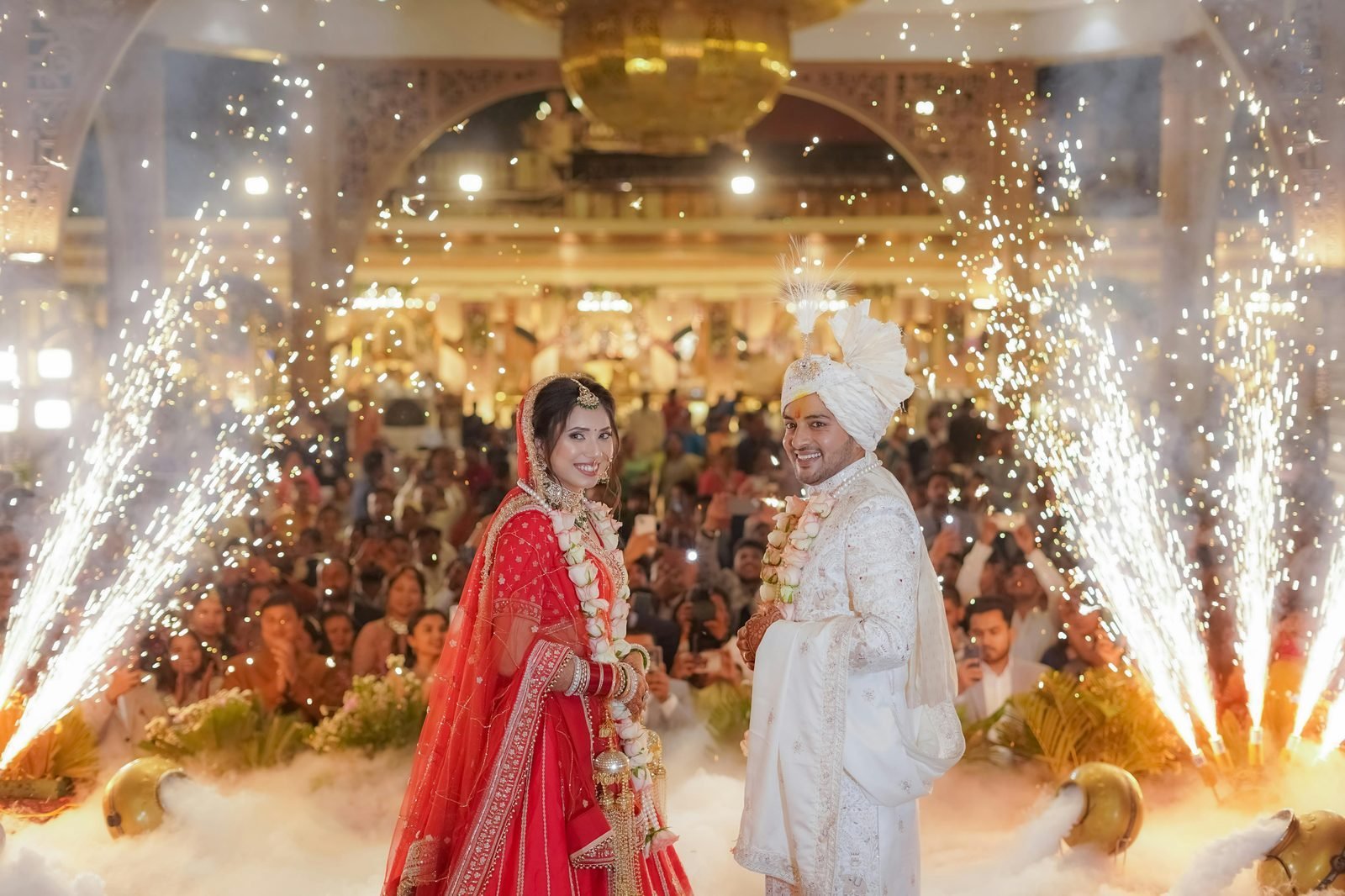
Government Registration of already-solemnized marriages. Both Hindu Marriage Act 1955 and Special Marriage Act 1954 options. SDM Office Certificate in 7-15 days.
Quick answer: Marriage registration in Delhi is done at the SDM office and produces a government marriage certificate in about 7 days (registration fee ₹100 under the Hindu Marriage Act, ₹15 under the Special Marriage Act; Tatkal ₹10,000). Our assisted package is from ₹6,000. You need age proof, Aadhaar, address proof, marriage proof/photos and two witnesses. Already-married couples can register an existing marriage too.
Marriage Registration Delhi — Complete Guide
Marriage Registration means official Government registration of an already-solemnized marriage. In Delhi, after the 2014 Delhi Compulsory Marriage Registration Order, registration of every marriage is mandatory — Hindu, Arya Samaj, Court Marriage or any religion.
Our Arya Samaj Court Marriage Delhi service handles every kind of Marriage Registration — recent marriages, marriages from 5-10-20 years ago, and even marriages performed outside Delhi for registration in Delhi. 15,000+ couples register through us each year.
📜 Highlights: Hindu Marriage Act 1955 | Special Marriage Act 1954 | Tatkal Service 7 days | All SDM Offices | Old Marriage Registration | Visa Use Valid | Fees from ₹6,000
Marriage Registration Acts
1. Hindu Marriage Act 1955 — Registration
For Hindu couples (Hindu, Sikh, Jain, Buddhist). Marriage must be already solemnized (in Mandir or by Hindu rites). Submit Form A at SDM Office. Both parties present. Certificate in 7-15 days.
2. Special Marriage Act 1954 — Registration
For inter-religion or secular couples. Already-married couples can also register under this act. 30-day notice optional in some cases. Religion-neutral certificate.
3. Delhi Compulsory Marriage Registration Order 2014
Marriage Registration is mandatory for every couple in Delhi. Aim is women's rights protection. ₹100-1000 penalty for non-registration.
Marriage Registration Documents
Document
Required
Marriage Affidavit (Both)
Joint Affidavit
Aadhar Card
Both parties
Age Proof (10th Marksheet)
Both parties
Address Proof
Both parties
Marriage Photos
Original photos
Mandir/Marriage Certificate
Original from venue
Pandit Ji Certificate
If Hindu marriage
Witnesses (2)
With ID proof
Passport Size Photos
4 each + 2 couple photos
Marriage Registration Process
Application Submission: Form A (Hindu) or Form B (Special Marriage Act) at concerned SDM Office.
What Registration Actually Is — and What It Is Not
Almost every worry people bring to us about marriage registration dissolves once this one distinction is clear, so we will start with it.
Registration records a marriage. It does not create one. If you were married by ceremony ten years ago and never registered it, you have been married for ten years. You are not “less married”, your marriage is not “invalid”, and your children’s position does not change — a child is legitimate whether or not the parents’ marriage was registered. What you do not have is proof in the form that banks, employers, insurers, passport offices, embassies and courts ask for.
That is the whole of it. The marriage is the ceremony and the consent. The certificate is the evidence. People are sold a great deal of anxiety on this point, usually by somebody who wants to charge for relieving it.
The legal backing sits in three places:
Section 8 of the Hindu Marriage Act, 1955 provides for registration of Hindu marriages, and leaves the detail to rules made by the state government. Delhi’s rules provide for registration by the Registrar in whose jurisdiction the marriage was solemnised, or in whose jurisdiction either party has been residing.
The Delhi (Compulsory Registration of Marriage) Order, 2014 makes registration compulsory for marriages solemnised in Delhi, whatever the religion of the parties, with the time limits set out below.
Seema v. Ashwani Kumar (Supreme Court, 2006) is the decision behind all of this — the Court directed the States and Union Territories to make registration of marriages compulsory, precisely because unregistered marriages were leaving women unable to prove the most basic fact about their own lives.
Note the first of those carefully, because it answers the question we are asked most: Delhi registers a marriage where it was solemnised as well as where a party resides. That is why a couple from Bihar or Uttar Pradesh who marry in Delhi can register here without having lived here first, and why a home-state Aadhaar is not a disqualification.
The Time Limits — and the One Deadline That Is Absolute
Under the Delhi Order, for a marriage solemnised in Delhi:
When you apply
What applies
Within 60 days of the marriage
Ordinary registration
The next 60 days
Permitted on payment of ₹500
After that
Permitted with a ₹1,000 penalty
Years later
Still possible — while both spouses are alive
So the penalties are small and the door stays open. We register marriages from the 1990s regularly, and there is nothing unusual or shameful about it. Being late costs you a four-figure penalty at worst, not the right to register.
The one true deadline: a death. After a spouse dies, the marriage can no longer be registered at all — not for a fee, not with an affidavit, not by any office and not by any agent. Everything the survivor then needs — an insurance claim, a family pension, a share in a house, a scheme, a passport — has to be proved some other way, through photographs, witnesses, affidavits, children’s records and often a court. We have had to say this to widows sitting in front of us. If you are married and it is not registered, do it while both of you are alive and well.
Which Law Applies to Your Marriage
The route depends on how you were married, not on what you would like it to be called.
How you were married
The law
What you produce
Hindu, Sikh, Jain or Buddhist ceremony — including an Arya Samaj wedding
Hindu Marriage Act, 1955, s.8
Mandir or pandit certificate, ceremony photographs, wedding card
Sikh Anand Karaj
Anand Marriage Act, with Delhi’s Anand Marriage Registration Rules, 2018
Gurudwara certificate and the gurudwara’s register entry
Nikah
Registered under the Delhi 2014 Order
The nikahnama, and the masjid or qazi’s register extract
Christian marriage in church
Indian Christian Marriage Act, 1872
The church certificate and the marriage register entry
Parsi marriage
Parsi Marriage and Divorce Act, 1936
The certificate signed by the priest and witnesses
A civil marriage with no ceremony, or an inter-faith marriage with no conversion
Special Marriage Act, 1954 — solemnised, not merely registered
The distinction that matters at the counter: under the Hindu Marriage Act and the Delhi Order you are registering a marriage that already happened, and the office is satisfying itself that it did. Under the Special Marriage Act the office performs the marriage, after a thirty-day public notice. They are different processes with different timelines, and a great deal of confusion — and a good deal of overcharging — comes from treating them as one.
If You Are an Inter-Faith Couple Who Already Married by Ceremony
This comes up often enough to need its own answer, because the wrong answer costs people two months.
If a ceremony has already taken place and it is a ceremony recognised by one of the personal-law statutes above, you are ordinarily registering that marriage under that law — you are not starting a Special Marriage Act file with its thirty days’ notice. Whether your particular ceremony qualifies depends on the facts and on the documents you hold, and it is exactly the sort of thing to put in front of us on the first call rather than to guess at.
If no ceremony has taken place and neither of you will convert — and nobody should convert to speed up paperwork — then the Special Marriage Act is the route, it takes about sixty days, and our fee for it is ₹15,000. Our inter-religion marriage guide sets out the options honestly.
Proving a Marriage From Years Ago
The single most useful section on this page for the families who need it most. If your wedding was in a village in 2003, the photographs are on paper, the pandit has died and nobody kept a receipt, this is how it is actually done.
In descending order of strength:
An attested register extract with the entry number from the mandir, gurudwara, masjid or church. This is the strongest thing you can go and get, and almost nobody thinks of it. Registers are kept by the institution, not by the individual — so a pandit or qazi who has died, retired or moved away is usually not the end of the road. Go and ask. Take a photograph of the register page if they allow it, and ask for the extract on the institution’s letterhead with a stamp.
Witnesses who genuinely know you as a married couple — two of them, with their own original identity documents. Neighbours who have lived in the same lane for twenty years are exactly this.
Your children’s birth certificates and school records naming both of you as parents. Quietly one of the most persuasive documents there is, because it was created years ago for another purpose entirely.
The ration card and any government record showing the household.
The wedding card and ceremony photographs. Phone photographs are fine. What matters is that both of you are visible at the ceremony.
A joint bank account, a joint rent agreement, property papers, an employer’s record naming the spouse, or an insurance policy naming the spouse — anything that shows the years passing.
Affidavits from both spouses setting out the date and place of the marriage. We prepare these; they are the frame, not the proof.
If the papers are old or fragile: photograph them flat, in good light, before you handle them any further. If a nikahnama or a certificate is in Urdu or another language, you will usually need a certified translation with the names spelled exactly as they appear on Aadhaar. Our Seelampur guide deals with handwritten, damaged and lost certificates in full detail.
If a document is lost entirely: search first, then look for an old photocopy, then go to the institution for the register extract, then file a police lost-article report online if a formal record of the loss helps, and then apply with an affidavit explaining the position. What you must not do is let anybody “arrange” a replacement. A manufactured document in a marriage file is discovered years later at a passport counter, and by then it cannot be quietly fixed.
Address Proof, and the Myth That Stops People Applying
A very large number of people never apply because they believe they cannot. They are usually wrong.
A home-state address proof is a valid address proof. An Aadhaar showing a village in Bihar, Jharkhand, West Bengal or Uttar Pradesh is a real government document, not a defect, and an enormous share of marriages registered in Delhi every year involve exactly that. Combined with the solemnisation limb described above, it is usually enough.
What is commonly accepted: Aadhaar, voter identity card, passport, driving licence, a utility bill in your own name, a bank passbook or statement with the address printed, a ration card, or a registered rent agreement. A notarised eleven-month rent agreement is often accepted and sometimes queried, so do not let it be your only plan.
If you live in a rented room, a shared room, or a quarter on an employer’s plot — the electricity bill is in somebody else’s name and there is no rent agreement — bring what you actually have and let the office assess it. Do not decide in advance that you do not qualify. Our Vasant Vihar guide was written for exactly this situation.
What we will never do is claim a Delhi address you do not have, prepare an affidavit for a residence you do not live at, or use a friend’s address on your application. That is the request we refuse most often, and the reason is simple: a false address sits on a public record for the rest of your life.
Worth doing anyway: once your tenancy or your situation is stable, update your Aadhaar to your actual Delhi address. A rent agreement is among the documents UIDAI accepts for an address update, and once your Aadhaar agrees with your life, every future application in Delhi gets simpler.
“Tatkal” and Same-Day Claims: What Is and Is Not Possible
Delhi has offered a tatkal facility for marriage registration, under which an appointment and the certificate can be obtained far faster on payment of a substantially higher prescribed government fee — commonly quoted at ₹10,000. Availability, eligibility and the fee are set by the government and they change, so confirm the current position on the Delhi e-District portal before planning around it, and treat any figure you read on a website, including this one, as something to verify.
What matters far more is understanding what it does and does not do:
It can speed up the appointment and issue in a registration of a marriage that has already been solemnised.
It cannot shorten the Special Marriage Act’s thirty-day notice period. That period is in the statute. No fee, no tatkal counter, no contact and no emergency shortens it, and an office that appeared to do so would be acting outside the Act.
It is a government fee, not our fee. Anybody who quotes you a single lump sum for “tatkal” without separating the government charge from their own is hiding something.
The line that decides who you should trust. A ceremony can be same-day — an Arya Samaj wedding, where both of you are eligible and have your documents and witnesses, happens on the day and the mandir issues its certificate on the day. A government marriage certificate follows registration at a government office, by appointment. Anybody promising you a government certificate in your hand within hours is either about to take your money and stall, or about to file something false in your names.
What the Certificate Actually Unlocks
Not theory — the specific things that have been refused to people for want of it.
Where it is needed
Why
Passport — spouse particulars
Entered on proof of marriage. Note that adding a spouse’s name, or changing your own, is a re-issue, which changes the passport number.
Spouse visa, dependent visa, OCI
Every mission asks for it. For an OCI application based on marriage, the marriage must be registered and subsisting for the prescribed period.
Insurance or accident claim after a death
The insurer must be satisfied who the spouse is. A certificate settles it; photographs and affidavits invite an investigation and months of delay.
EPF, EPS pension and gratuity
A spouse’s claim and a family pension are paid on proof of the relationship.
ESIC and Ayushman Bharat PM-JAY
A spouse must be on the family record to be treated.
Employer medical cover
Group cover usually has a window of about 30 days from the marriage to add a spouse.
Bank accounts, lockers, loans, nominations
Straightforward with a certificate; argumentative without one.
Hospital consent and next of kin
Where a patient cannot decide for themselves, hospitals look to next of kin.
Adoption, IVF and surrogacy
CARA adoption requires proof of two years of a stable marital relationship; ART and surrogacy are built around a legally married couple. See our Vivek Vihar guide.
Succession and property after a death
The one that ruins lives. A widow whose marriage was never registered can find her husband’s family simply denying that she was his wife. See our Yamuna Vihar guide.
A landlord, a school, a housing society
Not a legal requirement, but it ends the conversation.
And what it does not do, so that nobody is sold a promise: it does not make anybody an owner of anything, it does not put a spouse’s name on a house or a bank account, it is not an address proof in most offices’ practice, and it does not override a valid will. It proves one fact — who the spouse is — and almost everything else then turns on that fact.
Who Attends, and What Happens at the Appointment
Less frightening than people expect, and knowing its shape removes most of the nerves.
Both spouses attend in person. There is no power-of-attorney registration, no video-call registration and no arrangement under which a relative, an employer or an agent stands in for one party. If one of you is abroad, the appointment waits until you are both in Delhi — plan the trip around it rather than hoping.
Two witnesses attend, each an adult who genuinely knows you, each carrying their own original photo identity and address proof. For registering an old marriage, witnesses who know you as a married couple are the strongest kind.
We do not provide witnesses. Not for a fee, not as a favour, not because you are new to the city. It is a fixed term of how we work and it is in our terms and conditions. A paid witness is a false statement to a public authority, and it leaves your record open to challenge exactly when you most need it solid.
At the counter the officer checks the documents against the application and asks straightforward questions to confirm who you are and that the marriage took place. There is no interrogation and nothing to be caught out on if your papers are honest. Dress as you would for any office, arrive early, and keep the originals together in one folder in one person’s hands.
The most valuable minute of the whole process. Before you leave the counter, check both names and their exact spellings, both fathers’ names, the date of marriage, the place, and both dates of birth. A correction made on the spot takes a minute. The same correction later means a fresh application, a ₹2,500 fee and another day off work — and on a file that a bank, an embassy or a court will read, a mismatched spelling is the crack that everything else gets stuck in.
Why Applications Get Rejected or Stalled
In our experience, in order of frequency. Almost all of it is preventable on the first call.
Names spelled differently across the application, the Aadhaar, the age proof and the ceremony certificate. Fix this before you apply, not during.
Age proof missing, because it is in a trunk in another state. Start this item first and have it couriered.
A previous marriage not documented — no decree, no death certificate, just an assurance.
A ceremony certificate that does not say what the applicant thinks it says, or a photograph that does not show both parties.
An address claimed that the documents do not support.
Witnesses who cannot be produced, or who arrive without originals.
Uploads that are unreadable — a dark photograph of a document is a rejection waiting to happen. Scan or photograph flat, in daylight, with all four corners visible.
Both spouses not present on the day.
The wrong process chosen — a Special Marriage Act file opened when a registration under the Hindu Marriage Act was all that was needed, costing two months for nothing.
Corrections, Duplicates, and the Difference Between Them
Three different things, confused constantly, including by people charging for them.
A duplicate is another copy of a certificate that exists. What speeds it up enormously is the registration number and the date of registration — if you have those, even on an old photocopy or written in a diary, the record is found quickly. A recent record is often located in about two weeks; an old paper register can take three to six. ₹2,500.
A correction fixes something that was never true — a misspelt name, a wrong father’s name, a wrong date. It needs the supporting document that proves the correct particular. ₹2,500.
A post-marriage name change is not a correction at all. No law requires anybody to change their surname. If you choose to, the sequence is affidavit, newspaper notices, Gazette of India, then Aadhaar, PAN, bank KYC, employer, and the passport last — because a passport name change is a re-issue and changes the passport number. Universities do not reissue a degree in a new name. Our Saket guide sets out the whole sequence.
Before you order any copy, ask the office or embassy that wants it which form it needs — plain, self-attested, notarised, office-certified or apostilled. They are different things and ordering the wrong one costs a week for nothing. An apostille is needed only where the document is going to a country party to the Hague Convention; others need embassy attestation.
And a reminder that matters on old files: a certificate is not invalidated because the office that issued it has since been renamed, merged or abolished. Under the reorganisation effective 1 January 2026, Delhi has 13 districts and 39 sub-divisions, and several familiar names are gone — Shahdara, a district since 2012, is now a sub-division of North East; Saraswati Vihar no longer exists as a sub-division. None of that touches your document. Anybody offering to “renew” a certificate for that reason is selling you nothing.
The Boring Half Hour After You Get the Certificate
Do this in the first month, while you are still near the office that issued it. It is the part everybody postpones and then regrets.
Photograph it and email it to both of you. Keep the original flat, not folded in a wallet. Write the registration number and date of registration on a separate note kept somewhere else — that note is what makes a future duplicate quick.
Get two or three attested copies made now, not later.
Update every nomination. EPF Form 2 and gratuity Form F nominations do not carry over on marriage, and a great many people still have a parent named years later. Check insurance, bank accounts and PPF too. And note that a nominee is a receiver, not an owner — nomination does not override succession law, with a deliberate exception for insurance, where a parent, spouse or child nominee is a beneficial nominee.
Aadhaar and bank KYC, for whichever of you has moved or is changing a name.
Employer records — spouse details, medical cover (usually a window of about 30 days), emergency contact.
Ration card and voter roll, if you are settling here.
A will, if you own anything worth arguing about. It is an advocate’s work, it costs little against what it settles, and we take no share of that fee.
Fees, at Cost and in Full
The same for everybody. They do not rise because you are in a hurry, because a visa interview is next month, or because you called on a Sunday.
Service
Our fee
What it covers
Marriage certificate — duplicate or correction
₹2,500
Application, follow-up and collection
Arya Samaj marriage — ceremony only
₹5,100
Pandit, havan, saptapadi and the mandir certificate, same day
Marriage registration
₹6,000
Full application, appointment and certificate
Nikah registration
₹6,000
Registration of a nikah under the Delhi 2014 Order
Court marriage assistance
₹6,100
End-to-end assistance with the civil registration
Arya Samaj marriage with registration
₹7,100
Ceremony at the mandir plus the registration work
Special Marriage Act (full assistance)
₹15,000
Notice, the thirty days, solemnisation and certificate
Government charges are separate and shown at cost, on their own line of your receipt with our charge on another. We add nothing to them and round nothing up — that includes the late-registration ₹500 or ₹1,000, and the tatkal fee if you choose it. If your receipt does not let you see exactly where every rupee went, tell us and we will rewrite it. The full list is on our fees page, and it is the same list on every page of this site.
Costs that are yours and not ours: e-stamp paper and notary charges for affidavits; photographs; courier if documents must come from another state; translation and attestation where a document is not in English; and an advocate’s fee for anything that ends in a court. We take no share of any advocate’s fee and we have no arrangement with anybody.
A Realistic Timeline
Your situation
Realistic time
What actually decides it
Recent ceremony, documents in hand, both in Delhi
About 7–10 days
Appointment availability
Old marriage, evidence has to be gathered
About 10–15 days
The institution’s register extract and the witnesses
Age proof has to come from another state
Add 2 days to 6 weeks
Courier, or a fresh application to the issuing authority
Nikah registration
About 7–10 days
The nikahnama, and a translation if it is in Urdu
Duplicate — recent record
About 2 weeks
Whether you have the registration number and date
Duplicate — old paper register
3–6 weeks
Locating the register entry
Correction
2–4 weeks
The document proving the correct particular
Special Marriage Act (no prior ceremony)
About 60 days
30 days’ residence, then 30 days’ notice
After a spouse has died
Not possible
The door is closed permanently
Nobody in this trade can beat these numbers. What a good service does is stop you losing a week to an unreadable upload, a missing age proof or an office you were never allotted — which is where most real delay actually comes from.
Four Situations, and What Happened
Anonymised, and each stands for many.
The 2011 marriage and the visa interview. Married by ceremony in Uttar Pradesh, living in Delhi since, never registered. A spouse visa application asked for the certificate. They brought the wedding card, photographs, the mandir’s register extract with the entry number and two neighbours. Registered in eleven days, correctly showing the 2011 date. The extract was the piece they had not known they could ask for.
The couple who did not need the sixty-day route. Both Hindu, married by ceremony the previous year, told by an agent that they needed a Special Marriage Act file with a thirty-day notice. They did not — the ceremony had already happened, so it was a registration. We told them on the first call, and it cost them ₹6,000 and ten days instead of two months and ₹15,000. We would rather make that call than take the larger booking.
The name that stalled everything. Certificate said one spelling, Aadhaar another, passport a third — three clerks over fifteen years writing a name differently. Nothing was wrong with the marriage. One correction application and one “same person” affidavit, and it moved. It would have cost nothing at all if it had been checked before the file was opened.
The widow who came three weeks late. Married in 2009, never registered, husband died in an accident. We could not register it, because registration is not possible after a death, and no fee changes that. She had to prove the relationship for the insurance claim another way — photographs, children’s records, witnesses, affidavits and an advocate — and it took months. This is the paragraph we most want people to read while they still have the choice.
What We Will Not Do
We do not provide witnesses.
We do not touch an under-age marriage. Under the Prohibition of Child Marriage Act, 2006 the minimum age is 21 for the groom and 18 for the bride. We decline in every case, at any price, and we decline where a document appears to have been altered.
We stop if either party is not giving a clear, free yes in their own words — and we speak to both of you separately to find out.
We do not register a marriage while an earlier one subsists.
We do not manufacture a residence, an affidavit, an age proof or a ceremony certificate, and we do not back-date anything.
We do not promise a government certificate the same day, and we will tell you when a date you have set is not achievable.
We do not charge an urgency, distance, weekend or deadline surcharge.
We do not practise law. Divorce, maintenance, custody, succession, protection petitions and property go to an independent advocate acting in their own name, whose fee we take no share of.
We do not discuss your file with anybody — not a family, not an employer, not a caller who says it is urgent.
Two safety notes. Never hand original documents to somebody who approaches you outside a court, an office or a mandir, and never sign a blank form or blank stamp paper. And nobody from us will ever ask you for an OTP, a UPI PIN, a card PIN, a CVV or a net banking password, or ask you to install a screen-sharing app, or ask you to approve a payment request in order to receive money. If it happens in our name: stop, share nothing, call +91 8376863962, and report it at cybercrime.gov.in or on 1930 — within the first hour if money has gone.
What Happens When You Call Us
You send photographs on WhatsApp — age proof and identity for both, whatever you have from the ceremony, and anything about a previous marriage.
We tell you within minutes which process applies, what is missing, and the honest timeline — including when the answer is “not by your date” or “this is a registration, not the sixty-day route you were told about”.
You get a written quote with our charge and the government charges on separate lines, before anything is paid.
We prepare the affidavits and the application, and tell you exactly what to bring and whom to bring.
You both attend, with your two witnesses.
You check the certificate at the counter, and then we tell you the boring things to do in the following month.
Phone and WhatsApp: +91 8376863962. Marriage registration ₹6,000 · nikah registration ₹6,000 · Arya Samaj marriage with registration ₹7,100 · court marriage assistance ₹6,100 · Special Marriage Act ₹15,000 · duplicates and corrections ₹2,500. Government charges separate and at cost.
This page is general information about the law and the procedure, not legal advice on your own case. Statutes, rules, fees and office allocations change, and the office in front of you applies the current version — confirm the details on the Delhi e-District portal before you act. We are a marriage documentation and coordination service, not a law firm; we do not practise law and we do not appear anywhere.
Registration FAQs
Is Marriage Registration mandatory?▼
Yes — under Delhi Compulsory Marriage Registration Order 2014, marriage registration is mandatory. ₹100-1000 penalty for non-registration. Without registration, you cannot legally prove your marriage.
Can 5-10 year old marriages be registered?▼
Yes — no time limit. 5, 10, 20 year old marriages can also be registered. Marriage proof (photos, invitation card, witnesses) needed. Late fees may be slightly higher.
How long does registration take?▼
Standard 7-15 days. Tatkal service in 7 days. Hindu Marriage Act registration is faster. Special Marriage Act may need 30-day notice in some cases.
What is Marriage Certificate used for?▼
Passport (spouse name addition), Visa (Spouse Visa), Property (joint ownership), Insurance (nominee), Bank (joint account), Government Schemes — all valid uses.
Is Online Marriage Registration possible?▼
Some Delhi SDM Offices accept online applications, but final appearance is physical. We coordinate everything online — you make 1-2 visits.
Can marriages from outside Delhi be registered here?▼
Yes — if one party is Delhi resident, Delhi registration is possible. Delhi address proof required. Our advocates help with this process.
Our marriage was never registered. Is it still valid?▼
Yes. Registration records a marriage; it does not create one. If you were married by ceremony ten years ago you have been married for ten years, your marriage is not invalid, and your children's position does not change — a child is legitimate whether or not the parents' marriage was registered. What you do not have is proof in the form banks, employers, insurers, passport offices, embassies and courts ask for. That is the only thing registration fixes, and it is worth fixing.
How late can we register a marriage?▼
For a marriage solemnised in Delhi, the 2014 Order allows registration within 60 days ordinarily, the next 60 days on payment of ₹500, and after that with a ₹1,000 penalty — and registration remains possible however late, while both spouses are alive. We register marriages from the 1990s regularly and there is nothing unusual about it. Being late costs a four-figure penalty at worst, not the right to register.
Is there any deadline we cannot miss?▼
One, and it is absolute: after a spouse dies, the marriage can no longer be registered at all — not for a fee, not with an affidavit, not by any office and not by any agent. Everything the survivor needs afterwards — an insurance claim, a family pension, a share in a house, a scheme, a passport — then has to be proved another way, through photographs, witnesses, affidavits, children's records and often a court. If you are married and it is not registered, do it while both of you are alive and well.
We married in another state and now live in Delhi. Can we register here?▼
Often yes. Delhi's rules under section 8 of the Hindu Marriage Act provide for registration by the Registrar in whose jurisdiction the marriage was solemnised, or in whose jurisdiction either party has been residing. So a marriage solemnised elsewhere can be registered here on the residence limb. Bring what you have from the ceremony and let us look at it — and if the honest answer is that it is simpler to register in your home state, we will tell you that instead.
Our Aadhaar shows a village address. Is that a problem?▼
No. A home-state address proof is a valid address proof, not a defect, and a very large share of marriages registered in Delhi every year involve exactly that. What you must never do is claim a Delhi address you do not have. A very large number of people never apply because they wrongly believe they cannot — bring what you actually have rather than deciding in advance that you do not qualify.
We live in a rented room with no agreement and the bill is in the owner's name. Can we still apply?▼
Usually yes — see the previous answer. Your own identity and address documents are what matter, and a home-state Aadhaar is a real government document. Where a Delhi address is genuinely needed, bring whatever you actually have. What we will never do is prepare an affidavit for a residence you do not live at or use a friend's address on your application, because a false address sits on a public record for the rest of your life.
What proves a marriage from fifteen years ago?▼
In descending order of strength: an attested register extract with the entry number from the mandir, gurudwara, masjid or church — registers are kept by the institution, not the individual, so a pandit or qazi who has died is usually not the end of the road; two witnesses who genuinely know you as a married couple; your children's birth certificates and school records naming both parents; the ration card; the wedding card and ceremony photographs; joint bank accounts, rent agreements, property papers or a policy naming the spouse; and affidavits from both spouses, which we prepare. The register extract is the piece almost nobody thinks to ask for and it is often the strongest document in the file.
The pandit who performed our wedding has died. Does that end it?▼
Usually not. The register belongs to the institution, so go to the mandir, gurudwara, masjid or church and ask for an attested extract with the entry number on their letterhead. Where no register exists, the combination of photographs, the wedding card, witnesses who know you as a couple, children's records and affidavits is what carries the application.
Our certificate is handwritten, in Urdu and falling apart. Is it usable?▼
Yes. Photograph it flat, in good light, before handling it any further. You will usually need a certified translation with the names spelled exactly as they appear on Aadhaar. If it is lost entirely: search, look for an old photocopy, go to the institution for a register extract, file a police lost-article report if a formal record helps, and apply with an affidavit explaining the position. What you must not do is let anybody “arrange” a replacement — a manufactured document is discovered years later at a passport counter, when it cannot be quietly fixed.
Which law applies to our marriage?▼
It depends on how you were married, not on what you would like it called. A Hindu, Sikh, Jain or Buddhist ceremony — including an Arya Samaj wedding — is registered under section 8 of the Hindu Marriage Act, 1955. A Sikh Anand Karaj falls under the Anand Marriage Act with Delhi's Anand Marriage Registration Rules, 2018. A nikah is registered under the Delhi 2014 Order. A church wedding falls under the Indian Christian Marriage Act, 1872, and a Parsi marriage under the Parsi Marriage and Divorce Act, 1936. A civil marriage with no ceremony, or an inter-faith marriage with no conversion, is solemnised under the Special Marriage Act, 1954 — a different process with a thirty-day notice.
What is the difference between registration and the Special Marriage Act?▼
Under the Hindu Marriage Act and the Delhi Order you are registering a marriage that already happened, and the office is satisfying itself that it did. Under the Special Marriage Act the office performs the marriage, after a thirty-day public notice. They are different processes with different timelines, and a great deal of overcharging comes from treating them as one — couples are routinely sold a sixty-day Special Marriage Act file when a ten-day registration was all they needed.
We are an inter-faith couple who already married by ceremony. Do we need the 30-day notice?▼
If a ceremony has already taken place and it is one recognised by a personal-law statute, you are ordinarily registering that marriage under that law, not starting a Special Marriage Act file. Whether your particular ceremony qualifies depends on the facts and the documents you hold, which is exactly the thing to put in front of us on the first call rather than guess at. If no ceremony has taken place and neither of you will convert — and nobody should convert to speed up paperwork — then the Special Marriage Act is the route, about sixty days, ₹15,000.
Is there a tatkal or same-day marriage registration in Delhi?▼
Delhi has offered a tatkal facility under which an appointment and the certificate can be obtained far faster on payment of a substantially higher prescribed government fee, commonly quoted at ₹10,000. Availability, eligibility and the fee are set by the government and they change, so confirm the current position on the Delhi e-District portal rather than relying on any website, including this one. Two things matter more: it can speed up a registration of a marriage already solemnised, and it cannot shorten the Special Marriage Act's thirty-day notice, which is in the statute and which nothing lawfully shortens.
Can anybody get us a government certificate the same day?▼
A ceremony can be same-day — an Arya Samaj wedding, where both of you are eligible and have your documents and your own two witnesses, happens on the day and the mandir issues its certificate on the day. A government marriage certificate follows registration at a government office, by appointment. Anybody promising a government certificate in your hand within hours is either about to take your money and stall, or about to file something false in your names, and a false marriage record surfaces years later when it cannot be quietly fixed.
Do both of us have to attend?▼
Yes, both spouses in person. There is no power-of-attorney registration, no video-call registration and no arrangement under which a relative, an employer or an agent stands in for one party. If one of you is abroad, the appointment waits until you are both in Delhi — plan the trip around it rather than hoping.
How many witnesses, and can you provide them?▼
Two witnesses for a registration, each an adult who genuinely knows you and carries their own original photo identity and address proof. For registering an old marriage, witnesses who know you as a married couple are the strongest kind. We do not provide witnesses — not for a fee, not as a favour, not because you are new to the city. It is a fixed term of how we work and it is in our terms and conditions. A paid witness is a false statement to a public authority and it leaves your record open to challenge exactly when you most need it solid.
What documents do we need?▼
Age proof for both (matriculation certificate, birth certificate, passport, or a school leaving certificate where school was not completed); photo identity for both in original; address proof for both, home-state is fine; several passport photographs each; whatever you have from the ceremony — wedding card, photographs, the institution's certificate or register extract; affidavits from both spouses, which we prepare; two witnesses with their own originals; and a divorce decree or death certificate where either party was married before. Start with the age proof — it is the item most often sitting in a trunk in another state and the one that most often holds a file up.
One of us was married before. What do you need?▼
A decree of divorce in original or certified copy with the case details legible, or a death certificate where a spouse has died. Not an affidavit saying the marriage “is finished”, not a panchayat paper. We also need the appeal position dealt with where there is a decree. And we will not register a marriage while an earlier one subsists — such a marriage is void for those governed by the Hindu Marriage Act and it is an offence, and the person who suffers most is almost always the second woman.
Why do applications get rejected?▼
In order of frequency: names spelled differently across the application, Aadhaar, age proof and ceremony certificate; age proof missing; a previous marriage not documented; a ceremony certificate that does not say what the applicant thinks, or photographs that do not show both parties; an address claimed that the documents do not support; witnesses who cannot be produced or arrive without originals; unreadable uploads — a dark photograph of a document is a rejection waiting to happen, so scan or photograph flat in daylight with all four corners visible; both spouses not present; and the wrong process chosen altogether.
What must we check before leaving the counter?▼
Both names and their exact spellings, both fathers' names, the date of marriage, the place, and both dates of birth. A correction on the spot takes a minute; the same correction later means a fresh application, a ₹2,500 fee and another day off. On a file a bank, an embassy or a court will read, a mismatched spelling is the crack everything else gets stuck in.
We lost the certificate. How do we get another?▼
Apply for a duplicate — ₹2,500 with us. What speeds it up enormously is the registration number and the date of registration; with those, even on an old photocopy or written in a diary, the record is found quickly. A recent record is often located in about two weeks, an old paper register in three to six. Without them, bring the approximate date, the office or address as it was then, and both parties' particulars.
What is the difference between a correction and a name change?▼
A correction fixes something that was never true — a misspelt name, a wrong father's name, a wrong date — and needs the document proving the correct particular (₹2,500). A post-marriage name change is not a correction at all. No law requires anybody to change their surname; if you choose to, the sequence is affidavit, newspaper notices, Gazette of India, then Aadhaar, PAN, bank KYC, employer, and the passport last, because a passport name change is a re-issue and changes the passport number. Universities do not reissue a degree in a new name.
Which kind of copy should we order?▼
Ask the office or embassy that wants it before you order — plain, self-attested, notarised, office-certified and apostilled are different things and the wrong one costs a week for nothing. An apostille is needed only where the document is going to a country party to the Hague Convention; others need embassy attestation, through the Ministry of External Affairs process. Order several at once while you are near the issuing office.
Our certificate came from an office that no longer exists. Is it still valid?▼
Yes, completely. A document is not cancelled, weakened or made “old” because an office was renamed, merged, split or abolished. Under the reorganisation effective 1 January 2026 Delhi has 13 districts and 39 sub-divisions, and several familiar names are gone — Shahdara, a district since 2012, is now a sub-division of North East, and Saraswati Vihar no longer exists as a sub-division. None of that touches your document. Anybody offering to “renew” a certificate for that reason is selling you nothing, and that fraud is run on older people more than anyone else.
Which office will handle our application?▼
Whichever sub-divisional office the Delhi e-District portal allots when you apply, on the basis of what you enter. Do not plan a morning around an office name you read on a website, including this one — apply first, see what you are allotted, then plan the travel. And note that no court marries or registers anybody: registration is done by the SDM or the Registrar of Marriages. “Court marriage” is everyday shorthand for a civil registration, not a description of a building.
Where will we actually need the certificate?▼
Passport spouse particulars; a spouse or dependent visa, and an OCI application based on marriage, where the marriage must be registered and subsisting for the prescribed period; an insurance or accident claim after a death; EPF, EPS pension and gratuity claims; ESIC and Ayushman Bharat family records; employer medical cover, which usually has about a thirty-day window to add a spouse; bank accounts, lockers, loans and nominations; hospital next-of-kin decisions; adoption, IVF and surrogacy, all of which are built around a provable marriage; and succession after a death — which is the one that ruins lives, because a widow whose marriage was never registered can find her husband's family simply denying she was his wife.
What does the certificate NOT do?▼
It does not make anybody an owner of anything — marriage does not put a spouse's name on a house, a lease, a shop or a bank account. It is not an address proof in most offices' practice. It does not override a valid will. And it does not settle a family dispute on its own. It proves one fact — who the spouse is — and almost everything else turns on that fact, which is why the argument is usually about it.
Does registration make our child legitimate?▼
Your child's legitimacy never depended on it. A child is legitimate whether or not the parents' marriage was registered, and a marriage certificate is also not required to register a birth — the Registration of Births and Deaths Act, 1969 records the birth and the parents' particulars, and a registrar may not demand one. If it is demanded, ask for the refusal in writing and escalate. What the certificate does is end those arguments at schools and offices before they start.
We want to adopt. Will they ask for this?▼
Yes. CARA adoption requires proof of at least two years of a stable marital relationship and the consent of both spouses, and fertility clinics and the surrogacy framework are built around a legally married couple. Register the marriage before you open the CARA registration or the clinic file, not after — a couple asked for the certificate at the home-study stage and starting from scratch loses weeks at the worst moment. Our Vivek Vihar guide covers all three routes.
Can we register the same marriage in Delhi and in our home state?▼
No, and it is the opposite of safe. One marriage, one registration. Two records of the same marriage create exactly the discrepancy that stops a passport or a visa later, and unwinding it is far harder than getting it right once. A marriage registered anywhere in India is valid everywhere in India — nobody has to “re-register” it at home.
How long does it take and what does it cost?▼
About 7–10 days for a recent ceremony with documents in hand, or 10–15 days where evidence of an old marriage has to be gathered, at ₹6,000. Add two days to six weeks if an age proof has to come from another state. A duplicate is about two weeks for a recent record and three to six for an old paper register; a correction two to four weeks; both ₹2,500. Government charges are separate and shown at cost on their own line of your receipt, including the late-registration ₹500 or ₹1,000 and the tatkal fee if you choose it.
Do you charge more if it is urgent?▼
No, never — not for urgency, distance, a weekend, a visa interview or family pressure. Marriage registration ₹6,000; nikah registration ₹6,000; court marriage assistance ₹6,100; Arya Samaj marriage with registration ₹7,100; Special Marriage Act ₹15,000; duplicates and corrections ₹2,500; Arya Samaj ceremony only ₹5,100. If somebody quotes a different number because you sound pressed, that is the whole review of that firm.
What costs are not in your fee?▼
E-stamp paper and notary charges for affidavits; photographs; courier if documents must come from another state; translation and attestation or apostille where a document is not in English; the government's own fees including any late-registration penalty; and an advocate's fee for anything that ends in a court. We take no share of any advocate's fee and have no arrangement with anybody.
What if one of us is not sure?▼
We stop. A marriage requires the free consent of both adults — not the consent of a family, and not the silence of somebody brought along and told to nod. We speak to both parties separately and ask directly, in a language each is comfortable in, and if somebody has been brought as a translator and is answering on the person's behalf we ask them to step outside. If the answer is not a clear yes from each of you in your own words, we do not proceed. If you are the person who is unsure, ask to speak to us alone; you will not be argued with and nothing will be told to the people waiting.
Can you register a marriage if the bride is 17 or the groom is 20?▼
No. Under the Prohibition of Child Marriage Act, 2006 the minimum age is 21 for the groom and 18 for the bride. We decline in every case, at any price, whoever is asking and however the situation is explained, and we also decline where a document appears to have been altered. A marriage built on a false age can be challenged and the record cancelled, and the young couple are the ones actually damaged.
What should we do in the month after we get the certificate?▼
Photograph it and email it to both of you; keep the original flat; write the registration number and date of registration on a separate note kept elsewhere, because that note is what makes a future duplicate quick; get two or three attested copies now. Then update every nomination — EPF Form 2 and gratuity Form F nominations do not carry over on marriage, and insurance, bank and PPF need the same check. Remember a nominee is a receiver, not an owner: nomination does not override succession law, with a deliberate exception for insurance where a parent, spouse or child nominee is a beneficial nominee. Then Aadhaar and bank KYC, employer records and medical cover, the ration card and voter roll, and a will if you own anything worth arguing about.
Will you discuss our file with our family or employer?▼
No, never. We do not call families, we do not confirm to any caller or visitor that you are our client, and we do not discuss one couple with another. If there is a particular number or name to be careful about, tell us at the start and it goes on your file.
Will anyone from your office ask for an OTP or a UPI PIN?▼
Never. Nobody from us is authorised to ask for an OTP, a UPI PIN, a card PIN, a CVV or a net banking password, and we will never ask you to install a screen-sharing app or approve a payment request in order to receive money — an approved request is money leaving your account. Get a receipt for every rupee from anybody including us, never hand originals to somebody who approaches you outside a court, an office or a mandir, and never sign a blank form or blank stamp paper. If anything is done in our name: stop, share nothing, call +91 8376863962 and report it at cybercrime.gov.in or on 1930, within the first hour if money has gone.
Do you give legal advice?▼
No. We are a marriage documentation and coordination service, not a law firm, and we do not practise law or appear anywhere. Divorce, maintenance, custody, succession, protection petitions and property matters go to an independent advocate acting in their own name, whose fee we take no share of. This page is general information about the law and the procedure, not advice on your own case — statutes, rules, fees and office allocations change, so confirm details on the Delhi e-District portal before acting.
What is the most useful thing we can do today?▼
Send photographs of whatever you have on WhatsApp to +91 8376863962 — age proof and identity for both, anything from the ceremony, and anything about a previous marriage. It is free, it takes minutes, and it tells you which process actually applies, what is missing and the honest timeline. It is also how most people find out that they need a ₹6,000 registration and not the ₹15,000 sixty-day route somebody told them about.
Arya Samaj Court Marriage Delhi — Government Registered Arya Samaj Mandir for Same Day Arya Samaj Marriage, Court Marriage Registration, Love Marriage, Inter-Caste Marriage, Inter-Religion Marriage, NRI Marriage in Delhi NCR. Services available in Delhi, Noida, Greater Noida, Gurgaon (Gurugram), Ghaziabad, Faridabad, Chandigarh, Jaipur, Lucknow, Meerut, Agra, Dehradun, Patna, Ludhiana, Mathura, Rohtak, Panipat, Sonipat, Ambala. Marriage under Hindu Marriage Act 1955, Special Marriage Act 1954, Arya Samaj Marriage Validation Act 1937. Same Day Mandir Certificate + SDM Court Government Registration. Marriage Documents, Fees, Process, Apostille, Embassy Attestation for USA, Canada, UK, Australia, Dubai, Singapore. Free consultation • 24/7 WhatsApp • 50,000+ Happy Couples • 25+ Years Experience.
📚 Knowledge Hub
Trending Marriage Guides
Expert articles on every marriage topic — read before you decide