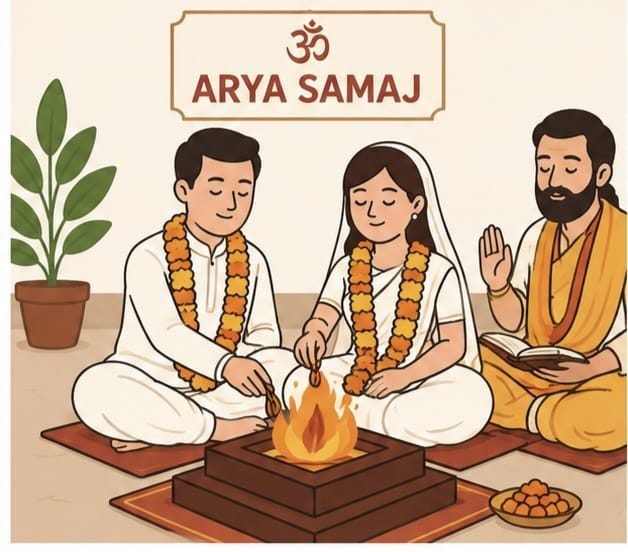
Hindu-Muslim, Hindu-Christian, Hindu-Sikh, Hindu-Jain — legal marriage for all religion combinations. Shuddhi Sanskar (Arya Samaj) or Special Marriage Act (Court) — both options.
Quick answer: Inter-religion marriage in Delhi is legal without changing anyone's religion, done under the Special Marriage Act 1954 (30-day notice) or via an Arya Samaj ceremony with Shuddhi where the couple chooses. Our package starts from ₹10,000. The certificate is government-valid and accepted for apostille and visa. You need age proof, Aadhaar, address proof, photos and two witnesses.
Inter-Religion Marriage Delhi — Complete Legal Guide
Inter-Religion Marriage means marriage between two people of different religions. Special laws have been made for inter-religion couples in multi-religious India to legally protect their marriage. Our Arya Samaj Court Marriage Delhi service helps 3,500+ inter-religion couples each year.
Two main options for Inter-Religion Marriage — (1) Court Marriage Special Marriage Act 1954 (no religion change), (2) Arya Samaj Marriage with Shuddhi Sanskar (non-Hindu partner does Shuddhi). We provide both and suggest best based on your situation.
🕊️ Highlights: Hindu-Muslim ✓ Hindu-Christian ✓ Hindu-Sikh ✓ Religion change optional | Same Day or 30 days | Legal Protection | Embassy valid for Foreign
Option 1: Court Marriage
Most popular option — no religion change needed. Both partners keep their original religion, marriage registered at SDM Office. Religion-neutral, 30-day public notice, 3 witnesses, Government Certificate. Fees from ₹6,100. Read details →
Option 2: Arya Samaj with Shuddhi Sanskar
If you want traditional Hindu ceremony and non-Hindu partner is willing, Shuddhi Sanskar (purification ceremony) is performed first, then Arya Samaj Vivah. Process:
Non-Hindu partner applies for Shuddhi at Arya Samaj Mandir
Pandit Ji performs Shuddhi with Vedic mantras
Shuddhi Certificate issued
Same day or next day Arya Samaj Vivah ceremony
Marriage Certificate issued
SDM Court Registration follows
Benefits: Same Day Marriage, Traditional Vedic ceremony, Religion change formally documented, Hindu Family acceptance easier. Fees from ₹10,000.
Both options available. Court Marriage (no religion change) or Arya Samaj with Shuddhi. Full legal protection. Many successful cases handled.
Hindu-Christian Marriage Delhi
Easily possible under Special Marriage Act. Indian Christian Marriage Act 1872 also an option (Church Marriage). We prefer SDM Court Marriage for stronger legal robustness.
Hindu-Sikh Marriage Delhi
Both fall under Hindu Marriage Act 1955 — Arya Samaj Marriage directly possible, no Shuddhi needed. Court Marriage also an option.
Hindu-Buddhist / Hindu-Jain Marriage
Buddhist and Jain fall under Hindu Marriage Act 1955 — Arya Samaj Marriage directly possible. Same day certificate.
Read This Before You Choose a Route
This page offers two options, and they are both lawful. But they are not equivalent, and the difference between them is not mainly about speed or price — it is about what happens to one of you afterwards. So before the comparison tables, the single most important paragraph on this page:
Do not convert in order to make a wedding faster, cheaper or quieter. The Special Marriage Act, 1954 exists precisely so that two people of different religions can marry with neither of them changing faith. Conversion is a serious and permanent decision about belief, with consequences in succession, in family relationships and increasingly in law. If the only reason anybody is converting is the paperwork, the route you want is the Special Marriage Act — and we will tell you that on the first call even though it moves you to a different service.
The Conversion Laws You Need to Know About
This is the part of the picture that has changed most in recent years, and almost nobody mentions it to couples before they decide.
A number of Indian states now have laws regulating religious conversion — among them Uttar Pradesh (the Prohibition of Unlawful Conversion of Religion Act, 2021), Uttarakhand, Madhya Pradesh, Himachal Pradesh, Gujarat, Chhattisgarh, Jharkhand, Odisha, Haryana, Karnataka, Rajasthan, and more recently Maharashtra. The details differ from state to state and they are amended, but the recurring features matter:
A prior declaration or notice to the District Magistrate is commonly required before a conversion, sometimes from the person converting and sometimes also from the person performing it, with a waiting period.
Conversion carried out solely for the purpose of marriage is commonly treated as unlawful, and in several states a marriage done for the sole purpose of conversion can be declared void.
The consequences can reach the people who arranged it — not only the couple, but whoever performed or abetted the conversion, with enhanced provisions in some statutes where a woman, a minor or a person from a Scheduled Caste or Scheduled Tribe is involved.
In several of these statutes the burden of proof is placed on the person who caused the conversion, rather than on the complainant.
Delhi does not have such a law. But that is not the end of the question, and this is the point couples miss: the law of the state where you live, where your families live and where you will go back to is what will be applied to you. A couple who converts in Delhi and returns to Meerut, Sonipat or Bhopal is going home to a state with its own statute. Check the current position for your own state and take proper legal advice from an advocate before anybody converts. We are not a law firm, we do not advise on this, and we will not pretend to.
What we do in practice. If you are an inter-faith couple and you ask us about shuddhi, the first thing we will tell you is that the Special Marriage Act needs no conversion at all. If, after that and after proper advice, either of you genuinely wishes to adopt a faith for your own reasons, that is your decision and not ours to police. But if what we are hearing is that one party is being pushed into it by the other’s family, or that the reason is a date, we stop.
The Honest Comparison
The table higher on this page compares speed and formalities. This one compares the things people find out later.
Special Marriage Act (no conversion)
Conversion, then a religious marriage
Does anybody change religion?
No
Yes — permanently, unless reversed
Public notice
30 days, displayed at the office, and a copy can be published in each party’s home district
None for the marriage — but several state conversion laws require their own prior declaration to the District Magistrate
Residence
30 days in the district before notice
Not required for the ceremony
Time
About 60 days
Can be same-day for the ceremony
Succession
Succession is regulated by the Indian Succession Act, 1925 for parties married under the Act, with a saving where both parties are Hindu, Buddhist, Sikh or Jain
The personal law of the religion now professed applies — which changes shares for the converting spouse and their children
Joint family / HUF
A marriage under the Act is deemed to effect severance from an undivided family for a member professing the Hindu, Buddhist, Sikh or Jain religion
Conversion has its own consequences for coparcenary and inheritance rights — ask an advocate
Legal risk in a state with a conversion law
None on this ground
Real, and it can attach to the family and the officiant too
If the relationship later fails
Divorce under the Special Marriage Act
Governed by the personal law now applicable — and the converting spouse is usually the one worse off
Read the succession rows twice if either family owns property or runs a business through an HUF. Ask an advocate about them before you give notice or before anybody converts — not afterwards, when the certificate has been issued and the position is fixed.
The Special Marriage Act, Step by Step
The route most inter-faith couples should take, set out properly so that you can plan around it instead of being surprised by it.
Residence. At least one of you must have resided in the district for thirty days immediately before the notice is given. Only one of you, not both. A hotel, a guest house or a friend’s floor for a few weeks is not residence, and an office assessing the claim knows the difference. Noida, Ghaziabad, Gurugram, Faridabad, Sonipat, Kaushambi and Vaishali are not Delhi.
The notice. Both of you give written notice of intended marriage to the Marriage Officer. It is entered in the Marriage Notice Book, which is open to public inspection without fee, and a copy is displayed at the office.
The copy that travels. Where neither of you permanently resides in that district, a copy is sent to the Marriage Officer of the district where each of you permanently resides, to be published there as well. This is the part nobody mentions, and for a couple whose families do not know, it is the single most important fact on this page.
Thirty days. Objections may be made in that window, but only on the ground that the marriage would breach a condition in section 4 — a living spouse, incapacity to give valid consent, the ages of 21 and 18, or the parties being within prohibited degrees. Different religions is not a ground. Family disapproval is not a ground. Caste is not a ground.
If somebody objects. The Marriage Officer cannot solemnise until he has inquired and is satisfied the objection does not prevent the marriage, and he must decide within thirty days. He has civil-court powers for the inquiry. If he refuses, either of you may appeal to the district court within thirty days, and that decision is final. A frivolous objection not made in good faith can carry costs against the person who made it.
Solemnisation. Both parties and three witnesses — three, not two — sign the declaration before the Marriage Officer, who countersigns it. Each of you declares that you take the other as your lawful wife or husband, in any language you understand. No religious ceremony of any kind is required or performed.
The certificate. The Officer enters a certificate in the Marriage Certificate Book, signed by you and the three witnesses. That entry is conclusive evidence that the marriage was solemnised and the formalities complied with — a stronger document than a registration certificate for a ceremony performed elsewhere.
Nothing lawfully shortens either thirty-day period. Not a fee, not a contact, not an expiring visa, not a medical reason. Anybody who says otherwise is proposing a false residence claim or a false document, and a false statement on a marriage record surfaces at exactly the counter you cannot afford to fail.
Planning Around the Notice
For an opposed couple the notice is weak as a legal obstacle and real as a practical one. Both things are true, and the plan follows from that.
Know before you file that the notice is displayed and may be published in your home district. Decide together whether that is acceptable, with the facts in front of you.
Decide where you will both live for those thirty days, and whether that is safe. The residence clock starts the day you actually start living there — so put both names on the rent agreement, keep the receipts, and update one Aadhaar to that address.
Prepare for an objection rather than fearing it: it has a defined length and a defined remedy, and most objections in inter-faith cases allege nothing section 4 covers, so they fail.
Keep documents, money and phones independent. Originals in your own hands, photographs in both email accounts, a bank account in her own name, both numbers live, and one trusted person outside the situation who knows where you are.
If there is a real apprehension of harm, a protection petition before the High Court is a recognised remedy — and it is an advocate’s work, in their own name. We do not draft or file petitions and we take no share of anybody’s fee for them. Emergency 112; women’s helpline 181.
And if you are both Hindu, Sikh, Jain or Buddhist — which some couples who describe themselves as “inter-religion” actually are, because these are treated together under the Hindu Marriage Act — then the Arya Samaj route with registration involves no notice at all, and nobody should sell you sixty days you did not need. Our love marriage page sets out that choice in full.
What Each Combination Actually Looks Like
Practical notes on the pairings we see most, beyond the general position.
Hindu and Muslim. The Special Marriage Act needs no conversion by either of you and is the route we recommend first. Note one consequence specifically: a Muslim party marrying under the Act comes within the Indian Succession Act, 1925 for succession, rather than Muslim personal law — which changes the shares for the spouse and the children, and is sometimes exactly why a couple chooses it and sometimes exactly why they do not. Our Hindu–Muslim marriage guide and our nikah with Special Marriage Act page go through it properly.
Hindu and Christian. Two lawful routes: the Special Marriage Act with no conversion, or a church marriage under the Indian Christian Marriage Act, 1872, which has its own requirements about the minister, the notice and the register, and which a church will explain. Whichever you use, complete the civil paperwork — the document a passport office or an embassy acts on is the government certificate.
Hindu and Sikh, Jain or Buddhist. This is the one couples most often get wrong. For the purposes of the Hindu Marriage Act, 1955, Hindus, Sikhs, Jains and Buddhists are treated together. A couple in this position is not in an inter-religion position at all for marriage law, can marry directly by ceremony — including an Arya Samaj wedding — and needs no notice and no conversion. A Sikh Anand Karaj is registered under the Anand Marriage Act with Delhi’s Anand Marriage Registration Rules, 2018.
Either party a Parsi. The Parsi Marriage and Divorce Act, 1936 governs marriages between two Parsis. For a Parsi marrying outside the community, the Special Marriage Act is ordinarily the route, and there are particular consequences under Parsi law for a Parsi who marries a non-Parsi that are worth asking an advocate about before you proceed.
Either party a foreign national. Add the embassy’s no-impediment certificate, a valid visa covering the whole period, and foreign documents apostilled or attested in the country that issued them. The thirty days’ residence is usually the binding constraint on a short visit, and it is generally easier for the Indian party to be the one who satisfies it. Our NRI marriage page sets out the trip planning.
If You Are Considering Shuddhi
Shuddhi sanskar is a genuine religious process with a long history in the Arya Samaj, and we are not going to pretend otherwise. What we will do is set out, plainly, the conditions under which it is a reasonable choice and the conditions under which it is not.
It may be a reasonable choice where: the person converting genuinely wishes to adopt the faith, for their own reasons, arrived at without pressure and without a deadline; both families understand what is happening; proper legal advice has been taken about the conversion law of the state you actually live in; and the succession consequences have been understood by both of you.
It is the wrong choice where: the reason is that the Special Marriage Act takes sixty days; the reason is the notice; the reason is that somebody’s family has made it a condition; the person converting is not the one who suggested it; or nobody has checked the law of the state you will be living in afterwards. Every one of those is a reason to use the Special Marriage Act instead.
Our fixed rules on this. We tell every inter-faith couple about the Special Marriage Act first. We do not press anybody to convert, ever, and we do not present conversion as the “easy” option. We speak to both parties separately, and if the person converting cannot explain in their own words why they are doing it, or is being answered for by somebody else in the room, we stop — however much has been paid and however angry anybody becomes. And we will not produce a shuddhi certificate for somebody who was not present or did not take part.
What Is True Whichever Route You Take
Nobody’s permission is needed but yours. Two adults may marry, and the consent of family, community or clan is not required — Lata Singh (2006) and Shakti Vahini (2018). In Shafin Jahan v. Asokan K.M. (2018), the Hadiya case, the Supreme Court set aside a High Court order annulling an adult woman’s marriage at her father’s instance and held that the right to choose a partner is part of the liberty and dignity protected by Article 21.
The ages are 21 and 18, under the Prohibition of Child Marriage Act, 2006 and section 4 of the Special Marriage Act. We decline every under-age case at any price, and we decline where a document appears to have been altered.
A living spouse is an absolute bar. Produce a decree of divorce in original or certified copy with the case details legible, or a death certificate — not an affidavit, not a panchayat paper, and not a talaqnama presented as a decree. And note the appeal position on a decree before you fix a date.
Both of you must attend in person, at the ceremony or solemnisation and at the office. There is no power-of-attorney marriage, no proxy and no video-call marriage.
We never provide witnesses — three for a Special Marriage Act solemnisation, two for an Arya Samaj ceremony, each an adult who genuinely knows you, with their own original photo identity and address proof, attending in person.
Complete the government registration. A mandir certificate or a church certificate records the ceremony; the government certificate is what a bank, an employer, an insurer, a passport office, an embassy or a court acts on.
Check the certificate at the counter before you leave — both names and their exact spellings, both fathers’ names, the date, the place, both dates of birth. On an inter-faith file a name written three different ways across three documents is the crack everything else gets stuck in.
Children, Records and the Questions Nobody Asks Until Later
Inter-faith couples are asked more questions by more offices than anybody else, so it is worth knowing the answers in advance.
A child is legitimate whether or not the parents’ marriage was registered, and a marriage certificate is not required to register a birth — the Registration of Births and Deaths Act, 1969 records the birth and the parents’ particulars. If a registrar demands a certificate, ask for the refusal in writing and escalate.
No school form can require a child’s religion to be stated in order to admit them, and under the RTE Act, 2009 no child may be denied admission for want of age proof or for a late application. Our Seemapuri guide covers children’s papers in full.
Succession is where the route you chose actually bites. See the comparison above, and take advice while both of you are alive and well rather than leaving it to be argued about later. A will settles far more than it costs, and in an inter-faith marriage where families are estranged it is the single most useful document after the certificate itself. It is an advocate’s work and we take no share of that fee.
Update every nomination. EPF Form 2 and gratuity Form F nominations do not carry over on marriage, and in an inter-faith marriage a policy still naming a parent is not a small detail. A nominee is a receiver, not an owner — nomination does not override succession law, with a deliberate exception for insurance, where a parent, spouse or child nominee is a beneficial nominee.
Guardianship, adoption and ART. CARA adoption requires proof of two years of a stable marital relationship, and the ART and surrogacy frameworks are built around a legally married couple. Register the marriage before you open any of those files, not after. Our Vivek Vihar guide sets out all three.
Fees
Service
Fee
What it covers
Special Marriage Act (full assistance)
₹15,000
Notice, the thirty days, solemnisation and the government certificate — no conversion by anybody
Hindu–Muslim / inter-religion marriage
₹10,000
As set out on our fees page — ask which route it refers to before you pay
Court marriage assistance
₹6,100
Assistance with the civil registration
Arya Samaj marriage with registration
₹7,100
Ceremony plus SDM registration and the government certificate
Arya Samaj marriage — ceremony only
₹5,100
Ceremony and the mandir certificate; no government registration
Marriage registration (ceremony already held)
₹6,000
Full application, appointment and certificate
Nikah registration
₹6,000
Registration under the Delhi 2014 Order
Duplicate or correction
₹2,500
Application, follow-up and collection
Ask exactly which route a quoted package covers, and get it in writing, before you pay anybody — including us. An inter-faith couple can be quoted for three different processes with three different consequences, and the difference between them is not a detail. Government charges are separate and shown at cost, on their own line of your receipt with our charge on another. The full list is on our fees page, and we do not charge an urgency, distance, weekend or pressure surcharge.
A Realistic Timeline
Your situation
Realistic time
What decides it
Special Marriage Act, one of you already resident 30 days
About 30–35 days from notice
The statutory notice period — nothing else
Special Marriage Act, recently moved in together
About 60 days
30 days’ residence, then 30 days’ notice
An objection is filed
Add up to 30 days, plus an appeal if refused
The Marriage Officer’s inquiry, then the district court
One party a foreign national
60 days plus the embassy’s own timeline
The no-impediment certificate and the visa
Both parties Hindu, Sikh, Jain or Buddhist (not actually inter-religion for marriage law)
Ceremony same day; certificate in a few working days
Originals in hand and two witnesses confirmed
Either party under 21 (groom) or 18 (bride)
Not at all
We decline, at any price
Ten Mistakes Inter-Faith Couples Make
Converting to save time, without checking the conversion law of the state they live in.
Not knowing the notice can be published in the home district.
Believing an agent who says the thirty days can be “managed”.
Claiming a residence they do not have — a false statement that sits on a public record for life.
Bringing two witnesses to a Special Marriage Act solemnisation. Three are needed.
Not asking about succession until after the certificate is issued, when the position is fixed.
Assuming a Hindu–Sikh or Hindu–Jain couple needs the sixty-day route. They do not; those faiths are treated together under the Hindu Marriage Act.
Stopping at a ceremony certificate — mandir or church — without the government registration.
Names spelled differently across the certificate, Aadhaar and passport.
Never updating the nominations, so a policy still pays a parent who has cut off contact.
Four Situations, and What Happened
Anonymised, and each stands for many.
The couple who did not need to convert. A Hindu–Muslim couple came asking about shuddhi, because a relative had told them it was the only way. We told them about the Special Marriage Act on the first call, and about the conversion statute of the state they were going back to. They took the sixty-day route, married without either of them changing faith, and went home with a certificate that nobody could question. It cost us the faster booking and it was obviously the right advice.
The notice that reached home. Neither party permanently resided in the district where notice was given, so a copy went for publication in each of their home districts — and her family learned of it in week two. Nothing unlawful happened and the marriage went through, but nobody had told them it could happen, and the fortnight was far harder than it needed to be.
The objection that failed. An uncle objected during the thirty days. The objection alleged nothing that section 4 covers — it was about the family’s standing. The Marriage Officer inquired, was satisfied it did not prevent the marriage, and the solemnisation went ahead. Three weeks and a great deal of anxiety; no change to the outcome.
The couple who were not inter-faith at all. A Hindu groom and a Sikh bride, quoted sixty days and ₹15,000 by somebody else. For the Hindu Marriage Act, Hindus, Sikhs, Jains and Buddhists are treated together — they could marry directly by ceremony, with no notice and no conversion, and register it. They saved seven weeks and a great deal of money by asking one more person.
What We Will Not Do
We do not press anybody to convert, and we tell every inter-faith couple about the Special Marriage Act first.
We will not produce a shuddhi certificate for somebody who was not present or did not take part, and we stop where the person converting cannot explain in their own words why they are doing it.
We stop if either party is not giving a clear, free yes in their own words — and we speak to both of you alone to find out.
We do not touch an under-age marriage, at any price, and we decline where a document appears to have been altered.
We do not marry anybody while an earlier marriage subsists.
We do not manufacture a residence to fit a notice into a short timeline, and we do not back-date anything.
We do not promise a “secret” Special Marriage Act marriage. The notice is public by statute and nobody can suppress it.
We do not advise on conversion law, succession or property. Those go to an independent advocate acting in their own name, whose fee we take no share of — as do protection petitions, divorce, maintenance and custody.
We never call your family and never confirm to any caller that you are our client.
We do not charge an urgency, distance or pressure surcharge.
Two safety notes. Never hand original documents to somebody who approaches you outside a mandir, a court or an office, and never sign a blank form or blank stamp paper. And nobody from us will ever ask you for an OTP, a UPI PIN, a card PIN, a CVV or a net banking password, or ask you to install a screen-sharing app, or ask you to approve a payment request in order to receive money. If it happens in our name: stop, share nothing, call +91 8376863962, and report it at cybercrime.gov.in or on 1930 — within the first hour if money has gone.
What Happens When You Call Us
You send photographs of your documents on WhatsApp — age proof and identity for both, and anything about a previous marriage. Free, and nothing goes anywhere.
We tell you which routes are genuinely open to you — including telling you when you are not in an inter-religion position at all, and when the answer is “take advice on your state’s conversion law before you decide”.
We explain the succession consequence of each route in plain words, and tell you to put it to an advocate before you give notice.
We speak to both of you, and at some point separately.
You get a written quote naming the exact route, with our charge and the government charges on separate lines, before anything is paid.
We prepare the papers, file the notice and prepare you and your witnesses for the day.
The certificate is checked at the counter before you leave, and we tell you what to do in the month that follows.
Phone and WhatsApp: +91 8376863962. Special Marriage Act ₹15,000 · court marriage assistance ₹6,100 · Arya Samaj marriage with registration ₹7,100 · marriage registration ₹6,000 · nikah registration ₹6,000 · duplicates and corrections ₹2,500. Government charges separate and at cost.
This page is general information about the law and the procedure, not legal advice on your own case. State conversion laws, succession rules, statutes and office allocations change, and the authority in front of you applies the current version — take your own legal advice from an advocate before anybody converts, and confirm procedure on the Delhi e-District portal. We are a marriage documentation and coordination service, not a law firm; we do not practise law and we do not appear anywhere. Emergency 112 · women’s helpline 181.
Inter-Religion Marriage FAQs
Is religion change required after Inter-Religion Marriage?▼
No — Court Marriage under Special Marriage Act requires no religion change. Both partners keep their original religion. Only if you choose Arya Samaj Marriage, the non-Hindu partner needs Shuddhi.
Best option for Hindu-Muslim couple?▼
Depends on your situation. (1) If neither wants religion change — Court Marriage is best. (2) If Muslim partner is ready for Shuddhi and Hindu family acceptance is important — Arya Samaj with Shuddhi is better.
How long does Shuddhi Sanskar take?▼
Shuddhi Sanskar is a 30-45 minute ceremony conducted by Pandit Ji. Includes mantras chanting, Havan, formal declaration. Shuddhi Certificate issued immediately. Marriage can happen same day.
Is Inter-Religion Marriage Certificate valid abroad?▼
Yes — in both cases, Government Marriage Certificate is valid abroad. With Apostille and Embassy attestation, can be used for Spouse Visa, PR, Green Card.
Family threatening us — protection?▼
Yes — Supreme Court (Shakti Vahini) clearly stated providing police protection to inter-religion couples is state's duty. Protection order arranged in 2-3 days.
Do children of Inter-Religion Marriage have different legal status?▼
No — children are fully legal with all rights to inheritance, property, education. Parents decide child's religion — usually father's, but child can choose own religion when adult.
Do either of us have to change religion to marry?▼
No. The Special Marriage Act, 1954 exists precisely so that two people of different religions can marry with neither of them changing faith. If somebody is telling you conversion is the only way, that is wrong — and if the only reason for converting is that the paperwork is faster or quieter, that is the clearest possible sign to use the Special Marriage Act instead.
Is it risky to convert just so we can marry faster?▼
Yes, and this is the part almost nobody mentions before a couple decides. A number of states now have laws regulating religious conversion — among them Uttar Pradesh (2021), Uttarakhand, Madhya Pradesh, Himachal Pradesh, Gujarat, Chhattisgarh, Jharkhand, Odisha, Haryana, Karnataka, Rajasthan and more recently Maharashtra. Several require a prior declaration or notice to the District Magistrate with a waiting period; several treat a conversion carried out solely for the purpose of marriage as unlawful and allow such a marriage to be declared void; several place the burden of proof on the person who caused the conversion; and the consequences can reach whoever performed or abetted it, not only the couple. Details differ by state and are amended — check your own state and take advice from an advocate before anybody converts.
Delhi has no conversion law, so are we safe?▼
Delhi does not have such a law, but that is not the end of the question. The law of the state where you live, where your families live and where you will go back to is what will be applied to you. A couple who converts in Delhi and returns to Meerut, Sonipat or Bhopal is going home to a state with its own statute. Take proper legal advice for your own state before deciding.
Which route do you recommend for an inter-faith couple?▼
The Special Marriage Act, first and by default, because nobody changes faith and nothing about it can be challenged on that ground later. We say this on the first call even when it moves the couple to a different service than the one they rang about. Where a couple genuinely wishes to convert for reasons of belief, arrived at without pressure and with proper advice, that is their decision — but it should be a decision about faith, not about a date.
How long does the Special Marriage Act really take?▼
About sixty days from a standing start: at least one of you must have resided in the district for thirty days before the notice is given, and the notice is then published for thirty days before solemnisation. If one of you already satisfies the residence requirement, about thirty to thirty-five days from the notice. If an objection is filed, add up to thirty days for the inquiry, and longer if there is an appeal.
Can the 30-day notice be shortened or avoided?▼
Not by any fee, contact or emergency — it is in the statute. It can only be avoided by using a different lawful route, which exists only where both parties are Hindu, Sikh, Jain or Buddhist. Anybody promising an “urgent” or “secret” Special Marriage Act marriage is proposing a false residence claim or a false document.
Where is the notice displayed, and can our families see it?▼
The notice is entered in the Marriage Notice Book, which is open to public inspection without fee, and a copy is displayed at the office. And where neither of you permanently resides in that district, a copy is sent to the Marriage Officer of each party's district of permanent residence, to be published there too. That last part is the single most important thing for a couple whose families do not know, and it is almost never mentioned in advance.
Can our families object because we are of different religions?▼
No. An objection can only be made on the ground that the marriage would breach a condition in section 4 — a living spouse, incapacity to give valid consent, the ages of 21 and 18, or the parties being within prohibited degrees. Different religions is not a ground. Family disapproval is not a ground. Caste is not a ground. An objection alleging those is not a valid objection at all.
What happens if somebody does object?▼
The Marriage Officer cannot solemnise until he has inquired into the objection and is satisfied it does not prevent the marriage, and he must decide within thirty days of it being made, with civil-court powers for the inquiry. If he upholds it and refuses, either of you may appeal to the district court within thirty days and that decision is final. Where an objection is frivolous and not made in good faith, costs can be awarded against the person who made it. Most objections in inter-faith cases allege nothing section 4 covers and fail for that reason.
Does marrying under the Special Marriage Act change who inherits from us?▼
Yes, and it is the consequence couples most often learn about too late. The Act provides that succession to the property of a person married under it is regulated by the Indian Succession Act, 1925 rather than the personal law that would otherwise apply, with a specific saving where both parties are Hindu, Buddhist, Sikh or Jain. For a Muslim party this means the Indian Succession Act rather than Muslim personal law, which changes the shares for the spouse and the children. Ask an advocate about it before you give notice, not after the certificate is issued.
Does it affect a joint family or HUF?▼
Yes. The Act provides that where a member of an undivided family professing the Hindu, Buddhist, Sikh or Jain religion marries under it, the marriage is deemed to effect his severance from that undivided family. In a family holding ancestral property or running a business through an HUF that is a real consequence, and it is a question for an advocate before the notice rather than after.
We are Hindu and Sikh. Is that an inter-religion marriage?▼
For marriage law, no — and this is the mistake that costs couples the most. Under the Hindu Marriage Act, 1955 Hindus, Sikhs, Jains and Buddhists are treated together. Such a couple can marry directly by ceremony, including an Arya Samaj wedding, with no notice period and no conversion by anybody, and then register it. If you have been quoted sixty days and ₹15,000 for this, ask one more person. A Sikh Anand Karaj is registered under the Anand Marriage Act with Delhi's Anand Marriage Registration Rules, 2018.
What are the options for a Hindu–Muslim couple?▼
The Special Marriage Act, with no conversion by either of you, is the route we recommend first. Note one consequence specifically: a Muslim party marrying under the Act comes within the Indian Succession Act, 1925 for succession rather than Muslim personal law, which changes the shares for the spouse and children — sometimes exactly why a couple chooses it and sometimes exactly why they do not. Our Hindu–Muslim marriage guide and our nikah with Special Marriage Act page set it out properly.
What about a Hindu–Christian couple?▼
Two lawful routes: the Special Marriage Act with no conversion, or a church marriage under the Indian Christian Marriage Act, 1872, which has its own requirements about the minister, the notice and the register and which the church will explain. Whichever you use, complete the civil paperwork — a passport office or an embassy acts on the government certificate, not on a church certificate alone.
One of us is a Parsi. What applies?▼
The Parsi Marriage and Divorce Act, 1936 governs marriages between two Parsis. Where a Parsi marries outside the community the Special Marriage Act is ordinarily the route, and there are particular consequences under Parsi law for a Parsi who marries a non-Parsi. That is a question to put to an advocate before you proceed rather than after.
One of us is a foreign national. What changes?▼
Add the embassy's no-impediment certificate, a valid visa covering the whole period including the paperwork days, and foreign documents apostilled or attested in the country that issued them. The thirty days' residence is usually the binding constraint on a short visit, and it is generally easier for the Indian party to be the one who satisfies it. Our NRI marriage page sets out how to plan the trip backwards from the departure date.
How many witnesses do we need?▼
Three for a solemnisation under the Special Marriage Act — three, not two, and bringing two is one of the commonest reasons a date has to be rescheduled. Two for an Arya Samaj ceremony. Each must be an adult who genuinely knows you, carrying their own original photo identity and address proof, attending in person.
Can you arrange witnesses for us?▼
No — not for a fee, not as a favour, and not because your families will not come. It is a fixed term of how we work. A paid witness is a false statement to a public authority, and on an inter-faith marriage that may one day be examined — at a visa interview, in a succession dispute, in a police complaint — it is a weakness you would be building in deliberately.
What counts as 30 days' residence?▼
What the office is really assessing is whether you actually live there. An Aadhaar showing the local address, a rent agreement, utility bills, a bank statement, an employer's letter or a landlord's declaration are what is usually put forward. A hotel, a guest house or a friend's floor for a few weeks is not residence. And Noida, Ghaziabad, Gurugram, Faridabad, Sonipat, Kaushambi and Vaishali are not Delhi, however close they feel.
Will you prepare an affidavit so we can give notice sooner?▼
No. We will not draft a residence claim for an address you do not live at, arrange a rent agreement for a room you have never occupied, or file a notice on a document we can see was made for the purpose. A false residence claim sits on a public record for the rest of your life and surfaces at the worst possible counter.
Do we need our families' permission?▼
No, in any form. Two adults may marry and the consent of family, community or clan is not required — Lata Singh (2006) and Shakti Vahini (2018), where the Supreme Court laid down directions for the police and district administration. In Shafin Jahan v. Asokan K.M. (2018), the Hadiya case, the Court set aside a High Court order annulling an adult woman's marriage at her father's instance and held that the right to choose a partner is part of the liberty and dignity protected by Article 21.
We are frightened for our safety. What can be done?▼
A couple with a real apprehension of harm can approach the High Court for protection, and the police have a duty to act. That is an advocate's work — drafted and filed in their own name — and we do not draft or file petitions or take any share of that fee. What helps the petition is specifics: who, when, what was said, and dated evidence, so save threatening messages. Practically: keep documents in your own hands with photographs in both email accounts, a bank account in her own name, both phones live, and one trusted person outside the situation who knows where you are. Emergency 112, women's helpline 181.
Is a shuddhi certificate a marriage certificate?▼
No. Shuddhi records a conversion. The marriage is a separate thing, and the document that a bank, an employer, an insurer, a passport office, an embassy or a court acts on is the government marriage certificate issued after registration. A mandir certificate records the ceremony and is what the registration is filed with.
Will you perform shuddhi if we ask?▼
We tell every inter-faith couple about the Special Marriage Act first, and we do not present conversion as the easy option or press anybody towards it. Where somebody genuinely wishes to adopt the faith for their own reasons, having taken advice about the law of the state they live in, that is their decision. We will not produce a shuddhi certificate for somebody who was not present or did not take part, and we stop where the person converting cannot explain in their own words why they are doing it, or is being answered for by somebody else in the room.
What are the age limits?▼
21 for the groom and 18 for the bride, under the Prohibition of Child Marriage Act, 2006 and section 4 of the Special Marriage Act. We decline every under-age case at any price, whoever is asking and however the situation is explained, and we also decline where a document appears to have been altered.
One of us was married before. What do you need?▼
A decree of divorce in original or certified copy with the case details legible, or a death certificate — not an affidavit saying the marriage “is finished”, not a panchayat paper, and not a talaqnama presented as a decree. Where there is a decree, the appeal position affects when a party may lawfully remarry, so have your advocate confirm it in writing before you fix a date. A living spouse is an absolute bar under section 4.
Can one of us attend by power of attorney?▼
No. Both parties must be physically present, at the solemnisation or ceremony and at the office. There is no power-of-attorney marriage, no proxy marriage and no video-call marriage in India.
Will our children face problems because we are of different religions?▼
Not legally. A child is legitimate whether or not the parents' marriage was registered, and a marriage certificate is not required to register a birth — the Registration of Births and Deaths Act, 1969 records the birth and the parents' particulars, and if a registrar demands a certificate, ask for the refusal in writing and escalate. Under the RTE Act, 2009 no child may be denied admission for want of age proof or for a late application. What does matter is completing your own registration, so that the family record is coherent from the start.
Should we make a will?▼
In an inter-faith marriage, especially where families are estranged, it is the single most useful document after the certificate itself — because the succession position depends on the route you took and on which personal law applies, and intestacy lets the law decide rather than you. It is an advocate's work, it costs little against what it settles, and we take no share of that fee.
What should we update after the marriage?▼
Every nomination first — EPF Form 2 and gratuity Form F nominations do not carry over on marriage, and in an inter-faith marriage a policy still naming a parent is not a small detail. Note also that a nominee is a receiver, not an owner: nomination does not override succession law, with a deliberate exception for insurance where a parent, spouse or child nominee is a beneficial nominee. Then Aadhaar and bank KYC, employer records and medical cover, and consider a will.
Which fee applies to us?▼
Special Marriage Act full assistance is ₹15,000; court marriage assistance ₹6,100; Arya Samaj marriage with registration ₹7,100 and ceremony only ₹5,100; marriage registration ₹6,000; nikah registration ₹6,000; duplicates and corrections ₹2,500. There is also an inter-religion figure of ₹10,000 on our fees page — ask exactly which route a quoted package covers, and get it in writing, before you pay anybody including us. An inter-faith couple can be quoted for three different processes with three different consequences, and the difference is not a detail.
Do you charge more if it is urgent?▼
No, never — not for urgency, distance, a weekend, a visa deadline or family pressure. Government charges are separate and shown at cost on their own line of your receipt, with our charge on another.
What if one of us is being pressured?▼
We stop. We speak to both of you separately, in a language each of you is comfortable in, and if somebody has been brought as a translator and is answering on the person's behalf we ask them to step outside. We do not accept an answer from anybody other than the two people marrying. If the answer is not a clear yes from each of you in your own words, we do not proceed — however much has been paid. If you are the one who is unsure, ask to speak to us alone; you will not be argued with and nothing will be repeated to the people waiting.
Will you tell our families that we contacted you?▼
No, never. We do not call families, we do not confirm to any caller or visitor that you are our client, and we do not discuss one couple with another. If there is a particular number or name to be careful about, tell us at the start and it goes on your file. The one thing confidentiality cannot do is suppress a Special Marriage Act notice, which is public by statute.
Do you give legal advice on conversion or succession?▼
No. We are a marriage documentation and coordination service, not a law firm. Conversion law, succession, property, protection petitions, divorce, maintenance and custody go to an independent advocate acting in their own name, whose fee we take no share of. This page is general information; state conversion laws and succession rules change, and the authority in front of you applies the current version.
What is the most useful thing we can do today?▼
Send photographs of your documents on WhatsApp to +91 8376863962 — free, and it tells you within minutes which routes are genuinely open to you, including whether you are in an inter-religion position at all. And before anybody converts, put one question to an advocate: what does the conversion law of the state we actually live in say? Those two steps between them prevent most of what goes wrong for couples in your position.
Arya Samaj Court Marriage Delhi — Government Registered Arya Samaj Mandir for Same Day Arya Samaj Marriage, Court Marriage Registration, Love Marriage, Inter-Caste Marriage, Inter-Religion Marriage, NRI Marriage in Delhi NCR. Services available in Delhi, Noida, Greater Noida, Gurgaon (Gurugram), Ghaziabad, Faridabad, Chandigarh, Jaipur, Lucknow, Meerut, Agra, Dehradun, Patna, Ludhiana, Mathura, Rohtak, Panipat, Sonipat, Ambala. Marriage under Hindu Marriage Act 1955, Special Marriage Act 1954, Arya Samaj Marriage Validation Act 1937. Same Day Mandir Certificate + SDM Court Government Registration. Marriage Documents, Fees, Process, Apostille, Embassy Attestation for USA, Canada, UK, Australia, Dubai, Singapore. Free consultation • 24/7 WhatsApp • 50,000+ Happy Couples • 25+ Years Experience.
📚 Knowledge Hub
Trending Marriage Guides
Expert articles on every marriage topic — read before you decide