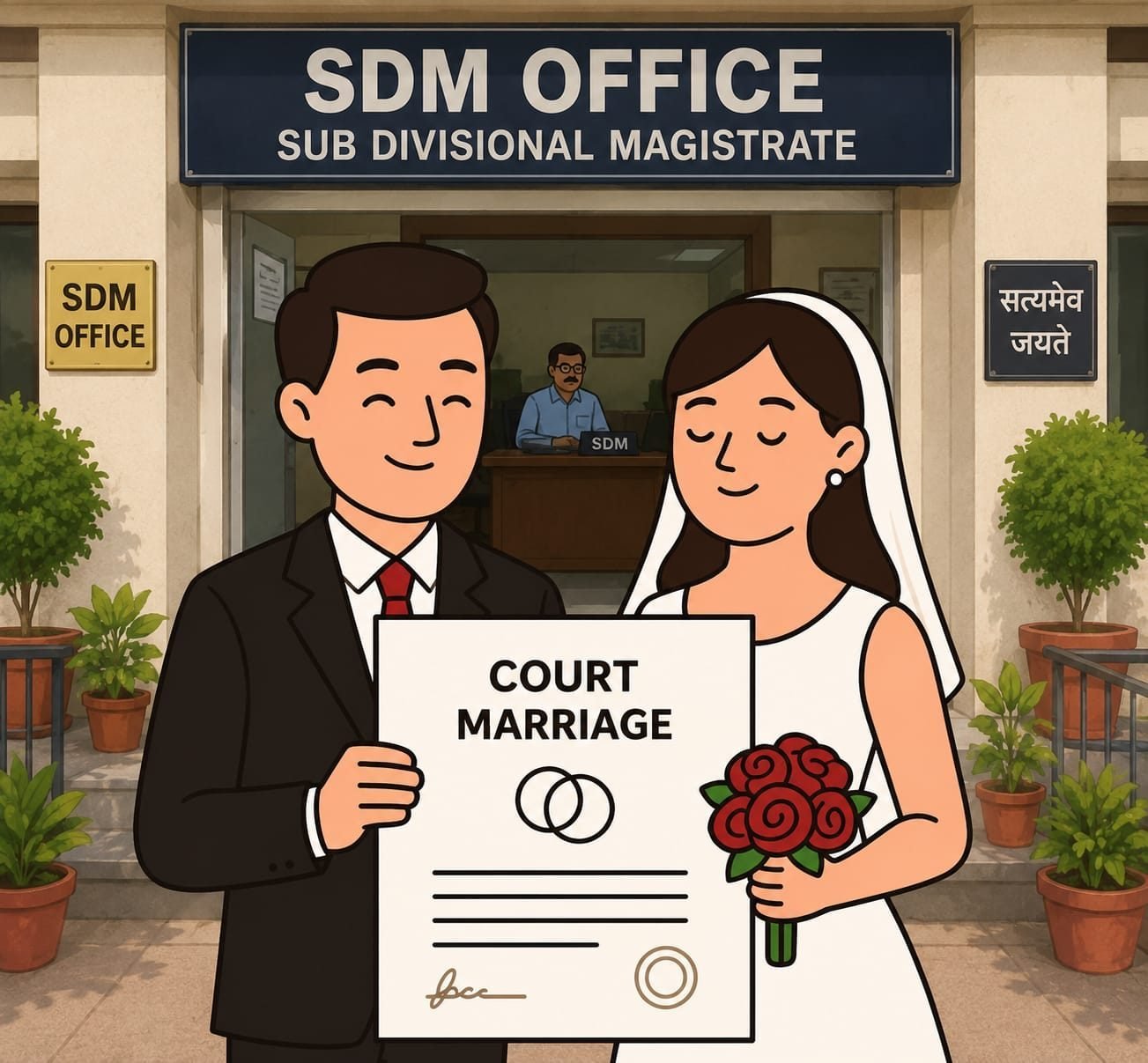
What an Arya Samaj Mandir Actually Is
Type “Arya Samaj mandir in Delhi” into a search box and what comes back is addresses. Ninety of them, a hundred of them, ranked one to a hundred in a table, with pin codes. Almost none of those pages tell you the one thing a couple needs to know before they go anywhere, which is what the building can do and what it cannot do.
So this page starts there, and it is going to be blunt about it.
An Arya Samaj mandir is a place of worship belonging to a reform movement founded in 1875. It is not a government office. It is not a court. It is not a registry. Nobody inside it is a public servant, and nothing it issues is a government document.
What it does, and this is not a small thing, is perform a wedding. A priest, a fire, the Vedic rites, the seven steps, two witnesses, a register of its own in which the ceremony is entered, and a certificate on its own letterhead at the end of the afternoon.
And in law, that ceremony is the marriage. Not a preparation for the marriage. Not a religious formality to be confirmed later by somebody official. The ceremony is the act by which two people become husband and wife, and it is complete on the day it happens.
What the mandir does not do is put your marriage into the record the State keeps. That is a separate act, done by a different officer, under a different provision, in a different building — and it is the step at which most of the confusion in this market lives.
Two certificates exist. They are not the same certificate. They do not do the same work. And a great many couples in Delhi walk away with one of them believing they have both.
This page sets out, from the words of the statute itself, exactly where the line falls:
why the ceremony alone already married you; why your marriage stays perfectly valid even if it is never registered anywhere; and why, despite that, the government entry is the thing that will actually be asked for — by a passport office, a bank, an insurer, a visa officer, a hospital, or a court — for the next forty years.
We also tell you, further down this page, why we do not print a list of a hundred mandir addresses, and we give the reason plainly rather than pretending the list is coming soon.
Read This Before the Rest: What We Are, and What We Are Not
This page is about a category of institution that we belong to, so our position has to be stated at the top rather than buried at the bottom.
We are one Arya Samaj mandir in Delhi, and we are telling you about our own work. We perform the Vedic ceremony here, and we get marriages entered on the government register. That is the whole of what happens at this office.
We do not rank, grade, certify, recommend or vouch for any other mandir, anywhere. We have no list of approved ones and no list of bad ones. If another mandir in this city does good, careful work, we are glad of it and we are not in a position to confirm it in writing to a stranger on the internet.
We are not a government body and we have no authority delegated from one. No mandir in India does. Any mandir, including this one, that lets you believe otherwise is doing you harm.
We are not advocates and we do not practise law. Nobody here appears in any court, files any application, drafts any pleading, or acts for anybody in any proceeding. We do not advise on divorce, maintenance, custody, domestic violence, succession, property, or any dispute. Where the honest answer to your question is “see an advocate”, that is the answer you will get, free, on the first call.
We do not perform or register a marriage for anybody below the legal age, at any price, under any pressure, for any reason, and no amount of family consent changes that. It is the one line on this website that has no exceptions and no further explanation.
We do not supply witnesses. There is no figure at which this office provides one, and any establishment that offers to arrange a witness for you should be refused on the spot. Later on this page we explain exactly why, and it is not a moral point — it is about what happens to that document in fifteen years.
We do not suggest, arrange, require or facilitate anybody's conversion to anything, and we hold no view on anybody's caste, community or faith.
And we do not write a ceremony date for an afternoon that did not happen. Not for a passport file, not for a visa, not for a landlord, not for a family. The request comes to us regularly and the answer has never once been yes.
Section 7: Why the Afternoon Is the Marriage
The legal weight of what happens in a mandir comes from one short section of the Hindu Marriage Act, 1955, and the section does not mention temples, priests, certificates or registers at all.
Section 7(1):
“A Hindu marriage may be solemnized in accordance with the customary rites and ceremonies of either party thereto.”
Section 7(2):
“Where such rites and ceremonies include the saptpadi (that is, the taking of seven steps by the bridegroom and the bride jointly before the sacred fire), the marriage becomes complete and binding when the seventh step is taken.”
Read what sub-section (2) actually fixes. It does not say the marriage is complete when a certificate is signed, or when a register is written up, or when a fee is paid, or when a photograph is taken. It says the marriage becomes complete and binding when the seventh step is taken.
A moment, in a room, with no paper in it.
That is the most important sentence on this entire website, and it cuts in a direction that costs us money. It means a couple who were married in an Arya Samaj mandir in 2011 and have never registered anything are married, were married that day, and have been married for fifteen years. Not nearly married. Not married subject to confirmation. Married.
So nobody should ever be frightened into a hurried registration by being told their marriage “is not valid yet”. If anybody says that to you — a tout outside a court, a man on a phone, or for that matter a mandir — they are either mistaken or working on you.
Whose rites, though? That question has its own answer, and the words “of either party thereto” in sub-section (1) are doing real work in a mixed marriage: the rites of one side are sufficient and the Act does not require both. Our Dwarka Sector 6 page takes that phrase apart properly, and if your two families follow different customs it is worth reading before the day.
One honest note on the wording. Published copies of the Act differ slightly on section 7(2): two independent copies we read give “before the sacred fire”, while a third prints simply “before the fire”, and the transliteration of the Sanskrit appears variously as saptpadi and saptapadi. Nothing legal turns on either difference, and we print it only because this page quotes statute and we would rather you knew which copy we were reading.
Section 8, All Five Sub-Sections, Because Nobody Prints Them
Registration sits in the very next section, and in nine years of doing this work we have never once seen a competitor's page quote it in full. It is quoted in full here, all five sub-sections, because every real answer about mandir certificates is inside it.
Section 8(1) — the purpose, stated by Parliament itself:
“For the purpose of facilitating the proof of Hindu marriages, the State Government may make rules providing that the parties to any such marriage may have the particulars relating to their marriage entered in such manner and subject to such conditions as may be prescribed in a Hindu Marriage Register kept for the purpose.”
Section 8(2) — the power to make it compulsory, and the penalty:
“Notwithstanding anything contained in sub-section (1) the State Government may, if it is of opinion that it is necessary or expedient so to do, provide that the entering of the particulars referred to in sub-section (1) shall be compulsory in the State or in any part thereof, in all cases or in such cases as may be specified, and whether any such direction has been issued, any person contravening any rule made in this behalf shall be punishable with fine which may extend to twenty-five rupees.”
Section 8(3) — the rules go before the legislature:
“All rules made under this section shall be laid before the State Legislature, as soon as may be, after they are made.”
Section 8(4) — and this is the sub-section that explains the whole market:
“The Hindu Marriage Register shall at all reasonable times be open for inspection, and shall be admissible as evidence of the statements therein contained and certified extracts therefrom shall, on application, be given by the Registrar on payment to him of the prescribed fee.”
Section 8(5) — and this is the sub-section nobody in this trade wants you to read:
“Notwithstanding anything contained in this section, the validity of any Hindu marriage shall in no way be affected by the omission to make the entry.”
Five sub-sections, and between sub-section (4) and sub-section (5) sits the entire honest answer to “do I need to register or not”. We take them one at a time in the next three sections, because each one is being misquoted to somebody in this city today.
“Shall In No Way Be Affected by the Omission to Make the Entry”
Start with sub-section (5), because it is the one that protects you and the one that is quietly left out of almost every page on this subject.
“Notwithstanding anything contained in this section, the validity of any Hindu marriage shall in no way be affected by the omission to make the entry.”
Parliament wrote that sentence into the Act on purpose, and it is doing one specific job: it stops registration from becoming a trap.
Three consequences, and all three of them matter to real households.
One — an unregistered Hindu marriage is a valid marriage. The children are legitimate. The wife is a wife. The husband is a husband. Nothing about the relationship is provisional. A couple married at a mandir in 1998 who never went near an SDM are as married as a couple who registered the same week.
Two — nobody can be made to pay for the fear of invalidity, because the fear has no basis. The commonest sales line in this market is a variation of “your marriage will not be considered valid without this”. Sub-section (5) is the answer to it, in Parliament's own words. If you are told that sentence by anybody, including by a mandir, you are being handled.
Three — there is no deadline, because there is no forfeiture. Since validity is untouched by the omission, nothing expires while the entry is not made. That is why a wedding from 1998 can be registered in 2026 and nothing has been lost in between. Our late registration page walks through that step by step, and the only cost of the delay is one of two fixed amounts under Delhi's 2014 Order — ₹500 if you are inside the second stretch of sixty days, ₹1,000 once past it, and the ADM or the DM may waive either.
We earn our living from registrations, and sub-section (5) is the provision that most weakens our sales pitch. It is on this page, quoted whole, because a couple who register because they understand why will be better served than a couple who register because somebody scared them.
“Admissible as Evidence” — and Why the Mandir’s Own Book Is Not That Register
Now sub-section (4), which is the reason to register despite everything sub-section (5) says.
“The Hindu Marriage Register shall at all reasonable times be open for inspection, and shall be admissible as evidence of the statements therein contained and certified extracts therefrom shall, on application, be given by the Registrar on payment to him of the prescribed fee.”
Three separate things are granted in that one sentence, and all three attach to a particular book.
First, the register is open to inspection at all reasonable times. It is a public record. Somebody who needs to check it can.
Second — and this is the sentence that decides everything — it is “admissible as evidence of the statements therein contained”. The entry is not merely a note somebody made. The statute itself declares the register evidence of what is written in it.
Third, certified extracts must be given on application on payment of the prescribed fee. So the document is reissuable. Lose your certificate in 2041 and the register is still there and a certified extract can still be obtained.
And now the uncomfortable part, which is what this page exists to say.
“The Hindu Marriage Register” in sub-section (4) means the register kept under rules made by the State Government under sub-section (1). It does not mean the register a mandir keeps on a shelf in its own office.
A mandir's register is a private record of a private institution. It is honest, it is contemporaneous, it is often beautifully kept, and in a dispute it is a piece of material that may well be put before a court and relied upon. What it is not is the book that section 8(4) is talking about. It is not open for public inspection by right. No statute declares it admissible evidence of the statements contained in it. And nobody has a duty to give you a certified extract from it — because the institution that holds it has no statutory obligation to exist in twenty years.
That last point is the one couples never think about and the one we see go wrong most often. A mandir is a private body. It can move premises. It can change hands. Its register can be lost in a flood, a fire, a family dispute or a shutter that simply stops opening. The State's register cannot quietly cease to exist, and when areas in Delhi were remapped during 2026 the registers went where their areas went rather than being destroyed.
So the honest comparison is not “real certificate versus fake certificate”. It is this: the mandir's certificate proves a ceremony took place and depends on the mandir. The government's certificate is an extract from a register that the Act itself makes evidence, and it depends on the State. Forty years is a long time to bet on a shutter.
And one honesty note on this very sub-section, which matters because it is the sub-section everything here rests on. Two independent published copies of the Act give the opening words as “The Hindu Marriage Register shall at all reasonable times be open for inspection”. A third published copy prints “The Hindu Marriage Registrar” — which reads as an error, since a registrar is a person and cannot be open for inspection or admissible as evidence. We rely on the two copies that agree and we print the discrepancy rather than quietly choosing. If you are putting a clause reference on paper, take the wording from the copy of the Act in front of the officer.
Twenty-Five Rupees
There is a detail in sub-section (2) that almost nobody has read, and once you have read it the whole subject stops being frightening.
Sub-section (2) lets a State Government make registration compulsory — in the whole State or part of it, in all cases or in specified cases. And then it says what happens to a person who contravenes a rule made under that power:
“…shall be punishable with fine which may extend to twenty-five rupees.”
Twenty-five rupees. That is the maximum fine in the section.
We print that figure for one reason and it is not amusement. The entire architecture of this market runs on the suggestion that failing to register is a serious legal default with serious consequences. Parliament's own maximum penalty for contravening a compulsory-registration rule, as the provision stands in the copies we read, is twenty-five rupees.
Which tells you precisely what section 8 is for. It is not a licensing regime and it is not an offence-creating provision with teeth. Sub-section (1) says what it is for in its own first seven words: “For the purpose of facilitating the proof of Hindu marriages”. That is all it is. A proof mechanism.
So the correct reason to register is not fear of a penalty and not fear of invalidity. It is sub-section (4): you want the entry in the book that the Act makes evidence, because in twenty years somebody will ask you to prove something and the easiest way to prove it is to hand over a certified extract. That is a good reason. It does not need to be dressed up as a legal emergency, and we do not dress it up.
A caution on the figure itself, because this page quotes statute. Twenty-five rupees is the amount in the published copies of the Act we read. Rupee figures in statutes from the 1950s are amended more often than the text around them suggests, and whether any compulsory-registration rule is in force for your area at all is a separate question again. We print the number because a provision shown without its penalty misleads more than one shown with it, not because we are warranting it as current.
The Two Certificates, Side by Side
Everything above, reduced to the comparison a couple actually needs before they decide what to pay for.
| The mandir’s certificate | The government certificate |
|---|
| Who issues it | A private institution — the mandir itself, on its own letterhead, from its own register | A public officer, from the register kept under rules made under section 8(1) |
| What it proves | That a ceremony was performed, on a stated date, before stated witnesses | That the particulars of the marriage stand entered in a register the Act itself makes “admissible as evidence of the statements therein contained” |
| When you get it | The same afternoon, at the end of the rites | After the registration step, which is a separate act before a different officer |
| Is it a government document | No. No mandir in India issues a government document, and any that implies otherwise is misleading you | Yes |
| Public inspection by right | No | Yes — “open for inspection” at all reasonable times under s.8(4) |
| Can you get a fresh copy in 2046 | Only if that institution still exists, still holds the book, and chooses to help | Yes — “certified extracts therefrom shall, on application, be given… on payment… of the prescribed fee” |
| Does the marriage depend on it | No — s.7(2): complete and binding when the seventh step is taken | No — s.8(5): validity “shall in no way be affected by the omission to make the entry” |
| What will actually be asked for | Occasionally accepted as supporting material; routinely not enough on its own | What a passport office, bank, insurer, visa section, employer or hospital will ask to see |
Read the last row twice, because it is where the money is. The legal position and the practical position point in different directions, and both are true at once. Legally, neither certificate is what makes you married. Practically, the counters of the world are organised around one of them and not the other.
And a limit on every row above. The two right-hand columns describe what the Act says and what offices in our experience ask for. No row tells you what any particular officer, bank, consulate or court will accept in your case, and no row is advice. Acceptance practice varies by institution and changes without notice.
How to Tell a Working Mandir From a Shop
Because we are one mandir among many and we will not grade the others, the useful thing we can do is tell you what to look at. Everything below is a question you can ask on the telephone before you travel anywhere, and none of it requires you to know any law.
One — ask whether the ceremony and the registration are the same thing. The correct answer is no, with an explanation. If the person on the phone blurs them together, or says the mandir certificate “is” the government certificate, stop there.
Two — ask whether your marriage will be valid without registration. The correct answer is yes, under section 8(5). An answer of “no, not valid” is either ignorance or a sales technique, and neither is what you want on the day of your wedding.
Three — ask whether they will supply witnesses. The correct answer is no. A place that offers to produce two men you have never met is handing you a document with a weakness built into it on purpose.
Four — ask whether both of you have to be physically present. The correct answer is yes, both, on the day, with originals. Anybody willing to do it with one party absent is willing to do worse.
Five — ask what the total is, broken into their charge and the State's charge. A place that quotes one lump sum and will not separate the government portion is a place where you will not be able to tell later what you paid for.
Six — ask whether they will write an earlier date. The correct answer is a flat no. If the answer is anything else, understand what is being offered: a document with a false statement in it, in your name, which you will be the one holding when somebody asks about it.
Seven — ask whether they require either of you to convert. Our answer is that we neither suggest nor arrange any conversion. If a place tells you a conversion is necessary before it will perform your ceremony, that is a decision about your faith being presented to you as paperwork.
Eight — ask what they are not able to do. Any institution that has been doing this seriously for years has a list and will give it to you without being pushed. A place with no limits is a place with no standards.
And one thing that is not a test, although everybody treats it as one. A long list of mandir names on a website, a rank number next to each, or a line claiming an institution is approved or recognised, tells you nothing whatever. Nobody ranks mandirs and no register of approved ones exists. Which brings us to the next section, and to the reason this page looks different from the ones you have been reading.
Why This Page Does Not List a Hundred Addresses
If you have searched this subject for ten minutes, you have seen the same thing four or five times: a table of eighty or ninety or a hundred Arya Samaj mandirs in Delhi, numbered, with addresses and pin codes, sometimes with a line next to each one saying it is government registered.
We are not going to publish that list, and you are entitled to the reason.
First — we cannot verify it, and neither can the people publishing it. To state in writing that a particular institution at a particular address performs valid ceremonies, keeps a proper register, and will still be reachable in a decade, you would have to have checked each one. Nobody compiling a hundred-row table has done that. What those tables mostly are is addresses copied from one website to the next, which is how an address that closed in 2019 is still being published in 2026.
Second — the phrase “government registered” next to a mandir's name does not mean what a reader thinks it means. A society or trust can be registered as a body. That is a fact about the organisation, not a certification of its ceremonies and not any kind of government approval of it as a marriage venue. There is no government list of approved mandirs to be on. Printing those two words beside ninety names manufactures a reassurance that does not exist.
Third — a list of addresses answers the wrong question. A couple searching for a mandir does not actually need ninety options. They need to know what the ceremony does in law, what it does not do, what the second step is, what it costs in total, and how to recognise a place that will do it properly. That is what this page is for, and it is why this page is long and the tables are provisions rather than pin codes.
What we will tell you, straightforwardly, is where we are and what we charge, and that is on this page. If you want to use a different mandir, use a different mandir — take the eight questions in the section above and ask them, and you will learn more in four minutes on the telephone than from any ranked table on the internet.
And if a page you are reading has a hundred addresses and no statute on it, notice what that tells you about who it was written for.
What Actually Happens on the Day, Hour by Hour
Couples arrive nervous because nobody has described the afternoon to them. So here it is, in order, with no mystique attached to any of it.
Before you come. You send photographs of your documents on WhatsApp — any hour, in any order, badly lit is fine. Somebody here looks at them and tells you three things: which route your facts belong to, what is missing, and what the total is. That costs nothing and takes about ten minutes, and its real purpose is to find the one missing paper before you have travelled across Delhi rather than after.
On arrival. Originals are checked against the photographs already sent. Names are read out as printed and the spellings are settled before anything is written anywhere. This is the five minutes that prevents the most common and most annoying problem in this whole business, which is a certificate that spells a name differently from the Aadhaar card.
The forms. Particulars are filled in: both names as the documents spell them, both fathers' names, both dates of birth, both addresses, the two witnesses' details. Read every line before you sign it. If a line is wrong, say so then; it is a two-minute correction on the day and a long errand afterwards.
The ceremony. The havan is lit. The priest conducts the Vedic rites. There are mantras, offerings into the fire, the exchange of garlands, and the saptapadi — the seven steps taken together. Under section 7(2) the marriage becomes complete and binding at the seventh step, so there is a precise moment in the afternoon at which the two of you stop being two people planning a wedding. Most couples do not notice it going past. It is worth knowing which moment it was.
How long. The rites themselves take roughly an hour to an hour and a half depending on how full a version you want. Nobody is hurried and nobody is padded out.
The signing. You sign, the witnesses sign, the priest signs. The ceremony is entered in the mandir's register. The mandir's certificate is prepared and handed to you the same afternoon.
Photographs. Take your own, with your own phone, and take some that show both faces clearly and the fire in the frame. Nobody will ask you for them for years and then one day somebody will.
Then the second step, which is a different act in a different place. If you have taken the package with registration, the government entry is handled from here — the application, the particulars, the appointment, the appearance. That step is not a formality we perform; it is done before a public officer, and our SDM registration page sets out what that officer does and what the department itself publishes about timelines.
What you should walk out with on the day. The mandir certificate, your originals back in your own hands, photographs on both of your phones, and a clear statement of what the next step is and when. If you leave without knowing what happens next, something has been done badly.
What to Bring
The detailed, service-by-service list is on our documents page; what follows is the short version, with the reason behind each item, because a list without reasons is a list people get wrong.
Proof of identity, for each of you. Something carrying the face and the name as it is actually spelled on your records. The registry's whole job is tying a named person to an entry, so identity is where it starts.
Proof of age, for each of you. Not because anybody is suspicious of you, but because section 5(iii) of the Hindu Marriage Act sets the ages — twenty-one for the bridegroom, eighteen for the bride — and that condition is checked, not assumed. This office does not perform or register a marriage for anybody below those ages at any price.
Proof of address, for each of you. The paper that matches where you genuinely live, not where your family is from and not where your shop is. Address is the single commonest reason a file in Delhi does not move, and it is not a legal problem at all — if the obstacle is that the premises have nothing in your own name, our Deoli and Khanpur page sets out the statutory route to a first paper in your own name.
Photographs. Passport-size, recent, and a couple of spares, because somebody always wants one more than you brought.
Two witnesses, each with his own identity and address documents. Their papers are theirs, brought by them, on the day. Nothing of a witness's is submitted in advance.
If either of you was married before: the decree of divorce, or the death certificate of the former spouse. Section 5(i) requires that neither party has a spouse living at the time of the marriage, and that is a condition of validity, not a formality. Our remarriage page covers the sequence.
If one of you is a foreign national or living abroad: the passport, the visa pages, and the residence position. That changes the route, the documents and sometimes the Act you marry under, so say it in the first minute of the first call rather than on the day — our NRI page sets out how it differs.
And bring the spellings written down. Every version of each name that appears on any paper you own — the school certificate version, the Aadhaar version, the bank version, the version your village uses. Bring the list and we will tell you which one the certificate should carry, which is nearly always the one your identity documents already use.
Two Witnesses, and Why We Will Not Find Them for You
Two witnesses attend. We do not provide them. There is no amount at which we would, and an establishment that offers to produce one for you deserves to be refused immediately.
Here is the reason, and it is not about ethics. A witness signs to say two things: that the two of you are the couple named in the papers, and that the ceremony took place. A man who was never in the room cannot say either of those things truthfully. So a document signed by a stranger has, built into it from the first day, the exact defect that anybody wanting to attack it later will look for first — and the person left holding that document is not the man who arranged the signature. It is you.
What is actually asked of a witness is small. He comes, he signs where the officer puts him, and that is the end of his involvement. He takes on no liability of any kind, he guarantees nothing, he is not responsible for either of you, and in the ordinary course nobody ever contacts him again. Say that to the relative you are nervous about asking, because what people imagine is being asked of them is far larger than what is being asked.
What he brings: two papers of his own, issued to him personally — one carrying his photograph, one fixing where he lives.
Who to choose. Somebody who will still be findable in twenty-five years and who has no stake in anything either of you may ever be in dispute about. A relative from outside your immediate situation is usually best. A business partner, a landlord, a tenant, a colleague from the same shop or unit is usually worst — not because they are dishonest, but because a witness whose answer can be characterised as interested is a weaker witness than one whose answer cannot.
Write three things down about each one on the day, in the back of a diary: his name spelled exactly as his own documents spell it; a permanent address in his home district with the district written out in full, which will outlive whichever Delhi address he is at today; and a telephone number that reaches somebody other than him — a brother, a son, a shop. Numbers change. Families stay findable.
Our witnesses page goes through who is eligible, what is asked of them, and the questions people are embarrassed to ask out loud.
Inter-Caste, Inter-Community, and the 1937 Act
A large share of the couples who come to an Arya Samaj mandir come because the two families are not of the same caste or community, and somebody has told them this is a problem. It is worth being precise about what the law actually says, because the reassurance here is real and it is statutory.
Caste is not a condition of a Hindu marriage. Look at section 5 of the Hindu Marriage Act: it sets out the conditions — no living spouse, capacity to consent, the ages, prohibited degrees, sapinda relationship. Caste, sub-caste and community are not among them, anywhere. There is nothing to be permitted, because there was never a prohibition.
And the Arya Samaj ceremony has its own statute behind it. The Arya Marriage Validation Act, 1937 was passed precisely to put beyond argument the validity of marriages solemnised by Arya Samaj rites between parties professing the Arya Samaj faith, whatever differences of caste or creed stood between them. Our inter-caste marriage page sets that Act out properly, with the operative words, and it is the page to read if this is your situation.
Where the two of you are of different religions, the position is different and the honest answer is longer, because the route you choose has consequences for notice, for privacy and sometimes for which Act you marry under. Our inter-religion page deals with it, and our court marriage page sets out Parliament's own civil route under the Special Marriage Act, which is open to any two adults of any faith.
And if the problem is not the law but the family, say so when you ring. The decision that matters most for an opposed couple is not which mandir — it is whether your route involves a public notice or not, because one of them is displayed at an office and in some circumstances sent to each party's home district, and the other is not. Couples are routinely sold the notice route when the no-notice route was available to them. Our love marriage page is written for exactly that situation, including what happens if a family goes to the police, and we would rather you read it before you choose than after.
What we will not do, in any of these situations: suggest, arrange, require or facilitate anybody's conversion; express a view on anybody's caste or community; or proceed where either of you is not freely willing. Section 5(ii) makes capacity to consent a condition of validity, and a ceremony performed on somebody who is being managed by relatives is not a service we provide.
What to Do With the Certificate for the Next Forty Years
Three copies, in three different places, and the reasoning is practical rather than superstitious.
One at home, where whoever is in the house can find it.
One with family elsewhere, in a household that is not affected by whatever might affect yours — a different locality, a different landlord, different circumstances.
One in the home district, with whichever relative is dependable about paper, because a Delhi address can change at a month's notice and the district address tends to outlast every Delhi address a family ever has.
Write three particulars down in the first week and keep the note somewhere other than with the certificate: the office that issued it, the date of the entry, and the serial number the entry carries in the register. With those three, a lost certificate is a form and a fee — because section 8(4) says certified extracts “shall, on application, be given” on payment of the prescribed fee — and without them it is somebody searching a register room without knowing what to look for. Our marriage certificate page covers additional certified copies, apostille and attestation.
Tell another adult in the household which of the three places holds which copy, out loud, on an ordinary day when nothing is wrong. The occasions on which this document is urgently needed are, without exception, bad days: a hospital, a death, a deadline, an officer. On those days a document nobody can locate is a document that does not exist.
And check the whole thing the day it reaches you, with both Aadhaar cards open on the table. Spellings first and slowest. Then each father's name in the form that man writes it himself; each date of birth against whichever age paper was filed; the date of the ceremony; both addresses; and the register's serial. If something is wrong, raise it immediately — a correction is a known, ordinary procedure, and our correction page sets it out, but it is far cheaper to catch the error at the table than two years later at a passport counter.
Two things people do afterwards and should plan for: changing a name on records, which has its own sequence and is covered on our name change page; and verifying a certificate, either your own or one somebody has produced to you, dealt with on our verification page.
Which Office — and Why This Website Names None
The government entry is made at the office holding jurisdiction over your address, and we do not name an office anywhere on this website, on purpose.
The reason is the 2026 district remapping. Sub-divisional boundaries in Delhi have been redrawn, and a web page that prints an office name goes out of date faster than a couple can act on it. Somebody who travels to the office a website told them to travel to, and is turned away because their address now falls elsewhere, has lost a working day and a good deal of confidence in the process. We would rather tell you how to find out.
Ring with the address and we will tell you which office it currently falls under. That call costs nothing and we do not ask you to book anything to get the answer.
Three things people ask at this point, with the honest answers.
Does a boundary change affect a certificate already issued? No. It is exactly as good as it was on the day it was made, nothing in it is redone, and no step is repeated because an area moved from one sub-division to another.
Can an old register still be traced? Yes. Nothing was destroyed; registers went where their areas went. Begin with a request in writing, and keep a right-to-information application in reserve for the day that request comes back empty — our Mayur Vihar Phase 2 page gives the sequence.
And what if an application simply stops moving? Delhi has legislation setting deadlines for notified services under which the officer at fault compensates the applicant personally. Our Lajpat Nagar page explains how that is raised. The default assumption in this city is that a stalled file is simply how things are, and there is a statute that says otherwise.
On appointments: how the appointment works, what is actually needed at it, and what the department itself publishes about turnaround are on our appointment page and our process page.
Where Couples Come to Us From
We work with couples from every part of Delhi and from the whole of the NCR, and nobody needs to live near us to be married here.
North and north-west: Rohini, Pitampura, Ashok Vihar, Shalimar Bagh, Model Town, Burari, Timarpur, Civil Lines, Narela, Bawana, Alipur, Jahangirpuri, Adarsh Nagar, Sultanpuri, Mangolpuri, Kirari, Nithari, Rithala.
West: Janakpuri, Uttam Nagar, Tilak Nagar, Rajouri Garden, Paschim Vihar, Hari Nagar, Nangloi, Mundka, Najafgarh, Dwarka and its sectors, Palam, Vikaspuri, Rani Bagh, Punjabi Bagh, Kirti Nagar, Moti Nagar, Naraina, Inderpuri, Mayapuri.
South: Saket, Mehrauli, Malviya Nagar, Hauz Khas, Vasant Kunj, Vasant Vihar, Munirka, R.K. Puram, Lajpat Nagar, Kalkaji, Govindpuri, Sangam Vihar, Deoli, Khanpur, Nehru Place, Chirag Dilli, Badarpur, Okhla, Jamia Nagar, Sarita Vihar.
East and north-east: Laxmi Nagar, Shakarpur, Patparganj, Mayur Vihar, Trilokpuri, Kondli, Krishna Nagar, Gandhi Nagar, Preet Vihar, Vivek Vihar, Shahdara, Seelampur, Jaffrabad, Maujpur, Yamuna Vihar, Karawal Nagar, Mustafabad, Nand Nagri, Dilshad Garden, Seemapuri, Ghazipur.
Central: Connaught Place, Karol Bagh, Paharganj, Daryaganj, Sadar Bazar, Patel Nagar, Lodhi Colony, Chanakyapuri, Delhi Cantt.
And across the NCR: Noida, Greater Noida, Ghaziabad, Gurgaon, Faridabad.
If your household's real centre of life is somewhere other than Delhi, we will tell you so and send you there instead. We say it although it loses us the work, because a certificate issued where you do not actually live is a certificate that creates a question rather than settling one.
The Provisions, Collected
Everything this page relies on, in one place. The middle column gives the Act’s own words except where the row says otherwise.
| Provision | The Act’s own words | What it means for a couple going to a mandir |
|---|
| HMA s.7(1) | “A Hindu marriage may be solemnized in accordance with the customary rites and ceremonies of either party thereto.” | The ceremony is the marriage. And “either party” means one side's rites suffice — the Act does not ask for both. |
| HMA s.7(2) | “Where such rites and ceremonies include the saptpadi… the marriage becomes complete and binding when the seventh step is taken.” | A precise moment in the afternoon, with no paper in it. Not the signing, not the certificate, not the register. |
| HMA s.8(1) | “For the purpose of facilitating the proof of Hindu marriages, the State Government may make rules… entered… in a Hindu Marriage Register kept for the purpose.” | Parliament states the purpose in its first seven words: proof. Not licensing, not permission, not validity. |
| HMA s.8(2) | The State may make entry “compulsory”, and a contravention “shall be punishable with fine which may extend to twenty-five rupees” | Twenty-five rupees is the maximum penalty in the section. Whatever else registration is, it is not a legal emergency. (Figure as printed in the copies read.) |
| HMA s.8(3) | “All rules made under this section shall be laid before the State Legislature, as soon as may be, after they are made.” | The rules are made publicly and answerable to a legislature. They are not an office's internal practice. |
| HMA s.8(4) | “The Hindu Marriage Register shall at all reasonable times be open for inspection, and shall be admissible as evidence of the statements therein contained and certified extracts therefrom shall, on application, be given by the Registrar on payment to him of the prescribed fee.” | The reason to register. Open to inspection; declared evidence by the statute itself; and reissuable on application. A mandir's own register is none of those three things. |
| HMA s.8(5) | “Notwithstanding anything contained in this section, the validity of any Hindu marriage shall in no way be affected by the omission to make the entry.” | The reason nobody may frighten you. An unregistered Hindu marriage is a valid marriage, and nothing expires while the entry is unmade. |
| HMA s.5(i) | Neither party may have a spouse living at the time of the marriage | A condition of validity, which is why a decree or death certificate is asked for on a second marriage. |
| HMA s.5(ii) | Capacity to give valid consent is a condition | A ceremony performed on somebody being managed by relatives is not a service we provide. |
| HMA s.5(iii) | Twenty-one for the bridegroom, eighteen for the bride | Checked, not assumed. No exception exists here at any price. |
| HMA s.5(iv)–(v) | Prohibited degrees of relationship, and sapinda relationship, unless custom permits | The only relationship bars in the Act. Caste, sub-caste and community appear nowhere in section 5. |
| Arya Marriage Validation Act, 1937 — referred to, set out in full elsewhere | Puts beyond argument the validity of marriages solemnised by Arya Samaj rites between parties professing that faith, notwithstanding differences of caste or creed | The statute standing behind the ceremony itself. Quoted properly on our inter-caste page rather than half-quoted here. |
| Special Marriage Act, 1954, s.4 | A marriage “between any two persons” may be solemnised under that Act | Parliament's civil route, open to any two adults of any faith — with a notice period and a residence requirement attached. |
One limit covers every row. These are provisions of the marriage Acts, each serving its own purposes. No row tells you whether any particular ceremony was validly solemnised, whether any particular document will be accepted by any particular office, whether any compulsory-registration rule is in force for your area, what any officer will require of you, or what any court would decide. The rupee figure in section 8(2) and the clause wording in section 8(4) are as printed in the copies of the Act we read, and the discrepancy between those copies is set out in the sources section below.
Ten Things That Go Wrong
Not legal errors — the ordinary, avoidable mistakes we watch couples make, in the order we see them.
One — believing the mandir certificate is the government certificate. The single most expensive misunderstanding in this market. One is a private institution's record of a ceremony; the other is an extract from the register that section 8(4) makes evidence. Couples discover the difference at a passport counter, years later, at the worst possible moment.
Two — being frightened into something by “your marriage is not valid”. Section 8(5) says the opposite, in Parliament's words. Anybody using that line on you is either mistaken or selling.
Three — choosing a mandir from a ranked table of a hundred addresses. Nobody ranks mandirs, no government list of approved ones exists, and those tables are mostly addresses copied from site to site. Four minutes on the telephone with the eight questions above tells you more.
Four — accepting the offer of arranged witnesses. It feels like convenience and it is a defect built into your document on day one, which you will be the one holding.
Five — letting the name spellings through. The certificate should match the identity documents you will produce it alongside. Settle it before anything is written, not after.
Six — not checking the certificate on the day it arrives. Fifteen minutes at a table with both Aadhaar cards open is the cheapest insurance in this entire process.
Seven — taking the notice route when the no-notice route was available. For a couple whose families are opposed, that choice is the whole of the matter, and it gets made for them by whoever they called first.
Eight — assuming an old wedding is too late. There is no cut-off, because section 8(5) means nothing was forfeited. One of two fixed late amounts applies and either may be waived.
Nine — registering the same marriage twice. One entry has effect throughout India. A second entry gives anybody who wants it two documents to set against each other, and solves nothing.
Ten — keeping all three copies in one house. One at home, one with family elsewhere, one in the home district, and somebody else told out loud which is where.
What We Charge
Four prices, and there is no fifth one hiding behind them. Extra certified copies, putting a wrong entry right, apostille and attestation, the fully managed arrangement, and every rupee the government itself collects are set out line by line on the fee page.
| What you would be taking | Price | Who takes it |
|---|
| Arya Samaj ceremony at our mandir | ₹5,100 | The Vedic rites and nothing further, ending with the mandir's own certificate in your hand the same afternoon. Under section 7(2) you are married at the seventh step — but no government register carries either name yet. |
| Ceremony with the registration handled | ₹7,100 | The rites and the government entry treated as one job. What most couples marrying this month should be taking, because the second step is the one that produces the document the world asks for. |
| A wedding already performed, put on the record | ₹6,000 | For a ceremony from an earlier year — here or anywhere, 2026 or 1998 — with nothing on paper from it, or with only a mandir certificate. Our commonest single job. |
| Special Marriage Act, start to finish | ₹15,000 | Parliament's civil route, open to any two adults of any religion or community. What it costs is calendar and exposure: a notice stays open to objection for thirty days. |
Government charges are separate, and they are not ours. They go to the department, you get a receipt for each one, and we have never kept a rupee of any of them. There are three in the ordinary case: ₹100 for the Marriage Clerk, ₹200 fixed on the application by Delhi's 2014 Order, and — only if you take the civil road — ₹15 at the District cashier. Where the wedding already happened, exactly one more amount appears and it has only two possible values: ₹500 while you are still inside the second stretch of sixty days, ₹1,000 once you are past it. Both can be let go entirely by the ADM or the DM. Which produces a fact worth saying out loud, because it stops households putting this off for another year: a wedding from 1998 and a wedding from five months ago end at the very same figure.
Some things carry no price here at any figure anybody cares to offer. We do not supply witnesses. We do not write a ceremony date for an afternoon that did not take place. We do not issue anything where only one of you has come. We do not perform or register a marriage for anybody below the legal age, under any circumstances. We neither suggest nor arrange anybody's conversion, and we hold no view on anybody's caste or community. We do not rank, grade, certify or vouch for any other mandir. We are not advocates and do not practise law: nobody here appears in any court, files any application, drafts any pleading or acts for anybody in any proceeding, and we do not advise on divorce, maintenance, custody, succession, property or any dispute. Where the honest answer is that an advocate matters more to you today than anything on this price list, that is what you will be told on the first call, free.
Sources, and the Limits of This Page
Sourced — the Hindu Marriage Act, 1955. Quoted whole: section 7(1) and 7(2); and section 8 in its entirety — sub-sections (1), (2), (3), (4) and (5). The conditions in section 5, clauses (i) to (v), are given in substance rather than quoted, because the clause on mental capacity runs through several limbs and a compressed quotation of it would mislead.
What was checked, and against what. Sections 7 and 8 were read in three independently published copies of the Act. Two of them agree word for word on both sections, and those are the copies quoted here.
Where the third copy differs, printed rather than resolved quietly. On section 8(4) the two agreeing copies open with “The Hindu Marriage Register shall at all reasonable times be open for inspection”, while the third prints “The Hindu Marriage Registrar”. We rely on the two that agree, since a registrar is a person and cannot sensibly be open for inspection or admissible as evidence — but we say so rather than let a reader assume the copies are identical. On section 7(2) the same two give “before the sacred fire” and the third gives “before the fire”, and the transliteration appears as both saptpadi and saptapadi. Nothing legal turns on the second difference.
Figures printed with a caution attached. The twenty-five rupee maximum fine in section 8(2) is the amount in the copies we read. Rupee figures in statutes from the 1950s are amended more often than the text around them suggests, and whether any compulsory-registration rule has been made for your area under section 8(2) at all is a separate question we do not answer. We print the figure because a provision shown without its penalty misleads more than one shown with it.
Everything else this page leans on, and where it came from. The Arya Marriage Validation Act, 1937 is pointed at here and quoted properly on our inter-caste page, which is where it belongs rather than half-reproduced in a paragraph. The civil road rests on section 4 of the Special Marriage Act, 1954, permitting solemnisation “between any two persons”, and brings with it that Act's own requirement about where the parties reside together with the month during which an objection may be lodged. Our figures split by who issued them. The ₹200 attached to the application, the measurement in sixty-day stretches and the two late amounts are all out of Delhi's 2014 Order. The ₹100 and the ₹15, and whatever turnaround the department states for itself, are from Delhi Revenue Department publications. Lying on a declaration falls under BNS s.236. The apostille and attestation amounts are whatever the Ministry of External Affairs currently lists.
What is deliberately absent from this page, and why. There is no list of Arya Samaj mandir addresses on this page, and there is not going to be one. We cannot verify another institution's premises, register, practices or continued existence, and publishing a hundred rows we have not checked would be manufacturing a reassurance rather than giving information. There is also no claim anywhere on this page that any mandir, including ours, is “government registered” as a marriage venue, because no such government list exists to be on. A society or trust may be registered as a body; that is a fact about an organisation and not an approval of its ceremonies. And no office is named, because sub-divisional boundaries in Delhi moved during 2026 and jurisdiction follows the address as written.
The questions this page cannot answer. Whether any particular ceremony, at any particular place, was validly solemnised. Whether any particular document will be accepted by any particular passport office, bank, insurer, consulate, employer or court. Whether a compulsory-registration rule is in force for your area. What any officer will require of you on the day. What any court would decide about anything. Whether any other mandir is a good one. Divorce, maintenance, custody, domestic violence, succession, inheritance, estates, probate, partition and property are all outside this office entirely, and none of them is work anybody here does or is paid for.
Put as shortly as it can be put: the ceremony is performed here, and marriages are entered on the government register. That is the whole of it. Section 8 is quoted in full on this page for one reason — it is the only honest way to answer the question couples actually arrive with, which is whether a mandir certificate is enough. The Act answers it twice, in opposite directions, and both answers are true: your marriage is valid without the entry, and the entry is the thing that will be asked for.
Before You Call
One — are you marrying now, or registering something already done? “We want to marry this week” and “we married in 2014 and have only the mandir paper” are completely different jobs at completely different prices. That one sentence settles most of the call.
Two — say at the start if the families are opposed, if either of you has been married before, or if either of you is a foreign national or living abroad. Each of those three changes the route, and two of them change which Act you should be marrying under. Saying it in the first minute saves you from being quoted for the wrong thing.
Three — have both Aadhaar cards open and read out the address line as it is printed, not as either of you would say it from memory. Mention every spelling either name has appeared under on any document you own.
The number is +91 8376863962, and photographs of your documents can go to it on WhatsApp at any hour of the night. Price is not the first subject raised. Three other things get said to you first: which of the four routes your particular facts belong to, what this office charges to do it, and — kept quite separate — what the government will take. And where the true answer turns out to be that the thing you were ringing up to buy is not something you need, you will be told that, and the call will still have cost you nothing.
Arya Samaj Mandir in Delhi — Your Questions75 Questions Answered
What is an Arya Samaj mandir, in plain terms?▼
A place of worship belonging to a reform movement founded in 1875. It performs the Vedic marriage ceremony. It is not a government office, not a court and not a registry, and nobody inside it is a public servant.
Is an Arya Samaj marriage legally valid?▼
Yes. Section 7(1) of the Hindu Marriage Act allows a Hindu marriage to be solemnised 'in accordance with the customary rites and ceremonies of either party thereto', and the Arya Samaj rites are such rites.
At what exact moment are we married?▼
Section 7(2) fixes it: where the rites include the saptapadi, 'the marriage becomes complete and binding when the seventh step is taken'. A moment in the afternoon, with no paper in it.
Not when we sign the certificate?▼
No. The section does not mention a certificate, a register, a signature or a fee. It names the seventh step and nothing else.
Is the mandir certificate a government certificate?▼
No. No mandir in India issues a government document. It is a private institution's record, on its own letterhead, from its own register.
Then what is the mandir certificate worth?▼
It is honest, contemporaneous evidence that a ceremony was performed on a stated date before stated witnesses, and in a dispute it may well be put before a court. What it is not is the register section 8(4) speaks about.
What does section 8(4) say?▼
That 'The Hindu Marriage Register shall at all reasonable times be open for inspection, and shall be admissible as evidence of the statements therein contained and certified extracts therefrom shall, on application, be given by the Registrar on payment to him of the prescribed fee.'
Why does that matter so much?▼
Three things are granted in one sentence: the register is public, the statute itself declares it evidence of what is written in it, and copies must be given on application. A mandir's own register is none of those three.
Our mandir keeps a proper register though.▼
Many do, carefully. But it is open to inspection by nobody as of right, no statute declares it admissible evidence, and no institution has a duty to still exist in twenty years.
Is our marriage invalid if we never register it?▼
No, and the Act says so expressly. Section 8(5): 'the validity of any Hindu marriage shall in no way be affected by the omission to make the entry.'
Somebody told us it is not valid without registration.▼
They are either mistaken or working on you, and section 8(5) is the answer in Parliament's own words. It is the commonest sales line in this market.
Then why register at all?▼
For section 8(4) and nothing else. You want the entry in the book the Act makes evidence, because for the next forty years somebody will ask you to prove you are married and a certified extract is the short way to do it.
Is registration compulsory?▼
Section 8(2) lets a State Government make it compulsory in the State or part of it. Whether such a rule is in force for your area is a separate question we do not answer.
What is the penalty if it is compulsory and we do not?▼
The section says a contravention 'shall be punishable with fine which may extend to twenty-five rupees' in the copies of the Act we read. That is the maximum in the provision.
Twenty-five rupees? Really?▼
That is the figure printed. We quote it to make a point: whatever registration is, it is not the legal emergency it is sold as. Note that rupee figures in 1950s statutes get amended, so verify the current text.
So what is section 8 actually for?▼
It says so in its own first seven words: 'For the purpose of facilitating the proof of Hindu marriages.' It is a proof mechanism, not a licensing regime.
Will a passport office accept only the mandir certificate?▼
In our experience the government certificate is what gets asked for, and the mandir paper is at best supporting material. But we cannot tell you what any particular office will accept, and acceptance practice changes without notice.
Who else asks for it?▼
Over the years: banks, insurers, employers, hospitals, visa sections, pension and provident fund offices, and anybody deciding a claim after a death.
We married at a mandir in 2011 and never registered. Can we still?▼
Yes. Since validity was never affected by the omission, nothing was forfeited and no deadline passed. It is the single commonest job this office does.
Does the delay cost extra?▼
One of exactly two amounts under Delhi's 2014 Order: five hundred rupees inside the second sixty days, a thousand once past them. The ADM or the DM may waive either.
So fifteen years late is the same as five months late?▼
On the late amount, yes. Both end at a thousand rupees, and both may be waived.
Do we have to do the ceremony again to register it?▼
No. The ceremony happened and cannot happen twice. What is outstanding is the entry, and that is a separate act before a different officer.
Why does your website not list all the Arya Samaj mandirs in Delhi?▼
Because we cannot verify another institution's premises, register, practices or continued existence, and publishing a hundred unchecked rows would manufacture a reassurance rather than give information.
Other websites have a hundred addresses ranked one to a hundred.▼
They do, and nobody ranks mandirs. Those tables are largely addresses copied from one site to the next, which is how a place that closed years ago is still being published today.
Some lists say a mandir is 'government registered'.▼
A society or trust can be registered as a body. That is a fact about an organisation, not an approval of its ceremonies. There is no government list of approved marriage mandirs to be on.
How do I judge a mandir then?▼
On the telephone, before travelling. Ask whether ceremony and registration are the same thing, whether your marriage is valid without registration, and whether they will supply witnesses. The right answers are no, yes, and no.
What else should I ask?▼
Whether both of us must attend in person, what the total is split between their charge and the State's, whether they will write an earlier date, whether any conversion is required, and what they are not able to do.
Why does 'what they cannot do' matter?▼
Because any institution doing this work seriously for years has a list and will give it without being pushed. A place with no limits is a place with no standards.
Will you tell me whether a particular other mandir is good?▼
No. We do not rank, grade, certify, recommend or vouch for any other mandir anywhere, and we have no approved list and no bad list.
Do you supply witnesses?▼
Never, at any price. A man who was never in the room cannot truthfully say the two things a witness signs to say, so the document carries that defect from day one.
But it would be so much easier.▼
It would, and the person left holding that document is not whoever arranged the signature. It is you, in front of whoever is questioning it.
What is actually asked of a witness?▼
He comes, he signs where the officer puts him, and that is the end of it. He takes on no liability, guarantees nothing, and in the ordinary course is never contacted again.
What does a witness bring?▼
Two papers of his own, issued to him personally: one carrying his photograph, one fixing where he lives. Nothing of his goes in beforehand.
Who should we pick as witnesses?▼
Somebody still findable in twenty-five years with no stake in anything either of you could be in dispute about. A relative from outside the situation is usually best; a landlord, partner or colleague usually worst.
What should we note down about each one?▼
His name spelled exactly as his own documents spell it, a permanent home-district address with the district written out, and a number that reaches somebody other than him.
Can we marry if we are from different castes?▼
Yes, and there is nothing to be permitted because there was never a prohibition. Look at the conditions in section 5 of the Hindu Marriage Act: caste, sub-caste and community appear nowhere in them.
Is there a statute behind the Arya Samaj ceremony specifically?▼
There is. The Arya Marriage Validation Act, 1937 was passed to put beyond argument the validity of marriages solemnised by Arya Samaj rites between parties professing that faith, whatever differences of caste or creed. Our inter-caste page sets it out properly.
What about gotra, or the same sub-caste?▼
Not conditions either. The only relationship bars in the Act are prohibited degrees and sapinda relationship, and each gives way where a custom governing the parties permits.
We are of two different religions.▼
Then the answer is longer and the route matters, because it affects notice, privacy and sometimes which Act you marry under. Our inter-religion page and our court marriage page both deal with it.
Do we have to convert?▼
Not through us. We neither suggest, arrange, require nor facilitate anybody's conversion to anything, and we hold no view on anybody's faith.
Our families are against it. Which is better for us?▼
That is the decision that matters most, and it is not about which mandir. It is whether your route involves a public notice or not, since one is displayed at an office and in some cases sent to each home district and the other is not.
Are couples really sold the wrong route?▼
Routinely. An opposed couple gets quoted the thirty-day notice route when the no-notice route was available to them. Read our love marriage page before you choose rather than after.
What if a family goes to the police?▼
That has its own answer and it is on the love marriage page, including what actually gets filed and the order to do things in. On this page the honest contribution is: ring an advocate early, not late.
What are the age limits?▼
Section 5(iii): twenty-one for the bridegroom, eighteen for the bride. They are checked, not assumed.
Is there any flexibility on age?▼
None, here, at any price, under any pressure, and no amount of family consent changes it. It is the one line on this website with no exceptions.
What documents do we bring?▼
Identity and age proof for each of you, address proof for each of you, photographs, and two witnesses with their own identity and address papers. Our documents page has the full list service by service.
Why is address proof such a problem for people?▼
Because the paper has to match where you genuinely live, not where your family is from or where your shop is. It is the commonest reason a Delhi file does not move, and it is not a legal problem at all.
We have nothing in our own name for the room we live in.▼
Extremely common. Our Deoli and Khanpur page sets out the statutory route by which a household occupying premises can get a first paper issued in its own name, whatever the ownership position.
One of us was married before.▼
Then bring the decree of divorce, or the former spouse's death certificate. Section 5(i) requires that neither party has a spouse living, and that is a condition of validity rather than a formality.
One of us lives abroad.▼
Say it in the first minute of the first call. It changes the route, the documents and sometimes the Act, and our NRI page sets out how.
How long does the ceremony take?▼
Roughly an hour to an hour and a half for the rites themselves, depending on how full a version you want. Nobody is hurried and nobody is padded out.
What happens before we even come?▼
Send photographs of the documents on WhatsApp, any hour, badly lit is fine. Ten minutes later you know which route you are on, what is missing and what the total is, at no charge.
Why send them in advance?▼
To find the one missing paper before you have crossed Delhi rather than after. That is the entire purpose of the exercise.
What should we walk out with on the day?▼
The mandir certificate, your originals back in your own hands, photographs on both phones, and a clear statement of what the next step is and when. Leaving without that last item means something was done badly.
Should we take our own photographs?▼
Yes, on your own phone, and get some showing both faces clearly with the fire in the frame. Nobody will ask for years, and then one day somebody will.
Which office handles the registration?▼
Whichever currently holds jurisdiction over your address. We name no office anywhere on this website, because sub-divisional boundaries moved during 2026 and a printed office name ages faster than a couple can act on it.
So how do we find out?▼
Ring with the address and we will tell you which office it falls under at the moment. That call is free and you are not asked to book anything to get the answer.
Does a boundary change affect a certificate we already have?▼
No. It is exactly as good as it was on the day it was made, nothing in it is redone, and no step is repeated.
Our old entry's register cannot be traced.▼
Nothing was destroyed; registers went where their areas went. Start with a request in writing and keep a right-to-information application in reserve. Our Mayur Vihar Phase 2 page gives the sequence.
Our application has stopped moving.▼
Delhi has legislation setting deadlines for notified services under which the officer at fault compensates the applicant personally. Our Lajpat Nagar page explains how it is raised.
How many copies of the certificate should we keep?▼
Three, in three different places: one at home, one with family elsewhere whose circumstances are not tied to yours, and one in the home district with whoever is dependable about paper.
Why spread them out?▼
Because a Delhi address can change at a month's notice, and the district address tends to outlast every Delhi address a family ever has.
What should we write down about the certificate itself?▼
Three particulars, kept somewhere other than with the certificate: the issuing office, the date of the entry, and the serial number the entry carries in the register.
What do those three particulars get us?▼
They turn a lost certificate into a form and a fee, because section 8(4) says certified extracts 'shall, on application, be given' on payment of the prescribed fee.
Anything else about keeping it?▼
Tell another adult in the household which of the three places holds which copy, out loud, on an ordinary day when nothing is wrong.
Why does that need saying?▼
Because every occasion on which this document is urgently needed is a bad day: a hospital, a death, a deadline, an officer. On those days a document nobody can locate is a document that does not exist.
What do we check the day it arrives?▼
All of it, with both Aadhaar cards open on the table. Spellings first and slowest, since this is the paper that will be produced alongside those cards for decades.
And after the spellings?▼
Each father's name in the form that man writes it himself, each date of birth against whichever age paper was filed, the date of the ceremony, both addresses, and the register's serial.
What if we find a mistake?▼
Raise it at once. Correction is a known, ordinary procedure and our correction page sets it out, but catching it at the table is far cheaper than catching it at a passport counter in two years.
Can we register the same marriage in two states?▼
No, and it would not help. One entry has effect throughout India, and a second entry simply gives anybody who wants it two documents to set against each other.
Will you write an earlier ceremony date for us?▼
No. The request comes regularly and the answer has never once been yes, whatever the reason given and whatever is offered.
Why so firm about that?▼
Because the family holding a document with a false statement in it is the family that gets asked about it, years later, in front of somebody with the power to act on the answer.
Can one of us attend and the other send papers?▼
No. Both of you attend, in person, with originals, on the day. Anybody willing to do it with one party absent is willing to do worse.
Tell us plainly what you will not do.▼
Provide a witness at any price. Write a date for an afternoon that did not happen. Issue anything with one of you absent. Perform or register a marriage for anybody under age. Rank, grade or vouch for another mandir. Suggest or arrange a conversion. Practise law, appear in any court, or advise on divorce, maintenance, custody, succession or property.
Does the first call cost anything?▼
Nothing, and that includes the calls where the useful answer turns out to be that you do not need the thing you were about to pay for. +91 8376863962, or photographs on WhatsApp at any hour.