Court Marriage Process in Delhi, Step by Step (2026)
📅 Updated 22 Sep 2026⏱ 45 min read
Quick answer: The court marriage process in Delhi has eight stages: (1) confirm eligibility and choose the correct Act, (2) identify the SDM office where one partner has lived for 30 days, (3) prepare documents and notarised affidavits, (4) file the Notice of Intended Marriage on the Delhi e-District portal and pay the fee, (5) appear together at the SDM office for verification, (6) wait out the 30-day public notice, (7) return with three witnesses for solemnisation within three months of the notice, and (8) collect the government marriage certificate. Under the Special Marriage Act this takes about 35 to 60 days. Hindu, Sikh, Jain and Buddhist couples can instead marry at an Arya Samaj mandir and register under the Hindu Marriage Act in 1 to 15 days.
Key takeaways
The Special Marriage Act process has 8 stages and needs two SDM office visits: verification and solemnisation.
File the notice on edistrict.delhigovt.nic.in in the sub-division where one partner has lived 30 days.
The 30-day notice and the 3-month solemnisation window are fixed by law and cannot be shortened.
Three witnesses are needed only on the solemnisation day; keep a fourth on standby.
Hindu, Sikh, Jain and Buddhist couples can use Arya Samaj + HMA registration (1–15 days, or Tatkal).
This article is deliberately practical. Our main article on court marriage in Delhi explains the law, the two routes and the costs. Here, we walk through the process itself: what you do on each day, which counter you stand at, what the officer is likely to ask, what can go wrong and how to recover when it does. If you follow the stages in order, you will reach the SDM office with nothing missing, which is the single biggest factor in how fast your marriage gets done.
The Whole Court Marriage Process at a Glance
Before going deep, here is the complete journey under the Special Marriage Act, 1954, in one table. The "day" column assumes you start preparing on day 0 and that the office gives you ordinary, not unusually slow, dates.
Stage
Typical day
What you do
Where
What you walk away with
1. Eligibility check
Day 0
Confirm age, marital status and relationship conditions
At home or on a call with us
Clarity on which Act applies
2. Jurisdiction
Day 0
Identify the sub-division covering one partner's 30-day address
e-District portal locality list
Name of your SDM office
3. Documents
Days 1–3
Collect proofs, get affidavits notarised, scan files
Notary, photo studio
A complete, consistent document set
4. Online notice
Day 3–4
File Notice of Intended Marriage, upload, pay fee
edistrict.delhigovt.nic.in
Application number and verification date
5. Verification
Day 5–10
Both partners appear with originals, sign the notice
SDM office
Notice entered in the Marriage Notice Book
6. Public notice
Next 30 days
Wait; keep documents and witnesses ready
Notice board of the office
Clearance if no valid objection
7. Solemnisation
Day 36–55
Marry before the SDM with three witnesses
SDM office
Signed entry in the Marriage Certificate Book
8. Certificate
Same day to a few days later
Collect or download, check every detail
SDM office or portal
Government marriage certificate
Two things in this table are fixed by law and cannot be shortened by anyone: the 30-day notice period under Section 6 read with Section 7, and the rule in Section 14 that the marriage must be solemnised within three calendar months of the notice. Everything else depends on how well you prepare and how busy your office is.
Three Decisions to Make Before Day One
Couples who rush into the portal without settling these three points are the ones who come back two weeks later and start again.
Decision 1: Which law will you marry under?
If you are of different religions and neither of you wants to convert, you must use the Special Marriage Act. If both of you are Hindu, Sikh, Jain or Buddhist, you have a choice, and the Hindu Marriage Act route is much faster because there is no public notice. Some Hindu couples still pick the Special Marriage Act because they want a purely civil wedding without any ritual, which is perfectly valid. If you are undecided, read Special Marriage Act versus Hindu Marriage Act first, because the choice also affects succession and divorce law later.
Decision 2: Through which partner's address will you apply?
Only one partner needs 30 days of residence in the district. Pick the partner whose Delhi address proof is strongest and most up to date. If the bride has a registered rent agreement and a recent electricity bill in her name while the groom has only an old Aadhaar address, apply through the bride's address. If safety is a concern, also think about which office is less likely to be watched by relatives.
Decision 3: What date do you want to be married by?
Work backwards. If you want to marry on a particular date under the Special Marriage Act, file the notice at least 35 days before it and preferably 45. If you have a hard deadline, such as a visa appointment, a joining date abroad or a posting, and you are both Hindu, plan on the Arya Samaj plus registration route instead, which is explained later in this article.
Stage 1: The Eligibility Self-Check
Section 4 of the Special Marriage Act sets out the conditions. Run through this checklist honestly. If you answer "no" or "not sure" to any item, stop and resolve it before filing, because the SDM will ask about each one.
Is the groom 21 or older and the bride 18 or older on the intended marriage date? Use the date of birth on your Class 10 certificate or birth certificate, not the date you celebrate at home. They are sometimes different, and the document wins.
Is neither partner currently married? If you were married before, is the divorce decree final with the appeal period over, or do you have your late spouse's death certificate?
Are both partners of sound mind and able to consent?
Are you outside the degrees of prohibited relationship? The First Schedule lists relationships such as sibling, parent's sibling and sibling's child. Cousins are covered in many cases. If you are related in any way, get specific advice before you file.
Are both of you marrying freely? Officers are alert to pressure from either side.
Notice what is not on the list: religion, caste, parental consent, income, occupation or nationality. None of these can be used to refuse your marriage. Our explainer on the legal marriage age in India covers the age rules in more detail, including what happens if one partner is about to turn 21.
Stage 2: Finding Your SDM Office
Delhi is divided into revenue districts, and each district into sub-divisions headed by an SDM. The SDM of the sub-division where one of you lives is your Marriage Officer. Here is how to identify the correct office without guesswork.
Write down the exact address exactly as it appears on the proof you will use, including the colony, block and pin code.
Open the service on the e-District portal and use the address or locality selection. The portal maps localities to sub-divisions, and the selection you make decides where your application goes.
Cross-check with the district's own website. Each Delhi district office publishes the localities under each sub-division. If the two sources disagree, ask at the district's help desk before filing.
Beware of recent reorganisations. Delhi's district and sub-division boundaries have been redrawn more than once. An old neighbour's advice about "our SDM office" may be out of date.
Note the office timings. Marriage work is typically handled in the morning session of working days. Plan to arrive early on every visit.
If your partner lives in another district, a copy of the notice is normally sent to the Marriage Officer there, as provided in Section 6. That does not change which office you file in; it only means the notice is displayed in both places.
For couples in the NCR outside Delhi, the same law applies but through the local SDM or registrar; see our pages for Noida, Gurgaon, Ghaziabad and Faridabad.
Stage 3: Preparing Documents the Right Way
A document set that is complete and consistent is what separates a two-visit marriage from a five-visit one. The full list is on our documents page and in the documents checklist article. Here we focus on how to prepare each item so that it passes verification the first time.
Step 3.1: Build a name-and-date sheet
Before you photocopy anything, write on one page, for each partner: full name, father's name, mother's name, date of birth, current address and permanent address, exactly as they appear on the birth proof. Then check every other document against this sheet. Wherever there is a difference, however small, decide now how you will deal with it. Common fixes are:
Using a document where the spelling already matches (for example, the passport instead of an older ID).
Adding a one-line declaration in the affidavit that "Ramesh Kumar" and "Ramesh Kr." are the same person.
For bigger differences, such as a completely different surname, getting a separate name-change affidavit or gazette notification.
Step 3.2: Choose the strongest proof for each fact
Fact to prove
Strongest proof
Acceptable backup
Avoid relying on
Date of birth
Class 10 certificate or marksheet
Birth certificate, passport
Aadhaar alone
Identity
Passport or Aadhaar
Voter ID, PAN, driving licence
Employee ID cards
30-day Delhi residence
Registered rent agreement plus a recent utility bill
Aadhaar or voter ID with the same address
Unregistered rent agreement alone
Marital status
Notarised affidavit
Divorce decree or spouse's death certificate where relevant
Oral statements
Step 3.3: Get the affidavits drafted and notarised
Each partner usually gives an affidavit on stamp paper, attested by a notary. A well-drafted affidavit covers, in numbered paragraphs:
Full name, parentage, age, date of birth and address.
Marital status: unmarried, divorced (with decree details) or widowed (with date of spouse's death).
That the deponent is not related to the other partner within the degrees of prohibited relationship.
Nationality.
That the deponent is marrying of their own free will, without any pressure.
Where needed, a clarification of any name or date variation between documents.
Read the affidavit fully before signing. Notaries work fast and a wrong date of birth typed into an affidavit is surprisingly common. Sign every page.
Step 3.4: Photographs
Get recent passport-size photographs with a plain light background, with the face clearly visible. Keep at least six per partner and two per witness. Some offices also ask for a joint photograph of the couple. Keep digital copies as JPEGs for the upload.
Step 3.5: Choose and brief your witnesses
You need three witnesses on the solemnisation day under the Special Marriage Act. You do not need them for filing or verification. Pick adults who:
have an original photo ID with an address (Aadhaar, voter ID, passport or driving licence);
can reliably take a morning off on the date you choose;
know at least one of you well enough to confirm your identity if asked.
Tell them what to expect: a short wait, signing the declaration and register, and perhaps being asked how they know you. Our article on witness requirements goes into detail. Please note that we do not provide witnesses; the law expects people who genuinely know you.
Step 3.6: Scan and organise
Scan each document as a clear colour PDF, one file per document, named clearly (for example "bride-dob-class10.pdf").
Check the portal's size limit before scanning; compress if necessary but keep the text readable.
Make two physical folders: one with originals, one with self-attested photocopies, in the same order as the upload.
Stage 4: Filing the Notice of Intended Marriage Online
The notice under Section 5 of the Special Marriage Act is filed through the Delhi government's e-District portal at edistrict.delhigovt.nic.in. The labels on the portal change from time to time, so treat the steps below as the sequence rather than exact button names.
Step 4.1: Create or log in to your account
Register with a working mobile number and, where asked, identity details. One account is used for the whole application, so use a number that one of you will keep. Note the login details somewhere safe.
Step 4.2: Select the right service
Choose the service for marriage under the Special Marriage Act. There is a separate service for registration under the Hindu Marriage Act; selecting the wrong one is a common mistake and the application cannot simply be switched later.
Step 4.3: Fill in the partners' details
Enter each partner's name, parentage, date of birth, occupation, religion (the Special Marriage Act does not require any particular religion, but the form records it), current address, permanent address and the length of residence at the current address. Copy the details from your name-and-date sheet so they match the documents exactly.
Step 4.4: Residence and jurisdiction
Select the district and sub-division that covers the address of the partner who meets the 30-day rule. Double-check this selection; it decides which office receives your file.
Step 4.5: Upload documents
Upload proof of date of birth, identity, address and the affidavits for both partners, plus photographs. Where the portal asks for optional documents, such as a divorce decree, upload them if they apply to you.
Step 4.6: Pay the fee
Pay the prescribed fee online. The official fee under the Special Marriage Act is modest, in the region of ₹15, plus a small gateway charge. Keep the payment receipt. For the detailed break-up of what couples actually spend, see court marriage fees in Delhi.
Step 4.7: Save the acknowledgement
After submission you receive an application number and usually a date for appearance. Download and print the acknowledgement. You will need the application number to track the status and to book later appointments.
If you would prefer not to handle the portal yourself, we file on your behalf while keeping you informed at each stage. Our separate article on court marriage registration online in Delhi discusses the online side in more depth, including common portal errors.
Stage 5: The Verification Visit at the SDM Office
This is the first time you meet the office in person, and it sets the tone for everything that follows.
What to bring
All original documents for both partners.
One set of self-attested photocopies.
Printed acknowledgement and payment receipt.
Extra passport photographs.
A pen, water and patience.
What usually happens
You arrive in the morning and join the queue for marriage matters.
A dealing assistant checks your originals against the uploaded copies.
If everything matches, you sign the notice in the form of the Second Schedule to the Act.
The notice is entered in the Marriage Notice Book, as required by Section 6, and a copy is prepared for display.
You may be asked a few simple questions by the officer.
Questions officers commonly ask
These are not traps. They are the officer's way of confirming that both of you are adults, consenting and eligible. Answer calmly and truthfully.
How do you know each other, and for how long?
Are your families aware of the marriage? (You are not required to have their approval; just answer honestly.)
Have either of you been married before?
Are you related to each other in any way?
Is anyone forcing you to marry?
Where will you live after marriage?
If the office asks for something extra
Occasionally an office asks for a document the law does not strictly require. The quickest solution is usually to provide it if you reasonably can. If you cannot, ask politely for the request in writing, so that you have a record. Most issues are sorted out at this level. If an office refuses to accept a complete application without a lawful reason, remedies exist, which we cover later under delays and how to recover.
Stage 6: The 30-Day Public Notice Period
Once the notice is in the Marriage Notice Book, the clock starts. For the next 30 days you are mostly waiting, but a few things are happening in the background and a few things are worth doing on your side.
What happens at the office
Display. Under Section 6, a copy of the notice is affixed at a conspicuous place in the Marriage Officer's office.
Transmission to another district. If either partner lives permanently outside that district, a copy is sent to the Marriage Officer of the district where that partner lives, for display there as well.
Inspection. The Marriage Notice Book is open for inspection by any person during office hours without fee.
Objections window. Under Section 7, any person may object within 30 days from the date of publication, but only on the ground that the marriage would contravene one of the conditions in Section 4.
What you should do during the 30 days
Track the application status on the portal every few days.
Confirm your three witnesses and give them a tentative date.
Keep all original documents together; do not lend any of them out.
If you move house, do not change the address on file; the notice has already been given for that address.
Count the three-month deadline from the notice date and write the last valid date in your phone calendar.
If you are concerned about safety, prepare a written request for police protection in advance so it can be submitted immediately if needed.
If an objection is filed
An objection pauses the process but does not end it. The steps are set out in the Act:
The Marriage Officer records the nature of the objection in the Marriage Notice Book.
Under Section 8, the officer inquires into the objection and must decide it within 30 days of receiving it.
For the inquiry, Section 9 gives the officer the powers of a civil court to summon witnesses and call for documents.
If the officer finds the objection is not reasonable and not made in good faith, costs of up to ₹1,000 can be imposed on the objector and awarded to the couple.
If the officer upholds the objection and refuses the marriage, either partner can appeal to the district court within 30 days.
In practice, most objections we see are from relatives who simply disapprove of the match. Since disapproval is not a ground in Section 4, these objections fail. An objection that alleges a genuine legal bar, such as an existing marriage, is a different matter and needs a proper response with documents.
Stage 7: Solemnisation Day
Once 30 days have passed without a valid objection, you book the solemnisation. Most offices give a date within one to two weeks after the notice period ends; in the busy season it can take longer, which is why the three-month window matters.
Before the day
Submit the names and ID details of your three witnesses if the office asks for them in advance; many offices prefer at least one day's notice.
Reconfirm with each witness, and keep a fourth person on standby in case someone falls ill.
Carry every original document again, including the ones you showed at verification.
The day itself, hour by hour
Time
What happens
Early morning
Couple and three witnesses arrive together, well before the office opens its marriage session
First hour
Documents of couple and witnesses are checked; names are called in order
In the officer's room
The partners and witnesses sign the declaration in the form of the Third Schedule
The ceremony
Each partner says to the other, in the presence of the officer and witnesses, "I take thee to be my lawful wife" or "husband", in any language both understand
Registration
The officer enters the certificate in the Marriage Certificate Book; the partners and witnesses sign it
Before leaving
Check every detail on the certificate or the printout; photographs with the couple are usually fine outside the room
Section 12 of the Act says the marriage can be solemnised in any form the parties choose, provided the declaration is made in the officer's presence with three witnesses. Many couples exchange garlands or rings, and some bring sweets for their witnesses. None of this is necessary; the declaration is what makes the marriage.
What the declaration says
The Third Schedule declaration is a short statement signed by each partner confirming that they are unmarried (or a widow, widower or divorcee), that they have reached the legal age, and that they are not related to the other partner within the degrees of prohibited relationship. It carries a warning that a false declaration is punishable. The three witnesses also sign, confirming the declaration was made in front of them. It is worth reading it slowly before you sign; it is a legal statement.
Stage 8: Collecting and Checking the Certificate
Under Section 13, the Marriage Officer enters a certificate in the Marriage Certificate Book in the form of the Fourth Schedule, signed by both partners and the three witnesses. That entry is conclusive evidence that the marriage was solemnised under the Act and that all formalities, including the witnesses' signatures, were complied with.
What to check
Spelling of both partners' names and their parents' names.
Dates of birth or ages.
Addresses.
Date and place of marriage.
Names of the witnesses.
A mistake noticed at the counter is fixed in minutes. A mistake noticed after you leave needs a separate correction application, which can take weeks. Once you have the certificate, keep the original in a safe place, store a high-quality scan in cloud storage, and order a few certified copies if you expect to need them for visas or banks. Our marriage certificate service handles certified copies, corrections and apostille.
A Worked Calendar Example
Dates make the process real. Suppose a couple files and completes verification so that the notice is published on Monday, 5 October 2026.
Earliest day the marriage can normally be solemnised
Mid-November 2026
Typical solemnisation date given by a moderately busy office
Early January 2027
About three calendar months from the notice date; the notice lapses after this, so the exact last date should be confirmed with the office
This example also shows why the wedding season matters. November to February is the peak period for all weddings in North India, and offices are busier. Starting in late September or early October gives you comfortable margins.
The Faster Process: Arya Samaj Wedding plus Hindu Marriage Act Registration
If both partners are Hindu, Sikh, Jain or Buddhist, the process is different and much shorter, because the marriage is completed by the religious ceremony and the SDM only registers it. There is no 30-day public notice.
Part A: The Arya Samaj ceremony (one morning)
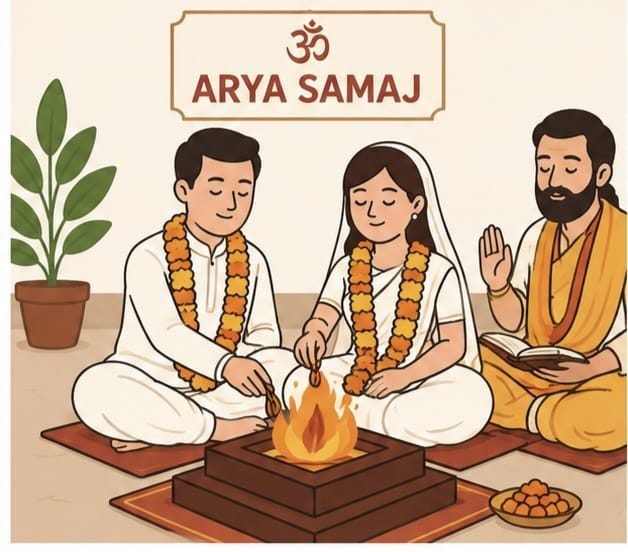
Before the ceremony, the mandir checks age proof, identity proof, photographs, affidavits and the IDs of witnesses. The Vedic ceremony itself usually takes one to two hours and follows a traditional order:
Welcome and sankalp. The couple is welcomed and states the intention to marry.
Havan. The sacred fire is lit and offerings are made with Vedic mantras.
Panigrahan. The groom takes the bride's hand as a pledge of lifelong companionship.
Pratigya. Mutual vows are exchanged.
Lajahoma and parikrama. Offerings of puffed rice and the rounds around the fire.
Saptapadi. The seven steps taken together, each with a vow. Under Section 7 of the Hindu Marriage Act, where the rites include saptapadi, the marriage becomes complete and binding when the seventh step is taken.
Sindoor and mangalsutra. Customary symbols, if the couple wishes.
Blessings and certificate. The mandir issues its marriage certificate the same day.
Arya Samaj marriages have been specifically protected since the Arya Marriage Validation Act, 1937, including between partners of different castes. More on the ceremony and its legal position is in our Arya Samaj court marriage article, and on the Arya Samaj marriage service page. For couples who want to choose a venue, see our list of Arya Samaj mandirs in Delhi.
Part B: Registration under the Hindu Marriage Act
Online application on the e-District portal under the Hindu Marriage Act service, with details of the ceremony, the mandir certificate, wedding photographs and the documents of both partners and the witnesses.
Fee payment of the prescribed official fee, about ₹100 for a normal appointment.
Appointment at the SDM office, usually within a week or two.
Appearance by both partners with witnesses (most Delhi offices ask for two) and original documents.
Registration in the marriage register and issue of the government certificate.
Delhi offers Tatkal (priority) appointments for registration under the Hindu Marriage Act for a higher official fee of ₹10,000. The steps are the same as a normal registration, except that you select the Tatkal option on the portal and pay the higher fee, and the appointment is usually given within one to two working days. Tatkal does not apply to marriages under the Special Marriage Act, because nothing can shorten the statutory 30-day notice. Our Tatkal marriage certificate article explains who it suits and when it is not worth the extra cost.
How the Process Changes for Different Couples
The eight stages stay the same for everyone, but the preparation and the questions at the counter vary depending on who you are. These are the variations we deal with most often.
Divorced partners
The key document is a certified copy of the final divorce decree. The process changes in three ways:
Timing. A decree is not final for the purpose of remarriage until the time for appeal has passed without an appeal, or any appeal has been dismissed. Under the Hindu Marriage Act, Section 15 says a divorced person may remarry only after that point. If your decree is very recent, wait out the appeal period before filing, or you risk a refusal or, worse, a void marriage.
Affidavit wording. The affidavit should state the court, case number and date of the decree and that no appeal is pending.
Mutual consent divorces. These cannot normally be appealed on merits, but the officer may still ask for the certified copy with the date clearly visible.
If the divorce was granted abroad, the officer may ask for the decree to be apostilled or attested, and in some cases for advice on whether the foreign decree is recognised in India. Start this early.
Widows and widowers
Carry the death certificate of the late spouse and mention the date of death in the affidavit. There is no waiting period in law after a spouse's death. The officer may ask a sympathetic question or two; that is normal.
A groom who is about to turn 21
The age condition applies on the date of marriage. So a notice can be filed while the groom is 20 years and 11 months, provided the solemnisation date falls on or after his 21st birthday and within three months of the notice. Plan the calendar carefully: if the birthday falls after the three-month window, wait before filing. The same logic applies to a bride approaching 18.
Students and people in paying-guest accommodation
Residence can be tricky when you live in a hostel or PG. Useful proof includes a hostel or PG letter on letterhead with the period of stay, a registered rent or licence agreement, and a bank statement showing the Delhi address. If your proof is thin, apply through your partner's address if theirs is stronger.
Government employees
Civil service conduct rules generally do not require permission to marry, but some departments expect employees to inform them after marriage, and service rules often restrict marrying someone who already has a living spouse. If one partner is marrying a foreign national, many services require prior intimation or permission. Check your department's rules before filing, not afterwards.
Armed forces and paramilitary personnel
Service personnel usually need to follow their service's procedure for marriage, including informing their unit, and there are specific restrictions on marrying foreign nationals. The civil process at the SDM office is the same, but the service paperwork should be completed alongside it.
Couples where one partner has converted
If one partner has converted to Hinduism through Shuddhi at an Arya Samaj and the couple will use the Hindu Marriage Act route, the conversion certificate becomes part of the file. The conversion must be genuine and voluntary. If there is any doubt, or if either partner is uncomfortable, the Special Marriage Act is the safer choice because it needs no conversion at all. The ritual and its legal effect are explained in Shuddhi Sanskar before marriage.
Couples with children already born
If you have been living together and already have a child, the process is the same. Children born of a relationship that is later formalised are protected, and registering your marriage strengthens the child's documents. Carry the child's birth certificate if you want both parents' details recorded consistently.
What the Office Actually Looks for in Your File
It helps to see the process from the other side of the counter. A dealing assistant handling dozens of files a day is essentially checking four things, and a file that answers all four quickly moves quickly.
Is this the right office? The residence proof must show an address inside the sub-division, for at least 30 days.
Are these two people who they say they are? Identity documents must match each other and the photographs.
Are they eligible? Age proof must show the legal ages, and the affidavits must cover marital status and prohibited relationship.
Is anything unusual? A previous marriage, a foreign partner, a recent conversion or a name variation. These are not problems, but each needs its supporting document to be present and easy to find.
Put your file together in the same order: residence, identity, age, affidavits, then any special documents. Use tabs or paper clips. It sounds trivial, but a file that is easy to check tends to be checked in minutes.
Local Differences Across Delhi Offices
The law is uniform, but offices differ in the small things that shape your experience. From our visits across the city:
Arrival time. Offices in high-demand areas of South and West Delhi fill their marriage slots early, so arriving well before the session starts helps.
Witness details in advance. Some offices want witness names and IDs a day before solemnisation; others take them on the spot.
Joint photographs. A few offices ask for a joint photograph of the couple; carrying one costs nothing.
Seasonal load. Election duties and the November-to-February wedding season slow most offices down.
These composite examples are drawn from real patterns. They are included because each one cost a couple weeks that could have been saved in five minutes.
"We filed in the office nearest to us"
A couple living near a district border filed in the office they could see from their balcony. Their colony, however, fell under a neighbouring sub-division. The application was returned after the verification date and they had to file again, losing about ten days. The fix was simply to check the locality mapping on the portal before filing.
"Aadhaar has my date of birth, isn't that enough?"
A groom produced only his Aadhaar as age proof. The office asked for his Class 10 certificate, which was at his parents' home in another state and which he did not want to request because his family did not know about the marriage. He eventually used his passport, but only after a second visit. The lesson: settle your age proof on day one.
"Our witness had to travel"
On solemnisation day, one of three witnesses was called away for work. With no standby, the couple had to take a new date nearly two weeks later, uncomfortably close to their three-month deadline. Always keep a fourth person ready.
Process for Registering a Marriage That Already Happened
Many couples are already married by religious rites but never registered. The process depends on how the marriage was performed.
Hindu, Sikh, Jain or Buddhist ceremony
Register under the Hindu Marriage Act. Apply on the e-District portal with whatever proof of the ceremony you have: the invitation card, wedding photographs, a temple or gurdwara certificate, or an affidavit from people who attended. Delayed registration is possible, though the office may ask you to explain the delay and may charge an additional amount. If proof of the original ceremony is weak, some couples choose to reaffirm their marriage through an Arya Samaj ceremony and register that.
Any other form of ceremony: Section 15 of the Special Marriage Act
Section 15 allows a marriage celebrated in another form to be registered under the Special Marriage Act, which gives it the civil status and consequences of that Act. The conditions are specific:
a ceremony of marriage was performed and the couple have lived together as husband and wife ever since;
neither has more than one spouse living at the time of registration;
neither is of unsound mind at the time of registration;
both have completed 21 years of age at the time of registration;
they are not within the degrees of prohibited relationship (subject to custom); and
they have lived in the Marriage Officer's district for at least 30 days before the application.
Under Section 16, the Marriage Officer gives public notice of the application, allows 30 days for objections, and registers the marriage if satisfied. So the timeline is similar to a fresh Special Marriage Act marriage.
Process for NRIs and Foreign Nationals
The stages are the same, but there are extra steps at the start and at the end.
Extra steps before filing
Residence. One partner must meet the 30-day Delhi residence rule. If the Indian partner lives in Delhi, this is simple. If both partners live abroad, one of them must stay at a Delhi address for 30 days before notice, so plan the trip accordingly.
Single-status document. A foreign partner usually needs a certificate of no impediment or single-status letter from their embassy or home authority. Start this early; some countries take weeks.
Translations and apostilles. Documents not in English or Hindi may need certified translations, and foreign public documents may need an apostille from their country of origin.
Passport and visa. Carry the passport with a valid Indian visa; the office will note the passport details.
Extra steps after marriage
Obtain the marriage certificate and check every detail against both passports.
Get the certificate authenticated at the state level and then apostilled by the Ministry of External Affairs if it will be used in a Hague Apostille Convention country; otherwise, follow the embassy attestation route for that country.
Submit the apostilled certificate with your spouse visa or residence application.
If you expect opposition, the legal steps are the same, but the order in which you do some things changes. The goal is to keep you safe while you complete the process.
Choose the route with the least exposure. If both of you are Hindu, Sikh, Jain or Buddhist, the Arya Samaj plus registration route avoids a 30-day public notice altogether.
Keep the plan private until the marriage is complete. Tell only the people who must know, such as your witnesses.
Prepare a protection request in advance. A short letter to the Station House Officer and the Deputy Commissioner of Police for your district, stating that you are adults, are marrying of your own will and fear harm, with copies of your age proofs. Following the Supreme Court's directions in Shakti Vahini v. Union of India (2018), police are expected to act on such requests and districts are to have arrangements, including safe houses, for couples facing threats.
Keep evidence of threats. Save messages and call logs, and back them up outside your phone.
If threats are serious, approach the Delhi High Court. A petition for protection of life and liberty is usually heard quickly. Courts have consistently held that adults are free to marry whom they choose.
After the marriage, keep certified copies of the certificate with you and with a trusted person.
A certificate you do not use is only half the benefit. These are the steps most couples take in the first few months.
Task
What you need
Where
Add spouse's name or change surname in passport
Marriage certificate, existing passport, application
Passport Seva online and Passport Seva Kendra
Update Aadhaar name or address
Marriage certificate and supporting proof
Aadhaar Seva Kendra or online
Update bank nominations or open a joint account
Marriage certificate, KYC
Your bank branch or app
Add spouse to employer health cover
Marriage certificate
HR department
Apostille for use abroad
Original certificate
State authentication, then MEA
Inter-caste marriage incentive (if eligible)
Registered marriage certificate, caste certificate, bank details
Through the state or central scheme channel
Common Delays and How to Recover
Problem
Why it happens
How to fix it
Typical time lost
Application returned for wrong office
Locality mapped to a different sub-division
Re-file in the correct sub-division
1–2 weeks
Name mismatch at verification
Different spellings across documents
Clarifying affidavit or matching document
A few days
Age proof rejected
Only Aadhaar produced
Bring Class 10 certificate, birth certificate or passport
A few days
Residence doubted
Unregistered rent agreement or recent move
Add utility bill, registered agreement or other proof
1 week
Objection filed
Relative or third party objects
Respond with documents; officer decides within 30 days
Up to 30 days
Witness absent on the day
Illness or cold feet
Keep a standby witness
1–2 weeks for a new date
Notice lapsed
Three-month window missed
File a fresh notice
30+ days
Unexplained delay by office
Workload or informal extra demands
Written request citing the Act; escalate to the district; writ petition if needed
Varies
Where an office sits on a complete application without a lawful reason, a polite written representation to the Deputy Commissioner (District Magistrate) usually works. As a last resort, a writ petition before the Delhi High Court can seek a direction to process the application; the High Court has issued such directions for adult couples on many occasions.
Visit-by-Visit Checklists
Visit 1: Verification (both partners)
Original age, identity and address proofs of both partners
Notarised affidavits (originals)
Divorce decree or death certificate of former spouse, if applicable
Self-attested photocopies of all the above
Printed acknowledgement and fee receipt
Four to six passport photographs each
Visit 2: Solemnisation (both partners and three witnesses)
Everything from Visit 1
Witnesses' original photo IDs with address, and photocopies
Two photographs of each witness
Garlands or rings if you wish (optional)
For Hindu Marriage Act registration
Mandir or religious marriage certificate
Wedding photographs showing the ceremony
Invitation card if available
Documents of both partners and two witnesses
Court Marriage Process Terms, Explained Simply
Officers and forms use terms that are rarely explained. Here is what each one means in plain language.
Marriage Officer: the official appointed under the Special Marriage Act to receive notices, solemnise and register marriages. In Delhi, this is usually the SDM of the sub-division.
SDM (Sub-Divisional Magistrate): the head of a revenue sub-division. Marriage work is one of many duties of this office, which is why appointments can slow down during elections.
Notice of Intended Marriage: the formal notice under Section 5, in the form of the Second Schedule, telling the Marriage Officer that you intend to marry. The 30-day clock starts from its publication.
Marriage Notice Book: the official record in which every notice is entered. Anyone can inspect it during office hours.
Publication: displaying a copy of the notice at a conspicuous place in the office, and sending a copy to another district where needed.
Objection: a formal complaint under Section 7 that the marriage would break one of the conditions in Section 4. Anything else is not a legal objection.
Solemnisation: the act of marrying. Under the Special Marriage Act, it is the declaration and the words exchanged before the officer and three witnesses.
Declaration (Third Schedule): the signed statement by each partner confirming eligibility, countersigned by the witnesses.
Marriage Certificate Book (Fourth Schedule): the register in which the certificate is entered and signed. Its entry is conclusive evidence of the marriage.
Prohibited degrees of relationship: the close relationships listed in the First Schedule, within which marriage is not allowed unless a recognised custom permits it.
Registration under the Hindu Marriage Act: recording a Hindu marriage that has already been performed by religious rites; there is no notice period.
Tatkal: a priority appointment for Hindu Marriage Act registration, available for a higher official fee.
Apostille: an internationally recognised certificate from the Ministry of External Affairs that makes an Indian document acceptable in Hague Apostille Convention countries.
Certified copy: an officially attested copy of the certificate, useful when you need to submit it to several authorities at once.
The Whole Process on One Page
If you only remember one section of this article, make it this one:
Decide the law, the office and the target date before you touch the portal.
Make every name and date match across documents before you upload them.
Use a Class 10 certificate, birth certificate or passport for age, not Aadhaar alone.
File in the sub-division that actually covers the address you use.
Both of you attend verification with originals and copies.
Write down the last valid date, three months from the notice, the day it is published.
Book three witnesses and one standby for solemnisation day.
Check every letter on the certificate before you leave the office.
How We Take Couples Through the Process
Since 1998, we have walked couples through every version of this process: first-time couples, divorcees, NRIs, inter-religion couples and couples under pressure from their families. Our work at each stage is simple to describe:
Stage 1–2: a free consultation to confirm the right Act and the right office.
Stage 3: drafting and checking every affidavit and document so nothing is returned.
Stage 4: filing online on your behalf and sharing the acknowledgement with you.
Stages 5 and 7: accompanying you to the office on both visits.
Stage 6: tracking the notice, handling any objection and keeping the three-month deadline.
Stage 8 and after: certificate checks, certified copies, apostille and name-change support.
Advocate-assisted court marriage in Delhi with drafting, online filing and both office visits from ₹6,100. Government fees are separate and shown in writing.
Frequently Asked Questions About the Court Marriage Process in Delhi
What is the very first thing to do before starting court marriage in Delhi?▼
Settle three things before opening the portal: which Act you will marry under, which partner's address you will use for the 30-day residence rule, and the date you want to be married by. The Act decides whether there is a 30-day notice at all. The address decides your SDM office. The date tells you how early to file. Couples who decide these first rarely have to refile, while couples who skip them often lose one or two weeks.
How many times do we have to go to the SDM office?▼
Under the Special Marriage Act, normally twice. The first visit is for verification of original documents and signing the notice, a few days after you file online. The second is for solemnisation with three witnesses, after the 30-day notice ends. A third visit is only needed if something is missing or a correction is required. Hindu Marriage Act registration usually needs just one visit when the documents are complete.
Can one partner complete the online filing alone?▼
Yes. Either partner, or someone helping you, can fill in the online notice, upload documents and pay the fee, as long as the details are correct for both partners. What cannot be done by one partner alone is the office part: both partners must appear in person for verification and again for solemnisation. The officer needs to see both of you and confirm free consent directly.
What should we carry on the verification day?▼
Carry original age, identity and address proofs for both partners, the notarised affidavits, a divorce decree or death certificate if relevant, one set of self-attested photocopies in the same order as your upload, the printed acknowledgement and fee receipt, and four to six passport photographs each. Arrange the file in the order residence, identity, age, affidavits and special documents, so the dealing assistant can check it quickly.
What questions might the officer ask us at verification?▼
Usually simple ones: how long you have known each other, whether either of you was married before, whether you are related, whether anyone is pressuring you, whether your families know and where you will live after marriage. These questions help the officer confirm age, eligibility and free consent. There are no right or wrong answers beyond telling the truth. You are not required to have family approval.
When does the 30-day notice period actually start?▼
It runs from the date the notice is published, which is when it is entered in the Marriage Notice Book and displayed at the office after verification. It does not start from the day you filled in the form online. Ask the office for the date of publication and write it down, because both the 30-day objection period and the three-month solemnisation deadline are counted from the notice.
Can we track our court marriage application online?▼
Yes. The e-District portal shows the status of your application using the application number from your acknowledgement. Check it every few days during the notice period. If the status shows a query or a return, respond quickly with the requested document, because an unanswered query can hold up the solemnisation appointment.
What if a relative files an objection during the notice?▼
The officer records the objection and inquires into it, with powers to summon witnesses and documents, and must decide within 30 days of receiving it. Only objections based on Section 4 conditions count: age, existing spouse, sound mind or prohibited relationship. An objection that the family simply disapproves is not valid. If the officer finds the objection frivolous and not made in good faith, costs of up to ₹1,000 can be imposed on the objector.
How do we book the solemnisation date?▼
After the 30 days pass without a valid objection, request a solemnisation date through the office or the portal, as your office prefers. Choose a date that all three witnesses can attend, and make sure it falls well within three calendar months of the notice. In the November to February wedding season, book as soon as the notice period ends, because slots fill quickly.
What exactly do we say during solemnisation?▼
After signing the declaration, each partner says to the other, in any language both understand, words to the effect of "I take thee to be my lawful wife" or "I take thee to be my lawful husband", in the presence of the Marriage Officer and three witnesses. That is the whole ceremony under the Special Marriage Act. You may exchange garlands or rings as well, but that is optional.
How long does the solemnisation take on the day?▼
The part inside the officer's room usually takes less than half an hour. Most of the time is spent waiting for your turn and having documents of the couple and witnesses checked. Arrive early in the morning session and plan for the whole morning. Tell your witnesses to keep at least three to four hours free.
What should we check on the certificate before leaving?▼
Check the spelling of both partners' names and their parents' names, dates of birth or ages, addresses, the date and place of marriage and the witnesses' names. A mistake noticed at the counter can be corrected immediately. A mistake noticed later needs a correction application with supporting documents, which can take weeks and may delay passport or visa work.
Can the whole court marriage process be done in one visit?▼
Not under the Special Marriage Act, because the notice must be verified first and the marriage can only be solemnised after 30 days. For Hindu, Sikh, Jain and Buddhist couples, the Arya Samaj ceremony plus Hindu Marriage Act registration can often be completed with a single visit to the SDM office, especially with a Tatkal appointment.
How is the Arya Samaj route different, step by step?▼
First, a Vedic ceremony at an Arya Samaj mandir, including havan and saptapadi, after which the marriage is complete and the mandir issues its certificate. Second, an online application for registration under the Hindu Marriage Act with the mandir certificate, photographs and IDs. Third, one appearance before the SDM with witnesses for registration and the government certificate. There is no 30-day public notice at any point.
Who can use the Tatkal process and how fast is it?▼
Tatkal is for registration under the Hindu Marriage Act, so it suits couples who are both Hindu, Sikh, Jain or Buddhist and have already married by religious rites. You select Tatkal on the portal and pay the ₹10,000 official fee, and an appointment is usually given within one to two working days. It is not available for Special Marriage Act notices.
What if we filed in the wrong SDM office?▼
The application is usually returned, and you file afresh in the correct sub-division. There is no simple transfer. This is why confirming the locality mapping on the portal, and cross-checking with the district website, is worth ten minutes before filing. If the residence proof of one partner is doubtful, apply through the other partner's address.
Can the process continue if we shift house during the notice?▼
Yes. The notice was validly given for the address on record, and moving afterwards does not cancel it. Do not edit the address in the existing application. Keep proof of the old address handy in case the office asks, and update your address on other documents after the marriage.
What changes in the process for a divorced partner?▼
The key difference is timing and paperwork. Wait until the divorce decree is final, meaning the appeal period has passed without an appeal or any appeal was dismissed. Carry a certified copy of the decree, mention the court, case number and date in your affidavit, and get foreign decrees apostilled or attested. Otherwise, the eight stages are the same.
What changes if the groom is about to turn 21?▼
You can file the notice before his birthday, but the solemnisation date must fall on or after it and within three calendar months of the notice. If the birthday is more than three months away, wait before filing, or the notice will lapse before he becomes eligible. The same rule applies to a bride approaching 18.
Is the process different for government employees?▼
The SDM process is the same. Separately, check your department's conduct rules: many require you to inform them after marriage, and there are usually restrictions if you are marrying a foreign national or if either partner has a living spouse. Armed forces and paramilitary personnel should complete their service's marriage procedure alongside the civil process.
How do NRIs fit the 30-day residence rule into their trip?▼
One partner must have lived at a Delhi address for 30 days immediately before the notice. If the Indian partner lives in Delhi, the NRI partner can arrive later, attend verification and return for solemnisation. If both live abroad, one must stay in Delhi for 30 days before filing, then the notice runs for another 30 days, so plan roughly two to three months, or consider the Hindu Marriage Act route if eligible.
What should couples facing family opposition do first?▼
Pick the route with the least public exposure you are eligible for, keep the plan private, prepare a written protection request to the local police and the Deputy Commissioner of Police in advance, and save any threatening messages. If threats are serious, the Delhi High Court can grant protection quickly. After marriage, keep certified copies of the certificate with you and with a trusted person.
Can we register a marriage that happened years ago?▼
Yes. Hindu, Sikh, Jain and Buddhist couples register under the Hindu Marriage Act with whatever proof of the ceremony exists, such as photographs, the invitation card or a temple certificate; the office may ask why registration was delayed. Couples married in another form can register under Section 15 of the Special Marriage Act, which requires both to be 21 or older, a 30-day residence and a 30-day public notice.
What happens after we receive the certificate?▼
Store the original safely and keep a scanned copy. Then update your passport, Aadhaar, bank nominations and employer records as needed. For use abroad, get state authentication and an apostille from the Ministry of External Affairs. Order certified copies if you will need to submit the certificate to several authorities at the same time.
What if the SDM office keeps delaying without reason?▼
First, make a polite written request citing the Special Marriage Act and asking for the application to be processed, and keep a receiving copy. If that does not work, write to the Deputy Commissioner (District Magistrate). As a last resort, a writ petition in the Delhi High Court can seek a direction to the Marriage Officer; the High Court has issued such directions for adult couples many times.
Can we do the process ourselves without any agent?▼
Yes. The law is designed so that couples can apply directly on the e-District portal and appear at the SDM office on their own. If your documents are consistent and you are comfortable with the portal, you can manage it. Professional help is most useful for divorcees, NRIs, inter-religion couples under pressure and anyone with a document mismatch or a tight deadline.
How long before our wedding date should we start the process?▼
For the Special Marriage Act, start at least 45 days before the date you want, and 60 days in the wedding season or around elections. For Arya Samaj marriage plus Hindu Marriage Act registration, a week is usually comfortable, and a couple of days can work with Tatkal if all documents are ready.
What does your service include at each stage?▼
A free consultation on the route and office, drafting and checking every affidavit, filing online on your behalf, accompanying you on both office visits, tracking the notice and handling objections, and after-marriage help with certified copies, apostille and name changes. Advocate-assisted court marriage costs ₹6,100; the full Special Marriage Act process is ₹15,000; government fees are extra and shown in writing.
Sources and Official References
Facts in this article were checked against the following primary sources. Government fees and procedures change, so confirm current details on the official portal before applying.