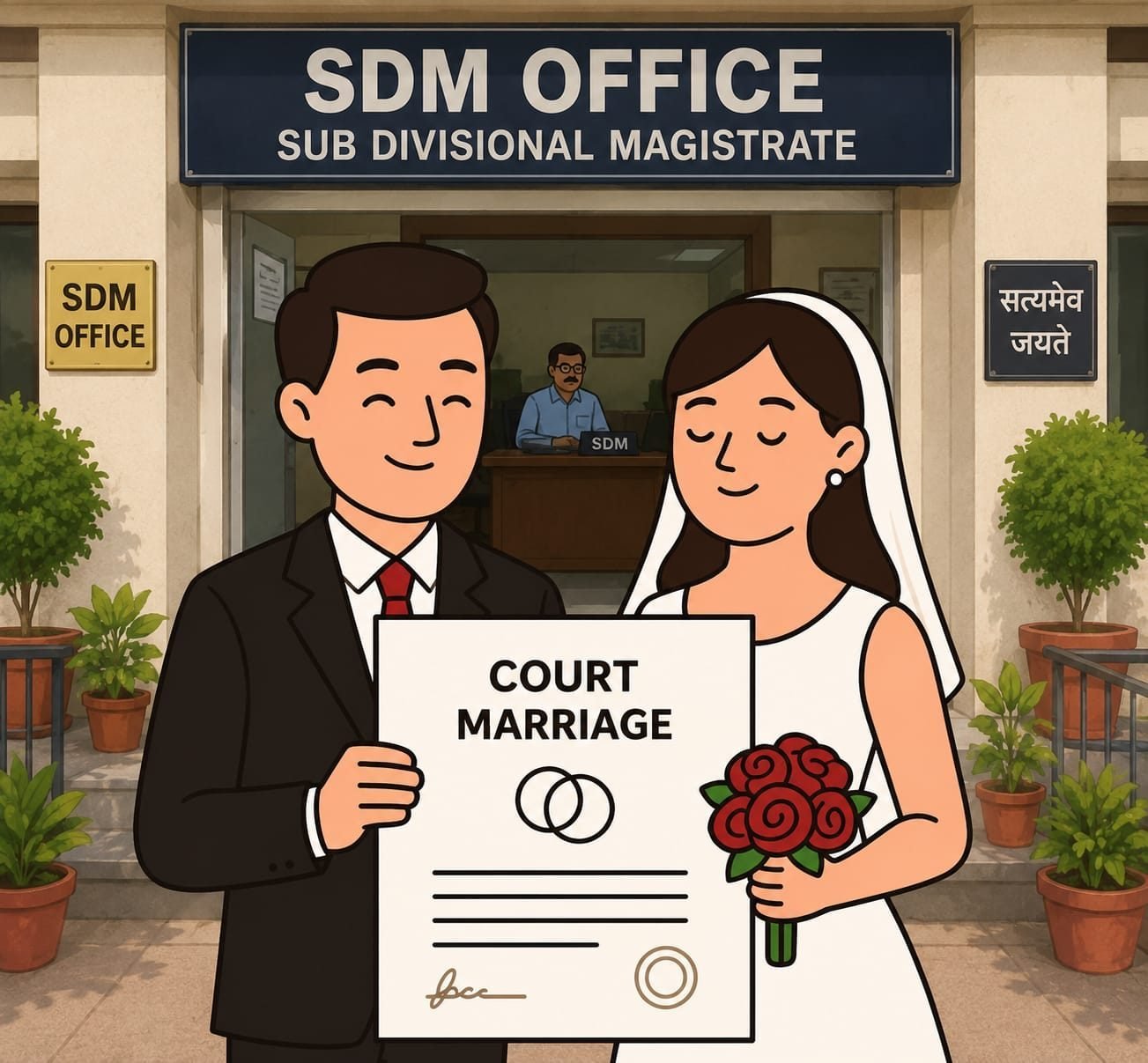
Paschim Vihar: a Flat in the Family's Name, and a Couple With No Paper Trail
Paschim Vihar, Peeragarhi, Meera Bagh and the society blocks around them are a settled belt. The flats were bought in the 1980s and 1990s, often through a co-operative group housing society, and they are still in the name of the person who bought them. The children grew up here, some married and stayed, and a daughter-in-law or son-in-law moved in.
That produces a household which is prosperous, stable, entirely ordinary — and in which the married couple appears on no document at all. The flat is in the father's name. The electricity is in the father's name. The society's records name the father. The couple have their Aadhaar cards, which may still show a hostel or a previous city, and nothing else.
Nobody notices for years, because nothing asks. Then something does ask — a bank, a passport office, an insurer, a hospital, or, in the worst case, the moment after a death in the family — and the household discovers that it has a great deal of property and almost no evidence of who lives there.
So this page is about two things a settled family can do cheaply this month: put the married couple on the record, and understand the document that families in this belt eventually need, which is not the one they expect. The general law of marriage and registration is on our process, documents and registration pages; the fees are on the fee page; this page does not repeat them.
Getting Into the Record When You Live in a Family Flat
None of what follows requires the flat to be transferred, divided or touched in any way. It is simply about the couple existing on paper at the address where they live.
Aadhaar, with this address. The one document every office reads first. For a person who has nothing of their own showing the address — which is the normal position for somebody who has just moved into a family home — the Authority's Head of Family route was designed for exactly this: an adult family member whose Aadhaar already carries the address consents online, and a marriage certificate is one of the relationship documents that route accepts. The particulars are on our Laxmi Nagar page.
The electoral roll. Free, in your own name, at your current address. The Election Commission's own forms and the rule that nobody may be enrolled in two places are on our Janakpuri page. For a couple in a family flat this is the cheapest record in existence and almost nobody bothers.
A bank account with this address on it. Not a new account necessarily — a change-of-address request at your existing bank produces a statement carrying the address within a month, in your name, from an institution that verified it.
Your own name somewhere on a utility, if the family is willing. Optional, slower, and genuinely useful in the long run. A second connection, a piped-gas account, a broadband connection in the couple's name — anything that is billed to them at that flat.
And the marriage certificate itself, which is the document that ties the two of you together for every one of the above. Without it, a daughter-in-law is a person at an address; with it, she is a spouse at an address, which is a materially different thing to every institution she will ever deal with.
Total cost of that list: the registration fee, a bank visit, and two free applications. Total time: an afternoon, spread over a month.
Why a Settled Family Should Care — the Document Nobody Plans For
Here is the situation this belt eventually meets, and it is the reason the previous section is worth an afternoon.
A parent dies. The flat, the bank accounts, the investments and the society membership are in that parent's name. The family now has to establish, to a bank, to the society, to an insurer and to whichever office is involved, who the surviving family members are. And the instrument Delhi uses for that is one most people have never heard of until the week they need it: the Surviving Member Certificate, sometimes spoken of as a legal heir certificate.
It is not a court document. It is issued through the Revenue administration — the applications go to the SDM or Tehsildar's office or a Citizen Service Centre, and can be made through Delhi's e-District system. It is not a will, it does not decide who inherits what, and it does not replace succession law. What it does is answer one question officially: who the surviving members of this family are.
Every institution that then has to release something — a bank, a society, a department, an insurer — starts from that answer. Which is why a household where a spouse cannot easily be shown to be a spouse discovers the problem at the worst possible time, with everybody grieving and a form on the table.
VERIFIED — What a Surviving Member Certificate Application Actually Asks For
Delhi's own district administration publishes the requirements, and they are worth reading years before anybody needs them, because every single item is easier to assemble in advance.
| What is required | Why it matters to a couple reading this now |
|---|
| Identity proof of the applicant and of all the surviving family members | Every member, not just the person applying. A household where one person's documents are incomplete holds up the whole application. |
| Present address proof of the applicant, and permanent address proof | This is precisely what a couple living in a family flat with nothing in their own name cannot produce quickly. Fixing it now costs an afternoon; fixing it then costs weeks. |
| The death certificate of the deceased | Obtained separately, and the one document nobody forgets. |
| A list of surviving members where there are more than four | Which requires the family to be able to name and evidence everybody — including spouses who married in. |
| A self-declaration, signed; where the application is made online, a scanned copy of the original self-declaration is uploaded | Ordinary, and it is a declaration — so it should be accurate, for the reasons any declaration should be. |
| A passport-size photograph of the applicant and of all the surviving family members | Again: everybody. |
How it is applied for. At a Citizen Service Centre, where originals are produced at the counter, or online through the e-District application system. The office involved is the SDM's or Tehsildar's, through the district administration.
Where the marriage certificate fits. Nowhere on that list by name — and that is exactly the point people miss. A spouse appears in such an application as a surviving family member, and the ordinary way a spouse is shown to be a spouse is the marriage certificate. A family that has one produces it and moves on. A family that never registered has to establish the relationship some other way, at the worst possible moment, sometimes years after the wedding and after witnesses have moved or died.
That is the strongest argument for registration that exists, and it has nothing to do with the law of validity. Order 8 of Delhi's 2014 Order is clear that registration does not make a marriage valid — the ceremony does that, under section 7 of the Hindu Marriage Act. Registration simply means that on the worst week of your family's life, nobody has to prove anything from memory.
Two honest limits. Requirements and practice differ between districts and change over time, so check the current list at the office or on the portal rather than working from any website, including this one. And we do not obtain surviving member certificates — it is not our work, we take no fee for it, and this section exists so that a family knows the shape of it in advance.
The Family File: One Envelope, One Afternoon
Every family in this belt already owns the contents of this list. What almost none of them has is the list in one place, known to more than one person. Put it together once and it never needs doing again.
For each adult in the household: Aadhaar, PAN, and one document showing the current address in that person's own name.
For each couple: the marriage certificate. Two certified copies, kept in different places, and a photograph of it on both spouses' phones — not as proof, but because the entry number, the date of registration and the name of the issuing office are the three facts that turn a lost certificate into a short request instead of a search.
For the household: the property papers as they are, the society's own records if there is a society, and a single sheet listing every bank account, insurance policy and locker with the nominee written against each. The nominations themselves are dealt with, with the statutory wording, on our Pitampura page — and for a family with a business, on the same page.
And one thing that costs nothing: tell the other adults where the envelope is. The commonest failure in an otherwise organised household is that one person knew where everything was.
What not to put in it: nothing invented, nothing back-dated, and no affidavit swearing something the records do not support. A false statement in a declaration receivable as evidence engages section 236 of the Bharatiya Nyaya Sanhita, and a family file is exactly the place where such a thing would surface years later.
Society Records, and What They Do and Do Not Prove
Where the flat is in a co-operative group housing society, families often assume the society's register is the authoritative record of the household. It is not, and the distinction is worth ten minutes.
What a society's records do. They show who the member is, who the nominee is for the membership, and who the society will deal with. That matters a great deal for the flat and for the society's own processes.
What they do not do. They do not establish a marriage, they do not decide inheritance, and a nomination in a society's records is — like a nomination anywhere else — an instruction about whom to deal with rather than a final answer on entitlement. The same distinction, with the statutory wording for bank deposits and life policies, is set out on our Pitampura and Malviya Nagar pages.
What to do about it, practically. If the family wants the couple recognised by the society — for a parking allotment, an intercom listing, a maintenance receipt — ask what the society needs. Frequently it is a copy of the marriage certificate and an application from the member. It is a small thing, it is usually granted without fuss, and it quietly produces yet another record with the couple's names at that address.
What we do not do: society transfers, membership disputes, nomination filings or anything else in that world. Those belong to the society's own bye-laws and, where they go wrong, to an advocate.
Which Route, in Four Lines
Because this belt usually wants the short version.
Arya Samaj ceremony — ₹5,100. The Vedic rites at our mandir with the institution's certificate. You are married that day under section 7. Nothing is on a government record yet.
Ceremony with registration — ₹7,100. The same morning plus the government side handled. For a family whose whole concern is that the couple should exist on the record, this is the only sensible option.
A wedding already held — ₹6,000. Any earlier year, including one held elsewhere, brought onto the record now. The Order's own late charges apply and never compound, so a marriage from 2012 costs what last month's would.
Special Marriage Act — ₹15,000. The civil route, with its public notice and its statutory period. Everything is itemised on our fee page rather than repeated here.
A Word for the Parents Reading This
In this belt it is often the father or mother who telephones, not the couple, so this paragraph is written for them.
Registering the marriage takes nothing away from you. It does not transfer the flat, it does not create a claim on anything you own, it does not change the society's membership, and it does not oblige anybody to move out or move in. It records that two adults married, on a date, before witnesses.
What it does do is protect your own household, in the specific way set out earlier on this page: when the family one day has to establish who its surviving members are, a registered marriage is the difference between producing a certificate and arguing from photographs.
And the one thing we will not help with, however the question is phrased. We do not arrange a ceremony where one of the two people is not marrying freely — consent is a condition of a valid marriage under section 5(ii) of the Hindu Marriage Act, and there is no version of that conversation which ends well. Where a family is unhappy about a match, that is a family matter and not a paperwork one, and we say so plainly to whoever calls.
Equally, we speak to the couple about the couple's file. Not because anybody is being secretive, but because the file belongs to them, and a service that discusses it with whoever telephones is a service you would not want your own daughter using.
Which Office Will Handle It — and Why We Will Not Name One
Readers in this belt often want the answer in one word: which office. We do not print office allocations anywhere on this site, and the reason is practical rather than evasive. A file is allotted on the exact address you enter, not on the colony's reputation; the district and sub-division boundaries in Delhi were redrawn during 2026; and a confident name in print costs somebody a morning and a parking fee when it turns out to be stale.
What we do instead is simple. You tell us the address as your Aadhaar spells it, we find out where that address currently goes, and you are told before anything is paid. If the answer changes between your call and your appointment — which happens — you are told again.
Two assurances worth stating plainly, because families in a settled belt often hold documents from thirty years of different administrations. A certificate issued before any reorganisation stays valid; renaming or resplitting a district does nothing to a document already granted. And an entry made in an old register does not vanish when the office is renamed — it is held by whichever office succeeded to those records, which is a question of tracing rather than of loss. The written-request-then-RTI sequence for tracing an old entry is set out step by step on our Mayur Vihar Phase 2 page, and where an application is simply sitting untouched, Delhi's own time-bound service law and the compensation it carries are on the Lajpat Nagar page.
One boundary point that genuinely matters out here rather than being trivia: the western edge of this belt runs into Haryana faster than people expect. Bahadurgarh begins a short drive past Tikri, and Bahadurgarh is Haryana, with its own registration machinery and its own portal. Mundka, Nangloi, Peeragarhi and Paschim Vihar are Delhi. If either of you lives on the other side of that line, say so on the first call, because on the civil route it decides where the notice may lawfully begin.
Paschim Vihar and the Colonies Around It
| Area | What the file usually turns on here |
|---|
| Paschim Vihar A, B and the society blocks | Owner-occupied flats in a parent's name. The couple's problem is not the property — it is having nothing at all in their own names. |
| Peeragarhi, Meera Bagh, Rohtak Road frontage | A mix of flats above shops and commercial addresses. Write the residential address, not the shop's. |
| Punjabi Bagh, Madipur, Rajouri Garden side | Older colonies, long-held property, and families who assume everything is already on record. It rarely is. |
| Janakpuri, Vikaspuri, Uttam Nagar | Covered in their own depth on our Janakpuri and Vikaspuri pages. |
| Nangloi, Mundka, Tikri | Delhi, but close to the State line. Check which side the residence is on before assuming. |
| Bahadurgarh and beyond | Haryana. Different law, different portal, different office. |
| Rented rooms and staff households across the belt | The build-a-file-from-nothing method on our Laxmi Nagar page applies unchanged. |
| Households with a family business | Nominations, accounts and lockers — the statutory wording is on our Pitampura page. |
The pattern across all of them is the same one this page opened with: the further back a family's roots in a colony go, the less likely it is that the youngest married couple in the house appears on anything.
If You Move Out Later — What Travels With You
A fair number of couples in this belt live in the family flat for three or four years and then take a place of their own, in Dwarka, in Gurugram, or abroad. It is worth knowing in advance which of the records described on this page move with you and which have to be rebuilt.
The marriage certificate travels unchanged. It is a record of an event, not of an address. It does not expire, it does not need renewal, and no later move affects it. Whichever office holds the entry keeps holding it, which is also why the entry number and the name of that office are worth writing down once and keeping forever.
The Aadhaar address does not travel; it is updated. At a new address of your own you will have a rent agreement or an allotment letter in your own name, which makes the update straightforward and removes any need for the Head-of-Family route a second time.
The electoral roll entry does not travel either, and this is the one people forget. A shift to a new constituency requires a fresh application, and nobody may lawfully be enrolled at two addresses at once — the forms and the rule are on our Janakpuri page.
Bank and insurance records follow you, but the nominations need re-reading, particularly where a nomination was written before the marriage. The statutory position on what a nomination does and does not settle is on our Pitampura page.
The practical lesson is the same one this page keeps returning to: the certificate is the only item on the list that never has to be done twice. Everything else is a maintenance task. That alone is a reason to do the permanent thing first.
Two Witnesses, From a Household That Has Plenty of People
This is the one part of the process where a joint family has an advantage and wastes it. A household of eight adults ought to be able to produce two witnesses without a single telephone call, and yet the commonest reason a Paschim Vihar appointment is rescheduled is that the two people named at the start of the week turned out to have work, a train, or a pending visa appointment.
What a witness is actually doing is narrow: attending, and signing before the officer to say that these two people are who they say they are and that the marriage took place. A witness is not standing surety for anything, is not taking on liability for the couple, and is not making a promise about the future. Families in settled colonies sometimes treat being asked as a serious undertaking; it is worth telling the person you ask that it is an hour, not an obligation.
What each witness carries: their own original photo identity and their own address proof, in their own name. Nothing is sent ahead, nothing is signed in advance, and nobody signs on somebody else's behalf. Who qualifies, and the handful of situations where a particular person is a poor choice, are set out on our witnesses page.
Choose people who live here. A neighbour on the same floor beats a cousin in Faridabad, every time, for the unglamorous reason that a neighbour can walk over if the appointment shifts by a day.
And the line that does not move. We do not provide witnesses, and we do not arrange them through anybody else, at any price. In a belt where a household commonly has six or eight adults in it, a couple who cannot find two of them has a family conversation to have, not a service to purchase.
The First Month, in the Order That Actually Works
Settled families are good at doing things thoroughly and bad at doing them in sequence, which is why a household will spend a Saturday on a bank branch and then find the bank wanted a document that takes three weeks. The order below is not a rule of law; it is simply the sequence in which each step unlocks the next.
Week one — the marriage on the record. Everything else on this list is easier once a certificate exists, because it is the single document that establishes the relationship rather than merely the person. It is also the only item on the list that depends on other people's calendars, so it goes first.
Week two — Aadhaar address. With the certificate in hand, the Head-of-Family route is open to a spouse who has nothing of their own showing the address. Thirty days is the window the Authority gives the consenting family member to complete their side, so starting early in the month matters more than people realise. The particulars are on our Laxmi Nagar page.
Week three — the bank, and the electoral roll. A change-of-address request at an existing bank produces a statement in your own name within a cycle, and the roll application is free and can be made the same afternoon. Both of these read the Aadhaar you have just corrected, which is why they come third and not first.
Week four — the nominations, and the envelope. Every account, policy and locker gets a nominee written against it, and everything from the whole month goes into the family file described earlier on this page. This is the week that costs nothing and gets postponed for a decade.
Four weeks, one registration fee, two free applications and a bank visit. Against that, the alternative is a household that discovers all of it in the week it can least afford to.
Ten Mistakes Settled Households Make
One — assuming that because the family is established, the couple is. A forty-year-old flat in a father's name proves a great deal about the father and nothing whatsoever about the daughter-in-law living in it.
Two — treating the wedding cards and the album as the record. They support a file; they are not the file. The certificate is what a bank, an insurer, a passport office or an office of the Revenue administration reads.
Three — postponing registration because "there is no urgency". Correct, until the day there is, and on that day everybody is grieving and the office is closed until Monday.
Four — believing the society register is the household's official record. It records the member. It does not establish a marriage and it does not decide inheritance.
Five — assuming a nomination settles entitlement. It settles whom the institution deals with. That is a different question, and it is dealt with fully on our Pitampura and Malviya Nagar pages.
Six — leaving a spouse's Aadhaar at a hostel or a previous city's address for years. It is the first document every counter reads and the easiest one on the list to fix.
Seven — never writing down the entry number. A lost certificate with the entry number, date and office is a short request. Without them it is a search.
Eight — one person knowing where everything is. The most organised household on the block is one bereavement away from being the least organised, if the organisation lived in one head.
Nine — naming witnesses who cannot actually attend. Ask people who live on the same street and confirm two days before.
Ten — not reading the certificate on the day it arrives. Six fields, two minutes. A misspelt name caught on day one is a correction; caught in year nine it is a story you have to tell repeatedly.
What We Charge
Four routes, four prices, and the whole itemised list — duplicates, corrections, apostille handling, the premium service and the government's own small fees — is on our fee page rather than reprinted here, so that there is exactly one place on this site where a price can go out of date.
| Route | Our fee | Who it suits in this belt |
|---|
| Arya Samaj ceremony at our mandir | ₹5,100 | A couple who want the Vedic rites and the institution's certificate now, and will handle the government side themselves later. |
| Ceremony with registration handled | ₹7,100 | The default here, and the one a family should choose if the concern is that the couple should exist on the record. |
| A wedding already held, brought onto the record | ₹6,000 | The married-in-2009-and-never-registered household, which this belt has a great many of. |
| Special Marriage Act, whole route | ₹15,000 | The civil route, with its published notice and its statutory waiting period. |
The government's own charges are separate, small, and never ours: ₹100 to the Marriage Clerk, ₹200 as the requisite fee under Delhi's 2014 Order, and ₹15 to the cashier of the District where the civil route is used. Every counter receipt is handed back to you. Where a wedding is being registered years later, the Order's own charges apply — ₹500 as condonation inside the second sixty days and then ₹1,000 as a penalty which the ADM or DM may remit — and, importantly for a household that has been putting it off, neither compounds. A marriage from 2009 attracts the same charge as one from last spring. The route is set out on our late registration page.
And the standing list of what is not for sale here at any price: witnesses, back-dating, a promise about a particular officer, or an assurance about a document that is not ours to issue.
Sources, and What This Page Does Not Decide
Sourced. The requirements for a Surviving Member Certificate set out in the table above are taken from the published material of the Delhi district administration: identity proof of the applicant and of all surviving family members; present and permanent address proof of the applicant; the death certificate of the deceased; a list of surviving members where these exceed four; a signed self-declaration, a scanned copy of which is uploaded where the application is made online; and passport-size photographs of the applicant and of all surviving members. The application is made at a Citizen Service Centre, where originals are produced at the counter, or online through Delhi's e-District system, the office concerned being that of the SDM or Tehsildar.
On the marriage side this page relies on the statutes the rest of this site relies on: section 7 of the Hindu Marriage Act (a marriage is solemnised by the customary rites, and is complete when they are), section 5(ii) (free consent as a condition of a valid marriage), and section 8 (registration for the purpose of facilitating proof); Order 8 of Delhi's 2014 registration Order, which states that registration will not tantamount to validity, along with the same Order's ₹200 requisite fee, sixty-day window, ₹500 condonation and ₹1,000 penalty; the Delhi Revenue Department, which publishes the ₹100 payable to the Marriage Clerk, the ₹15 to the cashier of the District, and its own stated periods of normally fifteen days under the Hindu Marriage Act and normally sixty days for a Special Marriage Act solemnisation; the Special Marriage Act, whose notice enters the Marriage Notice Book and stands open to inspection and objection for thirty days; section 236 of the Bharatiya Nyaya Sanhita on false statements in declarations receivable as evidence; and the Ministry of External Affairs on attestation, free for normal attestation and ₹50 for each document or page apostilled. The Unique Identification Authority's Head-of-Family route, the Election Commission's enrolment forms and the statutory provisions on bank and insurance nominations are quoted at length, with their section numbers, on the Laxmi Nagar, Janakpuri, Pitampura and Malviya Nagar pages linked throughout.
What this page does not decide. Whether a particular family will be granted a surviving member certificate, or on what terms — that is entirely for the Revenue administration, requirements differ between districts and change over time, and the current list should be checked at the office or on the portal rather than taken from any website, this one included. Who inherits what — a surviving member certificate answers who the surviving members are, not what each of them takes; succession is governed by statute and, where contested, by a court, and it is an advocate's subject. Anything about the title to a flat — ownership, partition, transfer and society membership are outside a marriage file altogether. Which office serves a given address — allotted on the exact address, after boundaries that moved in 2026. And a service limit stated plainly: we do not obtain surviving member certificates, legal heir certificates, society transfers or succession documents. We register marriages. This page explains the rest so that a family knows the shape of it years in advance, and it takes no fee for any of it.
Before You Call
One — say who is actually asking. If you are a parent calling about your son's or daughter's marriage, say so at the start. We will help, and we will also tell you honestly that the file itself is discussed with the couple.
Two — have both addresses as the Aadhaar cards spell them. Not as the colony is spoken of — as the card prints it. That one detail decides where the file goes and is the commonest source of a wasted morning.
Three — say whether the wedding has already happened. A marriage from any earlier year is ordinary work and nothing about it compounds, so there is no reason to be vague about the date.
Call +91 8376863962. You will be told which route fits, what it costs, and what the government's own share of that is, before anything is paid. If the honest answer is that you should do it somewhere other than here, that is what you will be told.
Paschim Vihar Families — Your Questions54 Questions Answered
We live in my parents' flat in Paschim Vihar. Can we still register our marriage?▼
Yes, and nothing about the flat is touched by it. Registration records that two adults married; it says nothing about who owns the property you live in and creates no claim on it.
Nothing is in our own names. Is that a problem?▼
It is the usual position in this belt and it is solvable. What a counter wants is that the address you state is genuinely where you live and matches what your Aadhaar prints.
Whose address should the form carry — ours or my father's?▼
The flat's address, because that is where you reside. The name on the property papers is irrelevant to a marriage form; the form asks where you live, not what you own.
Will registering create any right over the family flat?▼
No. Ownership and inheritance are governed by property and succession law and are decided nowhere on a marriage register. A certificate proves a marriage and nothing further.
What is a Surviving Member Certificate?▼
A document issued through the Revenue administration answering one question officially: who the surviving members of a family are. It is not a will, it is not a court order, and it does not decide who inherits what.
Who issues it?▼
It is dealt with by the SDM's or Tehsildar's office through the district administration, applied for at a Citizen Service Centre or online through Delhi's e-District system.
What does the application ask for?▼
Identity proof of the applicant and of every surviving family member, the applicant's present and permanent address proof, the death certificate, a list of surviving members where there are more than four, a signed self-declaration, and passport photographs of the applicant and all surviving members.
Is the marriage certificate on that list?▼
Not by name — and that is the point people miss. A spouse features as a surviving family member, and the ordinary way a spouse is shown to be a spouse is the marriage certificate.
Can I apply for one online?▼
The application can be made through e-District, where a scanned copy of the signed self-declaration is uploaded. At a Citizen Service Centre the originals are produced at the counter instead.
Do you obtain surviving member certificates for families?▼
No. It is not our work, we charge nothing for it, and this page exists only so a family knows the shape of it long before anybody needs it.
Are the requirements the same in every district?▼
They differ between districts and change over time. Check the current list at the office or on the portal rather than relying on any website, this one included.
Why should a settled, comfortable family bother registering at all?▼
Because property does not prove relationships. A household can own a great deal and still be unable to show, quickly, that a particular person is a spouse.
My daughter-in-law's Aadhaar still shows her parents' city.▼
Very common, and fixable. The Authority's Head of Family route lets an adult family member whose Aadhaar already carries the address consent online, and a marriage certificate is accepted as the relationship document.
How long does that Aadhaar route take?▼
The consenting family member has a thirty-day window to complete their side, so begin early in a month rather than late in one.
Is there a fee for the Aadhaar address update?▼
A small one — ₹50 for the update at an enrolment centre.
What else can a couple get into their own names cheaply?▼
An electoral roll entry at the current address, which is free; a change of address at an existing bank, which produces a statement in your own name; and, where the family agrees, any utility or broadband connection billed to the couple.
Does the society's register count as proof that we live there?▼
It shows who the member is and whom the society deals with. It does not establish a marriage and it does not settle inheritance.
Should we ask the society to record us?▼
It is worth asking, usually costs nothing, and generally needs a copy of the marriage certificate plus an application from the member. It quietly produces another record with both names at that address.
Do you handle society transfers or membership matters?▼
No. Those belong to the society's bye-laws and, where they go wrong, to an advocate.
When exactly are we married — at the ceremony or at the office?▼
At the ceremony. Section 7 of the Hindu Marriage Act does that on the day, and Order 8 of Delhi's 2014 Order says from the other side that registration will not tantamount to validity.
Then what is registration for?▼
Section 8 puts it plainly: facilitating proof. It is the difference between a marriage everybody knows about and a marriage that can be shown to a stranger in one page.
How long does the registration itself take?▼
The Revenue Department's own wording is normally within fifteen days under the Hindu Marriage Act, and normally within sixty days where the Special Marriage Act route is used.
What does the government charge?▼
₹100 to the Marriage Clerk, ₹200 as the requisite fee under the 2014 Order, and ₹15 to the cashier of the District on the civil route. Each receipt comes back to you.
We married in 2009 and never registered. Is it too late?▼
No. It is ordinary work. The Order's charges apply — ₹500 as condonation inside the second sixty days, then ₹1,000 as a penalty the ADM or DM may remit — and nothing compounds with time.
So waiting another year costs nothing extra?▼
Financially, no. Practically it costs a great deal, because witnesses move, memories fade and the reason you finally need the certificate is rarely a convenient one.
What helps when registering a wedding held long ago?▼
The institution's certificate if one was issued, photographs showing the rites themselves with both families present, the invitation card, and any document since that names you as a couple.
Which office will our file go to?▼
The one the exact address you enter allots it to. We print no office names on this site, because the districts were redrawn during 2026 and a stale name in print costs somebody a morning.
Is our old certificate from before the reorganisation still valid?▼
Yes. Renaming or resplitting a district does nothing to a document already issued.
Our application has been sitting for weeks with no movement.▼
Delhi has a time-bound service law with a stipulated period and compensation payable by the officer who is late. The courteous way to use it is set out on our Lajpat Nagar page.
We cannot trace which office holds an old register entry.▼
A written request first, then the Right to Information route. The sequence is on our Mayur Vihar Phase 2 page.
Is Bahadurgarh in Delhi?▼
No — it is Haryana, with its own registration law and portal. Paschim Vihar, Peeragarhi, Nangloi, Mundka and Tikri are Delhi.
Why does the State line matter?▼
On the civil route, a notice begun in the wrong State cannot be shifted across; it starts again from the first day, which costs a month.
What do our witnesses have to bring?▼
Their own original photo identity and their own address proof, and they sign in front of the officer. Nothing in advance, nothing sent ahead, and no signing on anybody's behalf.
Is a witness taking on any liability?▼
No. They attend and confirm identity and that the marriage took place. They are not standing surety and are not promising anything about the future.
Can you arrange witnesses for us?▼
No, at any price. In a belt where households commonly have six or eight adults, two of them can attend for an hour.
Who makes a good witness here?▼
Somebody who lives nearby and is not travelling. A neighbour on the same floor is worth more than an important relative in another city.
How many people should know where our documents are?▼
More than one. The commonest failure in an otherwise organised household is that a single person knew where everything was.
How many copies of the certificate should we keep?▼
Two certified copies stored in different places, plus a photograph on both spouses' phones — chiefly so the entry number, date and issuing office are never lost.
What if the certificate itself is lost?▼
With the entry number, date and office it is a short request for a duplicate or certified extract. Without them it becomes a search.
Should my wife change her surname after marriage?▼
No law requires it. For a woman with a degree, a business registration or a passport in her existing name it is often more trouble than it is worth. Our name change page sets out the route and when to skip it.
One of us works abroad.▼
Say so on the first call. That is a different route with its own documents and timing, set out on our NRI marriage page rather than guessed at here.
The certificate will be used overseas.▼
It is authenticated in sequence — State level, then the Ministry of External Affairs, then an apostille for a Hague Convention country or attestation plus that country's embassy. Normal attestation is free and an apostille is ₹50 a document or page.
We want this done quietly because the families disagree.▼
Ordinary work for us. An Arya Samaj ceremony with registration under the Hindu Marriage Act involves no public notice; the Special Marriage Act route does, because its notice is published and open to inspection.
Can the thirty-day notice be shortened?▼
No. It sits in the statute, and no fee, venue or agent alters it.
My parents disapprove. Will you speak to them?▼
We will be courteous to anybody who calls, and we will not discuss a couple's file with anyone but the couple. The file belongs to them.
My son is marrying against our wishes. Can you refuse to perform it?▼
Not on that ground. Two consenting adults may marry, and where a family is unhappy about a match that is a family matter rather than a paperwork one. We say so plainly to whoever calls.
What will you refuse to do?▼
Perform a ceremony where one person is plainly not marrying freely — free consent is a condition under section 5(ii) — back-date anything, supply witnesses, or promise a result that belongs to an office rather than to us.
Can one of us attend the registration alone?▼
No. Where both are required, both attend in person. India recognises no marriage by proxy.
Does the day of the week or the muhurat affect validity?▼
Not at all. Only the paperwork notices the day: government offices are shut on Sundays and holidays, so the registration step moves to the next working day.
We are marrying again after a divorce.▼
Lawful and ordinary. The one question that matters is whether the decree is final, which is a narrower test than most people expect; it is set out with the statutory wording on our remarriage page, and where it is not final we stop before any money changes hands.
Is the premium service worth it for a family like ours?▼
Occasionally. If the whole household is elderly or abroad and nobody can attend to the running about, it earns its price. Otherwise the ₹7,100 service does the same job and we will say so.
Do you charge for the first call?▼
No — including a call where the answer is that you do not need us, or that your file belongs to another State.
What is the single most useful thing to have ready?▼
Both Aadhaar addresses exactly as the cards print them, and the names of two people who will genuinely come on the day.
How do we reach you?▼
Call +91 8376863962. Say where each of you lives, whether the wedding has already taken place, and who will attend — you will get a straight answer before anything is paid.