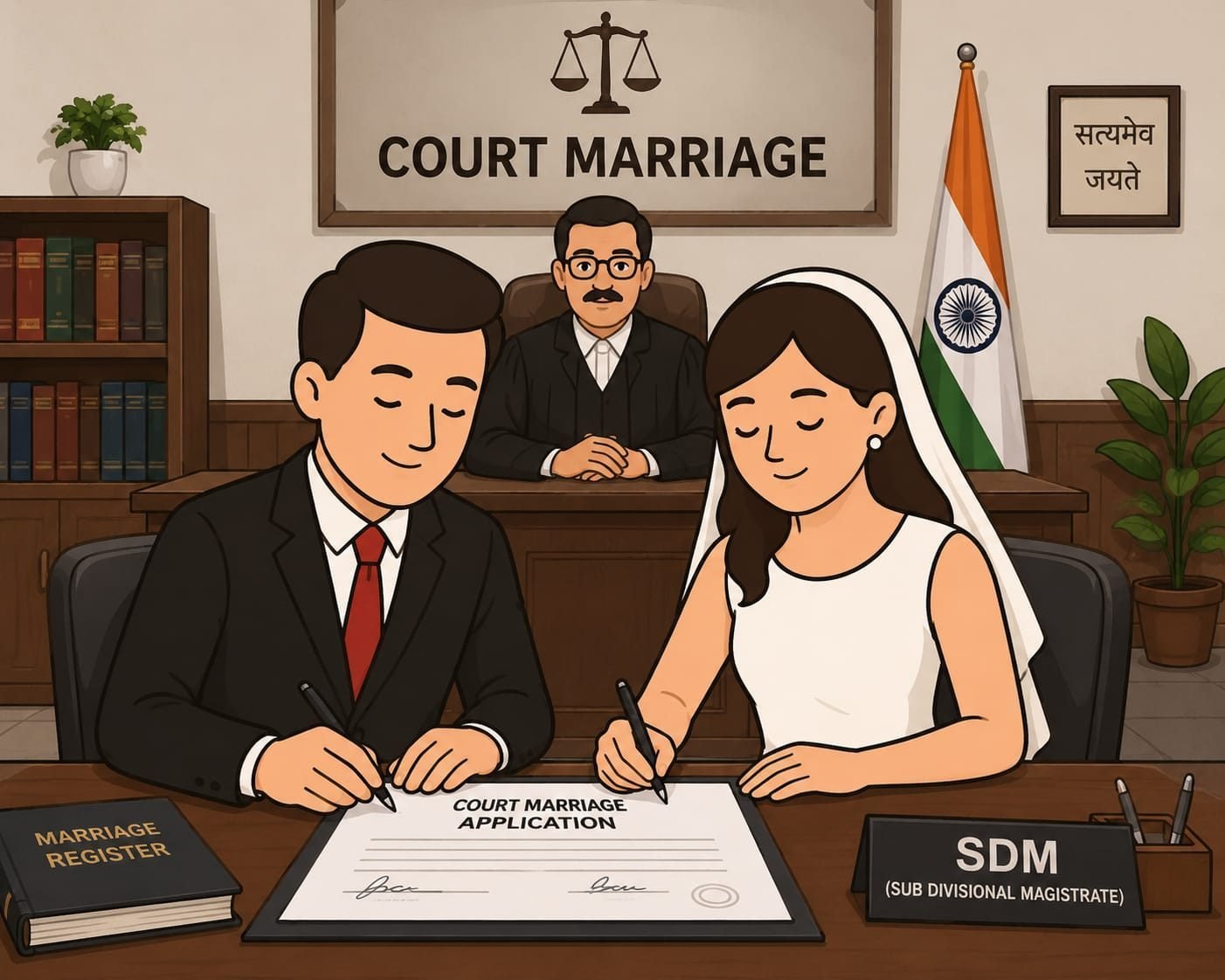
Hindu–Muslim Marriage in India (2026): The Three Legal Routes, Their Risks and What They Change
📅 Updated 22 Sep 2026⏱ 38 min read
Quick answer: A Hindu and a Muslim can marry legally in India in three ways. The Special Marriage Act, 1954 lets them marry with neither converting, after 30 days' notice, and is the route most lawyers recommend. Alternatively, the Hindu partner can genuinely convert to Islam and the couple marry by nikah, or the Muslim partner can convert to Hinduism (for example through shuddhi) and marry by Hindu rites. The conversion routes are faster but carry real legal risks: courts scrutinise conversions made only to marry, several states criminalise unlawful conversion, and conversion changes inheritance for the convert's future children. Each route also decides which law governs divorce and succession. Adults need no family permission; if threatened, Delhi Police, the 181 helpline and the High Court protect couples.
Key takeaways
Three routes: Special Marriage Act (no conversion), conversion to Islam + nikah, or conversion to Hinduism + Hindu marriage.
The Special Marriage Act takes 35–60 days with a 30-day notice but avoids all conversion risks.
Conversions only for marriage are fragile, and UP, Uttarakhand, Haryana, MP and others regulate conversion by law.
The route decides divorce and succession; a convert's later children may lose inheritance from Hindu relatives (HSA s.26).
Adults need no permission; Delhi Police, 181, safe houses and the High Court protect couples.
Last reviewed: 22 September 2026 · 38 min read
Hindu–Muslim couples are among the most common interfaith couples in Delhi, and among the most pressured. Families argue about religion, names, food, the wedding ceremony and the children's future. Relatives suggest a quick conversion "just for the papers". Friends share frightening news stories. Many couples arrive at our office confused about what is legal, what is safe and what each choice will mean years from now. This guide sets out the three legal routes side by side, what each one changes for both partners and for their children, the laws on conversion in Delhi's neighbouring states, how to stay safe, and the practical steps in Delhi.
We are a marriage service that reads nikahs and conducts Arya Samaj weddings every week, so we have no reason to steer couples away from either. Yet for most Hindu–Muslim couples we recommend neither. We recommend a civil marriage under the Special Marriage Act, because it is the one route that does not ask either partner to give up anything, and the one that no family, state conversion law or later change of heart can easily unravel. This guide explains why, and when the other routes may still be right.
The Three Legal Routes
Special Marriage Act, 1954 (no conversion). A civil marriage before the Marriage Officer of the district where one partner has lived for thirty days. Thirty days' notice, three witnesses, and a certificate that is valid everywhere. Each partner keeps their religion.
Conversion to Islam, then nikah. The Hindu partner genuinely embraces Islam, and the couple marry by nikah under Muslim personal law. The marriage is then registered, in Delhi under the 2014 Order.
Conversion to Hinduism, then Hindu marriage. The Muslim partner genuinely embraces Hinduism (often through an Arya Samaj shuddhi ceremony), and the couple marry under the Hindu Marriage Act, 1955, usually by Vedic rites, and register the marriage.
There is no fourth route. A nikah between a Muslim woman and a Hindu man who has not converted is not valid under Muslim law, and a Hindu ceremony between a Hindu and a Muslim who has not converted does not create a valid marriage under the Hindu Marriage Act, which applies only when both parties are Hindus (including Sikhs, Jains and Buddhists).
The Routes Compared
Point
Special Marriage Act
Conversion to Islam + nikah
Conversion to Hinduism + Hindu marriage
Anyone converts?
No
Hindu partner
Muslim partner
Time
About 35–60 days
Days, plus any notice required by state conversion laws
Days, plus any notice required by state conversion laws
Public notice
Yes, 30 days
No marriage notice; some states require notice before conversion
Same as left
Governing law
Special Marriage Act
Muslim personal law
Hindu Marriage Act
Divorce
Court only
Talaq, khula, mubarat or court
Court only (Hindu Marriage Act)
Second marriage
Void; bigamy
Permitted to the husband under personal law, subject to limits
Void; bigamy
Succession
Indian Succession Act
Muslim personal law
Hindu Succession Act
Mahr
Not part of the Act
Yes
No
Risk under state conversion laws
None from the marriage
Yes, where applicable
Yes, where applicable
Risk if conversion later found not genuine
None
Marriage may be questioned
Marriage may be questioned
The Special Marriage Act is slower and involves a public notice, which is why couples are tempted by the conversion routes. But on almost every other measure, it is the most secure. It is also the only route that treats both partners' faiths equally.
The Special Marriage Act Route
Eligibility: the man at least 21, the woman at least 18, neither with a living spouse, both of sound mind, not within prohibited degrees, and one of them resident in the district for at least 30 days.
Notice: both give notice of intended marriage to the Marriage Officer, with documents and affidavits.
Notice period: 30 days, during which anyone may object, but only on legal grounds. A difference of religion or family disapproval is not a ground.
Solemnisation: after 30 days and within three months, before the Marriage Officer and three witnesses, the couple sign the declaration and accept each other in words of their choice.
Certificate: entered in the Marriage Certificate Book; conclusive evidence of the marriage.
In Safiya Sultana v. State of U.P. (2021), the Allahabad High Court held that couples may ask for the notice not to be published, on privacy grounds; that ruling binds Uttar Pradesh, and practice in Delhi should be checked when you apply. Our Nikah + Special Marriage Act service handles the whole process for ₹15,000.
What the Act Changes for the Hindu Partner
No conversion: they remain Hindu for all purposes of their own religion and identity.
Joint family: under section 19 of the Act, a member of an undivided Hindu, Buddhist, Sikh or Jain family who marries under the Act (other than to another Hindu, Buddhist, Sikh or Jain) is deemed to be severed from that family. In practical terms, their interest in coparcenary (ancestral joint family) property becomes separate.
Succession: their own succession, and their children's, is governed by the Indian Succession Act rather than the Hindu Succession Act.
Inheritance from Hindu relatives: they do not lose their right to inherit from their Hindu relatives because of the marriage.
What the Act Changes for the Muslim Partner
No conversion: they remain Muslim for all purposes of faith.
Marriage law: the marriage is governed by the Act, not Muslim personal law: no talaq, divorce only by court, and no second marriage while the spouse lives.
Succession: governed by the Indian Succession Act, so sons and daughters inherit equally, the spouse's share differs from Muslim law, and wills are not limited to one-third.
Mahr: not part of the Act, though the couple may agree any settlement.
Conversion to Islam and Nikah
Some Hindu partners genuinely wish to embrace Islam. Conversion to Islam requires no formal ceremony in religious terms beyond a sincere declaration of faith (the shahada), but for legal purposes a documented, genuine conversion matters.
Documentation: a certificate from a recognised institution, an affidavit of conversion, and where the state law requires it, the notice to and permission of the District Magistrate.
The nikah: after a genuine conversion, a nikah is valid between two Muslims. It should be registered, in Delhi under the 2014 Order.
Muslim man and Hindu woman: Hanafi law treats a nikah with a Hindu woman who has not converted as irregular, not fully valid. A Christian or Jewish woman does not need to convert for a valid Hanafi nikah.
Muslim woman and Hindu man: the nikah is not valid unless he genuinely converts.
Risks: if the conversion is later found to be only for the marriage, or not done according to a state's conversion law, the marriage and the conversion can be questioned and criminal complaints may follow.
Conversion to Hinduism and Hindu Marriage
The reverse route is equally common in Delhi. The Muslim partner converts to Hinduism, often through a shuddhi ceremony at an Arya Samaj mandir, and the couple marry by Vedic rites, registering the marriage under the Hindu Marriage Act.
Documentation: a shuddhi or conversion certificate, an affidavit, and any notice required by the relevant state law.
The marriage: valid under the Hindu Marriage Act only if both are Hindus at the time and the ceremony is performed. The Supreme Court held in Dolly Rani v. Manish Kumar Chanchal (2024) that a Hindu marriage without a proper ceremony is not valid, and a certificate cannot make it so.
Risks: the same as above. Courts have questioned conversions made solely for marriage, and state conversion laws apply equally to conversion to Hinduism, subject to certain exceptions for "reconversion" to a person's earlier religion in some state laws.
Courts do not decide what is in anyone's heart, but when a conversion is challenged, they look at the evidence. Signs a court may treat as showing that a conversion was not genuine include:
The conversion happened only days before the marriage, with no prior interest in the new faith.
The convert knows nothing of the new faith and continues to practise the old one.
The conversion was arranged by the partner's family as a condition of marriage.
There is evidence of pressure, inducement or deception.
The conversion was followed by a second marriage while the first continued (see below).
The Supreme Court upheld an adult woman's conversion and marriage in Shafin Jahan v. Asokan K.M. (2018), stressing that adults have the right to choose their faith and partner. But several High Courts have refused protection to couples where the conversion appeared to be only for marriage. A conversion is a serious personal step. It should never be treated as a document.
Conversion Laws in Nearby States
Delhi does not have a separate anti-conversion law at the time of writing. Many Delhi couples, however, have families in states that do, and complaints are often filed there.
State
Law
Typical features
Uttar Pradesh
Prohibition of Unlawful Conversion of Religion Act, 2021
Prior declaration to the District Magistrate; conversion by marriage or for marriage can be unlawful; significant penalties
Uttarakhand
Freedom of Religion Act, 2018 (amended since)
Prior declaration; restrictions on conversion for marriage
Haryana
Prevention of Unlawful Conversion of Religion Act, 2022
Prior declaration; marriages by unlawful conversion can be declared void
Madhya Pradesh
Freedom of Religion Act, 2021
Prior declaration; marriage for the sole purpose of conversion can be void
Himachal Pradesh
Freedom of Religion Act, 2019 (amended since)
Prior declaration; restrictions on conversion for marriage
Gujarat
Freedom of Religion Act, 2003 (amended 2021)
Restrictions on conversion by marriage
These laws are detailed, several provisions have been challenged in the courts, and they change. The practical lesson is clear: if either partner or their family lives in or comes from such a state, a conversion route carries a real risk of a criminal case. The Special Marriage Act avoids it entirely.
Inheritance for Converts and Their Children
Situation
Position
A Hindu who converts to Islam, inheriting from Hindu relatives
The Caste Disabilities Removal Act, 1850 protects the convert's own right; conversion alone does not forfeit inheritance
Children born to the convert after conversion, inheriting from Hindu relatives
Section 26 of the Hindu Succession Act, 1956 disqualifies them and their descendants from inheriting from Hindu relatives, unless they are Hindus when the succession opens
The convert's own estate after death
Governed by the law of their new religion: Muslim personal law for a convert to Islam, the Hindu Succession Act for a convert to Hinduism
A Hindu partner married under the Special Marriage Act
Remains Hindu; not disqualified; but succession to their own estate is governed by the Indian Succession Act, and they are severed from any undivided Hindu family
A Muslim partner married under the Special Marriage Act
Succession to their own estate is governed by the Indian Succession Act
These rules are often overlooked in the rush of a wedding, yet they decide who inherits property for generations. They are one more reason to choose a route deliberately.
Conversion and a Second Marriage
A married Hindu man cannot escape the prohibition on bigamy by converting to Islam and marrying again. In Sarla Mudgal v. Union of India (1995), the Supreme Court held that the first marriage, under the Hindu Marriage Act, continues despite the conversion, and that a second marriage is void and can be the offence of bigamy. Lily Thomas v. Union of India (2000) confirmed this. The same principle applies to a Muslim married under the Special Marriage Act. We will not read a nikah for anyone who has converted while an earlier marriage subsists.
Children's Religion and Names
Special Marriage Act: the parents decide how to raise their children. The law does not prescribe a religion. Children can be introduced to both traditions.
Conversion routes: children are usually raised in the religion of the marriage, and personal law follows.
Names: many Hindu–Muslim couples choose names acceptable in both families, or give a name from each tradition.
Birth certificates: record both parents' names; religion is not a condition of registration.
School admission: the marriage certificate and birth certificate are enough; some forms ask for the child's religion, which the parents answer.
Inheritance: depends on the route, as explained above.
Couples who discuss these questions before the wedding, rather than after the first child is born, have far fewer arguments later, with each other and with their families.
Families and Safety
Hindu–Muslim couples sometimes face intense opposition, and occasionally threats. The law is firmly on the side of consenting adults:
The Supreme Court held in Lata Singh (2006), Shakti Vahini (2018) and Shafin Jahan (2018) that adults may marry whom they choose, across caste and religion.
Delhi Police set up special cells for threatened couples in 2020, and the Delhi government's 2021 procedure provides for help through the 181 helpline and safe houses.
The Delhi High Court held in Uma Bharti v. GNCTD (August 2026) that relatives have no right to interfere with consenting adults' choice, and routinely directs police protection.
Practical steps: carry your own documents, take nothing that belongs to your family, record threats, give a written complaint to the SHO and DCP early, keep a safe place to stay during the notice period, and if needed ask a lawyer to seek protection from the High Court. Allegations of forced conversion are common in these disputes; a Special Marriage Act marriage, with no conversion at all, answers them simply.
Everyday Life in a Hindu–Muslim Marriage
Law is the easy part. Daily life is where interfaith marriages succeed or struggle.
The legal marriage is only the beginning. The couples who do best are those who have talked honestly, before the wedding, about the everyday questions that families will raise for years. Here are the ones that come up most often in our conversations with Delhi couples.
Question
What couples usually decide
Festivals
Many celebrate both Eid and Diwali, often with each family; some celebrate each partner's festivals with that partner's family
Food at home
Agreements on beef and pork, halal meat, vegetarian days; respect for each other's restrictions
Prayer and worship
Each partner practises their own faith; space for a prayer mat or a small mandir at home
Fasting
Support during Ramadan or Navratri fasts, even if the other partner does not fast
Children's names
Names acceptable in both families, or one from each tradition
Children's religious education
Exposure to both, with the child choosing as an adult; or a decision to raise the child in one faith
Rites of passage
Aqiqah, naming ceremonies, mundan, circumcision: discussed in advance, not decided in the delivery room
Last rites
Each partner's wishes about burial or cremation, written down; this is rarely discussed and often disputed
None of these is a legal requirement. But families argue about them far more than about the marriage certificate, and couples who have agreed their answers in advance can present a united front.
Last Rites and Wills
One of the most painful disputes in interfaith marriages arises at death, when families disagree about burial or cremation, or about who inherits. A few simple steps prevent it:
Each partner writes down their wishes about last rites and tells both families.
Each makes a will. Under a Special Marriage Act marriage, the Indian Succession Act gives freedom of testation, so a will is effective and important.
Nominations on bank accounts, insurance and pensions are kept up to date.
Important documents are kept where the surviving spouse can find them.
Work, Housing and Documents
Employers: add your spouse to medical insurance and records with the marriage certificate.
Housing: some landlords and housing societies are hostile to interfaith couples. A rent agreement in both names and police tenant verification put you in a strong position; discrimination can be challenged, and threats reported.
Aadhaar and passport: update addresses and spouse's names with the marriage certificate. Religion is not recorded on Aadhaar.
Surnames: neither partner has to change their surname. Some wives keep their own, some add their husband's.
Having a Ceremony Too
Many families want a religious or cultural ceremony, even when the couple marry under the Special Marriage Act. That is entirely possible:
The Special Marriage Act allows the marriage to be solemnised in any form the couple choose, provided the declaration before the Marriage Officer and three witnesses is made.
After the civil marriage, a family can hold a dua gathering, a reception, a haldi or mehndi, or any cultural celebration.
A nikah after a Special Marriage Act marriage is valid in Muslim law only if both are Muslim; a Hindu ceremony is meaningful to the family but the civil marriage is what the law recognises.
Couples often hold two celebrations, one for each family, on different days.
What matters is that everyone understands which step is the legal marriage. That avoids arguments later about whether the couple are "really" married.
Practical Steps in Delhi
Decide the route together, after understanding the consequences. For most couples, the Special Marriage Act.
Check residence: one partner must have lived in the Delhi district for 30 days before notice; the office is allocated by address under Delhi's 2026 map of 13 districts and 39 sub-divisions.
Prepare documents: age proof, ID, residence proof, photographs, affidavits; divorce decree or death certificate if previously married.
Plan safety for the notice period if families are likely to object.
File notice and attend verification.
Wait 30 days; answer any objection with documents.
Solemnise with three witnesses you bring.
Update records and make wills, since the Indian Succession Act applies.
Documents
Document
Notes
Age proof for both
Class 10 certificate, birth certificate or passport
Identity proof for both
Aadhaar, voter ID, passport
Residence proof for 30 days
For at least one partner in the Delhi district
Photographs
Passport size
Affidavits
Age, marital status, not within prohibited degrees
Proof of earlier marriage ending
Divorce decree, valid divorce documents or death certificate
For a conversion route
Conversion certificate, affidavit, and any notice required by state law
Witnesses
Three for the Special Marriage Act, with ID; we do not provide witnesses
Common Mistakes
Converting "only on paper" to satisfy a family, then facing a complaint under a state conversion law.
Holding a nikah or Hindu ceremony without conversion and believing it is a legal marriage.
Not realising that the Special Marriage Act changes succession and severs the Hindu partner from an undivided family.
Ignoring the effect of conversion on the future children's inheritance from Hindu relatives.
Converting while an earlier marriage subsists, and remarrying.
Using a Delhi address where neither partner lives.
Failing to plan for the notice period becoming known to families.
Leaving the children's religion and names to be fought over later.
Couples We Have Helped
The teacher and the engineer
A Muslim teacher from Jamia Nagar and a Hindu engineer from Mayur Vihar had been together for five years. Both families suggested a conversion, each in their own direction. The couple chose the Special Marriage Act, filed notice in his district, and married with three friends as witnesses. His family held a reception; hers, a dua gathering. Neither converted.
The Haryana family
A Hindu bride's family lived in Haryana, which has a conversion law. The groom's family wanted a nikah after her conversion. We explained the risk under the Haryana law and the effect on their children's inheritance. They married under the Special Marriage Act instead.
The genuine convert
A Hindu woman who had studied Islam for years and embraced it with full conviction married her Muslim fiancé by nikah after a documented conversion and affidavit, with both families' knowledge. The marriage was registered under the Delhi 2014 Order.
The second marriage we refused
A married Hindu man asked for a nikah after converting to Islam, to marry a Muslim woman while his first wife lived. We refused. After Sarla Mudgal, such a marriage is void and can be bigamy.
Myths About Hindu–Muslim Marriage
Myth
Fact
One partner must convert for the marriage to be legal
The Special Marriage Act requires no conversion
A court marriage is only for couples who have eloped
Many couples married under the Act have their families' full support
The family can cancel the marriage later
Only a court can dissolve a marriage, on legal grounds
Interfaith marriages are illegal in some states
No state bans interfaith marriage; some regulate religious conversion
The police will return the woman to her parents
An adult cannot be handed over against her will; courts consistently let adults go where they choose
A nikah or Hindu ceremony alone is enough
Without conversion, neither creates a valid marriage between a Hindu and a Muslim
The children cannot inherit
Children of a Special Marriage Act marriage inherit under the Indian Succession Act; conversion routes have their own rules
Questions to Answer Together Before You Marry
Which route will we use, and do we both understand its consequences for divorce and succession?
Is either of us being asked to convert? Do we want to?
Do either of our families live in a state with a conversion law?
Where will we live during the thirty-day notice period if our families object?
Who will be our three witnesses?
How will we celebrate festivals and raise our children?
What are our wishes about last rites?
When will we make wills?
A Short History
The Special Marriage Act, 1954 replaced an 1872 law that had required those marrying under it to declare that they did not profess any religion. The 1954 Act removed that requirement, allowing people of any faith, or none, to marry while keeping their religion. For seventy years it has been the legal home of interfaith marriage in India, used by couples of every community. Debates about it continue, particularly about the public notice, which some courts have made optional, and about how state conversion laws interact with interfaith marriages. But its central promise is unchanged: two adults can marry across religion without either having to give up their own.
The Thirty Days, Step by Step
Stage
What happens
What you should do
Day 0
Notice filed and verified; entered in the Marriage Notice Book
Keep the receipt; tell your trusted friend
Days 1–30
Notice open for objections; copy sent to the other district if either partner lives elsewhere
Carry your documents; stay in a safe place if needed; record any threats
If an objection is filed
Marriage Officer inquires and decides within 30 days
Produce documents that answer the objection; most fail for want of a legal ground
Day 31 onward
Solemnisation possible (within three months of notice)
Book the appointment; brief your three witnesses
Solemnisation day
Declaration signed by both and three witnesses; certificate entered
Check the certificate details before leaving
What counts as a valid objection
One partner already has a living spouse.
One partner is under age (man under 21, woman under 18).
One partner is not of sound mind.
The partners are within the prohibited degrees under the Act.
Neither partner meets the thirty-day residence condition in the district.
What does not count
"They are of different religions."
"Our family does not agree."
"She has been brainwashed," without any legal ground.
Community or caste objections.
The Act provides for costs against a person who objects without reasonable grounds. Couples whose documents are in order rarely have anything to fear from objections.
If One of You Genuinely Wishes to Convert
We recommend the Special Marriage Act for most couples, but a genuine conversion is a person's constitutional right, and some partners sincerely choose it. If that is your situation:
Take time. Learn about the faith. A conversion made weeks before a wedding invites suspicion.
Check the law of every relevant state. If you live in, come from, or will live in a state with a conversion law, follow its procedure, which often includes prior notice to the District Magistrate.
Document it properly: a certificate from a recognised institution and a sworn affidavit of voluntary conversion.
Consider timing: converting well before the marriage, and not as a condition imposed by the other family, strengthens the position that it was genuine.
Understand the consequences: the governing law of your marriage, your succession, and your future children's inheritance from Hindu relatives.
Update records if you change your name, with the usual affidavit and, if you wish, a notification in the Gazette of India.
Already Married by Nikah or Hindu Rites After a Quick Conversion?
Some couples come to us after a hurried conversion and religious marriage, worried about its validity or about a family complaint. Depending on the facts, options include registering the existing marriage, or bringing it under the Special Marriage Act through registration under section 15 of that Act (which has its own conditions and a thirty-day notice), or marrying afresh under the Act. If a complaint or FIR already exists, speak to a lawyer before taking any step. Tell us the full facts privately and we will explain the safest path.
Using Your Certificate Abroad
Hindu–Muslim couples who plan to live or study abroad often choose the Special Marriage Act partly because its certificate is familiar to foreign authorities. For countries party to the Hague Apostille Convention, such as the UK, US, Canada and Saudi Arabia, the certificate can be apostilled by the Ministry of External Affairs after authentication by the Delhi government. For others, such as the UAE (subject to current rules), embassy attestation is needed. Names on the certificate should match passports exactly. Our NRI service handles apostille.
After the Marriage
Once the certificate is in your hands, a few steps complete the job:
Collect and check the certificate.
Update passports, Aadhaar addresses and employer records.
Make wills and update nominations.
Agree how festivals, food and children's upbringing will work, if not already done.
If families are still hostile, keep your police complaint receipts and documents safe, and do not meet hostile relatives alone.
Give families time. Many who opposed the marriage come round after a year or the birth of a child.
Couples Across Delhi
We help Hindu–Muslim couples from every part of Delhi: from Jamia Nagar, Zakir Nagar and Okhla to Lajpat Nagar and Kalkaji; from Old Delhi and Daryaganj to Karol Bagh and Patel Nagar; from Seelampur and Jafrabad to Laxmi Nagar, Preet Vihar and Mayur Vihar; and from Dwarka, Janakpuri, Rohini and Pitampura. Many couples work in Noida or Gurugram and rent in Delhi. For the Special Marriage Act, what matters is where one partner has lived for the thirty days before notice; the online system then allocates the office under Delhi's 2026 map of 13 districts and 39 sub-divisions.
Why Couples Come to Us
We explain all three routes honestly, including the risks of conversion that others gloss over.
We prepare documents so that objections have nothing to hold on to.
We help you plan for the thirty-day notice period with safety in mind.
We never push anyone to convert, and never provide witnesses.
Everything is confidential; we do not contact families.
For Parents on Both Sides
If you are the parent of a son or daughter who wants to marry across religion, this may be one of the hardest moments of your life. Your fears are real: about faith, about what relatives will say, about grandchildren, about your child's safety and happiness. Some things may help.
The law will not stop an adult marriage. Objections, complaints and threats rarely succeed, and they often damage the relationship with your child for years.
A Special Marriage Act marriage means no one gives up their faith. Your child remains a Hindu, or a Muslim, as before.
Your influence is greatest through love, not pressure. Children who are cut off tend to move further away; children who are welcomed tend to keep their family's traditions alive.
Talk to the other family. Many parents find that the other side shares exactly the same worries.
Think about the grandchildren. They will want to know both families.
We have seen many families move from anger to acceptance. The ones that reconcile fastest are those who, after the first shock, choose a calm conversation over a police complaint.
Faith Perspectives
Religious scholars in both traditions hold a range of views on interfaith marriage. Many Muslim scholars regard a Muslim woman's marriage to a non-Muslim man as impermissible, and a Muslim man's marriage to a non-kitabi woman as problematic without her conversion. Many Hindu religious leaders prefer marriage within the faith, though Hindu tradition has no single binding authority on the question. Couples for whom faith is central often consult a scholar they trust. This guide deals with the law of the land, which, through the Special Marriage Act, allows any two eligible adults to marry regardless of religion, and leaves questions of faith to the couple and their conscience.
Quick Decision Guide
If you...
Consider
Both want to keep your religions
Special Marriage Act
Have family in UP, Uttarakhand, Haryana or MP
Special Marriage Act, to avoid conversion-law risk
Need to marry within days
A conversion route is faster but riskier; better to start the Special Marriage Act notice now
One of you genuinely, independently wishes to convert
A conversion route, done properly and not rushed
Plan to live abroad
Special Marriage Act, with apostille
Are not ready to marry yet
A live-in agreement, then the Special Marriage Act when ready
Three More Couples
The couple with a deadline
A Muslim doctor and his Hindu fiancée had a posting abroad in six weeks. His family wanted her to convert for a quick nikah. They filed Special Marriage Act notice the next day instead, married on day 33, and apostilled the certificate before they flew.
The objection that failed
A Hindu bride's uncle filed an objection saying the families "could not accept a Muslim". The Marriage Officer noted that this was not a ground under the Act and allowed the marriage to proceed.
The parents who came round
A Muslim bride's parents refused to attend her Special Marriage Act wedding. A year later, when their grandson was born, her mother came to the hospital. The families now celebrate Eid and Diwali together.
In each case, what protected the couple was not secrecy or a quick conversion, but a correct legal route, complete documents and patience.
Summary
If you have read this far, here is everything in six lines:
Three routes: Special Marriage Act (no conversion), conversion to Islam and nikah, or conversion to Hinduism and Hindu marriage.
The Special Marriage Act is slower but the most secure, and treats both faiths equally.
Conversion only for marriage is risky; several neighbouring states criminalise unlawful conversion.
Each route decides the law of divorce and succession; conversion also affects the convert's future children's inheritance from Hindu relatives.
Conversion cannot be used to marry again while an earlier marriage subsists.
Adults need no family permission; police and courts protect threatened couples.
Hindu–Muslim marriage without conversion – ₹15,000
Full Special Marriage Act process in Delhi · safety guidance during the notice period · you bring three witnesses.
Yes. Under the Special Marriage Act, 1954, without either converting, or after a genuine conversion by one partner, by nikah or by Hindu rites.
Which route do most lawyers recommend?▼
The Special Marriage Act. It avoids conversion and the risks of state conversion laws, treats both faiths equally, and produces a certificate valid everywhere.
How long does a Special Marriage Act marriage take?▼
Usually 35 to 60 days, most of which is the fixed 30-day notice period.
Does anyone have to convert under the Special Marriage Act?▼
No. Both partners keep their religions.
Can a Hindu girl marry a Muslim boy without converting?▼
Yes, under the Special Marriage Act. A nikah without her conversion is irregular under Hanafi law and not recommended.
Can a Muslim girl marry a Hindu boy?▼
Yes, under the Special Marriage Act. A nikah is not valid unless he genuinely converts to Islam.
Is a nikah valid if the Hindu partner has not converted?▼
For a Muslim woman and a non-Muslim man, no. For a Muslim man and a Hindu woman, Hanafi law treats it as irregular. The Special Marriage Act is the correct route.
Is a Hindu ceremony valid if the Muslim partner has not converted?▼
No. The Hindu Marriage Act applies only when both parties are Hindus (including Sikhs, Jains and Buddhists).
Is conversion for marriage legal?▼
A genuine conversion is a constitutional right. Conversion only for marriage has been questioned by courts, and several states regulate conversion with prior-notice requirements and penalties.
Which states have conversion laws?▼
Among others, Uttar Pradesh (2021), Uttarakhand (2018), Haryana (2022), Madhya Pradesh (2021), Himachal Pradesh (2019) and Gujarat (2003, amended 2021). Delhi has no separate law at the time of writing.
Does Delhi have an anti-conversion law?▼
Not at the time of writing. But complaints are often filed in the families' home states, where such laws may apply.
Will my family be told about the Special Marriage Act notice?▼
The notice is published under the Act, and sent to the other partner's district if they live elsewhere. The Allahabad High Court held in 2021 that publication can be optional at the couple's request in UP; check Delhi practice.
Can my family stop the marriage by objecting?▼
Only on legal grounds such as an existing marriage or being under age. A difference of religion or family disapproval is not a ground.
What does the Special Marriage Act change for the Hindu partner?▼
They remain Hindu, but are deemed severed from an undivided Hindu family, and their succession is governed by the Indian Succession Act.
What does the Special Marriage Act change for the Muslim partner?▼
They remain Muslim, but the marriage is governed by the Act: divorce only by court, no second marriage, succession under the Indian Succession Act, and no mahr requirement.
Does conversion affect inheritance?▼
The convert keeps their own right to inherit from relatives, but children born after conversion are disqualified from inheriting from Hindu relatives under section 26 of the Hindu Succession Act unless they are Hindus when succession opens.
Can a married Hindu man convert to Islam and marry again?▼
No. The Supreme Court held in Sarla Mudgal (1995) that the first marriage continues and a second marriage is void and can be bigamy.
What religion will our children follow?▼
Under the Special Marriage Act, the parents decide. Under a conversion route, children are usually raised in the religion of the marriage.
Can we have a nikah after a Special Marriage Act marriage?▼
A nikah is valid in Muslim law only if both are Muslim. A dua gathering or reception is always possible. The civil marriage is the legal one.
Can we have a Hindu ceremony after a Special Marriage Act marriage?▼
Yes, as a family celebration. The civil marriage is what the law recognises.
Do we need our parents' consent?▼
No. Adults do not need parental consent. The Supreme Court has repeatedly protected adults' right to marry across religions.
What if our families threaten us?▼
Call 112 or 181, give a written complaint to the SHO and DCP, ask about the special cell and safe houses, and if needed seek protection from the Delhi High Court.
What if my family alleges forced conversion?▼
If you married under the Special Marriage Act, there was no conversion, which answers the allegation directly. Your own clear statement as an adult is central.
How many witnesses are needed?▼
Three for the Special Marriage Act. They can be of any religion. We do not provide witnesses.
Where do we apply in Delhi?▼
With the Marriage Officer of the district where one of you has lived for 30 days. The system allocates the office by address.
Can we marry in Delhi if we both live in Noida?▼
Only if one of you has actually lived in the Delhi district for 30 days. Otherwise give notice in your own district. Never use a false address.
Is a Special Marriage Act certificate valid abroad?▼
Yes. It can be apostilled for Convention countries after Delhi government authentication, or attested for others.
Do we need to make wills?▼
It is strongly advisable. Under the Indian Succession Act you have freedom to decide how your property passes.
Can one of us convert later?▼
Yes, freely. A later conversion does not dissolve a Special Marriage Act marriage, which stays governed by the Act.
What names should our children have?▼
Parents choose. Many couples pick names acceptable to both families or give a name from each tradition.
Is a Hindu–Muslim marriage registered differently?▼
A Special Marriage Act marriage is registered under that Act. A nikah after genuine conversion is registered under the Delhi 2014 Order; a Hindu marriage after conversion under the Hindu Marriage Act.
How do Hindu–Muslim couples handle festivals?▼
Many celebrate both Eid and Diwali, often with each family. Agreeing this before the wedding avoids arguments later.
What about last rites in an interfaith marriage?▼
Each partner should write down their wishes about burial or cremation, tell both families, and make a will. This prevents painful disputes.
Can a landlord refuse an interfaith couple?▼
Some do. A rent agreement in both names and police tenant verification strengthen your position. Threats or harassment should be reported.
Does the wife have to change her surname?▼
No. Neither partner is required to change their surname after marriage.
Is interfaith marriage banned in any Indian state?▼
No state bans interfaith marriage. Some states regulate religious conversion, which affects the conversion routes, not the Special Marriage Act.
Why does the Special Marriage Act require public notice?▼
To allow legal objections, such as an existing marriage. Some courts have made publication optional on privacy grounds; practice differs by state.
What happens during the 30-day notice?▼
The notice is open for objections on legal grounds. If one is filed, the Marriage Officer decides within 30 days. After day 30 and within three months, the marriage can be solemnised.
What is a valid objection?▼
Only a legal ground: an existing spouse, under age, unsound mind, prohibited degrees, or failure of the residence condition. Religion and family disapproval are not grounds.
What if I genuinely want to convert?▼
Take time, follow the law of every relevant state, document it with a certificate and affidavit, and understand its effect on your marriage law and your children's inheritance.
We already had a quick conversion and nikah. What now?▼
Depending on the facts, register the existing marriage, bring it under the Special Marriage Act, or marry afresh under the Act. If a complaint exists, see a lawyer first.
Can the certificate be used for a UK or Canada visa?▼
Yes. It can be apostilled by the MEA after Delhi government authentication. Names must match passports exactly.
Do families usually accept the marriage eventually?▼
Many do, often within a year or after a child is born. Keep communication open through a trusted relative, while keeping your safety rules until trust returns.
What should parents do if their child wants an interfaith marriage?▼
Talk calmly with your child and the other family. The law will not stop an adult marriage, and pressure usually drives children away. A Special Marriage Act marriage means no one gives up their faith.
What do religious scholars say about Hindu–Muslim marriage?▼
Views vary. Many Muslim scholars regard a Muslim woman marrying a non-Muslim as impermissible; many Hindu leaders prefer marriage within the faith. The law, through the Special Marriage Act, leaves such questions to the couple.
We need to marry quickly. Which route?▼
The conversion routes are faster but risky. It is usually better to file the Special Marriage Act notice immediately; the marriage can take place after 30 days.
We are not ready to marry. What can we do?▼
Some couples make a live-in relationship agreement and marry under the Special Marriage Act later. A live-in agreement is not a marriage and gives no spouse rights.
Can a Hindu–Muslim couple adopt a child?▼
Couples can adopt under the Juvenile Justice Act framework, which is open to all religions, subject to its eligibility rules.
Is there any government incentive for interfaith marriage?▼
Some states have schemes for inter-caste or interfaith couples, but eligibility varies. Delhi's incentive scheme is mainly for inter-caste marriages involving a Scheduled Caste partner. Check current schemes.
Can we marry under the Special Marriage Act if we have a visa deadline?▼
Yes, if you start early enough. File notice at least 31 days before you need the certificate, and allow time for apostille if it will be used abroad.
What if an uncle files an objection?▼
Only a legal ground counts. An objection that the families cannot accept the marriage, or that the partners are of different religions, is not a ground under the Act.
Can we keep the marriage private at work?▼
You are not obliged to tell your employer, but adding your spouse to insurance and records requires the certificate. Most employers are supportive.
Is it safer to marry outside Delhi?▼
Safety depends on planning, not the city. Delhi has special cells, safe houses and an active High Court. Marry where one of you meets the 30-day residence condition.
Do we need a lawyer for a Special Marriage Act marriage?▼
Not necessarily. Couples can apply themselves. A service or lawyer helps with documents, objections and planning; a lawyer is needed if court protection is required.
Can a Hindu–Muslim couple register a marriage done abroad?▼
A marriage validly performed abroad is generally recognised in India; use the foreign certificate, authenticated. Do not remarry in India without advice, as two records of one marriage cause problems.
Can a Sikh or Jain marry a Muslim the same way?▼
Yes. The Special Marriage Act applies to people of all religions, including Sikhs, Jains, Buddhists, Christians and Parsis.
Will the certificate mention our religions?▼
The Special Marriage Act records the particulars required by the Act. Religion is not a condition of eligibility, and neither partner is asked to change it.
Is the Special Marriage Act the same as a court marriage?▼
Yes, that is the common name for it, though the marriage takes place before a Marriage Officer, not a judge.
How do we tell our families?▼
Many couples tell a sympathetic relative first, then parents, calmly and together. Have your plan and documents ready so the conversation is about your future, not about whether the marriage is possible.
Can our marriage be challenged later for being interfaith?▼
No. A Special Marriage Act marriage cannot be challenged because the partners are of different religions. Only the legal conditions in the Act matter.
What if one partner is already divorced?▼
Bring the divorce decree or valid divorce documents. For a Muslim woman, an instant triple talaq is not a valid divorce, so she must obtain a valid dissolution before marrying again.
Can we marry if the man is 20 and the woman 22?▼
Not yet. Under the Special Marriage Act the man must be at least 21. You can file notice once he turns 21.
Do we need to be in Delhi for the whole 30 days?▼
One partner must have lived in the district for 30 days before notice. After filing, you need to appear again for solemnisation within three months.
How much does your service cost?▼
Our Special Marriage Act service is ₹15,000, covering documents, notice, guidance through the 30 days and solemnisation. Government fees are at cost.
Will you push us to convert?▼
Never. We explain all routes honestly and recommend the Special Marriage Act for most Hindu–Muslim couples.
What will you refuse?▼
To marry anyone under the legal age, anyone with a living spouse, anyone converting to escape an existing marriage, to use a false address, or to provide witnesses.
Sources and Official References
Facts in this article were checked against the following primary sources. Government fees and procedures change, so confirm current details on the official portal before applying.