Key takeaways
- Interfaith couples can marry under the Special Marriage Act without either converting.
- Conversion only for marriage is legally risky, and several states criminalise it; the Act avoids that.
- 30 days' residence, 30-day notice, three witnesses (yours), usually 35–60 days in total.
- Under the Act: court-only divorce, no polygamy, and succession under the Indian Succession Act.
- Two Muslims wanting only a certificate should register the nikah under the Delhi 2014 Order instead.
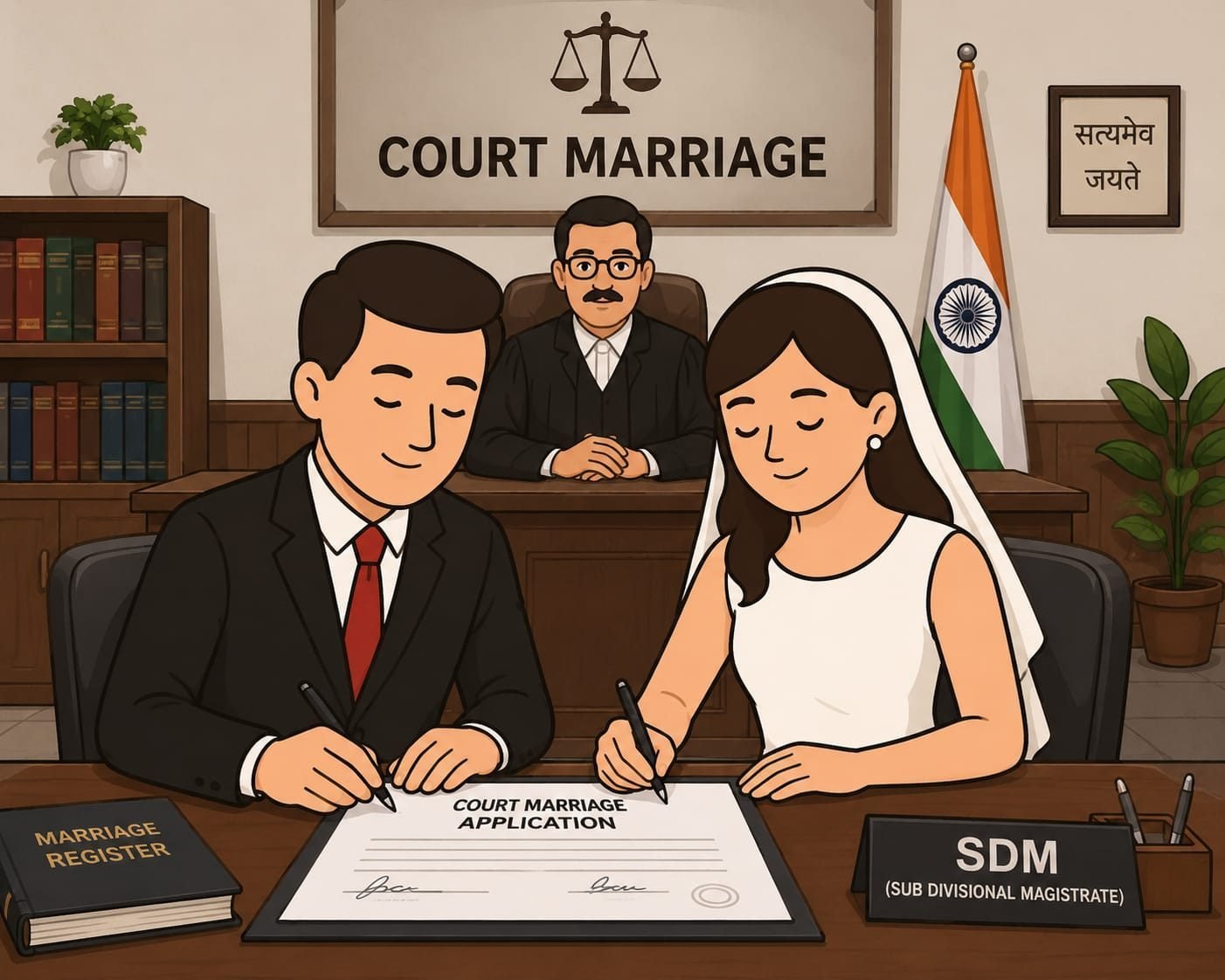
A Muslim woman and a Hindu man. A Muslim man and a Sikh woman. A Christian bride and a Muslim groom. Delhi has thousands of such couples, and almost all of them face the same question: do we marry by nikah, which may require one of us to convert, or is there another way? There is another way, and for most interfaith couples it is the safer one: the Special Marriage Act, 1954, a civil marriage law that lets two people of any religion marry without either giving up their faith.
This page explains the Special Marriage Act as it works in Delhi in 2026, why we usually recommend it over a conversion followed by a nikah, what it changes about divorce and inheritance, how the thirty-day notice works and what it means for your privacy and safety, and how couples who want a religious ceremony as well can have one. For ₹15,000 we handle the full Special Marriage Act process, and for Muslim couples who want both a nikah and a civil marriage, we arrange both.
We are a marriage service that reads nikahs every week, so it may seem strange that we often advise couples to marry under a civil law instead. The reason is simple: our job is to give couples a marriage that is valid, safe and secure for the rest of their lives. For a Muslim and a partner of another faith who do not both wish to share one religion, that marriage is almost always a Special Marriage Act marriage. We would rather tell you that honestly than sell you a quick nikah that a court, a family or a state law can later unravel.
Who This Service Is For
| Couple | What we recommend |
|---|
| A Muslim and a Hindu, Sikh, Jain, Buddhist, Christian, Parsi or non-religious partner, neither wishing to convert | Marriage under the Special Marriage Act |
| An interfaith couple whose families want a religious ceremony too | Special Marriage Act marriage first; any religious ceremony afterwards, understanding that the civil marriage is what the law recognises |
| Two Muslims who want their marriage governed by the Special Marriage Act and the Indian Succession Act | A nikah and a marriage (or registration) under the Special Marriage Act, chosen knowingly |
| A Muslim and a foreign national of another faith | Special Marriage Act, with the foreign partner's documents; see also our NRI service |
| Two Muslims who simply want a government certificate | Not this service; registration of the nikah under the Delhi 2014 Order keeps Muslim personal law |
If you are both Muslim and only need a certificate, please read our Muslim marriage registration page first. Registering a nikah under the Special Marriage Act changes the law of succession for your family, and the Delhi High Court has had to set aside such registrations for couples who did it without understanding.
What the ₹15,000 Includes
- A private consultation on the right route, including the consequences for divorce and inheritance
- Checking both partners' documents and eligibility
- Drafting the affidavits and declarations
- Filing the notice of intended marriage and booking the verification appointment
- Guidance through the thirty-day notice period, including privacy and safety
- Booking the solemnisation appointment and preparing you and your three witnesses
- Follow-up until the marriage certificate is issued
- For two Muslim partners who want it: a nikah by our own Qazi, with nikahnama
Government fees and notary charges are at actual cost. Apostille for use abroad is separate; see our NRI package.
Why We Usually Recommend the Special Marriage Act for Interfaith Couples
Under Muslim personal law, a nikah between a Muslim woman and a non-Muslim man is not valid unless he genuinely becomes a Muslim, and the Hanafi school treats a nikah between a Muslim man and a Hindu or Sikh woman as irregular unless she becomes a Muslim. The obvious answer seems to be conversion. It is often the worst answer.
- Conversion only for marriage is legally fragile. Courts have questioned conversions made solely to marry, and a marriage built on a conversion that a court later finds was not genuine can be challenged.
- Several states criminalise it. Uttar Pradesh, Uttarakhand, Haryana, Madhya Pradesh and other states have laws regulating religious conversion, with prison terms for unlawful conversion and provisions targeting conversion for marriage. Families use these laws against couples. If either partner lives in, comes from or has family in such a state, the risk is real even if the marriage is in Delhi.
- It causes lasting family pain. A partner who converts under pressure often regrets it, and the other family treats the conversion as a defeat.
- The Special Marriage Act avoids all of this. Neither partner converts. Each keeps their religion. The marriage is valid everywhere in India and recognised abroad.
Who Can Marry Under the Special Marriage Act
| Condition | What it means |
|---|
| Neither has a spouse living | Both must be unmarried, divorced by a valid decree or dissolution, or widowed |
| Sound mind | Both must be capable of giving valid consent |
| Age | The man at least 21, the woman at least 18 |
| Not within prohibited degrees | The Act has its own list of prohibited relationships; a custom permitting a marriage can make an exception |
| Residence | At least one partner must have lived in the district for at least 30 days before giving notice |
Religion is irrelevant. A Muslim can marry a Hindu, a Christian, a Sikh, a Parsi, a Jew or a person of no religion, and two Muslims can also marry under the Act.
The Process, Step by Step
- Consultation: we confirm eligibility, the district, and the documents, and explain the consequences of the Act.
- Documents and affidavits: age proof, ID, residence proof for the thirty days, photographs, and affidavits on marital status, age, and that you are not within prohibited degrees.
- Notice of intended marriage: filed with the Marriage Officer of the district where one of you has lived for thirty days. Both partners appear for verification.
- Notice period: the notice is entered in the Marriage Notice Book and, under the Act, published. If either partner lives in another district, a copy is sent there. Anyone can object within thirty days, but only on the legal grounds that a condition is not met.
- Solemnisation: after thirty days and within three months of the notice, the couple and three witnesses appear before the Marriage Officer. The partners and witnesses sign the declaration, and the couple say to each other, in any language they understand, "I take thee ... to be my lawful wife (or husband)".
- Certificate: the Marriage Officer enters the certificate in the Marriage Certificate Book, signed by the couple and witnesses. It is conclusive evidence of the marriage.
| Stage | Typical time |
|---|
| Documents and filing | A few days |
| Notice period | 30 days, fixed by law |
| Solemnisation | Within three months after the notice period; depends on appointments |
| Total | Usually 35 to 60 days |
Three Witnesses
The Special Marriage Act requires three witnesses at the solemnisation, who sign the declaration with the couple. They must be adults with ID and address proof, and ideally people who know you well. We do not provide witnesses. For interfaith couples, friends and colleagues are often the easiest choice when families are not yet supportive. Witnesses can be of any religion.
The Thirty-Day Notice: Privacy and Safety
The notice period is the part interfaith couples fear most, because the Act provides for the notice to be published, and families sometimes learn of the marriage this way. Several points matter:
- Objections must be legal: a parent's disapproval, or the fact that the partners are of different religions, is not a ground for objection. Only a claim that a legal condition is not met (for example, that one partner is already married or underage) is valid, and the Marriage Officer must inquire into it.
- Privacy: in Safiya Sultana v. State of U.P. (January 2021), the Allahabad High Court held that mandatory publication of the notice violates the right to privacy and that couples may ask for it not to be published. That ruling binds Uttar Pradesh; practice in Delhi should be checked at the time. We explain the current position before filing.
- A copy to the other district: if one partner is registered as living elsewhere, the notice goes to that district too. Plan for that.
- Safety planning: if you expect trouble, prepare before filing: a safe place to stay, your documents with you, a trusted friend informed, and a written complaint to the police ready if threats begin. Delhi has special cells and safe houses for couples under its 2021 standard operating procedure, and the Delhi High Court routinely directs police protection for threatened adult couples.
If Someone Objects
Objections during the notice period frighten couples more than they should. The Act limits them tightly.
- Who can object: any person, within thirty days of the notice being published.
- On what grounds: only that the marriage would breach one of the conditions in the Act: that a partner already has a living spouse, is not of sound mind, is under age, the partners are within prohibited degrees, or the residence condition is not met. "They are of different religions" and "the family does not agree" are not grounds.
- What the officer does: the Marriage Officer records the objection and must inquire into it and decide within thirty days. The marriage cannot be solemnised until the objection is decided.
- If the objection is rejected: the marriage proceeds.
- If the objection is upheld: either partner can appeal to the district court within thirty days.
- False objections: the Act provides for costs against a person who objects without reasonable grounds.
In practice, objections from angry relatives usually fail because they cite no legal ground. What matters is that your documents clearly show you meet every condition: age proof, marital status, residence. That is why we check them so carefully before filing.
Inheritance Under the Indian Succession Act
The biggest long-term effect of marrying under the Act, for Muslim partners, is on inheritance. Under section 21 of the Special Marriage Act, succession to the property of a person married under the Act, and of their children, is governed by the Indian Succession Act.
| Example: a husband dies without a will, leaving a wife, a son and a daughter | Share |
|---|
| Widow | One-third |
| Son | One-third |
| Daughter | One-third |
Under the Indian Succession Act, sons and daughters inherit equally, and a person may leave the whole estate by will. Under Sunni Muslim law in the same example, the widow would take one-eighth, and the son would take twice the daughter's share of the remainder, with wills limited to one-third for non-heirs. Some couples choose the Act for exactly this reason. Others would rather keep Muslim personal law. Either choice is legitimate; the important thing is to make it knowingly.
A practical tip for every couple married under the Act: make wills. With the freedom to leave property as you wish comes the responsibility to say how.
Divorce Under the Act
A marriage under the Special Marriage Act can be ended only by a court decree. Talaq, khula and mubarat do not apply.
- Grounds: the Act lists grounds on which either spouse may seek divorce, including adultery, desertion for two years, cruelty, serious mental disorder, and several others, with additional grounds available to the wife.
- Mutual consent: spouses who have lived separately for a year or more and agree that the marriage should end can file jointly for divorce by mutual consent.
- Time bar: ordinarily, no divorce petition can be filed within one year of the marriage, except in cases of exceptional hardship or depravity.
- Maintenance and alimony: the court can order maintenance and permanent alimony for the wife.
For many couples, particularly Muslim women, the Act's court-based divorce is a real protection: no marriage can be ended by one spouse's unilateral pronouncement.
Conversion Laws in Neighbouring States
Delhi does not have a separate anti-conversion law at the time of writing. But most interfaith couples in Delhi have family roots in neighbouring states, and complaints are often filed there. Several states have laws regulating religious conversion, typically requiring advance notice to the District Magistrate before converting, and treating conversion "for the purpose of marriage" with suspicion or as an offence.
| State | Law |
|---|
| Uttar Pradesh | Prohibition of Unlawful Conversion of Religion Act, 2021 |
| Uttarakhand | Freedom of Religion Act, 2018 (amended since) |
| Haryana | Prevention of Unlawful Conversion of Religion Act, 2022 |
| Madhya Pradesh | Freedom of Religion Act, 2021 |
| Himachal Pradesh | Freedom of Religion Act, 2019 (amended since) |
| Gujarat | Freedom of Religion Act, 2003 (amended 2021) |
These laws are complex, some provisions have been challenged in the courts, and their details change. The practical point is simple: a marriage under the Special Marriage Act involves no conversion, so none of these laws is engaged by the marriage itself. That is the single biggest legal reason we recommend the Act to interfaith couples with roots in these states.
Living Through the Notice Period
The thirty days between notice and solemnisation are the most delicate part of an interfaith marriage. Couples who plan them well rarely have trouble.
- Decide in advance whether to tell families before filing. Some couples tell their families first, hoping for support; others file first so the process is underway. Either is legitimate; what matters is being prepared for the reaction.
- Keep your routine. Go to work or college as usual. Avoid confrontations.
- Stay reachable to each other and to a trusted friend. Share locations with each other, not with family members you fear.
- Keep your documents with you. Families sometimes hide or destroy documents to stop a marriage.
- Record threats and report them in writing early.
- Do not make public announcements on social media until after the marriage.
- Keep the solemnisation date flexible within the three-month window, in case you need to move it.
Employers and Colleagues
Many interfaith couples meet at work, and many witnesses are colleagues. After the marriage, update your employer's records for insurance, leave and nominations with the marriage certificate. If a family's threats reach your workplace, tell HR and security, and include those incidents in your police complaint. Most employers in Delhi and the NCR are supportive once they understand the situation.
What Changes When You Marry Under the Act
| Matter | Nikah under Muslim law | Marriage under the Special Marriage Act |
|---|
| Religion of the spouses | Both Muslim (or a valid kitabiya marriage for a Muslim man) | Any religion; no conversion |
| Ceremony | Ijab, qubool, witnesses, mahr | Declaration before the Marriage Officer and three witnesses |
| Mahr | Required; the wife's right | Not part of the Act; the couple may agree any gift or settlement |
| More than one spouse | A man may, subject to conditions | Void; bigamy is an offence for either spouse |
| Divorce | Talaq, khula, mubarat, or court under the 1939 Act | Only by a court decree under the Act, including divorce by mutual consent |
| Maintenance | Under Muslim law and the general law | Under the Act and the general law |
| Succession | Muslim personal law; will limited to one-third | Indian Succession Act; a person can will away the whole estate |
| Children's religion | Usually raised as Muslims | Decided by the parents |
These differences are not a reason to avoid the Act. They are the reason to choose it knowingly. Many couples prefer its equal treatment of husband and wife, its court-based divorce, and its single, clear succession law.
Can We Still Have a Religious Ceremony?
Yes, with care. The Act allows the marriage to be solemnised in any form the parties choose, provided the declaration before the Marriage Officer and witnesses is made. Many couples add a religious or cultural celebration afterwards.
- Two Muslims: a nikah can be read before or after the Special Marriage Act marriage, and many couples do both. Once married under the Act, the Act governs the marriage, including divorce and succession.
- A Muslim and a non-Muslim: a nikah requires the non-Muslim partner to be Muslim (or, for a Muslim man, the woman to be a Christian or Jew). If the partner has not genuinely converted, a nikah is not valid in Muslim law, but it does not affect the civil marriage. Some families hold a religious gathering, dua or blessing instead of a formal nikah.
- A Hindu, Sikh or Christian ceremony for the other family can also follow the civil marriage.
The civil marriage is what the law recognises. Religious ceremonies after it are for faith and family.
What If One of Us Converts Later?
Some partners, years after marriage, freely choose to adopt their spouse's faith. That is their right. A conversion after a Special Marriage Act marriage does not dissolve it, and the marriage remains governed by the Act. The Act's rules on divorce and succession continue to apply. Conversion by a spouse can, however, be a ground on which the other spouse seeks divorce under some personal laws, so take advice if this arises.
Documents Needed
| Document | Who | Notes |
|---|
| Age proof | Both | Class 10 certificate, birth certificate or passport |
| Identity proof | Both | Aadhaar, voter ID, passport, driving licence |
| Residence proof for 30 days in the district | At least one partner | Aadhaar with address, rent agreement with owner's documents and utility bill, voter ID |
| Photographs | Both | Passport-size, recent |
| Affidavits | Both | Date of birth, marital status, not within prohibited degrees, nationality |
| Divorce decree or death certificate | If previously married | A valid dissolution is essential; instant triple talaq is void |
| Foreign partner | If applicable | Passport, visa, and proof of single status from the embassy or home authorities, often with translation |
| Witnesses' ID and address proof | Three witnesses | Originals on the day |
Myths About the Special Marriage Act
| Myth | Fact |
|---|
| You must convert to marry someone of another religion | Not under the Special Marriage Act. Neither partner converts. |
| The family's objection can stop the marriage | Only a legal ground can stop it, and the officer must decide objections within thirty days. |
| A court marriage is only for runaway couples | Many couples married under the Act have the full support of their families. |
| The certificate is less valid than a religious marriage | A Special Marriage Act certificate is conclusive evidence of a valid marriage, recognised throughout India and abroad. |
| Children must follow the father's religion | The parents decide how to raise their children. |
| You cannot have a religious ceremony afterwards | You can. The law recognises the civil marriage; ceremonies are for faith and family. |
| It takes six months | Usually 35 to 60 days, most of which is the fixed notice period. |
| Muslims cannot use the Act | Anyone can. Two Muslims can marry under it, knowing it changes divorce and succession. |
For Two Muslims: Nikah and the Act Together
Some Muslim couples want both: a nikah, because their faith and families expect it, and a Special Marriage Act marriage, because they want its legal framework. The order usually works like this:
- Our Qazi reads the nikah, with the nikahnama and certificate, on a date that suits the families.
- We file notice under the Special Marriage Act (or, where appropriate, apply to register the existing marriage under section 15 of the Act, which also involves public notice and thirty days).
- After the notice period, the couple and three witnesses appear before the Marriage Officer.
- The certificate issued under the Act becomes the governing legal record.
The couple should understand from the start that, once under the Act, their marriage is governed by it for divorce and succession, even though they also had a nikah. We explain this in writing before filing.
Using the Certificate Abroad
A Special Marriage Act certificate is widely accepted by embassies and immigration authorities, which is one reason couples with plans abroad choose it. For use in countries party to the Hague Apostille Convention, the certificate can be apostilled by India's Ministry of External Affairs, usually after authentication by the Delhi government. Other countries require embassy attestation. Our NRI package handles this.
Planning Your Dates
| Week | What happens |
|---|
| Week 0 | Consultation; documents collected; affidavits sworn |
| Week 1 | Notice filed; verification appointment |
| Weeks 1–5 | Thirty-day notice period; safety plan in place |
| Week 5–8 | Solemnisation appointment with three witnesses |
| Same day | Certificate entered and signed |
| Afterwards | Any religious ceremony; apostille if needed; update records |
If you have a fixed deadline, such as a visa appointment, tell us at the start. The thirty-day notice period cannot be shortened, so the earlier you begin, the better.
Children of Interfaith Marriages
- Birth certificate: records both parents' names; religion is not a condition of registration.
- Names: parents choose. Many interfaith couples choose names acceptable to both families.
- Religion: the parents decide how to raise their children. The Special Marriage Act does not prescribe it.
- Inheritance: children of a marriage under the Act inherit under the Indian Succession Act, sons and daughters equally.
- School admission: the marriage certificate and the child's birth certificate are usually all that is needed.
Religion in Your Documents
Couples sometimes worry that they must record a religion somewhere. Aadhaar does not record religion. The Special Marriage Act certificate records the marriage, not a conversion. Some forms, such as certain school or census forms, ask about religion; each person answers for themselves. Nothing about a Special Marriage Act marriage requires either partner to change how they identify.
When Both Families Support You
Not every interfaith marriage is contested. Many families, once they know their child's partner, are supportive. For them the Act is simply the correct legal framework, and the celebrations can be as grand as the families wish. Common patterns we see in Delhi:
- The civil marriage in the morning with close family as witnesses, followed by a reception.
- A civil marriage followed on separate days by a Hindu or Sikh ceremony for one family and a dua gathering or walima-style dinner for the other.
- A single inter-cultural celebration with elements from both traditions.
Whatever the celebration, the thirty-day notice and the three witnesses remain the same. Book the solemnisation date first, then plan the functions around it.
After the Marriage
- Collect the certificate and check every detail.
- Make wills, since the Indian Succession Act governs your succession.
- Update employer, bank, insurance and pension nominations.
- Update addresses on Aadhaar if you have moved.
- Apply for apostille if the certificate will be used abroad.
- Keep a copy with a trusted friend, and scans in both partners' email.
Three Routes for Interfaith Couples, Compared
Interfaith couples in Delhi are usually offered three routes. Only one involves no conversion.
| Point | Conversion to Islam + nikah | Conversion to Hinduism (shuddhi) + Arya Samaj / Hindu marriage | Special Marriage Act |
|---|
| Does anyone convert? | Yes, the non-Muslim partner | Yes, the non-Hindu partner | No |
| Risk under state conversion laws | Yes, where the laws apply | Yes, where the laws apply | None from the marriage |
| Time | Days | Days | 35–60 days |
| Public notice | No | No | Yes, 30 days |
| Law governing the marriage | Muslim personal law | Hindu Marriage Act | Special Marriage Act |
| Succession | Muslim personal law | Hindu Succession Act | Indian Succession Act |
| Challenge if conversion later found not genuine | The marriage may be questioned | The marriage may be questioned | Not applicable |
The faster routes are faster because they skip the notice period, but they carry the conversion risk. For a couple where one partner genuinely and freely wishes to adopt the other's faith, a conversion route may be right, and we can explain it; our site also has a detailed guide on conversion and marriage. For couples who want to keep their own faiths, the Special Marriage Act is the only route that fits.
Already Had a Nikah After a Conversion?
Some couples come to us after a conversion and nikah done in a hurry, worried that the conversion may be questioned or that a family will use a conversion law against them. Options depend on the facts:
- If the conversion was genuine and the nikah valid, registering the nikah under the Delhi 2014 Order records it.
- If the couple want the security of a civil marriage, they may be able to register their marriage under section 15 of the Special Marriage Act, which has its own conditions and thirty-day notice, or to marry under the Act. Either brings the marriage under the Act.
- If there is an existing complaint or FIR, a lawyer should advise before any further step.
Tell us the full facts in a private consultation, and we will explain the safest path.
Why the Service Costs ₹15,000
A Special Marriage Act marriage involves two appearances a month apart, a statutory notice, a possible objection inquiry, three witnesses, and, for interfaith couples, careful planning around privacy and safety. Our charge covers the consultation, documents and affidavits, filing, guidance through the notice period, the solemnisation appointment and follow-up to the certificate, and, for two Muslim partners who want it, a nikah by our Qazi. Government fees and notary charges are paid at actual cost, and we tell you every cost before you commit.
Terms You Will Hear
| Term | Meaning |
|---|
| Marriage Officer | The official appointed under the Special Marriage Act to receive notices and solemnise marriages; in Delhi, officers of the revenue administration |
| Notice of intended marriage | The formal notice both partners give the Marriage Officer before the marriage |
| Marriage Notice Book | The register in which notices are entered and which the public can inspect |
| Objection | A claim by any person, within thirty days, that a legal condition for the marriage is not met |
| Declaration | The statement signed by both partners and three witnesses before solemnisation |
| Solemnisation | The marriage itself, before the Marriage Officer and witnesses |
| Marriage Certificate Book | The register in which the certificate is entered; the certificate is conclusive evidence of the marriage |
| Section 15 registration | Registration under the Act of a marriage already celebrated in another form, such as a nikah |
| Indian Succession Act | The law of inheritance that applies to people married under the Special Marriage Act |
| Prohibited degrees | Close relationships within which marriage is not allowed under the Act |
Where Delhi Couples Apply
The notice is filed with the Marriage Officer of the district in which at least one partner has lived for the thirty days before notice. Since 1 January 2026 Delhi has 13 revenue districts and 39 sub-divisions, and the online system allocates the office by address. Couples from Jamia Nagar and Okhla usually fall under the South East district, the Old Delhi mohallas under the Old Delhi district, and the Seelampur–Mustafabad belt under the North East district, but always follow the office named in your appointment.
Interfaith Couples and Their Families
Interfaith marriages attract the strongest family reactions, sometimes from both sides at once. The law is clear: adults may marry whom they choose, across religions. The Supreme Court said so in Shafin Jahan v. Asokan K.M. (2018), the Hadiya case, and in Lata Singh (2006) and Shakti Vahini (2018). The Delhi High Court reaffirmed in August 2026 that relatives have no right to interfere with consenting adults' choice.
Practical steps for interfaith couples:
- Carry your own documents; do not take family property when you leave home.
- Prepare a safe place to stay for the notice period if you expect trouble.
- Record threats and report them in writing to the SHO and DCP early.
- If a family alleges kidnapping or conversion, the woman's own clear statement that she is an adult marrying by choice, without converting, is decisive; the Special Marriage Act helps precisely because no conversion is involved.
- If police protection is inadequate, a lawyer can petition the Delhi High Court.
Couples from the NCR often ask whether they can marry in Delhi under the Act. The answer turns on residence: at least one partner must have actually lived in the Delhi district for thirty days before the notice. A couple both living in Noida or Gurugram would normally give notice in their own district. Never use a Delhi address where neither of you lives; the declaration is made on oath, and a false address can invalidate the process and expose you to prosecution.
Common Mistakes
- Converting only to have a nikah, then facing a complaint under a state conversion law.
- Using an address where neither partner has lived for thirty days.
- Not preparing for the notice becoming known to families.
- Bringing only two witnesses; the Act needs three.
- Letting the three-month window after the notice lapse, so the notice must be given again.
- Two Muslims registering under the Act without realising it changes succession.
- A partner whose earlier marriage ended only by instant triple talaq applying as "divorced".
- Assuming a religious ceremony afterwards changes the law governing the marriage.
Four Delhi Couples
The Hindu groom and the Muslim bride
A software engineer from Mayur Vihar and a teacher from Jamia Nagar had been together for six years. Neither wanted to convert. They filed notice in the district where he lived, prepared for her family's reaction, and married before the Marriage Officer with three college friends as witnesses. Her family did not attend; two years later they came to the child's aqiqah.
The conversion they did not make
A Muslim groom's family insisted his Sikh fiancée convert before a nikah. Her family lived in Haryana, which has a conversion law. We explained the risk. They married under the Special Marriage Act, and his family held a dua gathering afterwards.
The two Muslims who chose the Act
A Muslim couple, both lawyers, wanted equal inheritance rights for their daughters and a court-based divorce law. After a nikah read by our Qazi, they married under the Special Marriage Act, fully aware of the effect.
The foreign bride
A Muslim groom from Zakir Nagar married a Christian woman from the Philippines. Her passport, visa and a certificate of single status from her embassy, with the thirty days' residence shown by his address, were enough. The certificate was later apostilled for her country.
Checklist
- ☐ Both eligible: ages 21 and 18, no living spouse, sound mind
- ☐ Decided knowingly: the Act changes divorce and succession
- ☐ At least one partner has lived 30 days in the district
- ☐ Age proof, ID, residence proof, photographs, affidavits
- ☐ Divorce decree or death certificate if previously married
- ☐ Safety plan for the notice period
- ☐ Three witnesses with ID
- ☐ Solemnisation within three months of notice
- ☐ Religious ceremony, if any, planned after the civil marriage
Whatever route you choose, choose it together and with full information.
How We Help
We explain your options honestly, including why a rushed conversion is risky, prepare and file your notice, guide you through the thirty days with privacy and safety in mind, prepare you and your witnesses for solemnisation, and follow up until you hold the certificate. For two Muslim partners who want it, our Qazi reads the nikah as well. We do not provide witnesses, we do not marry anyone under the legal age, and we never push anyone to convert.
Questions and Answers
Can a Muslim marry a Hindu without converting?▼
Yes, under the Special Marriage Act, 1954. Neither partner converts, and each keeps their religion. The marriage is valid throughout India.
Why not simply convert and have a nikah?▼
Conversion only for marriage is legally fragile and, in states such as Uttar Pradesh, Uttarakhand, Haryana and Madhya Pradesh, can lead to criminal complaints. The Special Marriage Act avoids these risks entirely.
What does the ₹15,000 include?▼
Consultation on the route and its consequences, document checks, affidavits, filing the notice, guidance through the thirty days, the solemnisation appointment and certificate follow-up. For two Muslim partners who want it, a nikah by our Qazi as well.
How long does it take?▼
Usually 35 to 60 days. The thirty-day notice period is fixed by law and cannot be shortened.
What are the conditions?▼
Neither partner has a living spouse, both are of sound mind, the man is at least 21 and the woman at least 18, they are not within prohibited degrees, and one of them has lived in the district for thirty days before notice.
How many witnesses are needed?▼
Three, at the solemnisation. They can be of any religion. We do not provide witnesses.
Can my family object?▼
Anyone can object within thirty days, but only on legal grounds, such as an existing marriage or being under age. Different religion or family disapproval is not a ground.
What happens if someone objects?▼
The Marriage Officer must inquire and decide within thirty days. If the objection is upheld, either partner can appeal to the district court within thirty days. Objections without reasonable grounds can attract costs.
Will the notice be published?▼
The Act provides for publication. The Allahabad High Court held in 2021 that mandatory publication violates privacy and couples may ask for non-publication; that ruling binds Uttar Pradesh. We check current practice in Delhi before filing.
Will my family find out through the notice?▼
They may. If either partner's address is in another district, the notice is also sent there. Plan for this: a safe place, your documents, a trusted friend informed, and a police complaint ready if threats begin.
Can we have a nikah after the Special Marriage Act marriage?▼
Two Muslims can. For a Muslim and a non-Muslim, a nikah requires the partner to be Muslim (or, for a Muslim man, the woman to be Christian or Jewish). A religious gathering or dua is possible instead. The civil marriage is what the law recognises.
Does marrying under the Act affect inheritance?▼
Yes. Succession for the couple and their children is governed by the Indian Succession Act instead of personal law. Sons and daughters inherit equally, and a person can will away the whole estate.
Is there mahr under the Act?▼
Mahr is not part of the Special Marriage Act. The couple can agree any gift or financial arrangement they wish, and record it separately.
Can a husband married under the Act take a second wife?▼
No. A second marriage while the first spouse is living is void and is the offence of bigamy, whatever the husband's religion.
How does divorce work under the Act?▼
Only by court decree, on the grounds in the Act or by mutual consent after at least a year's separation. Talaq and khula do not apply.
Can two Muslims marry under the Act?▼
Yes, if they choose to. It changes divorce and succession for them. If they only want a government certificate, registering the nikah under the Delhi 2014 Order keeps Muslim personal law.
What religion will our children follow?▼
The parents decide. The Act does not prescribe a religion for children.
Can a Muslim woman marry a Hindu man under the Act?▼
Yes. The Act permits marriage between any two eligible people regardless of religion. No conversion is needed.
Do we need our parents' consent?▼
No. Adults do not need parental consent. The Supreme Court has repeatedly protected adults' right to marry across religions.
Where do we file the notice?▼
With the Marriage Officer of the district where at least one of you has lived for thirty days. The system allocates the office by address under Delhi's 2026 district map.
What address proof works for the thirty days?▼
Aadhaar with the address, a rent agreement with the owner's documents and a utility bill, voter ID, or similar proof showing residence for at least thirty days.
Can we marry if one of us lives outside Delhi?▼
Yes, if the other has lived in the Delhi district for thirty days. The notice is also sent to the other partner's district.
What if the three-month window lapses?▼
The marriage must be solemnised within three months of the notice. If it lapses, a fresh notice is needed and the thirty days start again.
Can a divorced person marry under the Act?▼
Yes, with a valid divorce decree or dissolution. A Muslim woman whose only 'divorce' was instant triple talaq is still married, because it is void.
Can a foreign national marry under the Act?▼
Yes. The foreign partner needs a passport, visa and usually proof of single status from their embassy, with translation. One partner must meet the thirty-day residence condition.
Is the certificate valid abroad?▼
It is widely accepted. For countries in the Hague Apostille Convention, it can be apostilled by the MEA after Delhi government authentication; others need embassy attestation.
Can we get police protection during the notice period?▼
Yes. Call 112 or 181 in an emergency, give a written complaint to the SHO and DCP, and ask about the special cell and safe houses. A lawyer can petition the Delhi High Court if needed.
What if my family files a kidnapping complaint?▼
The woman's clear statement that she is an adult marrying by choice, without converting, is decisive. Her age proof and the notice papers support it.
Can I convert later if I choose to?▼
Yes, freely. A later conversion does not dissolve the marriage, which remains governed by the Act. Take advice, as conversion can have consequences under some personal laws.
Does the Act require a ceremony?▼
The parties make a declaration before the Marriage Officer and three witnesses and say words of acceptance to each other in any language they understand. They may add any form of ceremony they wish.
Is a Special Marriage Act marriage a 'court marriage'?▼
That is the common name for it. The marriage takes place before the Marriage Officer, a revenue official, not a judge.
What is the government fee?▼
A small statutory fee. Our ₹15,000 charge covers our work; government fees and notary charges are at actual cost.
Can we have a Hindu ceremony and a Muslim gathering too?▼
Yes. Many interfaith couples hold both family celebrations after the civil marriage. They do not change the law governing the marriage.
Will we have to appear twice?▼
Usually yes: once for notice verification and once for solemnisation, about a month apart.
What if one of us was born abroad or has foreign documents?▼
Foreign documents may need translation and authentication. Tell us early; they can take time.
Should we make wills?▼
Yes. Under the Indian Succession Act you have freedom to decide how your property passes. A will ensures your wishes are followed.
Can our marriage be challenged later?▼
Only on the legal grounds in the Act, such as an existing marriage or a prohibited relationship. A properly solemnised marriage with correct documents is secure.
Does Delhi have an anti-conversion law?▼
Delhi does not have a separate anti-conversion law at the time of writing, but neighbouring states such as Uttar Pradesh, Uttarakhand and Haryana do, and complaints are often filed where families live. A Special Marriage Act marriage involves no conversion.
Should we tell our families before filing the notice?▼
It is your choice. Some couples tell families first hoping for support; others file first. Either way, prepare for the reaction: a safe place, documents with you, and a police complaint ready if threats begin.
Does Aadhaar record our religion?▼
No. Aadhaar does not record religion, and the Special Marriage Act certificate records the marriage, not any change of religion.
Can both families be witnesses?▼
Yes. Any three adults with ID can be witnesses, including parents and relatives from both sides.
Can we have a big wedding after the civil marriage?▼
Yes. The civil marriage is the legal step; the celebrations can be as large as you wish.
Do children of an interfaith marriage face problems in school?▼
No. The marriage certificate and the child's birth certificate are usually all that schools need.
Is the Arya Samaj route faster for interfaith couples?▼
It is faster because it has no notice period, but it requires the non-Hindu partner to convert through shuddhi, which carries the same risks as any conversion for marriage. The Special Marriage Act is the only route without conversion.
We already converted and had a nikah. Can we switch to the Special Marriage Act?▼
Depending on the facts, you may be able to register the marriage under section 15 of the Act or marry under it, bringing the marriage under the Act. If there is an existing complaint, take a lawyer's advice first.
Is the notice period ever waived?▼
No. The thirty-day notice period is fixed by the Act. Start early if you have a deadline.
Can we marry under the Act on a weekend?▼
Solemnisation happens at the Marriage Officer's office on working days, by appointment.
Do we need to be present for the notice?▼
Yes. Both partners usually appear for verification of the notice, and again for solemnisation.
Who is the Marriage Officer in Delhi?▼
Officers of the Delhi revenue administration appointed under the Act. The office is allocated by the address of the partner meeting the residence condition.
Can the public see our notice?▼
The Marriage Notice Book is open to inspection under the Act. Ask us about current practice on publication and privacy in Delhi before filing.
Can our witnesses be from different religions?▼
Yes. Witnesses under the Special Marriage Act can be of any religion, as long as they are adults with ID.
Can a Muslim man marry a Christian woman by nikah instead?▼
Under Hanafi law, a nikah between a Muslim man and a Christian or Jewish woman is valid without conversion. Some couples still choose the Special Marriage Act for its civil framework and wide recognition abroad. We explain both.
What happens to mahr if we also have a nikah?▼
If two Muslims have a nikah, the mahr agreed in the nikahnama is a contractual obligation. Once their marriage is under the Act, the Act governs divorce and succession; take advice on how the mahr agreement will be treated in your case.
Can we marry under the Act if one of us is 20?▼
The man must be at least 21 and the woman at least 18. If the man is 20, wait until he turns 21.
Does the Act apply across India?▼
Yes. The Special Marriage Act applies throughout India, and a certificate from Delhi is valid everywhere in the country.
Will the Marriage Officer ask about our religions?▼
The notice and declaration record particulars required by the Act. Religion is not a condition of eligibility, and neither partner is asked to change it.
Can we choose the date of solemnisation?▼
Within the window from the thirty-first day to three months after the notice, subject to appointment availability. Book as soon as the notice period is about to end.
We both live in Noida. Can we marry under the Act in Delhi?▼
Only if one of you has actually lived in the Delhi district for thirty days before notice. Otherwise give notice in your own district. Never use a false address.
Is a Special Marriage Act certificate enough for a passport?▼
Yes. It is a government-issued marriage certificate and is accepted as proof of marriage for passports and visas.
Will you help if an objection is filed against us?▼
Yes. We help you gather the documents that answer the objection, which usually fail when no legal ground is shown. If the matter goes to appeal in court, a lawyer will be needed.
How do we start?▼
WhatsApp +91 8376863962 with your ages, religions, where each of you has lived for the last month, and whether either was married before. We arrange a private consultation.
What will you refuse?▼
We refuse to marry anyone under the legal age or with a living spouse, to push anyone to convert, to use a false address, or to provide witnesses.
Sources and Official References
Legal points on this page were checked against these sources. Procedures and portals change, so confirm current details before applying.
- The Special Marriage Act, 1954 – India Code
- Safiya Sultana v. State of U.P., Allahabad High Court, 12 January 2021 – Indian Kanoon
- Shafin Jahan v. Asokan K.M., Supreme Court, 2018 – Indian Kanoon
- Lata Singh v. State of U.P., Supreme Court, 2006 – Indian Kanoon
- Shakti Vahini v. Union of India, Supreme Court, 2018 – Indian Kanoon
- Delhi High Court directs online registration of Muslim marriages (Faizan Ayubi, November 2024) – LiveLaw
- Delhi government SOP for protection of inter-faith and inter-caste couples (Scroll, 2021)
- Muslim Personal Law (Shariat) Application Act, 1937 – Indian Kanoon
This page is general information, not legal advice for your specific case. Call +91 8376863962 for advice on your situation.
Related Services and Guides
📚 Live-in Relationship Law in India 2026: Rights and Limits
Legal status, key judgments, DV Act protection, maintenance, children, property, married partners, Uttarakhand
Read →
📚 Hindu–Muslim Marriage in India 2026: Legal Routes and Risks
Special Marriage Act without conversion vs nikah or Hindu rites after conversion, state conversion laws, inher
Read →
🤝 Inter-Religion Marriage
All interfaith routes.
Read →
❤️ Muslim Love Marriage
Both Muslim, families opposed – ₹7,000.
Read →
📜 Muslim Marriage Registration
Two Muslims, certificate only – ₹6,000.
Read →
☪️ Muslim Nikah Delhi
Nikah with certificate – ₹5,000.
Read →
🌍 NRI Muslim Nikah
Apostille and visas – ₹30,000.
Read →
🏠 Live-in Agreement
Not ready yet – ₹11,000.
Read →
⚖️ Court Marriage Delhi
Special Marriage Act for all.
Read →
📚 SMA vs HMA
Which law applies.
Read →
📚 Inter-Religion Guide
Legal routes explained.
Read →
💰 All Prices
Full fee list.
Read →