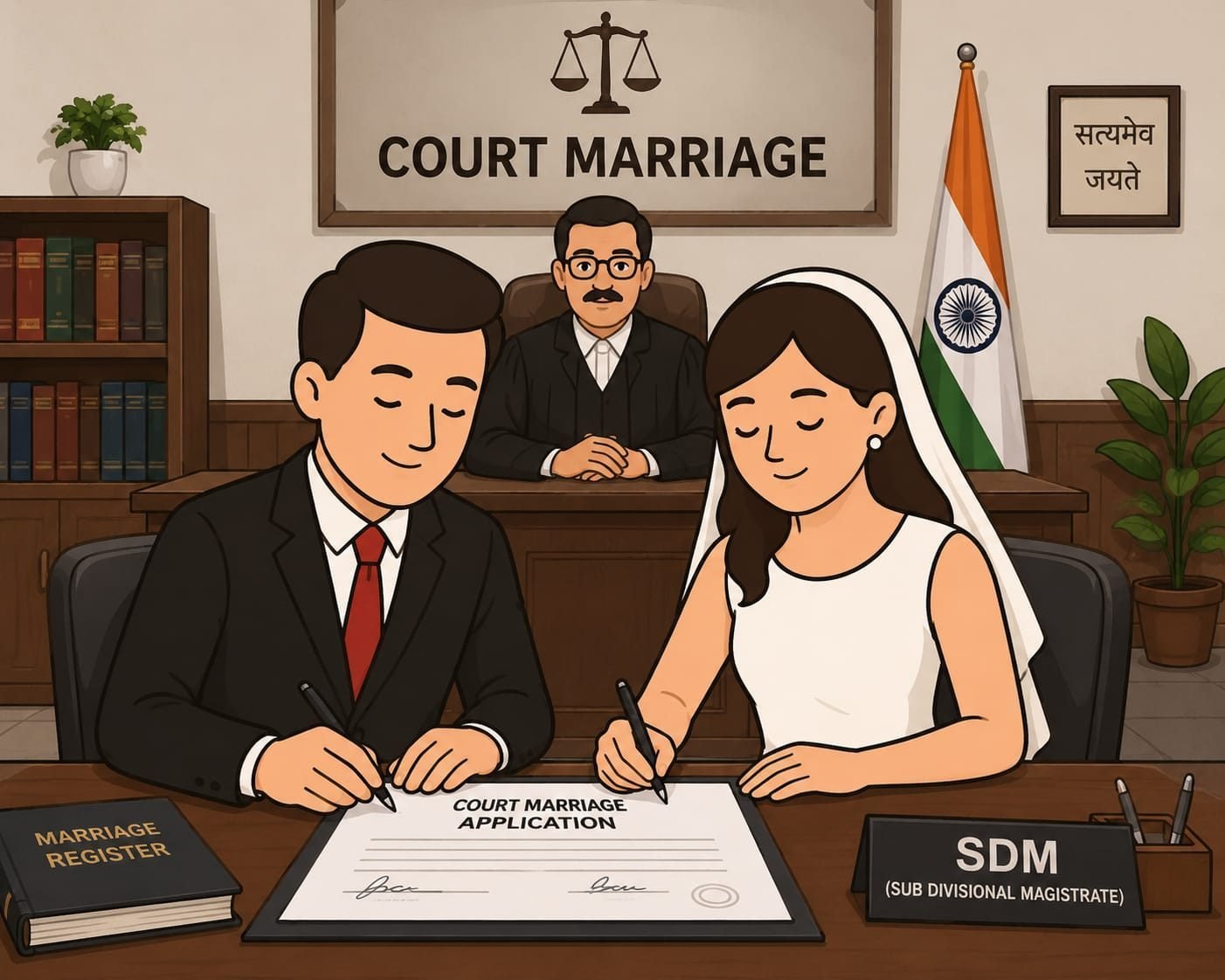
Quick answer: Kotwali is the old police and revenue name for the heart of the walled city: Chandni Chowk, Daryaganj, Chawri Bazar, Ballimaran, Sita Ram Bazar, Kinari Bazar, Turkman Gate, the Jama Masjid lanes and, just north, Kashmere Gate. Under Delhi's 2026 revenue map these areas are in the new Old Delhi district, whose two sub-divisions are Chandni Chowk and Sadar Bazar; most walled-city addresses are expected to be allotted to Chandni Chowk. Hindu, Sikh, Jain and Buddhist couples can have an Arya Samaj wedding and register it under the Hindu Marriage Act. Couples of different religions who do not want to convert marry under the Special Marriage Act, with a 30-day notice. Muslim couples register their nikah under the Delhi 2014 Order; Sikh couples can register an Anand Karaj under Delhi's 2018 Rules; Christian couples marry under the Indian Christian Marriage Act, 1872. Families sharing old havelis, tenants under old rent arrangements and couples arriving at Kashmere Gate from other states each have points to watch, covered below. Inter-religion marriage: ₹10,000; Special Marriage Act full process ₹15,000.
Key takeaways
- From 1 January 2026 the walled city is in the new Old Delhi district (sub-divisions Chandni Chowk and Sadar Bazar); e-District allots the office by address.
- Interfaith couples who keep their faiths marry under the Special Marriage Act: 30 days' residence, 30 days' notice, three witnesses; family dislike is not a legal objection.
- Conversion must be genuine and never ends an existing marriage; a stamp-paper "marriage agreement" is not a marriage.
- Nikah: register under the Delhi 2014 Order; Sikhs can register an Anand Karaj; Christians marry under the 1872 Act and can also register with Delhi.
- Shared havelis and old tenancies are no bar to proving residence. We never marry anyone under age and never provide witnesses.
Last reviewed: 22 September 2026 · 37 min read
On this page
- Kotwali at a glance
- Kotwali under the 2026 map
- Which office registers your marriage
- The legal routes
- Interfaith couples in the walled city
- Special Marriage Act step by step
- Getting through the 30-day notice
- Conversion: what the law expects
- Arya Samaj + registration
- Nikah and its registration
- Sikh Anand Karaj
- Christian marriages
- Jain families
- Address proof in shared havelis
- Old tenancies and rented rooms
- Registering an old marriage
- Weddings in havelis and dharamshalas
- Second marriages
- Couples arriving at Kashmere Gate
- Age: why we turn some couples away
- If your families oppose
- Affidavits, stamp paper and notaries
- Witnesses
- Marrying into a market family
- Documents checklist
- At the appointment
- What it costs
- Timeline
- Getting around the walled city
- Common mistakes
- After registration
- Five walled-city situations
- Checklist
- One-minute summary
- How we help
- Questions and answers
Stand at the eastern end of Chandni Chowk, with the Red Fort behind you, and within a few hundred metres you can see the whole of India's religious life. The Digambar Jain Lal Mandir is at your shoulder. A little further along are the Gauri Shankar temple, Gurdwara Sis Ganj Sahib, the Central Baptist Church and, at the western end, the Fatehpuri Masjid. The domes of Jama Masjid rise to the south. St. James' Church, one of Delhi's oldest, stands at Kashmere Gate to the north. For nearly four centuries, families of every faith have lived, traded and married in these lanes.
The walled city is also where Delhi's weddings are dressed. Kinari Bazar sells the gota, tinsel and turbans; Dariba Kalan the silver; Chawri Bazar the wedding cards; Katra Neel and the cloth markets the fabric; and the halwais of Chandni Chowk the sweets. Many families still hold their functions in dharamshalas and the courtyards of old havelis, with relatives from across Delhi squeezing into lanes where a car cannot pass.
Marriage questions here reflect all this. A Hindu boy from Sita Ram Bazar and a Muslim girl from Ballimaran want to marry without either converting. A Christian couple wants to know whether the church certificate is enough. A family sharing one haveli with three brothers' households has one electricity meter between them. A young couple who arrived at the Kashmere Gate bus terminal the night before, from another state, wants to marry today. This guide answers each of them, honestly, including where the answer is to wait.
For the general Delhi process, see the complete Delhi court marriage guide. Nearby area guides: Sadar Bazar, Civil Lines, Karol Bagh and Gandhi Nagar.
Kotwali at a Glance
| Item | Detail |
|---|---|
| District (from 1 January 2026) | Old Delhi |
| Sub-divisions in the district | Chandni Chowk and Sadar Bazar |
| Neighbourhoods | Chandni Chowk, Daryaganj, Chawri Bazar, Ballimaran, Sita Ram Bazar, Kinari Bazar, Dariba, Nai Sarak, Turkman Gate, Jama Masjid, Matia Mahal, Kashmere Gate |
| Pincode | 110006 for much of the walled city; 110002 for Daryaganj |
| Metro | Yellow Line: Chandni Chowk, Kashmere Gate; Violet Line: Lal Quila, Jama Masjid, Delhi Gate |
| Places of worship | Jain Lal Mandir, Gauri Shankar temple, Gurdwara Sis Ganj Sahib, Central Baptist Church, Fatehpuri Masjid, Jama Masjid, St. James' Church |
| Typical questions | Interfaith marriage without conversion, nikah registration, Christian and Sikh weddings, shared-haveli address proof, couples from other states |
Kotwali Under the 2026 Revenue Map
Before 2026, many couples knew the office for this area as SDM Kotwali. From 1 January 2026, Delhi was reorganised into 13 districts and 39 sub-divisions, and a new Old Delhi district was created with two sub-divisions, Chandni Chowk and Sadar Bazar. Most addresses in the walled city, from Daryaganj to Chandni Chowk and the Jama Masjid lanes, are expected to be allotted to the Chandni Chowk sub-division; addresses towards Sadar Bazar, Pahar Ganj's edge or Kashmere Gate may be allotted according to the exact boundary. Certificates issued by the old Kotwali office remain fully valid; nothing needs to be re-registered.
Which Office Registers Your Marriage?
You apply on the Delhi e-District portal and the system allots the office by the address you enter. For Hindu Marriage Act registration, the office can be where the marriage was performed or where either spouse lives. For the Special Marriage Act, notice goes to the Marriage Officer of the district where at least one of you has lived for 30 days. For nikah registration under the 2014 Order, the office is decided in the same way through the portal. Your appointment slip names the office, and that is where you go.
The Legal Routes for a Walled-City Couple
| Your situation | Law | Waiting period | Our fee |
|---|---|---|---|
| Different religions, neither converting | Special Marriage Act, 1954 | 30-day notice | ₹15,000 (full process) |
| Hindu–Muslim or other inter-religion couple, guidance and route | SMA, or a genuine voluntary conversion route | Depends on route | ₹10,000 |
| Both Hindu, Sikh, Jain or Buddhist | Arya Samaj wedding + Hindu Marriage Act registration | Wedding same day; registration by appointment | ₹7,100 combined |
| Both Muslim | Nikah + registration under the Delhi 2014 Order | Nikah same day; registration by appointment | ₹5,000 nikah; ₹6,000 registration |
| Sikh couple after Anand Karaj | Delhi Anand Marriages Registration Rules, 2018, or HMA | By appointment | ₹6,000 |
| Christian couple | Indian Christian Marriage Act, 1872, then registration | Notice periods under the Act | Guidance on request |
| Already married, not registered | HMA registration, or 2014 Order for other marriages | By appointment | ₹6,000 |
Government fees, stamp paper and notary charges are extra at actual cost. Full list: fees.
Interfaith Couples in the Walled City
In few places in Delhi do Hindu, Muslim, Jain, Sikh and Christian families live as closely as in the walled city. Children grow up in the same galis, study in the same schools and colleges, and work in the same markets. Some fall in love across faiths. Their families may accept it, reluctantly accept it, or refuse. Whatever the family's response, the law gives two adults real choices, and the most important thing is to choose knowingly.
| Option | What happens | Things to know |
|---|---|---|
| Special Marriage Act | A civil marriage; both keep their religion | 30-day notice; three witnesses; succession under the Indian Succession Act; a Hindu partner marrying a non-Hindu is severed from the joint family (s.19) |
| One partner genuinely embraces Islam, then nikah | Muslim marriage under Muslim personal law | Conversion must be sincere and voluntary; courts examine conversions made only to marry; state conversion laws may apply |
| One partner genuinely adopts Hinduism, then Arya Samaj wedding | Hindu marriage under the Hindu Marriage Act | Same caution about sincerity; carry the certificate of the ceremony of conversion and an affidavit |
We never pressure anyone to convert, and we do not conduct conversions made as a mere formality. For most interfaith couples who want to keep their own faith and their own family ties, the Special Marriage Act is the cleanest route. The Supreme Court held in Shafin Jahan (2018) that the choice of a partner is part of every adult's liberty under Article 21. See our inter-religion marriage service and the Hindu–Muslim marriage guide.
The Special Marriage Act, Step by Step
- Residence: at least one of you must have lived in the district for the 30 days before the notice. A walled-city address with Aadhaar, a bill or a rent agreement works.
- Notice: file the notice of intended marriage online, with age proof, ID, address proof and photographs.
- Display for 30 days: the notice is displayed at the Marriage Officer's office. Anyone may object, but only on legal grounds: that a party is under age, already married, of unsound mind, or within prohibited degrees of relationship. A family's dislike of the match is not a legal ground.
- Objection, if any: the Marriage Officer inquires within 30 days and decides. A frivolous objection is rejected.
- Solemnisation: after the 30 days, both of you appear with three witnesses, sign the declarations before the Marriage Officer, and the marriage is entered in the marriage certificate book. The certificate is conclusive proof of the marriage.
Couples often fear the notice period because they worry their families will find out. The law requires the notice; you cannot skip it in Delhi. What you can do is plan for it: keep your documents safe, choose supportive witnesses, and if you fear threats during the notice period, seek police protection. See the Special Marriage Act vs Hindu Marriage Act guide.
Getting Through the 30-Day Notice Safely
For many interfaith couples, the hardest part of the Special Marriage Act is not the paperwork but the month of waiting. The notice is displayed at the Marriage Officer's office, and couples worry that word will reach their families before the marriage is solemnised. A calm plan makes that month easier.
- Decide where each of you will stay for the month, and tell only people you trust. Some couples continue living as before; others stay with a relative or friend who supports them.
- Keep your documents with you — age proof, ID, address proof, and copies with a trusted friend or in your own email.
- Confirm your three witnesses early, and check that they can come on the solemnisation date.
- Keep a record of any threat: messages, call logs, the names of people who threatened you. If it becomes serious, approach the police special cell, or apply to the High Court for protection; the Supreme Court's directions in Shakti Vahini support you.
- Do not sign anything at home under pressure, and do not surrender your documents to anyone.
- Know the objection process: if an objection is filed, the Marriage Officer inquires and must decide within the period the Act allows. Only legal grounds count, and a rejected objection can be appealed by the objector, not used to delay indefinitely.
- Keep working or studying as normal where you safely can. A month passes.
If either of you feels unsafe at any point, call 112, or 181 for the women's helpline. We handle every interfaith case quietly, and we do not call your family or anyone else about your case.
Conversion: What the Law Expects
Some couples decide, for their own reasons of faith or family, that one partner will adopt the other's religion. That is their right, but the law expects the conversion to be real:
- It must be voluntary and sincere, not a formality to get around a marriage law.
- Conversion does not end an existing marriage. The Supreme Court held in Sarla Mudgal (1995) and Lily Thomas (2000) that a married Hindu who converts to Islam and marries again commits bigamy, and the second marriage is void.
- Several states, including Uttar Pradesh, Uttarakhand, Madhya Pradesh and others, have laws requiring notice to the District Magistrate before conversion and punishing conversion by force, fraud or for marriage alone. Delhi currently has no such law, but if either partner lives in or has links with such a state, take advice.
- Keep the certificate of conversion and a sworn affidavit that it was voluntary, with the date and place.
Arya Samaj Wedding + Registration
For two Hindus, including Sikhs, Jains and Buddhists, who are all covered by the Hindu Marriage Act, an Arya Samaj wedding followed by registration is the quickest complete route. The Vedic ceremony, with havan, pheras and saptapadi, takes about an hour and can be held the same day once documents are checked; the mandir certificate is issued immediately. For passports, visas and legal protection, the marriage is then registered under the Hindu Marriage Act on e-District. Our combined fee is ₹7,100. The Supreme Court held in Dolly Rani (2024) that a Hindu marriage requires the essential ceremonies; a certificate without a ceremony is not a marriage. See our Arya Samaj marriage page.
Nikah and Its Registration
Around Jama Masjid, Matia Mahal, Ballimaran, Chitli Qabar and Turkman Gate, nikahs are read every week, in homes, mosques and the community halls of the walled city. The nikah is the marriage under Muslim law: two adults free to marry, free consent, mahr, ijab and qubool in one sitting, and witnesses. Our own Qazi reads nikahs with nikahnama and certificate for ₹5,000.
Delhi law then requires registration under the Delhi (Compulsory Registration of Marriage) Order, 2014, within 60 days; a further 60 days are allowed with a ₹500 fee, after which a ₹1,000 penalty applies. Make sure the application is on the right route. A nikah registered under the Special Marriage Act moves the couple's succession to the Indian Succession Act. In 2024 the Delhi High Court (Faizan Ayubi) directed that Muslim marriages be registrable online under the 2014 Order. Our nikah registration service (₹6,000) files on the correct route. See also Muslim nikah in Delhi and the nikah documents guide.
Sikh Anand Karaj
Gurdwara Sis Ganj Sahib, built where Guru Tegh Bahadur was martyred, is among the most revered gurdwaras in India, and many Sikh families of the walled city and beyond hold their Anand Karaj at a gurdwara, with the four laavan around the Guru Granth Sahib. Delhi notified the Delhi Anand Marriages Registration Rules in 2018, so a Sikh couple can register the marriage as an Anand marriage; registration under the Hindu Marriage Act also remains available. Bring the gurdwara's certificate, photographs of the laavan, age proof, ID and address proof of both, and witnesses.
Christian Marriages
The walled city and Kashmere Gate have some of Delhi's oldest churches, and Christian families from Daryaganj, Kashmere Gate and the surrounding areas often marry in them. Christian marriages in India are governed by the Indian Christian Marriage Act, 1872, where at least one party is a Christian. The main points:
- Who solemnises: a minister of religion recognised or licensed under the Act (such as a priest or pastor of the church), or a Marriage Registrar appointed under the Act.
- Notice: the Act requires notice of the intended marriage, and a certificate is issued only after a short waiting period. Your church will explain its own notice and banns practice, which may be longer.
- Witnesses: the marriage is solemnised in the presence of at least two witnesses besides the minister.
- Time: the Act generally requires marriages to be solemnised between 6 a.m. and 7 p.m., with limited exceptions.
- Record: the minister enters the marriage in the church's marriage register and gives a certificate; returns go to the government registry.
Many Christian couples also register the marriage with the Delhi government to get a state certificate for passports and visas, since the 2014 Order requires registration of all marriages solemnised in Delhi. A Christian marrying a person of another faith who does not want a church wedding, or whose church will not solemnise an interfaith marriage, can marry under the Special Marriage Act. The Indian Christian Marriage Act applies only where at least one party is Christian; it cannot be used by two non-Christians.
Jain Families
The Jain community of the walled city, centred on the Lal Mandir, Naya Mandir and the lanes of Dharampura and Kinari Bazar, is one of Delhi's oldest. Jains are covered by the Hindu Marriage Act, so a Jain wedding performed with the community's customary rites can be registered under it, as can an Arya Samaj wedding. A Jain marrying a Hindu, Sikh or Buddhist remains within the Hindu Marriage Act and is not severed from a joint family by the marriage. A Jain marrying a Muslim or Christian without conversion uses the Special Marriage Act, with its property consequences explained above.
Address Proof in Shared Havelis
Many walled-city families live in old havelis divided among brothers, cousins and tenants over generations. One doorway may lead to six households; one electricity meter may serve three; the property may be in a great-grandfather's name, or in dispute. When a form asks for "proof of residence", people worry. Remember that registration asks where you live, not who owns the building.
- Aadhaar with your current address is the simplest proof.
- Voter ID for the walled-city address.
- Electricity or water bill in a family member's name, with proof of relationship (a ration card or family ID listing you together, or an affidavit).
- Passport or bank statement showing the address.
- Ration card listing the household.
Where several families share one address, write the complete address precisely, including the house number, gali, katra or kucha name, so it matches your documents. Many walled-city addresses are long; small differences between documents cause questions, so be consistent.
Old Tenancies and Rented Rooms
A large part of the walled city is let on very old tenancies, some protected under the Delhi Rent Control Act, with rents fixed decades ago and no written agreement in the current occupant's name. Others are ordinary rented rooms above shops. For marriage registration:
- rent receipts over time, together with Aadhaar or voter ID at that address, are good evidence of residence;
- newer tenants should have a written rent agreement and police tenant verification;
- if your documents show a different address, update Aadhaar first, or use the other spouse's address.
Registering a marriage does not change or affect any tenancy rights, and you do not need the landlord's permission to marry or register.
Registering a Marriage Performed Years Ago
Many walled-city couples married decades ago with full ceremonies, in a haveli courtyard, a dharamshala, a gurdwara, a church or at home, and never registered. The need for a certificate often arrives suddenly: a passport for a child, a visa to visit family abroad, a property mutation after a parent's death, a bank or insurance claim. Registration of an existing marriage is straightforward if you collect proof:
- the wedding card, photographs or video showing the ceremony;
- a certificate from the priest, mandir, gurdwara, church or Qazi, or the nikahnama;
- age proof, ID and address proof of both spouses;
- affidavits giving the date and place of the wedding and marital status;
- two witnesses who attended the wedding or have long known the couple as married;
- for long marriages, children's birth certificates or passports naming both parents, joint ration cards or bank records.
For a nikah, late registration under the 2014 Order attracts the fee or penalty for delay. Our fee for registering an existing marriage is ₹6,000. See our marriage registration service.
Weddings in Havelis and Dharamshalas
Old Delhi's weddings still spill into its courtyards. A haveli that has seen five generations of weddings, a community dharamshala near Fatehpuri or Chandni Chowk, a baraat squeezing through a gali on foot: for many families, a wedding elsewhere would not feel like home. None of this affects the legal side, as long as three things are right:
- The essential ceremony is performed. For a Hindu wedding, the rites customary to either family, usually including saptapadi; for a nikah, ijab and qubool before witnesses; for a Sikh wedding, the four laavan; for a Christian wedding, solemnisation by an authorised minister.
- Someone records it. Ask the pandit, Qazi, granthi or minister for a signed certificate with the date and place, and photograph the key moment of the ceremony.
- It is registered. A haveli wedding is registered in exactly the same way as any other: on e-District, with the ceremony proof, documents and witnesses.
Couples who want a simple legal wedding first, and a big family function in a haveli later, can hold an Arya Samaj wedding or nikah first and register it. The later function is then a celebration, not a second marriage, and the first ceremony's date goes on every record.
Second Marriages
A divorced or widowed person can remarry once the first marriage has legally ended. A Hindu, Sikh, Jain or Buddhist needs a certified copy of the final court decree; a stamp-paper or panchayat "divorce" does not end a Hindu marriage, except where a recognised custom of divorce applies and is proved. A Muslim needs the talaqnama, khulanama, mubarat deed or decree, and a woman must have completed her iddat. A Christian marriage is dissolved under the Divorce Act, 1869, by a court. A Special Marriage Act marriage can be ended only by a court decree. A widowed person needs the former spouse's death certificate. Remarrying while the earlier marriage subsists can be void and a crime, whatever religion either party converts to.
Couples Arriving at Kashmere Gate
The Maharana Pratap Inter-State Bus Terminal at Kashmere Gate is where buses from Uttar Pradesh, Uttarakhand, Himachal, Punjab, Haryana, Rajasthan and Jammu and Kashmir arrive. Every week, some of the couples who call us have just stepped off one of those buses, often having left home without telling their families, and want to marry that same day. We understand why they come, and we help those whom the law allows us to help. But some things need to be said plainly.
- Both must be adults. The groom must be 21 and the bride 18, shown by reliable documents. If either is younger, we will not conduct a marriage, and no honest service will. The next section explains why.
- Bring your documents. Couples who leave home without age proof and ID cannot marry legally. Photographs of documents on a phone help us check, but the originals are needed.
- A same-day Arya Samaj wedding is possible for two Hindus with complete documents. Registration then follows by appointment.
- Special Marriage Act needs 30 days' residence in the district before the notice. A couple who arrived yesterday cannot give notice in Delhi until they have lived here for 30 days; staying in a hotel or dharamshala does not count as residence.
- Registration needs a Delhi connection: for the Hindu Marriage Act, the wedding performed in Delhi; for other routes, Delhi residence. Otherwise, register in your home state.
- Families often file complaints of kidnapping or of a "missing" daughter. An adult woman who has left voluntarily can tell the police and the magistrate so; courts regularly protect adult couples. Keep your age proof with you.
If you are in danger, call 112. If you are safe and both of you are adults with documents, call us before coming, so we can check everything on WhatsApp and tell you exactly what is possible today.
Age: Why We Turn Some Couples Away
The Prohibition of Child Marriage Act, 2006 treats a woman under 18 and a man under 21 as a child for marriage. A child marriage is voidable at the option of the child, and anyone who performs, conducts, directs or promotes it can be punished, including priests and organisers. Where the girl is under 18, the POCSO Act and the rape provisions of the criminal law may also be engaged, whatever the couple's feelings for each other. Courts treat these cases seriously, and a young man can face years of criminal proceedings.
So we never conduct a marriage where either party is under age, and we ask for a Class 10 certificate, birth certificate or passport, not just Aadhaar, which is identity proof rather than reliable age proof. If you are close to the age, the kindest advice is to wait until both of you are legally adults, keep studying or working, and marry then, with the full protection of the law. See our marriage age guide.
If Your Families Oppose
For interfaith and inter-caste couples in the walled city, opposition can come from the family, the neighbourhood or the community, all at once, in lanes where everyone knows everyone. The law is clear:
- The Supreme Court in Lata Singh (2006) directed police to protect inter-caste and inter-religion couples from harassment and violence.
- In Shakti Vahini (2018), it held that no family, community or panchayat can interfere with the marriage of two consenting adults, and directed preventive and protective measures.
- Delhi Police has special cells for couples under threat, and safe houses can be arranged; the Delhi High Court regularly orders protection.
Practical steps: keep your documents and phone with you; leave copies with a trusted friend; choose witnesses who support you; register promptly; record any threats; call 112 in an emergency and 181 for the women's helpline. Everything you share with us is confidential. See our love marriage service and the guide to love marriage legal rights.
Affidavits, Stamp Paper and Notaries
The Tis Hazari court complex, a short ride from Kashmere Gate, is full of notaries, oath commissioners and typists, and many couples buy stamp paper and swear affidavits there. A few cautions:
- In Delhi, non-judicial stamp paper is issued as e-stamp certificates through authorised centres; buy from an authorised vendor and keep the e-stamp certificate number.
- An affidavit is sworn evidence. Read every line before signing, and never sign one with a false age, address or marital status; a false affidavit is an offence.
- Affidavits for marriage are usually about age, marital status, nationality, and, where names differ, that the names refer to the same person.
- No affidavit, however stamped and notarised, is a marriage. A "marriage agreement" or "court marriage" on stamp paper, without a ceremony under a marriage law or registration under the Special Marriage Act, does not create a legal marriage.
We draft affidavits only from what your documents support, and include them in our packages.
Witnesses
Hindu Marriage Act registration needs two witnesses, the Special Marriage Act three, a Christian marriage at least two, and a nikah as the school followed requires. Registration witnesses bring photo ID and address proof and must actually know you.
We do not provide witnesses. A person who does not know you is not a real witness, and using one can make the record false. Bring friends, relatives, colleagues or neighbours who know you both. See the witness requirements guide.
Marrying Into a Market Family
Business in the walled city is family business. A shop in Chawri Bazar or Nai Sarak may be a hundred years old, run from a single room, with stock, accounts and living quarters wound together. When a son or daughter marries, the new couple usually joins that life directly, and a few practical points are worth settling early, whatever the marriage route.
- Who owns what: many shops are held in a partnership, a Hindu undivided family or an old tenancy. Write down what belongs to the firm and what to individuals, and keep the papers safe.
- The bride's own money: her jewellery, cash gifts and anything given to her are her stridhan, her absolute property. Keep bills and a signed list, and let her hold her own copies.
- Nominations: update bank accounts, insurance policies and provident fund records after the marriage, so a claim is never delayed.
- If one partner is not Hindu and the couple marry under the Special Marriage Act, section 19 severs the Hindu partner from the undivided family; plan the business papers and make wills accordingly.
- Working daughters-in-law: if the bride will work in the shop or in her own job, agree that openly. Many families write such understandings into the nikahnama or a family memorandum.
These are conversations for before the wedding, not after a dispute. A marriage certificate, clear ownership papers and simple wills prevent most of the family quarrels we see years later.
Documents Checklist
| Document | Who | Notes |
|---|---|---|
| Age proof | Both | Class 10 certificate, birth certificate or passport |
| Photo ID | Both | Aadhaar, voter ID, passport, driving licence or PAN |
| Address proof | At least one in Delhi (for SMA, 30 days' residence) | Aadhaar, voter ID, bill with proof of relationship, rent receipts, passport, bank statement |
| Photographs | Both | Passport size; wedding photographs for registration |
| Proof of the ceremony | For registration | Arya Samaj certificate, nikahnama, gurdwara or church certificate, wedding card |
| Affidavits | Both | Age, marital status, nationality; one-and-same-person where names differ |
| Conversion certificate and affidavit | If a partner changed religion | With date, place and a statement that it was voluntary |
| Divorce decree or death certificate | If married before | Certified copy; for Muslims, talaqnama, khulanama or decree, and iddat completed |
| Witnesses' ID and address proof | Each witness | Two for HMA, three for SMA |
Full list: documents required for court marriage in Delhi.
At the Appointment
Both spouses and the witnesses attend the office named on the slip with all originals. The officer checks the originals against the uploads, confirms identities, and asks simple questions: when and where you married, who performed the ceremony, whether either was married before, and whether you marry by choice. For the Special Marriage Act, you and your three witnesses sign declarations before the Marriage Officer. If an extra document is asked for, bring it on the next date; that is a correction, not a refusal. Answer briefly and truthfully, and never let anyone coach a witness to say something untrue.
What It Costs
| Service | Our fee |
|---|---|
| Arya Samaj marriage (same day) | ₹5,100 |
| Hindu Marriage Act or Anand registration | ₹6,000 |
| Court marriage (advocate assisted) | ₹6,100 |
| Arya Samaj + registration combined | ₹7,100 |
| Hindu–Muslim / inter-religion marriage | ₹10,000 |
| Special Marriage Act, full process | ₹15,000 |
| Muslim nikah with certificate | ₹5,000 |
| Nikah registration (2014 Order) | ₹6,000 |
Government fees, e-stamp and notary charges at actual cost. Full list: fees.
Timeline
| Route | Typical time |
|---|---|
| Arya Samaj wedding or nikah | Same day, once documents are ready |
| HMA, Anand or nikah registration | Depends on the appointment; Tatkal faster where available |
| Special Marriage Act | 30 days' residence before notice, then 30 days' notice, then solemnisation |
| Christian marriage | As the church and the Act's notice period require |
Getting Around the Walled City
Cars cannot reach most walled-city homes, and Chandni Chowk's main street has been pedestrianised for much of the day since its redevelopment. Use the metro: Chandni Chowk and Kashmere Gate on the Yellow Line, and Lal Quila, Jama Masjid and Delhi Gate on the Violet Line. Agree to meet your witnesses at a metro exit, not somewhere inside the lanes. E-rickshaws and cycle rickshaws cover the last stretch. Markets close on Sundays in much of Chandni Chowk, which makes Sunday a quieter day for family functions but not for government offices. If needed, we arrange pickup and drop within Delhi NCR for ₹1,500.
Common Mistakes
- Converting in a hurry to marry, instead of considering the Special Marriage Act.
- Believing a stamp-paper "marriage agreement" is a marriage. It is not.
- Registering a nikah under the Special Marriage Act by mistake.
- Arriving from another state without documents, or expecting to give SMA notice without 30 days' residence.
- Using a hotel or dharamshala as an address.
- Inconsistent walled-city addresses: different house numbers, katra or gali names in different documents.
- Aadhaar as the only age proof.
- Witnesses who do not know the couple, or who cannot come on the day.
- Agents promising registration without appearance or offering witnesses.
After Registration
- Update Aadhaar, bank nominations, insurance and passport.
- Keep the certificate, the ceremony certificate and photographs safe, with digital copies.
- Couples married under the Special Marriage Act should consider wills, since the Indian Succession Act governs succession.
- Muslim brides should keep their own copy of the nikahnama, with the mahr recorded. See the Muslim women's rights guide.
- Every bride should keep bills and a list of her jewellery and gifts; they are her own property.
Five Walled-City Situations
The couple from Sita Ram Bazar and Ballimaran
A Hindu man from Sita Ram Bazar and a Muslim woman from Ballimaran, both teachers, wanted to marry without either changing religion. They gave notice under the Special Marriage Act on her Ballimaran address. Her uncle objected that the match was "against the family's wishes"; the Marriage Officer noted that this was not a legal ground. The marriage was solemnised after the 30-day period with three colleagues as witnesses, and both made wills.
The nikah on the wrong route
A couple from Matia Mahal had their nikah read and began an online application that landed in the Special Marriage Act category. Before the appointment, they asked us to check. We explained what that route would do to their succession and re-filed under the 2014 Order.
The church wedding and the visa
A Christian couple married at a church near Kashmere Gate. The church certificate was enough for their families, but the bride's employer abroad wanted a government certificate for a dependant visa. We guided them through registration with the Delhi government, using the church certificate as proof of solemnisation.
The haveli with one meter
A groom in Kucha Pati Ram lived in a haveli shared by four branches of the family, with the electricity bill in his late grandfather's name. His Aadhaar and voter ID showed the correct address, and the family ration card listed him. That was enough; the old bill was never needed.
The couple from the bus terminal
A couple from Uttarakhand called from the Kashmere Gate bus terminal early one morning. Both were Hindus; he was 22 and she was 20, with Class 10 certificates and Aadhaar on their phones and the originals in their bags. We checked everything on WhatsApp, held the Arya Samaj wedding that afternoon with two friends from Delhi as witnesses, and filed for registration on the basis of the Delhi wedding. When her family filed a missing-person complaint, she appeared before the police with her age proof and a statement that she had married of her own will.
Checklist
- ☐ Choose the route: SMA, Arya Samaj + HMA, nikah + 2014 Order, Anand, or Christian marriage
- ☐ Interfaith couples: understand SMA consequences; avoid conversion as a formality
- ☐ Age proof for both: Class 10, birth certificate or passport
- ☐ Delhi address proof; for SMA, 30 days' residence
- ☐ Consistent walled-city address across documents
- ☐ Ceremony proof: mandir, nikahnama, gurdwara or church certificate
- ☐ Affidavits on e-stamp from an authorised vendor
- ☐ Your own witnesses with ID and address proof
- ☐ Documents and phone kept with you; copies with a trusted friend
- ☐ After the certificate: records, nominations, wills where needed
One-Minute Summary
- From 1 January 2026 the walled city is in the Old Delhi district; most addresses are expected to be allotted to the Chandni Chowk sub-division.
- Interfaith couples who keep their faiths marry under the Special Marriage Act, with 30 days' residence, 30 days' notice and three witnesses.
- Conversion must be genuine; it never ends an existing marriage.
- Muslim couples register the nikah under the 2014 Order; Sikhs can register an Anand Karaj; Christians marry under the 1872 Act and can also register with the Delhi government.
- Shared havelis and old tenancies are no bar: Aadhaar, voter ID, bills and rent receipts prove residence.
- We never marry anyone under age, and we never provide witnesses.
How We Help
We check documents on WhatsApp, explain every route and its consequences in plain words, prepare affidavits, conduct Arya Samaj weddings and nikahs, file Special Marriage Act notices and registration applications, and prepare you for the appointment. Interfaith couples get careful, confidential guidance from the first call. We do not provide witnesses, and we do not conduct any marriage where a party is under age.
Interfaith marriage for walled-city couples – without conversion
Inter-religion marriage ₹10,000 · Special Marriage Act full process ₹15,000 · Arya Samaj + registration ₹7,100 · Nikah ₹5,000.
Book Inter-Religion Marriage – ₹10,000 →Also: Court marriage · Arya Samaj · Muslim nikah
Questions and Answers: Court Marriage for Kotwali and the Walled City
Sources and Official References
Facts in this guide were checked against the following primary sources. Government procedures and office allocations change, so confirm current details on the official portal before applying.
- Delhi e-District – official online application portal
- Revenue Department, Delhi – notification dated 25 December 2025 creating 39 sub-divisions and 13 areas
- The Special Marriage Act, 1954 – India Code
- The Hindu Marriage Act, 1955 – India Code
- The Indian Christian Marriage Act, 1872 – India Code
- The Delhi (Compulsory Registration of Marriage) Order, 2014 – Revenue Department, Delhi
- Delhi High Court directs online registration of Muslim marriages (Faizan Ayubi, November 2024) – LiveLaw
- Sikhs in Delhi now have their own marriage rules (Delhi Anand Marriages Registration Rules, 2018) – The Week
- Shafin Jahan v. Asokan K.M., Supreme Court, 2018 – Indian Kanoon
- Lata Singh v. State of U.P., Supreme Court, 2006 – Indian Kanoon
- Shakti Vahini v. Union of India, Supreme Court, 2018 – Indian Kanoon
- Sarla Mudgal v. Union of India, Supreme Court, 1995 – Indian Kanoon
This guide is general information, not legal advice for your specific case. Call +91 8376863962 for advice on your situation.
Related Articles
🚌 Arriving at Anand Vihar to Marry
The honest answer to “can we marry today?” — for couples who just got off a bus or train.
Read →🌉 Court Marriage in Mayur Vihar
Delhi or Noida registration, working couples.
Read →🛍️ Court Marriage in Sadar Bazar
Old Delhi district guide.
Read →🏛️ Court Marriage in Civil Lines
North Delhi guide.
Read →🛍️ Court Marriage in Karol Bagh
Central district guide.
Read →🏘️ Court Marriage in Karawal Nagar
Interfaith and nikah registration.
Read →🤝 Hindu–Muslim Marriage
Legal options explained.
Read →⚖️ SMA vs HMA
Which Act suits you.
Read →📜 Nikah Registration
Documents and steps.
Read →❤️ Love Marriage Rights
If families oppose.
Read →👥 Witness Requirements
Who can be a witness.
Read →🏛️ Court Marriage in Delhi
The complete Delhi guide.
Read →