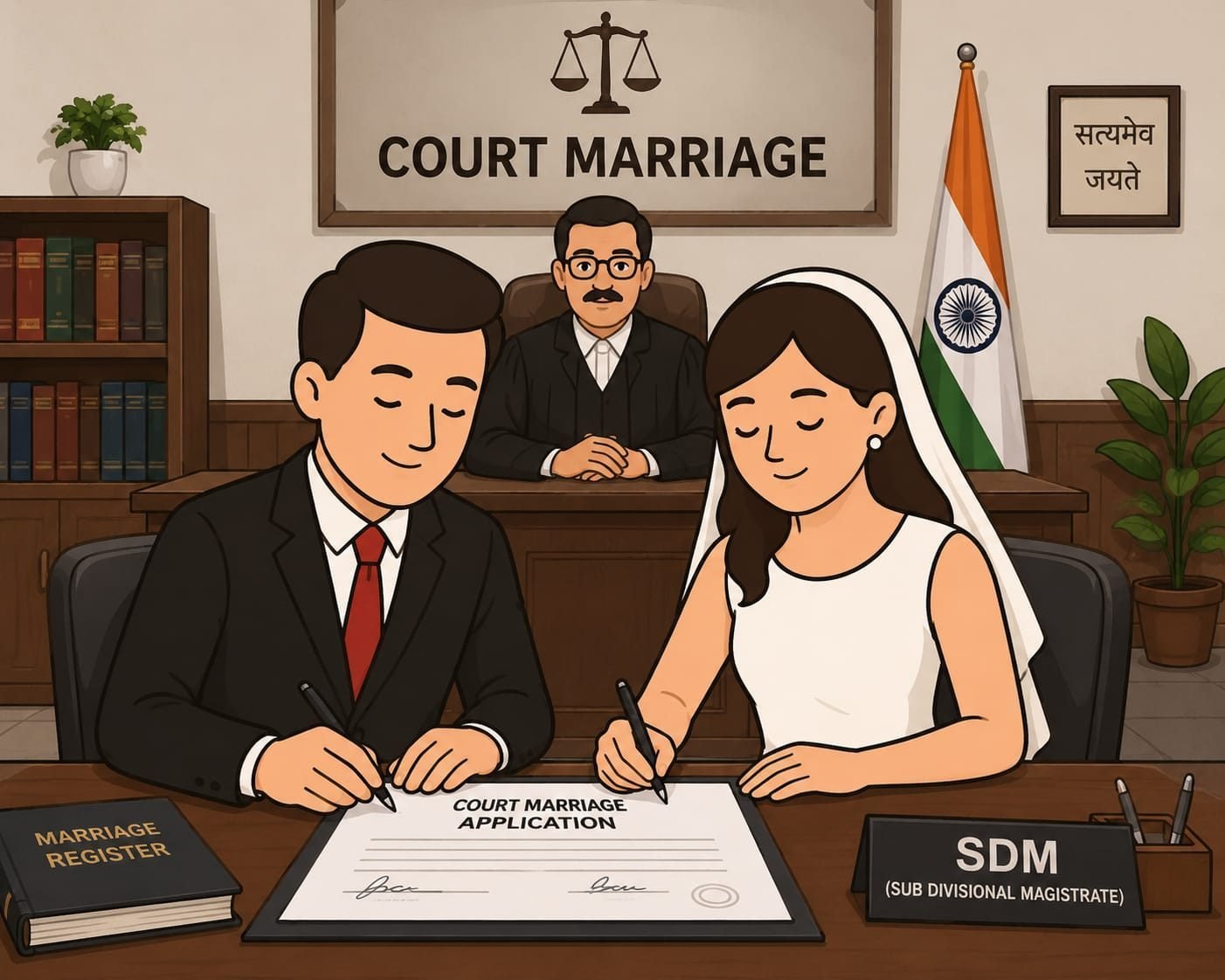
Quick answer: Sadar Bazar is Delhi's largest wholesale market — Qutub Road, Bara Tooti Chowk, Teliwara, Pul Mithai, Sadar Thana Road — and most of the people who work there did not grow up there. Under Delhi's 2026 revenue map, Sadar Bazar is one of two sub-divisions of the new Old Delhi district (with Chandni Chowk); the e-District portal allots the office by address, and older pages that still say "North Delhi" are out of date. Two Hindus, Sikhs, Jains or Buddhists can have an Arya Samaj wedding and register it under the Hindu Marriage Act; couples who keep different faiths use the Special Marriage Act; a nikah is registered under the Delhi 2014 Order. This guide is written for the specific problem a bazaar couple actually has: your Aadhaar still shows a village in UP or Bihar, you live in a rented kothri above the shop, the bill is in the landlord's name, and your name is spelled three different ways across four documents. It also answers the question every trading family asks afterwards — what marriage does, and does not, change about the shop. Marriage registration: ₹6,000.
Key takeaways
- From 1 January 2026 Sadar Bazar is a sub-division of the new Old Delhi district, with Chandni Chowk; guides that still say "North Delhi" are out of date.
- The obstacle here is evidence, not law: fix your address proof and your name spellings before you apply, not after you are turned away.
- No document in your name? Aadhaar can be updated through the Head-of-Family route, and a bank record plus a landlord letter usually completes the picture.
- Living in Delhi but Aadhaar shows the village? You can still register in Delhi — and if you are staying in Delhi, you should, because every duplicate and correction later happens here.
- Marriage changes nothing automatically about a shop, a firm or a GST registration — but nominations made before marriage can lapse, so fix those in the first month.
- The Special Marriage Act 30-day public notice cannot be shortened by anyone. We never provide witnesses and never touch an under-age marriage.
Last reviewed: 23 September 2026 · 38 min read
On this page
- Sadar Bazar at a glance
- Sadar Bazar under the 2026 map
- Which office registers your marriage
- The legal routes
- Arya Samaj + registration
- Special Marriage Act
- Surviving the 30-day notice in a bazaar
- Nikah and its registration
- Register in Delhi, or back home?
- "Where do you live?" — the real problem
- If nothing is in your name
- Fixing your Aadhaar address first
- When your name is spelled four ways
- Age proof without a birth certificate
- Registering a marriage held years ago
- What marriage does not change about the shop
- Adding a spouse to a firm
- GST, trade licence and Udyam
- The nominations that quietly lapse
- Rented shops, gaddis and tenancy
- Ration card and ONORC
- Market days versus office days
- Cash, receipts and touts
- If your families oppose
- Age: why we turn some couples away
- Witnesses
- Documents checklist
- At the appointment
- What it costs
- Timeline
- Getting there
- Common mistakes
- After registration
- Six bazaar situations
- Checklist
- One-minute summary
- How we help
- Questions and answers
Sadar Bazar at a Glance
Sadar Bazar is not a residential colony that happens to have shops. It is a working market that people also sleep in. The lanes off Qutub Road and Sadar Thana Road carry stationery, toys, cosmetics, packaging, hardware, decorative goods and festival stock to buyers from every state in India, and a very large share of the people who make that happen — gaddi owners, salesmen, loaders, packers, cart pullers, tempo drivers, godown keepers, karigars — are first- or second-generation migrants from Uttar Pradesh, Bihar, Rajasthan and Haryana.
That single fact shapes almost every marriage-registration problem that comes to us from this area. The law is the same here as anywhere else in Delhi. What is different is the paperwork: the address on your Aadhaar is your father's village, the room you actually live in is rented month to month with no agreement, the electricity meter is in the landlord's name, the shop's rent receipt says a firm's name and not yours, and the spelling of your own name changes depending on which clerk wrote it down.
None of that makes you ineligible to marry or to register a marriage. All of it can be sorted out. But it has to be sorted out in the right order, and the couples who get rejected are almost always the ones who walked into the office first and started fixing documents afterwards.
| Question | Short answer |
|---|---|
| Which district is Sadar Bazar in now? | Old Delhi district, from 1 January 2026. Sadar Bazar is one of its two sub-divisions; the other is Chandni Chowk. |
| Can I register if my Aadhaar shows a UP or Bihar address? | Yes, if you can show you live in Delhi. Read the residence section — this is the single most common problem we fix. |
| Same-day possible? | The Arya Samaj ceremony, yes. Registration under the Hindu Marriage Act is often same-day or next-day. The Special Marriage Act needs 30 days and nobody can shorten it. |
| Do you provide witnesses? | No. Never. Your witnesses must be your own people with their own original ID. See witnesses. |
| Does marriage change my shop, firm or GST? | No — nothing changes automatically. See what marriage does not change. |
| What does it cost? | Marriage registration ₹6,000; Arya Samaj wedding with registration ₹7,100; court marriage ₹6,100; SMA ₹15,000. Government charges are separate and shown on the receipt. |
Sadar Bazar Under the 2026 Revenue Map
With effect from 1 January 2026, Delhi's revenue administration was reorganised into 13 districts and 39 sub-divisions. The walled city and its surrounding markets were carved into a new district called Old Delhi, which has exactly two sub-divisions: Sadar Bazar and Chandni Chowk.
Before this, addresses around Sadar Bazar, Qutub Road, Teliwara, Idgah Road and Bara Hindu Rao were administered as part of the old North district. A great deal of material online — including the earlier version of this very page — still says "North Delhi". If you are reading a guide, a form or a blog that tells you your SDM is in the North district, check its date.
One practical consequence is worth knowing. Because Old Delhi district is geographically small and extremely dense, its two sub-divisions handle a heavy load from a compact area. Appointment slots can fill faster than in the outer districts, and walking in without a slot is a wasted morning. Apply early, take the first workable slot, and treat the slot as fixed.
Which Office Registers Your Marriage?
Three different offices can be involved, and people mix them up constantly:
- The SDM / Registrar of Marriages registers a marriage under the Hindu Marriage Act, 1955 or under the Delhi (Compulsory Registration of Marriage) Order, 2014. This is the office that issues the certificate almost everyone actually needs.
- The Marriage Officer handles the Special Marriage Act, 1954 — notice, 30-day display, objections, solemnisation and certificate.
- The Arya Samaj mandir performs the wedding ceremony and issues its own certificate. That is a record of the ceremony. It is not a government marriage certificate, and no bank, passport office or embassy treats it as one.
Jurisdiction is decided by address, not by where you were born, not by where your family lives, and not by where your shop is. If you live in a rented room in Sadar Bazar, Sadar Bazar is your jurisdiction — even if your Aadhaar still shows Gorakhpur or Chhapra, provided you can show the office where you actually live now.
A very common mix-up in this area: the shop is in Sadar Bazar but the couple sleeps in Shahdara, Seelampur or Bawana. The relevant address is where you reside, not where you trade. Two people from the same gaddi can end up at two different offices, and that is normal.
The Legal Routes for a Sadar Bazar Couple
| Your situation | Route | Time | Our fee |
|---|---|---|---|
| Both Hindu, Sikh, Jain or Buddhist; want to marry now | Arya Samaj ceremony, then registration under the Hindu Marriage Act, 1955 | Ceremony same day; registration usually same or next day | ₹7,100 |
| Already married by ceremony (any year); need the certificate | Registration under the Hindu Marriage Act or the Delhi 2014 Order | Usually one appointment | ₹6,000 |
| Different faiths and neither will convert; or you simply prefer a civil marriage | Special Marriage Act, 1954 | 30 days' notice minimum | ₹15,000 |
| Muslim couple, nikah performed or to be performed | Nikah, then registration under the Delhi 2014 Order | Usually one appointment after the nikah | ₹6,000 |
| Straightforward civil registration with our full documentation support | Court marriage assistance | Depends on route chosen | ₹6,100 |
There is no secret sixth route. Anybody in this market who offers you a marriage certificate without a ceremony, without both parties present, or without the office seeing you, is selling you a document that will fail the first time it is checked — usually at a passport counter or a bank, years later, when it matters most.
Arya Samaj Wedding Plus Registration
This is what most couples from this area actually use, because it produces a real wedding and a government certificate inside a couple of days.
An Arya Samaj wedding is a Vedic ceremony performed by a pandit — havan, the vows, the pheras, the recitation. The Arya Marriage Validation Act, 1937 recognises the validity of a marriage solemnised in that form between persons professing the Arya Samaj faith, and the ceremony is available to Hindus, Sikhs, Jains and Buddhists. The mandir issues its own certificate the same day.
That mandir certificate is the proof of the ceremony. The step that gives you the document the world asks for is registration under the Hindu Marriage Act, 1955 at the SDM office, and that is a separate application with its own forms, its own fee and its own appointment.
What the day looks like: both parties reach the mandir with their original documents and two witnesses of their own. The pandit conducts the ceremony. Photographs are taken. The mandir certificate is issued. We then move to the registration application with the forms already filled and checked. For a couple who work in the market, the whole thing can usually be arranged so you lose one trading day rather than three.
The Special Marriage Act, Step by Step
The Special Marriage Act, 1954 is a civil marriage. Nobody converts, nobody performs a religious ceremony, and the marriage is valid regardless of what the two families believe. It is the correct route for a couple of different faiths who intend to keep their faiths, and it is also open to a couple of the same faith who simply want a civil marriage.
- Residence. At least one of you must have resided in the district for at least 30 days before the notice is given. For a Sadar Bazar couple this is often the hardest condition to prove, not to satisfy — see the residence section.
- Notice. You give written notice to the Marriage Officer of the district.
- Public display, 30 days. The notice is displayed publicly for thirty days. This is a requirement of the Act. It is not a fee, it is not discretionary, and no service, no contact and no amount of money can lawfully shorten or hide it. Anybody who tells you otherwise is lying to you.
- Objections. Anyone may object within those thirty days, but only on a ground the Act recognises — for example that a party is under age, has a living spouse, or is within the prohibited degrees. A family's disapproval is not a legal objection, and an objection that is merely angry does not stop the marriage.
- Solemnisation. After the thirty days, the marriage is solemnised before the Marriage Officer with three witnesses.
- Certificate. The certificate is issued and signed.
Budget roughly sixty days end to end. The thirty-day clock does not start the moment you decide; it starts when the notice is actually given, and getting the notice accepted requires the documents to already be correct.
Surviving the 30-Day Notice in a Market Where Everyone Knows Everyone
In a colony, a notice on a board is a piece of paper almost nobody reads. In Sadar Bazar, where families have traded next to each other for three generations and news travels through the lanes faster than through any phone, thirty days of public notice is a genuine worry — and we are not going to pretend otherwise.
Here is what is honest:
- The notice cannot be avoided if you marry under the Special Marriage Act. It is a statutory feature of that Act.
- It can be avoided by choosing a different route, where a different route is lawfully available to you. Two Hindus, Sikhs, Jains or Buddhists marrying by Arya Samaj ceremony and registering under the Hindu Marriage Act do not go through a thirty-day public notice at all. A Muslim couple registering a nikah under the Delhi 2014 Order does not either. If the notice is your main fear, the first question to ask is whether the Special Marriage Act is actually the only route open to you — very often it is not.
- The notice goes to the district where the notice is given. If one of you genuinely resides in a different district, the notice is given there. This is not a trick and we will not manufacture a residence for you — but if one partner really has been living in another district, that is a legitimate fact, not a scheme.
- Nobody can lawfully object merely because they are upset. If an objection is filed, the Marriage Officer inquires into it. A false objection delays you; it does not defeat you.
Practical steps that genuinely help: get your documents completely ready before the notice so the thirty days are not extended by a correction; decide in advance where each of you will stay during that month; agree what you will say if asked; and keep a written record of any threat. If there is real danger, read the safety section — protection is available and it is not a favour, it is your right.
Nikah and Its Registration
A nikah is a valid marriage under Muslim personal law when the essentials are satisfied: an adult bride and groom, free consent, offer and acceptance in one sitting, witnesses, and mahr settled on the bride. The nikahnama records it.
To get a government certificate, the marriage is registered under the Delhi (Compulsory Registration of Marriage) Order, 2014. In outline: the Order expects registration within 60 days; a further 60 days is allowed on payment of ₹500; beyond that a penalty of ₹1,000 applies, and registration is still possible. Late registration is normal and nothing to be embarrassed about.
Mahr should be written into the nikahnama clearly: the amount, and whether it is prompt or deferred. "It was settled verbally" becomes very hard to enforce years later. A detailed walkthrough is in our nikah documents and registration guide.
Register in Delhi, or Back Home in the Village?
This is the question we are asked most often in Sadar Bazar, and the honest answer is: it depends on where you are actually going to live, and on which certificate you will need to produce.
| Register in Delhi | Register in your home state | |
|---|---|---|
| Where you must be | Delhi, with proof you live here | Your home district, usually with both parties present |
| Proof needed | Delhi residence proof — the hard part for market workers | Home address proof, which you usually already have |
| Travel | None | At least one trip, often two, plus lost trading days |
| Later corrections and duplicates | Easy — the office is in Delhi | Every correction means another trip home |
| Governing rules | Hindu Marriage Act 1955 / Special Marriage Act 1954 / Delhi 2014 Order | UP: Marriage Registration Rules, 2017 (igrsup.gov.in). Haryana: Compulsory Registration of Marriages Act, 2008 (shaadi.edisha.gov.in). Other states have their own rules. |
Our general advice for a couple who are going to keep living and working in Delhi: register in Delhi. A certificate is not a one-time document. You will go back to that office for a duplicate when the original is lost, for a correction when a spelling is wrong, for an attested copy when a bank wants one. If that office is eleven hours away by train, every one of those becomes a two-day journey and a lost week of trade.
The exception: if you are genuinely going back, if the marriage is happening in the village with the whole family present, and if your documents all carry the village address anyway, register there. It will be simpler. Both certificates are valid everywhere in India — a marriage registered in Ballia is as valid in Delhi as one registered in Sadar Bazar, and vice versa.
What you must not do is register twice, in two states, for the same marriage. One marriage, one registration. Two records of the same marriage create exactly the kind of discrepancy that gets a passport or a visa application stopped.
"Where Do You Live?" — The Real Problem in This Market
Everything else in this guide is ordinary. This section is the reason Sadar Bazar couples get sent away, and it is worth reading slowly.
The office needs to be satisfied of two different things, and people confuse them:
| Hindu Marriage Act registration | Special Marriage Act | |
|---|---|---|
| What is required | That your marriage falls within this Registrar's jurisdiction — normally because one or both of you reside in the district, or the marriage was solemnised there. | That at least one party has resided in the district for at least 30 days immediately before the notice. |
| How strict | Address proof of current residence. | Stricter — the thirty-day period is a condition of the Act, and the office may ask how it is made out. |
Now the reality in the bazaar. A very large share of the people who work here live in one of these ways:
- a rented room or kothri above or behind the shop, with no written agreement;
- a bed in a shared room taken by the month, rent paid in cash to a caretaker;
- a mezzanine or store-room in the gaddi, with the owner's permission;
- a room in a nearby katra or a rented portion in Bara Hindu Rao, Idgah Road, Pahari Dhiraj or Teliwara, where the meter and the tax receipt are in the landlord's name;
- at home in Shahdara, Seelampur, Welcome, Nand Nagri or Bawana, commuting in daily.
In every one of those cases you genuinely reside in Delhi. The difficulty is purely evidential: you have no document with your name and this address on it.
If Nothing Is in Your Name
Here is the ladder we work through with couples, from strongest to weakest. You do not need all of these. You need enough for the office to be satisfied.
- Aadhaar with the current Delhi address. This is by far the strongest and simplest. If you can update it, update it. See the next section — there is a route that works even when nothing is in your name.
- Voter ID (EPIC) with the Delhi address. Many market workers have registered to vote in Delhi without realising they now hold a Delhi address proof.
- A written rent agreement in your name for the room you live in. Many landlords here dislike paperwork, but a simple registered or notarised agreement is not exotic and is worth asking for. It also protects you.
- Electricity, water or gas connection in your name, or a piped-gas or LPG consumer record at that address.
- Bank passbook or a bank statement showing the Delhi address, with the bank's stamp.
- Passport, driving licence or ration card carrying the Delhi address.
- Employer's certificate on the firm's letterhead, with the firm's GST or trade details, confirming that you work there and reside at the stated address. This is weaker on its own but useful alongside something else — and in this market, an employer's letter is usually easy to obtain.
- An affidavit of residence, supported by the landlord's identity document and a short letter from the landlord confirming the tenancy. An affidavit alone is the weakest option and should never be your only one.
What to do if you truly have nothing: start the Aadhaar update, and while it is in process, open or update a bank account with the Delhi address and ask the landlord for a one-page letter with a copy of his own ID. Those three steps, done in that order, take a few weeks and cost almost nothing, and they solve the problem permanently — not just for this marriage, but for every school admission, loan, licence and claim that follows.
Fixing Your Aadhaar Address First
For most people in this market, the fastest permanent fix is an Aadhaar address update. Two things are worth knowing:
- The ordinary route is to update online or at an Aadhaar centre with a valid proof of address in your own name — a rent agreement, a bill, a passbook, a ration card.
- The Head-of-Family route exists precisely for people who have no document in their own name. Where a relative already has Aadhaar with the correct address, an adult family member can have their address updated on the basis of that relationship, with the Head of Family's consent and a document proving the relationship. For a married couple, a spouse can be the Head of Family; for others, a parent or an adult child. Requirements and the exact process are set by UIDAI and change from time to time, so check the current position on uidai.gov.in or at an Aadhaar Seva Kendra before you go.
Two cautions. First, an Aadhaar update takes time — plan for it rather than doing it the week before the wedding. Second, when you change your Aadhaar address, make sure the name and date of birth on it match your other documents, because you are about to hand all of them to the same clerk. If a correction is needed, do the name correction and the address change together, not in two separate rounds months apart.
When Your Name Is Spelled Four Different Ways
This is the second great Sadar Bazar problem, and it is almost universal in trading families. One man is "Mohd. Shakeel" on his Aadhaar, "Mohammad Shakil" on his PAN, "Shakeel Ahmad" on the shop's trade papers and "M. Shakeel" on the bank account. A woman is "Poonam Devi" on her school certificate and "Punam" everywhere else. A surname appears on some documents and not on others. Spellings changed because a clerk wrote what he heard, in a language he was transliterating.
None of this means you did anything wrong. But the office comparing your papers has to be satisfied that all of them belong to one person, and a mismatch is a normal, common and entirely fixable reason for an application to be stopped.
How to deal with it, in order:
- Pick one canonical spelling — the one on the document you will use most for the rest of your life. For most people that is Aadhaar, or the passport if you have one.
- Correct the documents you can correct. Aadhaar name corrections, PAN corrections and bank record updates are all ordinary procedures. Do them before you apply.
- For documents you cannot change — an old school certificate, a village record — use a "one and the same person" affidavit, which states that the differently-spelled names refer to you, and attach copies of both documents. This is a standard, accepted instrument. Notarise it properly on the correct stamp paper.
- Do not create a fresh mismatch by writing your name in the marriage application differently from your ID. Copy it letter for letter from the document you are producing, even if you personally prefer another spelling.
Age Proof When There Is No Birth Certificate
Many people who grew up in a village in the 1980s and 1990s have no birth certificate, because the birth was never registered. That is very common and it is not a barrier.
Usable age proofs include the school leaving or transfer certificate (often the most reliable document a migrant family holds), a matriculation certificate, a passport, an Aadhaar showing date of birth, a PAN card, or a birth certificate obtained late from the local registrar, which is possible in most states with the right procedure.
Two hard rules apply and we do not bend them:
- Under the Prohibition of Child Marriage Act, 2006, the minimum age is 21 for the groom and 18 for the bride. We do not assist, document or register a marriage where either party is below that age, in any circumstances, for any family, at any price. See why we turn some couples away.
- Where a document shows an age that the family says is wrong, the document governs until it is lawfully corrected. We do not proceed on the basis that "the school certificate made her a year older". Correct the record first.
Registering a Marriage Held Years Ago
Plenty of couples in this market married ten, twenty or thirty years ago in a village, by ceremony, with no registration — and now a bank, an insurer, a school or a passport office wants a certificate. This is completely normal and it is usually straightforward.
What helps the application:
- the wedding invitation card, if one survives;
- photographs of the ceremony;
- a certificate from the mandir, pandit or qazi, where one can be obtained;
- both parties' age proof, identity proof and current address proof;
- affidavits from both spouses stating the date, place and fact of the marriage;
- two witnesses who actually know you as a married couple — ideally someone who attended the wedding, or a long-standing neighbour or relative. As always, your own witnesses, with their own ID.
Under the Delhi 2014 Order a late registration attracts the fees noted earlier — ₹500 for the second sixty days, then a ₹1,000 penalty — and registration remains possible after that. Our fee for this work is ₹6,000.
What Marriage Does Not Change About the Shop
Once the certificate is in hand, the next round of questions starts — usually from the older generation, and usually in the form of a worry. "Ab dukaan mein hissa ho jayega?" "Will the firm have to be changed?" "Does the GST need to be redone?"
The short answer is reassuring and it surprises people: marriage by itself changes almost nothing about a business. Nothing happens automatically.
| What people assume | What actually happens |
|---|---|
| "My spouse now owns half the shop." | No. A proprietorship belongs to the proprietor. Marriage does not transfer ownership of a business, a shop, a stock of goods or a tenancy to a spouse. |
| "The partnership firm has to add my spouse." | No. A partnership is a contract. A new partner joins only by a deliberate act — a fresh or supplementary deed that everybody signs. See below. |
| "The GST registration has to be changed." | Not because of the marriage. GST records change when the constitution of the business, the authorised signatory, the address or the trade name actually changes. |
| "My spouse automatically gets a share in the ancestral shop." | No. Marriage does not create a coparcenary share. Rights in family property come from succession law and from the actual character of the property — not from a wedding. |
| "The trade licence and Udyam will update themselves." | They will not. Nothing updates itself. If a particular is genuinely to change, you apply to change it. |
| "Nothing at all needs doing, then." | Wrong in the other direction. Several nominations quietly lapse on marriage, and those do need attention. See below. |
Understanding this cuts both ways, and both sides matter. A family worried about losing control of a business should be reassured. A newly married spouse who assumes they are now protected should understand that they are not — protection comes from documents that are actually executed, not from the marriage itself.
Adding a Spouse to a Firm — a Deliberate Act, Not an Automatic One
If a family genuinely wants a spouse to become a partner, that is done under the Indian Partnership Act, 1932 by agreement:
- a new or supplementary partnership deed, signed by all existing partners and the incoming partner, stating the share of profits and losses, the capital contribution, the powers of each partner and the terms on which anybody may retire;
- where the firm is registered with the Registrar of Firms, an application to record the change;
- updating the firm's PAN details, bank mandate and authorised signatory;
- amending the GST registration where the constitution of the business or the authorised signatory changes;
- telling the firm's bankers, and any supplier or landlord whose contract requires notice of a change in constitution.
Three things are worth saying plainly to trading families, because we see the consequences of all three:
- A share written on a piece of plain paper and kept in a drawer is not a partnership. If the intention is real, execute a proper deed.
- Do not make a spouse a partner purely as a paper arrangement — for a loan, for a subsidy, for a tax reason — while telling them privately that they have no real say. A partner carries liability. Somebody who is a partner on paper can be pursued for the firm's obligations, and somebody who was told they were "only for the file" discovers the hard way that the file is what counts.
- Conversely, do not leave a working spouse entirely off the record. A woman who has sat on the gaddi for fifteen years, kept the books and held the keys, but whose name appears on nothing, has a very hard case to make if the relationship or the family breaks down. If she is a partner, say so in the deed. If she is an employee, pay her properly and keep the record.
These are decisions for the family, not for us — we are not a law firm and we do not give legal advice. What we do is tell you which decisions exist, so that you can take them deliberately and, where it matters, with an advocate.
GST, Trade Licence, Udyam and the Current Account
Marriage is not a trigger for any of these. A change in the underlying facts is. Use this as a checklist only where something has actually changed:
| Record | When it genuinely needs updating |
|---|---|
| GST registration | Constitution of business changes; authorised signatory changes; principal or additional place of business changes; trade name changes; a partner is added or retires. A core-field amendment is filed on the GST portal. |
| Trade licence / tehbazari | The licensee changes, or the premises change. Held with the municipal authority. |
| Udyam registration | Ownership, constitution or address changes, or the turnover and investment figures move the enterprise into a different category. |
| Current account and bank mandate | Signatories change. Banks ask for the amended deed or board resolution — a marriage certificate alone is not what they want here. |
| Shops and Establishments record | Employer particulars or premises change. |
| Import-export code, FSSAI, or any sectoral licence | On the same logic — the holder or the particulars change, not because of a wedding. |
One caution worth stating for this market in particular. A marriage certificate is a document about a marriage. Using it to try to establish a claim over a business — or, from the other side, refusing to update a record that genuinely has changed — creates a mismatch between what is on paper and what is true. That mismatch is exactly what a dispute feeds on ten years later.
The Nominations That Quietly Lapse
This is the part nobody mentions at the wedding, and it is the part that causes real hardship.
Under the rules of several schemes, a nomination made by an unmarried person in favour of a parent or sibling becomes invalid on marriage. The money does not vanish, but the claim becomes contested, slow and expensive at exactly the moment a family can least afford it.
- Employees' Provident Fund and gratuity. A nomination made before marriage in favour of a parent or brother becomes invalid when you marry, and a fresh nomination has to be made in favour of family. If you are covered by EPF through a firm here, do this within the first month of marriage.
- Employees' Pension Scheme. Family particulars need updating so that the spouse is on record.
- ESIC. Family particulars must be updated, or your spouse cannot get treatment on your card.
- Life insurance. Update the nomination. An old nomination in a parent's favour is not automatically set aside, but it is a frequent source of family conflict.
- Bank accounts, fixed deposits, post office schemes, mutual funds, demat. Every one of these has a nomination field and most people fill it once and forget.
- Shop insurance, stock insurance, vehicle insurance, loan insurance. Check who the beneficiary is.
- Ayushman Bharat / state health cover, where you are covered. Add the spouse.
A will is the other half of this. Nomination decides who receives; a will decides who is entitled. For a trading family with stock, a tenancy, a current account and no written arrangement, a short will made properly is worth more than any amount of verbal understanding.
Rented Shops, Gaddis and Tenancy
Many shops in this market are held on tenancies that are decades old, sometimes passed down within a family, often with nothing more than a rent receipt as evidence.
Marriage does not transfer a tenancy. A spouse does not become a tenant by marrying the tenant. What happens to an old tenancy on the tenant's death depends on the tenancy itself, on the applicable rent law and on the facts — and it is one of the most litigated subjects in the walled city.
What you can sensibly do now, without a dispute:
- Keep the rent receipts. Every one of them, in order, in a file. In a tenancy dispute the receipts are usually the strongest thing anyone has.
- Pay by bank transfer where the landlord will accept it, so there is an independent record.
- Do not let the tenancy quietly change hands without a document. "Everyone knows my son sits there now" is not a record.
- Ask an advocate before doing anything clever. Tenancy is exactly the area where an amateur arrangement made to save a little money creates a claim against you.
The same applies to the room you live in. A residential tenancy is a contract with the landlord; your marriage does not add your spouse to it. If you are moving your spouse into a rented room, tell the landlord and get it in writing — and where you can, get the agreement in both names.
Ration Card, ONORC and Everyday Records
For a migrant couple, these are the records that touch daily life more than any certificate.
Ration card. After marriage a spouse's name is normally added to the household's card, and removed from the parents' card in the home state. Both steps matter — a name on two cards causes problems. The procedure is a state one; in Delhi it is handled through the food supplies department's portal and the circle office.
One Nation One Ration Card (ONORC). This lets a ration cardholder draw their entitlement from a fair price shop anywhere in the country using biometric authentication. For a family split between Delhi and the village, this is genuinely useful, and it is one of the few schemes designed for exactly this situation. It does not remove the need to keep the card's particulars correct.
Everything else. Voter registration, bank KYC, Aadhaar, school records for children, and any labour or welfare board registration should all end up telling the same story about who you are, where you live and who you are married to. Consistency across records is not bureaucratic fussiness — it is what makes a claim work when you eventually need it to.
Market Days Versus Office Days
A trading family does not lose a day lightly. Planning the calendar properly is worth real money here, so it is worth a section of its own.
- Government offices work Monday to Friday, with public holidays, and the useful window for submissions is the morning. An afternoon appointment that runs into a lunch break or a file movement often becomes a next-day appointment.
- Wholesale markets in this area keep their own rhythm, with different lanes closed on different days. Work out which of your two weekly slow points falls on a working weekday and aim for that.
- Festival season is the worst possible time. From the run-up to Raksha Bandhan through Diwali, this market is at its busiest and you will not want to be standing in a queue. Offices are also closed on more days. If your wedding date is flexible, avoid that window entirely.
- Do not send a helper. Both parties must be present at the appointment, in person. There is no arrangement under which a munim, a brother or an agent attends for you.
- Tell your witnesses the day before, not the morning of. A witness who arrives without an original ID sends everyone home.
A workable pattern for a Sadar Bazar couple: documents collected and checked over a week without leaving the shop; the Arya Samaj ceremony and the mandir certificate in one morning; the registration appointment on a weekday morning soon after. Two half days rather than four full ones.
Cash, Receipts and the People Standing Outside the Office
This market runs on cash and on trust, and both of those are exactly what a tout exploits. There are people around the courts and offices in this part of Delhi who will offer a certificate "in one day, no notice, no problem". Some of them will take your money and disappear. Some will produce a document that looks real and is not. A few will file something on your behalf using details you never checked.
The rules that protect you are simple:
- Get a receipt for every rupee. Ours separate our own service charge from government charges, so you can see exactly what went where. Anyone who will not give you a receipt is telling you something about themselves.
- Never hand over original documents to somebody standing outside an office. Originals stay with you; you produce them at the counter yourself.
- Never sign a blank form or a blank stamp paper. Read what you sign, even if it is slow and even if somebody is impatient.
- Be suspicious of speed that the law does not allow. Nobody can shorten the Special Marriage Act's thirty-day notice. Anybody promising to is either lying or is about to file something false in your name.
- We will never ask you for an OTP, a UPI PIN, a card PIN, a CVV or a net banking password, and we will never ask you to approve a payment request in order to receive money. Anybody doing that in our name is committing a fraud. Stop, and call us on +91 8376863962. Report it at cybercrime.gov.in or on 1930 — within the first hour if money has gone, because that is when it can still be stopped.
If Your Families Oppose the Marriage
In a dense market where families have known each other for generations, opposition is not abstract. Take it seriously and act early rather than hoping it passes.
- Two consenting adults may marry. The Supreme Court has said this repeatedly, and family disapproval is not a legal ground of objection under the Special Marriage Act.
- Protection is available. A couple who fears for their safety can approach the High Court for protection, and the police have a duty to act. There are also police helplines and the women's helpline 181, and 112 for an emergency.
- Keep evidence. Save threatening messages, note dates and names, and keep copies of your documents somewhere outside the house — with a trusted friend, or in your own email.
- Think about the practical things in advance. Where you will stay, what money you can access, which phone number you will use, and who knows where you are.
- Choose your route with your eyes open. If the thirty-day public notice is the danger, check whether another lawful route is open to you before you commit to the Special Marriage Act.
Everything you tell us is confidential. We do not call families, we do not confirm to a caller that you are our client, and we do not discuss one couple with another. If there is a particular number or name we should be careful about, tell us at the start and it goes on your file. Our full commitment is written out in our Privacy Policy.
Age: Why We Turn Some Couples Away
We are asked, more often in this area than we would like, to help where the bride is under 18 or the groom under 21 — sometimes with a document that has been adjusted, sometimes with a whole family standing behind the request.
The answer is no, and it is always no. Under the Prohibition of Child Marriage Act, 2006 the minimum age is 21 for the groom and 18 for the bride. We do not arrange the ceremony, we do not prepare the papers, we do not file the registration, and no fee changes that. We also do not proceed where a document has obviously been altered.
This is not us being difficult. A marriage built on a false age can be challenged, the record can be cancelled, and the people who helped create it are exposed too. If you are waiting for a birthday, wait for the birthday — and come back to us then, and we will do the whole thing properly.
Witnesses
A witness is a person who genuinely knows you and is willing to say so before a pandit or a Marriage Officer. A borrowed or paid witness is a false statement made to a public authority — it exposes you and the witness, and it leaves the marriage record open to challenge years later, usually when a visa or a claim depends on it.
What a witness needs: to be an adult, to carry original photo identity and address proof, to know you, and to be physically present. An Arya Samaj ceremony needs two adult witnesses. Registration at the SDM office needs witnesses at the appointment. The Special Marriage Act needs three witnesses at solemnisation.
In practice, in this market, witnesses are rarely a problem once people understand the rule: a neighbour of twenty years, a fellow trader from the same lane, an uncle, a friend from the village who is in Delhi anyway. Ask early, tell them exactly what to bring, and confirm the night before. Our guide to witness requirements sets out the detail.
Documents Checklist
| Document | Who | Notes |
|---|---|---|
| Age proof — birth certificate, school leaving or matriculation certificate, passport, or Aadhaar/PAN showing date of birth | Both | See age proof if you have no birth certificate |
| Identity proof — Aadhaar, voter ID, passport, driving licence | Both | Originals at the appointment |
| Address proof of current residence | Both, or at least the applicant | The critical one in this area — see if nothing is in your name |
| Passport-size photographs | Both | Recent; carry spares |
| Ceremony proof — mandir certificate, nikahnama, photographs, wedding card | — | Where the marriage has already been solemnised |
| Death certificate of a former spouse, or a certified copy of the final divorce decree | Where applicable | No exceptions; a case that is still pending is not a decree |
| Affidavits in the prescribed form | Both | On correct stamp paper, properly notarised |
| "One and the same person" affidavit | Where spellings differ | See names |
| Two witnesses with original ID (three for the Special Marriage Act) | — | Your own people |
Carry originals and one clear photocopy set of everything. Keep a photograph of every document on your own phone before you hand anything over at a counter.
At the Appointment
- Both parties must attend in person. Witnesses attend with original ID.
- Reach early. An office in a dense area does not wait for a late applicant and the slot can be lost.
- Answer what is asked, simply. You are not being tested and there is no advantage in volunteering extra material.
- Check the certificate before you leave the counter. Both names, spellings, both fathers' names, the date of marriage, the place, and both dates of birth. A correction made on the spot takes a minute; the same correction made two years later takes weeks and a fresh application.
- Once the certificate is issued, photograph it and email the photograph to yourself, then keep the original somewhere it will not get wet, torn or lost in a godown.
What It Costs
| Service | Our fee |
|---|---|
| Marriage registration | ₹6,000 |
| Court marriage assistance | ₹6,100 |
| Arya Samaj marriage with registration | ₹7,100 |
| Nikah registration | ₹6,000 |
| Special Marriage Act (full process, 30-day notice) | ₹15,000 |
| Duplicate certificate or correction | ₹2,500 |
Government and other pass-through charges — registration and notice fees, stamp paper, notary, photographs, courier — are separate, are paid at the rate the office charges on the day, and are shown separately on your receipt. We confirm one written figure before we begin and we do not add to it afterwards. The full position is in our Terms & Conditions and our Refund & Cancellation Policy.
Timeline
| Route | Realistic time |
|---|---|
| Arya Samaj ceremony and mandir certificate | Same day |
| Registration under the Hindu Marriage Act | Often same or next day; depends on the office and the slot |
| Registration of a nikah under the Delhi 2014 Order | Usually one appointment |
| Registering a marriage held years ago | Usually one appointment once the evidence is assembled |
| Special Marriage Act | About 60 days, of which 30 are the statutory notice |
| Fixing an Aadhaar address or a name spelling first | Add two to four weeks — start this before anything else |
Getting There
Sadar Bazar is walkable from several points and impossible to drive through in the middle of the day. Plan to arrive by Metro or on foot rather than in a vehicle you then have to park. Pratap Nagar, Tis Hazari and Kashmere Gate are the practical Metro reference points for this area, with New Delhi and Chandni Chowk useful from the south side; a cycle rickshaw covers the last stretch through the lanes faster than anything with an engine.
Go early in the morning. The lanes fill with handcarts and loading by mid-morning, and a journey that takes fifteen minutes at eight o'clock takes fifty at noon. If you are bringing an elderly witness, factor that in — the walk is longer than it looks on a map and there is very little shade.
Common Mistakes
- Applying before fixing the address proof. The single biggest cause of a wasted morning in this area.
- Assuming the mandir certificate is the government certificate. It is not.
- Letting name spellings differ across documents and hoping nobody notices. Somebody always notices, usually at the passport office.
- Registering the same marriage twice, once in the village and once in Delhi, "to be safe". It is the opposite of safe.
- Believing somebody who says the 30-day notice can be skipped.
- Bringing a witness without original ID.
- Leaving the counter without reading the certificate.
- Paying cash with no receipt to somebody met outside an office.
- Treating a pending divorce case as a divorce. Only a final decree counts.
- Forgetting the nominations — and leaving a family to fight over an EPF balance years later.
After Registration
- Get two or three attested copies made and keep them apart from the original.
- Update the nominations listed in the nominations section. Do it in the first month.
- Update Aadhaar, bank KYC, and the ration card.
- Update ESIC and EPF family particulars if you are covered.
- If a spouse is joining a firm as a partner, do it by deed, and update GST and the bank mandate at the same time.
- Consider a short will. For a trading family with stock, a tenancy and a current account, it is the cheapest protection available.
- If you will need the certificate abroad — for a spouse visa or for work — read our apostille and visa guide before you apply for anything.
Six Bazaar Situations
1. The salesman whose Aadhaar says Bihar. He has lived above a stationery gaddi on Qutub Road for six years; the room is rented in cash, the meter is the landlord's. We start with the Aadhaar address update through the Head-of-Family route using his uncle's Delhi Aadhaar, open a bank account at the new address in parallel, and apply once both are through. One rejected morning avoided.
2. The couple with four spellings. His Aadhaar, PAN, school certificate and bank account each spell his name differently. We pick the Aadhaar spelling, correct the PAN and the bank record, prepare a "one and the same person" affidavit for the school certificate, and only then file. The certificate comes out consistent with his passport application two years later.
3. Married in 1998, never registered. A hardware trader and his wife need a certificate for a bank locker and a property mutation. Wedding card, ceremony photographs, affidavits, a neighbour and a cousin as witnesses, current address proof — one appointment, ₹6,000, and a twenty-eight-year-old marriage is on the record.
4. Interfaith, and the whole lane will know. A couple of different faiths, neither willing to convert, terrified of the thirty-day notice in a market where everyone talks. We explain honestly that the notice cannot be avoided under the Special Marriage Act, check whether any other lawful route is open to them, help them plan where each will stay for the month, and tell them exactly what an objection can and cannot do.
5. "Will my wife take half the shop?" A father asks before agreeing to the wedding. The answer is that marriage transfers nothing automatically — not the proprietorship, not the tenancy, not a coparcenary share. What we also tell him: if he wants his daughter-in-law protected, or his son's wife made a partner, that takes a deed, and it should be a decision rather than a drift.
6. The widow on the gaddi. Her husband died four years ago; she has run the shop since; the tenancy and the current account are still in his name and the marriage was never registered. Registration is no longer possible after a spouse's death. We tell her so plainly, set out what other evidence can prove the marriage in the claims she has to make, and send her to an advocate for the tenancy — because that part is legal work and not ours.
Checklist Before You Leave the Shop
- Address proof sorted — Aadhaar updated, or a bank record and landlord letter in hand.
- Name spellings aligned, or the affidavit prepared.
- Age proof for both, and both genuinely above 21 and 18.
- Death certificate or final decree, where an earlier marriage ended.
- Photographs, photocopies, and a photo of every document on your phone.
- Two witnesses confirmed (three for the Special Marriage Act), with original ID, told what to bring.
- Appointment slot noted, office named on the slip, weekday morning.
- Written quotation from us, and a receipt for anything already paid.
One-Minute Summary
From 1 January 2026 Sadar Bazar is a sub-division of the new Old Delhi district, alongside Chandni Chowk, and the e-District portal allots your office by address. Two Hindus, Sikhs, Jains or Buddhists can marry by Arya Samaj ceremony and register under the Hindu Marriage Act, usually inside two days. Couples of different faiths who will not convert use the Special Marriage Act, with a thirty-day public notice nobody can shorten. A nikah is registered under the Delhi 2014 Order. The real obstacle in this market is not the law but the paperwork: fix your address evidence and your name spellings before you apply, not after you are turned away. Afterwards, remember that marriage changes nothing about a shop, a firm or a GST registration by itself — but it does invalidate nominations, and those need attention in the first month. We never provide witnesses and we never touch an under-age marriage. Marriage registration ₹6,000.
How We Help a Sadar Bazar Couple
We do the documentation and the coordination; the ceremony is done by the Arya Samaj pandit, and anything that needs an advocate is done by an independent advocate in their own name. We are not a law firm and we do not give legal advice — where a question belongs with an advocate, a tenancy court or the Registrar of Firms, we say so instead of guessing.
What that looks like for a family working in this market:
- an honest first call in which we tell you which route is actually open to you, including when the cheaper route is the right one;
- an address-evidence plan before anything is filed, so you are not turned away on the day;
- a document and spelling check on every paper, done before submission rather than at the counter;
- the forms prepared, the appointment arranged, and a calendar built around your slow day rather than your busiest;
- one written figure for our own work, government charges shown separately, and a receipt for everything;
- a straight answer about what changes for the shop afterwards, and what does not;
- complete confidentiality — we do not call families and we do not confirm to anybody that you are our client.
And two things we will not do at any price: provide witnesses, or touch a marriage where either party is under age.
Marriage registration for Sadar Bazar couples – ₹6,000
Register a marriage from any year · Arya Samaj + registration ₹7,100 · court marriage ₹6,100 · nikah registration ₹6,000 · duplicates and corrections ₹2,500.
Book Marriage Registration – ₹6,000 →Also: Arya Samaj marriage · Court marriage · Certificate & duplicates
Questions and Answers: Court Marriage for Sadar Bazar Couples
Sources and Official References
Facts in this guide were checked against the following primary sources. Government procedures and office allocations change, so confirm current details on the official portal before applying.
- Delhi e-District – official online application portal
- UIDAI – Aadhaar address update and Head of Family based update
- Hindu Marriage Act, 1955
- Special Marriage Act, 1954
- Indian Partnership Act, 1932
- GST portal – amendment of registration
- Udyam Registration portal
- EPFO – member services and nomination
- ESIC – insured person services
- Uttar Pradesh marriage registration (IGRSUP)
- Haryana marriage registration
- One Nation One Ration Card – Department of Food and Public Distribution
- National Cyber Crime Reporting Portal
- National Consumer Helpline
This guide is general information, not legal advice for your specific case. Call +91 8376863962 for advice on your situation.
Related Articles
👶 Seemapuri: Your Children’s Papers
Birth registration, RTE school admission and a child’s passport — and the myths that cost families most.
Read →🏛️ Court Marriage in Kotwali
The walled city and interfaith couples.
Read →🏭 Court Marriage in Narela
ESIC, EPF and worker families.
Read →🛍️ Court Marriage in Karol Bagh
Central district guide.
Read →🏠 Court Marriage in Seelampur
North East Delhi guide.
Read →📄 Documents Required
The full documents list.
Read →👥 Witness Requirements
Who can be a witness.
Read →⚖️ SMA vs HMA
Which Act suits you.
Read →📅 Marriage Age Limit
21 and 18 explained.
Read →✈️ Apostille & Visa
Using the certificate abroad.
Read →🏛️ Court Marriage in Delhi
The complete Delhi guide.
Read →