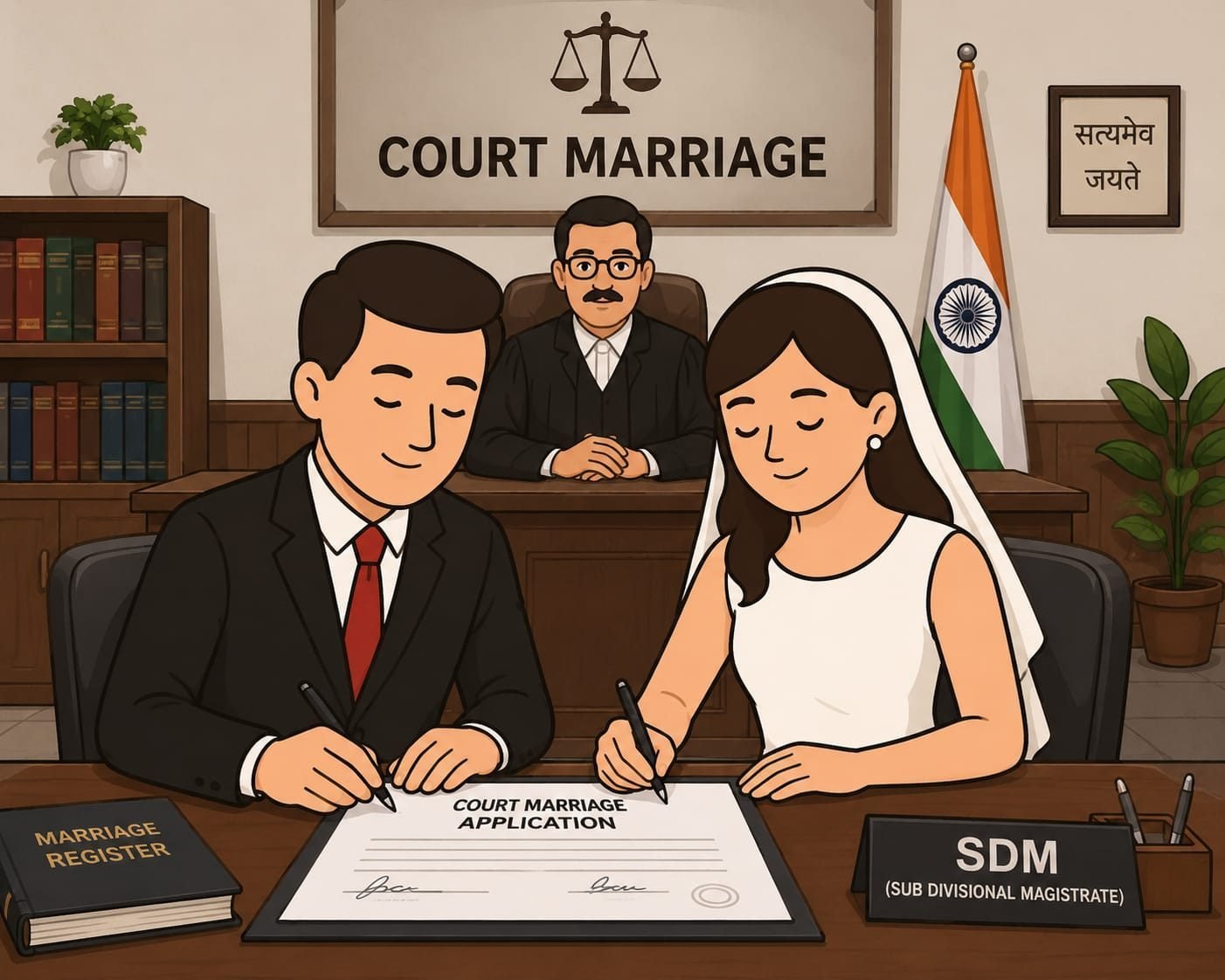
Quick answer: Narela is Delhi's far northern edge: an industrial estate with thousands of small factories, sector after sector of DDA and resettlement flats, old villages, and the Haryana border at Kundli and Singhu a few minutes up the GT Road. Under Delhi's 2026 revenue map, Narela is one of three sub-divisions of the Outer North district (with Bawana and Mundka). Two Hindus, Sikhs, Jains or Buddhists can have an Arya Samaj wedding and register it under the Hindu Marriage Act; interfaith couples who do not want to convert use the Special Marriage Act with 30 days' residence and a 30-day notice; Muslim couples register a nikah under the Delhi 2014 Order. For factory families the certificate is not paperwork for its own sake: ESIC and EPF benefits, employees' compensation after an accident, gratuity and pension claims all turn on proof of marriage. Registration of an existing marriage: ₹6,000.
Key takeaways
- From 1 January 2026 Narela is one of three sub-divisions of the Outer North district, with Bawana and Mundka.
- In a factory family the marriage certificate is what ESIC care, maternity benefit, compensation, pension and provident fund claims rest on.
- File a fresh EPF and gratuity nomination after marriage: a nomination made before you had a family does not survive it.
- A village wedding is valid; register it once, in Delhi on your Delhi residence or in your home state. Order duplicate documents early.
- Registration is impossible after a spouse dies – do not postpone. We never provide witnesses.
Last reviewed: 22 September 2026 · 37 min read
On this page
- Narela at a glance
- Narela under the 2026 map
- Which office registers your marriage
- The legal routes
- Why a certificate matters in a factory family
- ESIC: adding your spouse
- EPF, pension and gratuity nominations
- If there is an accident at work
- Widows' claims and why proof fails
- Contract workers and agencies
- Children's documents
- Ration cards and schemes
- A one-month plan
- Shifts, leave and planning the dates
- If you move away later
- Married in the home state
- Getting documents from your home state
- DDA and resettlement flats: address proof
- Rented rooms near the industrial area
- Kundli, Sonipat and the Haryana side
- Arya Samaj + registration
- Registering a wedding already held
- Special Marriage Act
- Keeping the wedding affordable
- Inter-caste couples
- Muslim couples
- For brides and working women
- If your families oppose
- Age
- Witnesses
- Documents checklist
- At the appointment
- What it costs
- Timeline
- Getting around
- Common mistakes
- After registration
- Five Narela situations
- Checklist
- One-minute summary
- How we help
- Questions and answers
Narela is the part of Delhi most of the city never visits. Past Alipur and Bawana, the GT Road runs north to Kundli, and on either side lie industrial plots: plastic moulding, garments, packaging, auto parts, footwear, food processing, print. Shifts change at eight and at eight, and the roads fill with cycles, e-rickshaws and buses. Around the estate stand the sectors of Narela, built by the DDA over three decades, many of them allotted to families relocated from other parts of Delhi, and beyond them the villages of the old Narela block.
Most of the people who keep those factories running came from somewhere else: Uttar Pradesh, Bihar, Jharkhand, Uttarakhand, West Bengal, Odisha. They marry at home in their villages, return to work, and live for years without a marriage certificate, because nothing seems to need one. Then something does. A hospital wants the ESIC card updated. A delivery is due and the maternity benefit form asks for proof. A man is injured at a machine and the compensation claim asks who his dependants are. A widow tries to claim a pension and is asked to prove she was his wife.
This guide is written for those families, and for the young couples in the sectors who are marrying by choice. It explains the routes, the documents, the address-proof problems specific to allotted flats and rented rooms, how to get papers from a home state, and exactly which benefits depend on a registered marriage.
For the general Delhi process, see the complete Delhi court marriage guide. Nearby area guides: Alipur, Kanjhawala, Rohini and Model Town.
Narela at a Glance
| Item | Detail |
|---|---|
| District (from 1 January 2026) | Outer North |
| Sub-divisions in the district | Narela, Bawana, Mundka |
| Areas | Narela town and sectors, Narela industrial area, Holambi Kalan and Khurd, Bankner, Lampur, Singhola, Alipur's edge, villages of the Narela block |
| Borders | Kundli and Sonipat (Haryana) up the GT Road; Singhu border |
| Transport | Rithala (Red Line) and Samaypur Badli (Yellow Line) are the nearest metro stations today; a metro corridor towards Narela has been approved and is under construction. Rail: Narela station on the Delhi–Panipat line; buses along the GT Road |
| Typical questions | ESIC and EPF records, compensation and pension claims, address proof for allotted flats and rented rooms, registering a village wedding, documents from home states |
Narela Under the 2026 Revenue Map
From 1 January 2026, Delhi's revenue administration was reorganised into 13 districts and 39 sub-divisions. The new Outer North district has three sub-divisions: Narela, Bawana and Mundka. Narela keeps a sub-division in its own name and covers the town, the sectors, the industrial area and the surrounding villages. The e-District portal allots the registering office by the address you enter, and your appointment slip names it. Certificates issued before 2026 remain fully valid and need no re-registration.
Which Office Registers Your Marriage?
Applications are filed on the Delhi e-District portal. For Hindu Marriage Act registration, the office can be the one for the place where the marriage was solemnised or where either spouse lives; for the Special Marriage Act, notice goes to the Marriage Officer of the district where at least one of you has lived for the past 30 days. For families living in the Narela sectors or the villages, that is normally the Outer North district office named on the slip.
The Legal Routes
| Your situation | Route | Waiting period | Our fee |
|---|---|---|---|
| Married at home, never registered | Hindu Marriage Act registration | By appointment | ₹6,000 |
| Both Hindu, Sikh, Jain or Buddhist, marrying now | Arya Samaj wedding + HMA registration | Wedding same day | ₹5,100; ₹7,100 with registration |
| Different religions, no conversion | Special Marriage Act | 30 days' residence, then 30-day notice | ₹15,000 |
| Both Muslim | Nikah + registration under the Delhi 2014 Order | Nikah same day; registration by appointment | ₹5,000 / ₹6,000 |
| Sikh couple after Anand Karaj | Delhi Anand Marriages Registration Rules, 2018, or HMA | By appointment | ₹6,000 |
| Court marriage with advocate assistance | SMA or SDM registration with drafting | Depends on route | ₹6,100 |
| One partner in Haryana (Kundli, Sonipat) | Register in Delhi, or in Haryana under its 2008 Act | Depends on route | Guidance included |
Government fees are extra at actual cost. Full list: fees.
Why a Certificate Matters in a Factory Family
In a salaried office job, a marriage certificate is a form to be filed. In an industrial family it is often the only document that stands between a household and a benefit it is entitled to. Here is where it is actually used:
| Situation | What the certificate does |
|---|---|
| Adding a spouse to ESIC records | Lets her use ESIC medical facilities as a family member |
| Maternity benefit and delivery in an ESIC hospital | Supports the claim and the family record |
| EPF and pension nomination | Names the spouse and prevents disputes with other relatives |
| Accident at work | Establishes the spouse as a dependant for compensation |
| Death of the earning spouse | Pension, provident fund, gratuity, insurance and any employer settlement |
| Children's documents | Birth registration, school admission, later passports |
| Ration card and government schemes | Adding the spouse to the household |
| Bank and post office | Joint accounts and nominations |
Every one of these becomes difficult, and some become impossible, without proof of the marriage. That is why we tell factory families plainly: register within months of the wedding, not years.
ESIC: Adding Your Spouse
Most workers in the Narela estate are covered by the Employees' State Insurance scheme, with contributions deducted from wages. The insured person's family is entitled to medical care at ESIC dispensaries and hospitals, and the insured person's own benefits include sickness and, for insured women, maternity benefit.
- After marriage, declare your spouse in the family particulars your employer submits, so that her name and photograph appear in the ESIC record.
- Carry the marriage certificate when you do this; employers and ESIC branch offices commonly ask for it.
- Check the entry, including the spelling of her name and her date of birth, before you need it in an emergency.
- If you change employers, confirm the family details have carried over with your insurance number.
- Keep your own copy of the family particulars, not only the employer's.
The common story we hear is a wife turned away at a hospital counter because she is not in the record. The fix takes a day in normal times and is very hard on the day of an emergency.
EPF, Pension and Gratuity Nominations
Provident fund and gratuity go to the people you nominate, and marriage changes who those people are meant to be.
- File a fresh EPF nomination after marriage. Under the provident fund scheme, a nomination made by a member who had no family becomes invalid once he acquires a family, so an old nomination in favour of a parent or brother does not survive the marriage. File a new one naming your spouse.
- Pension: under the employees' pension scheme, a widow or widower and children are the beneficiaries; the records must show the spouse's name and date of birth correctly.
- Gratuity: nomination under the Payment of Gratuity Act works on the same principle, in favour of family, with a fresh nomination required once a member acquires a family.
- Insurance and any employer scheme: update the nominee, and keep the acknowledgement.
- Bank and post office accounts: add the spouse as nominee, or open a joint account.
Half an hour of paperwork after the wedding prevents the commonest and cruellest kind of dispute: a widow and the deceased's brothers producing rival claims because the records were never updated.
If There Is an Accident at Work
Machine injuries, falls, burns and road accidents on the way to work are a reality in an industrial belt, and the law provides for them.
- Where ESI covers the worker, an employment injury brings benefits under that scheme, including medical care, temporary or permanent disablement benefit, and dependants' benefit if the worker dies.
- Where ESI does not apply, the Employees' Compensation Act, 1923 makes the employer liable to pay compensation for death or injury arising out of and in the course of employment, and compensation for a death is payable to the dependants, through the Commissioner.
- In either case the spouse must be proved to be the spouse. A registered marriage certificate settles that in one document; without it, the family must prove the marriage by other evidence while also grieving and dealing with the employer.
- Report the accident and insist that the employer records it. Keep copies of everything: the accident report, hospital papers, wage slips and ESIC or EPF numbers.
- Do not sign a settlement you do not understand, and do not accept cash "in full and final settlement" without advice; you may be giving up a statutory claim.
Widows' Claims and Why Proof Fails
The saddest files we see come from households where the earning spouse died young and nothing was in order. The pattern repeats: no marriage certificate; the ESIC record never updated; an EPF nomination still naming a parent; a ration card from another state; children's birth certificates with a different spelling of the mother's name. Each of those is a separate fight, and together they can take years.
Registration is not possible after a spouse's death, so the marriage then has to be proved by other evidence: the wedding card and photographs, the testimony of relatives, children's records, joint documents, and sometimes a court declaration. Where a couple lived together long enough, the law can presume a marriage, following Badri Prasad (1978), but a presumption is rebuttable and is a much weaker position than a certificate.
If you are reading this and you have been married for years without registering, treat it as the one piece of paperwork to do this month.
Contract Workers and Agency Employment
A large part of the workforce here is employed through contractors rather than directly by the factory. That does not change your marriage or your family's rights, but it does change where the records live, and records are what claims are built on.
- Know who your employer of record is. Your ESIC and EPF numbers are tied to it; if you move between contractors, make sure the same numbers follow you rather than new ones being created.
- Keep your own copies of appointment letters, wage slips, ESIC and EPF numbers and any identity card. Contractors change; your record should not vanish with them.
- Check your contributions on the provident fund portal or passbook from time to time, and raise a complaint early if months are missing.
- Update family details with each employer, not just the first one, so the spouse's name is in the current record.
- If an accident happens, the question of who is liable can involve both the contractor and the principal employer; keep the accident report and every paper you are given.
None of this is a marriage question, but it is where marriage paperwork ends up being used, and families who keep these records find every later claim easier.
Children's Documents
Children's papers are the second most common reason a family discovers it needs a marriage certificate.
- Birth registration: register the birth within the prescribed time, with both parents' names spelt exactly as in their own documents. Late registration is possible but slower.
- School admission: schools ask for the birth certificate and often for the parents' documents; consistent spellings prevent problems later.
- Aadhaar for children, linked to a parent's Aadhaar.
- Passports: a child's passport application asks for both parents' details, and a marriage certificate resolves questions about the parents' status.
- Inheritance and benefits: where a parent dies, a child's claim is easiest where both the marriage and the birth are on record.
Get the mother's name identical across her Aadhaar, the marriage certificate and every child's birth certificate. A difference of one letter, repeated across three children's records, is a week of work to fix later.
Ration Cards and Government Schemes
Households here often hold a ration card from their home state, or none at all. After marriage:
- Add the spouse to the household's Delhi ration card where you have one.
- One Nation One Ration Card portability allows a card from another state to be used to draw rations in Delhi; the family details on it should be current.
- Scheme applications — housing, insurance, pension and welfare board schemes for construction and industrial workers — typically ask for identity, address and family documents, and often the marriage certificate.
- Labour welfare boards: if you are registered with a welfare board, check what benefits exist for a spouse and children, and what proof they require.
- Keep one folder with the certificate, Aadhaar cards, ration card, ESIC and EPF numbers and children's birth certificates, and a photograph of each on both spouses' phones.
A One-Month Plan
- Week 1: photograph every document you both have and send them to us; we tell you what is missing. Order any duplicate from your home state the same week.
- Week 2: fix the weak document — Aadhaar address, rent agreement and tenant verification, or a name affidavit.
- Week 3: affidavits prepared and sworn; the ceremony, if you are marrying now, on your off day; the application filed online.
- Week 4: the appointment, in the first slot of the morning, with both spouses and two witnesses.
- The week after: certificate checked, ESIC particulars and all nominations updated, copies given to your wife and stored on both phones.
One month, one half-day of leave each, and a household that can prove what it needs to prove for the rest of its life.
Shifts, Leave and Planning the Dates
Losing a day's wage matters, and a factory worker cannot simply take an afternoon off. The process fits into far less time than people expect if it is planned.
| Step | Time | Who must attend |
|---|---|---|
| Document check with us on WhatsApp | One evening | Nobody in person |
| Affidavits and notarisation | A couple of hours | Both spouses |
| Arya Samaj wedding | About an hour | Both spouses, two witnesses |
| Online application | Same day, no visit | Nobody in person |
| Registration appointment | Half a day | Both spouses, two witnesses |
- Take the first appointment slot of the morning where possible; offices move fastest then.
- Ask your supervisor for a half-day rather than a full day, and tell your witnesses the date as early as you can, since they need leave too.
- Night-shift workers can do the ceremony in the morning after a shift ends; we schedule around rosters.
- Keep the appointment slip and the document folder together, so nothing is forgotten in a hurry.
If You Move Back Home or to Another City
Work in this belt is mobile: a unit closes, a contract ends, a family goes back to the village for a year, or a better job comes up in another state. Your marriage record moves with you, but only if you keep it.
- The certificate is valid everywhere in India; you never register the same marriage again in a new state.
- Take digital copies before you move, and keep one physical copy with each spouse rather than both in one bag.
- Update the address on Aadhaar and the ration card after the move, so future documents match.
- Tell the new employer your existing ESIC and EPF numbers rather than starting new ones, and declare your family again in the new record.
- If you return to Delhi later, nothing needs to be redone; the certificate stands.
Married in the Home State
Most workers here were married in their villages, with full ceremonies and hundreds of witnesses, and never registered. That marriage is valid; what is missing is proof. You can register it either in your home state, under that state's rules, or in Delhi on the basis of your Delhi residence. Register once, and keep the certificate safe.
For registration in Delhi you will need:
- the wedding card, photographs or video of the ceremony;
- a certificate from the pandit or temple, if one can be obtained;
- age proof, photo ID and Delhi address proof;
- affidavits with the date and place of the wedding and marital status;
- two witnesses who attended the wedding or have known you as a married couple;
- for long marriages, children's birth certificates or a ration card naming both parents.
Our fee is ₹6,000. See our marriage registration service.
Getting Documents From Your Home State
The commonest obstacle is not the law but a missing paper in a village four hundred kilometres away. Plan for it:
- Class 10 certificate or marksheet: most boards issue duplicates on application, with a fee, and many now have online services. This is the strongest age proof.
- Birth certificate: issued by the municipality or panchayat where the birth was registered; late registration is possible in many states with the prescribed procedure.
- Aadhaar: update the address to your Delhi room or flat, so you have a current Delhi proof.
- Voter ID: transfer to the Delhi address once you have rented documents.
- Caste or income certificates for any scheme you plan to apply to.
- Ask a relative at home to collect and courier originals, and keep photographs of everything on your phone in the meantime.
Begin this a month before you plan to register; nothing here is difficult, but each step takes days.
DDA and Resettlement Flats: Address Proof
Many households in the Narela sectors live in flats allotted under DDA schemes or as part of relocation, sometimes with possession taken years before the conveyance papers arrived, and sometimes occupied under an arrangement with an allottee. For marriage registration, none of that is an obstacle: the registrar wants proof of residence, not ownership.
- Aadhaar or voter ID with the flat address is the simplest proof.
- An electricity or water bill, in a family member's name with proof of relationship, works.
- An allotment letter or possession letter supports the file but is not a substitute for a current residence proof.
- Where you live in a relative's flat, a ration card listing you, or an affidavit, links you to the address.
- Write the address exactly as in your documents: sector, pocket, block, flat number and floor, the same way everywhere.
Rented Rooms Near the Industrial Area
Workers who came alone usually rent a room in Narela town, the nearby villages or Holambi, often without any paper at all. Before you apply:
- ask the landlord for a written rent agreement, and complete police tenant verification, which is required anyway and protects you;
- update your Aadhaar address using that agreement;
- or use your spouse's Delhi address if it is better documented;
- where the wedding is performed in Delhi, Hindu Marriage Act registration can also proceed on the place of solemnisation;
- an employer's letter confirming accommodation, with an affidavit, helps where housing is provided.
For the Special Marriage Act, the 30 days' residence must be genuine; do not borrow an address.
Kundli, Sonipat and the Haryana Side
Families here are often connected across the border: a bride from a village near Sonipat, a brother working in Kundli's industrial belt, in-laws in Rai or Ganaur. A marriage needs to be registered once, and a certificate from either state is valid across India.
- Delhi: register here if one of you has a Delhi address, or if the wedding was solemnised in Delhi, under the Hindu Marriage Act.
- Haryana: register there under the Haryana Compulsory Registration of Marriages Act, 2008, through the state's online portal, if the wedding or your residence is on that side.
- Choose by practicality: whose address proof is correct, and where both of you and your witnesses can attend on a working day.
- Never register the same marriage twice, in two states.
Our Najafgarh guide explains the Delhi–Haryana choice in more detail.
Arya Samaj Wedding + Registration
For two Hindus, including Sikhs, Jains and Buddhists, the Arya Samaj route is the quickest complete ceremony: havan, garlands, pheras and saptapadi in about an hour, with the mandir certificate the same day. It suits couples who cannot afford a large function, and couples marrying by choice who need the ceremony to be quiet.
The mandir certificate proves the ceremony; the government certificate comes from Hindu Marriage Act registration on e-District, and that is the one ESIC, EPF, banks and passport offices recognise. Our combined package is ₹7,100, the ceremony alone ₹5,100. The Supreme Court held in Dolly Rani (2024) that a Hindu marriage requires the essential ceremonies, so avoid anyone offering a "certificate only" without a wedding. See our Arya Samaj marriage page.
Registering a Wedding Already Held
Whether the wedding was last month in a Narela banquet hall or fifteen years ago in a village in Bihar, an unregistered Hindu marriage can be registered with proof of the ceremony, documents of both spouses, affidavits and two witnesses. Our fee is ₹6,000. For a nikah, late registration under the 2014 Order attracts the delay fee or penalty. The one situation that cannot be fixed is registration after a spouse has died, which is why we press families not to postpone.
Special Marriage Act
The Special Marriage Act, 1954 allows any two adults to marry as a civil marriage without conversion. At least one of you must have lived in the district for 30 days before the notice; the notice is displayed for 30 days, and objections are entertained only on legal grounds such as age, an existing spouse, unsoundness of mind or prohibited relationship; then the marriage is solemnised before the Marriage Officer with three witnesses. Our full service is ₹15,000.
Note the property effect where one partner is not Hindu: section 19 severs the Hindu partner from the undivided family and section 21 applies the Indian Succession Act, while section 21A excludes those effects where both parties are Hindus. See the SMA vs HMA guide and our inter-religion marriage service.
Keeping the Wedding Within Your Means
Wedding spending in worker households is often borrowed money, repaid over years at rates that eat a monthly wage. Nothing in law requires a big wedding, and a small one is exactly as valid.
- A lawful Hindu wedding needs the ceremony, not a marquee; a nikah needs consent, mahr and witnesses, not a banquet.
- Hold the ceremony on an off day with close family, and a lunch at home rather than a hall.
- Refuse dowry demands; giving and taking dowry are offences, and a loan taken to satisfy one is the beginning of years of trouble.
- Spend the saving on the things that protect the household: the registration, a bank account for the bride, and an emergency fund.
- If relatives insist on a display, let the celebration come later, when you can afford it, after the marriage is already registered.
Inter-Caste Couples
An inter-caste marriage between two Hindus is entirely lawful and needs nobody's permission. Where one spouse belongs to a Scheduled Caste and the other does not, the couple may be eligible for the ₹2.5 lakh incentive under the Dr. Ambedkar Scheme for Social Integration through Inter-Caste Marriages, subject to its current conditions, including registration under the Hindu Marriage Act and it being the first marriage of both. Keep the registered certificate and caste certificates, and check the Foundation's current guidelines. See our inter-caste marriage service and the legal process guide.
Muslim Couples
Muslim families working in and around the industrial area marry by nikah: two adults free to marry, free consent, mahr, and the proposal and acceptance before witnesses. Our own Qazi reads nikahs with nikahnama and certificate for ₹5,000. Delhi law requires registration under the Delhi (Compulsory Registration of Marriage) Order, 2014 within 60 days, with a ₹500 fee for the next 60 days and a ₹1,000 penalty after. Register under that Order, not the Special Marriage Act, which would move succession to the Indian Succession Act; the Delhi High Court directed online registration of Muslim marriages under the 2014 Order in Faizan Ayubi (2024). For ESIC, EPF and compensation claims, the government certificate is what the offices want, not the nikahnama alone. See our nikah registration service.
For Brides and Working Women
Many women in this belt work in the same factories, in packing, stitching, quality checking and food processing, and their rights are often the least discussed part of a marriage.
- Her wages and property are her own. A husband or in-laws have no claim over them.
- Maternity benefit: insured women are entitled to maternity benefit under the ESI scheme, and women in covered establishments to maternity leave under the Maternity Benefit Act. Make sure the employer's records show her correctly.
- Stridhan: jewellery and gifts given to the bride are her absolute property, held by others only in trust. Keep bills and a list.
- Dowry is an offence under the Dowry Prohibition Act, 1961, whatever the custom.
- Protection: the Protection of Women from Domestic Violence Act, 2005 gives rights to residence, protection orders and monetary relief; 181 is the women's helpline, 112 for emergencies.
- Her own documents: she should hold her own Aadhaar, bank account, ESIC or EPF number and a copy of the marriage certificate.
If Your Families Oppose
Young couples in the sectors, often from different states or castes, sometimes marry against their families' wishes. The law protects adults who choose to marry: the Supreme Court directed protection for inter-caste and inter-religion couples in Lata Singh (2006), held in Shakti Vahini (2018) that no family or community body may interfere with the marriage of consenting adults, and in Shafin Jahan (2018) that the choice of a partner is part of personal liberty. Delhi Police has special cells for threatened couples and the Delhi High Court can order protection. Keep your documents with you, leave copies with a friend, choose supportive witnesses, register promptly, and record any threats. See our love marriage service and the love marriage rights guide.
Age
The groom must be at least 21 and the bride 18 on the wedding day, shown by a Class 10 certificate, birth certificate or passport; Aadhaar is identity proof, not reliable age proof. We never conduct a marriage where either party is under age. Families sometimes press for an early marriage when a daughter has left school; the Prohibition of Child Marriage Act punishes anyone who performs or promotes a child marriage, and where the girl is under 18 the POCSO Act and the criminal law may apply. See the marriage age guide.
Witnesses
Two witnesses for Hindu Marriage Act registration, three for the Special Marriage Act, and for a nikah as the school followed requires. They bring photo ID and address proof and must actually know you: co-workers, neighbours, relatives or friends.
We do not provide witnesses. A person who does not know you is not a real witness. Bring your own, and tell them the date early so they can arrange leave. See the witness requirements guide.
Documents Checklist
| Document | Who | Notes |
|---|---|---|
| Age proof | Both | Class 10 certificate, birth certificate or passport; duplicates can be obtained from your board |
| Photo ID | Both | Aadhaar, voter ID, driving licence, PAN or passport |
| Address proof | At least one in Delhi; 30 days' residence for SMA | Aadhaar, voter ID, bill with relationship proof, rent agreement with tenant verification |
| Photographs | Both | Passport size, plus clear ceremony photographs |
| Ceremony proof | For registration | Arya Samaj or temple certificate, nikahnama, wedding card |
| Affidavits | Both | Age, marital status, nationality; one-and-same-person where names differ |
| Divorce decree or death certificate | If married before | Certified copy; for Muslims, talaqnama or decree and iddat completed |
| Witnesses' ID and address proof | Each witness | Two for HMA, three for SMA |
Full list: documents required for court marriage in Delhi.
At the Appointment
Both spouses and the witnesses attend the office named on the slip with all originals. The officer compares originals with the uploads, confirms identity, and asks simple questions: when and where you married, who performed the ceremony, whether either was married before, and whether you married of your own will. Witnesses say how they know you. If everything is in order, you sign the register and the certificate is issued, often digitally, the same day or within a few days. Check the spellings, your parents' names and the date before you leave, and keep the acknowledgement.
What It Costs
| Service | Our fee |
|---|---|
| Registration of an existing marriage | ₹6,000 |
| Arya Samaj marriage (same day) | ₹5,100 |
| Arya Samaj + registration combined | ₹7,100 |
| Court marriage (advocate assisted) | ₹6,100 |
| Inter-religion marriage | ₹10,000 |
| Special Marriage Act, full process | ₹15,000 |
| Muslim nikah / nikah registration | ₹5,000 / ₹6,000 |
| Pickup and drop within Delhi NCR | ₹1,500 |
Government fees, e-stamp and notary charges at actual cost. Full list: fees. We quote before we start, and there are no surprise charges on the day.
Timeline
| Route | Typical time |
|---|---|
| Arya Samaj wedding or nikah | Same day once documents are ready |
| Hindu Marriage Act registration | Depends on the appointment; Tatkal faster where available |
| Special Marriage Act | 30 days' residence, 30 days' notice, then solemnisation |
| Obtaining a duplicate Class 10 certificate | Days to a few weeks, depending on the board |
Getting Around
Narela is served by buses along the GT Road and by the Delhi–Panipat rail line; the nearest metro stations today are Rithala on the Red Line and Samaypur Badli on the Yellow Line, with a metro corridor towards Narela approved and under construction. Allow extra travel time for any appointment, especially in the morning peak when shift traffic and the GT Road are both busy. Agree a meeting point with your witnesses at a bus stand or metro station rather than inside the sectors. Pickup and drop within Delhi NCR is ₹1,500.
Common Mistakes
- Leaving a village marriage unregistered for years, until a claim makes it urgent.
- Never updating ESIC family particulars, so a wife is turned away at the hospital.
- An EPF nomination still naming a parent after marriage.
- Aadhaar as the only age proof.
- Waiting for documents from the home state instead of starting the process a month earlier.
- Treating an allotment letter as address proof without a current bill or Aadhaar.
- Registering in both Delhi and Haryana.
- Witnesses who cannot get leave on the appointment day.
- Signing a "full and final" settlement after a workplace accident without advice.
- Paying an agent who promises registration without appearance.
After Registration
- Update ESIC family particulars and your EPF, gratuity and insurance nominations.
- Add your spouse to the ration card, or use portability if the card is from another state.
- Update Aadhaar and voter ID addresses, and bank nominations.
- Register children's births with both parents' names spelt consistently.
- Keep the certificate, ceremony proof and photographs together, with digital copies on both spouses' phones.
- Give the wife her own complete set of documents.
Five Narela Situations
The hospital counter
A worker in a packaging unit took his wife to an ESIC hospital late in her pregnancy and was told she was not in the family record. They had married in Jharkhand four years earlier and never registered. We registered the marriage on their Delhi residence, with the wedding card, photographs and two neighbours as witnesses, and the ESIC record was corrected through his employer.
The nomination that was never changed
A man died in an accident on the Delhi–Panipat road. His provident fund nomination, filed when he joined at nineteen, still named his father. There was no marriage certificate and his widow had to establish her claim through documents and testimony while the family argued. It took more than a year.
The duplicate certificate
A couple wanted to register but the groom's Class 10 certificate had been lost in a house flood in Bihar. He applied to his board for a duplicate, which arrived in three weeks. Meanwhile we prepared everything else, and the registration was completed in a single visit.
The sector flat
A family living in an allotted flat in the Narela sectors worried that their possession papers were incomplete. They did not need them: the groom's Aadhaar and voter ID showed the flat address and the family ration card listed him.
The couple from two states
A machine operator from Uttar Pradesh and a quality checker from West Bengal, both working in the same unit, married against both families' wishes. We conducted the Arya Samaj ceremony on their weekly off day, with two colleagues as witnesses, and filed for registration the same week. The certificate, in hand within weeks, settled every later question about their status.
Checklist
- ☐ Age proof for both: Class 10, birth certificate or passport (order duplicates early)
- ☐ Photo ID and Delhi address proof; rent agreement with tenant verification for tenants
- ☐ Ceremony proof: certificate, wedding card, photographs
- ☐ Affidavits prepared from your documents
- ☐ Two witnesses with ID, and their leave arranged
- ☐ Appointment in the first morning slot
- ☐ Certificate checked for spellings and dates before leaving
- ☐ ESIC family particulars updated with the employer
- ☐ EPF, gratuity, insurance and bank nominations changed
- ☐ Ration card, Aadhaar and voter ID updated; wife holds her own copies
One-Minute Summary
- Narela is one of three sub-divisions of the Outer North district from 1 January 2026.
- In a factory family the certificate is the document behind ESIC care, maternity benefit, compensation, pension and provident fund claims.
- Register a village marriage once, in Delhi on your Delhi residence or in your home state.
- Order duplicate documents from your home state a month in advance.
- Allotted flats and rented rooms both prove residence without ownership papers.
- Update ESIC particulars and every nomination immediately after the wedding.
- Registration is impossible after a spouse dies, so do not postpone it.
- We never provide witnesses and never marry anyone under age.
How We Help
We check documents on WhatsApp after your shift, tell you exactly which paper to order from your home state, prepare affidavits, conduct Arya Samaj weddings and nikahs on your off day, register marriages performed years ago, file Special Marriage Act notices, and prepare you and your witnesses for the appointment. We also tell you, plainly, what to update afterwards so that a claim is never refused for want of a record. Everything is confidential. We do not provide witnesses, and we never conduct a marriage where a party is under age.
Marriage registration for Narela families – ₹6,000
Register a village wedding or a Delhi ceremony · Arya Samaj + registration ₹7,100 · nikah registration ₹6,000 · government fees at actual cost.
Book Marriage Registration – ₹6,000 →Also: Arya Samaj marriage · Court marriage · Love marriage
Questions and Answers: Court Marriage for Narela Couples
Sources and Official References
Facts in this guide were checked against the following primary sources. Government procedures and office allocations change, so confirm current details on the official portal before applying.
- Delhi e-District – official online application portal
- Revenue Department, Delhi – notification dated 25 December 2025 creating 39 sub-divisions and 13 areas
- The Hindu Marriage Act, 1955 – India Code
- The Special Marriage Act, 1954 – India Code
- Employees' State Insurance Corporation – official website
- Employees' Provident Fund Organisation – official website
- The Employees' Compensation Act, 1923 – India Code
- The Payment of Gratuity Act, 1972 – India Code
- The Delhi (Compulsory Registration of Marriage) Order, 2014 – Revenue Department, Delhi
- The Haryana Compulsory Registration of Marriages Act, 2008 – India Code
- Badri Prasad v. Dy. Director of Consolidation, Supreme Court, 1978 – Indian Kanoon
- Lata Singh v. State of U.P., Supreme Court, 2006 – Indian Kanoon
- Shakti Vahini v. Union of India, Supreme Court, 2018 – Indian Kanoon
- Dowry Prohibition Act, 1961 – Indian Kanoon
This guide is general information, not legal advice for your specific case. Call +91 8376863962 for advice on your situation.
Related Articles
📜 Seelampur: Old Nikahnamas
Handwritten, Urdu, worn or lost nikahnamas — and what a family with no employer can claim.
Read →🏥 Sarita Vihar & the Hospital Belt
What the certificate does at an admission desk — consent, organ donation, insurance and next of kin.
Read →📜 Saraswati Vihar & Old Certificates
The sub-division that no longer exists — and why your old certificate is still valid. Duplicates and corrections.
Read →🏪 Court Marriage in Sadar Bazar
Address proof when nothing is in your name, name-spelling fixes, and what marriage does not change about the shop.
Read →🌾 Court Marriage in Alipur
North Delhi rural guide.
Read →🚜 Court Marriage in Kanjhawala
Outer Delhi guide.
Read →🌾 Court Marriage in Najafgarh
Delhi or Haryana registration.
Read →🏙️ Court Marriage in Rohini
North West Delhi guide.
Read →🏭 Court Marriage in Kapashera
Workers and village weddings.
Read →📄 Documents Required
Full documents list.
Read →💻 Registration Online
e-District step by step.
Read →❤️ Love Marriage Rights
If families oppose.
Read →👥 Witness Requirements
Who can be a witness.
Read →🏛️ Court Marriage in Delhi
The complete Delhi guide.
Read →