Quick answer: There is one reason couples come to us that almost nobody writes about, and it is not a landlord or a bank or a passport. It is this: an adoption agency, a fertility clinic or a surrogacy authority has asked for the marriage certificate, and the couple does not have one. Indian law makes a registered marriage a practical precondition for all three routes to parenthood outside natural conception — adoption under the CARA system needs proof of two years of a stable marital relationship, ART clinics work with a “commissioning couple” that the law defines as a legally married man and woman, and surrogacy is restricted to a legally married intending couple with a certificate of eligibility. This guide explains exactly what each one asks for, in what order, and how to get the certificate you are missing. Marriage registration: ₹6,000.
Key takeaways
- All three routes to parenthood need a marriage you can prove. CARA adoption asks for two years of a stable marital relationship; the ART Act defines a “couple” as a legally married Indian man and woman; surrogacy is limited to a legally married intending couple with a certificate of eligibility.
- Registering an old marriage records the real date. A 2019 marriage registered today is a 2019 marriage — registration records a marriage, it does not create one. Bring the wedding card, photographs and joint documents with you.
- Do it in this order: register the marriage → check every spelling → get certified copies → fix Aadhaar and KYC → then open the CARA, clinic or surrogacy file. Doing it the other way round is where the weeks are lost.
- Marrying a child’s mother does not make you the legal father. A step-parent has no automatic guardianship, cannot consent as a parent and is not in the line of succession — step-parent adoption is the fix, and the two-year rule is carved out for it.
- Years of raising a relative’s child is not adoption. Without an order or a valid adoption under personal law, the child is not yours for a passport, guardianship, succession or service benefits.
- Surrogacy is altruistic only. Commercial surrogacy is prohibited; the surrogate must be an ever-married woman with a child of her own, 25–35, once in a lifetime, with 36 months’ insurance.
- Name mismatches stall more files than missing certificates. Fix them before you open the file: correction ₹2,500, or a “one and the same person” affidavit where a document cannot be changed.
- We handle only the marriage paperwork — no adoption, ART or surrogacy work, and no fee for either. We never put a false date on anything, never provide witnesses, and never touch an under-age marriage.
Last reviewed: 24 September 2026 · 37 min read
On this page
- Vivek Vihar at a glance
- “Shahdara District” is out of date
- Which office registers you
- Why this page exists
- What we do and do not handle
- Adoption: what CARA asks for
- The two-year rule
- Adoption under Hindu law
- Adopting your spouse’s child
- Relative adoption
- IVF and the ART Act
- What a clinic will ask to see
- Surrogacy: the strictest of the three
- The surrogate mother’s own position
- If you are single, widowed or divorced
- Same-sex and unmarried couples
- The order to do things in
- If your marriage was never registered
- If you need a certified copy
- Name and spelling mismatches
- Your three lawful routes
- Arya Samaj and registration
- The Special Marriage Act
- Witnesses
- Fees, at cost and in full
- Documents checklist
- A realistic timeline
- Mistakes we see
- Four Vivek Vihar situations
- Agents, and what they cannot do
- What we will not do
- Talk to us
1. Vivek Vihar at a Glance
Vivek Vihar lies in east Delhi, laid out in three phases between Jhilmil to the south and Dilshad Garden to the north, with Vivek Vihar railway station on its edge and Anand Vihar a short distance away. Around it sit Jhilmil Colony, Surajmal Vihar, Karkardooma, Preet Vihar and the Jhilmil industrial area. The Metro is at Karkardooma and Anand Vihar on the Blue Line, and Dilshad Garden and Jhilmil on the Red Line.
It is a settled, largely residential colony of plotted houses and builder floors, with an older generation who took these plots decades ago and a younger generation now raising children in the same blocks. Karkardooma’s court complex and the government offices along Vikas Marg are minutes away, and a dense band of nursing homes, IVF and fertility clinics runs through this part of east Delhi.
2. “SDM Vivek Vihar, Shahdara District” Is Out of Date
The earlier version of this page, like a great many others still online, sent you to “SDM Vivek Vihar, Shahdara District”. Both halves of that need correcting.
Under the revenue reorganisation effective 1 January 2026, Delhi has 13 districts and 39 sub-divisions. Shahdara is no longer a district at all — it was made one in 2012, and it is now a sub-division of the North East district, alongside Karawal Nagar, Gokal Puri and Yamuna Vihar. The East district’s sub-divisions are Gandhi Nagar, Vishwas Nagar and Patparganj. Vivek Vihar is not the name of a sub-division on that map.
What follows from that:
- Let the portal allot your office. Apply on Delhi e-District, see which sub-divisional office you are given, and go there. Do not plan a morning around an office name from a website.
- Your existing certificate is completely unaffected. A document is not cancelled, weakened or made “old” because an office was renamed, merged or abolished. This matters doubly on this page, because an adoption or a clinic file may contain a certificate issued by an office that no longer exists under that name — and it is still the certificate. Anybody offering to “re-do” or “renew” it for that reason is selling you something you do not need. Our Saraswati Vihar guide covers record continuity in full.
- A duplicate or correction is applied for using the address as it was then; the application reaches the successor office, and the registration number and date decide how fast it is found.
3. Which Office Registers Your Marriage
Applications go through the Delhi e-District portal: an account, the application, the uploads, an appointment. The portal allots the office from what you enter.
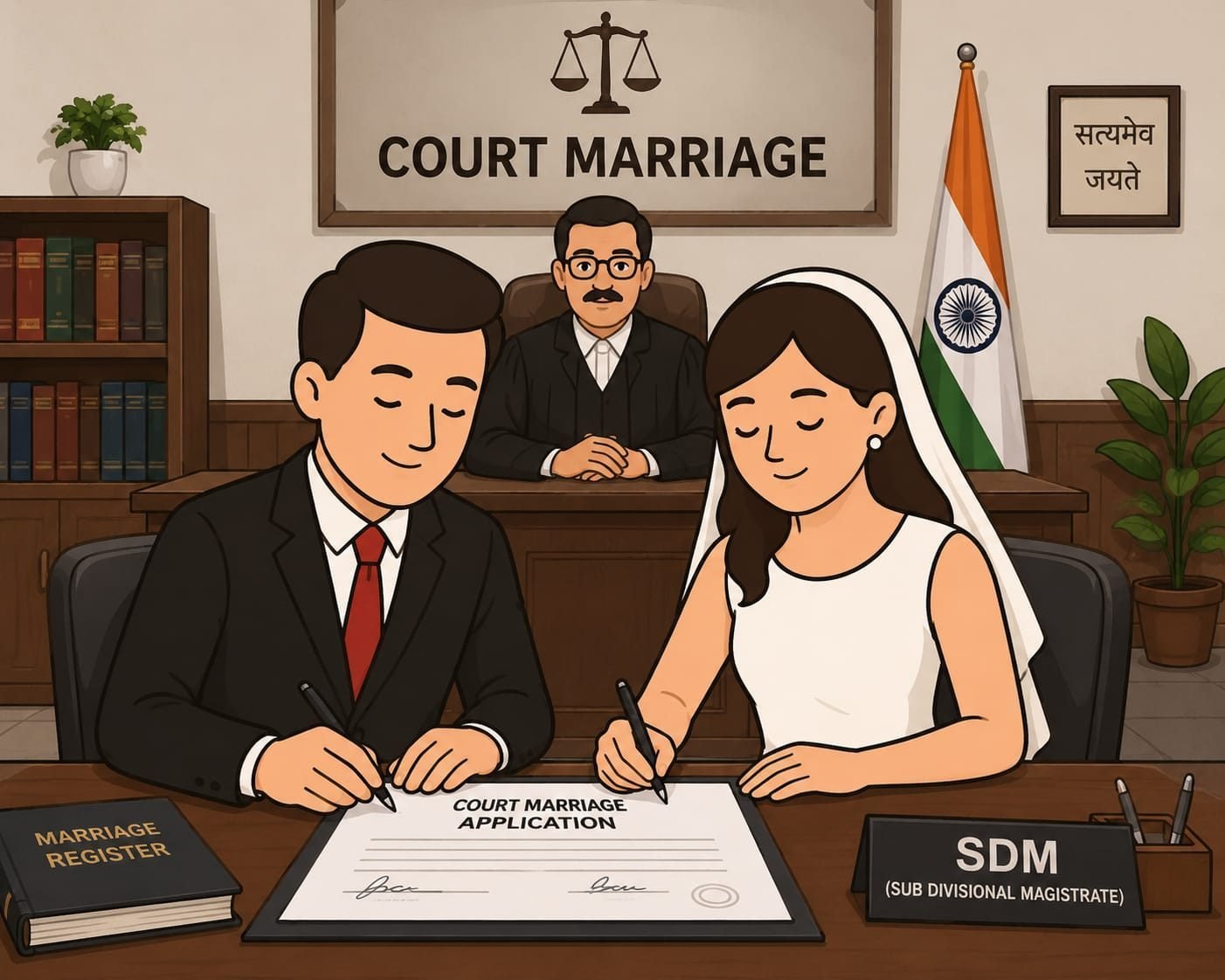
Two clarifications people in this colony ask constantly, because Karkardooma is next door. No court marries you and no court registers you. Registration is done by the SDM or the Registrar of Marriages; a Special Marriage Act marriage is solemnised before the Marriage Officer. “Court marriage” is everyday shorthand for a civil registration, not a description of a building — our Preet Vihar guide takes the myth apart along with the touts who live off it. And both parties attend in person; there is no power-of-attorney marriage and no video-call marriage.
4. Why This Page Is About Becoming Parents
Every locality guide we write concentrates on the problem that locality actually brings to our phone. For this belt, a striking share of the calls have nothing to do with a wedding at all. They sound like this:
“Sir, hum log adoption ke liye register kar rahe hain, CARA ki site pe marriage certificate maang raha hai. Humari shaadi 2019 mein hui thi, registration kabhi karaya hi nahi. Ab kya karein?”
Or a clinic has told a couple to bring the marriage certificate before the next cycle. Or a surrogacy file has been sent back by the appropriate authority because the certificate of eligibility requires a legally married intending couple and the proof is not there. Or a man is trying to adopt his wife’s daughter from her first marriage and has discovered that being her stepfather, on its own, gives him nothing in law.
In all four, the missing piece is the same document, and it is one we can actually help with. The rest of the process — the home study, the clinic, the authority — is not ours, and we will say so at every point on this page.
5. What We Handle and What We Do Not
Stated at the top, before anything else, so that nobody reads a word of this page as an offer.
We handle: marriage registration (₹6,000), Arya Samaj marriage with registration (₹7,100), court marriage assistance (₹6,100), nikah registration (₹6,000), Special Marriage Act assistance (₹15,000), and duplicate or corrected marriage certificates (₹2,500).
We do not handle, and earn nothing from: adoption applications, CARA registration, home study reports, court petitions for adoption, fertility treatment, ART clinic paperwork, surrogacy files, certificates of essentiality or eligibility, birth certificates for the child afterwards, or any scheme enrolment. We are not a law firm and we do not practise law; the court steps in an adoption go to an independent advocate acting in their own name, whose fee we take no share of.
And we do not put ourselves in the middle of your clinic or agency. We will not “speak to” CARA, an agency or a clinic on your behalf, and anybody in this trade who offers to is describing influence they do not have.
Everything below is general information, not advice on your file. Adoption, ART and surrogacy are governed by statutes and regulations that are amended, and the authority or clinic in front of you applies the current version. Confirm every requirement with CARA, your clinic and the appropriate authority before you act on it — and take your own legal advice for the court steps.
6. Adoption: What the CARA System Actually Asks For
Adoption in India for most people runs through the Central Adoption Resource Authority (CARA), under the Juvenile Justice (Care and Protection of Children) Act, 2015 and the Adoption Regulations made under it. Prospective adoptive parents register online, are home-studied by a specialised adoption agency, are referred a child in turn, and the adoption is finally made by an order of the court.
The eligibility conditions that matter for a married couple, as the authority sets them out:
- At least two years of a stable marital relationship — the condition this entire page turns on. Relative and step-parent adoptions are treated differently.
- The consent of both spouses is required. One spouse cannot register the family for adoption alone.
- A composite age criterion that pairs the parents’ ages against the age of the child. Broadly, the maximum combined age of a couple is 85 years for a child up to 2, 90 for a child above 2 and up to 4, 100 for a child above 4 and up to 8, and 110 for a child above 8 and up to 18 — with single parents at 40, 45, 50 and 55 for the same bands.
- A minimum age gap of 25 years between the child and either parent.
- A single female may adopt a child of any gender; a single male may not adopt a girl child.
- Couples who already have two or more children are ordinarily considered only for children with special needs or hard-to-place children — relative and step-child adoptions apart.
- Prospective parents must be physically, mentally and emotionally stable and financially capable, and must not have a life-threatening medical condition.
Every one of those is applied by the authority and the agency, not by us, and the figures above are the position as we understand it — check the current criteria on CARA’s own site before you rely on them. What we want you to take from the list is simply this: near the very top of it sits a requirement that rests on a document many couples in this colony have never obtained.
7. The Two-Year Rule, and Why It Catches People
“Two years of stable marital relationship” sounds easy to satisfy when you have been married for nine. The problem is proving it.
The natural proof is a marriage certificate showing the date of marriage. And here is where an unregistered couple discovers something painful: if you register your 2019 marriage today, the certificate correctly records the marriage as having taken place in 2019 — registration records a marriage, it does not create one. That is the honest and reassuring part.
But a certificate issued this month, for a marriage in 2019, is a document an agency may look at more carefully, and they may ask what else you have. So bring the rest of the story with you:
- The wedding card and ceremony photographs from the actual date.
- A certificate or register extract from the mandir, gurudwara, church or qazi — with the entry number, where a register was kept.
- Joint documents that show the years passing: a joint bank account and its statements, a joint rent agreement or property papers, a shared address on both Aadhaars, an employer’s record naming the spouse, an insurance policy naming the spouse, a ration card.
- Affidavits from both spouses setting out the date and place of the marriage, which we prepare as part of the registration.
The practical advice is to start the registration before the CARA registration, not after. A couple who registers their marriage in October and their adoption application in November has a clean file. A couple who is asked for the certificate at the home-study stage and then begins from scratch has lost weeks at the worst moment.
The one thing we will not do: put a false date on anything. If your marriage was in 2019 it is registered as 2019, whatever a deadline requires. A record with a date that was invented to satisfy a rule is the kind of thing that surfaces in a court hearing about a child, and there is no version of that we will be part of.
8. Adoption Under Hindu Law, and How It Differs
Alongside the CARA route there is adoption under the Hindu Adoptions and Maintenance Act, 1956, which applies where the parties are Hindu, Sikh, Jain or Buddhist. It is a different mechanism with different consequences, and it is usually seen in relative adoptions within a family.
The points that matter here:
- A married person cannot adopt alone. A married Hindu man needs his wife’s consent, and a married Hindu woman’s position is likewise governed by the Act. So the marriage — and, in practice, proof of it — is in the middle of it again.
- There are conditions on who may be adopted, including conditions about not already having a living son or daughter of the same gender, and about age gaps.
- The adoption is ordinarily recorded in a registered adoption deed, and a registered deed carries a presumption that the adoption was made in accordance with the Act.
- An adoption, once validly made, cannot be cancelled. That is not a formality; it is the whole seriousness of it.
Which route is right for a particular family — the CARA process or a Hindu law adoption — is a question for an advocate who has read your papers, and it is not one we answer. We are telling you the two exist so that you are not sold one as though it were the only option.
9. Adopting Your Spouse’s Child
This is the situation that surprises people most, so it gets a section of its own.
Marrying a child’s mother does not make you that child’s legal father. Being a stepfather is a family relationship, not a legal parentage. Without an adoption, a step-parent has no automatic guardianship, cannot give legal consent as a parent, may not be able to sign for a passport as a parent, and does not stand in the line of succession as a parent.
Step-parent adoption exists precisely to fix that, and the adoption framework treats it separately from an ordinary adoption — the two-year marital relationship condition is expressly carved out for relative and step-parent adoptions, and the number of children you already have is treated differently too. What it does require, without exception, is:
- Proof of the marriage to the child’s parent.
- The consent of the child’s other biological parent, where that parent is alive and their rights have not been terminated — or a death certificate, or a court order dealing with it. This is the step that most often takes the time, and it is an advocate’s work.
- The child’s own consent where the child is old enough for it to be taken.
- A court order, at the end.
People in this position often ask whether they can simply put their name on the school form and the passport application and leave it there. The school form, sometimes. The passport, no — a minor’s passport is issued on the particulars of the parents, with annexures where a parent cannot or will not consent, and a stepfather who is not the legal father is not the father on that form. Doing it properly once is far less painful than discovering the gap at an airport.
Our Preet Vihar guide deals with the wider blended-family picture — maintenance from a first marriage continuing, custody, what a decree must say before you remarry — and it is the right companion to this section.
10. Relative Adoption Within the Family
Adoption within a family — a child of a brother, a sister or a first cousin — is a recognised route, and it is common in extended families in this part of Delhi where a child is already being raised by an uncle or an aunt in practice.
The two things worth saying plainly:
“He has lived with us since he was two” is not adoption. Years of actually raising a child creates no legal relationship on its own. Without an adoption order or a valid adoption under the applicable personal law, the child is not your child for guardianship, for a passport, for succession, or for a claim on your service benefits. Families discover this at a hospital, at a passport office, or after a death.
The couple’s marriage has to be provable here too, because both spouses are party to the adoption and both must consent. Which brings the same missing certificate back into the room.
11. IVF and the ART Act, 2021
The Assisted Reproductive Technology (Regulation) Act, 2021 brought India’s fertility clinics and gamete banks under a statutory framework: clinics and banks must be registered, records must be kept, donors are regulated, consent and counselling are mandatory, and services are provided to defined categories of people.
The definition that matters on this page: under the Act, a “couple” means a legally married Indian man and woman, and a “commissioning couple” is an infertile couple who approach a clinic or bank for ART services. The Act also makes provision for a “woman” in her own right — in practice a single woman — to avail ART services in defined circumstances.
Age limits are prescribed for the commissioning couple. As the framework is generally applied, the woman must be between 21 and 50 and the man between 21 and 55. Note that in 2026 the Gujarat High Court considered whether that age bar applies to each individual or to the couple as a unit — a reminder that this is live law, and that your clinic will apply the position as it currently stands and as its own appropriate authority directs. Ask your clinic; do not argue from this page.
The practical consequence for a married couple is simple: the clinic needs to be satisfied that you are legally married, and the ordinary way of satisfying that is a marriage certificate. That is the point at which a couple who married by ceremony and never registered comes to us — usually with a cycle already scheduled, which is exactly the wrong moment to start.
12. What a Clinic Will Ask to See
Clinics vary and each has its own file requirements, but the recurring list is:
- The marriage certificate, in original for sighting, with photocopies for the file. Some clinics want an attested or certified copy.
- Photo identity and address proof for both, matching the names on the certificate.
- Age proof for both.
- Written informed consent from both, after counselling, which the Act requires — it is not a formality and you should read it.
- Medical records, which are between you and the clinic and are none of our business.
The most common paperwork failure is not a missing certificate at all — it is a mismatch. The certificate says “Sunita Devi”, the Aadhaar says “Sunita Rani”, the passport says “Sunita”. See section 20, because it is fixable and it is much easier to fix before a file is opened than after.
13. Surrogacy: The Strictest of the Three
The Surrogacy (Regulation) Act, 2021 is far more restrictive than most people expect, and a great deal of what is said about surrogacy in India online is out of date. The headline points:
- Only altruistic surrogacy is permitted. Commercial surrogacy is prohibited. Nothing may be paid to the surrogate mother beyond her medical expenses and the insurance cover the Act requires.
- The intending couple must be a legally married Indian man and woman — the Act defines a “couple” as a legally married Indian man and woman above 21 and 18 respectively.
- Age limits for the certificate of eligibility: the woman between 23 and 50, and the man between 26 and 55.
- No surviving child — biological, adopted or through an earlier surrogacy — except where an existing child is mentally or physically challenged or has a life-threatening disorder.
- A certificate of essentiality is required, which involves a District Medical Board certifying the medical indication for gestational surrogacy, an order of a court on the parentage and custody of the child to be born, and insurance cover for the surrogate mother for 36 months from delivery.
- A certificate of eligibility for the intending couple, from the appropriate authority.
- An “intending woman” — an Indian widow or divorcee between 35 and 45 — is also provided for.
Read that list again and notice how much of it rests on the first two items being provable. A surrogacy file cannot begin without proof of a legal marriage, and the authority is not a clinic reception — it is a statutory body issuing a certificate, and it will not work around a missing document.
We handle none of this. We cannot obtain a certificate of essentiality or eligibility, we have no contact at any authority, and anybody telling you they can move a surrogacy file is describing influence they do not have. What we can do is make sure that the one document you must bring is in your hand, correct, and in your own names.
14. If You Have Been Asked to Be a Surrogate
This section is not for the intending couple. It is for the woman being asked, because in a belt like this one she is usually the person with the least information in the room.
Under the Act, a surrogate mother must be an ever-married woman who has a child of her own, aged 25 to 35 on the day of implantation, willing, with written consent, and she may not act as a surrogate more than once in her lifetime. She cannot provide her own gametes. She must be given the insurance cover described above.
And this: commercial surrogacy is an offence. If a clinic, an agent or a broker is offering you a payment to carry a child, that arrangement is outside the law, and the person facing the consequences of an unlawful arrangement is never the one who arranged it. Nobody may be pressured into it by a husband, a relative, an employer or a debt.
If any of that is happening to you, you can speak to the police, to the women’s helpline 181, or on 112. We have no interest in this trade and we will not document any part of it — and we would rather write this paragraph on a page about marriage certificates than pretend it does not happen.
15. If You Are Single, Widowed or Divorced
An honest summary, because people are given a lot of wrong information here.
- Adoption: a single person may adopt. A single female may adopt a child of any gender; a single male may not adopt a girl child. The composite age table applies, with a lower ceiling for a single parent than for a couple.
- Surrogacy: the Act provides for an “intending woman” who is a widow or divorcee between 35 and 45. A single man is not provided for.
- ART: the Act makes provision for a woman availing services in her own right, alongside the commissioning couple. The exact position for different categories of single women is the sort of thing that has been litigated and amended, so ask your clinic and its appropriate authority rather than relying on any article.
If you are divorced or widowed and planning to remarry before any of this, our Preet Vihar guide covers what a decree must say and when you may lawfully remarry — and note that a second marriage restarts the two-year clock for an ordinary CARA adoption.
16. Same-Sex Couples and Unmarried Couples
We will give you the position as it stands rather than what anybody wishes it were.
Same-sex marriage is not recognised in India. In Supriyo v. Union of India (2023) the Supreme Court declined to read a right to marry into the Special Marriage Act, and a review was dismissed in January 2025. There is no marriage certificate we or anybody else can obtain for a same-sex couple, and any person offering one is offering a fraud that will fail its first check. The adoption, ART and surrogacy frameworks described above are built around a legally married man and woman or specified categories of single persons.
What can still be done, and should be: wills, nominations on every account and policy, a power of attorney, a medical directive naming the person you want consulted, and joint ownership documents. None of it is a substitute for marriage, and we do not pretend it is, but it is the difference between a partner who can act in a hospital or a bank and one who cannot. That is advocate work, not ours.
For an unmarried heterosexual couple, the same holds for adoption, ART and surrogacy: the frameworks are built around marriage. If you intend to marry anyway, the routes are in section 21 — but do not marry only to satisfy a form. Our Shakarpur guide makes that argument at length in another context and it applies here too.
17. The Order to Do Things In
Almost every avoidable delay we see on these files comes from doing this in the wrong sequence. Here is the order that works.
- Get the marriage registered first, before you register anywhere else. If it is already registered, get the certificate into your hands and check it.
- Read the certificate against your other documents. Spellings, both fathers’ names, the date of marriage, both dates of birth. Fix any mismatch now — section 20.
- Get certified or attested copies made while you are near the issuing office. You will need several, for the agency, the clinic and your own file.
- Update Aadhaar and bank KYC so that the names and addresses across your documents agree.
- Then start the adoption registration, the clinic file or the surrogacy application.
- Take independent legal advice for anything that ends in a court order — adoption, step-parent adoption, the parentage order in a surrogacy file.
Steps 1 to 4 are ours and take about a week to ten days. Steps 5 and 6 are not ours at all, and take as long as they take.
18. If Your Marriage Was Never Registered
The commonest situation on this page, and an ordinary one to fix.
Bring: the wedding card; ceremony photographs; a certificate or register extract from the mandir, gurudwara, church or qazi where one can be obtained, with the entry number; age proof for both; photo identity for both; current address proof for both; affidavits from both spouses setting out the date and place, which we prepare; and two witnesses who genuinely know you as a married couple, with their own original identity documents. Children’s birth certificates and school records naming both parents, and the ration card, are strong supporting evidence of a long marriage.
Our fee is ₹6,000, with government charges separate and at cost. It takes about a week to ten days in an ordinary case.
There is no cut-off for registering a Hindu marriage — a marriage from fifteen years ago can be registered, and we do it often. For a nikah in Delhi the 2014 Order sets 60 days ordinarily, the next 60 days on payment of ₹500, and a ₹1,000 penalty after that, but registration remains possible however late, while both spouses are alive. That last clause is the one real deadline: after a spouse dies, registration is not possible at all.
If the pandit or qazi who performed your wedding has died, that is usually not the end — registers are kept by the institution, so ask the mandir or masjid for an attested extract with the entry number. Our Seelampur guide deals with old, handwritten and lost certificates in detail.
19. If You Need a Certified Copy and Cannot Find the Original
Very common on adoption and clinic files, where the certificate was issued years ago and has been moved house three times.
What speeds it up: the registration number and the date of registration. If you have those, even on an old photocopy or in a diary, the file is found quickly. If you do not, bring the approximate date, the office or the address as it was then, and both parties’ particulars.
What to expect: a recent record is often located within about two weeks; an old paper register can take three to six weeks. A correction — fixing something that was never true — is a different application from a post-marriage name change, which is a separate process entirely.
Our fee for a duplicate or a correction is ₹2,500. And a reminder from section 2: nobody needs to “re-do” a certificate because the office has been renamed.
Ask your agency or clinic which form of copy they want — plain, self-attested, notarised, office-certified or apostilled — before you order it. Getting the wrong one is a week lost for no reason, and an apostille is only needed where a document is going abroad.
20. Name and Spelling Mismatches
The quiet killer of otherwise complete files.
Your marriage certificate, Aadhaar, PAN, passport, bank record and educational certificates were created at different times by different clerks, and in this belt it is entirely normal for a person to appear as “Kumari”, “Devi” and “Rani” across three of them, or for a father’s name to carry an initial in one place and not another. An agency or a clinic seeing two different names has to resolve it before it can proceed.
How it is actually fixed:
- Decide which spelling is going to be the correct one for the rest of your life. Usually whichever appears on the passport, or failing that the Aadhaar.
- Correct the others to match it, one at a time, starting with Aadhaar.
- Where a document cannot be corrected — an old educational certificate, typically — the usual instrument is a “one and the same person” affidavit, sworn by you, stating that the differently-spelled names refer to one person. Many offices accept it; some also want a supporting document.
- If the error is on the marriage certificate itself, that is a correction application — ₹2,500 with us.
- A change of surname after marriage is not a correction and not automatic: no law requires a woman to change her surname. If you do change it, the sequence is affidavit, newspaper notices, Gazette of India, then Aadhaar, PAN, bank KYC, employer and finally passport — and a passport name change is a re-issue, which changes the passport number. Universities do not reissue a degree in a new name. Our Saket guide sets out the whole sequence.
Do this before you open the file, not while it is open. A correction in progress is a file on hold.
21. Your Three Lawful Routes to Being Married
For readers who are not yet married at all, the same three routes as everywhere, with no fourth.
Route A — Arya Samaj marriage, then registration (₹7,100). Where both of you are Hindu, Sikh, Jain or Buddhist. A real marriage under the Hindu Marriage Act, with havan and saptapadi; possible the same day where you are both eligible, have your originals and bring your own two witnesses. The mandir issues its certificate that day; the registration follows by appointment.
Route B — registration of a marriage that has already happened (₹6,000). Section 18.
Route C — the Special Marriage Act, 1954 (₹15,000). The civil route, any two adults, any religions, no conversion. Thirty days’ residence before notice, thirty days’ public notice, then solemnisation before the Marriage Officer with three witnesses — about sixty days, and nothing lawfully shortens it.
Nobody can produce a government marriage certificate today. A ceremony can be same-day; a certificate follows registration at a government office by appointment.
22. Arya Samaj Marriage and Registration, Step by Step
- Call and send document photographs on WhatsApp. We tell you in minutes what works and what is missing. Free.
- Confirm your two witnesses and remind them the night before.
- Bring the originals — age proof, photo identity and address proof for both, plus passport photographs.
- The ceremony at the mandir, and the mandir’s certificate the same day.
- The registration application on e-District with the mandir certificate, the ceremony photographs and both parties’ documents.
- The appointment, attended by both of you in person.
- Check the certificate at the counter before you leave the building.
The mandir certificate is not the end. It records the ceremony. Every agency, clinic and authority named on this page will want the document issued after registration. Do not stop halfway — it is the commonest expensive mistake in this whole trade.
23. The Special Marriage Act from This Belt
At least one party must have resided in the district for thirty days before notice; the notice is then published for thirty days; solemnisation follows before the Marriage Officer with three witnesses. No fee, no contact and no emergency shortens either period, and an office that appeared to do so would be acting outside the statute.
The notice is a public document during those thirty days. For most couples that is a formality nobody looks at; for a couple whose families are opposed it is a real consideration, better discussed at the start than discovered in week three. For an inter-faith couple our inter-religion marriage guide sets out the options honestly, including a straight treatment of conversion and why it should never be done under pressure.
We will not manufacture a residence. No affidavit for an address you do not live at, no arranged rent agreement, and no notice filed on a document we can see was made for the purpose.
24. Witnesses
We do not provide witnesses. Not for a fee, not as a favour, not because your family is in another state. It is a fixed term of how we work and it is written into our terms and conditions.
A witness must be an adult who genuinely knows you, carries their own original photo identity and address proof, and attends in person. Two for an Arya Samaj ceremony; three for solemnisation under the Special Marriage Act. For registering an old marriage, witnesses who know you as a married couple are the strongest of all — and on an adoption or clinic file, where the marriage’s history may be looked at, that matters more than usual.
A paid witness is a false statement to a public authority. On a file that is going to be read by an adoption agency or a court deciding about a child, that is not a shortcut — it is a weakness you are building in deliberately. Our witness guide sets out exactly who qualifies.
25. Fees, at Cost and in Full
The same for everybody, and never higher because a clinic has given you a date or an agency has given you a deadline.
| Service | Our fee | What it covers |
|---|---|---|
| Marriage certificate — duplicate or correction | ₹2,500 | Application, follow-up and collection |
| Arya Samaj marriage — ceremony only | ₹5,100 | Pandit, havan, saptapadi and the mandir certificate, same day |
| Marriage registration | ₹6,000 | Full application, appointment and certificate |
| Nikah registration | ₹6,000 | Registration of a nikah under the Delhi 2014 Order |
| Court marriage assistance | ₹6,100 | End-to-end assistance with the civil registration |
| Arya Samaj marriage with registration | ₹7,100 | Ceremony at the mandir plus the registration work |
| Special Marriage Act (full assistance) | ₹15,000 | Notice, the thirty days, solemnisation and certificate |
Government charges are separate and shown at cost on your receipt, on their own line with our charge on another. Nothing is added and nothing is rounded up. The full list is on our fees page.
There is no fee on this page for anything to do with adoption, ART or surrogacy, because we do not do any of it. If somebody quotes you a package covering “marriage certificate plus CARA” or “certificate plus clinic formalities”, you are being sold access that does not exist.
26. Documents Checklist
- Age proof for both — matriculation certificate, birth certificate, school leaving certificate or passport.
- Photo identity for both — Aadhaar, voter card, driving licence or passport, in original.
- Address proof for both — home-state is fine.
- Passport photographs — several each.
- Two witnesses with their own original identity and address proof (three for the Special Marriage Act).
- Divorce decree or death certificate if either of you was married before. No affidavit substitutes for it — and on an adoption file it will be asked for.
- For an old marriage: wedding card, ceremony photographs, mandir or qazi certificate or register extract, affidavits from both spouses, children’s records and the ration card if you have them.
- For an adoption or clinic file afterwards: several certified copies of the certificate, and your documents corrected so that every name matches.
27. A Realistic Timeline
| What you need | Realistic time | What decides it |
|---|---|---|
| Registering a marriage that already happened | About a week to ten days | Photographs, the institution’s slip, and the affidavits |
| Duplicate certificate, recent record | About two weeks | Whether you have the registration number and date |
| Duplicate certificate, old paper register | Three to six weeks | Locating the register entry |
| Correction on the certificate | Two to four weeks | The supporting document proving the correct particular |
| Arya Samaj marriage with registration | Ceremony same day; certificate in a few working days | Originals in hand and witnesses confirmed |
| Special Marriage Act | About sixty days | 30 days’ residence, then 30 days’ notice |
| Adoption, ART or surrogacy itself | Not ours to estimate | The agency, the clinic and the authority |
Notice the last row. We will never give you a timeline for something we do not control, and anybody who does is guessing at your expense.
28. Mistakes We See on These Files
- Starting the CARA registration or the clinic file first, and only then discovering the certificate is missing.
- Stopping at the mandir certificate and assuming it is the marriage certificate.
- Name mismatches left unfixed across the certificate, Aadhaar and passport.
- Ordering the wrong kind of copy — a notarised copy where the agency wanted an office-certified one, or an apostille nobody asked for.
- Assuming a step-parent is a legal parent. They are not, without an adoption.
- Assuming years of raising a relative’s child is adoption. It is not.
- Believing something read online about surrogacy that predates the 2021 Act.
- Waiting until after a spouse’s death to register a marriage. It cannot be done then, at all.
- Paying an agent for “approval” at an authority. Nobody sells that.
- Leaving the counter without checking the spellings on a freshly issued certificate.
29. Four Situations From This Colony
Anonymised, and each stands for many.
The couple who had been married since 2019. Registered on CARA, reached the home-study stage, and were asked for the marriage certificate they had never obtained. They came with the wedding card, photographs, a slip from the mandir and two neighbours who had attended the wedding. Registered in nine days, correctly showing the 2019 date. The lesson they passed on to their friends was to do it in the other order.
The stepfather. Married in 2021 to a woman with a daughter from her first marriage. He had been raising the child for four years and had assumed that was that, until a passport application asked for the father’s particulars. We registered the marriage — the part that was ours — and told him plainly that the adoption itself needed an advocate and the consent position on the biological father had to be dealt with first. He was not pleased to hear it and he was better off hearing it.
The clinic file that stalled on a surname. Certificate said one spelling, Aadhaar another, passport a third. Nothing was wrong with the marriage; three clerks over fifteen years had simply written a name differently. One correction application and one “same person” affidavit, and the file moved. Total cost, ₹2,500 and three weeks — and it would have been nothing at all if it had been checked before the file opened.
The one we sent away. A couple asked whether we could show their marriage as two years older than it was, because of the two-year rule. The answer was no, and it would have been no at any price. A false date on a marriage record, on a file that ends with a court making an order about a child, is not a shortcut — it is the thing that unravels the adoption later. They waited the months they had to wait.
30. Agents, and What Nobody Can Sell You
- Nobody can get a marriage certificate issued today.
- Nobody can move you up a CARA waiting list, arrange a referral, or influence a home study.
- Nobody can obtain a certificate of essentiality or eligibility for a surrogacy file other than by the statutory process.
- Nobody can back-date a marriage, an affidavit or a register entry.
- Never hand original documents to somebody who approaches you outside a court, an office, a clinic or a mandir.
- Never sign a blank form or blank stamp paper, and get a receipt for every rupee from anybody, including us.
- Nobody from us will ever ask for an OTP, a UPI PIN, a card PIN, a CVV or a net banking password, or ask you to install a screen-sharing app, or ask you to approve a payment request in order to receive money. If it happens in our name: stop, share nothing, call +91 8376863962, and report it at cybercrime.gov.in or on 1930 — within the first hour if money has gone.
31. What We Will Not Do
- We will not put a false date on anything, whatever rule it would satisfy.
- We do not provide witnesses.
- We do not touch an under-age marriage. Under the Prohibition of Child Marriage Act, 2006 the minimum age is 21 for the groom and 18 for the bride. We decline in every case, at any price, and we decline where a document appears to have been altered.
- We stop if either party is not giving a clear, free yes in their own words — and we speak to both of them alone to find out.
- We do not manufacture a residence, a rent agreement, an affidavit or an age proof.
- We do not document any part of a commercial surrogacy arrangement.
- We do not charge for, or promise anything about, adoption, ART or surrogacy processes.
- We do not practise law. Adoption petitions, parentage orders, step-parent adoptions, divorce, maintenance, custody and succession go to an independent advocate acting in their own name, whose fee we take no share of.
- We do not discuss your file with anybody — not a family, not an agency, not a clinic, unless you ask us to in writing.
32. Talk to Us Before the Deadline, Not After It
If an agency, a clinic or an authority has asked you for a marriage certificate and you do not have one, the useful thing to do today costs nothing: send us photographs of what you do have on WhatsApp. Within minutes we will tell you whether it is a registration, a duplicate or a correction, exactly what is missing, and how long it will honestly take — including when the answer is “this will not be ready by your date”, which is far better heard now than in three weeks.
We are in this belt, minutes from Karkardooma and Anand Vihar on the Blue Line and Jhilmil and Dilshad Garden on the Red Line.
And the one line to take away if you take nothing else: get the marriage registered while both of you are here and well. Every route to parenthood in Indian law is built on that document being in your hands, and it is the only part of this whole journey that is quick, cheap and entirely within your control.
Marriage registration – ₹6,000
Register a marriage that already happened · duplicates and corrections ₹2,500 · Arya Samaj with registration ₹7,100 · court marriage assistance ₹6,100 · nikah registration ₹6,000 · Special Marriage Act ₹15,000. Call first — it is free.
Register Your Marriage – ₹6,000 →Also: Duplicates and corrections · Arya Samaj marriage · Court marriage · Find our office
Questions and Answers: Marriage Certificates for Adoption, IVF and Surrogacy
Sources and Official References
Facts in this guide were checked against the following primary sources. Government procedures and office allocations change, so confirm current details on the official portal before applying.
- Delhi e-District – official online application portal
- Hindu Marriage Act, 1955 – section 8, registration
- Special Marriage Act, 1954
- Surrogacy (Regulation) Act, 2021
- Assisted Reproductive Technology (Regulation) Act, 2021
- CARA – eligibility criteria for prospective adoptive parents
- Adoption Regulations, 2022 (CARA)
- Juvenile Justice (Care and Protection of Children) Act, 2015
- Hindu Adoptions and Maintenance Act, 1956
- Prohibition of Child Marriage Act, 2006
- UIDAI – Aadhaar name and address correction
- National Cyber Crime Reporting Portal
This guide is general information, not legal advice for your specific case. Call +91 8376863962 for advice on your situation.
Related Articles
⚖️ Preet Vihar: Remarriage and Blended Families
Decrees, maintenance, custody, second families.
Read →👶 Seemapuri: Your Children’s Papers
Birth registration, RTE and school admission.
Read →✏️ Saket: The Surname Question
Gazette, passport and every record to update.
Read →🏢 The Office That No Longer Exists
Duplicates when the office was renamed.
Read →📜 Seelampur: Old and Lost Papers
Handwritten certificates and register extracts.
Read →🏠 Vasant Vihar: The People Who Work There
Registering with no Delhi address.
Read →🏢 Shakarpur: Renting as a Couple
Landlords, agreements and the law.
Read →🕊 Inter-Religion Marriage
Options without conversion.
Read →👥 Witness Requirements
Who can be a witness, and who cannot.
Read →🏛️ Court Marriage in Delhi
The complete Delhi guide.
Read →🏡 Yamuna Vihar: GPA Houses and Widows
Property papers, succession and the certificate.
Read →