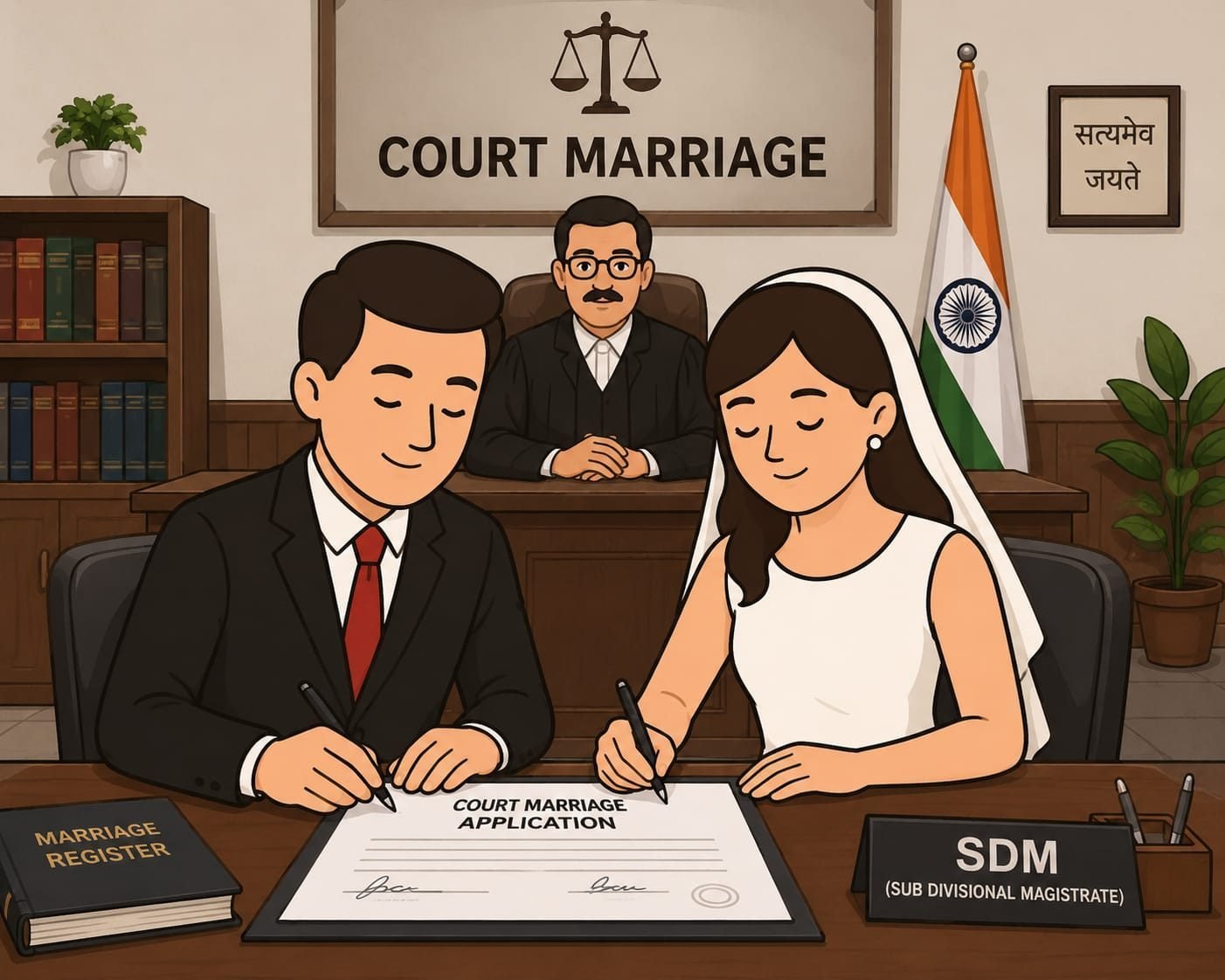
Quick answer: Najafgarh is rural Delhi's largest town: dozens of villages, the Najafgarh drain and jheel, farmland turning into colonies, and the Haryana border a few minutes away at Jhajjar and Bahadurgarh on one side and Gurugram on the other. Under Delhi's 2026 revenue map, Najafgarh is one of four sub-divisions of the South West district (with Matiala, Dwarka and Bijwasan). Two Hindus, Sikhs, Jains or Buddhists can have an Arya Samaj wedding and register it under the Hindu Marriage Act; interfaith couples who do not want to convert use the Special Marriage Act with 30 days' residence and a 30-day notice. Couples with one partner in Haryana must choose one state to register in: Delhi under the 2014 Order and the Hindu Marriage Act, or Haryana under its Compulsory Registration of Marriages Act, 2008. Same-gotra and same-village marriages are lawful; no khap or panchayat can void a marriage, and protection is available from the police and the High Court. Love and inter-caste marriage with a same-day Arya Samaj ceremony: ₹5,100.
Key takeaways
- From 1 January 2026 Najafgarh is one of four sub-divisions of the South West district, with Matiala, Dwarka and Bijwasan.
- Couples with one family in Haryana register ONCE: in Delhi, or in Haryana under its Compulsory Registration of Marriages Act, 2008.
- Same-gotra and same-village marriages are lawful; sapinda relationship and prohibited degrees are what make a Hindu marriage void.
- No khap or panchayat can void a marriage – Shakti Vahini (2018); protection from the police and the High Court is easier to get early.
- Marriage does not transfer land; daughters are coparceners since Vineeta Sharma (2020). We never provide witnesses.
Last reviewed: 22 September 2026 · 37 min read
On this page
- Najafgarh at a glance
- Najafgarh under the 2026 map
- Which office registers your marriage
- The legal routes
- Delhi or Haryana: where to register
- How Haryana registration works
- Protection petitions: which High Court
- Khap panchayats and what they cannot do
- Same gotra and same village
- Sapinda and prohibited degrees
- Farmland, bhumidhari and marriage
- Daughters and village property
- Brides from other states
- Arya Samaj + registration
- Registering a wedding already held
- Special Marriage Act
- Inter-caste couples and the incentive
- Muslim couples
- Dowry, gifts and stridhan
- If a marriage turns bad
- Second marriages
- Planning a village wedding
- Address proof in villages and colonies
- Tenants in Uttam Nagar and the colonies
- Age: the line we never cross
- Witnesses
- Documents checklist
- At the appointment
- Roka, sagai and the weeks before
- What the registrar will ask
- What it costs
- Timeline
- Getting around
- Common mistakes
- After registration
- Five Najafgarh situations
- Checklist
- One-minute summary
- How we help
- Questions and answers
Najafgarh does not feel like the rest of Delhi. Beyond the last stretch of the Dwarka flyovers, the roads run between fields and village gates, past akharas where boys train before dawn, dairies, tractor workshops and grain stores. Villages such as Dichaon Kalan, Jharoda Kalan, Kair, Goela Khurd, Nangli Sakrawati and Mitraon have their own chaupals and their own histories, and families here are related by marriage to families across the border in Jhajjar, Bahadurgarh and Gurugram. At the same time, colonies have spread over what was farmland, and thousands of families who came from Uttar Pradesh, Bihar and Rajasthan now rent in Uttam Nagar, Matiala and the settlements around them.
Marriages here are family affairs on a large scale, and the questions that reach us reflect village life rather than city life. Where should we register when the bride's home is in Haryana? Is a same-gotra marriage legal? Can the panchayat stop it? What happens to our land when my sister marries? My wife's name is not on any paper; how do we prove the marriage after thirty years? A young couple who are being threatened asks the most urgent question of all: which court do we go to, and how fast?
This guide answers those questions plainly, including where the honest answer is that a custom carries no legal weight at all.
For the general Delhi process, see the complete Delhi court marriage guide. Nearby area guides: Dwarka, Kapashera, Kanjhawala and Hari Nagar.
Najafgarh at a Glance
| Item | Detail |
|---|---|
| District (from 1 January 2026) | South West |
| Sub-divisions in the district | Najafgarh, Matiala, Dwarka, Bijwasan |
| Areas | Najafgarh town, Dichaon Kalan, Jharoda Kalan, Kair, Mitraon, Goela Khurd, Nangli Sakrawati, Khaira, Ujwa, Surakhpur, with Uttam Nagar and Matiala to the east |
| Borders | Jhajjar and Bahadurgarh (Haryana) to the west and north; Gurugram to the south |
| Metro | Grey Line: Dwarka–Najafgarh–Dhansa Bus Stand; Blue Line at Uttam Nagar and Dwarka Mor |
| Typical questions | Delhi or Haryana registration, khap and same-gotra objections, protection petitions, farmland and daughters' rights, old unregistered marriages |
Najafgarh Under the 2026 Revenue Map
From 1 January 2026, Delhi's revenue administration was reorganised into 13 districts and 39 sub-divisions. The South West district now has four sub-divisions: Najafgarh, Matiala, Dwarka and Bijwasan. Najafgarh keeps a sub-division in its own name and covers much of the rural belt; addresses towards Uttam Nagar may fall under Matiala, and those towards the airport side under Bijwasan. The e-District portal allots the office by address, and your appointment slip names it. Certificates issued before 2026 remain valid.
Which Office Registers Your Marriage?
You apply online on the Delhi e-District portal. For Hindu Marriage Act registration, the registering office can be the one for the place where the marriage was solemnised or where either spouse lives; for the Special Marriage Act, notice goes to the Marriage Officer of the district where at least one of you has lived for the last 30 days. A wedding held in a village here, with the groom's home in Najafgarh and the bride's in Haryana, is normally registered in Delhi on the Delhi address or the place of the wedding.
The Legal Routes
| Your situation | Route | Waiting period | Our fee |
|---|---|---|---|
| Love or inter-caste marriage, both Hindu | Confidential Arya Samaj wedding + HMA registration | Wedding same day | ₹5,100; ₹7,100 with registration |
| Village wedding already held, not registered | Hindu Marriage Act registration | By appointment | ₹6,000 |
| Different religions, no conversion | Special Marriage Act | 30 days' residence, then 30-day notice | ₹15,000 |
| Court marriage with advocate assistance | SMA or SDM registration with drafting | Depends on route | ₹6,100 |
| Both Muslim | Nikah + registration under the Delhi 2014 Order | Nikah same day; registration by appointment | ₹5,000 / ₹6,000 |
| Sikh couple after Anand Karaj | Delhi Anand Marriages Registration Rules, 2018, or HMA | By appointment | ₹6,000 |
| Bride or groom from Haryana | Register in Delhi, or in Haryana under its 2008 Act | Depends on route | Guidance included |
Government fees are extra at actual cost. Full list: fees.
Delhi or Haryana: Where Should You Register?
Half the marriages in this belt involve a family across the border. A marriage needs to be registered once, and a certificate from either state is valid across India, so the choice is practical.
| Situation | Delhi | Haryana |
|---|---|---|
| Wedding in a Najafgarh village, groom lives in Delhi | Yes, on his address or the place of the wedding | Not usually |
| Wedding in Jhajjar or Bahadurgarh, bride's family there, couple will live in Delhi | Possible on the Delhi spouse's residence | Yes, under the 2008 Act, on the place of marriage or residence |
| Both families in Haryana, couple settling in Delhi later | After the couple has a Delhi address | Simpler immediately after the wedding |
| Special Marriage Act | If one has lived 30 days in the Delhi district | If one has lived 30 days in the Haryana district |
| Use for passport, visa, bank, pension | Equally valid | Equally valid |
Decide by three questions: whose address proof is already correct; where both of you and your witnesses can reach an office on a working day; and where the wedding itself took place. Do not register the same marriage in both states.
How Haryana Registration Works
Haryana has its own law, the Haryana Compulsory Registration of Marriages Act, 2008, under which all marriages in the state are to be registered, with applications made through the state's online marriage registration portal and the certificate issued by the registrar for the area. In outline:
- the application is filed online with both parties' details, photographs and documents;
- age proof, identity proof, residence proof and proof of the marriage are required, as in Delhi;
- witnesses attend with their own identity documents;
- registration within the prescribed period avoids a late fee; delayed registration is still possible;
- the certificate, once issued, is valid throughout India.
The practical difference for couples in this belt is usually geography, not law: which office is easier to reach with both families and the witnesses. If the bride's family is in a Haryana village and the wedding is held there, registering in Haryana is often simpler; if the couple will live in Najafgarh, registering in Delhi keeps the record where their address will be. We advise on both and prepare the documents either way; the Haryana filing is done on the state's own portal.
Protection Petitions: Which High Court?
When a couple in this belt is threatened, the practical question is where to go, and quickly. The rule of thumb is the territory:
- If you live in Delhi and the threat is in Delhi, the Delhi High Court hears protection petitions, and Delhi Police's special cells and the 181 helpline are the first point of contact, with 112 for emergencies.
- If you or your families are in Haryana, the Punjab and Haryana High Court at Chandigarh hears such petitions, and hears a very large number of them from this region.
- Either way, the law is the same: the Supreme Court in Lata Singh (2006) directed protection for inter-caste and inter-religion couples, and in Shakti Vahini (2018) held that no khap panchayat, family or community can interfere with the marriage of two consenting adults, directing states to take preventive and punitive measures.
- Move early. A protection order is far easier to obtain before something happens than after.
- Take your proof: age documents, the marriage certificate or ceremony proof, and a record of the threats.
We are not a law firm and do not file petitions, but we register marriages quickly and confidentially, which is what such a petition needs first, and we can explain the practical steps. See our love marriage service and the love marriage rights guide.
Khap Panchayats and What They Cannot Do
In the villages of south-west Delhi and across the Haryana border, khap and biradari panchayats still carry social weight. They mediate disputes, decide community matters and, in some cases, pronounce on marriages. Families believe their word is final. In law it is not.
- A panchayat cannot declare a lawful marriage void. Only a court can decide the validity of a marriage.
- It cannot order a couple to separate, boycott a family, impose fines, or expel anyone from a village; such acts can themselves be offences.
- Shakti Vahini v. Union of India (2018) is the leading judgment: the Supreme Court held that any assembly which gathers to condemn a marriage between consenting adults acts illegally, and issued directions to state governments, including preventive steps by district administrations, special cells, and action against those who threaten couples.
- Threats, confinement and violence in the name of family honour are crimes under the ordinary criminal law, whoever commits them.
- Police protection can be sought immediately; the High Court can direct it.
None of this means a family cannot disagree with a match. It means disagreement has to stay within the law.
Same Gotra and Same Village
The most common objection here is not caste but gotra, or the rule that families of the same village, or of villages bound as brothers, do not marry. Couples are told the marriage would be "like brother and sister" and therefore illegal.
- The Hindu Marriage Act does not mention gotra. Its conditions are about age, capacity, an existing spouse, prohibited degrees of relationship and sapinda relationship.
- Village exogamy is a custom, not a statutory condition. A marriage that offends it is socially controversial but legally valid.
- A marriage cannot be registered or refused on the basis of gotra; the registrar looks at the Act's conditions.
- Couples in this position should register quickly, because the certificate ends any argument about whether they are married.
Sapinda and Prohibited Degrees
What does make a Hindu marriage void is closeness of blood. The Act prohibits marriage between parties within the degrees of prohibited relationship or in a sapinda relationship, unless a custom governing both permits it.
- Sapinda extends, broadly, three generations upward through the mother and five through the father, which covers close cousins.
- Prohibited degrees include lineal ascendants, a brother's or sister's descendants within limits, and certain relations by marriage.
- In Neetu Grover v. Union of India (2024), the Delhi High Court upheld the constitutional validity of the sapinda prohibition.
- Write out the family tree if there is any doubt, and take advice before the wedding. A void marriage causes problems for property, children's status and any later marriage.
So the honest summary for a village family is this: the rule your elders should be asking about is sapinda, not gotra.
Farmland, Bhumidhari and Marriage
Land is the background to many marriages here. A few points that couples and families ask about:
- Marriage does not by itself transfer land. A wife does not automatically become an owner of her husband's land on marriage, and a husband does not become an owner of his wife's.
- Agricultural land in Delhi is governed by the Delhi Land Reforms Act, with its own rules on bhumidhari rights, transfers and succession, separate from the Hindu Succession Act.
- Succession to such land has a history of male-preference rules; the Supreme Court considered the position for successions before September 2005 in Har Naraini Devi (2022). Families holding agricultural land should take specific legal advice rather than rely on village practice.
- Registration of the marriage matters precisely because land disputes arise years later, when a widow or a daughter-in-law has to prove she was married to the deceased.
- Wills and clear records prevent most of the litigation we hear about from this belt. A marriage certificate, a will and mutation records in order are worth more than any oral family arrangement.
Daughters and Village Property
Since the Supreme Court's judgment in Vineeta Sharma (2020), a daughter is a coparcener in Hindu joint family property by birth, with the same rights as a son, whether or not her father was alive in 2005. Marriage does not take that right away, and no document a family asks a daughter to sign at her wedding, renouncing her share "as is the custom", is a substitute for a properly executed release or family settlement, made voluntarily and, where it concerns immovable property, in the form the law requires.
Agricultural land under the Delhi Land Reforms Act, as noted above, follows its own rules, so a family should get advice specific to the land they hold. What is clear is that a daughter's rights are a legal question, not a village one, and a daughter should not be pressured into signing anything at the time of her wedding, when she is in no position to take advice.
Brides From Other States
Many households in this belt have brought a bride from Uttar Pradesh, Bihar, Rajasthan, Jharkhand, West Bengal or the North East, sometimes through relatives, sometimes through intermediaries. Whatever the route, the law's requirements are the same, and they exist to protect everyone:
- She must be an adult and must consent freely. A marriage arranged without her consent is open to challenge, and forcing it can be a crime.
- Her documents matter. Age proof and identity documents should be genuine and in her own possession, not held by the family.
- Beware of intermediaries who take money to "arrange" a bride from a distant state. Trafficking in the guise of marriage is a serious crime, and families have been prosecuted.
- Register the marriage. Without a certificate, a woman far from her family has almost no way to prove her status, claim maintenance, or protect her children's rights.
- Language and paperwork: help her obtain her own Aadhaar, bank account and, in time, voter registration at the new address.
We check documents carefully in such cases, and we do not proceed where consent appears to be missing or where the woman's age cannot be reliably established.
Arya Samaj Wedding + Registration
For two Hindus, including Sikhs, Jains and Buddhists, the Arya Samaj route is the quickest complete ceremony: havan, garlands, pheras and saptapadi in about an hour, with the mandir certificate the same day. It is what most love and inter-caste couples from this belt choose, because it can be done quietly, with only their own witnesses present.
The mandir certificate proves the ceremony; the government certificate comes from Hindu Marriage Act registration on e-District. Our combined package is ₹7,100, and the ceremony alone is ₹5,100. The Supreme Court held in Dolly Rani (2024) that a Hindu marriage requires the essential ceremonies, so beware of anyone offering a "certificate only". See our Arya Samaj marriage page.
Registering a Wedding Already Held
Village weddings in this belt are large, witnessed by hundreds of people, and often never registered. Decades later the certificate is needed: for a widow's pension, a land mutation, a passport, a bank claim or a visa to visit children abroad. Registration is still possible with proof:
- the wedding card, photographs or video of the ceremony;
- a certificate from the pandit or mandir, if available;
- age proof, ID and address proof for both spouses;
- affidavits with the date and place of the wedding;
- two witnesses who attended or have known you as a married couple;
- children's birth certificates, ration cards or passports naming both parents, for very old marriages.
Our fee is ₹6,000. Where a spouse has died and the marriage was never registered, registration is no longer possible, and the family has to prove the marriage by other evidence in the relevant proceedings, which is exactly the difficulty the certificate avoids. See our marriage registration service.
Special Marriage Act
The Special Marriage Act, 1954 lets any two adults marry as a civil marriage without conversion. At least one of you must have lived in the district for 30 days before the notice; the notice is displayed for 30 days, and objections are entertained only on legal grounds such as age, an existing spouse, unsoundness of mind or prohibited relationship; then the marriage is solemnised before the Marriage Officer with three witnesses. Our full service is ₹15,000.
For families with joint land, note the property effect: where a Hindu, Sikh, Jain or Buddhist marries a person of another religion under this Act, section 19 severs the Hindu partner from the undivided family and section 21 applies the Indian Succession Act; where both are Hindus, section 21A excludes those effects. Discuss this before filing, and make wills. See the SMA vs HMA guide.
Inter-Caste Couples and the Incentive
An inter-caste marriage between two Hindus is entirely lawful and needs no permission from anyone. Where one spouse belongs to a Scheduled Caste and the other does not, the couple may be eligible for the ₹2.5 lakh incentive under the Dr. Ambedkar Scheme for Social Integration through Inter-Caste Marriages, subject to its current conditions, which include registration of the marriage under the Hindu Marriage Act and it being the first marriage of both. Keep the registered certificate and caste certificates, and check the Dr. Ambedkar Foundation's current guidelines before applying. See our inter-caste marriage service.
Muslim Couples
Muslim families in the older villages and in the colonies around Najafgarh marry by nikah: two adults free to marry, free consent, mahr, and the proposal and acceptance before witnesses. Our own Qazi reads nikahs with nikahnama and certificate for ₹5,000, and Delhi law requires registration under the Delhi (Compulsory Registration of Marriage) Order, 2014 within 60 days, with a ₹500 fee for the next 60 days and a ₹1,000 penalty after. Register under that Order rather than the Special Marriage Act, which would move succession to the Indian Succession Act; the Delhi High Court directed online registration of Muslim marriages under the 2014 Order in Faizan Ayubi (2024). See our nikah registration service and the nikah documents guide.
Dowry, Gifts and the Village Wedding
Wedding spending in this belt can be enormous: tractors, cars, furniture, gold, and hundreds of guests fed for days. Much of it is called "gift" and some of it is dowry, and the difference matters in law.
- Dowry is illegal. Giving, taking or demanding dowry is an offence under the Dowry Prohibition Act, 1961, whatever the custom, and cruelty connected with dowry demands is punishable under the criminal law.
- Gifts freely given to the bride are hers. Her jewellery, cash and gifts are stridhan, her absolute property. The Supreme Court held in Pratibha Rani (1985) that the husband and in-laws hold them only in trust.
- Keep lists and bills. The Dowry Prohibition rules themselves contemplate lists of presents. A signed list, with photographs and bills, protects both families from later accusations.
- Do not put jewellery only in the in-laws' locker. The bride should hold her own bills and, ideally, be a joint holder of the locker.
- Refusing a demand is not an insult. Families who record a demand and refuse it are in a far better position than families who pay and complain later.
If a Marriage Turns Bad
We register marriages; we also see what happens when they fail, and women in village households are often the last to know their rights.
- The Protection of Women from Domestic Violence Act, 2005 gives a woman the right to reside in the shared household, protection orders, monetary relief and custody orders. It covers physical, emotional and economic abuse.
- Maintenance can be claimed under section 144 of the Bharatiya Nagarik Suraksha Sanhita and under personal law.
- Her stridhan must be returned, and refusal can be criminal breach of trust.
- A registered marriage makes all of this straightforward. Without one, the first battle is proving that the marriage existed at all.
- Helplines: 112 in an emergency, 181 for the women's helpline, and Protection Officers under the 2005 Act.
Families sometimes fear that a marriage certificate gives a daughter-in-law "extra rights". It gives her the rights she already has in law, in a form she can prove. The same certificate protects the husband and the children too.
Second Marriages
A divorced or widowed person may remarry once the earlier marriage has legally ended. A Hindu, Sikh, Jain or Buddhist needs a certified copy of the final decree; a panchayat or stamp-paper "divorce" does not end a Hindu marriage, except where a recognised custom of divorce applies and is actually proved in court, which is rare. A Muslim needs the talaqnama, khulanama, mubarat deed or decree, and a woman must have completed her iddat. A Special Marriage Act marriage ends only by a court decree. A widowed person brings the former spouse's death certificate.
Marrying while an earlier marriage subsists is bigamy where monogamy applies, and the second marriage is void; conversion does not change that, as the Supreme Court held in Sarla Mudgal (1995). Where land and children from a first marriage are involved, settle guardianship, mutation and a will at the same time.
Planning a Village Wedding So the Paperwork Works
- A month before: collect both partners' age proof, ID and address proof, and fix any name or date mismatch with an affidavit.
- Two weeks before: decide who your two witnesses will be for the registration appointment, and check they can travel on a working day.
- The wedding day: ask the pandit for a signed certificate with his details, and take clear photographs of the pheras; keep the printed card.
- Within days: file the registration application online and take the first appointment both of you can attend.
- At the office: originals, photocopies, witnesses, and time to read the certificate before leaving.
- After: update Aadhaar, ration card, bank and insurance; for farming families, check land records and make wills.
Weddings in this belt are planned months in advance; adding the paperwork to that plan costs nothing and saves years of trouble.
Address Proof in Villages and Colonies
Houses in the villages are often built on ancestral plots with no registered sale deed, and in the colonies on land divided and sold informally. For marriage registration this is not a problem: the registrar needs proof of residence, not ownership.
- Aadhaar with the current address is the simplest.
- Voter ID for the village or colony address.
- Electricity or water bill in a father's or grandfather's name, with a ration card, family ID or affidavit showing the relationship.
- Ration card listing the household.
- Passport or bank statement with the address.
- Tenants: a written rent agreement with police tenant verification.
Write the address exactly as your documents show it, including the village name, and keep it identical across the application, the affidavits and the ceremony certificate.
Tenants in Uttam Nagar and the Colonies
The colonies east of Najafgarh house a very large migrant population: drivers, factory workers, delivery riders, shop staff and their families, most of them tenants with Aadhaar cards showing a village in another state. For them:
- ask the landlord for a written rent agreement and complete police tenant verification, which protects you as well;
- update the Aadhaar address using the agreement, which solves the problem for years;
- or use the other spouse's Delhi address, if it is better documented;
- for a wedding performed in Delhi, Hindu Marriage Act registration can also proceed on the place of solemnisation.
Couples married in their home villages can register either in Delhi, on a Delhi address, or in the home state. Register once.
Age: The Line We Never Cross
The groom must be at least 21 and the bride 18 on the wedding day, shown by a Class 10 certificate, birth certificate or passport; Aadhaar is identity proof, not reliable age proof. The Prohibition of Child Marriage Act, 2006 punishes anyone who performs, conducts or promotes a child marriage, and where the girl is under 18 the POCSO Act and the criminal law may also apply. We refuse such cases, whatever the family or the panchayat says, and we advise families to wait. See the marriage age guide.
Witnesses
Two witnesses for Hindu Marriage Act registration, three for the Special Marriage Act, and for a nikah as the school followed requires. They bring photo ID and address proof and must actually know you: relatives, friends, neighbours or colleagues.
We do not provide witnesses. A person who does not know you is not a real witness. Bring your own. See the witness requirements guide.
Documents Checklist
| Document | Who | Notes |
|---|---|---|
| Age proof | Both | Class 10 certificate, birth certificate or passport |
| Photo ID | Both | Aadhaar, voter ID, passport, driving licence or PAN |
| Address proof | At least one in Delhi; 30 days' residence for SMA | Aadhaar, voter ID, bill with relationship proof, rent agreement with verification |
| Photographs | Both | Passport size, plus clear ceremony photographs |
| Ceremony proof | For registration | Arya Samaj or mandir certificate, nikahnama, wedding card, venue address |
| Affidavits | Both | Age, marital status, nationality; one-and-same-person where names differ |
| Divorce decree or death certificate | If married before | Certified copy; for Muslims, talaqnama or decree and iddat completed |
| Witnesses' ID and address proof | Each witness | Two for HMA, three for SMA |
Full list: documents required for court marriage in Delhi.
At the Appointment
Both spouses and the witnesses attend the office named on the slip, with all originals. The officer compares originals with the uploads, confirms identity, and asks simple questions: when and where you married, who performed the ceremony, whether either was married before, and whether you married of your own will. Witnesses say how they know you. If everything is in order, you sign the register and the certificate is issued, often digitally, the same day or within a few days.
Roka, Sagai and the Weeks Before
A village wedding in this belt is a sequence: the families meet, the roka fixes the match, the sagai follows with rings and gifts, and the wedding comes weeks or months later. Legally, only the last of these is a marriage.
- A roka or sagai is not a marriage. It creates no marital rights, and either side can withdraw, though gifts are usually returned.
- Neither creates a legal bar to marrying someone else later, however much offence it causes.
- Use the gap wisely: collect both partners' documents, fix any spelling or date mismatch, and decide the witnesses for the registration.
- Talk about the things that matter before the wedding: where you will live, whether the bride will study or work, how money will be handled, and what each family expects. Couples who discuss these begin marriage with fewer surprises.
- Put nothing in writing under pressure. Any agreement about property or a daughter's share should be made with advice, not in the middle of wedding arrangements.
What the Registrar Will Ask
| Question | Why | How to answer |
|---|---|---|
| When and where did the marriage take place? | To match the application and the ceremony proof | Give the exact date and the village or venue as in the application |
| Who performed the ceremony? | To confirm a real ceremony | Name the pandit, mandir or Qazi and show the certificate |
| Was either of you married before? | Freedom to marry | Answer honestly; show the decree or death certificate |
| Are you marrying of your own free will? | Consent | Say so clearly; the bride may be asked separately |
| How do the witnesses know you? | Genuineness | Witnesses answer in their own words |
| Why are the names spelt differently? | Identity | Show the one-and-same-person affidavit |
Nobody is tested on ceremony details or family history. Officers see hundreds of couples and can tell an honest, nervous couple from a rehearsed story. Never let anyone coach a witness to say something untrue; a false statement can undo the registration and is an offence.
What It Costs
| Service | Our fee |
|---|---|
| Love / inter-caste marriage (same-day Arya Samaj ceremony) | ₹5,100 |
| Arya Samaj + registration combined | ₹7,100 |
| Registration of an existing marriage | ₹6,000 |
| Court marriage (advocate assisted) | ₹6,100 |
| Inter-religion marriage | ₹10,000 |
| Special Marriage Act, full process | ₹15,000 |
| Muslim nikah / nikah registration | ₹5,000 / ₹6,000 |
| Pickup and drop within Delhi NCR | ₹1,500 |
Government fees, e-stamp and notary charges at actual cost. Full list: fees.
Timeline
| Route | Typical time |
|---|---|
| Arya Samaj wedding or nikah | Same day once documents are ready |
| Hindu Marriage Act registration | Depends on the appointment; Tatkal faster where available |
| Haryana registration | Online application, then the registrar's office |
| Special Marriage Act | 30 days' residence, 30 days' notice, then solemnisation |
Getting Around
The Grey Line connects Dwarka to Najafgarh and Dhansa Bus Stand, which has made the town far easier to reach; Uttam Nagar and Dwarka Mor on the Blue Line serve the colonies. Roads from the villages are busy with tractors and buses in the morning, and the Najafgarh–Dhansa and Najafgarh–Bahadurgarh roads are slow in the evening. Take a morning appointment, meet witnesses at a metro station, and allow extra time in the wedding season. Pickup and drop within Delhi NCR is ₹1,500.
Common Mistakes
- Registering the same marriage in Delhi and Haryana.
- Believing a panchayat can void a marriage, or that gotra is a legal bar.
- Ignoring sapinda and prohibited-degree rules, which do make a Hindu marriage void.
- Waiting for trouble before seeking protection.
- Thinking property papers are needed to register a marriage.
- Leaving an old village marriage unregistered until a pension or land matter makes it urgent.
- Asking a daughter to sign away her share at her own wedding.
- Aadhaar as the only age proof.
- Witnesses who do not really know the couple or cannot attend.
- Paying an agent who promises registration without appearance.
After Registration
- Update Aadhaar, ration card, bank nominations, insurance and, where applicable, ESIC or EPF.
- For farming families: check mutation and land records, and make wills.
- Keep digital copies of the certificate, ceremony certificate and photographs.
- Inter-caste couples: check the Ambedkar scheme's conditions and time limit.
- Brides: keep your own copies of every document, plus bills and a list of jewellery and gifts.
- Couples under threat: keep the certificate with you and give a copy to a trusted person.
Five Najafgarh Situations
The bride from Jhajjar
A groom from a Najafgarh village married a bride whose family lives in Jhajjar. The wedding was held at her village. Because the couple would live in Delhi and his documents showed a Najafgarh address, they registered in Delhi on his residence, with the wedding card, photographs and two uncles as witnesses. They did not register again in Haryana.
The same-gotra couple
Two adults from villages a few kilometres apart, of the same gotra, were told their marriage would be void. It was not: gotra is not a condition under the Hindu Marriage Act and they were not sapindas. They married at an Arya Samaj mandir with two friends as witnesses, registered within three weeks, and moved temporarily to a relative's home in another part of Delhi while tempers cooled.
The couple who came at nine in the morning
A couple facing threats from the bride's family called us at seven, arrived at nine with their documents and two friends, married the same morning and had the application filed by evening. With the ceremony certificate and affidavits in hand, they approached the police the next day and, on advice, filed for protection.
The widow with no certificate
A woman in a village near Ujwa lost her husband after thirty-one years of marriage, and found that a pension claim and a land mutation both needed proof of the marriage. The marriage had never been registered, and registration was no longer possible. She had to prove the marriage by other evidence: the ration card, children's records, photographs and the testimony of relatives. Her daughters-in-law all registered their marriages within the year.
The tenant couple in Uttam Nagar
A couple from Bihar, married in their village four years earlier, needed a certificate to add the wife to an ESIC record. A rent agreement with tenant verification, updated Aadhaar, the wedding card and photographs were enough to register the marriage in Delhi on their Delhi residence.
Checklist
- ☐ Decide the state: Delhi or Haryana — register once
- ☐ Route chosen: Arya Samaj + HMA, SMA, nikah + 2014 Order, or registration of an existing marriage
- ☐ Age proof for both: Class 10, birth certificate or passport
- ☐ Address proof, or the Delhi venue for registration on place of solemnisation
- ☐ Family tree checked for sapinda and prohibited degrees
- ☐ Ceremony proof: certificate, wedding card, clear photographs
- ☐ Your own witnesses with ID, available on a working day
- ☐ If threatened: documents with you, copies with a friend, police and High Court steps understood
- ☐ After the certificate: Aadhaar, ration card, nominations, land records, wills
- ☐ Brides: own copies of everything, plus a list of jewellery and gifts
One-Minute Summary
- Najafgarh is one of four sub-divisions of the South West district from 1 January 2026.
- Couples with one family in Haryana register once: in Delhi, or in Haryana under its 2008 Act.
- Same-gotra and same-village marriages are lawful; sapinda and prohibited degrees are what make a Hindu marriage void.
- No khap or panchayat can void a marriage; protection comes from the police and the High Court, and is easier to get early.
- Marriage does not transfer land, and daughters are coparceners since Vineeta Sharma (2020); agricultural land follows its own rules.
- Old village marriages can still be registered with proof; after a spouse's death it is too late.
- We never provide witnesses and never marry anyone under age.
How We Help
We check documents on WhatsApp, advise whether Delhi or Haryana is simpler for your case, conduct Arya Samaj ceremonies and nikahs with our own pandit and Qazi, register village weddings performed years ago, file Special Marriage Act notices, and prepare you and your witnesses for the appointment. Love marriage and inter-caste cases are handled confidentially and quickly, because for couples under pressure speed is protection. We do not provide witnesses, and we never conduct a marriage where a party is under age.
Love marriage for Najafgarh couples – ₹5,100
Confidential same-day Arya Samaj ceremony and certificate · with SDM registration ₹7,100 · registration of a village wedding ₹6,000.
Book Love Marriage – ₹5,100 →Also: Inter-caste marriage · Marriage registration · Court marriage
Questions and Answers: Court Marriage for Najafgarh Couples
Sources and Official References
Facts in this guide were checked against the following primary sources. Government procedures and office allocations change, so confirm current details on the official portal before applying.
- Delhi e-District – official online application portal
- Revenue Department, Delhi – notification dated 25 December 2025 creating 39 sub-divisions and 13 areas
- The Hindu Marriage Act, 1955 – India Code
- The Special Marriage Act, 1954 – India Code
- The Haryana Compulsory Registration of Marriages Act, 2008 – India Code
- Haryana marriage registration portal (e-Disha)
- Shakti Vahini v. Union of India, Supreme Court, 2018 – Indian Kanoon
- Lata Singh v. State of U.P., Supreme Court, 2006 – Indian Kanoon
- Neetu Grover v. Union of India – Delhi High Court upholds the sapinda prohibition (January 2024) – LiveLaw
- Dowry Prohibition Act, 1961 – Indian Kanoon
- The Delhi (Compulsory Registration of Marriage) Order, 2014 – Revenue Department, Delhi
- Dr. Ambedkar Scheme for Social Integration through Inter-Caste Marriages – Dr. Ambedkar Foundation
This guide is general information, not legal advice for your specific case. Call +91 8376863962 for advice on your situation.
Related Articles
🏭 Court Marriage in Narela
Factory families, ESIC and EPF records.
Read →🏙️ Court Marriage in Dwarka
South West district guide.
Read →🏭 Court Marriage in Kapashera
Border workers and village weddings.
Read →🌾 Court Marriage in Kanjhawala
Rural north-west Delhi guide.
Read →🏛️ Court Marriage in Mehrauli
Farmhouse weddings and gotra law.
Read →❤️ Love Marriage Rights
If families oppose.
Read →🤝 Inter-Caste Marriage
Legal process and protection.
Read →💻 Registration Online
e-District step by step.
Read →📄 Documents Required
Full documents list.
Read →👥 Witness Requirements
Who can be a witness.
Read →🏛️ Court Marriage in Delhi
The complete Delhi guide.
Read →