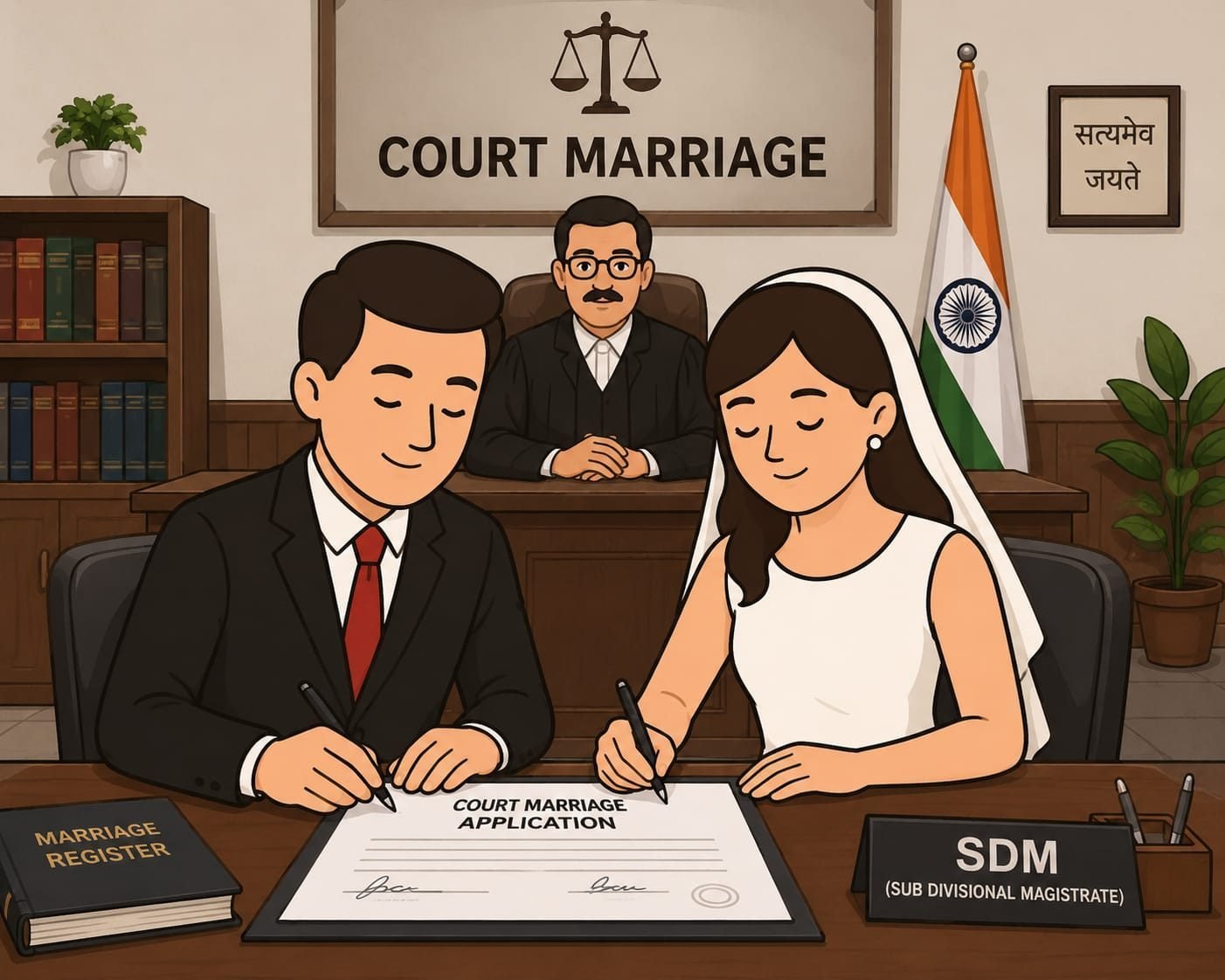
Quick answer: Kanjhawala (pincode 110081) is a cluster of villages in outer north-west Delhi, among them Kanjhawala, Karala, Jaunti, Qutabgarh, Ladpur, Nizampur, Ghevra and Savda, where many families still farm and where the village and the biradari carry real weight. Two Hindus, Sikhs, Jains or Buddhists can marry by Arya Samaj rites or family custom and register the marriage under the Hindu Marriage Act on the e-District portal, for ₹100 or ₹10,000 with Tatkal. Couples of different religions use the Special Marriage Act, which has a 30-day notice. Under Delhi's 2026 revenue map, "Kanjhawala" is no longer a sub-division name. These villages are expected to fall under the North West district (sub-divisions Kirari, Nangloi Jat and Rohini) or, for some villages, the Outer North district (Mundka, Narela and Bawana). The e-District portal allocates the office by exact address. This guide is written especially for couples whose choice is opposed by family, village or khap. The Supreme Court has said plainly that no panchayat can stop two adults from marrying, and the police must protect them.
Key takeaways
- From 1 January 2026, "Kanjhawala" is no longer a sub-division; its villages fall under the North West or Outer North district, and e-District allocates by address.
- No khap, panchayat or family can legally stop two adults from marrying; the Supreme Court said so in Shakti Vahini (2018) and ordered police protection and safe houses.
- The Hindu Marriage Act does not prohibit same-gotra or same-village marriage; only sapinda and prohibited-degree relationships are barred.
- If threatened: call 112 or 181, give a written complaint to the police and DCP, and seek a safe house or High Court protection.
- Agricultural land in Delhi follows the Delhi Land Reforms Act; take advice, but marrying by choice does not reduce a daughter's legal rights.
Last reviewed: 22 September 2026 · 36 min read
On this page
- Kanjhawala at a glance
- Kanjhawala under the 2026 map
- Which office registers your marriage
- Legal routes
- Khap panchayats and the law
- What the Supreme Court ordered in 2018
- A safety plan for threatened couples
- Same gotra, same village: what the law says
- Daughters, marriage and agricultural land
- Village documents and age proof
- Police, army and sports families
- Industrial area workers
- Arya Samaj + registration
- Special Marriage Act
- Inter-caste and inter-religion couples
- Witnesses
- Talking to your family
- After marriage: staying safe
- Traditional village weddings
- Dowry and gifts
- Partners from Haryana
- Young couples: age and patience
- When the village talks
- When brothers or relatives threaten
- Widow remarriage
- If a panchayat meeting is called
- Documents checklist
- What happens at the appointment
- What it costs
- Timeline
- Getting around
- Common mistakes
- Four Kanjhawala situations
- Checklist
- One-minute summary
- How we help
- Questions and answers
Drive west from Rohini past the last sectors and the city thins into fields, farmhouses, chaupals and old village settlements. Kanjhawala and its neighbours are among the last places in Delhi where farming families, village councils and old customs still shape daily life. Many families here have sons in the Delhi Police, the army and the paramilitary forces; many young people train as wrestlers, athletes and boxers; and the Kanjhawala and Bawana industrial areas nearby draw workers from across North India.
Most marriages here are arranged, happy and well supported. But the calls we get from Kanjhawala are sometimes different from anywhere else in Delhi. "We are from the same village. Can we legally marry?" "My family says our gotra is the same, so the panchayat will not allow it." "The boy is from another caste and my brothers have threatened him." "If I marry against my family, will I lose my share of the land?" These are hard questions, and this guide answers them honestly, starting with the law, which is firmly on the side of adult couples.
For the general Delhi process, see our complete Delhi court marriage guide. For village address proof and Haryana-border couples, see our Alipur guide. For your rights when families object, read love marriage legal rights.
Kanjhawala at a Glance
| Point | Detail |
|---|---|
| Pincode | 110081 (Kanjhawala and nearby villages); nearby areas use 110039, 110041 and others |
| Main villages and areas | Kanjhawala, Karala, Jaunti, Qutabgarh, Ladpur, Nizampur, Ghevra, Savda, Tatesar, Jatkhor, Kanjhawala Industrial Area |
| Revenue district from 1 January 2026 | Expected under North West (Kirari, Nangloi Jat, Rohini) or Outer North (Mundka, Narela, Bawana), depending on the village; the portal decides |
| Local body | Municipal Corporation of Delhi; many areas are villages with lal dora abadi land |
| Metro | Nearest stations on the Red Line (Rithala) and Green Line (Mundka and beyond); most people travel by road |
| Typical couples | Farming families, village couples in arranged or love marriages, police, army and sports families, industrial workers |
Kanjhawala Under the 2026 District Map
On 1 January 2026, Delhi's revenue administration moved from 11 districts and 33 sub-divisions to 13 districts and 39 sub-divisions, aligned with municipal zones, under a Revenue Department notification dated 25 December 2025. Kanjhawala was previously a well-known sub-division of the North West district. Under the new map, the North West district's sub-divisions are Kirari, Nangloi Jat and Rohini, and a new Outer North district covers Mundka, Narela and Bawana. Kanjhawala is not a sub-division name any more.
| Before 2026 | From 1 January 2026 |
|---|---|
| Kanjhawala was a sub-division of North West district | North West district: Kirari, Nangloi Jat, Rohini. Outer North district: Mundka, Narela, Bawana |
| 11 districts, 33 sub-divisions | 13 districts, 39 sub-divisions |
| "SDM Kanjhawala" on older pages | The portal allocates by address; follow the appointment slip |
Because the Kanjhawala villages sit where the North West and Outer North districts meet, two neighbouring villages may be allocated to different offices. Enter your exact address on e-District and follow the slip. Certificates issued before 2026 by the old Kanjhawala office remain valid.
Which Office Registers Your Marriage
- Hindu Marriage Act registration: the office allocated on e-District for the Delhi address of either partner, or the place in Delhi where the marriage was performed.
- Special Marriage Act: the Marriage Officer of the district where at least one partner has lived for 30 days before notice.
- Couples who have left the village for safety: you can register where you now live, or where you married, not only in your home village's district. For the Special Marriage Act, the 30-day residence counts where you actually live.
Legal Routes
| Couple | Usual route | Time |
|---|---|---|
| Two Hindus, Sikhs, Jains or Buddhists (any caste, any gotra, same or different village) | Arya Samaj wedding + Hindu Marriage Act registration | Ceremony same day; certificate 1–2 weeks (Tatkal 1–2 working days) |
| Traditional village wedding already held | Register the existing marriage | 1–2 weeks |
| Different religions | Special Marriage Act | About 35–60 days |
| Couple facing threats | Same routes, with a written complaint to police and, if needed, a protection petition | Protection first; marriage on the same routes |
Khap Panchayats and the Law
In many villages of outer Delhi and neighbouring Haryana, khap panchayats and village elders have long settled disputes and set social rules, including rules about who may marry whom. Respect for elders runs deep, and many khap leaders today speak against violence. But on one point the law leaves no room for doubt: no panchayat, khap, biradari or family has any legal power to stop two adults from marrying, to annul their marriage, or to punish them for it.
| What a panchayat may say | What the law says |
|---|---|
| "You cannot marry within the gotra" | The Hindu Marriage Act does not prohibit same-gotra marriage. It prohibits only sapinda relationships and degrees of prohibited relationship, unless a valid custom permits them |
| "You cannot marry within the village" | No law prohibits marriage between two people from the same village |
| "The marriage is cancelled" | Only a court can annul or dissolve a marriage |
| "The family must be boycotted" | Social boycott and threats can be criminal offences |
| "The couple must be separated / returned" | Adults cannot be forced to separate; confining them is a crime |
We say this with respect for village traditions. Families are free to hold their views and to try to persuade their children. What no one may do is threaten, confine, harm or "punish" adults for a lawful choice.
What the Supreme Court Ordered in 2018
On 27 March 2018, in Shakti Vahini v. Union of India, a bench of the Supreme Court led by the then Chief Justice held that khap panchayats have no authority to interfere with the marriage of consenting adults, that the right to choose a life partner is part of liberty and dignity under the Constitution, and that "honour" cannot justify any interference. It gave detailed directions to state governments and the police, including:
- Preventive steps: identifying districts where honour crimes have occurred, appointing senior police officers as nodal officers, and acting promptly when a khap gathering is planned to consider a marriage.
- Protection: registering FIRs against those who threaten couples, providing police protection, and setting up safe houses where threatened couples can stay.
- Remedial and punitive steps: treating any failure by officers to act as deliberate negligence, special cells, 24-hour helplines, and fast-track trials for honour crimes.
In Delhi, these directions are reflected in the district special cells set up by Delhi Police in 2020, the 181 helpline for couples in distress, and the Delhi government's 2021 standard operating procedure on safe houses.
A Safety Plan for Threatened Couples
If your marriage is opposed and you fear for your safety, follow these steps, in this order:
- Immediate danger: call 112. Do not wait.
- Help as a couple: call 181. The Delhi government's procedure uses this helpline for couples in distress, and it can connect you to the special cell and a safe house.
- Written complaint: give a written complaint to the local police station and to the DCP of the district, naming who has threatened you and how. Keep a stamped copy or the diary number.
- Proof of age: carry copies of both partners' Class 10 certificates or birth certificates. The police first check that you are adults.
- A safe place: if you cannot stay at home, ask the special cell about a safe house. Tell only people you trust where you are.
- Protection petition: if the police do not act, a lawyer can file a petition in the Delhi High Court, which regularly directs the police to protect adult couples.
- Marry and register: a registered certificate is the strongest proof that you are lawfully married by choice.
Families sometimes respond by filing a "missing person" or kidnapping complaint against the boy. If both of you are adults and together by choice, the woman can state this to the police or a magistrate, and a protection or habeas corpus petition deals with it. Keep age proof with you. We are not lawyers and do not take such cases, but we can help you get your marriage and documents in order quickly.
Same Gotra, Same Village: What the Law Says
This is the question Kanjhawala couples ask most often. The answer is clear:
- Same gotra: the Hindu Marriage Act does not treat same-gotra marriage as prohibited. Earlier laws that invalidated such marriages were done away with long ago. A same-gotra marriage is valid if the couple is not within the prohibited degrees or sapinda relationship.
- Same village: no law forbids two people from the same village marrying.
- Sapinda and prohibited degrees: these are the real legal limits. Broadly, sapinda relationship extends to three generations on the mother's side and five on the father's side, and prohibited degrees include close relatives such as siblings, uncles, aunts and first cousins, unless a custom governing both parties permits it. If you are unsure whether you are related within these limits, take advice before marrying.
- Customs: village customs that forbid same-gotra or same-village marriages are social rules. They cannot make a lawful marriage invalid.
For more, see our inter-caste marriage guide, which also discusses gotra rules.
Daughters, Marriage and Agricultural Land
In a farming area, the fear of losing land is often behind family opposition to a daughter's choice. The law here is complicated, and it is important to be accurate:
- Agricultural land in Delhi held as bhumidhari land is governed by the Delhi Land Reforms Act, 1954, not only by the Hindu Succession Act.
- Section 50 of the Delhi Land Reforms Act sets out an order of succession that favours male lineal descendants; daughters appear much further down the list. In Har Naraini Devi v. Union of India (September 2022), the Supreme Court upheld Section 50(a) and held that, at least where succession opened before 9 September 2005, the Delhi Land Reforms Act governs rather than the Hindu Succession Act.
- After 2005: the position for successions opening after the 2005 amendment to the Hindu Succession Act has been argued in the courts. If land matters to you, take advice from a lawyer who knows Delhi revenue law.
- Marriage itself does not take away any right a daughter already has. A daughter who marries against her family's wishes has exactly the same legal rights as one who marries with their blessing.
- Non-agricultural property, such as a house in the abadi or money, generally follows the Hindu Succession Act, under which daughters inherit equally.
- A will can leave self-acquired property as the owner wishes.
We cannot advise on land disputes. We mention this because families sometimes threaten a daughter with "losing the land" to stop a marriage, and she deserves to know that her marriage does not change her legal position.
Village Documents and Age Proof
Village families often have fewer formal documents than city families, and older family members may have none. For the couple, what matters is:
| Need | What usually works | If it is missing |
|---|---|---|
| Age proof | Class 10 certificate, birth certificate or passport | Apply for a delayed birth certificate through the municipal birth and death registration office; it takes time, so start early. Aadhaar is not proof of age |
| Identity | Aadhaar, voter ID, passport or driving licence | Almost everyone has Aadhaar; use it |
| Address in the village | Aadhaar or voter ID with the village address; or a family member's electricity bill with a consent letter and affidavit | Lal dora houses often have no registered title; the electricity bill and affidavit usually suffice |
| Address if you have moved away for safety | Rent agreement where you now live, or a letter from the safe house or relative you are staying with, with an affidavit | For the Hindu Marriage Act, marrying in Delhi also allows Delhi registration |
| Documents held by family | Duplicate marksheets and certificates can be obtained from the board or school | Do not delay the marriage for original documents you cannot safely collect; ask us what else will work |
A common problem for couples facing opposition is that the family keeps the girl's Class 10 certificate or Aadhaar card. Duplicates can usually be obtained: an e-Aadhaar can be downloaded, and school boards issue duplicate certificates. Tell us your situation and we will suggest the quickest safe route.
Police, Army and Sports Families
Outer Delhi's villages send many young people into the Delhi Police, the armed forces and paramilitary forces, and into competitive sport. For them, marriage has a service side as well as a civil side:
- Service records: government employees, including police and armed forces personnel, generally have to report their marriage to their department, and are bound by conduct rules that bar bigamy. Submit the registered certificate for service records, nominations and family benefits. Our Delhi Cantt guide covers the armed forces in detail.
- Timing: leave and training camps can be short. Plan the ceremony and the registration together, using Tatkal if needed.
- Athletes: sportspersons with jobs under sports quotas are government or public-sector employees like any other; the same reporting rules apply.
- Love marriage in uniform: a police constable or soldier who marries against family wishes has the same rights as anyone. Threats against a serving officer can also be reported to their own department.
Industrial Area Workers
The Kanjhawala and Bawana industrial areas employ thousands of workers from Bihar, Uttar Pradesh, Uttarakhand and elsewhere, many living in rented rooms in the villages. For them:
- A notarised rent agreement with the landlord's ID and electricity bill, plus an affidavit, usually serves as Delhi address proof. Home-state Aadhaar is valid ID.
- The ceremony can be on the weekly off day; registration needs one working morning.
- After marriage, add your spouse to ESIC for medical cover and update your EPF nomination.
- If both of you are from your home state and families are arranging the wedding there, it may be easier to marry and register at home.
Arya Samaj + Registration
- Document check: send us clear photos of both partners' age proof, ID, address proof and photographs.
- Affidavits: date of birth, marital status, religion and free consent, notarised.
- Ceremony: the Vedic ceremony at the Arya Samaj mandir, with havan, pheras and saptapadi, takes about 90 minutes. Families are welcome; for couples facing opposition, it can be held quietly with just friends.
- Online application: we file the Hindu Marriage Act registration on e-District and book the appointment.
- Appointment: both partners and two witnesses attend with originals.
- Certificate: issued once approved.
Since 2022 courts have said the mandir certificate alone is not conclusive proof of marriage, and in 2024 the Supreme Court held that a certificate without a genuine ceremony is worthless. A real ceremony and government registration together protect you. See our Arya Samaj court marriage guide.
Special Marriage Act
- Residence: one partner has lived in the district for 30 days before notice.
- Notice: filed online and verified at the Marriage Officer's office, where it is displayed.
- 30-day period: for legal objections only; family or caste disapproval is not a legal objection.
- Solemnisation: after 30 days and within three months, before the Marriage Officer and three witnesses.
- Certificate: issued under the Special Marriage Act.
Couples facing serious threats sometimes worry about the notice. If both of you are Hindus, Sikhs, Jains or Buddhists, the Hindu Marriage Act route has no public notice. For inter-religion couples, ask us about current practice at your office and consider seeking police protection before filing. See our inter-religion guide.
Inter-Caste and Inter-Religion Couples
- Inter-caste Hindus: a valid Hindu marriage; caste is not on the certificate. Where one partner belongs to a Scheduled Caste, the Dr. Ambedkar scheme (₹2.5 lakh, subject to conditions) and Delhi's ₹50,000 incentive may apply. Where one partner is from a Scheduled Caste and faces caste-based threats, the Scheduled Castes and Scheduled Tribes (Prevention of Atrocities) Act may also apply.
- Different religions: the Special Marriage Act, without conversion.
- Conversion: must be genuine; many families nearby are in Haryana and Uttar Pradesh, which regulate conversion by law. Read our Shuddhi guide first.
Witnesses
Hindu Marriage Act registration needs two witnesses; the Special Marriage Act needs three. They must be adults with ID and address proof who genuinely know you. For couples whose families oppose the marriage, friends, colleagues or a supportive relative are fine. We do not provide witnesses. See our witness guide.
Talking to Your Family Before You Marry
Not every objection ends in threats. In many Kanjhawala families, the first reaction to a love marriage is anger or fear of what the village will say, and it softens with time. If you feel safe doing so, talking before the wedding can save years of distance. Some approaches that have worked for couples we have helped:
- Start with the person most likely to listen, often a mother, an elder sister, an aunt or a grandparent, rather than the most senior man in the family.
- Bring facts, not arguments. Explain who your partner is, their family, their work, and your plans. Families often fear the unknown more than the person.
- Address the gotra or caste worry calmly. Many elders genuinely believe same-gotra marriage is illegal. It is not, and a calm explanation sometimes helps.
- Give them time, but set a limit for yourself. You do not need their permission, and waiting indefinitely is not a plan.
- Keep yourself safe. If you sense that the conversation could lead to confinement, violence or your documents being taken, do not have it alone. Tell a trusted friend where you are, and have your documents safe with you.
Some couples marry first and talk later, especially where they fear violence. That is also a lawful choice. Many families come round once they see the couple settled and the marriage registered.
After Marriage: Staying Safe and Settled
For couples who married against opposition, the weeks after the wedding can still be tense. Practical steps:
- Keep copies of the marriage certificate, age proof and any police complaint in more than one place, including on your phone and with a trusted friend.
- Update your address in Aadhaar and your bank once you have a stable home, so that you have documents in your own names.
- Open or update bank accounts in your own control. A woman who has left her parental home should have her own account and her own documents.
- Keep the police informed if threats continue. Ongoing threats after marriage are still crimes.
- Build a support network: friends, colleagues, a supportive relative or community group. Isolation makes couples more vulnerable.
- Consider reconciliation carefully. If your family asks you to return "just to talk", make sure it is safe. Meet in a public place or with someone you trust.
Traditional Village Weddings
Most Kanjhawala weddings are not love marriages at all: they are arranged weddings within the biradari, with the barat, the pheras in the courtyard or a banquet hall, and the whole village involved. For these couples, the question is simply registration, which is often forgotten.
- A traditional Hindu village wedding by customary rites is a valid marriage. Registration records it.
- Proof: the wedding card, clear photographs of the pheras and other rites, a letter from the pandit if possible, and two witnesses who attended.
- Deadline: Delhi's 2014 compulsory registration order asks for registration within 60 days of the marriage; later registration is possible with an explanation and any late fee or penalty that applies.
- Why it matters: passports, bank accounts, government jobs, insurance and visas all ask for the certificate. A daughter married into another village may need it to prove her marriage years later.
Our fee for registering an existing marriage is ₹6,000 plus the government fee. See our Defence Colony guide for more on registering after the wedding.
Dowry and Wedding Gifts in Village Weddings
Village weddings often involve large exchanges of gifts, including vehicles, jewellery, furniture and cash. The law is the same as everywhere:
- Giving, taking or demanding dowry is a crime under the Dowry Prohibition Act, 1961, for both families.
- Customary gifts given voluntarily, without demand, and reasonable for the family's means are not dowry. The bride and groom should each keep a signed list of presents, as the 1985 dowry rules suggest.
- Streedhan, the jewellery and gifts given to the bride, belongs to her even if the in-laws keep it.
- Demands for money, a car or land after the wedding, with harassment, can lead to criminal cases for cruelty and dowry.
Partners From Haryana
Kanjhawala borders Haryana's Jhajjar and Sonipat districts, and many marriages cross the border. Briefly:
- You can marry and register in Delhi if one partner lives in Delhi or the marriage takes place in Delhi.
- Haryana has its own registration system; register in one state only.
- Haryana has a law regulating religious conversion. Inter-religion couples should use the Special Marriage Act rather than convert only to marry.
- For more on Haryana-border couples, see our Alipur guide.
Young Couples: Age, Pressure and Patience
In village areas, young people sometimes want to marry very early, often because they fear being separated or married off elsewhere. The law does not bend on age, and it is worth understanding why:
- The groom must be 21 and the bride 18 on the day of the marriage. A marriage below these ages is a child marriage under the Prohibition of Child Marriage Act, 2006, and those who perform, arrange or promote it can be prosecuted.
- If the girl is under 18, anyone who takes her away, even with her agreement, can face serious criminal charges, including under the POCSO Act where applicable. This is one of the most common ways young love turns into a criminal case.
- If the groom is 19 or 20, he must wait until his 21st birthday. No mandir or office can lawfully marry him earlier.
- If you fear being married off to someone else before you are ready, a forced marriage of an adult can be annulled, and forced child marriages can be stopped. Call 112, the women's helpline 181, or the child helpline 1098 if you are under 18.
Our honest advice to couples who are not yet old enough: wait, stay in touch, finish your studies or training, and marry when you both meet the legal age. The law will protect your choice then.
When the Village Talks
Even without threats, village gossip and social pressure can be hard to bear. Families worry about their standing, about the marriages of younger siblings, and about what the chaupal will say. Some things that help couples and families through this period:
- A registered marriage ends the rumours about "running away". It shows the marriage is lawful and serious.
- Time softens most opposition. The birth of a grandchild has reconciled many families we have known.
- Supportive elders matter. A respected elder who speaks up for the couple can change the village conversation.
- Boycott and threats are illegal. Social boycott of a family because of a child's marriage, and threats, can be reported to the police.
When Brothers or Relatives Threaten
In many cases we see, the most serious threats come not from parents but from brothers, cousins or uncles who feel their honour is at stake. The law treats their threats exactly as it treats anyone else's. Name them in your complaint, keep any messages or voice notes, and tell the police if they turn up where you live or work. A written complaint is especially important if the family has influence locally, because it creates a record that officers cannot later ignore.
Widow Remarriage in the Villages
In some village families, a young widow is expected either not to remarry or to marry within the late husband's family. The law gives her full freedom. The Hindu Widows' Remarriage Act of 1856 first recognised widow remarriage, and today a widow can marry anyone she chooses under the Hindu Marriage Act or the Special Marriage Act, with the same rights as any other adult.
- Documents: her late husband's death certificate, plus the usual age, ID and address proof.
- Consent: no one, including her in-laws or parents, can force her to marry or stop her from marrying.
- Property: rights she has already inherited from her late husband under the Hindu Succession Act are generally not lost on remarriage; agricultural land may follow the Delhi Land Reforms Act, which has its own rules. Take advice.
- Children: her children from the first marriage keep their rights to inherit from their father's family.
- Pensions: if she receives a family pension, check the pension's rules on remarriage with the paying authority before marrying.
If a Panchayat Meeting Is Called About You
Sometimes couples learn that elders have called a meeting to "decide" about their relationship. The Supreme Court's 2018 directions specifically cover this: when the police learn that such a gathering is planned to consider a marriage, they are expected to inform the senior officers, prevent any unlawful decision, and protect the couple. If you hear of such a meeting:
- Tell the police in writing immediately, naming the meeting, place and date if you know them.
- Ask for protection if you are in the village.
- Do not attend alone or be pressured into attending.
- Remember that any "decision" of the meeting has no legal force.
Documents Checklist
| Document | Who | Notes for Kanjhawala couples |
|---|---|---|
| Age proof | Both | Class 10 certificate, birth certificate or passport; duplicates can be obtained if family holds the originals |
| Identity proof | Both | Aadhaar (e-Aadhaar download is fine), voter ID, passport |
| Address proof | At least one partner for Delhi | Village Aadhaar or voter ID, family electricity bill with consent letter, or rent agreement where you now live |
| Photographs | Both | Passport-size and ceremony photographs |
| Affidavits | Both | Date of birth, marital status, religion and free consent; notarised |
| Mandir certificate or priest's letter | Couple | For registration of the ceremony |
| Police complaint copy | If threatened | Keep a copy with you; it helps if you need protection later |
| Divorce decree or death certificate | If previously married | Certified copy |
| Witness documents | Witnesses | ID and address proof |
What Happens at the Appointment
- Both partners and the witnesses arrive at the time on the slip, with originals.
- Staff match originals with the scans on the portal.
- The officer confirms your identities and asks each of you whether you are marrying by your own free will. Say so clearly.
- The witnesses confirm they know you.
- The registration is approved and the certificate issued, usually downloadable from the portal.
Keep your answers simple and truthful. The officer is not there to judge your families or your choice, only to confirm that you are both eligible, that you are marrying freely, and that the documents are genuine. If either of you feels pressured, you can say so to the officer privately; that is exactly what the question about free consent is for.
If you are facing threats, tell the police before the appointment and consider asking for protection on the day. Do not share the appointment date and place widely.
After the appointment, download the certificate as soon as it is approved and keep several copies. For couples who married against opposition, a copy with a trusted friend outside the family is sensible.
What It Costs
| Service | Our charge | Government fee |
|---|---|---|
| Arya Samaj marriage + mandir certificate | ₹5,100 | — |
| Registration of an existing marriage | ₹6,000 | ₹100 (Tatkal ₹10,000) |
| Arya Samaj marriage + registration | ₹7,100 | ₹100 (Tatkal ₹10,000) |
| Urgent / Tatkal handling | ₹6,100 | ₹10,000 |
| Inter-religion marriage | ₹10,000 | As applicable |
| Special Marriage Act full process | ₹15,000 | About ₹15 |
Current prices are on our fees page.
Timeline
| Couple | Typical time |
|---|---|
| Two Hindus, documents ready | Ceremony same day; certificate 1–2 weeks, or 1–2 working days with Tatkal |
| Age proof missing or held by family | Add time to obtain duplicates or a birth certificate |
| Different religions | About 35–60 days |
| Couple needing protection first | Protection can be sought immediately; marriage follows |
Getting Around
- Most Kanjhawala villages are reached by road via Kanjhawala Road, Qutabgarh Road or the Rohini sectors; Rithala (Red Line) is the nearest metro for many.
- Your office under the 2026 structure may be in Rohini, Kirari, Nangloi, Mundka or Bawana; check the appointment slip.
- Roads can be slow during harvest and around village fairs; leave early.
Common Mistakes
- Believing a panchayat decision can stop or cancel a lawful marriage.
- Assuming a same-gotra marriage is illegal.
- Waiting for threats to become violence before telling the police.
- Not carrying age proof when approaching the police.
- Sharing the appointment date widely when families are hostile.
- Using Aadhaar as proof of age.
- Stopping at the mandir certificate without registration.
- Government employees not reporting their marriage to their department.
- Believing that marrying by choice takes away a daughter's legal rights.
Four Kanjhawala Situations
The same-gotra couple
Two young people from neighbouring villages learned their gotras were the same, and elders objected. They checked that they were not related within the prohibited degrees, married by Arya Samaj rites with a few friends, registered under the Hindu Marriage Act, and gave a precautionary written complaint to the police beforehand. Over the following year, one family came round.
The couple who needed a safe house
A young woman and her partner from another caste were threatened by her brothers. They called 181, gave a written complaint to the DCP, and were placed in a safe house. With her duplicate Class 10 certificate and e-Aadhaar, they married and registered within two weeks.
The constable's wedding
A Delhi Police constable from a Kanjhawala village married a girl from Karala in a traditional village wedding. They registered the marriage two weeks later and he submitted the certificate to his department for records and nominations.
The factory worker
A worker in the Bawana industrial area from Uttar Pradesh married a Delhi girl by Arya Samaj rites on a Sunday. His village rent agreement supported his address, and he later added his wife to his ESIC records.
Kanjhawala Checklist
- ☐ Groom 21+, bride 18+; neither with a living spouse; not within prohibited degrees
- ☐ Route chosen: Hindu Marriage Act for Hindus of any caste or gotra; Special Marriage Act for different religions
- ☐ Office checked on e-District (North West or Outer North district)
- ☐ Age proof in hand, including duplicates if family holds originals
- ☐ If threatened: 112, 181, written complaint to police and DCP, copy kept
- ☐ Two witnesses (three for the Special Marriage Act) who genuinely know you
- ☐ Registration completed, not just the mandir certificate
- ☐ Government employees: report the marriage to your department
One-Minute Summary
- From 2026, the Kanjhawala villages fall under the North West or Outer North district; the portal allocates by address.
- No khap, panchayat or family can legally stop two adults from marrying (Shakti Vahini, Supreme Court, 2018).
- Same-gotra and same-village marriages are not prohibited by the Hindu Marriage Act; only sapinda and prohibited-degree relationships are.
- If threatened: 112, 181, written complaint, special cell, safe house, High Court.
- Agricultural land succession in Delhi has its own law; take advice, but marrying by choice does not reduce a daughter's rights.
- Always register the marriage.
How We Help
We check your documents on WhatsApp, help you obtain duplicates when family holds your originals, conduct quiet Arya Samaj ceremonies, register marriages under the Hindu Marriage Act, handle Tatkal when time matters, and guide Special Marriage Act marriages. We will tell you honestly what the law says about gotra and village customs. Everything is confidential. We do not provide witnesses, and we do not marry anyone under the legal age.
Love and court marriage help for Kanjhawala couples
Arya Samaj + registration ₹7,100 · Tatkal handling ₹6,100 · Special Marriage Act ₹15,000.
Book Love Marriage Help →Different castes? Inter-caste marriage · Court marriage
Questions and Answers: Court Marriage for Kanjhawala Couples
Sources and Official References
Facts in this guide were checked against the following primary sources. Government procedures and office allocations change, so confirm current details on the official portal before applying.
- Delhi e-District – official online application portal
- Revenue Department, Delhi – notification dated 25 December 2025 creating 39 sub-divisions and 13 areas
- Shakti Vahini v. Union of India, Supreme Court, 27 March 2018 – Indian Kanoon
- Har Naraini Devi v. Union of India, Supreme Court, 20 September 2022 (Delhi Land Reforms Act s.50) – LiveLaw
- Delhi government SOP for protection of inter-faith and inter-caste couples (Scroll, 2021)
- The Hindu Marriage Act, 1955 – India Code
- The Special Marriage Act, 1954 – India Code
This guide is general information, not legal advice for your specific case. Call +91 8376863962 for advice on your situation.
Related Articles
🚌 Arriving at Anand Vihar to Marry
The honest answer to “can we marry today?” — for couples who just got off a bus or train.
Read →🌾 Court Marriage in Alipur
Village address proof, Haryana border.
Read →🏭 Court Marriage in Narela
Outer North guide.
Read →🏙️ Court Marriage in Rohini
North West guide.
Read →🌾 Court Marriage in Najafgarh
Rural South West guide.
Read →🎓 Court Marriage in Civil Lines
Families objecting, 181 help.
Read →🎖️ Court Marriage in Delhi Cantt
Soldiers and service records.
Read →⚖️ Love Marriage Legal Rights
If families oppose.
Read →🤝 Inter-Caste Marriage
Gotra rules and incentives.
Read →🎂 Marriage Age Limit
21 and 18 explained.
Read →🏛️ Court Marriage in Delhi
The complete Delhi guide.
Read →🏠 Shakarpur: Renting as a Couple
Landlords, rent agreements and marriage.
Read →