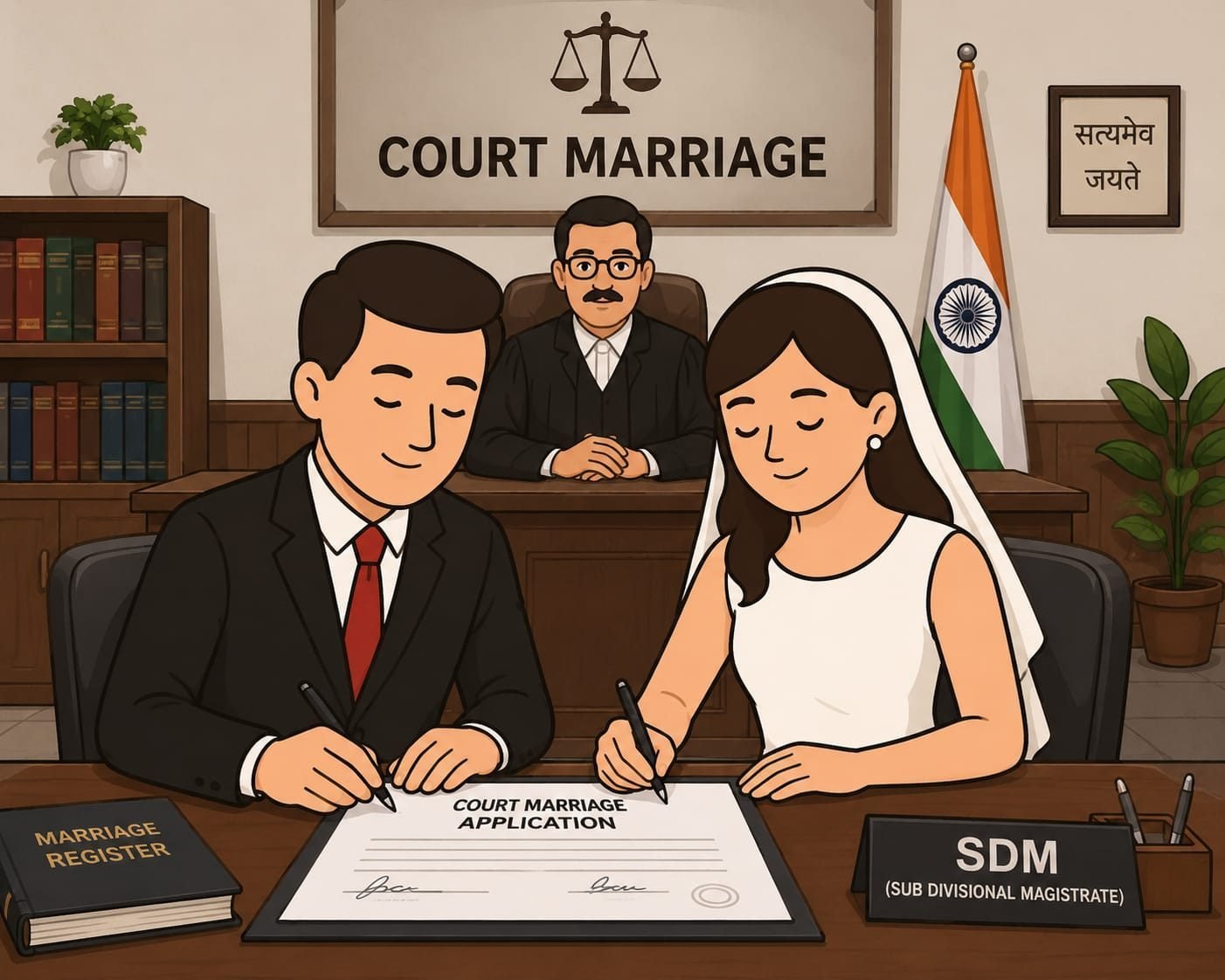
Quick answer: Mehrauli is both one of Delhi's oldest inhabited places and one of its newest wedding destinations: the Qutub Minar and the Archaeological Park on one side, the farmhouse belt of Chhatarpur, Satbari, Ghitorni and Fatehpur Beri on the other, and old urban villages in between. Under Delhi's 2026 revenue map, Mehrauli is one of four sub-divisions of the South district (with Chhatarpur, Malviya Nagar and Deoli). Two Hindus, Sikhs, Jains or Buddhists can have an Arya Samaj wedding and register it under the Hindu Marriage Act; couples of different religions who do not want to convert use the Special Marriage Act, with 30 days' residence and a 30-day notice; Muslim couples register a nikah under the Delhi 2014 Order. Couples married at a Mehrauli or Chhatarpur farmhouse can usually register in Delhi on the place of solemnisation even if they live elsewhere. Same-gotra marriage is not banned by law, though sapinda and prohibited-degree rules apply. Inter-caste and love marriage with Arya Samaj ceremony: ₹5,100.
Key takeaways
- From 1 January 2026 Mehrauli is one of four sub-divisions of the South district, with Chhatarpur now separate; e-District allots the office by address.
- A wedding at a Mehrauli or Chhatarpur farmhouse can usually be registered in Delhi on the place of solemnisation, even if the couple lives outside Delhi.
- Collect the pandit's certificate, clear photographs of the pheras and the invitation on the wedding day itself.
- Same-gotra and same-village marriages are lawful; sapinda and prohibited-degree rules are what make a Hindu marriage void.
- Lal dora property papers are not needed – residence proof is. We never provide witnesses.
Last reviewed: 22 September 2026 · 37 min read
On this page
- Mehrauli at a glance
- Mehrauli under the 2026 map
- Which office registers your marriage
- The legal routes
- Farmhouse weddings: the paperwork
- Couples who live elsewhere
- NRI weddings in the farm belt
- Booking a venue: what to ask
- Heritage venues and permissions
- Season, muhurat and the registrar
- Urban villages and lal dora property
- Tenants and staff living in the belt
- Same gotra, same village: what the law says
- Prohibited degrees and sapinda rules
- If a panchayat or community objects
- Inter-caste couples
- Arya Samaj + registration
- Interfaith couples
- Muslim couples
- Marrying quietly
- Families in two states
- Registering a wedding already held
- For brides: property and protection
- Second marriages
- Age
- Witnesses
- Documents checklist
- At the appointment
- What it costs
- Timeline
- Getting around
- Common mistakes
- After registration
- Five Mehrauli situations
- Checklist
- One-minute summary
- How we help
- Questions and answers
Few parts of Delhi hold as much history in as small a space as Mehrauli. The Qutub Minar and the ruins around it, the stepwells and tombs of the Archaeological Park, the dargah of Qutbuddin Bakhtiyar Kaki, the Jahaz Mahal where the Phool Walon Ki Sair procession still gathers every year with flowers offered at both the dargah and the Yogmaya temple: this is a place where Hindu and Muslim neighbours have shared festivals for centuries.
Just south of it lies a very different Delhi. Along the roads to Chhatarpur, Satbari, Ghitorni, Sultanpur and Fatehpur Beri stand the farmhouses where the city's biggest weddings are held, with lawns, marquees and parking for hundreds of cars. Families fly in from Mumbai, Dubai and Toronto for three days of functions. Between the two lie old villages, Mehrauli, Lado Sarai, Aya Nagar, Chhatarpur village and others, where families have lived for generations on land recorded as lal dora, and where the people who staff the farmhouses, the nurseries and the studios also live, in rooms rented from those same families.
Each of these worlds brings its own marriage questions. A family holding a wedding at a farmhouse wants to know whether the marriage can be registered in Delhi when the couple lives in Gurugram. A village family wants to know whether a same-gotra marriage is legal. A groom whose panchayat has objected wants to know what protection he has. A bride's parents want to know how to keep a record of her jewellery. A couple who married at the dargah's neighbourhood want to register the nikah. This guide answers all of them, with the paperwork to collect on the wedding day, the rules that decide which marriages are valid, and the protection available when a community objects.
For the general Delhi process, see the complete Delhi court marriage guide. Nearby area guides: Saket, Hauz Khas, Kalkaji and Vasant Vihar.
Mehrauli at a Glance
| Item | Detail |
|---|---|
| District (from 1 January 2026) | South |
| Sub-divisions in the district | Mehrauli, Chhatarpur, Malviya Nagar, Deoli |
| Areas | Mehrauli village, Lado Sarai, Chhatarpur, Satbari, Sultanpur, Ghitorni, Aya Nagar, Fatehpur Beri, Qutub Institutional Area, Saket's edge |
| Metro | Yellow Line: Qutub Minar, Chhatarpur, Sultanpur, Ghitorni, Arjan Garh |
| Known for | Heritage monuments, farmhouse wedding venues, nurseries and design studios, urban villages |
| Typical questions | Registering farmhouse weddings, couples living outside Delhi, lal dora address proof, same-gotra and inter-caste marriages, panchayat opposition |
Mehrauli Under the 2026 Revenue Map
From 1 January 2026, Delhi's revenue administration was reorganised into 13 districts and 39 sub-divisions. The South district now has four sub-divisions: Mehrauli, Chhatarpur, Malviya Nagar and Deoli. Mehrauli keeps a sub-division in its own name, and Chhatarpur, which used to be handled along with Mehrauli for many purposes, is now a sub-division too. So a wedding at a Chhatarpur farmhouse and a home in Mehrauli village may point to different offices; the e-District portal decides by address, and your appointment slip names the office. Certificates issued before 2026 remain valid.
Which Office Registers Your Marriage?
Apply on the Delhi e-District portal. For Hindu Marriage Act registration, the registering office can be the one for the place where the marriage was solemnised, or where either spouse resides. That matters here: a couple living in Gurugram or Faridabad who married at a Mehrauli or Chhatarpur farmhouse can often register in Delhi on the place of solemnisation. For the Special Marriage Act, the position is stricter: notice goes to the Marriage Officer of the district where at least one of you has lived for the last 30 days, so a venue in Delhi is not enough by itself.
The Legal Routes
| Your situation | Route | Waiting period | Our fee |
|---|---|---|---|
| Inter-caste or love marriage, both Hindu | Arya Samaj wedding (confidential) + HMA registration | Wedding same day | ₹5,100 wedding; ₹7,100 with registration |
| Wedding held at a farmhouse or banquet, not registered | Hindu Marriage Act registration | By appointment | ₹6,000 |
| Different religions, no conversion | Special Marriage Act | 30 days' residence, then 30-day notice | ₹15,000 |
| Both Muslim | Nikah + registration under the Delhi 2014 Order | Nikah same day; registration by appointment | ₹5,000 nikah; ₹6,000 registration |
| Sikh couple after Anand Karaj | Delhi Anand Marriages Registration Rules, 2018, or HMA | By appointment | ₹6,000 |
| NRI or foreign partner | Usually SMA, or HMA where both are Hindus | Plan around the visit | From ₹15,000; apostille ₹4,500 |
| Court marriage with advocate assistance | SMA or SDM registration with drafting | Depends on route | ₹6,100 |
Government fees are extra at actual cost. Full list: fees.
Farmhouse Weddings: The Paperwork Nobody Plans
A farmhouse wedding in the Mehrauli–Chhatarpur belt is planned to the minute: the mandap, the caterer, the band, the valet parking. The legal paperwork is usually nobody's job, and the family discovers weeks later that no one collected anything the registrar will ask for. Five minutes of planning fixes that.
- Ask the pandit for a signed certificate of the ceremony, with the date, the venue's full address and his own details. If the ceremony is at an Arya Samaj mandir, the mandir certificate does this.
- Get two or three clear photographs of the pheras, not just the stage portraits, and make sure the faces are visible. Ask the photographer for these separately, on the day; the album can take months.
- Keep the printed wedding invitation. It records the date and venue and is routinely accepted as supporting proof.
- Note the venue's exact address as it appears on the booking: farmhouse name, road, village. It goes into the application as the place of solemnisation.
- Decide who your two witnesses will be for the registration appointment, and tell them before they fly home. Relatives who leave the next morning are the most common problem.
- Collect both partners' documents the week before the wedding, not after the honeymoon.
With these in hand, registration is a straightforward application and one appointment. Our fee for registering a marriage already performed is ₹6,000, and we can file within days of the wedding. See our marriage registration service.
Couples Who Live Outside Delhi
Many farmhouse weddings involve couples who live in Gurugram, Noida, Faridabad, Mumbai or abroad, with the venue chosen because the families are in Delhi. Where should such a marriage be registered?
- Hindu Marriage Act: registration can generally be done in Delhi on the basis of the place where the marriage was solemnised, even if neither spouse lives here. Bring the ceremony proof and the venue address.
- Home state: you may instead register where you live, under that state's rules, with the same ceremony proof.
- Register once. A certificate from any state is valid across India; two registrations for one marriage only cause confusion.
- Special Marriage Act: this route needs 30 days' residence in the district before notice, so a Delhi venue alone will not do. Interfaith couples who live elsewhere usually give notice where they live.
Tell us where each of you lives and where the wedding will be held, and we will tell you which route is simplest before the cards are printed.
NRI Weddings in the Farm Belt
A large share of farmhouse weddings involve an NRI bride or groom, home for two or three weeks. The certificate they need for a spouse visa cannot be arranged after they leave, because both spouses must attend the registration appointment.
- Before the flight: send photographs of both partners' documents, including passports and any divorce decree, for checking.
- Wedding: hold it early in the visit rather than in the last week.
- File within days and take the earliest appointment; where there is a genuine visa deadline, ask whether Tatkal is available.
- Attend together with two witnesses who are still in Delhi.
- Apostille or attestation after the certificate: the Ministry of External Affairs apostilles for countries in the Hague Convention, including the UK, the US, Australia and, since 2024, Canada. The UAE has traditionally required embassy attestation. Check the destination's current rules.
See our NRI marriage service and the NRI apostille guide.
Booking a Venue: Questions Worth Asking
Most families choose a farmhouse for the lawn, the parking and the price, and never ask the questions that matter later. Before you sign the booking:
- Is the full address on the booking confirmation? You will need it as the place of solemnisation.
- Will the venue give a letter confirming the date and event if asked? It is rarely needed, but useful when a wedding was years ago.
- Is a pandit included, or do you bring your own? Either is fine; what matters is that he gives a signed certificate afterwards with his details.
- Where will the ceremony itself take place, and can the photographer take clear pictures of the pheras from the front?
- What are the noise and timing rules? Delhi's rules on loudspeakers at night apply in the farm belt as elsewhere, and neighbours in the villages do complain.
- Parking and access: guests' cars on the Mehrauli–Gurgaon road cause the traffic everyone remembers instead of the wedding.
None of this changes the legality of the marriage. A wedding in a small mandir, with ten people, is exactly as valid as a wedding on a four-acre lawn. The difference is only the cost.
Heritage Venues and Permissions
Couples sometimes ask about marrying at one of Mehrauli's monuments: a photograph beside a stepwell, a ceremony in a garden within the Archaeological Park. Protected monuments are governed by the rules of the Archaeological Survey of India and the Delhi authorities, and events, catering and structures inside them require permissions that are rarely granted for private weddings. Photography for personal use is usually allowed where entry is allowed, with ticket rules applying. Never assume access has been arranged because a planner says so; ask for the written permission. The marriage's validity does not depend on the venue, so no couple should risk a dispute with the authorities for a backdrop.
The Season, the Muhurat and the Registrar
From November to February the farm belt has weddings every night, and again around the spring muhurats. That affects your paperwork in two practical ways. First, everyone's pandit, photographer and relatives are busy, so collect the ceremony proof on the day rather than chasing it later. Second, registration appointments in the following weeks are in demand, so file the application within days of the wedding rather than after the honeymoon.
A muhurat is a family's own choice. The law fixes no auspicious dates: an Arya Samaj wedding or a nikah can take place on any day of the year, and registration works on the date the ceremony actually happened. Couples who want to marry legally before the family function later in the season can do so; the first ceremony is the marriage, and the later function is a celebration.
Urban Villages and Lal Dora Property
Mehrauli village, Lado Sarai, Chhatarpur village, Aya Nagar, Fatehpur Beri and Satbari are urban villages: old settlements whose inhabited core was recorded as lal dora land, outside many municipal building rules, with ownership often passing through family partition, general power of attorney and oral arrangement rather than registered sale deeds. Families sometimes fear that without a registry they cannot prove anything.
For marriage registration, this fear is misplaced. The registrar needs proof of residence, not ownership.
- Aadhaar with the current address is the simplest proof.
- Voter ID for the village address.
- Electricity or water bill, even in a father's or grandfather's name, with a ration card, family ID or affidavit showing the relationship.
- Passport or bank statement with the address.
- Tenants: a written rent agreement with police tenant verification.
Write the address exactly as your documents show it, including the village name and khasra or house number, and keep it identical across the application, affidavits and ceremony certificate.
Tenants and Staff Living in the Belt
The farmhouse belt runs on people who live nearby: gardeners, cooks, drivers, security staff, nursery workers, housekeeping teams, and the families who rent rooms in the villages. Many are from Uttar Pradesh, Bihar, Uttarakhand, Jharkhand, West Bengal and Nepal.
- Married at home, living here: a wedding performed in your village with customary rites is valid; you only lack the certificate. Register in Delhi on your Delhi residence, or in your home state. Bring the wedding card, photographs, age proof, ID, address proof and affidavits.
- Address proof: a rent agreement with tenant verification, an employer's letter where accommodation is provided, or an updated Aadhaar.
- Nepali partners: a Nepali citizen is a foreign national for marriage purposes; the Special Marriage Act is usually the route, with passport or citizenship documents. The 1950 India–Nepal treaty governs residence and work, not marriage law.
- Why it matters: a certificate lets you add a spouse to a ration card, ESIC and EPF records, open joint accounts, and claim compensation or benefits if something happens to the earning spouse.
- Timing: we check documents on WhatsApp in the evening and schedule weddings and appointments on your weekly off day.
Same Gotra, Same Village: What the Law Actually Says
In the villages of south Delhi, as in Haryana and western Uttar Pradesh, many families follow customs that forbid marriage within the same gotra, or between families of the same village or neighbouring villages treated as brother-and-sister communities. Couples are often told, firmly, that such a marriage is "illegal". It is not.
- The Hindu Marriage Act does not mention gotra. Its conditions for a valid marriage are about age, mental capacity, an existing spouse, prohibited degrees of relationship and sapinda relationship. Gotra is not among them.
- Same-village or same-khap custom likewise has no place in the Act. A panchayat cannot declare a lawful marriage void.
- The Supreme Court in Lata Singh (2006) held that an adult is free to marry whom she chooses, and directed the police to protect such couples from harassment.
- In Shakti Vahini (2018), the Court held that no khap panchayat, family or community can interfere with the marriage of two consenting adults, and laid down preventive, remedial and punitive measures for the states.
So a same-gotra marriage between two Hindus who are not within prohibited degrees or a sapinda relationship is a valid marriage, can be solemnised at an Arya Samaj mandir, and can be registered under the Hindu Marriage Act like any other.
Prohibited Degrees and Sapinda Relationships
What the Act does regulate is closeness of blood relationship. A Hindu marriage is void if the parties are within the degrees of prohibited relationship or are sapindas of each other, unless a custom governing both of them permits such a marriage.
- Sapinda relationship extends, broadly, three generations upwards through the mother's line and five through the father's, counting from the person. In plain terms, it covers close cousins and similar relations.
- Prohibited degrees include lineal ascendants, a brother's or sister's descendants within limits, and certain relations by marriage, such as a brother's widow or a wife's sister in the lifetime of the wife.
- Custom exception: in some southern communities, marriage between certain cousins is permitted by long-established custom, and such marriages are valid where the custom is proved for both parties.
- Court view: in Neetu Grover v. Union of India (2024), the Delhi High Court upheld the constitutional validity of the prohibition on sapinda marriages.
If you are unsure whether you are related within these rules, write out the family tree before the wedding and take advice. A void marriage creates real problems later, for property, children's status and remarriage. Under the Special Marriage Act, a similar list of prohibited relationships applies to both parties.
If a Panchayat or Community Objects
When an objection comes not just from parents but from a wider group, the situation needs care rather than argument.
- Document your ages and keep originals with you or with a trusted friend.
- Marry and register quickly. A registered marriage is strong proof and changes the conversation.
- Approach the police special cell for couples under threat; Delhi Police has a standing arrangement, and the helpline numbers are 112 for emergencies and 181 for women.
- Consider a protection petition in the Delhi High Court; such petitions are commonly filed and often decided quickly, with directions to the police.
- Do not attend a panchayat meeting called to "settle" the matter if you feel unsafe, and do not sign anything under pressure.
- Keep evidence of threats: messages, call recordings where lawful, and the names of those involved.
We handle such cases confidentially, including the Arya Samaj ceremony with your own witnesses and quick registration. See our love marriage service and the love marriage rights guide.
Inter-Caste Couples
Inter-caste marriages are common here, between village families and the professionals who have moved into the area, between staff from different states, and among students at the institutions of the Qutub Institutional Area. The law is simple: any two Hindus who meet the Act's conditions can marry, whatever their caste. An Arya Samaj wedding is available the same day and is followed by Hindu Marriage Act registration.
Where one spouse belongs to a Scheduled Caste and the other does not, the couple may be eligible under the Dr. Ambedkar Scheme for Social Integration through Inter-Caste Marriages, which offers an incentive of ₹2.5 lakh subject to conditions, including registration of the marriage under the Hindu Marriage Act and it being the first marriage of both. Check the current guidelines of the Dr. Ambedkar Foundation before applying, and keep the registered certificate and caste certificates ready. See our inter-caste marriage service and the legal process guide.
Arya Samaj Wedding + Registration
For two Hindus, including Sikhs, Jains and Buddhists, an Arya Samaj wedding is the quickest lawful ceremony: havan, garlands, pheras and saptapadi, completed in about an hour, with the mandir certificate issued the same day. It is the route most inter-caste and love-marriage couples choose, because it is dignified, quick and needs only the couple and their witnesses.
The mandir certificate is proof of the ceremony but not a government certificate. Register the marriage under the Hindu Marriage Act on e-District for the certificate that banks, passport offices and courts recognise. Our combined package is ₹7,100. The Supreme Court held in Dolly Rani (2024) that a Hindu marriage requires the essential ceremonies, so a certificate without a real ceremony is worthless. See our Arya Samaj marriage page.
Interfaith Couples
Mehrauli's own history is a reminder that people of different faiths have shared this ground for centuries: the Phool Walon Ki Sair, revived after Independence, still sees floral offerings made both at the dargah of Qutbuddin Bakhtiyar Kaki and at the Yogmaya temple in the same procession.
For an interfaith couple today, the law offers a civil route that requires no conversion: the Special Marriage Act, 1954. At least one of you must have lived in the district for 30 days before notice; the notice is displayed for 30 days, during which objections are allowed only on legal grounds; then the marriage is solemnised before the Marriage Officer with three witnesses. Remember the property effect: where a Hindu marries a person of another religion under this Act, section 19 severs the Hindu partner from the undivided family and section 21 applies the Indian Succession Act; where both parties are Hindus, section 21A excludes those effects. In the farm-belt families where land is held jointly, this is worth discussing before you file, and wills are sensible. See our inter-religion marriage service.
Conversion is a personal decision and must be genuine if it happens at all; it never dissolves an existing marriage, as the Supreme Court held in Sarla Mudgal (1995). We do not conduct conversions performed only as a formality to marry.
Muslim Couples
Muslim families around Mehrauli village and the dargah, and workers from other states living in the belt, marry by nikah: two adults free to marry, free consent, mahr, and the proposal and acceptance before witnesses. Our own Qazi reads nikahs with nikahnama and certificate for ₹5,000. Delhi law then requires registration under the Delhi (Compulsory Registration of Marriage) Order, 2014, within 60 days, with a ₹500 fee for the next 60 days and a ₹1,000 penalty after that. Register under that Order rather than the Special Marriage Act, which would move succession to the Indian Succession Act; the Delhi High Court directed online registration of Muslim marriages under the 2014 Order in Faizan Ayubi (2024). See our nikah registration service and the nikah documents guide.
Marrying Quietly in South Delhi
A large share of the couples who call us from this part of the city want the opposite of a farmhouse wedding: a lawful marriage that nobody discusses. They may be from village families where an inter-caste match would be argued over for years, or professionals who simply want their private life private. A quiet marriage is entirely normal and entirely legal.
- The ceremony can be small. An Arya Samaj wedding needs the couple, the priest and two witnesses. It takes about an hour.
- Your witnesses are your choice. Friends, flatmates or colleagues are as good as relatives, provided they know you and bring ID.
- Nobody is informed. The registration process does not notify parents, employers or neighbours under the Hindu Marriage Act route. The Special Marriage Act, by contrast, requires a public notice for 30 days, which is why couples who need privacy and are both Hindus usually prefer the Arya Samaj route.
- Keep your own copies of every document, including in your email, rather than in a family cupboard.
- Tell people in your own time. Many couples marry quietly, then tell their families weeks or months later, once the legal position is secure.
- We keep your case confidential and do not call your family or employer.
If there is any risk to your safety, say so on the first call. We will plan the day, the witnesses and the registration timing around that, and explain how police protection and a High Court petition work.
When the Two Families Are in Different States
Couples here often come from two different states, meeting in Delhi at work or at college. Families who have never met each other, and who hear the news by telephone, tend to react more sharply than families who live nearby. Practical steps that help:
- Documents first. Get both partners' age proofs and IDs in order before any announcement, so a family cannot delay the marriage by holding papers.
- One address for the paperwork. Use whichever partner has the stronger Delhi proof; the other partner's home-state address does not prevent registration.
- Ceremony in Delhi, celebrations later. Many couples marry in Delhi with two friends as witnesses and hold functions in each home state afterwards.
- Language and customs. The law does not require any particular rites, only the customary rites of either party. Families can each perform their own later.
- Register once. Do not register in Delhi and again in a home state.
Registering a Wedding Already Held
Whether the wedding was at a farmhouse last month or in a village courtyard twenty years ago, an unregistered Hindu marriage can be registered with proof:
- wedding card, photographs or video of the ceremony;
- a certificate from the pandit, mandir, gurdwara or Qazi, where available;
- age proof, ID and address proof for both spouses;
- affidavits with the date and place of the wedding and marital status;
- two witnesses who attended or have known you as a married couple;
- for long marriages, children's birth certificates or passports naming both parents.
Our fee is ₹6,000. For a nikah, late registration under the 2014 Order attracts the delay fee or penalty.
For Brides: Property and Protection
In families that own farm land or village property, a bride's position is worth stating plainly:
- Stridhan: jewellery, cash and gifts given to her before, at or after the wedding are her absolute property. The Supreme Court held in Pratibha Rani (1985) that the husband and in-laws hold them only in trust. Keep bills and a signed list, and let her hold her own copies.
- Daughters inherit: since Vineeta Sharma (2020), daughters are coparceners by birth in Hindu joint family property, equally with sons.
- Agricultural land in Delhi: succession to agricultural land has its own history under the Delhi Land Reforms Act, and the Supreme Court considered its male-preference rule in Har Naraini Devi (2022) for successions before September 2005. Families holding such land should take specific advice rather than rely on what the village says.
- Protection: the Protection of Women from Domestic Violence Act, 2005 gives every woman rights to residence, protection and monetary relief; dowry demands are an offence under the Dowry Prohibition Act, 1961.
A registered marriage is what makes these rights easy to enforce.
Second Marriages
A divorced or widowed person can remarry once the earlier marriage has legally ended. A Hindu, Sikh, Jain or Buddhist needs a certified copy of the final decree of divorce; a panchayat or stamp-paper "divorce" does not end a Hindu marriage, except where a recognised custom of divorce applies and is proved, which is rare and must be established. A Muslim needs the talaqnama, khulanama, mubarat deed or court decree, and a woman must have completed her iddat. A marriage under the Special Marriage Act or the Indian Christian Marriage Act ends only by a court decree. A widowed person brings the former spouse's death certificate.
Marrying while an earlier marriage subsists is bigamy for those whose personal law requires monogamy, and the second marriage is void; conversion does not change that, as the Supreme Court held in Sarla Mudgal (1995). Where land or a business is involved, and where there are children from the first marriage, settle guardianship, nominations and a will at the same time as the wedding.
Age
The groom must be at least 21 and the bride 18 on the wedding day, shown by a Class 10 certificate, birth certificate or passport; Aadhaar is identity proof, not reliable age proof. We never conduct a marriage where either party is under age, whatever a family or panchayat says. See the marriage age guide.
Witnesses
Two witnesses for Hindu Marriage Act registration, three for the Special Marriage Act, and for a nikah as the school followed requires. They bring photo ID and address proof and must actually know you: friends, colleagues, neighbours or relatives.
We do not provide witnesses. A person who does not know you is not a real witness. Bring your own. See the witness requirements guide.
Documents Checklist
| Document | Who | Notes |
|---|---|---|
| Age proof | Both | Class 10 certificate, birth certificate or passport |
| Photo ID | Both | Aadhaar, voter ID, passport, driving licence or PAN |
| Address proof | At least one, or the Delhi venue for HMA registration on place of solemnisation | Aadhaar, voter ID, bill with relationship proof, rent agreement with tenant verification |
| Photographs | Both | Passport size, plus clear photographs of the ceremony |
| Ceremony proof | For registration | Pandit's or mandir certificate, nikahnama, gurdwara certificate, wedding card, venue address |
| Affidavits | Both | Age, marital status, nationality; one-and-same-person where names differ |
| Divorce decree or death certificate | If married before | Certified copy; for Muslims, talaqnama or decree and iddat completed |
| Passport, visa, no-impediment certificate | NRI or foreign partner | Translated where needed |
| Witnesses' ID and address proof | Each witness | Two for HMA, three for SMA |
Full list: documents required for court marriage in Delhi.
At the Appointment
Both spouses and the witnesses attend the office named on the slip, with all originals. The officer compares the originals with the uploads, confirms identity, and asks simple questions: when and where you married, who performed the ceremony, whether either was married before, and whether you married of your own will. Witnesses say how they know you. If everything is in order, you sign the register and the certificate is issued, often digitally, the same day or within a few days. If one more document is asked for, that is a correction, not a refusal.
What It Costs
| Service | Our fee |
|---|---|
| Love / inter-caste marriage (same-day Arya Samaj ceremony) | ₹5,100 |
| Arya Samaj + registration combined | ₹7,100 |
| Registration of an existing marriage | ₹6,000 |
| Court marriage (advocate assisted) | ₹6,100 |
| Inter-religion marriage | ₹10,000 |
| Special Marriage Act, full process | ₹15,000 |
| Muslim nikah / nikah registration | ₹5,000 / ₹6,000 |
| NRI registration with apostille and embassy | ₹30,000 |
Government fees, e-stamp and notary charges at actual cost; Tatkal, where available, adds ₹10,000. Full list: fees.
Timeline
| Route | Typical time |
|---|---|
| Arya Samaj wedding or nikah | Same day once documents are ready |
| Registration after a farmhouse wedding | File within days; appointment as allotted |
| Special Marriage Act | 30 days' residence, 30 days' notice, then solemnisation |
| Apostille for NRI couples | Several working days after the certificate |
Getting Around
The Yellow Line runs down the spine of this area: Qutub Minar, Chhatarpur, Sultanpur, Ghitorni and Arjan Garh, with the Gurugram border a few stations further. Most farmhouses are a short auto ride from Chhatarpur or Sultanpur. Traffic on the Mehrauli–Gurgaon road and around Andheria Mor is heavy in the evenings and on wedding nights, so keep appointments in the morning and tell your witnesses to travel by metro. We can arrange pickup and drop within Delhi NCR for ₹1,500.
Common Mistakes
- No ceremony proof from a farmhouse wedding: no pandit's certificate, no clear photographs of the pheras.
- Witnesses who fly home before the registration appointment.
- Assuming a Delhi venue is enough for the Special Marriage Act; that route needs 30 days' residence.
- Registering in two states for one marriage.
- Believing a same-gotra marriage is illegal, or that a panchayat can void a marriage.
- Ignoring sapinda and prohibited-degree rules, which do make a marriage void.
- Thinking lal dora property papers are needed for registration; residence proof is what is asked for.
- Aadhaar as the only age proof.
- Agents who promise registration without appearance or offer witnesses.
After Registration
- Update Aadhaar, bank nominations, insurance, EPF or ESIC, and passport.
- Keep digital copies of the certificate, ceremony certificate and photographs.
- Inter-caste couples: check eligibility and time limits for the Dr. Ambedkar scheme.
- NRI couples: apostille or attestation, then the visa application.
- Families with land: consider wills, and take advice where agricultural land is involved.
- Brides: keep bills and the list of jewellery and gifts, and your own copies of every document.
Five Mehrauli Situations
The farmhouse wedding with no papers
A family held a 400-guest wedding at a Chhatarpur farmhouse. Three weeks later, applying for the bride's passport, they found they had no ceremony proof except album proofs still with the photographer. We used the printed invitation, two phone photographs of the pheras taken by a cousin, and a certificate obtained from the pandit who had performed the ceremony. The registration went through at the first appointment.
The same-gotra couple from Fatehpur Beri
Two adults from neighbouring villages, of the same gotra, were told by elders that their marriage would not be legal. It was: gotra is not a condition under the Hindu Marriage Act, and they were not sapindas. They married at an Arya Samaj mandir with two friends as witnesses and registered the marriage within the month. When pressure continued, they filed a protection petition in the High Court.
The gardener and the cook
A couple working at a Satbari farmhouse had married in their village in Jharkhand six years earlier. The employer's insurance scheme needed proof of marriage. With the wedding card, photographs, their rent agreement and an employer's letter, they registered the marriage in Delhi on their Delhi residence.
The NRI groom and the two-week visit
A groom flying in from Toronto for sixteen days married at a Ghitorni farmhouse on day four. We filed for registration on day six and the couple attended the appointment on day eleven, with his cousins as witnesses. The certificate was apostilled before the spousal sponsorship was filed.
The interfaith couple and the family land
A Hindu man from a Mehrauli village family and a Muslim woman from Delhi chose the Special Marriage Act. Because his family holds ancestral land, we explained section 19 before they filed. The family took advice, recorded the arrangement properly, and both spouses made wills after the marriage.
Checklist
- ☐ Ceremony proof arranged before the wedding day: pandit's certificate, photographs of the pheras, invitation
- ☐ Venue's exact address noted for the application
- ☐ Two witnesses who will still be in Delhi for the appointment
- ☐ Age proof for both: Class 10, birth certificate or passport
- ☐ Address proof, or the Delhi venue for registration on place of solemnisation
- ☐ Family tree checked for prohibited degrees and sapinda relationship
- ☐ Affidavits prepared from your documents
- ☐ NRI: wedding early in the visit; both present at the appointment; apostille planned
- ☐ Register once, in Delhi or your home state
- ☐ After the certificate: records, nominations, wills, jewellery list
One-Minute Summary
- Mehrauli is one of four sub-divisions of the South district from 1 January 2026; Chhatarpur is now a separate sub-division.
- A wedding at a Mehrauli or Chhatarpur farmhouse can usually be registered in Delhi on the place of solemnisation, even if the couple lives outside Delhi.
- Collect the pandit's certificate, photographs of the pheras and the invitation on the wedding day itself.
- Same-gotra and same-village marriages are lawful; sapinda and prohibited-degree rules are what make a marriage void.
- No panchayat can void a marriage; protection is available from the police and the High Court.
- Lal dora property papers are not needed: residence proof is what the registrar asks for.
- We never provide witnesses and never marry anyone under age.
How We Help
We check documents on WhatsApp, tell you before the wedding what to collect on the day, conduct Arya Samaj ceremonies and nikahs with our own pandit and Qazi, register marriages performed at farmhouses and banquet venues, file Special Marriage Act notices, and plan apostille for NRI couples. Love-marriage and inter-caste cases are handled confidentially, with your own witnesses. We do not provide witnesses, and we never conduct a marriage where a party is under age.
Inter-caste and love marriage for Mehrauli couples – ₹5,100
Confidential same-day Arya Samaj ceremony and certificate · with SDM registration ₹7,100 · registration of a farmhouse wedding ₹6,000.
Book Inter-Caste Marriage – ₹5,100 →Also: Marriage registration · Love marriage · NRI marriage
Questions and Answers: Court Marriage for Mehrauli Couples
Sources and Official References
Facts in this guide were checked against the following primary sources. Government procedures and office allocations change, so confirm current details on the official portal before applying.
- Delhi e-District – official online application portal
- Revenue Department, Delhi – notification dated 25 December 2025 creating 39 sub-divisions and 13 areas
- The Hindu Marriage Act, 1955 – India Code
- The Special Marriage Act, 1954 – India Code
- Neetu Grover v. Union of India – Delhi High Court upholds the prohibition on sapinda marriages (January 2024) – LiveLaw
- Lata Singh v. State of U.P., Supreme Court, 2006 – Indian Kanoon
- Shakti Vahini v. Union of India, Supreme Court, 2018 – Indian Kanoon
- The Delhi (Compulsory Registration of Marriage) Order, 2014 – Revenue Department, Delhi
- Delhi High Court directs online registration of Muslim marriages (Faizan Ayubi, November 2024) – LiveLaw
- Dr. Ambedkar Scheme for Social Integration through Inter-Caste Marriages – Dr. Ambedkar Foundation
- Hague Apostille Convention – status table – HCCH
- Sarla Mudgal v. Union of India, Supreme Court, 1995 – Indian Kanoon
This guide is general information, not legal advice for your specific case. Call +91 8376863962 for advice on your situation.
Related Articles
🏡 Court Marriage in Punjabi Bagh
Property, prenups and the bride’s stridhan.
Read →🌾 Court Marriage in Najafgarh
Delhi or Haryana, gotra, khaps, village land.
Read →✈️ Court Marriage in Model Town
Spouse visas, apostille, student couples.
Read →🏙️ Court Marriage in Saket
South Delhi guide.
Read →🌳 Court Marriage in Hauz Khas
Nearby South Delhi area.
Read →🛕 Court Marriage in Kalkaji
South East district guide.
Read →🌿 Court Marriage in Vasant Vihar
South West Delhi guide.
Read →🤝 Inter-Caste Marriage
Legal process and protection.
Read →❤️ Love Marriage Rights
If families oppose.
Read →✈️ NRI Marriage & Apostille
Visa-ready certificate.
Read →📅 Marriage Age Limit
21 and 18 explained.
Read →👥 Witness Requirements
Who can be a witness.
Read →🏛️ Court Marriage in Delhi
The complete Delhi guide.
Read →