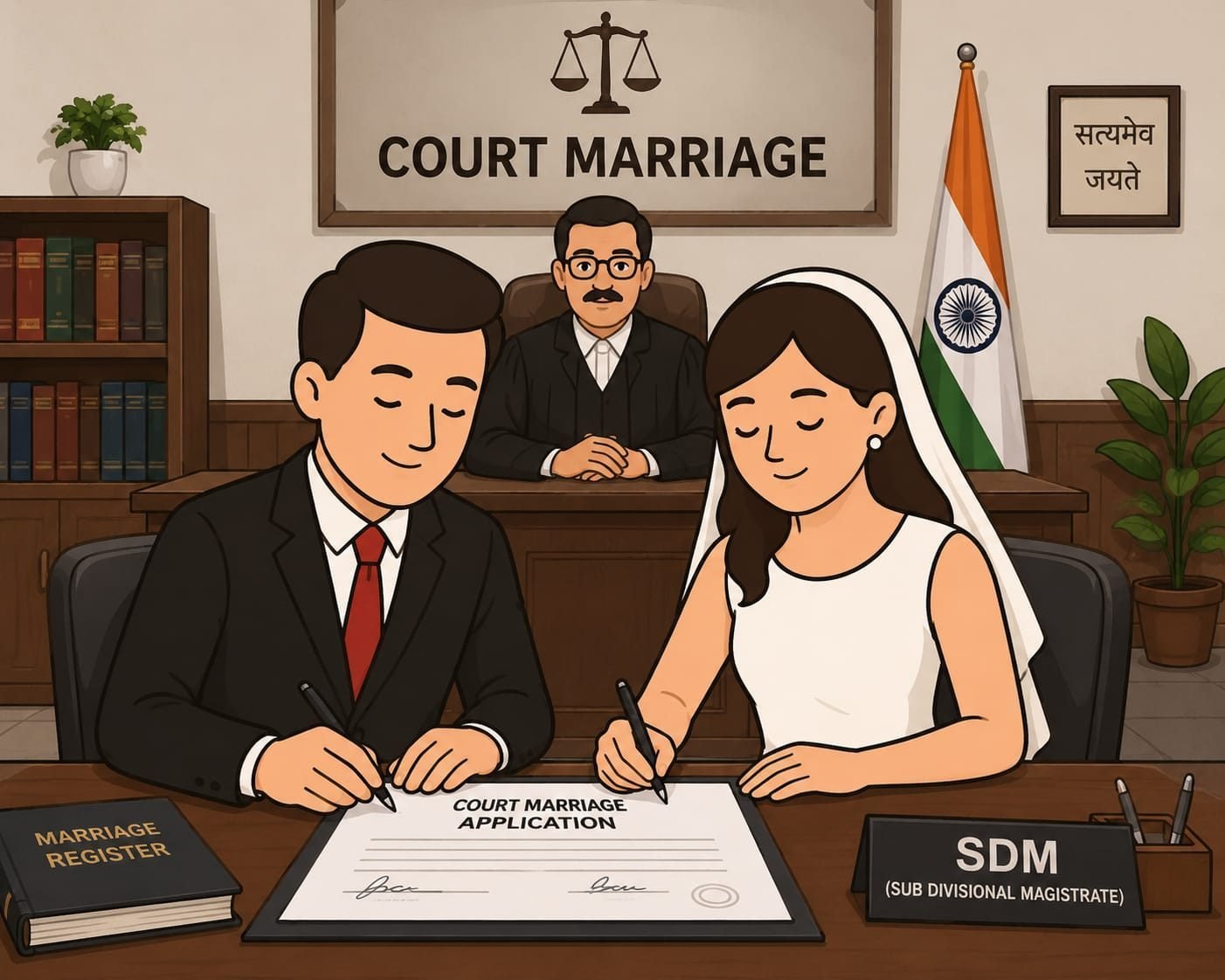
Quick answer: Patel Nagar, with East, West and South Patel Nagar, Ranjeet Nagar, Prem Nagar, Baljit Nagar, Shadipur and the small industrial units along the Rohtak Road side, is a colony built for salaried Delhi: government quarters, railway staff, bank and PSU employees, teachers, and the families who came after 1947 and stayed. Under Delhi's 2026 revenue map, Patel Nagar is one of the two sub-divisions of the Central district (the other is Karol Bagh). Two Hindus, Sikhs, Jains or Buddhists can have an Arya Samaj wedding and register it under the Hindu Marriage Act; interfaith couples who do not want to convert use the Special Marriage Act. For a government or PSU employee the certificate does real work: the service book entry, CGHS and medical cards, family pension records, group insurance and LTC all rest on it, and the conduct rules have their own requirements about marriage. Marriage certificate, duplicates and corrections: ₹2,500.
Key takeaways
- From 1 January 2026 Patel Nagar is one of two sub-divisions of the Central district, with Karol Bagh.
- For a government, railway, PSU or bank household the certificate drives the service book, CGHS card, family pension, insurance and LTC records.
- Intimate the marriage to your office within weeks, and check every spelling and date of birth before they are copied into your records.
- Conduct rules bar a second marriage during the first and regulate marrying a foreign national; an ordinary first marriage needs no permission.
- Government quarters are valid address proof with Aadhaar, an allotment letter or an office certificate. We never provide witnesses.
Last reviewed: 22 September 2026 · 37 min read
On this page
- Patel Nagar at a glance
- Patel Nagar under the 2026 map
- Which office registers your marriage
- The legal routes
- Government and PSU employees: what changes
- Service book and family details
- CGHS and medical cards
- Family pension and group insurance
- Conduct rules: second marriages and foreign spouses
- Living in government quarters: address proof
- Railway families and transfers
- When both of you are in service
- Leave, ceremony and office timing
- Children, schools and records
- Pensioners marrying again
- Working women: leave and rights
- Bank, PSU and school staff
- A one-month plan
- Arya Samaj + registration
- Registering a wedding already held
- Special Marriage Act
- Copies, corrections and duplicates
- Name changes and gazette notifications
- When there is a real deadline
- Inter-caste and interfaith couples
- Muslim couples
- When the office asks for the wrong thing
- Tenants, PGs and small units
- If your families oppose
- Age
- Witnesses
- Documents checklist
- At the appointment
- What it costs
- Timeline
- Getting around
- Common mistakes
- After registration
- Five Patel Nagar situations
- Checklist
- One-minute summary
- How we help
- Questions and answers
Patel Nagar was built to house people with jobs: neat blocks of quarters and flats, a market in each part, schools and dispensaries within walking distance. Three generations of central government staff, railway employees, bank officers, teachers and small manufacturers have lived here, and much of the colony still runs on that rhythm, the morning rush to offices in central Delhi and the evening walk in the park. Around it are older settlements, Baljit Nagar, Prem Nagar and Shadipur, and workshops and units along the Rohtak Road side where a different Delhi works.
Marriages here bring a particular set of questions, because for a salaried employee a marriage is not only a family event; it is a change that has to be recorded. A clerk in a ministry wants to know what to give the office. A railway employee wants the spouse's pass and medical card. A widow of a pensioner wants to know what a second marriage would mean for her pension. A young officer wants to marry a foreign national and has heard that permission is needed. A couple in a rented flat want to know whether a landlord's electricity bill will do as address proof.
This guide answers those, along with the ordinary questions every couple has about routes, documents, timing and cost.
For the general Delhi process, see the complete Delhi court marriage guide. Nearby area guides: Karol Bagh, Rajouri Garden, Punjabi Bagh and Hari Nagar.
Patel Nagar at a Glance
| Item | Detail |
|---|---|
| District (from 1 January 2026) | Central |
| Sub-divisions in the district | Patel Nagar and Karol Bagh |
| Areas | East, West and South Patel Nagar, Ranjeet Nagar, Prem Nagar, Baljit Nagar, Shadipur, Raja Garden's edge, government and railway colonies |
| Metro | Blue Line: Patel Nagar, Shadipur, Rajendra Place and Karol Bagh |
| Known for | Government and railway quarters, salaried households, schools and coaching, small industrial units |
| Typical questions | Service book and family details, CGHS cards, family pension, conduct rules, quarters as address proof, duplicate certificates |
Patel Nagar Under the 2026 Revenue Map
From 1 January 2026, Delhi's revenue administration was reorganised into 13 districts and 39 sub-divisions. The new Central district has two sub-divisions: Patel Nagar and Karol Bagh. Patel Nagar keeps a sub-division in its own name; addresses in the Patel Nagar blocks, Ranjeet Nagar, Prem Nagar, Baljit Nagar and Shadipur are likely to fall under it, while addresses closer to Karol Bagh and Rajinder Nagar may be allotted to the Karol Bagh sub-division depending on the boundary. The e-District portal decides by address, and the appointment slip names the office. Certificates issued before 2026 remain fully valid.
Which Office Registers Your Marriage?
Applications are filed on the Delhi e-District portal. For Hindu Marriage Act registration, the office can be the one for the place where the marriage was solemnised or where either spouse lives; for the Special Marriage Act, notice goes to the Marriage Officer of the district where at least one of you has lived for the past 30 days. Government quarters count as your residence in the ordinary way; what matters is the documents that show you live there.
The Legal Routes
| Your situation | Route | Waiting period | Our fee |
|---|---|---|---|
| Both Hindu, Sikh, Jain or Buddhist | Arya Samaj wedding + Hindu Marriage Act registration | Wedding same day | ₹5,100; ₹7,100 with registration |
| Wedding already held, not registered | Hindu Marriage Act registration | By appointment | ₹6,000 |
| Different religions, no conversion | Special Marriage Act | 30 days' residence, then 30-day notice | ₹15,000 |
| Certificate lost, or wrong spelling or date | Duplicate or correction from the issuing office | Days to weeks | ₹2,500 |
| Certificate needed abroad | MEA apostille or embassy attestation | Several working days | ₹4,500 / ₹3,500–₹7,000 |
| Both Muslim | Nikah + registration under the Delhi 2014 Order | Nikah same day | ₹5,000 / ₹6,000 |
| Sikh couple after Anand Karaj | Delhi Anand Marriages Registration Rules, 2018, or HMA | By appointment | ₹6,000 |
Government fees are extra at actual cost. Full list: fees.
Government and PSU Employees: What Changes After Marriage
For a salaried employee, particularly in government, a marriage sets off a short list of records that need updating. None of it is difficult; all of it is forgotten until the day it matters.
| Record | What to do | Why it matters |
|---|---|---|
| Service book | Intimate the marriage to your office; the spouse's name and date of birth are entered | Everything else flows from this entry |
| Family details form | Submit the revised family details to the office | Pension and benefits are paid on this record |
| CGHS or departmental medical card | Add the spouse as a family member | Treatment and reimbursement |
| Group insurance and gratuity nomination | File fresh nominations | Old nominations may no longer hold good after marriage |
| Provident fund nomination | File a fresh nomination naming the spouse | A nomination made before you had a family lapses on marriage |
| LTC and travel entitlements | Spouse added to the family record | Claims are rejected when the record is silent |
| Housing and HRA | Inform the allotting authority where rules require it | Entitlement and allotment questions |
| Bank, PAN and Aadhaar | Nominations and, if the surname changes, records | Consistency across documents |
The marriage certificate is the document every one of these offices asks to see. Register the marriage first, then do the list in one week.
Service Book and Family Details
A government servant's service book is the master record of a career: appointment, postings, increments, leave and family. After marriage:
- Submit a written intimation of the marriage to your office, with a copy of the certificate.
- Check that the spouse's name and date of birth are entered exactly as in her or his own documents. A wrong date entered in the service book follows the family into pension records decades later.
- Submit a revised statement of family details, since the form filled at joining will usually name parents only.
- Ask for a copy of the updated page or an acknowledgement, and keep it with the certificate.
- Repeat the same updates for any departmental welfare fund, canteen card or quarters record.
Employees in PSUs, banks, universities and autonomous bodies have equivalent records. The principle is identical: the employer's file should show your spouse, correctly spelt, within weeks of the wedding.
CGHS and Medical Cards
Central government employees and pensioners in Delhi are typically covered by CGHS, and the family members entitled to treatment are those recorded on the card. After marriage, apply through your office to add your spouse as a family member, with the marriage certificate and the usual particulars; the card is then reissued or updated.
- Do it early. The day a spouse needs a hospital is the wrong day to discover the card was never updated.
- Check the spelling of the name and the date of birth on the card, and keep a photograph of it on both spouses' phones.
- State employees, railway staff, defence civilians, PSU and bank employees each have their own medical schemes and their own forms; the marriage certificate is the common requirement.
- After retirement, the pensioner's card includes the spouse; that entitlement rests on the same records.
Family Pension and Group Insurance
Family pension is the reason most government households eventually need a marriage certificate, and it is also where missing paperwork causes the longest delays.
- The spouse is the first claimant for family pension under the central rules, followed by children and, in some circumstances, other family members. The entitlement is worked out from the family details recorded during service and carried into the pension payment order.
- The PPO matters. When a pensioner's payment order is issued, check that the spouse's name and date of birth appear correctly; a correction made while the pensioner is alive is a small matter, and afterwards it is not.
- A marriage after retirement should be intimated to the pension disbursing authority so the record can be updated; rules provide for this, and the certificate is what is asked for.
- Group insurance and any departmental welfare fund pay to the nominee. Nominations made before marriage should be replaced.
- Keep copies with the spouse, not only in the employee's file at home. The person who will need them is the one who should hold them.
Rules change from time to time and differ between central, state, railway and PSU service. Ask your own office for the current forms; what does not change is that the marriage must be on record and the names must match.
Conduct Rules: Second Marriages and Foreign Spouses
Government service brings two specific rules about marriage that employees in this colony ask us about regularly. We are not your department, and you should check the rules that apply to your own service, but in outline:
- A second marriage during the subsistence of the first is barred. Central conduct rules prohibit a government servant from marrying a person who already has a living spouse, and from marrying again while having a living spouse, except with the government's permission where personal law allows it. Breach is a disciplinary matter as well as, in most cases, an offence under the general law.
- Marrying a foreign national is regulated: service rules commonly require the employee to intimate the government, and in several services to obtain prior permission. If you are in a sensitive or uniformed post, treat prior permission as necessary and ask your department first.
- Intimation of marriage is in any case good practice, since the entitlement records depend on it.
- Dowry: conduct rules also bar government servants from giving, taking or demanding dowry; this is in addition to the Dowry Prohibition Act, 1961.
What the conduct rules do not do is require permission for an ordinary first marriage between two adults, whatever their caste or religion. Nobody's office can refuse a marriage; the office only records it.
Living in Government Quarters: Address Proof
Couples living in allotted quarters sometimes worry that they have no "own" address proof, because the flat is in the employee's name and the bills are institutional. In practice:
- Aadhaar with the quarters address is the simplest proof, and can be updated using the allotment letter.
- The allotment letter or licence-fee record supports the file, and a certificate from the office or estate section confirming residence is often accepted.
- Voter ID, bank statement or passport with the quarters address works.
- Where the spouse has just moved in, use the employee's proof; only one spouse's Delhi address is needed for registration.
- Write the address exactly as in the allotment: type of quarter, block, street and colony, consistently across the application and affidavits.
The same approach works for railway quarters, defence civilian accommodation, university and hospital housing, and hostels of central institutions.
Railway Families and Transfers
Railway households are a large part of this belt, and railway service has its own arrangements that a marriage touches:
- Passes and PTOs: the spouse is added to the family record for travel entitlements once the marriage is intimated.
- Railway medical card: the spouse is added as a family member.
- Transfers and spouse posting: where both spouses are in government service, requests for posting at the same station are considered under the applicable instructions, and a registered marriage is the starting document.
- Quarters: entitlement and retention on transfer follow the department's rules; the marriage record matters for family entitlement.
- Timing: if a transfer is due, register the marriage before you move; both spouses must attend the appointment in Delhi.
The same applies to defence civilians, postal staff, police and teachers: intimate, record, and keep copies.
Pensioners Marrying Again
Second marriages later in life are not unusual, and older residents ask two questions. First, can a pensioner marry again? Yes, once any earlier marriage has ended by death or a court decree; the age of the parties is no bar. Second, what happens to a family pension?
- A widow or widower receiving family pension should inform the pension disbursing authority of a remarriage; the rules deal with remarriage, and they include specific provisions for a childless widow, so ask for the current position rather than relying on what a neighbour says.
- A pensioner who marries after retirement should have the new spouse recorded, so that the entitlement is not disputed later.
- Children from the earlier marriage keep the rights they have; a will avoids disputes about property.
- Bring the death certificate or divorce decree of the earlier marriage to the wedding and the registration.
We register such marriages regularly, and the documents are no more complicated than for a first marriage.
When Both of You Are in Service
In this colony it is common for both spouses to be employed, often both in government or public sector jobs. That brings a few extra items, all of them easy if done early.
- Each office needs its own intimation. Both service books should record the marriage; do not assume one office tells the other.
- Medical cover: where both are entitled to CGHS or a departmental scheme, families usually choose one card for dependants, to avoid duplicate claims. Ask both offices how they want it recorded.
- Posting at the same station is considered under the instructions applicable to each service; apply with the certificate rather than on the basis of an application saying you are engaged.
- Nominations should be filed separately in both employments, and both should name the spouse where that is intended.
- Leave: plan the appointment on a day both can attend; witnesses too.
- House allotment: where both are entitled to accommodation, rules usually deal with what happens on marriage; ask the estate section before making any commitment about retaining two quarters.
Leave, Ceremony and Office Timing
A salaried couple can complete everything with very little leave if the order is right:
- Evening before: documents photographed and checked on WhatsApp; we tell you what is missing.
- A morning: affidavits sworn and, if you are marrying now, the Arya Samaj ceremony, which takes about an hour.
- Same day: the application filed online; no visit needed.
- One half-day: the registration appointment, in the first slot of the morning, with both spouses and two witnesses.
- The same week: office intimation, medical card, nominations.
Most couples use one day of casual leave each, and the witnesses half a day. Tell us if a transfer, a tour or an exam duty is coming up, and we will plan the dates around it.
Children, Schools and Records
Government schools and Kendriya Vidyalayas, and most private schools, ask for the child's birth certificate and the parents' documents. Where the marriage is registered and both parents' names are consistent across records, admissions, transfers between stations and later passports are straightforward. Where they are not, families spend weeks on affidavits. Register the birth within the prescribed time with both parents' names spelt exactly as in their own documents, and keep the mother's name identical on her Aadhaar, the marriage certificate and every child's certificate.
Working Women: Leave, Records and Rights
A large number of women in this colony are in service themselves, in schools, hospitals, ministries, banks and offices. Marriage changes some of their entitlements and none of their rights.
- Her service record is her own. Her name, her nominations and her leave are hers to decide; her employer deals with her, not with her husband or in-laws.
- Maternity and child care leave: central government rules provide maternity leave for women employees and child care leave in prescribed circumstances, and there is provision for paternity leave for male employees; the exact entitlement depends on the service and the current rules, so ask your establishment section.
- Women in private employment are covered by the Maternity Benefit Act, and insured women by maternity benefit under the ESI scheme.
- Her earnings and property are hers, and so is her stridhan: jewellery and gifts given to her, which the husband or in-laws hold only in trust, as the Supreme Court held in Pratibha Rani (1985).
- Protection: the Protection of Women from Domestic Violence Act, 2005 provides residence, protection and monetary orders. The women's helpline is 181 and 112 is for emergencies.
- Her own documents: she should hold her own copies of the certificate, her service documents, bank papers and jewellery bills.
Bank, PSU, University and School Staff
Not every salaried household here is central government. Banks, public sector undertakings, universities, municipal bodies and private schools each have their own service conditions, but the pattern after a marriage is the same:
- intimate the employer in writing, with a copy of the certificate;
- update the personal file or service record with the spouse's name and date of birth;
- add the spouse to the medical or mediclaim scheme within the window the policy allows, which is often short;
- refile nominations for provident fund, gratuity, superannuation and any group insurance;
- update the emergency contact, which offices rarely think of and families always need;
- check whether any staff housing or loan scheme requires an intimation.
Group mediclaim policies in particular often allow a new spouse to be added only within a set number of days of the marriage. Ask on the first working day after the wedding, not at the next renewal.
A One-Month Plan
- Week 1: both partners' documents photographed and checked; fix a name or date mismatch with an affidavit; decide the route and the date.
- Week 2: affidavits sworn; the ceremony held on a working day morning or a Saturday; the application filed online the same day.
- Week 3: the registration appointment, first slot, both spouses and two witnesses; read the certificate at the counter.
- Week 4: office intimation, service book and family details, medical card, nominations, bank, Aadhaar and passport; four attested copies made.
Two days of leave each, spread over a month, and every record in the household says the same thing about who is married to whom. That is the whole point of the exercise.
Arya Samaj Wedding + Registration
For two Hindus, including Sikhs, Jains and Buddhists, the Arya Samaj route is the quickest complete ceremony: havan, garlands, pheras and saptapadi in about an hour, with the mandir certificate the same day. Many salaried couples here choose it because it needs one morning rather than three days, and because it can be arranged around office leave.
The mandir certificate proves the ceremony; the government certificate comes from Hindu Marriage Act registration on e-District, and that is what your office, CGHS, the bank and the passport office will want. Our combined package is ₹7,100. The Supreme Court held in Dolly Rani (2024) that a Hindu marriage requires the essential ceremonies, so a "certificate only" arrangement is worthless. See our Arya Samaj marriage page.
Registering a Wedding Already Held
Plenty of couples in this colony married with full family ceremonies and never registered, because nothing demanded it at the time. Registration of an existing Hindu marriage needs the wedding card, photographs, a pandit's or mandir certificate where available, both spouses' age proof, ID and address proof, affidavits, and two witnesses who attended or have known you as a married couple. Our fee is ₹6,000. For older marriages, children's birth certificates and passports naming both parents help. See our marriage registration service.
Special Marriage Act
The Special Marriage Act, 1954 allows any two adults to marry as a civil marriage without conversion: 30 days' residence in the district before the notice, 30 days' public notice during which only legal objections count, then solemnisation before the Marriage Officer with three witnesses. Our full service is ₹15,000. Where a Hindu, Sikh, Jain or Buddhist marries a person of another religion under this Act, section 19 severs the Hindu partner from the undivided family and section 21 applies the Indian Succession Act, while section 21A excludes those effects where both parties are Hindus. See the SMA vs HMA guide and our inter-religion marriage service.
Copies, Corrections and Duplicates
Salaried households need copies of the certificate more often than most: one for the office file, one for CGHS, one for the bank, one for a visa, one for the child's school. Plan for it.
- Digital certificate: where the certificate was issued digitally, it can usually be downloaded again from the portal with the application number.
- Duplicate or certified copy: apply to the issuing office where the original is lost. Our service is ₹2,500.
- Corrections: a wrong spelling, a wrong date of birth or a wrong parent's name should be corrected as soon as you notice, with supporting documents; the longer it sits, the more records copy the error.
- Attested photocopies are what most offices keep; keep the original yourself.
- Apostille or attestation for use abroad, through the Ministry of External Affairs or the embassy.
See our marriage certificate service.
Name Changes and Gazette Notifications
A woman is not required to change her surname on marriage. Many employees keep their maiden name precisely because their service record, degrees and PAN are in it, and changing one document without the others creates years of mismatches. If you do change it:
- use the marriage certificate as the supporting document;
- publish a change-of-name notification in the Gazette where your office or the passport authority requires it;
- change PAN, Aadhaar, bank and passport together, not one at a time over years;
- inform the office so the service book and every downstream record match;
- keep both the old and new name documents; degrees and old service entries will remain in the earlier name.
When There Is a Real Deadline
Deadlines in salaried households are usually a posting order, a visa appointment, a deputation abroad or a medical emergency where a spouse's name must be on a card. Delhi provides for Tatkal registration with an additional government fee of ₹10,000 where it is available for your route, and it can shorten the wait for an appointment. What it cannot do is shorten the Special Marriage Act's 30-day notice, which is fixed by statute, or create a document you do not have. Tell us the deadline on the first call: often the ordinary route, started today, arrives in time at no extra cost. See our guides to Tatkal certificates and same-day registration.
Inter-Caste and Interfaith Couples
An inter-caste marriage between two Hindus is entirely lawful and needs no permission. Where one spouse is from a Scheduled Caste and the other is not, the couple may be eligible for the ₹2.5 lakh incentive under the Dr. Ambedkar Scheme for Social Integration through Inter-Caste Marriages, subject to its conditions, including registration under the Hindu Marriage Act and it being the first marriage of both.
Interfaith couples who do not want either partner to convert use the Special Marriage Act. Conversion, if chosen, must be genuine, and it never dissolves an existing marriage (Sarla Mudgal, 1995). Government service does not require permission for such a marriage; only the recording of it. See our inter-caste and inter-religion services.
Muslim Couples
Muslim families in Baljit Nagar, Shadipur and the surrounding areas marry by nikah: two adults free to marry, free consent, mahr, and the proposal and acceptance before witnesses. Our own Qazi reads nikahs with nikahnama and certificate for ₹5,000, and Delhi law requires registration under the Delhi (Compulsory Registration of Marriage) Order, 2014 within 60 days. Register under that Order rather than the Special Marriage Act, which would move succession to the Indian Succession Act; the Delhi High Court directed online registration of Muslim marriages under the 2014 Order in Faizan Ayubi (2024). For service records, CGHS and pension files, offices ask for the government certificate, not the nikahnama alone. See our nikah registration service.
When the Office Asks for Something We Cannot Give
Occasionally an establishment section asks for a document that does not exist, or asks the wrong question. A few we hear often, and the honest answer to each:
- "Bring an affidavit that the marriage is genuine." An affidavit of the date and place of the marriage is ordinary and we prepare it. No affidavit can substitute for the registration certificate, and none should claim anything you cannot support.
- "Bring the mandir certificate attested by the SDM." What the office needs is the government registration certificate; the mandir certificate is proof of the ceremony only.
- "Get the wife's name changed first." A surname change is optional. If the office insists on consistency, the simplest route is to keep the maiden name in all records rather than change some.
- "Bring the marriage certificate with the same address as the service record." The certificate shows the address at the time of registration; an address change is a separate intimation.
- "We need the original." Offices keep attested photocopies; you keep the original. Carry it for verification and take it home.
If a demand does not sound right, ask for it in writing. Most of the time the section is following an old checklist, and a polite written query settles it.
Tenants, PGs and Small Units
Not everyone here is in a quarter. Teachers on contract, staff of the units along Rohtak Road, students and young professionals rent rooms and barsatis across Prem Nagar, Baljit Nagar and Shadipur. For them:
- get a written rent agreement and complete police tenant verification;
- update the Aadhaar address using the agreement;
- or use the other spouse's Delhi address, since one spouse's proof is enough;
- for the Special Marriage Act, the 30 days' residence must be genuine;
- an employer's letter, with an affidavit, helps where accommodation is provided.
If Your Families Oppose
Adults may marry by choice, whatever their families think, and no employer, caste body or neighbour has any say. The Supreme Court directed protection for inter-caste and inter-religion couples in Lata Singh (2006), held in Shakti Vahini (2018) that no family or community body may interfere with the marriage of consenting adults, and in Shafin Jahan (2018) that the choice of a partner is part of personal liberty. Delhi Police has special cells for threatened couples, and the Delhi High Court can order protection. Keep your documents with you, leave copies with a friend, choose supportive witnesses, register promptly, record any threats, and call 112 in an emergency or 181 for the women's helpline. Everything you tell us stays confidential, including from your office. See our love marriage service.
Age
The groom must be at least 21 and the bride 18 on the wedding day, shown by a Class 10 certificate, birth certificate or passport; Aadhaar is identity proof, not reliable age proof. We never conduct a marriage where either party is under age. See the marriage age guide.
Witnesses
Two witnesses for Hindu Marriage Act or Anand registration, three for the Special Marriage Act, and for a nikah as the school followed requires. They bring photo ID and address proof and must actually know you: colleagues, neighbours, friends or relatives.
We do not provide witnesses. A person who does not know you is not a real witness. Bring your own, and tell them the date early so they can take leave. See the witness requirements guide.
Documents Checklist
| Document | Who | Notes |
|---|---|---|
| Age proof | Both | Class 10 certificate, birth certificate or passport |
| Photo ID | Both | Aadhaar, voter ID, passport, driving licence, PAN or office identity card |
| Address proof | At least one in Delhi; 30 days' residence for SMA | Aadhaar, voter ID, allotment letter with an office certificate, bill, rent agreement with tenant verification |
| Photographs | Both | Passport size, plus ceremony photographs for registration |
| Ceremony proof | For registration | Arya Samaj or mandir certificate, gurdwara certificate, nikahnama, wedding card |
| Affidavits | Both | Age, marital status, nationality; one-and-same-person where names differ |
| Divorce decree or death certificate | If married before | Certified copy |
| Witnesses' ID and address proof | Each witness | Two for HMA, three for SMA |
Full list: documents required for court marriage in Delhi.
At the Appointment
Both spouses and the witnesses attend the office named on the slip with all originals. The officer compares originals with the uploads, confirms identity, and asks simple questions: when and where you married, who performed the ceremony, whether either was married before, and whether you married of your own will. Witnesses say how they know you. If everything is in order you sign the register and the certificate is issued, often digitally, the same day or within a few days. Check the spelling of both names, both dates of birth and your parents' names before you leave; those entries will be copied into your service record.
What It Costs
| Service | Our fee |
|---|---|
| Marriage certificate, duplicate or correction | ₹2,500 |
| Registration of an existing marriage | ₹6,000 |
| Arya Samaj marriage (same day) | ₹5,100 |
| Arya Samaj + registration combined | ₹7,100 |
| Court marriage (advocate assisted) | ₹6,100 |
| Inter-religion marriage | ₹10,000 |
| Special Marriage Act, full process | ₹15,000 |
| MEA apostille / embassy attestation | ₹4,500 / ₹3,500–₹7,000 |
Government fees, e-stamp and notary charges at actual cost. Full list: fees.
Timeline
| Step | Typical time |
|---|---|
| Arya Samaj wedding or nikah | Same day once documents are ready |
| Hindu Marriage Act registration | Depends on the appointment; Tatkal faster where available |
| Special Marriage Act | 30 days' residence, 30 days' notice, then solemnisation |
| Service book and CGHS updates | Days, once you have the certificate |
| Duplicate or correction of a certificate | Days to a few weeks |
Getting Around
The Blue Line runs through the colony with stations at Patel Nagar, Shadipur and Rajendra Place, and Karol Bagh is one stop further. Parking around the markets is difficult on weekends, so travel by metro for the ceremony and the appointment, and agree a meeting point at a station with your witnesses rather than inside the blocks. Morning appointment slots move fastest. Pickup and drop within Delhi NCR is ₹1,500.
Common Mistakes
- Not intimating the office, so the service book and family details never show the spouse.
- Leaving CGHS or the departmental medical card unchanged until an emergency.
- Old nominations for provident fund, gratuity and group insurance still naming a parent.
- A wrong date of birth entered once and copied into every later record.
- Changing a surname on one document only.
- Assuming quarters cannot be address proof.
- Postponing registration until a transfer takes one spouse out of Delhi.
- Aadhaar as the only age proof.
- Witnesses who cannot get leave on the appointment day.
- Agents promising registration without appearance.
After Registration
- Intimate the office and update the service book and family details.
- Add the spouse to CGHS or your departmental medical scheme.
- File fresh nominations for provident fund, gratuity, group insurance and bank accounts.
- Update LTC and travel entitlement records, and the quarters record where required.
- Keep at least four attested copies of the certificate and a digital copy on both spouses' phones.
- Check that the spouse's name and date of birth are identical on every record.
Five Patel Nagar Situations
The date of birth that followed them for thirty years
A retired employee's family pension file showed his wife's year of birth wrongly, copied from a service book entry made in the 1980s. Correcting it after his death meant producing her school certificate, her Aadhaar and an affidavit, and months of correspondence. Their son, marrying last year, checked every entry on the certificate at the counter before leaving.
The CGHS card nobody updated
A couple married in March and told the office in October. In August, the wife needed treatment and was not on the card. The hospital admitted her privately and the reimbursement claim was refused. Now we tell every government employee the same thing: the certificate first, the office the same week.
The transfer that almost stopped the paperwork
A railway employee married in Delhi and was transferred within the month. We filed the registration application immediately and took an early appointment, so both spouses attended before he moved. Doing it afterwards would have meant a trip back to Delhi for a working day.
The officer marrying a foreign national
A central government officer engaged to a foreign national asked whether he could simply marry and inform the office later. We told him what we tell everyone in that position: check your own service rules first, because several services require prior permission, and a marriage that is legally valid can still be a disciplinary problem. He obtained the department's clearance and then married under the Special Marriage Act.
The widow who remarried
A pensioner's widow in her fifties decided to remarry. She brought her husband's death certificate, asked her pension office about the effect on her family pension rather than relying on neighbours' advice, and registered the new marriage. Her children were present as witnesses.
Checklist
- ☐ Route chosen: Arya Samaj + HMA, SMA, nikah + 2014 Order, or registration of an existing marriage
- ☐ Age proof for both: Class 10, birth certificate or passport
- ☐ Address proof, including quarters allotment with an office certificate where needed
- ☐ Witnesses confirmed with leave arranged
- ☐ Certificate checked at the counter: names, dates of birth, parents' names
- ☐ Office intimated; service book and family details updated
- ☐ CGHS or departmental medical card updated
- ☐ Provident fund, gratuity, group insurance and bank nominations refiled
- ☐ LTC, travel and quarters records updated
- ☐ Four attested copies and digital copies with both spouses
One-Minute Summary
- Patel Nagar is one of two sub-divisions of the Central district from 1 January 2026.
- For a salaried or government household, the certificate drives the service book, CGHS, pension, insurance and LTC records.
- Intimate the marriage to your office within weeks, and check every spelling and date.
- Conduct rules bar a second marriage during the first and regulate marrying a foreign national; an ordinary first marriage needs no permission.
- Government quarters are perfectly good address proof with Aadhaar, an allotment letter or an office certificate.
- Keep several attested copies; duplicates and corrections cost ₹2,500 and take days to weeks.
- We never provide witnesses and never marry anyone under age.
How We Help
We check documents on WhatsApp, conduct Arya Samaj weddings and nikahs around office hours, register marriages performed years ago, file Special Marriage Act notices, obtain duplicates and corrections, and arrange apostille or attestation. We also hand you a short list of what to give your office afterwards, so that the service book, medical card and nominations are all updated in one week. Everything is confidential, including from your employer. We do not provide witnesses, and we never conduct a marriage where a party is under age.
Marriage certificate, duplicates and corrections – ₹2,500
Copies for the service book, CGHS and pension files · registration of a marriage ₹6,000 · Arya Samaj + registration ₹7,100 · apostille ₹4,500.
Get Marriage Certificate – ₹2,500 →Also: Marriage registration · Arya Samaj marriage · Court marriage
Questions and Answers: Court Marriage for Patel Nagar Couples
Sources and Official References
Facts in this guide were checked against the following primary sources. Government procedures and office allocations change, so confirm current details on the official portal before applying.
- Delhi e-District – official online application portal
- Revenue Department, Delhi – notification dated 25 December 2025 creating 39 sub-divisions and 13 areas
- The Hindu Marriage Act, 1955 – India Code
- The Special Marriage Act, 1954 – India Code
- Central Civil Services (Conduct) Rules, 1964 – Department of Personnel and Training
- Central Government Health Scheme – official website
- Department of Pension and Pensioners' Welfare – official website
- The Delhi (Compulsory Registration of Marriage) Order, 2014 – Revenue Department, Delhi
- Delhi High Court directs online registration of Muslim marriages (Faizan Ayubi, November 2024) – LiveLaw
- Lata Singh v. State of U.P., Supreme Court, 2006 – Indian Kanoon
- Shakti Vahini v. Union of India, Supreme Court, 2018 – Indian Kanoon
- Sarla Mudgal v. Union of India, Supreme Court, 1995 – Indian Kanoon
- Dowry Prohibition Act, 1961 – Indian Kanoon
This guide is general information, not legal advice for your specific case. Call +91 8376863962 for advice on your situation.
Related Articles
⚖️ Court Marriage in Preet Vihar
What court marriage really means; remarriage after a decree.
Read →🛍️ Court Marriage in Karol Bagh
Central district guide.
Read →🌳 Court Marriage in Rajouri Garden
West Delhi guide.
Read →🏡 Court Marriage in Punjabi Bagh
West Delhi guide.
Read →✈️ Court Marriage in Model Town
Spouse visas and apostille.
Read →💻 Registration Online
e-District step by step.
Read →📄 Documents Required
Full documents list.
Read →⚡ Tatkal Certificate
When it helps.
Read →⚖️ SMA vs HMA
Which Act suits you.
Read →👥 Witness Requirements
Who can be a witness.
Read →🏛️ Court Marriage in Delhi
The complete Delhi guide.
Read →