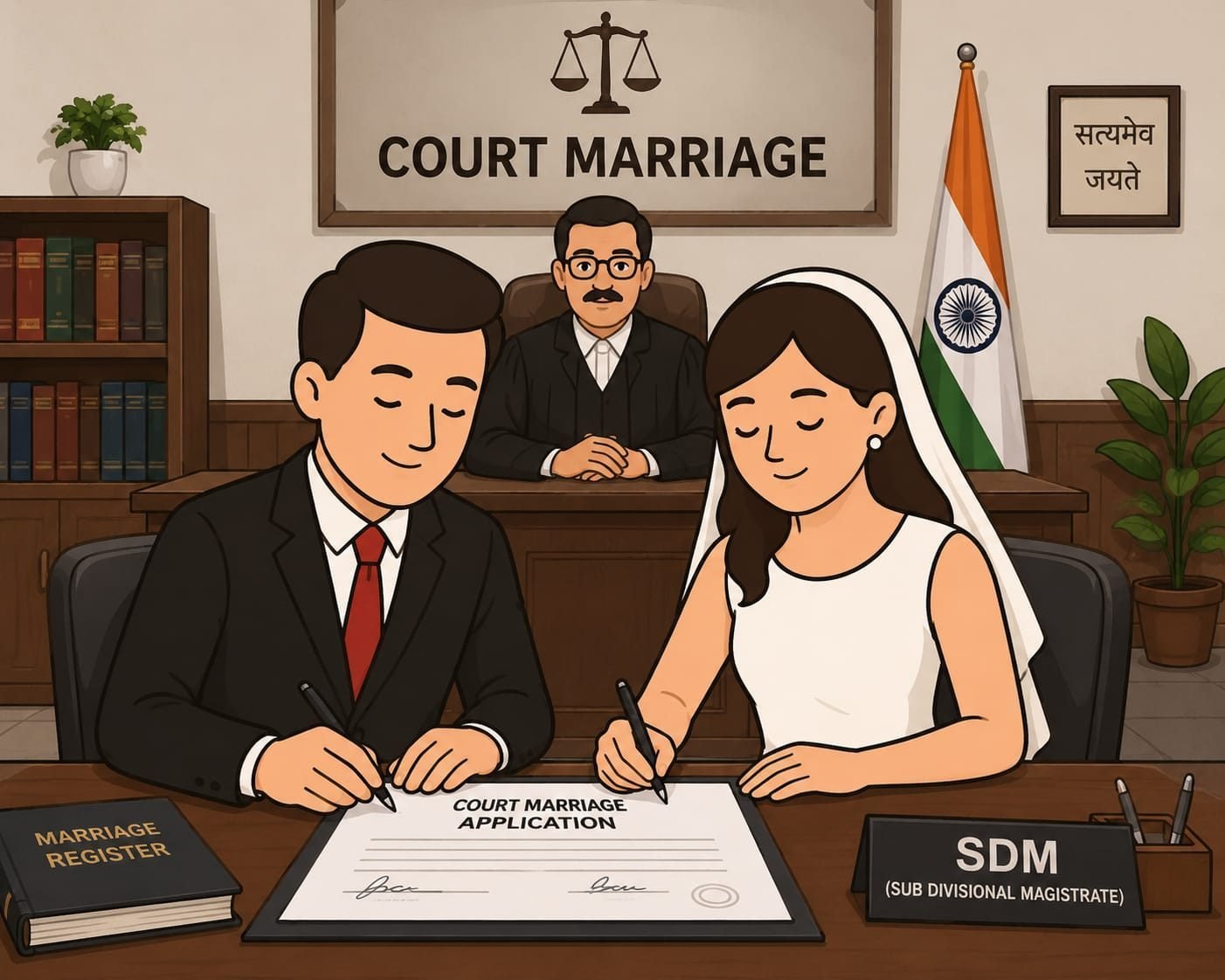
Quick answer: Preet Vihar sits on Vikas Marg between Laxmi Nagar's coaching lanes and the Karkardooma court complex, in a belt of East Delhi where lawyers, notaries, students and shopkeepers all work within a few hundred metres of each other. Under Delhi's 2026 revenue map, Preet Vihar is in the East district, whose sub-divisions are Vishwas Nagar, Gandhi Nagar and Patparganj; the e-District portal allots the office by address. The most useful thing to know here is what "court marriage" actually means: no marriage takes place in a court. A marriage is solemnised under the Hindu Marriage Act (for example by an Arya Samaj ceremony), under the Special Marriage Act before a Marriage Officer, or by nikah, and it is then registered by the SDM as Registrar. Anyone outside a court gate offering a same-day "court marriage certificate" without a ceremony or an appointment is selling you a problem. Court marriage with advocate-drafted papers: ₹6,100.
Key takeaways
- Preet Vihar is in the East district (Vishwas Nagar, Gandhi Nagar and Patparganj sub-divisions); the portal allots the office by address.
- "Court marriage" is not a law: a marriage is solemnised under the HMA, the Special Marriage Act or by nikah, and then registered by the SDM. Courts do not solemnise marriages.
- A stamp-paper agreement, a notarised affidavit or a certificate without a ceremony is not a marriage.
- Remarry only on a certified, final divorce decree; a pending petition or appeal means the earlier marriage still subsists.
- Nobody can waive the Special Marriage Act's 30-day notice, and nobody honest offers witnesses. We never provide them.
Last reviewed: 23 September 2026 · 37 min read
On this page
- Preet Vihar at a glance
- Preet Vihar under the 2026 map
- Which office registers your marriage
- What "court marriage" really means
- Touts, fake certificates and what they cost you
- The legal routes
- What an advocate actually does
- Valid marriage vs registered marriage
- For brides: what the certificate protects
- Planning it around work
- Affidavits, e-stamp and notaries
- Arya Samaj + registration
- Special Marriage Act step by step
- Registering a wedding already held
- Remarrying after a divorce decree
- Mutual-consent divorce and the waiting period
- If a case is still pending
- Maintenance, custody and the second marriage
- Protection petitions explained
- When a family files a complaint
- Two working spouses, one morning
- Laxmi Nagar students and young professionals
- Blended families: practical steps
- Address proof in flats and barsatis
- Shopkeepers and Vikas Marg offices
- Muslim couples
- Inter-caste and interfaith couples
- If your families oppose
- Age
- Witnesses
- Documents checklist
- At the appointment
- What it costs
- Timeline
- Getting around
- Common mistakes
- After registration
- Five Preet Vihar situations
- Checklist
- One-minute summary
- How we help
- Questions and answers
Vikas Marg is one of Delhi's working streets. At one end is Laxmi Nagar, where lakhs of students pass through coaching institutes for accountancy, banking and government exams, living four to a room in the lanes behind. In the middle are Preet Vihar and Nirman Vihar, with their flats, markets, malls and small offices. At the other end is Karkardooma, where the district courts and the family courts sit, and where the pavements are lined with typists, notaries, photocopiers and stamp-paper vendors.
That geography explains the questions we get from this belt. They are rarely about ceremonies and almost always about paper: is a stamp-paper marriage valid; can we get a court marriage done today; my divorce decree came last month, can I marry now; the notary outside the court says he can arrange everything; my parents are asking for the certificate before they will agree. This guide answers those, carefully, and it says plainly where the answer is that somebody is misleading you.
For the general Delhi process, see the complete Delhi court marriage guide. Nearby area guides: Mayur Vihar, Shakarpur, Vivek Vihar and Gandhi Nagar.
Preet Vihar at a Glance
| Item | Detail |
|---|---|
| District (from 1 January 2026) | East |
| Sub-divisions in the district | Vishwas Nagar, Gandhi Nagar, Patparganj |
| Areas | Preet Vihar, Nirman Vihar, Laxmi Nagar, Shakarpur, Vishwas Nagar, Anand Vihar's edge, Karkardooma |
| Metro | Blue Line: Preet Vihar, Nirman Vihar, Laxmi Nagar, Karkardooma; Pink Line at Karkardooma and Anand Vihar |
| Known for | Vikas Marg offices, Karkardooma courts, coaching institutes, markets and malls |
| Typical questions | What court marriage means, remarrying after a decree, affidavits and stamp paper, students' address proof |
Preet Vihar Under the 2026 Revenue Map
From 1 January 2026, Delhi's revenue administration was reorganised into 13 districts and 39 sub-divisions. The East district has three sub-divisions: Vishwas Nagar, Gandhi Nagar and Patparganj. Preet Vihar, Nirman Vihar and Laxmi Nagar addresses will be allotted among them according to the boundary, most often to Vishwas Nagar or Patparganj. You do not choose; the e-District portal allots by address and the appointment slip names the office. Certificates issued before 2026 remain valid.
Which Office Registers Your Marriage?
Applications are filed on the Delhi e-District portal. For Hindu Marriage Act registration, the registering office can be the one for the place where the marriage was solemnised or where either spouse lives; for the Special Marriage Act, notice goes to the Marriage Officer of the district where at least one of you has lived for the past 30 days. The Karkardooma court complex has nothing to do with either: the courts hear disputes, they do not register marriages.
What "Court Marriage" Really Means
"Court marriage" is an everyday phrase, not a legal one. People use it to mean a marriage done quickly and officially, without a big function. What actually happens is one of these:
| What people say | What it actually is | Where it happens |
|---|---|---|
| "We will do a court marriage today" | Usually an Arya Samaj wedding under the Hindu Marriage Act, followed by registration | Mandir, then the SDM office by appointment |
| "Court marriage under the Special Marriage Act" | Solemnisation before the Marriage Officer after a 30-day notice | The Marriage Officer's office, not a court |
| "Court marriage certificate" | The government marriage certificate issued on registration | SDM as Registrar of Marriages, through e-District |
| "Marriage on stamp paper" | An affidavit or agreement. Not a marriage at all | A notary's table |
| "Court will marry us" | Courts decide disputes and grant protection; they do not solemnise marriages | Karkardooma and other courts |
So when you hear "court marriage", ask one question: which law, and who signs the register? If the answer is "no ceremony, no appointment, just papers", walk away.
Touts, Fake Certificates and What They Cost You
Around every court complex in Delhi, including Karkardooma, there are people who promise anything for a fee: a certificate today, no appearance needed, no documents, backdated if you like. Couples under pressure are exactly the people who accept such offers. Here is what those shortcuts actually produce.
- A forged or fabricated certificate is worthless and dangerous. Using it for a passport, a visa, a bank or a benefit is a criminal offence, and the first careful verification exposes it.
- A backdated record is fraud. If someone offers to show your marriage as having happened earlier, refuse. Every later document built on that date becomes unsafe.
- "Witnesses provided" means false witnesses. A person who does not know you cannot honestly say they do. We never provide witnesses, and no honest service does.
- A "certificate without ceremony" is not a marriage. The Supreme Court held in Dolly Rani (2024) that a Hindu marriage requires the essential ceremonies; a paper without a wedding creates nothing.
- The money is gone and the problem stays. Couples come to us months later, having paid for something unusable, and then have to do the process properly anyway.
Everything legitimate can be done openly: a real ceremony, real documents, a real appointment where both of you appear. It is not slow, and it is not expensive.
The Legal Routes
| Your situation | Route | Waiting period | Our fee |
|---|---|---|---|
| Both Hindu, Sikh, Jain or Buddhist | Arya Samaj wedding + Hindu Marriage Act registration | Wedding same day | ₹5,100; ₹7,100 with registration |
| Want advocate-drafted papers and end-to-end handling | Court marriage service: drafting, affidavits, filing, appointment | Depends on route | ₹6,100 |
| Different religions, no conversion | Special Marriage Act | 30 days' residence, then 30-day notice | ₹15,000 |
| Wedding already held, not registered | Hindu Marriage Act registration | By appointment | ₹6,000 |
| Both Muslim | Nikah + registration under the Delhi 2014 Order | Nikah same day | ₹5,000 / ₹6,000 |
| Sikh couple after Anand Karaj | Delhi Anand Marriages Registration Rules, 2018, or HMA | By appointment | ₹6,000 |
| One of you divorced or widowed | Any of the above, with proof the earlier marriage ended | As per route | As per route |
Government fees are extra at actual cost. Full list: fees.
What an Advocate Actually Does in a Marriage File
People in this belt are used to dealing with lawyers, and it is worth being clear about what legal help adds and where it is unnecessary.
- Useful: drafting affidavits that match your documents; checking a divorce decree and whether it is final; advising where an earlier marriage, a maintenance order or a custody dispute affects the new marriage; preparing a protection petition where a couple is threatened; advising business or property families about the Special Marriage Act's effect on joint property.
- Useful: reading what you are being asked to sign, in a family settlement or an agreement presented at the time of a wedding.
- Not needed: to perform an Arya Samaj ceremony, to fill the e-District form, or to "get" an appointment. Appointments come from the portal.
- Never acceptable: any suggestion to state a false date, a false address or a false marital status, however routine someone says it is.
Our court marriage service at ₹6,100 covers advocate-drafted documents and end-to-end handling. Where your case involves a live court dispute, we will say so and tell you to take your own lawyer's advice on that part.
A Valid Marriage and a Registered Marriage
People often ask why registration matters if the marriage is already valid. Both things are true at once, and the distinction is worth holding on to.
- A Hindu marriage is valid when the essential ceremonies are performed between parties who meet the Act's conditions. It does not become valid because a certificate exists, and it does not become invalid because one does not.
- Registration records the marriage with the state and gives you a certificate, which is evidence. In Delhi it is also compulsory under the 2014 Order for marriages solemnised here.
- Evidence is the whole point. Passports, visas, bank accounts, insurance, pensions, school admissions, property and maintenance claims all turn on proof, and proof is what a certificate is.
- The Supreme Court in Seema v. Ashwani Kumar (2006) directed states to make registration of marriages compulsory, precisely because unregistered marriages left women without proof.
- A certificate cannot save an invalid marriage. If a party was under age, already married, or the ceremony never happened, no registration cures it — as the Court reminded everyone in Dolly Rani (2024).
So: perform a real ceremony, meet the conditions, then register. In that order.
For Brides: What the Certificate Protects
In every dispute that reaches the courts a few kilometres from here, the first question is whether the marriage can be proved. For a wife, the certificate is the difference between a straightforward claim and a long fight.
- Maintenance: a wife can claim maintenance under section 144 of the Bharatiya Nagarik Suraksha Sanhita and under personal law; a registered marriage removes the preliminary dispute about status.
- Residence and protection: the Protection of Women from Domestic Violence Act, 2005 provides residence, protection and monetary orders, and the Supreme Court held in Satish Chander Ahuja (2020) that a shared household can include a house owned by the in-laws.
- Stridhan: jewellery and gifts given to the bride are her absolute property, held by others only in trust (Pratibha Rani, 1985). Keep bills and a signed list.
- Dowry: giving, taking or demanding dowry is an offence under the Dowry Prohibition Act, 1961.
- Inheritance: a widow's claim to her husband's estate, and her children's, is far simpler to establish with a certificate.
- Her own copies: she should hold the certificate, the ceremony proof and photographs herself, not leave them in one family cupboard.
Planning It Around Work: Three Weeks
- Week 1: documents photographed and checked; a weak paper fixed (Aadhaar address, a duplicate certificate, a name affidavit); the route decided.
- Week 2: affidavits sworn on e-stamp; the ceremony held on a morning that suits you; the application filed online the same day.
- Week 3: the registration appointment in the first slot, with both spouses and two witnesses; the certificate read at the counter.
- Afterwards: attested copies, nominations, Aadhaar and, if needed, apostille.
For a Special Marriage Act marriage, add the 30 days' residence before the notice and the 30 days of the notice itself. Everything else stays the same.
Affidavits, E-Stamp and Notaries
Stamp-paper vendors and notaries are visible everywhere along this stretch, so it helps to know what each paper does.
- E-stamp: Delhi issues non-judicial stamp paper as e-stamp certificates through authorised vendors. Keep the certificate number; a photocopy of a plain paper with a stamp pasted on it is not the same thing.
- Affidavit: a statement sworn before a notary or oath commissioner. For a marriage file it usually covers age, marital status and nationality, the date and place of the wedding, and, where names differ across documents, that the names refer to the same person.
- Notarisation is not registration. A notarised affidavit records what you say; the marriage record is made by the Registrar.
- A "marriage agreement" or "marriage affidavit" is not a marriage. Couples are sometimes sold this as a cheap substitute. It gives neither spouse any marital status.
- False affidavits are offences. Read every line before signing, and refuse anything that states what your documents do not support.
Arya Samaj Wedding + Registration
For two Hindus, including Sikhs, Jains and Buddhists, this is the quickest lawful ceremony: havan, garlands, pheras and saptapadi, about an hour, with the mandir certificate the same day. It is what most couples in this belt actually mean when they say "court marriage in a day".
The mandir certificate proves the ceremony; the government certificate comes from Hindu Marriage Act registration on e-District, and that is the one banks, passport offices and employers recognise. Our combined package is ₹7,100, the ceremony alone ₹5,100. See our Arya Samaj marriage page.
Special Marriage Act, Step by Step
- Residence: at least one of you must have lived in the district for 30 days before the notice.
- Notice: filed online with age proof, ID, address proof and photographs.
- 30 days: the notice is displayed. Objections are entertained only on legal grounds — age, an existing spouse, unsoundness of mind, prohibited relationship. A family's disapproval is not a ground.
- Solemnisation: both of you appear before the Marriage Officer with three witnesses, sign the declarations, and the certificate is issued.
Two practical points for this area. The 30-day notice cannot be shortened by any fee or influence; anyone who says otherwise is lying. And where a Hindu, Sikh, Jain or Buddhist marries a person of another religion under this Act, section 19 severs the Hindu partner from the undivided family while section 21 applies the Indian Succession Act; section 21A excludes those effects where both parties are Hindus. See the SMA vs HMA guide.
Registering a Wedding Already Held
An unregistered Hindu marriage can be registered at any time with proof: the wedding card, photographs, a pandit's or mandir certificate where available, both spouses' age proof, ID and address proof, affidavits, and two witnesses who attended or have long known you as a married couple. Our fee is ₹6,000. For older marriages, children's birth certificates or passports naming both parents help. See our marriage registration service.
Remarrying After a Divorce Decree
Because the family courts sit at Karkardooma, we see more second marriages from this belt than from anywhere else in Delhi, and the same questions come up every week.
- Bring the decree, not a photocopy of a photocopy. A certified copy of the final decree of divorce is what the registrar and the Qazi or pandit will want.
- Wait until the decree is final. A decree can be appealed within the period the law allows, and courts and registrars expect a second marriage to take place only after that period has passed or the appeal has been decided. Ask your lawyer to confirm the position in your case, in writing if possible.
- A decree of judicial separation is not a divorce, and neither is an interim order, a settlement recorded in mediation, or a compromise deed. Only a decree of divorce dissolves the marriage.
- "Stamp-paper divorce" does not exist for Hindus, except where a recognised custom of divorce applies and can be proved, which is rare and must be established with evidence.
- A foreign divorce decree is not automatically valid in India; the Supreme Court set out the limits in Y. Narasimha Rao (1991). Take advice before remarrying on the strength of one.
- Muslim divorces: bring the talaqnama, khulanama, mubarat deed or court decree, and a woman must have completed her iddat.
A second marriage while the first subsists is void where monogamy applies, and can be prosecuted as bigamy. Nobody should treat this as a formality to be hurried.
Mutual-Consent Divorce and the Waiting Period
Many couples in this belt are at the other end of the process: they want to end a marriage by mutual consent and, often, to remarry later.
- Under the Hindu Marriage Act, a petition by mutual consent is followed by a statutory waiting period before the second motion, with the petition to be moved within the outer limit the section sets.
- In Amardeep Singh v. Harveen Kaur (2017), the Supreme Court held that the six-month waiting period is directory and can be waived in appropriate cases, on an application to the family court.
- In Shilpa Sailesh v. Varun Sreenivasan (2023), a Constitution Bench held that the Supreme Court can dissolve a marriage on the ground of irretrievable breakdown in exercise of its powers under Article 142, and can waive the waiting period in a suitable case.
- Whatever route is taken, the document you will need later is the certified copy of the decree.
We do not handle divorce matters; a family lawyer does. We say this here because couples ask us to "arrange" a quick divorce along with a marriage, and it cannot be done that way.
Protection Petitions: How They Actually Work
Because the courts are close by, couples here often ask how a protection petition works. In outline, and without pretending it is a substitute for a lawyer:
- Who files: the couple, usually jointly, after the marriage or when the threat begins.
- What it says: that both are adults, married or intending to marry by choice, and that they fear harm from named persons or fear interference with their liberty.
- What is annexed: age proof, the marriage certificate or ceremony proof, identity documents, and any record of threats.
- What the court can do: direct the police to provide protection, direct the station house officer to attend to complaints, and record the couple's statement so that later allegations of abduction are met.
- Police route first: a complaint at the police station and the special cell for couples can bring quicker help; 112 in an emergency and 181 for the women's helpline.
- Keep everything. Copies of the petition, the order and the police receipt should be with both spouses.
We prepare the marriage documents that such a petition needs, quickly and confidentially. The petition itself is filed by an advocate.
When a Family Files a Complaint
A pattern we see from this belt: an adult woman marries by choice, and her family files a missing-person complaint or alleges abduction. It is frightening, and it is manageable.
- Her age proof is the key document. An adult who has left voluntarily cannot be treated as missing against her will.
- She can record her statement before the police and, where required, before a magistrate, stating that she left and married of her own free will.
- The marriage certificate or ceremony proof supports that statement; this is why registering quickly matters.
- Take a lawyer with you to the police station if you can, and keep copies of everything filed.
- Do not hide. Couples who go underground make the allegations look plausible; couples who present documents usually end the matter.
- Threats are crimes. Report them; the Supreme Court's directions in Shakti Vahini require the administration to act.
Two Working Spouses, One Morning
Most couples here are working, often in offices along Vikas Marg or in Noida and central Delhi. The process fits into very little leave if it is ordered properly: an evening to check documents on WhatsApp, a morning for affidavits and the ceremony, the online application the same day, and one half-day for the appointment with two witnesses. Ask your witnesses early; they need the same half-day. Where one of you travels for work, tell us the travel dates before we take an appointment, because both spouses must attend.
If a Case Is Still Pending
Sometimes one partner has a case running at Karkardooma: a divorce petition, a maintenance application, a domestic violence proceeding, or a custody matter. Marriage plans and pending cases interact, and being honest early prevents harm.
- A pending divorce petition means the marriage still subsists. Until a decree of divorce is passed and becomes final, neither party is free to marry again.
- A pending appeal against a decree also matters; take your lawyer's advice before fixing a wedding date.
- Restitution, maintenance or protection proceedings do not dissolve a marriage at all.
- Disclosure: if you are marrying someone whose earlier marriage is in litigation, ask to see the papers. Many disputes we see later begin with a spouse who did not know.
- Do not swear an affidavit of "unmarried" status while a marriage subsists. That is a false affidavit, and it will be produced against you.
Maintenance, Custody and a Second Marriage
A second marriage does not wipe out obligations from the first.
- Maintenance ordered for a former spouse or children continues to be payable according to the order; remarriage of the payer is not by itself a ground to stop paying, and a court decides any variation.
- Children's rights to maintenance and inheritance from their parent are unaffected by that parent's remarriage.
- Custody and visitation arrangements stand until varied by the court; a new marriage can be a factor in a variation application, in either direction.
- Disclosure to the new spouse of existing obligations avoids the disputes that bring families back to court.
- Wills and nominations: after a second marriage, update them deliberately, taking account of children from the first marriage.
These are matters for a family lawyer. Our part is to make sure the new marriage itself is properly solemnised, properly registered, and supported by documents that are true.
Laxmi Nagar Students and Young Professionals
The coaching belt brings tens of thousands of young people from Bihar, Uttar Pradesh, Jharkhand, Rajasthan and the North East into rented rooms around Laxmi Nagar and Shakarpur. Couples form; some marry here, often quietly.
- Both must be adults: groom 21, bride 18, with reliable age proof.
- No institute or landlord permission is needed, and nobody is informed.
- Marriage does not affect exams or eligibility; declare marital status honestly on forms that ask.
- Residence for the Special Marriage Act must be genuine: 30 days in the district before the notice.
- Tell your families when it is safe to, and register promptly either way, because the certificate is what protects you if anyone later disputes the marriage.
Blended Families: Practical Steps
A second marriage often means two households becoming one, with children on one or both sides. Beyond the wedding itself, a few steps prevent the disputes that fill the family courts here.
- Tell the children, age-appropriately, before the wedding, and keep existing custody and visitation arrangements running exactly as ordered until a court varies them.
- School and medical records: update the guardian and emergency contact details; a step-parent has no automatic legal authority over a child.
- Wills: make or revise them after the marriage, remembering children from the first marriage. Without a will, succession law decides, and it may not match anyone's expectation.
- Nominations: bank, insurance, provident fund and property nominations should be reviewed deliberately, not left as they were.
- Property bought earlier stays as it is titled; if you intend to share it, say so in writing, with advice.
- Adoption or guardianship of a spouse's child is a separate legal process, not a consequence of marriage.
Address Proof in Flats and Barsatis
| Proof | Good for | Notes |
|---|---|---|
| Aadhaar with the current address | Everyone | Update it before applying if it shows a home-town address |
| Voter ID | Long-term residents | Check the flat number |
| Electricity or water bill | Owners and family members | With a ration card or affidavit showing the relationship |
| Rent agreement + police tenant verification | Tenants, students | The standard route in Laxmi Nagar and Shakarpur |
| Bank statement or passport | Everyone | Address must be current |
| Employer or institute letter | Staff accommodation, hostels | Supports an affidavit |
Write the address exactly as in your documents, including block, gali and floor, and keep it identical across the application, affidavits and ceremony certificate.
Shopkeepers and Vikas Marg Offices
Family businesses along Vikas Marg, in Laxmi Nagar's computer and book markets and in the Preet Vihar shopping blocks bring their own questions, mostly about property and timing.
- Timing: we conduct ceremonies early in the morning or on a weekly closing day, and take the first appointment slot so a shop loses no trading time.
- Joint family property: a marriage under the Hindu Marriage Act changes nothing; a Special Marriage Act marriage between a Hindu and a non-Hindu severs the Hindu partner from the joint family and changes succession. Plan the firm's papers and wills accordingly.
- Partnerships and GST records: where a spouse joins the business, record it properly rather than informally.
- Nominations: bank, insurance and demat nominations should be updated after the wedding.
- The bride's stridhan: jewellery and gifts given to her are her property; keep bills and a signed list.
Muslim Couples
Muslim families in this belt marry by nikah: two adults free to marry, free consent, mahr, and the proposal and acceptance before witnesses. Our own Qazi reads nikahs with nikahnama and certificate for ₹5,000. Delhi law requires registration under the Delhi (Compulsory Registration of Marriage) Order, 2014 within 60 days, with a ₹500 fee for the next 60 days and a ₹1,000 penalty after that. Register under that Order rather than the Special Marriage Act, which would move succession to the Indian Succession Act; the Delhi High Court directed online registration of Muslim marriages under the 2014 Order in Faizan Ayubi (2024). A divorced Muslim woman must have completed her iddat, and should bring her talaqnama, khulanama or decree. See our nikah registration service and the nikah documents guide.
Inter-Caste and Interfaith Couples
An inter-caste marriage between two Hindus is lawful and needs nobody's permission; where one spouse is from a Scheduled Caste and the other is not, the couple may be eligible for the ₹2.5 lakh incentive under the Dr. Ambedkar Scheme for Social Integration through Inter-Caste Marriages, subject to its current conditions, including registration under the Hindu Marriage Act and it being the first marriage of both. Interfaith couples who do not want either partner to convert use the Special Marriage Act; conversion, if chosen, must be genuine and never dissolves an existing marriage (Sarla Mudgal, 1995). See our inter-caste and inter-religion services.
If Your Families Oppose
Adults may marry by choice. The Supreme Court directed protection for inter-caste and inter-religion couples in Lata Singh (2006), held in Shakti Vahini (2018) that no family or community body may interfere with the marriage of consenting adults, and in Shafin Jahan (2018) that the choice of a partner is part of personal liberty. Delhi Police has special cells for threatened couples; the Delhi High Court can order protection, and petitions of this kind are filed regularly. Keep documents with you, leave copies with a friend, choose supportive witnesses, register promptly, record threats, and call 112 in an emergency or 181 for the women's helpline. See our love marriage service and the love marriage rights guide.
Age
The groom must be at least 21 and the bride 18 on the wedding day, shown by a Class 10 certificate, birth certificate or passport; Aadhaar is identity proof, not reliable age proof. We never conduct a marriage where either party is under age, and no affidavit changes that. See the marriage age guide.
Witnesses
Two witnesses for Hindu Marriage Act or Anand registration, three for the Special Marriage Act, and for a nikah as the school followed requires. They bring photo ID and address proof and must actually know you.
We do not provide witnesses. Anyone near a court offering witnesses is offering false ones. Bring friends, relatives, colleagues or neighbours who know you both. See the witness requirements guide.
Documents Checklist
| Document | Who | Notes |
|---|---|---|
| Age proof | Both | Class 10 certificate, birth certificate or passport |
| Photo ID | Both | Aadhaar, voter ID, passport, driving licence or PAN |
| Address proof | At least one in Delhi; 30 days' residence for SMA | Aadhaar, voter ID, bill with relationship proof, rent agreement with tenant verification |
| Photographs | Both | Passport size, plus ceremony photographs for registration |
| Ceremony proof | For registration | Arya Samaj or mandir certificate, gurdwara certificate, nikahnama, wedding card |
| Affidavits | Both | Age, marital status, nationality; one-and-same-person where names differ |
| Divorce decree | If divorced | Certified copy of the final decree; foreign decrees need advice |
| Death certificate | If widowed | Of the former spouse |
| Witnesses' ID and address proof | Each witness | Two for HMA, three for SMA |
Full list: documents required for court marriage in Delhi.
At the Appointment
Both spouses and the witnesses attend the office named on the slip with all originals. The officer compares originals with the uploads, confirms identity, and asks simple questions: when and where you married, who performed the ceremony, whether either was married before, and whether you married of your own will. Witnesses say how they know you. If everything is in order, you sign the register and the certificate is issued, often digitally, the same day or within a few days. Read the certificate before you leave: names, dates of birth, parents' names, the date and place of the marriage.
What It Costs
| Service | Our fee |
|---|---|
| Court marriage (advocate assisted, end to end) | ₹6,100 |
| Arya Samaj marriage (same day) | ₹5,100 |
| Arya Samaj + registration combined | ₹7,100 |
| Registration of an existing marriage | ₹6,000 |
| Inter-religion marriage | ₹10,000 |
| Special Marriage Act, full process | ₹15,000 |
| Muslim nikah / nikah registration | ₹5,000 / ₹6,000 |
| Marriage certificate, duplicate or correction | ₹2,500 |
Government fees, e-stamp and notary charges at actual cost. We quote before starting, and we do not ask for money for anything we cannot do. Full list: fees.
Timeline
| Route | Typical time |
|---|---|
| Arya Samaj wedding or nikah | Same day once documents are ready |
| Hindu Marriage Act registration | Depends on the appointment; Tatkal faster where available |
| Special Marriage Act | 30 days' residence, 30 days' notice, then solemnisation |
| Second marriage after a decree | After the decree is final; check the appeal position first |
Getting Around
The Blue Line runs the length of Vikas Marg with stations at Laxmi Nagar, Nirman Vihar, Preet Vihar and Karkardooma, and the Pink Line meets it at Karkardooma and Anand Vihar. Parking near the courts and the markets is difficult on working days, so travel by metro and meet your witnesses at a station gate. Morning appointment slots move fastest. Pickup and drop within Delhi NCR is ₹1,500.
Common Mistakes
- Believing a stamp-paper "marriage agreement" is a marriage.
- Paying a tout for a certificate without a ceremony or an appointment.
- Marrying before a divorce decree is final, or on a decree under appeal.
- Swearing an "unmarried" affidavit while a marriage subsists.
- Assuming a court can solemnise the marriage.
- Expecting the 30-day Special Marriage Act notice to be waived.
- Using a borrowed address for the residence requirement.
- Aadhaar as the only age proof.
- Witnesses who do not know the couple.
- Not reading the certificate before leaving the counter.
After Registration
- Check the certificate against both partners' documents and keep several attested copies.
- Update Aadhaar, bank nominations, insurance and, where employed, HR records.
- For second marriages, review wills, nominations and any existing court orders with your lawyer.
- Keep digital copies with both spouses, not only with one family.
- If the certificate will be used abroad, arrange the MEA apostille or embassy attestation.
Five Preet Vihar Situations
The certificate bought outside a court
A couple paid an agent near a court complex for a "same-day court marriage certificate". No ceremony was performed and neither of them signed any register. When the bride's passport application was filed, the certificate could not be verified. They came to us, had a proper Arya Samaj wedding, and registered it. The money paid to the agent was gone.
The decree that was still under appeal
A man whose divorce decree had been passed two months earlier wanted to marry immediately. His former wife had filed an appeal. We told him to get his lawyer's written confirmation of the position before fixing any date; the wedding was held after the matter was resolved. Had he married earlier, the second marriage would have been open to challenge.
The students from two states
Two adults preparing for banking exams in Laxmi Nagar married with two classmates as witnesses. She updated her Aadhaar to her rented address with a notarised rent agreement and tenant verification. The registration was completed within the month, and they told their families afterwards.
The shopkeeper's morning wedding
A family running a shop in a Laxmi Nagar market could not lose a trading day in season. The ceremony was held at eight in the morning, the shop opened at eleven, and the registration appointment was taken on the market's weekly closing day.
The affidavit that said too much
A couple were handed a draft affidavit by a typist which stated that they had been married for two years, to make a registration "easier". They refused, and came to us. We prepared affidavits stating the true date, and the marriage was registered without any difficulty at all.
Checklist
- ☐ Understand the route: Arya Samaj + HMA, SMA before the Marriage Officer, nikah + 2014 Order
- ☐ Nobody is offering you a certificate without a ceremony or an appointment
- ☐ Age proof for both: Class 10, birth certificate or passport
- ☐ Address proof; 30 days' genuine residence for the Special Marriage Act
- ☐ Divorce decree certified and final, or death certificate
- ☐ Affidavits that state only what your documents support
- ☐ Your own witnesses with ID
- ☐ Appointment booked; both spouses free that morning
- ☐ Certificate read at the counter before leaving
- ☐ Copies, nominations and, for second marriages, wills updated
One-Minute Summary
- Preet Vihar is in the East district; the portal allots the office among Vishwas Nagar, Gandhi Nagar and Patparganj by address.
- "Court marriage" means a marriage solemnised under a marriage law and registered by the SDM. Courts do not solemnise marriages.
- A stamp-paper agreement or a certificate without a ceremony is not a marriage.
- Second marriages need a certified, final decree; a pending appeal or a pending petition means the marriage still subsists.
- The Special Marriage Act's 30-day notice cannot be bought off.
- Affidavits must state the truth; a false affidavit is an offence.
- We never provide witnesses and never marry anyone under age.
How We Help
We check documents on WhatsApp, explain in plain words which law applies to you, prepare advocate-drafted affidavits that match your papers, conduct Arya Samaj weddings and nikahs at times that suit your work, file registration and Special Marriage Act applications, and prepare you and your witnesses for the appointment. Where your case involves a live court matter, we tell you so and ask you to take your lawyer's advice on that part rather than guessing. We decline anything that requires a false statement. Everything is confidential.
Court marriage, done properly – ₹6,100
Advocate-drafted documents, correct route, filing and appointment · Arya Samaj + registration ₹7,100 · registration only ₹6,000 · Special Marriage Act ₹15,000.
Book Court Marriage – ₹6,100 →Also: Arya Samaj marriage · Marriage registration · Inter-religion
Questions and Answers: Court Marriage for Preet Vihar Couples
Sources and Official References
Facts in this guide were checked against the following primary sources. Government procedures and office allocations change, so confirm current details on the official portal before applying.
- Delhi e-District – official online application portal
- Revenue Department, Delhi – notification dated 25 December 2025 creating 39 sub-divisions and 13 areas
- The Hindu Marriage Act, 1955 – India Code
- The Special Marriage Act, 1954 – India Code
- Amardeep Singh v. Harveen Kaur, Supreme Court, 2017 (waiver of the six-month period) – Indian Kanoon
- Shilpa Sailesh v. Varun Sreenivasan, Supreme Court, 2023 (Article 142 and irretrievable breakdown) – Supreme Court Observer
- Y. Narasimha Rao v. Y. Venkata Lakshmi, Supreme Court, 1991 – Indian Kanoon
- Seema v. Ashwani Kumar, Supreme Court, 2006 – Indian Kanoon
- The Delhi (Compulsory Registration of Marriage) Order, 2014 – Revenue Department, Delhi
- Delhi High Court directs online registration of Muslim marriages (Faizan Ayubi, November 2024) – LiveLaw
- Lata Singh v. State of U.P., Supreme Court, 2006 – Indian Kanoon
- Shakti Vahini v. Union of India, Supreme Court, 2018 – Indian Kanoon
- Sarla Mudgal v. Union of India, Supreme Court, 1995 – Indian Kanoon
This guide is general information, not legal advice for your specific case. Call +91 8376863962 for advice on your situation.
Related Articles
🚌 Arriving at Anand Vihar to Marry
The honest answer to “can we marry today?” — for couples who just got off a bus or train.
Read →🔍 Court Marriage in Rajouri Garden
Verify a match, NRI grooms, fraud remedies.
Read →🌉 Court Marriage in Mayur Vihar
Delhi or Noida registration.
Read →🏠 Shakarpur: Renting as a Couple
Landlords, rent agreements and marriage.
Read →👶 Vivek Vihar: Adoption, IVF and Surrogacy
The certificate CARA and clinics ask for.
Read →🧵 Court Marriage in Gandhi Nagar
East district guide.
Read →⚖️ How Court Marriage Works
Step-by-step in India.
Read →📜 SMA vs HMA
Which Act suits you.
Read →❤️ Love Marriage Rights
Protection and the law.
Read →📄 Documents Required
Full documents list.
Read →👥 Witness Requirements
Who can be a witness.
Read →🏛️ Court Marriage in Delhi
The complete Delhi guide.
Read →🏡 Yamuna Vihar: GPA Houses and Widows
Property papers, succession and the certificate.
Read →