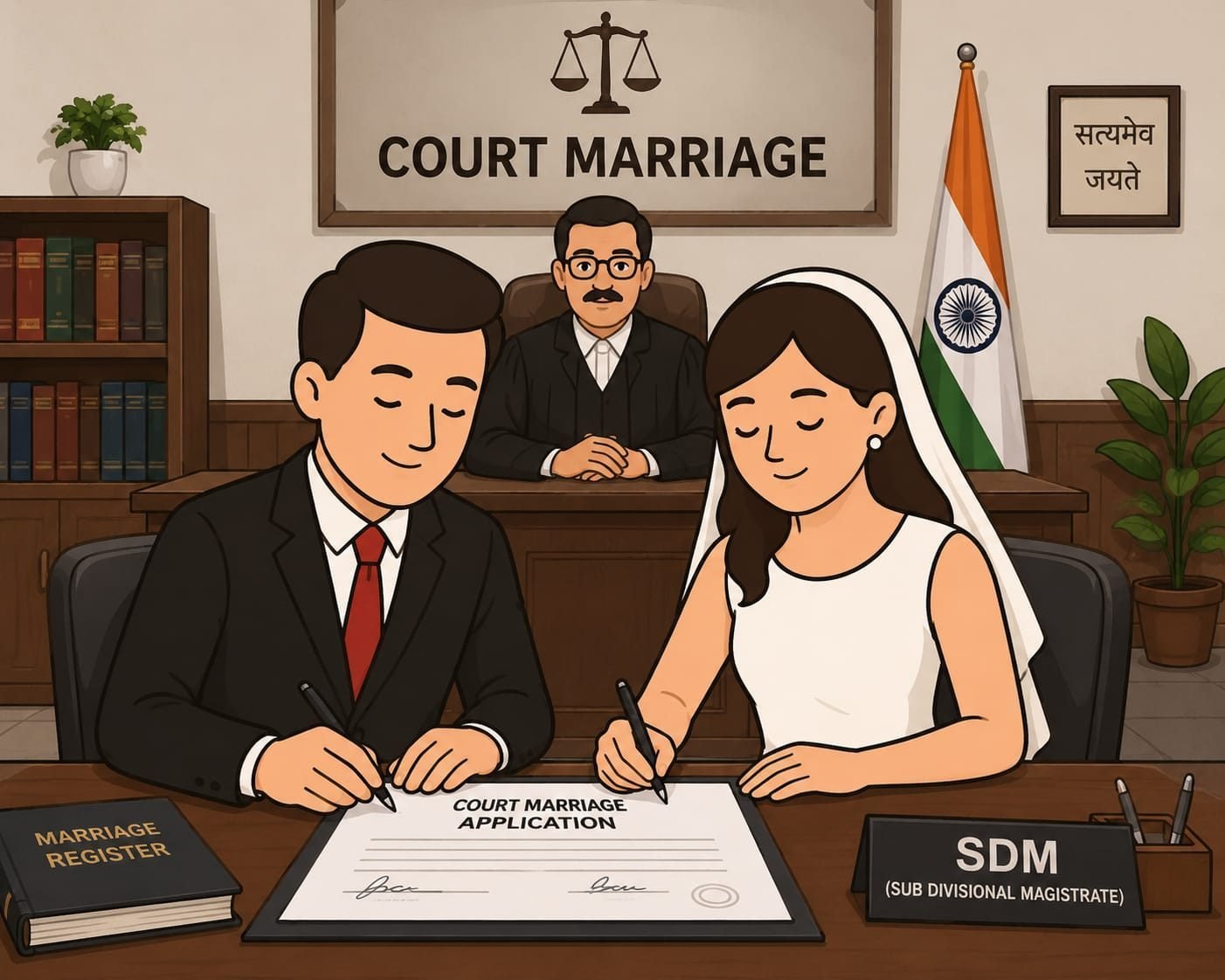
Quick answer: Rajouri Garden, with Tagore Garden, Subhash Nagar, Raja Garden and Vishal Enclave around it, is west Delhi's showroom-and-restaurant belt and a sub-division of the West district under Delhi's 2026 revenue map (with Janakpuri and Vikaspuri). Two Hindus, Sikhs, Jains or Buddhists can have an Arya Samaj wedding and register it under the Hindu Marriage Act; Sikh couples can register an Anand Karaj under Delhi's 2018 Rules; interfaith couples who do not want to convert use the Special Marriage Act. The part families here most often get wrong is not the ceremony but the checking: verifying who the other side actually is before the wedding. Matrimonial fraud, inflated jobs, hidden earlier marriages and "NRI grooms" who disappear after the reception are real, and almost all of it is preventable with four or five documents asked for politely and early. Court marriage with advocate-drafted papers: ₹6,100.
Key takeaways
- Rajouri Garden is a sub-division of the West district from 1 January 2026, with Janakpuri and Vikaspuri.
- Verify the match before the wedding: the same short document list from both sides, asked for before money is spent.
- For an NRI match, see every passport page and the visa, check the address abroad independently, and register the marriage before the flight back.
- Never send money before a marriage, and never hand over the bride's passport, certificates or jewellery bills.
- If a marriage was procured by concealment, remedies exist but are time-limited – see a lawyer quickly. We never provide witnesses.
Last reviewed: 23 September 2026 · 37 min read
On this page
- Rajouri Garden at a glance
- Rajouri Garden under the 2026 map
- Which office registers your marriage
- The legal routes
- Verifying a match before the wedding
- The documents to ask for
- Red flags families ignore
- How to ask without offending anyone
- What every bride should keep
- The first year: paperwork
- "NRI groom" cases
- Matrimonial sites and online matches
- If you were deceived: what the law gives you
- Health, disclosure and honest conversations
- Money questions to settle before the wedding
- Roka and engagement: what they commit you to
- Conversations worth having
- Arya Samaj + registration
- Sikh couples: Anand Karaj
- Special Marriage Act
- Registering a wedding already held
- Muslim couples
- Inter-caste and interfaith couples
- Young professionals and renters
- If your families oppose
- Second marriages
- Banquets and vendor contracts
- Age
- Witnesses
- Documents checklist
- At the appointment
- What it costs
- Timeline
- Getting around
- Common mistakes
- After registration
- Five Rajouri Garden situations
- Checklist
- One-minute summary
- How we help
- Questions and answers
Rajouri Garden is where west Delhi goes out. The main road is lined with showrooms and restaurants, the malls fill on weekends, and the metro interchange brings people from Janakpuri, Tilak Nagar, Punjabi Bagh and beyond. Behind that frontage are ordinary residential blocks: Punjabi and Sikh families who built businesses here over three generations, young professionals renting flats near the metro, and the staff who keep the shops and kitchens running.
Weddings from this belt are usually arranged through the family network, a community contact or a matrimonial website, and they are planned with care. What is often not checked is the other side itself. We have sat across the table from families who could describe the groom's car and not his employer, who had a photograph of a foreign apartment and no visa page, who learnt after the wedding that there had been an earlier marriage. Every one of those situations was avoidable with a short, polite list of documents, asked for early, before money was spent.
So this guide does two things. It sets out the ordinary process — routes, documents, timing, cost — and it sets out, in detail, how to verify a match before the wedding, and what the law gives you if you were deceived anyway.
For the general Delhi process, see the complete Delhi court marriage guide. Nearby area guides: Punjabi Bagh, Hari Nagar, Vasant Vihar and Patel Nagar.
Rajouri Garden at a Glance
| Item | Detail |
|---|---|
| District (from 1 January 2026) | West |
| Sub-divisions in the district | Rajouri Garden, Janakpuri, Vikaspuri |
| Areas | Rajouri Garden, Tagore Garden, Subhash Nagar, Raja Garden, Vishal Enclave, Ramesh Nagar's edge |
| Metro | Blue Line and Pink Line interchange at Rajouri Garden; Tagore Garden and Subhash Nagar on the Blue Line |
| Known for | Showrooms, restaurants and malls, business families, gurdwaras, banquet halls |
| Typical questions | How to verify a match, NRI grooms, matrimonial-site matches, Anand Karaj registration, second marriages |
Rajouri Garden Under the 2026 Revenue Map
From 1 January 2026, Delhi's revenue administration was reorganised into 13 districts and 39 sub-divisions. The West district has three sub-divisions: Rajouri Garden, Janakpuri and Vikaspuri. Rajouri Garden keeps a sub-division in its own name and covers the surrounding colonies, with addresses towards Janakpuri or Vikaspuri allotted accordingly. The e-District portal decides by address and your appointment slip names the office. Certificates issued before 2026 remain fully valid.
Which Office Registers Your Marriage?
Applications are filed on the Delhi e-District portal. For Hindu Marriage Act registration, the office can be the one for the place where the marriage was solemnised or where either spouse lives; for the Special Marriage Act, notice goes to the Marriage Officer of the district where at least one of you has lived for the past 30 days. A wedding in a banquet hall here with the family home nearby gives you both options.
The Legal Routes
| Your situation | Route | Waiting period | Our fee |
|---|---|---|---|
| Both Hindu, Sikh, Jain or Buddhist | Arya Samaj wedding + Hindu Marriage Act registration | Wedding same day | ₹5,100; ₹7,100 with registration |
| Want advocate-drafted papers and end-to-end handling | Court marriage service | Depends on route | ₹6,100 |
| Sikh couple after Anand Karaj | Delhi Anand Marriages Registration Rules, 2018, or HMA | By appointment | ₹6,000 |
| Family wedding already held | Hindu Marriage Act registration | By appointment | ₹6,000 |
| Different religions, no conversion | Special Marriage Act | 30 days' residence, then 30-day notice | ₹15,000 |
| NRI or foreign partner | Usually SMA, or HMA where both are Hindus, plus apostille | Plan around the visit | ₹6,100; ₹30,000 with apostille and attestation |
| Both Muslim | Nikah + registration under the Delhi 2014 Order | Nikah same day | ₹5,000 / ₹6,000 |
Government fees are extra at actual cost. Full list: fees.
Verifying a Match Before the Wedding
Verification is not distrust. It is what every business in this neighbourhood does before signing a contract, and a marriage is a bigger commitment than any contract. Done early and politely, it protects both sides: the family with nothing to hide is usually relieved to be asked, because they want to ask too.
The order that works:
- Ask both sides for the same list. When the same documents are exchanged mutually, nobody is insulted.
- Ask before money is spent. Once the hall is booked and the cards are printed, families talk themselves out of questions.
- Verify with the source, not the photocopy. An employer's letter means little; a call to the listed office number, or a look at the company's registration, means more.
- Meet at homes and workplaces, not only at restaurants and hotels.
- Write down what you were told: job, salary range, property, earlier marriages, health matters disclosed. If a dispute follows, what was represented matters.
- Take advice on anything that does not fit. A single inconsistency is usually a mistake; three are a pattern.
The Documents to Ask For
| Document | What it confirms | How to check it |
|---|---|---|
| Class 10 certificate or birth certificate | Real age and name | Compare with the photo ID and the matrimonial profile |
| Aadhaar / voter ID / PAN | Identity and address | Names and dates should match across all three |
| Passport (all pages) | Identity, nationality, travel, and for an NRI the visa and stamps | Check the visa category and its validity, not only the photo page |
| Employment letter and recent salary slips | The job actually claimed | Call the employer's published number; check the company exists |
| Degree certificates | Qualifications | Many universities have online verification |
| Divorce decree or death certificate | Freedom to marry | Certified copy; check the decree is final |
| Property papers, if property is claimed | Ownership | Title documents, not photographs of a building |
| Two family references | Who the family is | Speak to them yourself |
None of this is unusual, and none of it requires a detective. If the other side refuses the same list they were given, that refusal is itself information.
Red Flags Families Ignore
- Hurry. "The visa expires", "the muhurat is next week", "he has only ten days' leave" — pressure to marry before documents can be checked is the commonest sign of trouble.
- No paperwork, only photographs. A car, an apartment and a business can all be borrowed for a photograph.
- Vague employment. "Business abroad", "consultancy", "family company" with no letter, no address and no colleagues.
- Refusal to meet the family at home, or a family who are always travelling.
- Money requests before the wedding: for a visa, a ticket, a business deal, a "gift" to relatives.
- A gap in the story: unexplained years, a previous engagement nobody will discuss, a phone that changes.
- Pressure to keep it quiet from the wider family, or to marry outside the city where nobody knows them.
- Discouraging registration. Anyone who does not want the marriage on record should be asked why, at once.
None of these proves dishonesty. Each of them is a reason to slow down and ask for the list above.
How to Ask Without Offending Anyone
Most families know they should verify and do not know how to raise it. The trick is to make it mutual, routine and early. Some wording that works:
- To start: "We are old-fashioned about paperwork — we would like to exchange the usual documents on both sides before we go further. Shall we send ours first?"
- For the passport: "For the visa planning later, could we take a copy of the full passport, including the visa pages? We will do the same for our daughter."
- For employment: "Our elders like to send a formal letter to the office address; could we have the employer's letter with the office number?"
- For an earlier marriage: "We have been told there was an earlier marriage — that is not a problem for us, but we would like to see the decree, as any family would."
- If they refuse: "We understand. We are asking because we are giving the same to you. We would rather ask now than after the cards are printed."
- To your own side: "We are giving them everything they have asked for, so we can ask the same without any awkwardness."
Sending your own documents first changes the conversation completely, and it costs nothing.
What Every Bride Should Keep and Know
Whatever the family and however good the match, a bride should begin married life with her own papers in her own hands. This is not distrust; it is basic prudence, and any decent family will support it.
- Her documents: passport, Aadhaar, PAN, degree certificates, Class 10 certificate, bank papers — with her, not in a family locker.
- Copies of the marriage certificate and the ceremony certificate, in her own email as well as on paper.
- Her stridhan record: bills for jewellery in her name with the HUID, a signed list of gifts from both sides, and photographs.
- Her own bank account, operated by her, and ideally her own locker or joint operation of one.
- Two numbers she can call: 112 in an emergency and 181 for the women's helpline, and a trusted person outside the marital home.
- What the law gives her: her wages and property are her own; stridhan is hers and is held by others only in trust (Pratibha Rani, 1985); the Protection of Women from Domestic Violence Act, 2005 provides residence, protection and monetary orders; maintenance can be claimed; dowry demands are an offence.
Families that set this up at the wedding almost never need it. Families that do not are the ones we see later, trying to prove the obvious.
The First Year: Paperwork That Should Not Wait
- Within a month: the marriage registered, the certificate checked for spellings and dates, four attested copies made, and digital copies with both spouses.
- Within two months: nominations changed — bank, demat, insurance, provident fund; the spouse added to medical cover within the policy's window; HR records updated.
- Within three months: Aadhaar and voter ID addresses aligned; passport updated if a spouse's name is being added or a surname changed, with a gazette notification where required.
- Within six months: wills made or revised; any property arrangement documented properly; the stridhan list filed with the family papers.
- Before any move abroad: apostille or attestation of the certificate, and the visa file assembled with honest evidence of the relationship.
- Keep one folder — physical and digital — with all of it, and tell each other where it is.
It is an afternoon's work spread across a year, and it removes most of the paperwork emergencies that families face later.
"NRI Groom" Cases
Every year, families across north India are left with a daughter married to a man who returned abroad and stopped answering the phone. The pattern is well documented, and the Ministry of External Affairs and the National Commission for Women run support arrangements precisely because it is common. What protects a family is not luck; it is documents and timing.
- See the passport and the visa, every page, and note the visa category and expiry. A work visa, a study visa and a visitor visa are very different things.
- Check the address abroad with something independent: a utility bill, a tenancy, a bank statement, a letter from the employer with a telephone number that you call.
- Ask about marital status abroad. A divorce obtained in another country is not automatically valid in India, and the Supreme Court set out the limits in Y. Narasimha Rao (1991). Ask for the decree and take advice.
- Register the marriage in India before he leaves, and get the certificate in both spouses' hands. Both must attend the appointment; afterwards is too late.
- Apply for the spouse visa promptly, and keep copies of every application, receipt and communication.
- Keep the bride's documents with her: passport, certificates, jewellery bills. Documents surrendered "for safekeeping" are how people are stranded.
- If a spouse disappears: keep the record, file a police complaint, approach the National Commission for Women, and consult a lawyer about maintenance and, where applicable, proceedings in the country concerned. The MEA has schemes to assist deserted spouses.
Our Model Town guide covers the spouse-visa documentation in detail, and our NRI marriage service plans the registration and apostille around a short visit.
Matrimonial Sites and Online Matches
Most matches in this belt now begin online, on a matrimonial site or an app, and most are perfectly genuine. The few that are not follow a script.
- Reverse-search the photographs and look for the same pictures elsewhere.
- Video call early, and more than once. A person who will not appear on video after weeks of chatting is a problem.
- Do not send money, ever, for any reason, before a marriage: customs charges on a gift, a medical emergency, a ticket, an investment. This is the single clearest sign of a scam.
- Do not share intimate photographs or videos. Sextortion of both men and women is common and devastating; if it happens, preserve everything, report it to the cyber-crime helpline (1930) and the portal, and tell your family rather than paying.
- Verify the profile's claims separately: employer, city, degrees, marital status, through the documents listed above.
- Meet with family present before any commitment, and in a place you both know.
- Report fake profiles to the platform; it is often the only way another family is protected.
If You Were Deceived: What the Law Gives You
If a marriage has already happened and material facts were concealed, there are remedies, and they are time-sensitive.
- Voidable marriage: under the Hindu Marriage Act, a marriage can be annulled where consent was obtained by force or by fraud as to a material fact or circumstance concerning the respondent. The petition must be brought within the period the Act allows, and generally not after living together with full knowledge; do not delay.
- Bigamy: a second marriage while the first subsists is void where monogamy applies, and is an offence.
- Cheating: deception that causes a person to part with money or property can be a criminal offence under the ordinary criminal law.
- Cruelty and dowry: harassment connected with demands is punishable, and the Dowry Prohibition Act, 1961 covers giving, taking and demanding.
- Domestic violence: the 2005 Act provides protection, residence and monetary orders, including in cases of economic abuse.
- Maintenance can be claimed under section 144 of the Bharatiya Nagarik Suraksha Sanhita and under personal law.
- Evidence: keep the profile, the chats, the photographs, the invitation, the documents given to you, and the marriage certificate. Cases turn on what was represented and when.
These are matters for a lawyer, and the sooner the better. Our role is the marriage and its registration; we will not give legal advice on a dispute, but we will tell you honestly when you need a lawyer rather than a service provider.
Health, Disclosure and Honest Conversations
Families sometimes ask whether a medical report can be demanded before a marriage. The better framing is disclosure: both sides should be able to have an honest conversation, and concealment of something material can become a legal issue later.
- Talk about health honestly, including chronic conditions and anything that affects family planning. It is far easier before the wedding than after.
- Genetic counselling is worth considering where both families come from a community with a known carrier risk, such as thalassaemia; testing is simple and widely available.
- Do not turn it into an inquisition. A demand for a battery of tests without any discussion tends to poison the relationship before it begins, and confidential medical information should be treated with respect.
- Mental health deserves the same honesty and the same respect; a diagnosis is not a disqualification, and concealment helps nobody.
- Insurance and records: after the wedding, add the spouse to medical cover and keep a shared record of allergies, medication and emergency contacts.
Money Questions to Settle Before the Wedding
- Who is paying for what in the wedding itself, in writing between the families if the amounts are large.
- Dowry is illegal and no demand should be entertained; gifts freely given to the bride are hers as stridhan, and should be listed with bills.
- Where will the couple live, and on what terms if it is a family property.
- Will the bride continue to work or study, and does everyone agree.
- Debts: existing loans, business liabilities and guarantees should be disclosed, because they become part of a shared life.
- After the wedding: joint accounts, nominations, and a will, in that order of urgency.
Roka, Engagement and What It Commits You To
Matches in this belt usually pass through a roka and an engagement before the wedding, and families treat those as binding. In law they are not.
- A roka or sagai is a promise, not a marriage. It creates no marital rights and either side may withdraw.
- Gifts are usually returned if it is broken; keep a note of what was given, which avoids arguments.
- Money spent on a cancelled function is generally not recoverable unless there is an agreement or clear dishonesty; another reason to verify before spending.
- Use the engagement period for the document list, not for shopping alone.
- Do not let an engagement be used as pressure to marry despite what verification shows. It is far better to break an engagement than to unwind a marriage.
Conversations Worth Having Before the Wedding
Verification is about facts. These are about the life you are agreeing to share, and couples who discuss them start better:
- Where will you live, and with whom, and is that a permanent arrangement?
- Will both of you work, and whose career moves if there is a transfer or a posting abroad?
- How will money be handled: joint or separate accounts, who pays what, what each of you earns and owes?
- Children: whether, when, and how the two of you will share the work of raising them.
- Religion and practice: what each family expects at festivals and ceremonies.
- Elderly parents on both sides: what responsibility each of you will carry.
- Deal-breakers: anything one of you cannot live with, said out loud now.
None of this is legal advice and none of it needs a document. It prevents more disputes than any agreement could.
Arya Samaj Wedding + Registration
For two Hindus, including Sikhs, Jains and Buddhists, the Arya Samaj route is the quickest complete ceremony: havan, garlands, pheras and saptapadi in about an hour, with the mandir certificate the same day. The government certificate comes from Hindu Marriage Act registration on e-District, and that is what banks, passport offices and foreign missions recognise. Our combined package is ₹7,100, the ceremony alone ₹5,100. The Supreme Court held in Dolly Rani (2024) that a Hindu marriage requires the essential ceremonies, so no certificate substitutes for the wedding. See our Arya Samaj marriage page.
Sikh Couples: Anand Karaj
Many families here hold the Anand Karaj at a gurdwara, with the four laavan around the Guru Granth Sahib. Delhi notified the Delhi Anand Marriages Registration Rules, 2018, so the marriage can be registered as an Anand marriage; registration under the Hindu Marriage Act also remains available. Bring the gurdwara's certificate, photographs of the laavan, both spouses' age proof, ID and address proof, and two witnesses. Tell us at the start that yours is an Anand Karaj so the application is filed in the right category — it matters when the certificate is used abroad.
Special Marriage Act
The Special Marriage Act, 1954 is the civil route for any two adults, whatever their religion, without conversion: 30 days' residence in the district before the notice, a 30-day public notice during which only legal objections count, and then solemnisation before the Marriage Officer with three witnesses. Our full service is ₹15,000. Where a Hindu, Sikh, Jain or Buddhist marries a person of another religion under this Act, section 19 severs the Hindu partner from the undivided family and section 21 applies the Indian Succession Act; section 21A excludes those effects where both parties are Hindus. See the SMA vs HMA guide.
Registering a Wedding Already Held
An unregistered Hindu marriage can be registered with proof: the wedding card, photographs of the ceremony, a pandit's or gurdwara's certificate where available, both spouses' age proof, ID and address proof, affidavits, and two witnesses who attended or have long known you as a married couple. Our fee is ₹6,000. Collect two or three ceremony photographs on the wedding day itself; the album takes months and the registration should not. See our marriage registration service.
Muslim Couples
Muslim families in and around this part of west Delhi marry by nikah: two adults free to marry, free consent, mahr, and the proposal and acceptance before witnesses. Our own Qazi reads nikahs with nikahnama and certificate for ₹5,000. Delhi law requires registration under the Delhi (Compulsory Registration of Marriage) Order, 2014 within 60 days, with a ₹500 fee for the next 60 days and a ₹1,000 penalty after. Register under that Order rather than the Special Marriage Act, which would move succession to the Indian Succession Act; the Delhi High Court directed online registration of Muslim marriages under the 2014 Order in Faizan Ayubi (2024). Conditions agreed in the nikahnama, including mahr and a delegated right of divorce, are part of the contract and should be recorded carefully. See our nikah registration service.
Inter-Caste and Interfaith Couples
An inter-caste marriage between two Hindus is lawful and needs no permission; where one spouse is from a Scheduled Caste and the other is not, the couple may be eligible for the ₹2.5 lakh incentive under the Dr. Ambedkar Scheme for Social Integration through Inter-Caste Marriages, subject to its current conditions. Interfaith couples who do not want either partner to convert use the Special Marriage Act; conversion, if chosen, must be genuine and never dissolves an existing marriage (Sarla Mudgal, 1995). See our inter-caste and inter-religion services.
Young Professionals and Renters
The blocks around the metro are full of rented flats shared by people working in offices, hotels, restaurants and retail, many from other states. For them:
- Address proof: a written rent agreement with police tenant verification, or Aadhaar updated to the Delhi address; one spouse's proof is enough for registration.
- Special Marriage Act residence must be genuine — 30 days in the district before the notice.
- Shift work: we schedule ceremonies early in the morning or on weekly offs, and take first-slot appointments.
- Living together before marriage is not an offence between consenting adults, and there is no live-in registration in Delhi; see our live-in relationship guide.
- Privacy: Hindu Marriage Act registration notifies nobody; the Special Marriage Act requires a public notice for 30 days.
If Your Families Oppose
Adults may marry by choice. The Supreme Court directed protection for inter-caste and inter-religion couples in Lata Singh (2006), held in Shakti Vahini (2018) that no family or community body may interfere with the marriage of consenting adults, and in Shafin Jahan (2018) that the choice of a partner is part of personal liberty. Delhi Police has special cells for threatened couples and the Delhi High Court can order protection. Keep documents with you, leave copies with a friend, choose supportive witnesses, register promptly, record threats, and call 112 in an emergency or 181 for the women's helpline. See our love marriage service.
Second Marriages
A divorced or widowed person may remarry once the earlier marriage has ended: a certified copy of the final decree, or a talaqnama, khulanama or decree plus iddat for Muslims, or the former spouse's death certificate. A stamp-paper or panchayat "divorce" does not end a Hindu marriage except where a recognised custom applies and is proved. A pending petition or appeal means the marriage still subsists. Where there are children and property from the first marriage, settle guardianship, nominations and a will at the same time, with advice.
Banquets, Restaurants and the Wedding Around the Corner
This is a neighbourhood where the wedding industry is on the doorstep: banquet halls on the main roads, caterers, decorators, bridal studios and photographers, and restaurants that host sangeets and receptions. Convenience has a cost: families sign contracts quickly because the venue is five minutes away, and read them only when something changes.
- Get the booking in writing: date, hours, covered and open areas, guest numbers included and the rate beyond them.
- Read the cancellation and postponement clause before the advance is paid, and ask what happens if a date moves by a week.
- Confirm the final number including taxes, service charges and overtime, rather than a verbal assurance.
- Check licences and timings: music at night is restricted and neighbours in these blocks do complain; parking is the other standing complaint.
- Pay traceably and keep every invoice; a consumer complaint, if it ever comes to that, is built on documents.
- Ask the photographer for a few ceremony images on the day, because registration needs them long before the album arrives.
And keep the two things separate in your mind: the function is a contract with vendors, while the marriage is a ceremony plus a registration. A cancelled reception changes nothing about a marriage that has been solemnised, and the grandest reception does not create one.
Age
The groom must be at least 21 and the bride 18 on the wedding day, shown by a Class 10 certificate, birth certificate or passport; Aadhaar is identity proof, not reliable age proof. We never conduct a marriage where either party is under age. See the marriage age guide.
Witnesses
Two witnesses for Hindu Marriage Act or Anand registration, three for the Special Marriage Act, and for a nikah as the school followed requires. They bring photo ID and address proof and must actually know you.
We do not provide witnesses. A person who does not know you is not a real witness. Bring your own. See the witness requirements guide.
Documents Checklist
| Document | Who | Notes |
|---|---|---|
| Age proof | Both | Class 10 certificate, birth certificate or passport |
| Photo ID | Both | Aadhaar, voter ID, passport, driving licence or PAN |
| Address proof | At least one in Delhi; 30 days' residence for SMA | Aadhaar, voter ID, bill, passport, bank statement, rent agreement with tenant verification |
| Photographs | Both | Passport size, plus clear photographs of the pheras or laavan |
| Ceremony proof | For registration | Arya Samaj or mandir certificate, gurdwara certificate, nikahnama, wedding card |
| Affidavits | Both | Age, marital status, nationality; one-and-same-person where names differ |
| Divorce decree or death certificate | If married before | Certified copy of the final decree |
| Passport and visa | NRI or foreign partner | All pages; plus a no-impediment certificate where issued |
| Witnesses' ID and address proof | Each witness | Two for HMA, three for SMA |
Full list: documents required for court marriage in Delhi.
At the Appointment
Both spouses and the witnesses attend the office named on the slip with all originals. The officer compares originals with the uploads, confirms identity, and asks simple questions: when and where you married, who performed the ceremony, whether either was married before, and whether you married of your own will. Witnesses say how they know you. If everything is in order, you sign the register and the certificate is issued, often digitally, the same day or within a few days. Read every entry before leaving.
What It Costs
| Service | Our fee |
|---|---|
| Court marriage (advocate assisted, end to end) | ₹6,100 |
| Arya Samaj marriage (same day) | ₹5,100 |
| Arya Samaj + registration combined | ₹7,100 |
| Registration of an existing marriage or Anand marriage | ₹6,000 |
| Inter-religion marriage | ₹10,000 |
| Special Marriage Act, full process | ₹15,000 |
| NRI registration with apostille and embassy attestation | ₹30,000 |
| Marriage certificate, duplicate or correction | ₹2,500 |
Government fees, e-stamp and notary charges at actual cost. Full list: fees.
Timeline
| Step | Typical time |
|---|---|
| Verification of the match | Two to four weeks, before money is spent |
| Arya Samaj wedding or nikah | Same day once documents are ready |
| Registration | Depends on the appointment; Tatkal faster where available |
| Special Marriage Act | 30 days' residence, 30 days' notice, then solemnisation |
| Apostille for use abroad | Several working days after the certificate |
Getting Around
Rajouri Garden is a Blue Line and Pink Line interchange, with Tagore Garden and Subhash Nagar next door, so the metro is the sensible way to reach a ceremony or an appointment. The main road and the mall junctions are slow on weekend evenings and in wedding season. Take a morning slot and meet your witnesses at the station. Pickup and drop within Delhi NCR is ₹1,500.
Common Mistakes
- Booking the hall before checking the documents.
- Accepting photographs instead of papers for a job, a house or a visa.
- Sending money before a marriage for any reason at all.
- Letting an NRI spouse leave before registration.
- Handing over the bride's passport and certificates to the other family.
- Delay in acting when a marriage was procured by concealment — the remedies are time-limited.
- Believing a certificate can replace a ceremony.
- Aadhaar as the only age proof.
- Witnesses who cannot attend the appointment.
- Not reading the certificate at the counter.
After Registration
- Keep several attested copies and digital copies with both spouses.
- Update Aadhaar, bank and demat nominations, insurance and HR records.
- Add the spouse to medical cover within the policy's window.
- Make or revise wills, especially in a second marriage or a business family.
- Keep the stridhan list, bills and photographs with the bride's own papers.
- For couples going abroad, apostille or attestation, then the visa file.
Five Rajouri Garden Situations
The groom with no employer
A family was told the groom ran a consultancy abroad. Asked for an employment letter and a utility bill, the other side produced neither and grew offended. The family paused the match and lost nothing but a fortnight. Six months later they learnt the same profile had approached two other families.
The wedding that was registered before the flight
An NRI groom had eleven days in Delhi. The Anand Karaj was held on day three, the registration filed on day five and the appointment attended on day nine, with his cousins as witnesses. The certificate was apostilled the following week and the spouse visa file went in complete.
The decree that was not final
A bride's family found, on asking for the decree, that the groom's divorce was under appeal. They postponed the wedding until the position was clear. Had they not asked, the second marriage would have been open to challenge.
The money request
A match made online asked for money to clear "customs charges" on a gift sent from abroad. The family stopped, checked, and reported the profile. Nobody in the family had been told about the payment until it was nearly made.
The couple who married quietly and told the families later
Two adults from different communities, both working near the metro, married at an Arya Samaj mandir with two friends as witnesses and registered within the month. They told both families afterwards, with the certificate in hand, which changed the conversation entirely.
Checklist
- ☐ Same document list exchanged by both families, before money is spent
- ☐ Passport and visa pages seen for any NRI match
- ☐ Employment, degrees and property verified from the source
- ☐ Divorce decree certified and final, or death certificate
- ☐ No money sent to anyone before the marriage
- ☐ Route chosen: Arya Samaj + HMA, Anand registration, SMA, or nikah + 2014 Order
- ☐ Age proof for both; address proof; witnesses confirmed
- ☐ Ceremony photographs and certificate collected on the day
- ☐ Registration filed within days; both spouses at the appointment
- ☐ Certificate checked; copies, nominations and stridhan list in place
One-Minute Summary
- Rajouri Garden is a sub-division of the West district from 1 January 2026.
- Verify the match before the wedding: the same short document list from both sides, asked for early.
- For an NRI match, see every passport page and the visa, and register the marriage before the flight back.
- Never send money before a marriage, and never hand over the bride's documents.
- If a marriage was procured by concealment, the remedies are real but time-limited: see a lawyer quickly.
- Two Hindus: Arya Samaj wedding plus registration, ₹7,100 combined; Sikhs can register an Anand Karaj.
- We never provide witnesses and never marry anyone under age.
How We Help
We check documents on WhatsApp, tell you plainly which papers to ask the other family for, conduct Arya Samaj weddings and nikahs at times that suit the function, register weddings already held, file Special Marriage Act notices, and arrange apostille for couples going abroad. We do not investigate people and we do not give legal advice on disputes; where you need a lawyer, we say so. Everything is confidential.
Court marriage for Rajouri Garden couples – ₹6,100
Advocate-drafted documents, the right route, filing and appointment · Arya Samaj + registration ₹7,100 · registration only ₹6,000 · Special Marriage Act ₹15,000.
Book Court Marriage – ₹6,100 →Also: Arya Samaj marriage · Marriage registration · NRI marriage
Questions and Answers: Court Marriage for Rajouri Garden Couples
Sources and Official References
Facts in this guide were checked against the following primary sources. Government procedures and office allocations change, so confirm current details on the official portal before applying.
- Delhi e-District – official online application portal
- Revenue Department, Delhi – notification dated 25 December 2025 creating 39 sub-divisions and 13 areas
- The Hindu Marriage Act, 1955 – India Code
- The Special Marriage Act, 1954 – India Code
- Sikhs in Delhi now have their own marriage rules (Delhi Anand Marriages Registration Rules, 2018) – The Week
- Y. Narasimha Rao v. Y. Venkata Lakshmi, Supreme Court, 1991 (foreign divorce decrees) – Indian Kanoon
- National Commission for Women – official website
- Ministry of External Affairs – official website (services for Indians abroad)
- National Cyber Crime Reporting Portal (helpline 1930)
- Dowry Prohibition Act, 1961 – Indian Kanoon
- The Delhi (Compulsory Registration of Marriage) Order, 2014 – Revenue Department, Delhi
- Lata Singh v. State of U.P., Supreme Court, 2006 – Indian Kanoon
- Shakti Vahini v. Union of India, Supreme Court, 2018 – Indian Kanoon
- Sarla Mudgal v. Union of India, Supreme Court, 1995 – Indian Kanoon
This guide is general information, not legal advice for your specific case. Call +91 8376863962 for advice on your situation.
Related Articles
🏡 Court Marriage in Punjabi Bagh
Property, prenups and stridhan.
Read →🏙️ Court Marriage in Hari Nagar
West Delhi guide.
Read →✈️ Court Marriage in Model Town
Spouse visas and apostille.
Read →⚖️ Court Marriage in Preet Vihar
What court marriage really means.
Read →🌍 NRI Marriage Guide
Complete guide.
Read →📜 SMA vs HMA
Which Act suits you.
Read →📄 Documents Required
Full documents list.
Read →❤️ Love Marriage Rights
Protection and the law.
Read →👥 Witness Requirements
Who can be a witness.
Read →🏛️ Court Marriage in Delhi
The complete Delhi guide.
Read →