Quick answer: In this belt, the question that actually decides a family’s future is not “how do we get married?” It is “whose house is this, and what happens to it when somebody dies?” Thousands of houses in Yamuna Vihar, Bhajanpura, Ghonda and the lanes around them were bought on a GPA and an agreement to sell rather than a registered sale deed — and the Supreme Court has held that a GPA, an agreement to sell or a will does not transfer ownership of immovable property. Add an unregistered marriage to that, and a widow can find she can prove neither the marriage nor the house. This guide joins the two problems together: what a marriage certificate does for a property claim, what it cannot do, and the exact papers a family should put in order now. Marriage registration: ₹6,000.
Key takeaways
- A GPA is not ownership. In Suraj Lamp & Industries v. State of Haryana the Supreme Court held that GPA, agreement-to-sell and will transfers do not convey title to immovable property — a registered conveyance does. The Court has since rejected the argument that this applies only prospectively.
- Nomination is not inheritance. A nominee is a receiver, not an owner (Shakti Yezdani, SC 2023). The one carve-out is insurance, where a parent, spouse or child nominee is a beneficial nominee.
- Mutation is not title. It is a municipal record of who pays the tax — worth doing, but it decides nothing about ownership.
- Every succession system pays a spouse who can be proved. A widow is a Class I heir under the Hindu Succession Act and takes a fixed share under Muslim personal law — but a share that cannot be established at a counter is worth nothing.
- After a spouse dies, the marriage can never be registered. Not for a fee, not with an affidavit, not by anybody. That is the only true deadline in this business.
- A daughter is a Class I heir and a coparcener by birth (Vineeta Sharma, 2020). Marriage does not end her claim, and “bahu ka koi hissa nahi hota” is not the law either.
- Registering an old marriage records its real date — a 1994 ceremony registered today is a 1994 marriage. ₹6,000 and about a week.
- We do no property work at all — no mutation, regularisation, will, probate, succession or heir certificate, and no commission from anybody who does. We never provide witnesses and never register a marriage while an earlier one subsists.
Last reviewed: 24 September 2026 · 38 min read
On this page
- Yamuna Vihar at a glance
- Yamuna Vihar on the 2026 map
- Which office registers you
- Why this page is about the house
- What we handle, and what we do not
- GPA is not ownership
- The papers a house here actually has
- Regularisation and PM-UDAY
- Mutation is not title
- Nomination is not inheritance
- Dying without a will
- Under Muslim personal law
- What the widow actually needs
- Legal heir vs succession certificate
- If the marriage was never registered
- The deadline nobody tells you
- Proving an old marriage
- Why a will settles more than it costs
- Daughters, widows and the house
- Second marriages and two families
- What a certificate cannot do
- The family paper file
- Your three lawful routes
- Arya Samaj and registration
- Nikah registration in Delhi
- The Special Marriage Act
- Witnesses
- Fees, at cost and in full
- A realistic timeline
- Mistakes we see
- Five situations from this belt
- Agents and property “fixers”
- What we will not do
- Talk to us
1. Yamuna Vihar at a Glance
Yamuna Vihar runs in numbered blocks along the eastern bank of the river in north east Delhi, with Bhajanpura to its south, Ghonda and Brahmpuri alongside, Karawal Nagar to the north and Seelampur and Shahdara further down. The Pink Line serves Bhajanpura, Yamuna Vihar and Maujpur–Babarpur, and the Red Line is a short distance away at Welcome and Seelampur.
The building stock tells you everything about the paperwork. These are narrow plots, mostly self-built, mostly four storeys, very often with one floor sold to one family and another to a second, sometimes with a shop at the bottom and three tenancies above. Many of the colonies here grew before they were planned, several have been through one or another stage of regularisation, and a very large share of the transactions that built them were done on general power of attorney, agreement to sell, receipt and will — the four-document bundle that this belt has called “GPA property” for thirty years.
It is a settled, working, multi-generational belt: traders, karigars, e-rickshaw and transport families, small manufacturers, teachers, shop owners, and a very large number of households where three generations live on three floors of the same building.
2. Yamuna Vihar on the 2026 Revenue Map
Here there is good news for once: Yamuna Vihar genuinely is a sub-division under the reorganisation effective 1 January 2026. Delhi now has 13 districts and 39 sub-divisions, and the North East district’s sub-divisions are Karawal Nagar, Gokal Puri, Yamuna Vihar and Shahdara.
Two things still to note:
- Shahdara is no longer a district. It was made one in 2012 and is now a sub-division sitting alongside Yamuna Vihar. Pages that say “Shahdara District” are out of date, and Delhi went 9 districts to 11 in 2012 to 13 in 2026.
- Still let the portal allot your office. Even where the name is right, the allotment is made by Delhi e-District on the basis of what you enter, and it changes. Apply, see what you get, then plan the morning.
And for this page in particular: an old certificate issued by an office that has since been renamed or abolished is still a valid certificate. That matters enormously in a property file, where the documents are decades old. Nobody needs to “re-do” a certificate because the office changed — and that fraud is run on older people more than on anyone else. Our Saraswati Vihar guide covers record continuity in full.
3. Which Office Registers Your Marriage
Applications go through the Delhi e-District portal: an account, the application, the uploads, then an appointment at the allotted sub-divisional office. Both parties attend in person — there is no power-of-attorney marriage and no video-call marriage, whatever anybody tells you, and that is worth saying twice on a page about powers of attorney.
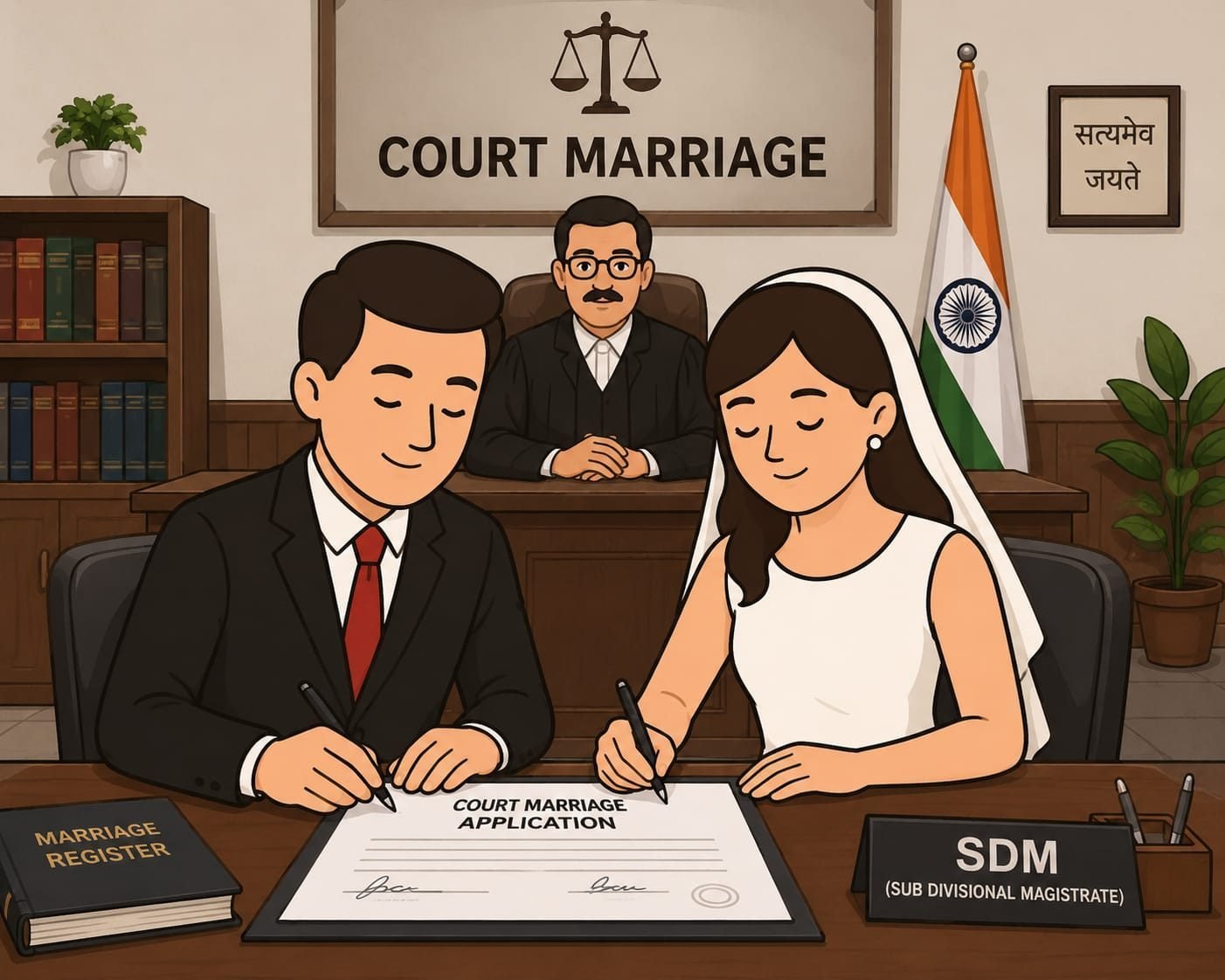
And courts do not marry or register anybody. Registration is done by the SDM or the Registrar of Marriages; a Special Marriage Act marriage is solemnised before the Marriage Officer. “Court marriage” is everyday shorthand for a civil registration, not a description of a building — our Preet Vihar guide takes that myth apart along with the touts who live off it.
4. Why This Page Is About the House
Every locality guide we write is built around the problem that locality actually brings to our phone. In this belt, an unusual share of the calls are not from couples at all. They are from families, and they come after something has gone wrong:
“Papa nahi rahe. Makaan GPA pe liya tha 1998 mein, unke naam se kuch nahi hai. Ammi ka nikah register nahi hai. Chacha keh rahe hain unka bhi hissa hai. Ab kya karein?”
Two separate failures meet in that sentence, and each one makes the other worse. The house has no registered title in the deceased’s name, so proving who owned it is already hard. And the marriage has no certificate, so proving who the widow is becomes a second argument — at exactly the moment when the people on the other side of it have every incentive to keep arguing.
The marriage half is the half we can actually help with, and it is the cheaper and faster of the two by a wide margin. But this page would be dishonest if it only told you about our half, so it explains both, tells you plainly which parts need an advocate, and gives you the sequence to follow while everybody is still alive and well.
5. What We Handle, and What We Do Not
We handle: marriage registration (₹6,000), Arya Samaj marriage with registration (₹7,100), court marriage assistance (₹6,100), nikah registration (₹6,000), Special Marriage Act assistance (₹15,000), and duplicate or corrected marriage certificates (₹2,500).
We do not handle, and earn nothing from: property registration, sale deeds, conveyance deeds, mutation, regularisation or PM-UDAY applications, wills, probate, succession certificates, legal heir certificates, partition, or any dispute about a house. We are not a law firm, we do not practise law, and we do not appear anywhere. Every one of those goes to an independent advocate acting in their own name, whose fee we take no share of, or to the relevant government office directly.
And nothing on this page is legal advice on your file. Succession law differs by religion and by the facts of each family; property law turns on the actual documents; and both change. Take proper advice on your own papers before acting on any of it.
6. GPA Is Not Ownership — and the Supreme Court Has Said So
This is the single most important paragraph on this page for a family in this belt.
In Suraj Lamp & Industries (P) Ltd. v. State of Haryana, the Supreme Court held that transactions done through the familiar bundle of general power of attorney, agreement to sell, receipt and will — what everybody here calls a GPA sale — do not convey title to immovable property. A transfer of immovable property requires a registered deed of conveyance. The Court has since rejected the argument that this ruling was meant to operate only prospectively.
Read carefully what that does and does not mean, because both halves matter:
- It does not mean your family is being thrown out. Possession held for decades, the agreement to sell, the payment, the power of attorney and the will together are evidence of a transaction, and they carry weight. An agreement to sell can found a suit for specific performance. Nobody should read this section and panic.
- It does mean you are not the registered owner, and that the day a registered owner is needed — for a bank loan, a clean sale, a regularisation application, or a dispute with a relative — you are starting from a weaker position than you thought.
- It means the person who signed the GPA still matters. A power of attorney is an agency; questions arise about what happens on the principal’s death, and that is one more reason not to leave this for the next generation to untangle.
- It means the chain is only as good as its weakest link. Three GPA sales in a row, two of the signatories dead, one set of papers lost in a flood — that is a common history in these lanes and it is exactly the history that turns into a ten-year civil suit.
What to do about it: that is an advocate’s question, on your actual papers, and it usually comes down to getting a proper registered conveyance executed while the people who can sign are alive and findable. We are telling you the position so that you go and ask, not so that you rely on us.
7. The Papers a House in This Belt Actually Has
Lay them out on a table and see which of these you hold, because families are often surprised by what is and is not there.
| Document | What it really is |
|---|---|
| Registered sale deed / conveyance deed | The strongest document. This is title. If you have one, most of this section does not apply to you. |
| Agreement to sell | A contract to transfer. Evidence of the transaction; not a transfer of title by itself. |
| General power of attorney | Authority to act for somebody else. Not ownership. |
| Will | Takes effect on death. Not a present transfer. |
| Possession letter and receipt | Evidence of payment and handover. |
| Electricity and water bills, house tax receipts | Evidence of long possession. Not title. |
| Mutation entry in municipal records | A record for tax purposes. Not proof of ownership — see section 9. |
| Regularisation or conveyance under a government scheme | Potentially the route to a real registered title — section 8. |
| Bank loan documents | Useful, because a bank usually insisted on better paper than a cash buyer did. |
Do this today, whatever else you do: photograph every one of those documents, front and back, and put the photographs into two different people’s email accounts. In a belt of shared stairwells, seepage and family disagreements, a paper file that exists in only one steel almirah is one flood, one fire and one quarrel away from being gone. It costs an hour and it has saved families years.
8. Regularisation and PM-UDAY
Many colonies in this belt have been through some stage of regularisation, and the scheme most people know by name is PM-UDAY — the central scheme for conferring ownership or transfer rights on residents of identified unauthorised colonies in Delhi, run through the DDA’s portal.
Three honest points:
- It is the realistic route to a registered title for a house that has only ever had GPA papers, which is why it is worth the trouble of the application.
- Eligibility, the list of colonies, the documents and the fees are set by the authority and they change. Check the current position on the official portal, not on any article, including this one.
- Nobody can get you approved. If somebody in the market offers to “get your file passed” for a fee, that is the oldest sale in this belt and it is a sale of influence that does not exist.
We do not file these applications, take money for them, or have any contact at the authority. What we can tell you is that a great many of these files ask about the household, and a family whose marriage certificates, birth certificates and identity documents all say the same names is a family whose application does not come back with a query.
9. Mutation Is Not Title
“Mutation ho gaya hai” is said in this belt as though it settled the question. It does not.
Mutation is the updating of a municipal or revenue record — principally so that the authority knows who to send the tax bill to. It is useful evidence, it is worth doing, and it should be done after a death. But it is a record of who is paying, not an adjudication of who owns. A mutation entered on the strength of an affidavit does not defeat somebody else’s inheritance, and an heir who was left out of a mutation has not lost their share by that fact alone.
The practical lesson cuts both ways. If you are the widow: get the mutation done, because it is one more brick in the wall, and it usually needs the death certificate, proof of relationship and the other heirs’ position. If you are relying on somebody else’s mutation to tell you the house is settled: it does not.
10. Nomination Is Not Inheritance
The most widely believed wrong thing in Indian family finance, and it costs families in this belt real money every year.
A nominee is a receiver, not an owner. Nomination tells the bank, the company, the insurer or the society whom to hand the asset to, so that the institution is discharged. It does not decide who is entitled to it. In Shakti Yezdani v. Jayanand Jayant Salgaonkar (2023), dealing with shares under the Companies Act, the Supreme Court held that a nominee does not become the absolute owner and that the nomination provisions do not override the law of succession — nomination is not a third mode of succession.
There is a deliberate exception in one place: under the Insurance Act as amended in 2015, a nominee who is a parent, spouse or child of the policyholder is a beneficial nominee and takes the proceeds beneficially. That carve-out proves the general rule rather than contradicting it.
Two things follow, and they are five-minute jobs:
- Update every nomination after a marriage. EPF Form 2 and gratuity Form F nominations in particular do not carry over — a great many people in this belt still have a parent named years after the wedding, and the small-premium PMJJBY and PMSBY policies fail for the same reason, or lapse silently when the auto-debit misses on renewal day.
- Do not rely on a nomination to pass the house or the money to your wife. If that is what you intend, say so in a will — section 18.
11. Dying Without a Will
Most people in this belt die intestate, which means the law decides, not the family.
For a Hindu, Sikh, Jain or Buddhist family, the Hindu Succession Act, 1956 governs. The points that matter here:
- On a Hindu man dying intestate, his property devolves first on his Class I heirs, who take simultaneously — and the widow, the mother, the sons and the daughters are all Class I heirs. The widow does not take everything, and she does not take nothing; she takes a share alongside the children and the mother.
- A daughter is an heir on the same footing as a son, and since the 2005 amendment as explained in Vineeta Sharma v. Rakesh Sharma (2020) a daughter is a coparcener by birth in her own right. “Ladki ko kya milega” is a social statement in this belt, not a legal one.
- A female Hindu dying intestate is governed by a different scheme under the Act, which takes account of where the property came from. It surprises families regularly.
- A widow does not lose her share by remarrying in the ordinary case, though specific statutes and tenancy rules can have their own provisions — another question for an advocate.
For Christians and Parsis the Indian Succession Act, 1925 applies, with its own shares. For a Muslim family, see the next section.
The common thread is this: in every one of these systems, a spouse’s share depends on being a spouse who can be proved. That is where an unregistered marriage stops being a paperwork nuisance and starts being the whole case.
12. Under Muslim Personal Law
A large number of families in this belt are Muslim, so this needs saying properly rather than being skipped.
Succession in a Muslim family is governed by Muslim personal law, in which shares are fixed rather than discretionary, and the scheme differs between Sunni and Shia law. Broadly, and as it is commonly stated, a widow takes one-eighth where there are children and one-fourth where there are none, with the remainder distributed among the other heirs in fixed shares; a son ordinarily takes twice a daughter’s share; and there are limits on how much of an estate can be disposed of by will without the consent of the heirs.
We are not going to compute your family’s shares on a web page, and you should be suspicious of anybody who offers to. The shares depend on exactly who survived, which school of law applies, and what the property actually is. Take this to somebody qualified. What we will say with confidence is the part that concerns us:
- The widow’s fixed share is only reachable if the nikah can be proved. A share that exists in law and cannot be established in an office is worth nothing at a bank counter.
- A nikahnama is not a registered marriage certificate, and offices increasingly ask for the latter. Register the nikah — see section 25.
- Mehr is a debt of the husband to the wife, not a gift, and an unpaid mehr is ordinarily treated as a debt against the estate. Write the amount down, keep the nikahnama safe, and do not let it be settled verbally after a death.
- Do not let anybody tell a widow she has “no claim” because the marriage was never registered. The marriage exists whether or not it was registered; registration proves it. The right response to that sentence is to go and get the proof, not to accept the conclusion.
Our Seelampur guide is the companion piece here: handwritten and Urdu nikahnamas, lost papers, dead qazis, and getting an attested register extract with the entry number.
13. What the Widow Actually Needs, in Order
Written as a list because in the weeks after a death nobody can hold a paragraph in their head.
- Death certificate, from the municipal authority — and get six to eight copies, not one. Every institution keeps one.
- Proof that she is the wife — the marriage certificate. This is the item that turns a two-week process into a two-year one when it is missing.
- Identity and address documents for her, in her own name, matching the certificate.
- A legal heir certificate or, where required, a succession certificate — section 14.
- Mutation of the property record, and the electricity and water connections transferred.
- Bank, EPF, EPS pension, gratuity, insurance and any scheme claims, each with a death certificate copy and proof of relationship.
- Her own bank account in her own name, if she does not already have one. This is the quiet one. A widow whose money can only reach somebody else’s account is a widow who depends on that person’s goodwill.
- Nominations and records updated on whatever is now hers.
Item 2 is ours, at ₹6,000 for a registration or ₹2,500 for a duplicate. Items 4, 5 and anything contested are an advocate’s or an office’s work, and we will say so rather than taking money for them.
14. Legal Heir Certificate and Succession Certificate: Not the Same Thing
These two are confused constantly, including by people charging for them.
A legal heir certificate is issued by the revenue authority — in Delhi, through the SDM and the e-District system — and identifies who the surviving heirs of a deceased person are. It is what most employers, pension offices, insurers and utilities ask for. It is comparatively quick and it is an administrative document.
A succession certificate is granted by a civil court under the Indian Succession Act, and it deals with the deceased’s debts and securities — bank balances, shares, deposits. It is a court proceeding, it takes longer, and it is an advocate’s work.
Neither of them decides who owns a house. Where there is a will, the process may be probate or letters of administration instead. Ask the institution in front of you which document it needs before you apply for anything — applying for the wrong one is weeks lost at the worst time.
Both of them will ask you to prove the relationship. Which is, again, the marriage certificate.
15. If the Marriage Was Never Registered
The commonest situation on this page, and an ordinary one to fix while everybody is alive.
The reassurance first: your marriage is valid. Registration records a marriage; it does not create one. A ceremony in 1994 registered today is recorded as a 1994 marriage. Nobody becomes “less married” for having skipped it, and no child’s position changes — a child is legitimate whether or not the marriage was registered.
What registration gives you is proof, and proof is the entire currency of everything else on this page.
Bring: the wedding card; ceremony photographs; a certificate or register extract from the mandir, gurudwara, church or qazi, with the entry number where a register exists; the nikahnama where there is one; age proof and photo identity for both; current address proof for both; affidavits from both spouses setting out the date and place, which we prepare; and two witnesses who genuinely know you as a married couple, with their own original identity documents. Children’s birth certificates and school records naming both parents, and the ration card, are strong supporting evidence of a long marriage.
₹6,000, about a week to ten days in an ordinary case, government charges separate and at cost.
16. The Deadline Nobody Tells You About
Everything else on this page can be done late. This cannot.
After a spouse dies, the marriage can no longer be registered. At all. Ever. Not for a fee, not with an affidavit, not by any office or any agent. The door closes with the death, and everything the survivor needs afterwards has to be proved some other way — photographs, witnesses, affidavits, children’s records, and often a court.
We have had to say this to widows sitting in front of us, and there is no way to make it sound better. So we say it here instead, to people who still have the choice: if you are married and it is not registered, do it this month. It is ₹6,000 and about a week. Compared with what the alternative costs a family in this belt — years, an advocate, and a relationship with the people on the other side of the argument — it is the cheapest insurance a household can buy.
For a nikah in Delhi the 2014 Order sets 60 days ordinarily, the next 60 days on payment of ₹500, and a ₹1,000 penalty after that — but registration remains possible however late, while both spouses are alive. Same door, same closing.
17. Proving an Old Marriage When the Papers Are Gone
For families where the wedding was decades ago and the participants are elderly or dead, in descending order of strength:
- An attested register extract with the entry number from the mandir, masjid, gurudwara or church. Registers are kept by the institution, so a pandit or qazi who has died is usually not the end of the road. This is the single strongest thing you can go and get.
- Witnesses who genuinely know you as a married couple — and in this belt, neighbours who have lived in the same lane for thirty years are exactly that.
- Children’s birth certificates and school records naming both parents.
- The ration card, and any government record showing the household.
- The wedding card and photographs.
- Affidavits from both spouses.
If the nikahnama is handwritten, in Urdu, worn out or lost, our Seelampur guide deals with translation, attestation, the Delhi Police online lost report and the whole recovery sequence.
18. Why a Will Settles More Than It Costs
Not our work, and we say so — but the advice we give most often in this belt and the one people are most grateful for later.
- A will decides; intestacy lets the law decide. In a family with two floors, three sons, a daughter and a widow, that difference is the difference between a division and a decade.
- Registration of a will is optional but sensible. It is not compulsory for validity; it makes the will much harder to attack.
- It must be signed by the testator and attested by two witnesses in the manner the law requires. A witness who is also a beneficiary creates a problem — use independent witnesses.
- A doctor’s note on the day, where the testator is elderly or unwell, heads off the “he was not in his senses” argument before it is made.
- A will cannot give away what you do not own, and it does not turn a GPA into a title. Section 6 still applies.
- Under Muslim personal law there are limits on testamentary disposition without the heirs’ consent — take advice.
- Say where the original is kept, and tell one person you trust. A perfect will nobody can find does nothing.
Get it drafted by an advocate. It is a small fee against the size of what it settles, and we take no share of it and have nobody to recommend.
19. Daughters, Widows and the House
Three sentences that are said in these lanes and are not the law.
“Shaadi ho gayi, ab is ghar mein iska kya haq hai.” A daughter’s inheritance is not extinguished by her marriage. Under the Hindu Succession Act a daughter is a Class I heir on the same footing as a son, and since the 2005 amendment as explained in Vineeta Sharma (2020) she is a coparcener by birth in her own right, whether or not her father was alive on any particular date. A daughter may of course choose to give up a claim, formally and voluntarily — that is her decision to make, in writing, knowing what she is giving up, and not a decision made for her in a room.
“Bahu ka koi hissa nahi hota.” A widow is a Class I heir in a Hindu family and takes a fixed share under Muslim personal law. What she must be able to do is prove she is the widow.
“Ghar unke bhai ke naam hai, aap kahaan rahengi.” Separately from ownership, the Protection of Women from Domestic Violence Act, 2005 gives a woman a right of residence in a shared household, and in Satish Chander Ahuja v. Sneha Ahuja (2020) the Supreme Court took a broad view of what a shared household can be, including premises belonging to a relative of the husband. A residence order is an advocate’s work and it is a real remedy, not a threat to be waved about.
And the item that is hers outright, whatever the house situation: stridhan — the jewellery and gifts given to a woman at her marriage remain her own property and not her in-laws’ (Pratibha Rani v. Suraj Kumar, 1985). Keep a list. Photograph it. Store it somewhere she controls.
20. Second Marriages and Two Families
This comes up in property disputes more than anywhere else, so it is worth being plain rather than delicate.
A second marriage during the subsistence of a first is void for those governed by the Hindu Marriage Act, and it is an offence. Nobody in our position can register such a marriage, and nobody should offer to. The person who suffers is almost always the second woman, who finds out at a bank counter, after a death, that the status she believed she had does not exist.
If a first marriage has ended, it must be provable that it ended: a decree of divorce, with the appeal position dealt with, or a death certificate. An affidavit that says a first marriage “is finished” is not a substitute for either, and we do not accept one.
Where there are children from a first marriage: their position as heirs does not depend on where they live or who raised them. And a stepfather or stepmother is not a legal parent without an adoption — our Vivek Vihar guide deals with step-parent adoption in full, and our Preet Vihar guide with maintenance, custody and what a decree must say before you remarry.
21. What a Marriage Certificate Cannot Do
We would rather you heard the limits from us than believed a promise.
- It does not make you an owner of anything. Marriage does not put a spouse’s name on a house, a lease, a shop or a bank account. Those change by their own documents.
- It does not fix a GPA chain or turn an agreement to sell into a title.
- It does not decide a succession dispute. It proves one fact — who the spouse is — on which the rest then turns.
- It does not override a valid will.
- It does not get a mutation done, a pension released or a claim paid by itself. It is the document those processes ask for; the processes are still the processes.
- It is not, on its own, an address proof in most offices’ practice.
What it does is remove one argument permanently, and it happens to be the argument on which the other side of a family dispute most often builds everything else.
22. The Family Paper File
One box, one list, both spouses knowing where it is, and photographs of everything in two email accounts. Build it on a Sunday.
- Marriage certificate, and the nikahnama or mandir certificate if there is one.
- Both spouses’ Aadhaar, PAN, voter cards and passports.
- Birth certificates and school records for every child.
- Every property document listed in section 7, in date order, oldest first.
- House tax receipts, electricity and water bills going back as far as you have them.
- Bank passbooks, with a note of which account has which nominee.
- EPF, EPS, gratuity, insurance policies — each with its nomination checked this year.
- The ration card and any scheme registrations, including e-Shram.
- The will, if there is one, with a note of where the original is held.
- Death certificates of any earlier generation, and any divorce decree.
- A single sheet at the front listing what is in the box and who to call.
That last sheet is the one families thank us for. In the week after a death, the difference between a file and a shoebox is measured in months.
23. Your Three Lawful Routes
Route A — Arya Samaj marriage, then registration (₹7,100). Where both are Hindu, Sikh, Jain or Buddhist. A real marriage under the Hindu Marriage Act, with havan and saptapadi; possible the same day where both are eligible, have their originals and bring their own two witnesses.
Route B — registration of a marriage that has already happened (₹6,000). Section 15. The route most families reading this page need.
Route C — the Special Marriage Act, 1954 (₹15,000). Any two adults, any religions, no conversion. Thirty days’ residence before notice, thirty days’ public notice, then solemnisation before the Marriage Officer with three witnesses — about sixty days, and nothing lawfully shortens it.
There is no fourth route, and nobody can produce a government marriage certificate today. A ceremony can be same-day; a certificate follows registration at a government office by appointment.
24. Arya Samaj Marriage and Registration, Step by Step
- Call and send document photographs on WhatsApp. Free, and it takes minutes to find out what works.
- Confirm your two witnesses and remind them the night before.
- Bring the originals — age proof, photo identity and address proof for both, plus passport photographs.
- The ceremony at the mandir; the mandir’s certificate the same day.
- The registration application on e-District with the mandir certificate, photographs and both parties’ documents.
- The appointment, attended by both in person.
- Check the certificate at the counter before leaving the building.
The mandir certificate is not the end. It records the ceremony. Every bank, insurer, pension office and revenue office on this page wants the document issued after registration. Stopping halfway is the commonest expensive mistake in this trade.
25. Nikah Registration in Delhi
Under the Delhi Compulsory Registration of Marriage Order 2014: within 60 days ordinarily; the next 60 days on payment of ₹500; a ₹1,000 penalty after that — and registration remains possible however late, while both spouses are alive.
Bring the nikahnama in original (photograph it flat before handling it if it is old), identity and age proof for both, address proof, photographs, and two witnesses. If the nikahnama is handwritten or in Urdu, a certified translation with the names spelled exactly as they appear on Aadhaar is usually needed. If it is lost, ask the masjid for an attested register extract with the entry number before assuming it is gone.
Our fee is ₹6,000. And for a family thinking about the sections above: this is the document that makes a widow’s fixed share collectable rather than arguable.
26. The Special Marriage Act
At least one party must have resided in the district for thirty days before notice; the notice is then published for thirty days; solemnisation follows before the Marriage Officer with three witnesses. No fee, no contact and no emergency shortens either period.
The notice is a public document during those thirty days — a formality for most couples, and a real consideration for a couple whose families are opposed. For an inter-faith couple our inter-religion marriage guide sets out the options honestly, including a straight treatment of conversion and why it should never be done under pressure.
One succession point worth knowing before you choose this route: a marriage under the Special Marriage Act can affect which succession law applies to the parties, and the Act contains its own provisions on that. If property is a significant part of your planning, ask an advocate about it before you give notice rather than afterwards.
We will not manufacture a residence. No affidavit for an address you do not live at, no arranged rent agreement, and no notice filed on a document we can see was made for the purpose.
27. Witnesses
We do not provide witnesses. Not for a fee, not as a favour. It is a fixed term of how we work and it is written into our terms and conditions.
A witness must be an adult who genuinely knows you, carries their own original photo identity and address proof, and attends in person. Two for an Arya Samaj ceremony; three for solemnisation under the Special Marriage Act. For registering an old marriage, witnesses who know you as a married couple are strongest of all.
And here more than anywhere: on a file that may one day be read in a property dispute, a paid witness is not a shortcut. It is a weakness you have built in deliberately, and the person on the other side of that dispute will be looking for exactly it. Our witness guide sets out who qualifies.
28. Fees, at Cost and in Full
The same for everybody, and never higher because a family dispute has made something urgent.
| Service | Our fee | What it covers |
|---|---|---|
| Marriage certificate — duplicate or correction | ₹2,500 | Application, follow-up and collection |
| Arya Samaj marriage — ceremony only | ₹5,100 | Pandit, havan, saptapadi and the mandir certificate, same day |
| Marriage registration | ₹6,000 | Full application, appointment and certificate |
| Nikah registration | ₹6,000 | Registration of a nikah under the Delhi 2014 Order |
| Court marriage assistance | ₹6,100 | End-to-end assistance with the civil registration |
| Arya Samaj marriage with registration | ₹7,100 | Ceremony at the mandir plus the registration work |
| Special Marriage Act (full assistance) | ₹15,000 | Notice, the thirty days, solemnisation and certificate |
Government charges are separate and shown at cost, on their own line of your receipt with our charge on another. Nothing is added and nothing is rounded up. The full list is on our fees page.
There is no fee on this page for anything to do with property, because we do not do any of it. No mutation, no regularisation, no succession or legal heir certificate, no will, no probate, no partition. If somebody quotes you a package covering “marriage certificate plus property work”, you are being sold access that does not exist.
29. A Realistic Timeline
| What you need | Realistic time | What decides it |
|---|---|---|
| Registering a marriage that already happened | About a week to ten days | Photographs, the institution’s slip, and the affidavits |
| Nikah registration | About a week to ten days | The nikahnama, and a translation if it is in Urdu |
| Duplicate certificate, recent record | About two weeks | Whether you have the registration number and date |
| Duplicate certificate, old paper register | Three to six weeks | Locating the register entry |
| Correction on a certificate | Two to four weeks | The supporting document proving the correct particular |
| Arya Samaj marriage with registration | Ceremony same day; certificate in a few working days | Originals in hand and witnesses confirmed |
| Special Marriage Act | About sixty days | 30 days’ residence, then 30 days’ notice |
| Legal heir certificate, succession certificate, mutation, probate, a property suit | Not ours to estimate | The office, the court and the other side |
Note the last row. We will not give you a timeline for something we do not control, and anybody who does is guessing at your expense.
30. Mistakes We See in This Belt
- Believing a GPA makes you the owner. Section 6.
- Believing a nomination is inheritance. Section 10.
- Believing mutation settles ownership. Section 9.
- Waiting to register a marriage until it is needed. By then it is often a death, and then it cannot be done at all.
- One death certificate copy. Get six to eight.
- Nominations never updated after the wedding — EPF, gratuity, PMJJBY, bank accounts still naming a parent.
- Dying without a will in a family with a house, several children and one widow.
- Papers in one almirah, photographed nowhere.
- A widow with no bank account in her own name.
- Accepting “aapka koi haq nahi hai” from a relative as though it were a legal opinion. It is a negotiating position.
- Paying an agent to “get the file passed” at any authority.
- Leaving the counter without checking the spellings on a freshly issued certificate.
31. Five Situations From This Belt
Anonymised, and each stands for many.
The 1998 GPA and the unregistered nikah. The father had bought the second floor on GPA, agreement to sell, receipt and will. He died; the nikah had never been registered; a brother claimed a share. We registered nothing — we could not, because registration is impossible after a death. What the family could do, with an advocate, was build the proof another way: the masjid’s register extract with the entry number, four neighbours from the same lane, the children’s school records naming both parents, the ration card, and thirty years of electricity bills. It worked, and it took fourteen months and an advocate’s fee. Registering the nikah in 2019 would have cost ₹6,000 and a week.
The daughter who was told she had no claim. Married, living in Ghaziabad, told by her brothers that the house in Yamuna Vihar was nothing to do with her now. It was not true, and an advocate told her so in one meeting. What she chose to do about it afterwards was her business; what mattered was that the decision was hers, made knowing the law, and not made for her in a room where she had been told she had no choice.
The nominee who thought he owned the flat. A son named as nominee on his father’s accounts and a society share assumed the whole thing was his. He was a receiver, not an owner, and his two sisters were Class I heirs. The family settled it themselves once somebody explained the difference — which is what usually happens when people are told the position early enough to still be reasonable with each other.
The couple who came in the same week. Both in their fifties, married in 1991, never registered, and they came in because a neighbour’s widow had just been through fourteen months of hell. They brought the wedding card, photographs, the mandir slip and two neighbours. Registered in eight days. It is the least dramatic story on this page and it is the one we would like more people to copy.
The one we refused. A man asked us to register a marriage while an earlier marriage was subsisting, because property was being divided and a second household needed standing. The answer was no, and it would have been no at any price: such a marriage is void and registering it would have harmed the woman it was supposedly for, by giving her a piece of paper that would collapse at the first counter that looked at it.
32. Agents and Property “Fixers”
- Nobody can get a marriage certificate issued today.
- Nobody can “get your file passed” at the DDA, a municipal office or an SDM.
- Nobody can back-date a marriage, an affidavit, a sale or a register entry.
- Never hand original property papers to anybody — an agent, a broker, a relative acting as a go-between. Photocopies, always. Original property documents that leave a house sometimes do not come back.
- Never sign a blank form, a blank stamp paper or a blank power of attorney. A signed blank GPA in the wrong hands is the most dangerous single piece of paper a family in this belt can create.
- Get a receipt for every rupee from anybody, including us.
- Nobody from us will ever ask for an OTP, a UPI PIN, a card PIN, a CVV or a net banking password, or ask you to install a screen-sharing app, or ask you to approve a payment request in order to receive money. If it happens in our name: stop, share nothing, call +91 8376863962, and report it at cybercrime.gov.in or on 1930 — within the first hour if money has gone. Families settling an estate are a favourite target precisely because large sums are moving.
33. What We Will Not Do
- We will not register a marriage where an earlier marriage is subsisting.
- We will not put a false date on anything.
- We do not provide witnesses.
- We do not touch an under-age marriage. Under the Prohibition of Child Marriage Act, 2006 the minimum age is 21 for the groom and 18 for the bride. We decline in every case, at any price, and we decline where a document appears to have been altered.
- We stop if either party is not giving a clear, free yes in their own words — and we speak to both of them alone to find out. A marriage arranged to move property is exactly the kind where somebody is being nodded through, and we watch for it.
- We do not manufacture a residence, a rent agreement, an affidavit or an age proof.
- We do not take property work, and we take no commission from anybody who does.
- We do not practise law. Succession, probate, partition, residence orders, protection petitions, divorce, maintenance and custody go to an independent advocate acting in their own name, whose fee we take no share of.
- We do not discuss your file with anybody — not a relative, not a caller who says it is urgent about a property matter.
34. Talk to Us While Everyone Is Still Here
If you are reading this because something has already happened, call anyway — we will tell you honestly what can and cannot be done now, including when the answer is “not this, and not by us”, and we will not charge you for the conversation.
But this page is really written for the other reader: the family where everybody is alive and well, the house has GPA papers in a drawer, and the marriage was never registered because there was never a reason to. You have the one thing the widow in section 31 did not have, which is time. Six thousand rupees and about a week closes the gap that cost that family fourteen months.
Send us photographs of whatever marriage papers you have on WhatsApp and we will tell you within minutes whether it is a registration, a nikah registration, a duplicate or a correction, what is missing, and how long it will take. We are minutes away on the Pink Line at Yamuna Vihar and Bhajanpura.
Marriage registration – ₹6,000
Register a marriage or nikah that already happened · duplicates and corrections ₹2,500 · Arya Samaj with registration ₹7,100 · court marriage assistance ₹6,100 · Special Marriage Act ₹15,000. Call first — it is free.
Register Your Marriage – ₹6,000 →Also: Nikah registration · Duplicates and corrections · Arya Samaj marriage · Find our office
Questions and Answers: Marriage, Property and Succession in Yamuna Vihar
Sources and Official References
Facts in this guide were checked against the following primary sources. Government procedures and office allocations change, so confirm current details on the official portal before applying.
- Delhi e-District – official online application portal
- Hindu Marriage Act, 1955 – section 8, registration
- Hindu Succession Act, 1956
- Indian Succession Act, 1925
- Transfer of Property Act, 1882
- Registration Act, 1908
- Special Marriage Act, 1954
- Protection of Women from Domestic Violence Act, 2005
- Prohibition of Child Marriage Act, 2006
- Delhi Development Authority – PM-UDAY
- Delhi Revenue Department – registration and certificates
- Delhi Commission for Women – 181 helpline
- National Cyber Crime Reporting Portal
This guide is general information, not legal advice for your specific case. Call +91 8376863962 for advice on your situation.
Related Articles
📜 Seelampur: Old and Lost Papers
Handwritten nikahnamas and register extracts.
Read →🏠 Karawal Nagar: Delhi–UP Border Couples
Which state, which office.
Read →👶 Seemapuri: Your Children’s Papers
Birth registration, RTE and school admission.
Read →🚌 Shahdara: Arriving in Delhi to Marry
Out-of-state couples at Anand Vihar.
Read →👥 Rohini: Seniors and Later-Life Marriage
Pensions, capacity and gifted property.
Read →👶 Vivek Vihar: Adoption, IVF and Surrogacy
The certificate CARA and clinics ask for.
Read →⚖️ Preet Vihar: Remarriage and Blended Families
Decrees, maintenance and second families.
Read →🏢 The Office That No Longer Exists
Duplicates when the office was renamed.
Read →👥 Witness Requirements
Who can be a witness, and who cannot.
Read →🏛️ Court Marriage in Delhi
The complete Delhi guide.
Read →