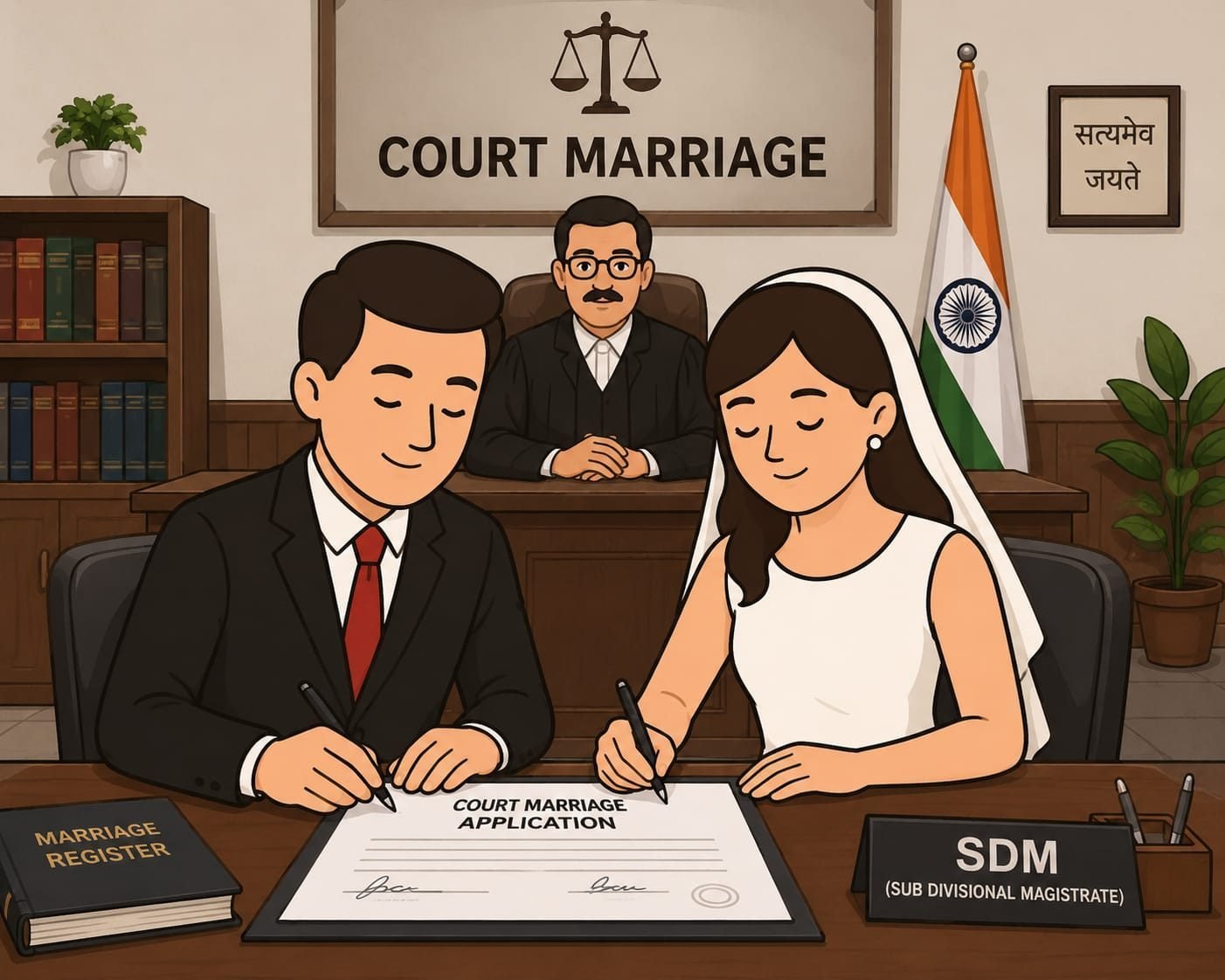
Quick answer: Karawal Nagar and its neighbouring colonies, including Sonia Vihar, Shiv Vihar, Johripur, Dayalpur, Mustafabad, Sherpur and Khajuri Khas, form one of the most crowded corners of North East Delhi, right on the border with Loni in Ghaziabad. Under Delhi's 2026 revenue map, Karawal Nagar is itself one of the four sub-divisions of the North East district (with Gokal Puri, Yamuna Vihar and Shahdara). A Hindu, Sikh, Jain or Buddhist couple can have an Arya Samaj wedding and register it under the Hindu Marriage Act on the e-District portal. A couple of different religions who do not want to convert use the Special Marriage Act, with its 30-day notice. A Muslim couple's nikah is registered under the Delhi 2014 Order. Couples split across the Delhi–UP border must choose where to register, and families living in unauthorised colonies often need extra help with address proof. We handle all of these; court marriage from ₹6,100.
Key takeaways
- From 1 January 2026 Karawal Nagar is one of four sub-divisions of the North East district; e-District allots the office by your address.
- Hindu couples: Arya Samaj wedding + Hindu Marriage Act registration; interfaith couples without conversion: Special Marriage Act.
- Muslim couples: register the nikah under the Delhi 2014 Order, not under the Special Marriage Act by mistake.
- Couples split across the Loni border register once, in Delhi or UP, wherever their documents are strongest.
- A house without a registry is no bar: Aadhaar, voter ID, bills and rent agreements prove residence. We never provide witnesses.
Last reviewed: 22 September 2026 · 37 min read
On this page
- Karawal Nagar at a glance
- Karawal Nagar under the 2026 map
- Which office registers your marriage
- The legal routes
- Arya Samaj + registration
- Registering a wedding already done
- Special Marriage Act
- Nikah and its registration
- Interfaith couples
- Across the Loni border
- If one partner lives in UP
- Address proof in unauthorised colonies
- Tenants and families in shared houses
- If your families oppose
- Small units, shops and daily earners
- Married in the village, living here
- For brides: your rights
- Age: the line we never cross
- Witnesses
- Marrying again
- Grooms working in the Gulf
- Different names in old records
- Documents checklist
- At the appointment
- Questions the officer may ask
- What it costs
- Timeline
- Getting around
- Common mistakes
- After registration
- Lost papers and old mistakes
- Five Karawal Nagar situations
- Checklist
- One-minute summary
- How we help
- Questions and answers
Drive north-east from the Signature Bridge along the Wazirabad road, and within a few kilometres the city changes. The wide roads give way to lanes barely wide enough for an e-rickshaw, lined with three- and four-storey houses built one room at a time over thirty years. This is Karawal Nagar and the colonies around it: Sonia Vihar along the Yamuna embankment, Shiv Vihar and Johripur at the end of the metro's Pink Line, Dayalpur, Sherpur, Mustafabad, Khajuri Khas, Ankur Enclave, Tukmirpur and many more. Most of these colonies grew up as unauthorised settlements; many families came from western and eastern Uttar Pradesh, Bihar and Uttarakhand, and many still have relatives a few minutes away across the border in Loni.
The people are as mixed as the lanes. Hindu and Muslim families live side by side, often in the same building. Men and women work in small jeans and garment units, in workshops, as e-rickshaw drivers, shopkeepers, tailors, teachers and nurses, and in offices across Delhi. Young people study at colleges in the city and meet partners from other castes, other religions and other states. When they decide to marry, the questions they bring us are specific to this part of Delhi: which office do we go to after the 2026 changes? Can we register in Delhi if one of us lives in Loni? Our house has no registry; what do we show as address proof? My partner is Muslim and I am Hindu; do we have to convert? How do we register our nikah? This guide answers them.
For the general Delhi process, see our complete Delhi court marriage guide. Nearby area guides: Yamuna Vihar, Seelampur, Shahdara and Gandhi Nagar.
Karawal Nagar at a Glance
| Item | Detail |
|---|---|
| District (from 1 January 2026) | North East |
| Sub-divisions in the district | Karawal Nagar, Gokal Puri, Yamuna Vihar, Shahdara |
| Neighbouring colonies | Sonia Vihar, Shiv Vihar, Johripur, Dayalpur, Sherpur, Mustafabad, Khajuri Khas, Ankur Enclave, Tukmirpur, Bhagirathi Vihar, Chandu Nagar and others |
| Border | Loni, Ghaziabad district, Uttar Pradesh |
| Metro | Pink Line: Johri Enclave and Shiv Vihar stations, Gokulpuri nearby |
| Electricity supplier | BSES Yamuna Power (bills are a common address proof) |
| Typical questions | Interfaith marriage, nikah registration, UP–Delhi couples, address proof in unauthorised colonies, family opposition |
Karawal Nagar Under the 2026 Revenue Map
On 1 January 2026, Delhi's revenue map was redrawn into 13 districts and 39 sub-divisions. Marriage registration is handled by the Sub-Divisional Magistrate (SDM) acting as Registrar, so the change matters. The North East district now has four sub-divisions: Karawal Nagar, Gokal Puri, Yamuna Vihar and Shahdara. Unlike many areas whose old SDM offices were merged, Karawal Nagar remains a sub-division in its own name, so most couples living in the Karawal Nagar belt will find the Karawal Nagar office on their appointment slip. Colonies nearer Gokulpuri, Bhajanpura or Yamuna Vihar may be allotted to those sub-divisions instead, depending on the exact address.
Certificates issued before 2026 by any office remain fully valid. Nothing needs to be re-registered because the map changed.
Which Office Registers Your Marriage?
You do not choose the office by walking in. You apply on the Delhi e-District portal, and the system allots the registering office based on the address you enter, usually the address of either spouse in Delhi. For a Hindu Marriage Act registration, the office can be the one where the marriage was performed or where either spouse has lived; for the Special Marriage Act, notice is given to the Marriage Officer of the district where at least one of you has lived for the last 30 days. Your appointment slip names the office, and that is the office to go to.
In practice, a couple where the groom lives in Karawal Nagar and the bride in Mustafabad will usually be registered by the North East district office for one of those addresses. A couple where one partner lives in Loni and the other in Delhi can register in Delhi on the Delhi partner's address, or in Uttar Pradesh on the Loni address, as explained below.
The Legal Routes for a Karawal Nagar Couple
| Your situation | Route | Waiting period | Our fee |
|---|---|---|---|
| Both Hindu, Sikh, Jain or Buddhist, want to marry now | Arya Samaj wedding + Hindu Marriage Act registration | Wedding same day; registration by appointment | ₹7,100 combined |
| Already married by Hindu rites, not registered | Hindu Marriage Act registration | By appointment | ₹6,000 |
| Different religions, no conversion | Special Marriage Act | 30-day notice | ₹15,000 |
| Both Muslim | Nikah + registration under the Delhi 2014 Order | Nikah same day; registration by appointment | ₹5,000 nikah; ₹6,000 registration |
| Court marriage with advocate assistance | SMA or SDM registration with drafting | Depends on route | ₹6,100 |
| Hindu–Muslim couple, one partner voluntarily adopting the other's faith | Shuddhi / conversion route, with care | Depends on route | ₹10,000 |
Government fees are extra at actual cost: the official Hindu Marriage Act registration fee is small (₹100), and Tatkal registration costs ₹10,000 where available. See the full price list.
Arya Samaj Wedding + Registration
For two Hindus (including Sikhs, Jains and Buddhists, who are Hindus for the purposes of the Hindu Marriage Act), the quickest complete route is an Arya Samaj wedding followed by registration. The wedding is a short Vedic ceremony with havan and saptapadi, the seven steps that complete a Hindu marriage in law. It can be done on the day you come, once your documents are in order, and you receive the Arya Samaj certificate the same day.
That certificate is proof that a ceremony took place, but it is not a government certificate. For a passport, visa, bank or legal protection, register the marriage under the Hindu Marriage Act on e-District. We file the application, book the appointment and prepare you for it. Our combined package is ₹7,100. Read more on our Arya Samaj marriage page.
The Supreme Court held in Dolly Rani v. Manish Kumar Chanchal (2024) that a Hindu marriage needs the essential ceremonies; a certificate without a real ceremony is not a marriage. An Arya Samaj wedding performed properly meets that requirement.
Registering a Wedding Already Performed
Many Karawal Nagar couples married with full family ceremonies, in the colony, in a banquet hall on the Wazirabad road, or back in the village, and never registered. Now a school admission, a passport or a bank asks for a marriage certificate. Registration of an existing Hindu marriage needs proof of the ceremony (wedding card, photographs, a priest's or mandir certificate), age proof and ID of both spouses, Delhi address proof of at least one, affidavits and two witnesses. Our fee is ₹6,000. Our marriage registration page has the full process.
Special Marriage Act: For Any Two Adults
The Special Marriage Act, 1954 lets any two adults marry as a civil marriage, whatever their religion, without either changing faith. The steps are:
- Notice: filed online to the Marriage Officer of the district where at least one of you has lived for the last 30 days.
- 30-day period: the notice is displayed, and anyone can object on legal grounds only, such as age, an existing spouse or prohibited relationship. Family disapproval is not a legal objection.
- Solemnisation and registration: after 30 days, you appear with three witnesses, sign the declarations and receive the certificate.
Our full Special Marriage Act service is ₹15,000. See inter-religion marriage and our guide on the Special Marriage Act vs the Hindu Marriage Act.
Nikah and Its Registration
For Muslim couples in Mustafabad, Chand Bagh, Kardampuri, Sonia Vihar and the other colonies of the area, the nikah is the marriage. It needs two adults free to marry, free consent, an agreed mahr, the proposal and acceptance in one sitting, and witnesses. Our own Qazi reads nikahs at our office, in homes and in mosques, with nikahnama and certificate, for ₹5,000.
After the nikah, Delhi law requires registration under the Delhi (Compulsory Registration of Marriage) Order, 2014, within 60 days (a further 60 days with a ₹500 fee, then a ₹1,000 penalty). Be careful about the route. For some years, Muslim couples were steered into registering under the Special Marriage Act, which moves their succession from Muslim personal law to the Indian Succession Act. In 2024 the Delhi High Court (Faizan Ayubi) directed that Muslim marriages be registrable online under the 2014 Order. Our nikah registration service (₹6,000) files on the right route.
More: Muslim nikah in Delhi, Muslim love marriage, and the nikah documents and registration guide.
Interfaith Couples: Your Options
In neighbourhoods where Hindu and Muslim families share walls, interfaith relationships are not unusual, and neither is the tension they can cause. The law gives adults three options, and the choice should be the couple's own, made freely and with full knowledge:
| Option | What it means | Consequences |
|---|---|---|
| Special Marriage Act | Civil marriage, no conversion | Both keep their religion; succession under the Indian Succession Act; 30-day notice |
| One partner embraces Islam, nikah | Genuine, voluntary acceptance of Islam, then nikah | Muslim personal law applies; a conversion made only to marry can be questioned; state conversion laws may apply |
| One partner adopts Hinduism (shuddhi), Hindu wedding | Genuine, voluntary adoption of Hinduism, then Arya Samaj wedding | Hindu Marriage Act applies; the same caution about genuineness and state laws |
We never pressure anyone to convert, and we do not conduct conversions made only as a formality to marry. For most interfaith couples who want to keep their own faiths, the Special Marriage Act is the cleanest route. The Supreme Court has repeatedly held that an adult's choice of partner is protected by Article 21 (Shafin Jahan, 2018). See our guide to Hindu–Muslim marriage in India.
Couples Across the Loni Border
From Shiv Vihar or Johripur, Loni is a few minutes away, and many families have one foot on each side of the border. A bride from Loni marries a groom from Karawal Nagar; a couple lives in a rented room in Delhi while their Aadhaar cards show addresses in Ghaziabad; a wedding takes place in a banquet hall in Loni and the couple then settle in Sonia Vihar. The question is always the same: where do we register?
| Situation | Register in Delhi? | Register in UP? |
|---|---|---|
| One spouse has a Delhi address proof | Yes, on that address | Also possible on the UP address |
| Wedding performed in Delhi, both addresses in UP | Often possible on the place of marriage for Hindu Marriage Act registration; check your case | Yes |
| Wedding in Loni, both living in UP | Usually no | Yes, under the UP Marriage Registration Rules, 2017, on the UP portal |
| Special Marriage Act | If at least one has lived in the Delhi district for 30 days | If at least one has lived in the UP district for 30 days |
A marriage needs to be registered only once. A Delhi certificate is valid in Uttar Pradesh and everywhere in India, and a UP certificate is valid in Delhi. Choose the state where your documents are strongest and where you can attend the appointment together with your witnesses. If you are unsure, send us photographs of your documents and we will tell you which route is simpler.
If One Partner Lives in Uttar Pradesh
Couples split across the border should know three things about Uttar Pradesh law:
- Registration in UP is done online under the Uttar Pradesh Marriage Registration Rules, 2017, through the Stamp and Registration Department's portal, followed by a visit to the registration office.
- The Special Marriage Act notice in UP: in Safiya Sultana (2021), the Allahabad High Court held that publication of the 30-day notice is optional in UP, at the couple's request. Delhi follows the Act's standard notice procedure.
- Conversion in UP is governed by the Uttar Pradesh Prohibition of Unlawful Conversion of Religion Act, 2021, which requires prior declarations to the District Magistrate and makes conversion by force, fraud or for marriage alone an offence. If an interfaith couple is considering conversion and either partner lives in UP, or the conversion would take place there, take legal advice first. For most such couples, a Special Marriage Act marriage in Delhi, without conversion, avoids these questions entirely.
Address Proof in Unauthorised Colonies
Many houses in Karawal Nagar, Sonia Vihar, Shiv Vihar and nearby colonies were bought on a general power of attorney, an agreement to sell and a receipt, not a registered sale deed. Families have lived in them for decades, but when a form asks for "proof of residence", they worry that they have none. In practice, residence and ownership are different things. For marriage registration you need to prove where you live, not that you own the house.
Useful address proofs include:
- Aadhaar card with the current address (the simplest);
- voter ID card for the area;
- a BSES Yamuna electricity bill or a Delhi Jal Board water bill, in your name or a family member's name with proof of relationship;
- a passport with the current address;
- a bank passbook or statement showing the address;
- a ration card listing the family at that address;
- for tenants: a rent agreement with the landlord's ID and the police tenant verification receipt.
Under the PM-UDAY scheme, owners in many unauthorised colonies have been able to apply to the Delhi Development Authority for conveyance deeds or authorisation slips. Those documents help with property, but you do not need them to register a marriage. If the bill is in your father's name, a family ID or ration card showing the relationship, or an affidavit, links you to it.
Tenants and Families in Shared Houses
A large share of the area's young people live as tenants: a couple in one room on the third floor, a group of workers from the same village sharing a flat, a family renting two rooms while the landlord lives downstairs. Tenants often have no bill in their name and an Aadhaar card still showing the village. The solutions are practical:
- ask the landlord for a written rent agreement and complete police tenant verification, which also protects you;
- update your Aadhaar address using the rent agreement; it takes some days but solves the problem for years;
- use the other spouse's Delhi address if it is better documented;
- for Hindu Marriage Act registration, use the place where the marriage was performed, if it was in Delhi.
If Your Families Oppose the Marriage
Couples from this area often come to us quietly, because their families oppose the match: a different caste, a different religion, a different state, or simply a choice the family did not make. The law is on the side of adults who choose to marry.
- The Supreme Court in Lata Singh (2006) directed police to protect inter-caste and inter-religion couples from harassment.
- In Shakti Vahini (2018), it held that no family, community or panchayat can interfere with the marriage of two consenting adults, and directed preventive, remedial and punitive measures.
- Delhi Police has special cells and a standard procedure for couples under threat, and safe houses can be provided. The women's helpline is 181, and 112 is for emergencies.
- Couples can also approach the Delhi High Court for protection; the Court routinely orders police to ensure their safety.
Practical steps: keep your ID, age proof and phone with you; keep copies of documents with a trusted friend; choose witnesses who support you; register quickly, because a certificate is strong proof; and if you receive threats, record them and approach the police or court. We keep every case confidential. See our love marriage service and guide to love marriage legal rights.
Small Units, Shops and Daily Earners
A great deal of Karawal Nagar's economy runs on small enterprises: jeans stitching and washing units, embroidery and finishing workshops, e-rickshaw fleets, grocery and hardware shops, tailoring, mobile repair and home tuition. People here work long hours, often six or seven days a week, and cannot afford to lose many days to paperwork.
- No income proof is needed to marry or to register a marriage. Registration asks about age, identity, residence and the marriage, not about salary.
- Plan around your off day. We check documents on WhatsApp in the evening, conduct Arya Samaj weddings and nikahs on your off day, and book registration appointments on dates you can manage.
- Bring your employer's letter if you live at the workplace or in a room provided by the employer; with an affidavit, it can support your address.
- After registration, add your spouse to your ration card, bank account nomination and, where you are covered, to ESIC and EPF records. The certificate makes this simple.
Married in the Village, Living in Karawal Nagar
Many families here came from villages in Uttar Pradesh, Bihar and Uttarakhand. A son marries in the village with full ceremonies, brings his wife to Delhi, and only years later discovers that no one has a marriage certificate. The marriage is valid if the essential ceremonies were performed, both were of legal age, and neither had a living spouse. What is missing is proof.
You can register such a marriage once, either in the home state or in Delhi on the basis of your Delhi residence. For Delhi registration, bring the wedding card, photographs showing the ceremony, a certificate from the priest or temple if available, age proof and ID for both, Delhi address proof, and affidavits. Check the ages carefully: if either spouse was under age (21 for the groom, 18 for the bride) on the wedding date, take advice before applying.
For Brides: Your Rights
Every bride, whatever her religion and whatever the route, has rights that a marriage certificate helps her enforce:
- Stridhan: gifts and jewellery given to a Hindu bride are her own property; the husband and in-laws hold them in trust.
- Mahr: for a Muslim bride, her mahr is her own money, recorded in the nikahnama. See our mahr guide.
- Maintenance: a wife who cannot maintain herself can claim maintenance under section 144 of the Bharatiya Nagarik Suraksha Sanhita, and under personal law.
- Residence and protection: the Protection of Women from Domestic Violence Act, 2005 protects every woman in a domestic relationship, with residence, protection and money orders.
- Dowry is a crime: giving, taking or demanding dowry is punishable under the Dowry Prohibition Act, 1961.
Keep your own copies of your marriage certificate, wedding photographs and any nikahnama. For Muslim brides, read the guide to Muslim women's rights in marriage.
Age: The Line We Never Cross
The groom must be at least 21 and the bride at least 18, shown by a reliable age document: a Class 10 certificate, a birth certificate or a passport. Aadhaar is identity proof, not reliable age proof. We do not conduct any marriage, Arya Samaj wedding or nikah where either party is under age, whatever the family's wishes, and we advise every family to wait. The Prohibition of Child Marriage Act, 2006 punishes those who perform, conduct or promote child marriages, and the POCSO Act protects children from exploitation. See our guide on the marriage age limit in India.
Witnesses
A Hindu Marriage Act registration needs two witnesses, a Special Marriage Act marriage needs three, and a nikah needs witnesses according to the school followed. Registration witnesses bring photo ID and address proof, and must actually know you. Relatives, friends, neighbours, co-workers or your landlord can be witnesses.
We do not provide witnesses. A witness who does not know you is not a real witness, and using one can make the record false. Bring people who know you both. Read more in our witness requirements guide.
Marrying Again After Divorce or a Spouse's Death
Second marriages are common, and the law fully allows them once the first marriage has ended. What matters is proof.
- Divorced Hindus need a certified copy of the court's divorce decree. Under the Hindu Marriage Act, a person may remarry once the decree is final and no appeal is pending. A panchayat or "stamp paper" divorce does not end a Hindu marriage; only a court decree does, except where a recognised custom of divorce applies, which must be proved.
- Divorced Muslims need the talaqnama, khulanama, mubarat deed or court decree, and a woman must have completed her iddat.
- Widowed persons need the former spouse's death certificate; a Muslim widow must also have completed her iddat of four months and ten days.
- A marriage under the Special Marriage Act can end only by a court decree, whatever the parties' religion.
Marrying while a previous marriage still subsists is bigamy, a criminal offence for those whose personal law requires monogamy, and the second marriage is void. The Supreme Court made clear in Sarla Mudgal (1995) that converting to another religion does not dissolve a Hindu marriage or permit a second one. We check these documents carefully before any wedding.
Grooms Working in the Gulf and Abroad
Many young men from North East Delhi work in Saudi Arabia, the UAE, Qatar, Kuwait and Oman as drivers, electricians, technicians and in shops, returning home once a year or once in two years. Weddings are planned around that short leave, and the marriage certificate is often needed urgently for the wife's passport and family visa.
- Before he lands: send photographs of both partners' documents on WhatsApp so we can check them in advance.
- First week of leave: hold the Arya Samaj wedding or nikah.
- Immediately after: file for registration and, where there is a genuine visa deadline, ask about Tatkal.
- Before he flies back: attend the registration appointment together; this is very hard to arrange once he has left.
- For the visa: the Gulf countries usually need the certificate attested or apostilled (Saudi Arabia joined the Apostille Convention in 2022; the UAE has traditionally required embassy attestation). Check the current rules for the destination country.
Our NRI marriage service, NRI nikah service and the apostille and visa guide explain the full process.
Different Names in Old Records
Families who moved from villages decades ago often have records with different spellings, a father's name written differently, or a date of birth on Aadhaar that does not match the school certificate. A bride may be "Pooja" on one card and "Puja Kumari" on another; a groom may have "Mohd." on one document and "Mohammad" on another. These differences are common and easy to handle if you prepare:
- choose one spelling, preferably the one on the passport or Class 10 certificate, and use it everywhere in the application;
- swear a one-and-same-person affidavit listing every version of the name;
- for dates of birth, use the school certificate or birth certificate, and explain the difference by affidavit;
- after the wedding, correct Aadhaar and other records to match, so the problem does not follow you.
Never pick a date of birth to make someone appear older. A false statement about age is an offence and can void the whole process.
Documents Checklist
| Document | Who | Notes |
|---|---|---|
| Age proof | Both | Class 10 certificate, birth certificate or passport |
| Photo ID | Both | Aadhaar, voter ID, passport, driving licence or PAN |
| Address proof | At least one in Delhi | Aadhaar, voter ID, BSES or DJB bill, passport, rent agreement with tenant verification |
| Photographs | Both | Passport size, plus wedding photographs for registration of an existing marriage |
| Proof of the wedding | For registration of a performed marriage | Wedding card, Arya Samaj certificate, nikahnama, photographs |
| Affidavits | Both | Age, marital status, nationality; one-and-same-person if names differ |
| Divorce decree or death certificate | If married before | Certified copy of the decree, or the former spouse's death certificate |
| Witnesses' ID and address proof | Each witness | Two for Hindu Marriage Act registration, three for the Special Marriage Act |
Full list with explanations: documents required for court marriage in Delhi.
At the Appointment
Both spouses and the witnesses attend the office named on your appointment slip, with all originals. Arrive early. The officer checks the originals against the uploaded copies, confirms identities, and may ask simple questions: when and where you married, whether either of you was married before, and whether you are marrying of your own free will. Witnesses confirm that they know you. If everything is in order, you sign the register and the certificate is issued, often digitally, the same day or within a few days.
Tips: carry two sets of photocopies, keep documents in the order of the checklist, and make sure every name is spelt the same way everywhere. If your names differ across documents, bring the one-and-same-person affidavit.
Questions the Officer May Ask
Couples often worry more about the appointment than about anything else. There is no need. The officer's job is to confirm that the documents are genuine, that you are the people named in them, that you are of legal age and free to marry, and that you are marrying of your own free will. The questions are simple, and the best answers are short and truthful.
| Question | Why it is asked | How to answer |
|---|---|---|
| When and where did you marry? | To match the application and wedding proof | Give the date and place exactly as in the application and certificate |
| Who performed the ceremony? | To confirm the ceremony took place | Name the Arya Samaj, temple, priest or Qazi |
| Were either of you married before? | To confirm freedom to marry | Answer honestly and show the decree or death certificate if so |
| Are you marrying by your own choice? | To confirm free consent | Say so clearly; the officer may ask the bride separately |
| How do the witnesses know you? | To confirm they are real witnesses | Witnesses explain the relationship in their own words: relative, friend, neighbour, colleague |
| Why are the names different in these documents? | To confirm identity | Show the one-and-same-person affidavit |
Do not memorise answers or let anyone coach your witnesses to say things that are not true. If you do not know something, say so. Officers deal with hundreds of couples and can tell a nervous but honest couple from a rehearsed story. If a question relates to a problem in your documents, the officer may ask you to bring an additional document or affidavit on another date; that is a correction, not a refusal.
Special Marriage Act couples also sign declarations at the solemnisation, in the presence of the Marriage Officer and three witnesses, stating that they are of legal age, not married to anyone else and not within prohibited degrees of relationship. Read each declaration before signing. Nikah registration under the 2014 Order is similar to Hindu Marriage Act registration: the officer checks the nikahnama, the documents and the witnesses, and confirms the details with both spouses.
What It Costs
| Service | Our fee |
|---|---|
| Arya Samaj marriage (same day) | ₹5,100 |
| Hindu Marriage Act registration of an existing marriage | ₹6,000 |
| Court marriage (advocate assisted) | ₹6,100 |
| Arya Samaj + registration combined | ₹7,100 |
| Hindu–Muslim / inter-religion marriage | ₹10,000 |
| Special Marriage Act, full process | ₹15,000 |
| Muslim nikah with certificate | ₹5,000 |
| Nikah registration (Delhi 2014 Order) | ₹6,000 |
| Muslim love marriage | ₹7,000 |
Government fees, stamp paper and notary charges are paid at actual cost. Tatkal, where available, adds ₹10,000 government fee. Full list: fees.
Timeline
| Route | Typical time |
|---|---|
| Arya Samaj wedding | Same day, once documents are ready |
| Nikah | Same day, once documents, witnesses and mahr are ready |
| Hindu Marriage Act registration | Depends on the appointment; Tatkal is faster where available |
| Nikah registration under the 2014 Order | Depends on the appointment |
| Special Marriage Act | 30 days' notice, then solemnisation; about 5–7 weeks in practice |
Getting Around
The Pink Line of the Delhi Metro reaches Johri Enclave and Shiv Vihar, with Gokulpuri a little further south, making it easier than before to reach the rest of Delhi from the northern colonies. From Sonia Vihar and the Yamuna side, the Wazirabad road and the Signature Bridge connect to North Delhi. Roads inside the colonies are narrow and crowded in the mornings, so leave early on appointment days, and agree a meeting point with your witnesses near a metro station rather than searching for each other in the lanes. If needed, we can arrange pickup and drop within Delhi NCR (₹1,500).
Common Mistakes
- Using Aadhaar as the only age proof. Bring a Class 10 certificate, birth certificate or passport.
- Different spellings of names across documents, with no affidavit explaining them.
- Assuming a house without a registry means no address proof. Bills, Aadhaar, voter ID and rent agreements all work.
- Registering a nikah under the Special Marriage Act by mistake, changing succession without realising it.
- Converting in a hurry to marry, instead of considering the Special Marriage Act.
- Registering in two states. One registration is enough.
- Witnesses who cannot come on the appointment day, or who do not know the couple.
- Waiting too long after a village wedding or nikah; late registration needs more proof and, for a nikah, a penalty.
- Trusting agents who promise registration "without appearance" or offer witnesses.
After Registration: Updating Your Records
The marriage certificate is the key that opens many other doors. Once you have it, work through this list in the first few months:
- Ration card: add your spouse to the family's Delhi ration card, or, if the card is in the home state, use One Nation One Ration Card portability to draw rations in Delhi.
- Aadhaar: update the wife's address (and surname, if she chooses to change it) using the marriage certificate and address proof.
- Bank: add your spouse as nominee, or open a joint account.
- Passport: apply for a passport, or update it with the spouse's name, on the Passport Seva portal.
- Voter ID: a bride who has moved to Karawal Nagar can transfer her voter registration to her new address.
- ESIC, EPF and insurance: add your spouse as a dependant or nominee.
- Children: the certificate makes birth registration and school admissions simpler, and protects children's rights to inherit.
If something happens to the earning spouse, a registered marriage makes claims for insurance, provident fund, compensation and inheritance far quicker. Families in this area have too often discovered this the hard way.
Lost Papers and Old Mistakes
Documents get lost in house moves, floods along the Yamuna embankment and fires. If your marriage certificate is lost, a duplicate or a certified copy can be obtained from the issuing office; if you registered on e-District, the digital certificate can usually be downloaded again. If a nikahnama is lost, a certified copy may be available from the Qazi's register, or a duplicate can be prepared. If a certificate has a spelling or date error, apply for correction to the issuing office with supporting documents. Keep digital copies of everything in your email.
Five Karawal Nagar Situations
The bride from Loni
A groom from Johripur and a bride from a colony in Loni married with family ceremonies in a banquet hall in Delhi. Both Aadhaar cards were in order, but only the groom had a Delhi address. We registered the marriage under the Hindu Marriage Act in Delhi on his address, with the wedding card, photographs and two relatives as witnesses. The bride then updated her Aadhaar to her new Delhi address using the certificate.
The couple who kept their faiths
A Hindu woman from Karawal Nagar and a Muslim man from Mustafabad had known each other since college. Neither wanted to change religion. They filed notice under the Special Marriage Act, their friends from college were the three witnesses, and the marriage was solemnised after the 30-day period. Both families came round within a year.
The nikah registered on the right route
A couple in Sonia Vihar had their nikah read by their local Qazi and tried to register online, but the application ended up in the Special Marriage Act category. Before the appointment, they asked us to check. We explained the succession consequences, and re-filed under the 2014 Order, which records the nikah while Muslim personal law continues.
The house without a registry
A family in Shiv Vihar had lived in their house for 22 years, bought on a power of attorney. The groom's Aadhaar was in order, the electricity bill was in his father's name, and the family ration card showed them all at that address. That was enough; the lack of a registered sale deed was never an issue for the marriage registration.
The couple under pressure
An inter-caste couple from Dayalpur came to us after the bride's family threatened them. Both were adults with valid age proof. We conducted the Arya Samaj wedding, registered the marriage, and explained how to approach the police special cell and the High Court for protection. They received a protection order and now live in another part of Delhi.
Checklist
- ☐ Choose the route: Arya Samaj + registration, Special Marriage Act, nikah + 2014 Order, or registration of an existing marriage
- ☐ Decide Delhi or UP registration if one of you lives across the border
- ☐ Age proof for both (Class 10, birth certificate or passport)
- ☐ Photo ID for both
- ☐ Delhi address proof for at least one (Aadhaar, voter ID, bill, rent agreement)
- ☐ Wedding proof, if already married
- ☐ Affidavits; one-and-same-person if names differ
- ☐ Your own witnesses with ID and address proof
- ☐ Appointment date agreed with witnesses
- ☐ After the certificate: ration card, Aadhaar, bank, passport, ESIC/EPF
One-Minute Summary
- Karawal Nagar is one of four sub-divisions of the North East district from 1 January 2026; e-District allots the office by address.
- Hindu couples: Arya Samaj + Hindu Marriage Act registration (₹7,100 combined).
- Interfaith couples without conversion: Special Marriage Act, 30-day notice (₹15,000).
- Muslim couples: nikah (₹5,000) and registration under the Delhi 2014 Order (₹6,000), not the Special Marriage Act by mistake.
- Loni–Delhi couples register once, in whichever state suits their documents.
- No registry? Aadhaar, voter ID, bills and rent agreements are valid address proof.
- Bring your own witnesses; we never provide them.
How We Help
We check documents on WhatsApp, advise on the right route and the right state, prepare affidavits, conduct Arya Samaj weddings and nikahs with our own pandit and Qazi, file registration and Special Marriage Act applications, and prepare you for the appointment. Every case is confidential. We do not provide witnesses, and we do not marry anyone under the legal age.
Court marriage for Karawal Nagar couples
Court marriage ₹6,100 · Arya Samaj + registration ₹7,100 · Special Marriage Act ₹15,000 · Nikah ₹5,000.
Book Court Marriage – ₹6,100 →Also: Arya Samaj marriage · Inter-religion · Muslim nikah
Questions and Answers: Court Marriage for Karawal Nagar Couples
Sources and Official References
Facts in this guide were checked against the following primary sources. Government procedures and office allocations change, so confirm current details on the official portal before applying.
- Delhi e-District – official online application portal
- Revenue Department, Delhi – notification dated 25 December 2025 creating 39 sub-divisions and 13 areas
- The Hindu Marriage Act, 1955 – India Code
- The Special Marriage Act, 1954 – India Code
- The Delhi (Compulsory Registration of Marriage) Order, 2014 – Revenue Department, Delhi
- Delhi High Court directs online registration of Muslim marriages (Faizan Ayubi, November 2024) – LiveLaw
- Uttar Pradesh Stamp and Registration Department – marriage registration portal
- PM-UDAY scheme for unauthorised colonies – Delhi Development Authority
- Lata Singh v. State of U.P., Supreme Court, 2006 – Indian Kanoon
- Shakti Vahini v. Union of India, Supreme Court, 2018 – Indian Kanoon
- Shafin Jahan v. Asokan K.M., Supreme Court, 2018 – Indian Kanoon
- Safiya Sultana v. State of U.P., Allahabad High Court, 2021 – Indian Kanoon
- Sarla Mudgal v. Union of India, Supreme Court, 1995 – Indian Kanoon
This guide is general information, not legal advice for your specific case. Call +91 8376863962 for advice on your situation.
Related Articles
👶 Seemapuri: Your Children’s Papers
Birth registration, RTE school admission and a child’s passport — and the myths that cost families most.
Read →🏰 Court Marriage in Kotwali (Old Delhi)
Interfaith, nikah, Anand Karaj, church weddings.
Read →🏡 Yamuna Vihar: GPA Houses and Widows
Property papers, succession and the certificate.
Read →🕌 Court Marriage in Seelampur
Nearby North East area.
Read →🚉 Court Marriage in Shahdara
North East district guide.
Read →🧵 Court Marriage in Gandhi Nagar
East Delhi traders' guide.
Read →📜 Nikah Documents & Registration
Muslim marriage registration.
Read →🤝 Hindu–Muslim Marriage
Legal options explained.
Read →❤️ Love Marriage Rights
If families oppose.
Read →📄 Documents Required
Full documents list.
Read →👥 Witness Requirements
Who can be a witness.
Read →🏛️ Court Marriage in Delhi
The complete Delhi guide.
Read →