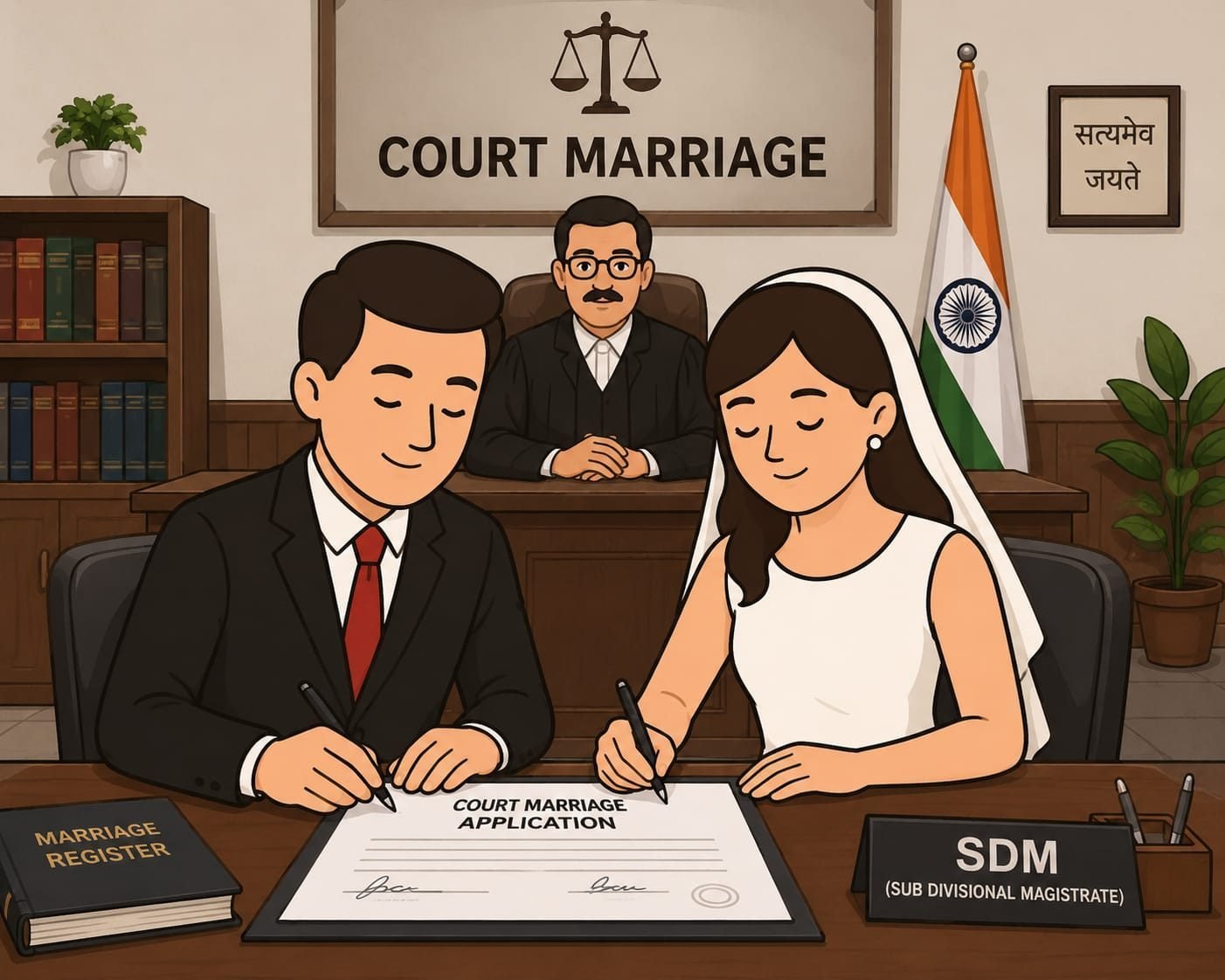
Quick answer: If you live around Saraswati Vihar, Pitampura, Shalimar Bagh, Ashok Vihar, Rani Bagh or Paschim Vihar, there is something you need to know before you go anywhere: “Saraswati Vihar” is no longer one of Delhi’s sub-divisions. Under the revenue reorganisation effective 1 January 2026, Delhi has 13 districts and 39 sub-divisions, and Saraswati Vihar is not among them — the area it covered has been redistributed. Every guide, signboard photo and old form that still says “SDM Saraswati Vihar, North West Delhi” is out of date, including the earlier version of this page. Your existing certificate is completely unaffected. A document is not cancelled because the office that issued it was renamed or reorganised — and that single principle, which nobody explains anywhere, is what most of this guide is about: old certificates naming offices that no longer exist, duplicates, corrections, lost documents, and every other record in your life that names a bank, a municipality or a district that has since changed its name. Marriage certificate, duplicate or correction: ₹2,500.
Key takeaways
- Saraswati Vihar is not one of Delhi’s 39 sub-divisions any more. The 2026 reorganisation redistributed it; a new Central North district covers Shakur Basti, Shalimar Bagh and Model Town.
- Your old certificate is completely valid. A document is not invalidated because the office named on it was renamed, merged or abolished — nothing needs re-registering.
- Anybody who tells you an old certificate must be “re-done” for a fee is taking your money. Call and ask before you pay anyone.
- A duplicate or correction goes to the successor office, which e-District identifies. What decides the speed is whether you can give the registration number — write it down today.
- A clerical error is correctable; a post-marriage name change is a different process and no office treats it as a correction.
- The same continuity principle covers old bank passbooks after a merger, old municipal receipts, old utility bills and a decree from a court that has moved.
- A marriage cannot be registered after a spouse has died. If both are alive and it is unregistered, do it this month.
Last reviewed: 23 September 2026 · 38 min read
On this page
- Saraswati Vihar at a glance
- The sub-division that no longer exists
- Which office registers your marriage now
- Is my old certificate still valid?
- The legal routes
- Arya Samaj + registration
- Special Marriage Act
- Registering a wedding held years ago
- Getting a duplicate certificate
- If the certificate is genuinely lost
- Corrections: what can and cannot be changed
- Attested and certified copies
- DigiLocker and digital copies
- When the issuing office has been reorganised
- The principle behind all of this
- Old district and locality names on documents
- Municipal reorganisation and your papers
- Bank mergers, IFSC codes and old passbooks
- Electricity and water bills in an old company’s name
- A decree from a court that has moved
- Society, DDA and flat records
- Children abroad asking for documents
- If your families oppose
- Age
- Witnesses
- Documents checklist
- At the appointment
- What it costs
- Timeline
- Getting there
- Common mistakes
- Six local situations
- Checklist
- One-minute summary
- How we help
- Questions and answers
Saraswati Vihar at a Glance
Saraswati Vihar sits in the belt of planned North West Delhi that grew through the 1980s and 1990s — DDA flats and cooperative group housing societies, with Pitampura, Shalimar Bagh, Ashok Vihar, Rani Bagh, Wazirpur and Paschim Vihar around it. Many of the families here have been in the same flat for thirty years. A large number of them are Partition-era families and their children; a large number of those children now live in Canada, the United States, Australia or the Gulf.
That produces a very particular pattern of work for us. Yes, couples get married. But at least as often somebody calls because a document from decades ago is suddenly needed — for a property mutation, a pension, an insurance claim, an OCI application, or a spouse visa for a child abroad — and it names an office, a district, a bank or a municipal body that no longer exists under that name.
This guide covers the marriage routes properly. But its real subject, and the reason it is longer than most, is record continuity: what happens to your papers when the institutions named on them are reorganised, and what to do about it.
| Question | Short answer |
|---|---|
| Is Saraswati Vihar still a sub-division? | No. From 1 January 2026 Delhi's 39 sub-divisions do not include it. See below. |
| Is my old certificate cancelled? | No. Nothing is cancelled, nothing needs re-registering. See is my old certificate still valid. |
| Where do I go now for a duplicate? | To the successor office, which e-District identifies from your address. See when the issuing office has been reorganised. |
| Can a wrong spelling on the certificate be fixed? | A clerical error, usually yes. The substance of the marriage, no — see corrections. |
| Do you provide witnesses? | No. Never. Your own people, with their own original ID. |
| What does it cost? | Certificate, duplicate or correction ₹2,500; marriage registration ₹6,000; court marriage ₹6,100; Arya Samaj with registration ₹7,100; Special Marriage Act ₹15,000. Government charges separate and itemised. |
The Sub-Division That No Longer Exists
With effect from 1 January 2026, Delhi's revenue administration was reorganised into 13 districts and 39 sub-divisions. Here is the full list, because almost nobody publishes it and half the confusion in this area comes from not having seen it:
| District | Sub-divisions |
|---|---|
| Central | Patel Nagar, Karol Bagh |
| Central North | Shakur Basti, Shalimar Bagh, Model Town |
| East | Gandhi Nagar, Vishwas Nagar, Patparganj |
| New Delhi | New Delhi, Delhi Cantonment |
| North | Burari, Adarsh Nagar, Badli |
| North East | Karawal Nagar, Gokal Puri, Yamuna Vihar, Shahdara |
| North West | Kirari, Nangloi Jat, Rohini |
| Old Delhi | Sadar Bazar, Chandni Chowk |
| Outer North | Mundka, Narela, Bawana |
| South | Chhatarpur, Malviya Nagar, Deoli, Mehrauli |
| South East | Jangpura, Kalkaji, Badarpur |
| South West | Najafgarh, Matiala, Dwarka, Bijwasan |
| West | Vikaspuri, Janakpuri, Rajouri Garden |
Saraswati Vihar is not on that list. It was a sub-division of the old North West district; the area it administered has been redistributed among the new sub-divisions, and a new Central North district now covers Shakur Basti, Shalimar Bagh and Model Town.
You will still see “SDM Saraswati Vihar” on old forms, in old guides, on stationery, in search results and in the memory of anybody who did paperwork here before 2026. None of that is dishonest; it is simply out of date. Check the date on anything you are reading — including this page, which was last reviewed in September 2026.
Which Office Registers Your Marriage Now
- The SDM / Registrar of Marriages registers a marriage under the Hindu Marriage Act, 1955 or the Delhi (Compulsory Registration of Marriage) Order, 2014. This is the office that issues the certificate almost everyone needs.
- The Marriage Officer handles the Special Marriage Act, 1954 — notice, thirty-day display, objections, solemnisation and certificate.
- The Arya Samaj mandir performs the wedding ceremony and issues its own certificate recording the ceremony. It is not a government marriage certificate and no bank, passport office or embassy treats it as one.
Jurisdiction follows where you reside. For long-settled families in this belt that is usually straightforward. For a son or daughter who has moved out and rents elsewhere in Delhi, the jurisdiction is where they live now, not the parents' flat — which surprises families constantly and is worth settling before anyone takes leave.
“Is My Old Certificate Still Valid?”
We get this call several times a month, usually from an elderly couple or from a son abroad who has read something alarming online. The answer is always the same, and it is worth understanding why it is the same, because the same reasoning protects a great many of your other documents too.
A certificate records a fact: that on a particular date, two named people were married, and that the marriage was entered in a register. The reorganisation of an administration changes who keeps the register going forward. It does not reach back and unmake the entry, and it does not unmake the certificate that was issued from it. This is the whole of it. See the principle behind all of this.
Be careful of anybody who tells you otherwise. “Your certificate is from an abolished office, it has to be re-done, the fee is X” is a straightforward way to take money from worried people, and it is aimed particularly at the elderly and at families operating from abroad. If you are told this by anybody, call us and ask before you pay anybody anything.
The Legal Routes
| Your situation | Route | Time | Our fee |
|---|---|---|---|
| Both Hindu, Sikh, Jain or Buddhist; want to marry now | Arya Samaj ceremony, then registration under the Hindu Marriage Act, 1955 | Ceremony same day; registration usually same or next day | ₹7,100 |
| Already married by ceremony (any year); need the certificate | Registration under the Hindu Marriage Act or the Delhi 2014 Order | Usually one appointment | ₹6,000 |
| Certificate lost, damaged, or carrying a wrong spelling | Duplicate or correction from the record-holding office | Usually two to four weeks | ₹2,500 |
| Straightforward civil registration with full documentation support | Court marriage assistance | Depends on route | ₹6,100 |
| Different faiths and neither will convert | Special Marriage Act, 1954 | 30 days' notice minimum | ₹15,000 |
| Muslim couple, nikah performed or to be performed | Nikah, then registration under the Delhi 2014 Order | Usually one appointment | ₹6,000 |
Arya Samaj Wedding Plus Registration
An Arya Samaj wedding is a Vedic ceremony performed by a pandit — havan, vows, pheras. The Arya Marriage Validation Act, 1937 recognises the validity of a marriage solemnised in that form between persons professing the Arya Samaj faith, and the ceremony is available to Hindus, Sikhs, Jains and Buddhists. The mandir issues its certificate the same day.
That certificate records the ceremony. The document the world acts on is the one issued after registration under the Hindu Marriage Act, 1955 at the SDM office — a separate application, with its own forms, fee and appointment.
The Special Marriage Act, Step by Step
A civil marriage. Nobody converts, nobody performs a religious ceremony, and the marriage is valid regardless of what either family believes.
- Residence. At least one party must have resided in the district for 30 days before the notice.
- Notice in writing to the Marriage Officer of the district.
- Public display for 30 days. A requirement of the Act. Nobody can lawfully shorten or hide it.
- Objections only on a ground the Act recognises — a party under age, a living spouse, a prohibited degree of relationship. Family disapproval is not a legal objection.
- Solemnisation before the Marriage Officer with three witnesses.
- Certificate issued and signed.
Budget about sixty days end to end. One point that matters for families in this belt: the Act contains its own succession provisions, which differ from what would otherwise apply to some families. That is not a reason to avoid it — it is a reason to ask an advocate before you file if family property arrangements matter to you. Our SMA versus HMA guide compares the two.
Registering a Wedding Held Years Ago
A very common request here, and usually straightforward even when the wedding was decades ago.
What helps the application:
- the wedding invitation card, if one survives;
- photographs of the ceremony;
- a certificate from the mandir, pandit or qazi, where one can be obtained;
- both parties' age proof, identity proof and current address proof;
- affidavits from both spouses stating the date, place and fact of the marriage;
- two witnesses who actually know you as a married couple — someone who attended the wedding, a long-standing neighbour, a sibling.
Under the Delhi 2014 Order, late registration attracts ₹500 for the second sixty days and a ₹1,000 penalty after that, and registration remains possible however late. Our fee for this is ₹6,000.
Getting a Duplicate Certificate
Certificates get lost, get damaged in a flood or a shifting, get eaten by damp in a Delhi monsoon, or get taken abroad by a child and never come back. A duplicate is an ordinary, routine thing to apply for and there is nothing embarrassing about needing one.
What a duplicate application generally needs:
- An application to the office that holds the record — the successor of the office that registered the marriage. See below for how to find it when the original office has been reorganised.
- Whatever identifying detail you have about the original registration: the date of marriage, the date of registration, the registration or serial number, and the names exactly as they appeared. A photocopy of the old certificate, even a poor one, makes everything faster.
- Identity proof of the applicant, and proof of the relationship where somebody other than a spouse is applying.
- An affidavit explaining the loss or damage.
- A police report or lost-article report, where the office asks for one — see the next section.
- The prescribed government fee, paid at the counter or online, with a receipt.
Our fee for handling a duplicate is ₹2,500, and government charges are separate and shown on your receipt. Realistically, allow two to four weeks — longer for a very old record that has to be retrieved from a record room rather than a database.
If the Certificate Is Genuinely Lost
Do these in order:
- Search properly first. Old property files, the locker, the insurance folder, the file the wedding album lives in, a child's visa folder abroad. A surprising number of “lost” certificates are in a house.
- Look for a copy before a duplicate. A photocopy, a scan in an old email, a WhatsApp forward from when a child applied for a visa, an attested copy in a bank or embassy file. A copy is not a substitute for the certificate, but it carries the registration details and makes the duplicate far quicker.
- File a lost report. Delhi Police accept online reports for lost documents and issue an acknowledgement, which is what most offices want. Keep it.
- Then apply for the duplicate, as above.
What not to do: do not accept a “reconstructed” certificate from anybody, do not let anyone produce a certificate without the office record behind it, and do not hand your originals or your affidavit to a person you met outside an office. A fabricated certificate fails at the first serious check — usually at an embassy, where the consequences are far worse than a delay.
Corrections: What Can and Cannot Be Changed
Wrong spellings on marriage certificates are common, particularly on older ones, because names were transliterated by hand from documents that themselves disagreed.
| Usually correctable | Not a correction at all |
|---|---|
| A misspelt name, where your identity documents show the correct spelling | Changing who the parties are |
| A wrong father's name, where documents support it | Changing the date of the marriage to a different event |
| An obviously wrong date of birth, supported by age proof | Adding or removing a marriage |
| A clerical error in the address or the place of registration | A post-marriage name change — that is a separate process, not a correction |
| A typographical error in the registration entry | Anything requiring the office to accept a different set of facts |
A correction is applied for to the office holding the record, with an affidavit and the documents that prove the correct particulars. Our fee for handling it is ₹2,500.
One more practical point. If the error is on the certificate and on your Aadhaar and on your PAN, fix them in a sensible order rather than all at once: establish which spelling is correct, correct the identity documents, and then use them to support the certificate correction. Going the other way round produces an application the office cannot grant.
Attested and Certified Copies
Different institutions want different things, and the words are used loosely, so it is worth separating them:
- A photocopy is just a photocopy. Almost nothing official accepts one on its own.
- A self-attested copy is a photocopy you have signed. Many Indian offices accept this now, and it costs nothing.
- A notarised copy is certified by a notary against the original. Commonly wanted by banks and some employers.
- A certified copy issued by the office that holds the register is the strongest — it comes from the record, not from your document.
- An apostilled or embassy-attested certificate is what a foreign authority wants, and it is done on the certificate itself through the prescribed route. See our apostille and visa guide.
Practical advice for a family whose children live abroad: get two or three certified or notarised copies made now, while everybody is well and the certificate is in the house, and keep them in different places. The time you will need one is exactly the time it is hardest to arrange.
DigiLocker and Digital Copies
A certificate issued through Delhi's e-District system can usually be kept in DigiLocker, which is recognised as a valid document holder. For an older paper certificate there may be no digital record to pull, but that does not stop you creating your own safety net:
- photograph the certificate properly — flat, in daylight, all four corners visible, text readable;
- email the photograph and a PDF to both spouses' email addresses, and to one child if they are abroad;
- keep the original flat in a folder, not folded into a wallet, and not in a damp cupboard;
- write the registration number and date of registration on a separate note kept elsewhere — if the certificate is ever lost, those two details are what make a duplicate quick.
This takes fifteen minutes once. We have watched families spend three months on a duplicate that would have taken a fortnight if somebody had written down the registration number.
When the Issuing Office Has Been Reorganised
This is the practical question behind the whole page: the office named on my certificate does not exist any more — where do I go?
You go to the successor office: the one that now holds, or can retrieve, the register for that area and that period. Records do not evaporate when an administration is reorganised; they are transferred, and the successor office is responsible for them.
How to find it without wasting days:
- Start on the Delhi e-District portal with the address as it was at the time of the registration, and see which office it allots. That is your first stop.
- Take everything you have — any old photocopy, the registration number, the date of registration, the exact names as they were then, and the address as it was then. The old address matters more than your current one for finding an old record.
- Ask specifically for the record room if the period predates the digital system. The counter staff deal with current applications; an old register is a different request and saying so plainly saves an afternoon.
- Get every instruction in writing, or at minimum write down the name and designation of whoever gave it to you. When an old record is involved you may be sent between two offices once, and a written note stops the loop from repeating.
- Do not pay anybody standing outside to “get it traced”. It is an ordinary application, and there is nothing to expedite.
We do this for families as part of the ₹2,500 duplicate or correction service, and the honest position is that the time it takes depends almost entirely on how well the original registration can be described. That is why writing down the registration number matters so much.
The Principle Behind All of This
This is not a special rule about marriage certificates. It is how continuity of records works generally, and it applies to almost every piece of paper an old Delhi family holds:
- a marriage certificate from an SDM office that has since been reorganised;
- a passbook from a bank that has since been merged into another;
- an electricity bill from a utility that was unbundled twenty years ago;
- a property receipt from a municipal body that has since been split and re-unified;
- a birth or death certificate from a district that has since been redrawn;
- an insurance policy from a company that has changed its name;
- a degree from a college that now sits under a different university.
In each case the correct move is the same: identify the successor, take whatever identifying details you have, and apply to it. What is not correct, and what costs people money, is assuming the document is dead and starting again from scratch — or worse, letting somebody persuade you that it is dead and charge you to “renew” it.
The sections below apply the same reasoning to the specific records that come up most often in this belt.
Old District and Locality Names on Documents
Delhi's district map has changed more than once in living memory. Nine districts were created in the 1990s; two more were added in 2012, taking it to eleven; and the 2026 reorganisation took it to thirteen with a redrawn set of thirty-nine sub-divisions. A document from 1998, 2010 and 2024 can each name a different district for the same flat.
What this means in practice:
- A document naming an old district is not wrong. It was right when it was issued, and that is the test.
- Do not “update” an old certificate to show the new district. There is nothing to correct — the entry recorded the position at the time, and an office will not alter a historical record to match a later reorganisation.
- Where a form asks for your district today, give today's district, even if your certificate names a different one. Nobody expects them to match across thirty years.
- Keep a one-line note of the history in your document file: “this address was in X district until 2012, Y until 2026, Z now”. It takes a minute and it answers a question that otherwise gets asked at a counter with a queue behind you.
Locality names shift too — blocks get renamed, a colony's official name differs from the one everybody uses, PIN codes get resequenced. The same principle applies: the document records what was true when it was made.
Municipal Reorganisation and Your Papers
Delhi's municipal administration was reorganised twice within a decade: the Municipal Corporation of Delhi was trifurcated in 2012 into North, South and East Delhi Municipal Corporations, and those three were re-unified into a single MCD in 2022.
So a house-tax receipt, a birth or death certificate, a trade licence or a mutation paper from this belt may name North Delhi Municipal Corporation, or plain MCD, or a pre-2012 body — all for the same property.
- All of them remain valid records. Nothing was cancelled by either reorganisation.
- Current applications go to the present MCD, which holds the earlier bodies' records.
- Birth and death certificates issued by a predecessor body are valid; a duplicate or correction is applied for to the present authority.
- House tax continuity matters for a property file. Keep the old receipts even where the issuing body no longer exists — in a mutation or a succession they are exactly the evidence that is wanted.
Bank Mergers, IFSC Codes and Old Passbooks
This one catches almost every family in this belt, because so many of them have banked with the same branch since the 1980s.
Several public sector banks were amalgamated, notably with effect from 1 April 2019 and 1 April 2020 — Bank of Baroda absorbed Vijaya Bank and Dena Bank; Punjab National Bank absorbed Oriental Bank of Commerce and United Bank of India; Canara Bank absorbed Syndicate Bank; Union Bank of India absorbed Andhra Bank and Corporation Bank; Indian Bank absorbed Allahabad Bank. The State Bank associates had been merged earlier. In many cases IFSC codes changed, branch names changed, and some account numbers changed.
- Your old passbook is still evidence of the account and of the transactions in it. It is not void.
- But an old IFSC will fail a live transfer. If a document you are submitting quotes bank details — a refund mandate, a pension form, an ECS instruction, a nomination — check the current IFSC and account number before you submit it, not after the payment bounces.
- A nomination made with the old bank survives the merger, but this is exactly the moment to check that it still names the person you want, especially if there has been a marriage or a death in the family since.
- Locker agreements and fixed deposits carried over too; get current statements rather than relying on paper from the predecessor bank.
- For a claim after a death, take both the old passbook and the current statement. The successor bank is the one to apply to.
None of this is marriage law and we are not advisers on it — but it is the second most common reason somebody in this area calls us about “old papers”, so it belongs on the page.
Electricity and Water Bills in an Old Company's Name
Old bills are frequently used as address proof, and this belt has plenty of them sitting in files.
The Delhi Vidyut Board was unbundled in 2002; distribution in this part of the city passed to North Delhi Power Limited, which was rebranded Tata Power Delhi Distribution Limited in 2011, while BSES Rajdhani and BSES Yamuna serve other parts of the city. Water is with the Delhi Jal Board.
- An old DVB or NDPL bill is a genuine historical document and is useful in a property file as evidence of occupation.
- It is usually not accepted as current address proof. Offices generally want a recent bill — commonly within the last two or three months — so print a current one rather than producing a twenty-year-old bill with a familiar logo.
- If the connection is still in a deceased parent's name, that is worth sorting out on its own account, and it is a common obstacle in a mutation. It is a separate application to the utility with the death certificate and the succession documents.
- A bill in a landlord's name is not your address proof. That holds however long you have lived there.
A Decree From a Court That Has Moved
Where either party has a previous marriage, registration needs the certified copy of the final decree — and Delhi's court complexes have been reorganised and expanded over the years, so a decree from the 1990s may name a court that now sits elsewhere or whose jurisdiction has been redistributed.
- The decree is valid regardless. A court's relocation does not affect its orders.
- A certified copy is obtained from the court that holds the record, through its copying agency — the successor court where jurisdiction has been transferred.
- A pending case is not a decree. A next hearing date, an order sheet, a mutual-consent petition that has not reached the second motion — none of these will be accepted, and no office will register a second marriage on them.
- Take an advocate for anything about the decree itself. We handle documentation; a decree is court work and belongs with an independent advocate in their own name.
Society, DDA and Flat Records
Most of this belt is DDA flats and cooperative group housing societies, and marriage touches those records in ways families under-estimate.
- Marriage does not transfer a flat, a membership or a lease to a spouse. Nothing changes automatically. What changes things is a document — a transfer, a will, a nomination, a gift deed — actually executed.
- Society nomination. A cooperative society membership usually has a nomination. Check who is named on it after any marriage or death in the family. Like a bank nomination, it decides who the society deals with, not who ultimately inherits.
- Update the society's records when occupants change, and keep the acknowledgement. It is a formality until the day it is not.
- Conversion, mutation and old allotment papers. Keep the whole chain — allotment letter, possession letter, conveyance or lease, old tax receipts — even where the issuing body has since been reorganised. In a mutation the chain is the case.
- A will is what a nomination is not. For a family with a flat and children in different countries, a properly made will is worth more than any amount of verbal understanding. That is advocate work, not ours.
Children Abroad Asking for Documents
A pattern we see weekly in this belt: a son or daughter in Toronto, Melbourne, London or Dubai needs a parent's marriage certificate for an OCI application, a family sponsorship, a pension or an estate, and the parents are in their seventies and being asked to run between offices.
What actually helps:
- Find out precisely what the foreign authority wants first — the certificate, an apostille, an embassy attestation, a certified translation, or a combination. Asking for the wrong thing is the main cause of delay, and it usually means doing the whole process twice.
- Do the apostille or attestation through the prescribed route, on the certificate itself. Canada joined the Apostille Convention in 2024 and Saudi Arabia in 2022; the UAE still runs on embassy attestation. Check the current position for the destination.
- Get several certified copies at the same time. Doing one now and another next year means repeating the whole journey.
- Do not send originals abroad by courier unless the authority specifically requires the original. Send apostilled certified copies where they are accepted.
- Elderly parents should not be running between offices. That is exactly what we are for, and it is a ₹2,500 job, not an adventure.
The full route is in our apostille and spouse-visa guide and our NRI marriage guide.
If Your Families Oppose
Settled colonies are not free of this, and here it usually takes the form of pressure rather than threat — a relative arriving at an office, an objection filed to run the clock, a long campaign of phone calls.
- Two consenting adults may marry. The Supreme Court has said so repeatedly. Under the Special Marriage Act, disapproval is not a ground of objection.
- An objection must be on a legal ground — a party under age, a living spouse, a prohibited degree. The Marriage Officer inquires. A false objection delays; it does not defeat.
- Protection is available if you fear for your safety: a petition to the High Court, and the police have a duty to act. Women's helpline 181, emergency 112.
- Keep evidence and keep copies of your documents outside the house.
- Never let a relative hold your originals “for safekeeping”.
Everything you tell us is confidential. We do not call families and we do not confirm to any caller that you are our client. Our Privacy Policy sets it out in full, and our Kanjhawala guide has a full safety plan.
Age
Under the Prohibition of Child Marriage Act, 2006 the minimum age is 21 for the groom and 18 for the bride. We do not arrange, document or register a marriage below that, in any circumstances, for any family, at any price, and we do not proceed where a document appears to have been altered.
Witnesses
A witness must be an adult who genuinely knows you, carries original photo identity and address proof, and attends in person. Two for an Arya Samaj ceremony, witnesses at the SDM appointment, and three for solemnisation under the Special Marriage Act.
For a late registration of an old marriage, the witnesses matter even more: the office wants people who can say they know you as a married couple, so a neighbour of thirty years or a cousin who attended the wedding is worth far more than a convenient stranger. Our witness guide has the detail.
Documents Checklist
| Document | Who | Notes |
|---|---|---|
| Age proof — birth certificate, school leaving or matriculation certificate, passport, or Aadhaar/PAN showing date of birth | Both | For older couples, the school certificate is often the surviving document |
| Identity proof — Aadhaar, passport, voter ID, driving licence | Both | Originals at the appointment |
| Address proof of current residence | Both | A recent bill, not a twenty-year-old one; a landlord's bill is not your proof |
| Passport-size photographs | Both | Recent; carry spares |
| Ceremony proof — mandir certificate, nikahnama, photographs, wedding card | — | For registering a wedding already held |
| Certified copy of the final decree, or death certificate of a former spouse | Where applicable | A pending case is not a decree |
| Old certificate photocopy, registration number, date of registration | — | For a duplicate or correction — the single most useful thing you can bring |
| Affidavits in the prescribed form | Both | Correct stamp paper, properly notarised |
| Two witnesses with original ID (three for the Special Marriage Act) | — | Your own people |
At the Appointment
- Both parties in person; witnesses with original ID. No proxies, and no power of attorney for a marriage.
- Reach early, and bring an extra set of photocopies.
- For an elderly applicant, go early in the day and take somebody along — not as a substitute, but to carry the file and hold a place.
- Check the certificate before you leave the counter — both names and exact spellings, both fathers' names, the date of marriage, the place, both dates of birth. A correction on the spot takes a minute; the same correction two years later is a fresh application and a ₹2,500 job.
- Photograph it, email it to both spouses and to one child, and write the registration number and date of registration on a separate note.
What It Costs
| Service | Our fee |
|---|---|
| Marriage certificate, duplicate or correction | ₹2,500 |
| Marriage registration | ₹6,000 |
| Court marriage assistance | ₹6,100 |
| Arya Samaj marriage with registration | ₹7,100 |
| Nikah registration | ₹6,000 |
| Special Marriage Act (full process, 30-day notice) | ₹15,000 |
Government and other pass-through charges — registration and notice fees, stamp paper, notary, photographs, courier — are separate, paid at the rate the office charges on the day, and shown separately on your receipt. We confirm one written figure before we begin and do not add to it afterwards. Full position in our Terms & Conditions and Refund & Cancellation Policy.
Timeline
| Step | Realistic time |
|---|---|
| Arya Samaj ceremony and mandir certificate | Same day |
| Registration under the Hindu Marriage Act | Often same or next day |
| Registering a wedding held years ago | Usually one appointment once evidence is assembled |
| Duplicate certificate, recent registration | Around two weeks |
| Duplicate certificate, old paper register | Three to six weeks, depending on how precisely the record can be described |
| Correction | Two to four weeks after the supporting documents are in order |
| Special Marriage Act | About 60 days, of which 30 are the statutory notice |
| Apostille or embassy attestation | On top of the above — start it only once the certificate is in hand |
Getting There
This belt is well served by the Red Line and the Pitampura–Rohini stretch, and by the Magenta and Pink line interchanges towards Azadpur and Netaji Subhash Place. For an elderly couple, the Metro plus a short auto is almost always easier than driving and parking near a government office in the middle of the morning.
Go early. If you are bringing a parent in their seventies or eighties, plan for one office visit a day rather than two, and carry water and the full file — a second trip because a photocopy was missing is much harder on them than on you.
Common Mistakes
- Believing that an old certificate is void because the office was reorganised. It is not, and somebody may try to charge you on that belief.
- Applying at the office named on the old certificate instead of letting e-District allot the successor.
- Going for a duplicate without the registration number, when an old photocopy is sitting in a property file at home.
- Confusing a correction with a name change. They are different processes with different evidence.
- Trying to “update” an old certificate to show the new district. There is nothing to correct.
- Using a twenty-year-old utility bill as current address proof.
- Submitting a form with an old bank IFSC after a merger, and losing a refund or a pension credit.
- Treating a pending divorce case as a decree.
- Assuming the Arya Samaj mandir certificate is the government certificate.
- Sending the only original abroad by courier.
- Leaving the counter without reading the certificate.
- Leaving an unregistered marriage unregistered while both spouses are alive — after a death it cannot be done at all.
Six Local Situations
1. “My certificate says an office that doesn't exist.” A retired couple, married 1991, certificate naming SDM Saraswati Vihar, panicked by a WhatsApp forward about the reorganisation. Nothing was wrong. The certificate is valid, nothing needed re-doing, and the call took four minutes and cost them nothing.
2. The OCI application from Toronto. A daughter needed her parents' marriage certificate apostilled. The original had been lost in a shifting years earlier. An old photocopy turned up in the property file with the registration number on it, which took the duplicate from a hunt to a straightforward application — then the apostille, then the submission.
3. One letter wrong for thirty years. A certificate spelling “Sudesh” as “Sudhesh”, which nobody had needed to care about until a property mutation. Corrected on the record with an affidavit and the identity documents. Not a name change — a clerical error, which is a different and much simpler application.
4. The pension that bounced. A widow's family pension mandate quoting the old bank's IFSC after the merger. Nothing to do with the marriage certificate at all, but it is what she called about, and it took one visit to the successor bank.
5. Married in 1986, never registered, husband alive. Registered on the strength of the wedding card, photographs, affidavits and two neighbours of thirty years. Done in one appointment for ₹6,000, and their son's sponsorship application went in the following month.
6. Married in 1979, never registered, husband died in 2021. The one we cannot fix. Registration is not possible after a spouse's death, and the marriage had to be proved by other evidence — children's school records, the pension record, photographs, affidavits from people who knew them. Every family in this belt with an unregistered marriage should read that sentence twice.
Checklist
- Let e-District allot your office — do not go by the name on an old document.
- For a duplicate: registration number, date of registration, old photocopy, names as they were then, address as it was then.
- For a correction: identity documents showing the correct particulars, and the affidavit.
- Current address proof — a recent bill, in your own name.
- Decree or death certificate, where an earlier marriage ended.
- Two witnesses (three for the Special Marriage Act), with original ID.
- Certified copies made before anybody needs them, kept in different places.
- Registration number written on a separate note.
- Written quotation from us, and a receipt for anything paid.
One-Minute Summary
Saraswati Vihar is no longer one of Delhi's 39 sub-divisions — the 2026 reorganisation redistributed the area, and a new Central North district now covers Shakur Basti, Shalimar Bagh and Model Town. Your old certificate is completely unaffected: a document is not invalidated because the office named on it was renamed or reorganised, and anybody telling you it must be “re-done” is taking your money. For anything new, let the e-District portal allot your office. A duplicate or correction is ₹2,500 and goes to the successor office — and the single thing that decides how long it takes is whether you can produce the registration number, so write it down today. A clerical error is correctable; a post-marriage name change is a different process entirely. The same continuity principle covers your old bank passbook, your old municipal receipts, your old utility bills and a decree from a court that has moved. And the one thing that cannot be fixed later: a marriage cannot be registered after a spouse has died. We never provide witnesses. Certificate, duplicate or correction ₹2,500.
How We Help a Family in This Belt
We do the documentation and the coordination. The ceremony is performed by the Arya Samaj pandit, and anything needing an advocate — a decree, a will, a tenancy, a succession — is done by an independent advocate in their own name. We are not a law firm and we do not practise law.
What that looks like here:
- a straight answer, free, on whether an old certificate is still valid — it almost always is;
- tracing a registration from the 1980s or 1990s to the office that now holds the record, and applying there;
- duplicates and corrections handled end to end for ₹2,500, with government charges shown separately;
- registering a marriage from any year, with the evidence assembled properly before we file;
- certified copies and apostille planning for children abroad, so elderly parents are not sent between offices;
- one written figure before we start, a receipt for everything, and no addition afterwards;
- complete confidentiality — we do not call families and we do not confirm to anybody that you are our client.
And two things we will not do at any price: provide witnesses, or touch a marriage where either party is under age. If somebody tells you your certificate is void because the office was renamed, call us before you pay them anything. That call is free and it takes four minutes.
Marriage certificate, duplicate or correction – ₹2,500
Lost certificate traced and re-issued · wrong spelling corrected · certified copies and apostille planning · registration of a marriage from any year ₹6,000.
Get Certificate / Duplicate – ₹2,500 →Also: Marriage registration · Arya Samaj marriage · Court marriage
Questions and Answers: Court Marriage and Certificates in Saraswati Vihar
Sources and Official References
Facts in this guide were checked against the following primary sources. Government procedures and office allocations change, so confirm current details on the official portal before applying.
- Delhi e-District – official online application portal
- Revenue Department, Government of NCT of Delhi
- Municipal Corporation of Delhi
- DigiLocker
- Delhi Police – citizen services and lost report
- Reserve Bank of India – amalgamation of public sector banks
- Tata Power Delhi Distribution Limited
- Delhi Jal Board
- Ministry of External Affairs – apostille and attestation
- Hindu Marriage Act, 1955
- Special Marriage Act, 1954
- National Consumer Helpline
- National Cyber Crime Reporting Portal
This guide is general information, not legal advice for your specific case. Call +91 8376863962 for advice on your situation.
Related Articles
👶 Seemapuri: Your Children’s Papers
Birth registration, RTE school admission and a child’s passport — and the myths that cost families most.
Read →🏥 Sarita Vihar & the Hospital Belt
What the certificate does at an admission desk — consent, organ donation, insurance and next of kin.
Read →🏘️ Court Marriage in Rohini
North West Delhi, three-generation families.
Read →✈️ Court Marriage in Model Town
Spouse visas and apostille.
Read →💼 Court Marriage in Saket
Surname change and record updates.
Read →🏭 Court Marriage in Narela
ESIC, EPF and worker families.
Read →✈️ Apostille & Spouse Visa
Using the certificate abroad.
Read →⚡ Tatkal Marriage Certificate
Same-day registration, honestly explained.
Read →🌎 NRI Marriage Guide
For children settled abroad.
Read →👥 Witness Requirements
Who can be a witness.
Read →📄 Documents Required
The full documents list.
Read →🏛️ Court Marriage in Delhi
The complete Delhi guide.
Read →🏠 Vasant Vihar: The People Who Work There
Registering with no Delhi address and one day off.
Read →👶 Vivek Vihar: Adoption, IVF and Surrogacy
The certificate CARA and clinics ask for.
Read →🏡 Yamuna Vihar: GPA Houses and Widows
Property papers, succession and the certificate.
Read →