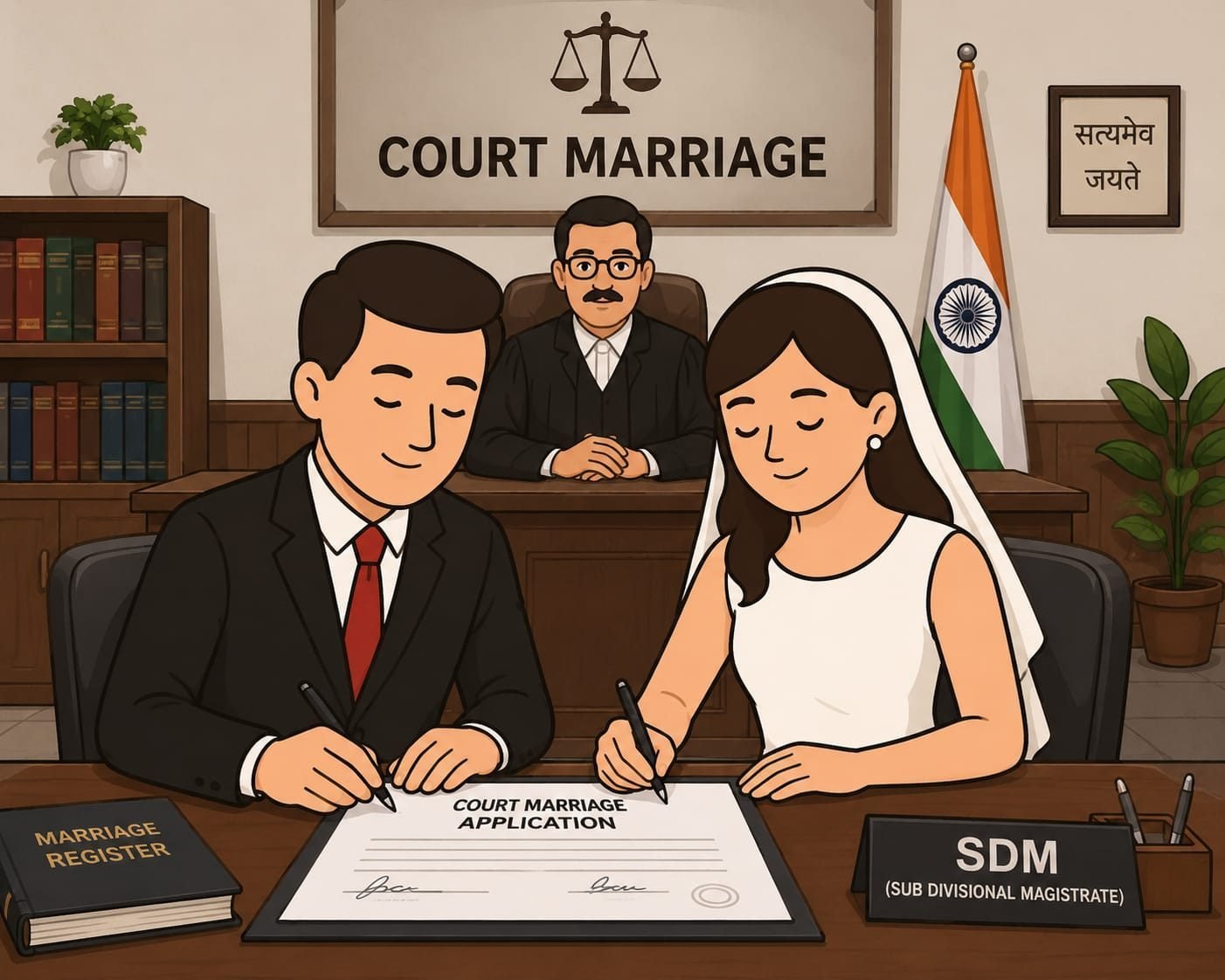
Quick answer: Vasant Vihar is two places at once. It is one of Delhi’s wealthiest colonies, and it is the workplace and the home of several thousand people who cook, drive, clean, guard and care for children in those houses — many of them living in a servant quarter on the same plot. Both groups marry, and the paperwork problem is completely different for each. This guide covers the residents’ side properly — which office, which route, what it costs — and then goes into the part nobody writes about: how a live-in domestic worker, a driver, a cook or a guard actually registers a marriage when the address on their Aadhaar is a village in Jharkhand, their originals are in a trunk at home, and their one day off is Sunday. It also says plainly what an employer may and may not do. Marriage registration: ₹6,000.
Key takeaways
- “SDM Vasant Vihar” is not a sub-division on the 2026 map. South West’s are Najafgarh, Matiala, Dwarka and Bijwasan. Let e-District allot your office — and no existing certificate is affected by a renamed office.
- A village Aadhaar is not a disqualification. Home-state address proof is valid, and Delhi registers a Hindu marriage where it was solemnised as well as where a party resides.
- Your documents are yours. No employer, agency or contractor may keep your originals as security. Photocopies, yes. Originals, no — and refusing to return them is a police matter.
- Registration is impossible after a spouse dies. That is the only real deadline in this business. A widow without a certificate has to prove the marriage some other way, and some offices send her to court.
- One weekday is usually all the appointment needs. Do the paperwork on a Sunday, ask for the day a week in advance, and send us photographs first so no day off is wasted.
- e-Shram, PMJJBY, PMSBY, PM-SYM, PM-JAY and the BOCW board all pay a spouse who can be proved. We handle none of them and earn nothing from them — open a bank account in your own name and register.
- We speak to both parties alone and we stop if either is not sure, whoever booked and whoever paid. We never take instructions about a marriage from an employer or an agent.
- We never provide witnesses, never touch an under-age marriage, and never manufacture an address, an affidavit or an age proof.
Last reviewed: 23 September 2026 · 38 min read
On this page
- Vasant Vihar at a glance
- “SDM Vasant Vihar” and the 2026 map
- Which office registers you
- The three lawful routes
- For residents of the colony
- The second Vasant Vihar
- Address proof from a servant quarter
- Documents that are 900 km away
- If your employer has your documents
- Placement agencies and marriage
- Consent: the section that matters most
- Marry in Delhi or back home?
- Getting the time off
- Already married, never registered
- What a registered marriage unlocks
- e-Shram and the welfare map
- If you are a woman worker
- Children, school and the quarter
- If you are the employer
- Arya Samaj and registration
- The Special Marriage Act
- Witnesses
- Fees, at cost and in full
- The documents checklist
- At the appointment
- A realistic timeline
- Mistakes we see
- Five situations from this colony
- Money, OTPs and agents
- What we will not do
- Talk to us
1. Vasant Vihar at a Glance
Vasant Vihar sits in South West Delhi, west of Munirka and north of Vasant Kunj, with Shanti Niketan, Anand Niketan and Westend as its neighbours and the diplomatic belt a short drive north. It is laid out in numbered blocks of large plots, most of them now rebuilt as builder floors, and a very large share of the houses have staff quarters on the ground floor or the roof.
The nearest Metro stations are Vasant Vihar and Munirka on the Magenta Line. Basant Lok market, the Priya complex, the Vasant Vihar police station and a dense cluster of embassies and international schools are all within the same few kilometres.
Two populations live here, and this guide is written for both. The residents are professionals, business families, diplomats, doctors and retired officers. The second population — cooks, drivers, house staff, nannies, guards, gardeners, and the people who staff the market shops and the salons — is roughly as large, mostly from West Bengal, Jharkhand, Bihar, Odisha, Uttarakhand, Nepal and the North East, and mostly living either in a quarter on the employer’s plot or in a shared room in Munirka, Kishangarh or the villages behind the colony.
2. “SDM Vasant Vihar” and the 2026 District Map
A lot of pages, including the earlier version of this one, tell you to go to “SDM Vasant Vihar”. Be careful with that.
Under the revenue reorganisation effective 1 January 2026, Delhi has 13 districts and 39 sub-divisions. The South West district’s sub-divisions are Najafgarh, Matiala, Dwarka and Bijwasan. The New Delhi district’s are New Delhi and Delhi Cantonment. Vasant Vihar is not the name of a sub-division on that map, and neither is Hauz Khas.
Three things follow, and they matter:
- Do not plan a journey around an office name you read on a website. Apply on the portal, see which office you are allotted, and go there.
- Nothing about an existing certificate changes. A document is not cancelled, weakened or made “old” because an office was renamed, merged or abolished. Anybody offering to “re-do” a certificate for that reason is running a fraud, and it is run on elderly people more than anyone else. Our Saraswati Vihar guide deals with this in full.
- A duplicate or correction for an old marriage is applied for using the address as it was then, and the application reaches the successor office. The registration number and the date of registration are what decide how fast it is found.
3. Which Office Registers Your Marriage
Applications for marriage registration in Delhi are made through the Delhi e-District portal. You create an account, complete the application, upload the documents and are given an appointment; the portal allots the sub-divisional office on the basis of what you enter. For an address in this belt it is one of the South West or New Delhi district offices, and it changes. Apply first, then plan the travel.
Two clarifications:
No court marries you and no court registers you. Registration is done by the SDM or the Registrar of Marriages, and a Special Marriage Act marriage is solemnised before the Marriage Officer. “Court marriage” is everyday shorthand for a civil registration and not a description of a building. Our Preet Vihar guide takes the myth apart, including the touts who trade on it.
Both parties must attend in person, at the ceremony and at the office. There is no power-of-attorney marriage, no video-call marriage and no arrangement under which a relative or an employer stands in for one party.
4. The Three Lawful Routes
There are three, and only three, whoever you are and whatever you earn.
Route A — Arya Samaj marriage, then registration. Where both of you are Hindu, Sikh, Jain or Buddhist. A real marriage under the Hindu Marriage Act, performed with havan and saptapadi, possible the same day if you are both eligible, have your original documents and bring your own two witnesses. The mandir issues its certificate on the day; the government registration follows by appointment. ₹7,100, covering both.
Route B — registration of a marriage that has already happened. Married by ceremony in your village last year, or ten years ago, and never registered it. This is the route most of the working households in this belt actually need. ₹6,000.
Route C — the Special Marriage Act, 1954. The civil route, open to any two adults of any religion with no conversion. Thirty days’ residence in the district before notice, then thirty days’ public notice, then solemnisation before the Marriage Officer with three witnesses — about sixty days, and no fee or contact shortens it. ₹15,000.
There is no fourth route. Nobody can produce a government marriage certificate today, and anybody who says they can is either lying or about to file something false in your names.
5. If You Live in the Colony
Most of what residents of Vasant Vihar ask us falls into four groups, and each is dealt with in full on a page of its own, so we will be brief here and link properly rather than repeat.
- Marrying a foreign national, or embassy and diplomatic staff. No-impediment certificates, translations, the Foreign Marriage Act, apostille, a foreign spouse’s visa position, and whether you can marry at an embassy instead — all of that is in our Chanakyapuri guide, which is built for exactly this.
- NRI and OCI planning. Apostille, attestation, the country you will actually live in, and the trap of registering the same marriage twice — see the NRI marriage guide and the apostille guide.
- The surname question and everything to update afterwards. Gazette, passport re-issue, PAN, bank KYC, employer records — see our Saket guide.
- Family property, an HUF, a prenuptial understanding or stridhan. See our Punjabi Bagh guide.
What is left, and what this page spends its length on, is the thing none of those pages covers and none of the other guides in this belt covers either.
6. The Second Vasant Vihar
Ask anybody who works in this colony how they got married and you will hear a version of the same story. The wedding was at home, in the village, during the season, arranged by the families. Both of them came back to Delhi within a few weeks because the job was here. There is a photograph, there is a wedding card, there may be a pandit’s slip. There is no registration and there never has been, because nobody said it mattered and because the office is in Delhi and the marriage was in Dumka.
Then, years later, something needs it. A form for a welfare scheme asks for the spouse’s name. An insurance claim is filed after an accident and the company wants proof of the relationship. A passport application for the wife needs the husband’s particulars. A hospital asks who the next of kin is. A landlord asks. A school asks. And a family in the village decides, after a death, that the widow was never really the wife.
That last one is the reason we put the working households’ section on this page rather than a smaller one. The people most damaged by an unregistered marriage in India are not the people with lawyers. They are the people whose entire claim to a pension, an insurance payout, a room, or a child’s place rests on somebody else agreeing that the marriage happened.
The one thing to take from this page if you work in a house here: if you are married and it is not registered, get it registered while both of you are alive and in Delhi together. It costs ₹6,000 with us, it takes about a week to ten days, and there is no version of this that becomes easier by waiting. After a spouse dies, registration is no longer possible at all.
7. Address Proof When You Live in a Servant Quarter
This is the first wall people hit, and it is far lower than it looks.
You live in a room on your employer’s plot. The electricity bill is in their name. The water bill is in their name. There is no rent agreement because you do not pay rent. Your Aadhaar shows a village address in Malda or Gumla or Almora. So, people assume, there is no way to apply.
That assumption is wrong, for two independent reasons.
First, your home-state address proof is a valid address proof. An Aadhaar showing a village in West Bengal is a real government document, not a defect. Nothing in the process requires you to hold a Delhi address, and an enormous number of marriages registered in Delhi every year involve people whose documents show another state. What you must never do is claim a Delhi address you do not have.
Second, and more useful: registration of a Hindu marriage is provided for by section 8 of the Hindu Marriage Act, 1955, with the detail left to state rules, and Delhi’s rules provide for the Registrar in whose jurisdiction the marriage was solemnised, or in whose jurisdiction either party resides. So if the ceremony takes place in Delhi, the Delhi registration follows regardless of what your Aadhaar says.
For a marriage that already happened in your village, you are on the residence limb rather than the solemnisation limb, and your documents plus the affidavits are what carry the application. Come and talk to us with what you actually have rather than deciding in advance that you do not qualify. We have done this many times and the failure rate is much lower than people fear.
Two practical things worth doing anyway:
- Open a bank account in your own name, with your own mobile number on it, if you do not have one. Not a joint account with an employer, not an account operated by anybody else. Every welfare payment, insurance payout and pension in this country lands in an account, and a worker without one is a worker who depends on somebody else to be paid.
- Keep your own mobile number, registered to you, linked to your own Aadhaar. A number that belongs to somebody else is a number that can be taken away, and every OTP in your life goes to it.
8. When the Documents Are Nine Hundred Kilometres Away
The second wall: the originals are in a steel trunk at your parents’ house, and going to get them means four days of leave and a fare you were saving for something else.
Work through this in order:
- Courier, do not travel. Somebody at home puts the originals into a registered post or a courier envelope and it reaches Delhi in two or three days. Photograph each document before it is sent, from both ends, so that if it goes missing you know exactly what was in it.
- Aadhaar can usually be handled where you stand, if the linked mobile number is with you — it can be downloaded and printed. If the linked number is an old one you no longer have, that has to be fixed at an enrolment centre and it is worth doing anyway.
- Age proof is the item that actually holds applications up. A matriculation certificate is the usual one. If you did not complete school, a school leaving certificate or a transfer certificate is commonly relied on, and a birth certificate can be obtained from the panchayat or municipality where the birth was registered — that is a home-state application, so start it early rather than at the end.
- Do not accept “we will manage it” from anybody. If a document does not exist, it is obtained from the authority that issues it. It is not created by an agent for a fee, and a marriage record resting on a manufactured age proof can be challenged and cancelled years later.
Photograph everything, twice. Every document, onto both partners’ phones and into an email account that belongs to you. A worker whose documents live only in one plastic folder in one room is one theft, one fire and one dispute away from having nothing.
9. If Your Employer or an Agency Is Holding Your Documents
We will put this plainly, because it is common and because the people it happens to are usually told the opposite.
Your documents are yours. Your Aadhaar, your passport, your educational certificates and your bank passbook belong to you. Nobody — not an employer, not an agency, not a contractor, not a supervisor — is entitled to keep the originals as a condition of employment, as “security” against your leaving, or against money that is said to be owed. An employer may reasonably take photocopies for their own records and for police verification, and that is normal and fine. Holding the originals is a different thing altogether.
If your originals are being held:
- Ask once, calmly and in writing — a message is enough, and it creates a record. “Mujhe apne original documents wapas chahiye. Photocopy aap rakh sakte hain.”
- Do not sign anything in exchange for getting them back.
- If they are not returned, that is a matter you can take to the police. Retention of a person’s identity documents to prevent them from leaving a job is treated seriously, and the Vasant Vihar police station is a few minutes away. The Delhi Commission for Women helpline 181 and the emergency number 112 both take calls from workers, not only from residents.
- If you are being stopped from leaving the house, or your wages are being withheld to keep you there, or you were brought to Delhi on a promise that turned out to be false — that is not an employment disagreement. Call 112 or 181, and if you can, tell somebody outside the house where you are. There is no version of a job in which a person can be kept.
We say this on a marriage page because in this belt the two things arrive together more often than they should: a worker cannot marry, or cannot register a marriage, because somebody else is holding the documents that would let them.
10. Placement Agencies, Contractors and Marriage
A large part of the household workforce in South Delhi arrives through placement agencies and contractors. Most are ordinary businesses. Some are not, and the pattern worth knowing is this one.
A young woman is brought from a district in Jharkhand, Odisha, West Bengal or the North East on a promise of household work. Somewhere in the chain, a “marriage” is proposed or arranged — to a man she has not met, in another state, with a fee changing hands and a ceremony performed quickly. Sometimes it is described to her as a job. Sometimes the paperwork is asked for afterwards, to make it look settled.
That is trafficking, whatever it is called and whoever performs the ceremony, and a marriage arranged that way is not a marriage. We refuse this work, and we will say so to the person who brings it to us rather than quietly declining the appointment.
Signs that should stop everybody in the room: the woman has not met the man before; somebody else is holding her documents; somebody else is doing all the talking and answers on her behalf; money has been paid to a third person for the match; she does not speak the language of the place she is being taken to; she is vague or fearful about where she will live; or she is being hurried.
If any of that is happening to you or to somebody you know: call 112, the women’s helpline 181, or the child helpline 1098 where a minor is involved. You can walk into any police station, including one in a colony where you work rather than where you live. You do not need documents to make a complaint, and you do not need permission from anybody.
11. Consent — The Section That Matters Most on This Page
A marriage requires the free consent of both adults. Not the consent of a family, not of an employer, not of an agent, not of whoever paid for the journey, and not the silence of somebody who has been brought along and told to nod.
How we work, every time, without exception:
- We speak to both parties separately, and we ask directly whether each of them wants this marriage.
- We ask in a language the person is comfortable in. If somebody has been brought as a translator and is answering for the person, we ask them to step outside.
- We do not accept an answer given by anybody other than the two people marrying.
- If the answer is not a clear yes from each of them in their own words, we stop — however much has been paid, however far anybody has travelled, and however angry the other people in the room become.
If you are the person who is not sure: ask to speak to us alone. You will not be argued with, you will not be reported to anybody, and nothing will be told to the people waiting outside. If it is easier, call us later from a different phone. 181 and 112 exist for exactly this and they are not only for emergencies that have already happened.
12. Marry in Delhi, or Go Home and Do It There?
We will tell you honestly, even when the honest answer costs us the booking.
Do it at home if: the wedding is going to be at home anyway during the season; your families are there, which means your witnesses are there; your documents are there; and you expect to go back to your home state eventually. Every future duplicate or correction will then be a bus ride rather than a journey across the country. Uttar Pradesh has its Marriage Registration Rules 2017 and its own portal; West Bengal, Jharkhand, Bihar, Odisha and Uttarakhand each have their own arrangements. Ask at the block office when you are there.
Do it in Delhi if: you are both already in Delhi and getting leave together is the hard part; the marriage has already happened and you simply need it registered; going home means losing wages you cannot afford; or the families are the problem rather than the help.
And never do both. One marriage, one registration. Two records of the same marriage in two states create exactly the discrepancy that stops a passport, a visa or an insurance claim later, and unwinding it is far harder than getting it right once.
13. Getting the Time Off Without Losing the Job
A practical problem that decides whether any of this actually happens.
Government offices work on weekdays. Most household staff in this colony get Sunday off, or one afternoon, or nothing regular at all. So the honest planning advice is this:
- Do the paperwork on Sundays and the appointment on one weekday. The document gathering, the photographs, the affidavits and the conversation with us can all happen on a day off or in an evening. What genuinely needs a working day is the appointment, and usually only one.
- Ask for the one day in advance and in plain terms. Most employers in this colony, asked a week ahead for a single day to register a marriage, will say yes. Asked at nine in the morning on the day, many will not.
- Both of you need to be there on the same day, so coordinate the two households’ leave before you take the appointment, not after.
- Send us photographs on WhatsApp first. We will tell you what is missing before you spend a day off on it. That call is free and it saves more Sundays than anything else on this page.
- Tell us if the timing is the constraint. We plan around it. We do not charge more for a difficult date, and we do not charge more for urgency — ever.
14. Already Married, Never Registered — Exactly What to Bring
This is the commonest situation in this belt, so here is the full list rather than a summary.
- Wedding card, if one was printed.
- Ceremony photographs — phone photographs are fine. Ones that show both of you at the ceremony are what matter.
- A certificate or slip from the mandir, the pandit, the church or the qazi, where one can be obtained. If the institution keeps a register, ask for an attested extract with the entry number — registers are held by institutions, so even a pandit who has died is usually not the end of the road.
- Age proof for both — matriculation certificate, birth certificate, school leaving certificate, or passport.
- Photo identity for both — Aadhaar, voter card, driving licence or passport, in original.
- Address proof for both — home-state is fine.
- Affidavits from both spouses setting out the date and place of the marriage. We prepare these.
- Two witnesses who genuinely know you as a married couple, with their own original identity documents.
- Children’s birth certificates and school records naming both parents, and the ration card, if you have them. These are strong supporting evidence of a long marriage.
- A divorce decree or a death certificate if either of you was married before. No affidavit substitutes for it.
Our fee for this is ₹6,000, and government charges are separate and shown at cost on your receipt.
How late is too late? For a Hindu marriage there is no cut-off — a marriage from fifteen years ago can be registered. For a nikah in Delhi, the 2014 Order sets 60 days ordinarily, the next 60 on payment of ₹500, and a ₹1,000 penalty after that, but registration remains possible however late, while both spouses are alive. The one true deadline is a death. After that it cannot be done at all, and everything the survivor needs has to be proved some other way.
15. What a Registered Marriage Actually Unlocks
Not theory — the specific things that have been refused to people in this belt for want of a certificate.
| Situation | Why the certificate matters |
|---|---|
| Insurance or accident claim after a death | The insurer must be satisfied who the spouse is. A nominee form plus a certificate settles it; photographs and affidavits invite an investigation and months of delay. |
| EPF, EPS pension and gratuity | A spouse’s claim and a family pension are paid on proof of the relationship. Nominations made before marriage often still name a parent — update them. |
| Employees’ State Insurance and health cover | A spouse must be on the family record to be treated. |
| Ayushman Bharat PM-JAY | The spouse must appear on the family record to be covered. |
| Government schemes with a spouse component | Almost every application form asks for the spouse’s particulars and some ask for proof. |
| A passport for the wife or husband | Spouse particulars on a passport are entered on proof of marriage. |
| A bank account, a nominee or a locker | Straightforward with a certificate; argumentative without one. |
| Hospital consent and next of kin | Where a patient cannot decide for themselves, hospitals look to next of kin. A spouse who cannot be proved is a spouse who can be left outside the conversation. |
| A claim on the family’s land or house after a death | This is the one that ruins lives. A widow whose marriage was never registered can find the husband’s family simply denying that she was his wife. |
| A child’s papers | Registration is not required to register a birth, and a child is legitimate either way — but a certificate ends arguments at schools and offices before they start. Our Seemapuri guide covers children’s papers fully. |
16. e-Shram and the Welfare Map for People With No Employer on Paper
Most household workers have no written contract, no PF and no employer who files anything for them. The schemes below are built for exactly that, and every one of them pays a spouse who can be proved.
- e-Shram — the national database of unorganised workers. Registration is free, done with Aadhaar and a mobile number, and it is the door through which other benefits are increasingly routed. If you take one action after reading this page, make it this one plus a bank account in your own name.
- PMJJBY and PMSBY — very low-premium life and accident cover through your own bank account. Two failure modes ruin these: the nominee is still a parent years after the marriage, and the auto-debit fails on renewal day so the cover lapses silently. Check both once a year.
- PM-SYM — the pension scheme for unorganised workers, with a family pension for the spouse.
- Ayushman Bharat PM-JAY — the spouse must be on the family record.
- The BOCW board, for anybody who has worked in construction — registration must be kept live, and the board pays marriage assistance, maternity benefit, education assistance, disability and death benefits and a pension. A very large number of people in this belt have done construction work at some point and never registered.
- Employees’ Compensation Act, 1923 — dependants’ compensation where ESIC does not apply.
- Delhi’s own labour department schemes for registered workers, which change from year to year — ask, and ask again next year.
We do not handle any of these and we earn nothing from them. We are telling you about them because a registered marriage is what makes several of them pay out, and because nobody else in the transaction has any reason to mention them. The registration is our work; the schemes are yours, and they are free.
17. If You Are a Woman Working in One of These Houses
A short section, and the most important one for some readers.
- Your consent is the only consent that matters for your own marriage. Not your employer’s, not the agency’s, not your brother’s, not the person who paid your fare.
- Your documents are yours. See section 9.
- Your wages are yours, and they should reach an account in your own name.
- A marriage registered in your name protects you more than it protects him. The widow with a certificate and the widow without one are in completely different positions when a family in the village starts talking about property.
- Stridhan is yours — the jewellery and gifts given to you at your marriage remain your property and not your husband’s family’s. Keep a list and, where you can, photographs.
- Helplines that work for you, not only for residents: women’s helpline 181, emergency 112, child helpline 1098. The Vasant Vihar police station is in the colony you work in, and you can walk into any police station in Delhi.
- If you are being pressured into a marriage you do not want, or if a “job” has turned into a proposal, tell somebody today. We will stop a marriage at any stage, including at the mandir, if we are not satisfied that both people want it.
18. Children, School and the Quarter
Three things that come up constantly, stated plainly because families in this belt are routinely told otherwise:
- A marriage certificate is not required to register a birth. The Registration of Births and Deaths Act, 1969 records the birth and the parents’ particulars, and a registrar may not demand a marriage certificate. If one is demanded, ask for the refusal in writing and escalate.
- A child is legitimate whether or not the marriage was registered. Registration records a marriage; it does not create one.
- A school may not refuse admission for want of age proof or for a late application under sections 14 and 15 of the RTE Act, 2009, and a child must be placed in an age-appropriate class under section 4. The 25% EWS and disadvantaged-group seats under section 12(1)(c) are run online in Delhi by the Directorate of Education, with a lottery — and mismatched addresses are the single biggest reason applications are rejected, so get the address on the Aadhaar, the ration card and the school form to say the same thing before you apply.
Our Seemapuri guide goes through all of it, including birth registration deadlines and the late routes, in much more detail than fits here. We do not handle birth certificates, school admissions or scheme enrolments, and we earn nothing from any of them.
19. If You Are the Employer
Residents of this colony ask us this often enough that it deserves its own section, and the answer has a helpful half and a hard half.
What genuinely helps, if you want to help:
- Give the day off, asked for in advance, without making it a favour. One weekday is usually all the appointment needs. This is the single most useful thing an employer can do and it costs almost nothing.
- Return the originals if you are holding any, and keep photocopies instead. Police verification needs a copy, not the original.
- Help them get a bank account and an e-Shram registration in their own name. Not a joint account, not one you operate.
- Tell them the deadline that actually exists — that registration becomes impossible after a spouse dies. Most people have never been told this.
- Pay for it if you want to, openly and without conditions. Some residents do. It is a kind thing. It must not come with a lock-in on the job, and it must not be deducted from wages afterwards.
What is not yours to decide, however well meant:
- Whether they marry, and whom. We will not take instructions about a marriage from anybody other than the two people marrying, and we will not discuss their file with an employer — including an employer who is paying. If you book and pay, we will still speak to both of them alone, and if either of them is not sure, we will stop and we will not tell you why.
- Arranging a match for a worker. Do not. Even with good intentions, an employer proposing and organising a marriage for a live-in employee sits on the wrong side of a line, because the person cannot say no to you in the way they could say no to anybody else.
- Standing in as a witness while their own witnesses are absent. A witness must be somebody who genuinely knows the couple, and there are good reasons for a worker’s witnesses not to be the person who controls their job and their room.
- Holding the certificate for safe keeping. Give it to them. It is theirs, and the whole point of it is that it works when you are not there.
20. Arya Samaj Marriage and Registration, Step by Step
For a couple who are both Hindu, Sikh, Jain or Buddhist and who are marrying now rather than registering an old ceremony.
- Call and send document photographs on WhatsApp. We tell you within minutes whether what you have will work and what is missing. Free.
- Confirm your two witnesses, tell them the date, and confirm again the night before.
- Bring the originals on the day — age proof, photo identity and address proof for both, plus passport photographs.
- The ceremony at the mandir, with havan and saptapadi. It is a real marriage under the Hindu Marriage Act, not a formality, and the mandir issues its certificate on the day.
- The registration application on the e-District portal, with the mandir certificate, the ceremony photographs and both parties’ documents.
- The appointment, which both of you attend in person.
- Check the certificate at the counter before leaving the building.
₹7,100 for the ceremony and the registration work together. Government charges separate, at cost.
The mandir certificate is not the end. It records the ceremony. The document a bank, an insurer, an employer or a passport office will act on is the one issued after registration. Do not stop halfway; it is the commonest expensive mistake in this whole trade.
21. The Special Marriage Act from This Belt
The civil route, for any two adults of any religion, with no conversion by anybody.
At least one of you must have resided in the district for thirty days before the notice is given. The notice is then published for thirty days, during which objections may be made. Solemnisation follows before the Marriage Officer with three witnesses. About sixty days in total, and nothing lawfully shortens either period.
Two points specific to people in this belt:
Residence. What the office is assessing is whether you actually live in the district. For somebody living in a quarter on an employer’s plot, the supporting material is what you genuinely have — an Aadhaar updated to the Delhi address, a bank statement, an employer’s letter confirming that you live there, a ration card. We will not draft a residence claim for an address you do not live at, and we will not file a notice on a document we can see was arranged.
The notice is public during those thirty days. For most couples it is a formality nobody looks at. For a couple whose families are opposed, or whose employer must not know yet, it is a real consideration and it is better discussed at the start than discovered in week three.
Our fee for the full assistance is ₹15,000. For an inter-faith couple, our inter-religion marriage guide sets out the options honestly, including a straight treatment of conversion as an alternative and why it should never be done under pressure.
22. Witnesses
We do not provide witnesses. Not for a fee, not as a favour, not because you are far from home and not because you have nobody in Delhi. This is a fixed term of how we work and it is written into our terms and conditions.
A witness must be an adult who genuinely knows you, carries their own original photo identity and address proof, and attends in person. Two for an Arya Samaj ceremony; three for solemnisation under the Special Marriage Act. For registration of an old marriage, witnesses who know you as a married couple are best of all.
A paid witness is a false statement to a public authority, and it leaves your marriage record open to challenge at exactly the moment you most need it to be solid — a claim, a pension, a property dispute. It is not a shortcut; it is a weakness built into the document.
Who people in this belt actually use: a cousin or a brother-in-law already working in Delhi, somebody from the same village working in the next colony, a long-standing colleague, the friend whose room you stayed in when you first arrived. Ask a week ahead, tell them what to bring, and confirm the night before. Our witness guide sets out exactly who qualifies and who does not.
23. Fees, at Cost and in Full
The same for everybody. They do not change with your address, your employer, your accent or your hurry.
| Service | Our fee | What it covers |
|---|---|---|
| Marriage certificate — duplicate or correction | ₹2,500 | Application, follow-up and collection |
| Arya Samaj marriage — ceremony only | ₹5,100 | Pandit, havan, saptapadi and the mandir certificate, same day |
| Marriage registration | ₹6,000 | Full application, appointment and certificate |
| Nikah registration | ₹6,000 | Registration of a nikah under the Delhi 2014 Order |
| Court marriage assistance | ₹6,100 | End-to-end assistance with the civil registration |
| Arya Samaj marriage with registration | ₹7,100 | Ceremony at the mandir plus the registration work |
| Special Marriage Act (full assistance) | ₹15,000 | Notice, the thirty days, solemnisation and certificate |
Government charges are separate and shown at cost on your receipt, on their own line, with our charge on another. Nothing is added to them and nothing is rounded up. If your receipt does not let you see exactly where each rupee went, ask us and we will rewrite it. The full list is on our fees page.
We never charge more for urgency, for distance, for a weekend or for a difficult date. If somebody in this trade quotes you a different number because of who you are or how worried you sound, that is the whole review of that firm.
24. The Documents Checklist
- Age proof for both — matriculation certificate, birth certificate, school leaving certificate or passport.
- Photo identity for both — Aadhaar, voter card, driving licence or passport, in original.
- Address proof for both — home-state is fine; see section 7.
- Passport photographs — several each.
- Two witnesses with their own original identity and address proof (three for the Special Marriage Act).
- Divorce decree or death certificate if either of you was married before.
- For an old marriage: wedding card, ceremony photographs, mandir or qazi certificate or register extract, affidavits from both spouses, children’s records and the ration card if you have them.
25. What Happens at the Appointment
It is far less frightening than people expect, and knowing the shape of it removes most of the fear.
You both attend, with your witnesses and your originals. The officer checks the documents against the application, asks straightforward questions to confirm who you are and that the marriage took place or is taking place, and the witnesses sign. There is no interrogation, no test and nothing to be caught out on if your papers are honest. Dress as you would for any office; arrive early; keep the originals in one folder in one person’s hands.
Before you leave the counter, check: both names and their exact spellings, both fathers’ names, the date of marriage, the place, and both dates of birth. A correction made on the spot takes a minute. The same correction later means a fresh application, a ₹2,500 fee and another day off — which for somebody in this belt is the expensive part.
26. A Realistic Timeline
| Your situation | Realistic time | What actually decides it |
|---|---|---|
| Both Hindu, marrying now, originals in Delhi, witnesses confirmed | Ceremony same day; certificate within a few working days | Whether both of you can get the same weekday off |
| Same, but the originals are at home | Add 2–4 days | Courier time |
| Married in the village, registering now | About a week to ten days | Photographs, the mandir or qazi slip, and the affidavits |
| Age proof does not exist yet | Add 2–6 weeks | A home-state application to the panchayat or municipality |
| Inter-faith, already resident 30 days | About 30–35 days from notice | The statutory notice period |
| Inter-faith, recently arrived | About 60 days | 30 days’ residence, then 30 days’ notice |
| Either party under 21 (groom) or 18 (bride) | Not at all | We decline, at any price |
Nobody can beat these numbers. What a good service does is stop you losing four days to a missing document, a wrong upload or an office you were never allotted — which for somebody who gets one day off a week is the difference between done and never done.
27. Mistakes We See in This Belt
- Assuming you cannot apply because your Aadhaar shows a village address. You can. Section 7.
- Stopping at the mandir certificate and never completing the registration.
- Leaving the originals with an employer or an agency and then being unable to marry when you want to.
- Waiting. “Next year, when we go home.” Ten years of next year, and then a death, and then it cannot be done at all.
- Registering the same marriage in two states to be safe. It is the opposite of safe.
- Nominations never updated — EPF, gratuity, PMJJBY, bank accounts still naming a parent.
- Letting an agent “manage” a missing age proof. A manufactured document is a cancelled marriage record later.
- Leaving the counter without checking the spellings. For somebody in this belt a correction costs a day’s wages as well as ₹2,500.
- No bank account in the worker’s own name, so every benefit depends on somebody else.
- Paying cash with no receipt to somebody met that morning near a court or a mandir.
28. Five Situations From This Colony
Anonymised, and each stands for many.
The cook who had been married eleven years. Married in a village in Jharkhand in 2015, two children in a Delhi school, never registered. His employer’s insurance form asked for a spouse’s name and proof. He came with a wedding card, phone photographs, the children’s birth certificates and school records naming both parents, and a neighbour from the same village who worked two colonies away. Registered in nine days. He said afterwards that he had assumed for eleven years that it was not possible for someone like him.
The driver whose documents were in a drawer. His previous employer had kept his originals as “security” and had not returned them when he left. One written request, politely worded, got them back within a week. Nothing further was needed. Most such cases end exactly there — it is the asking that people find hard, not the getting.
The woman who was not sure. Brought to us by three other people, one of whom answered every question for her. We asked her to come and sit with us alone, in her own language. She said, in her own words, that she did not want to marry the man and had been told she was coming to Delhi for work. We stopped, we did not tell the people waiting outside what she had said, and we gave her the numbers for 181 and the police. We would rather write this paragraph than pretend it does not happen in this belt.
The couple who both worked in the same lane. Both Hindu, both from Uttarakhand, both with Sunday off and different weekday schedules. The whole problem was a single shared weekday. Their employers, asked a week in advance, both said yes without argument. Ceremony on a Sunday, appointment the following Wednesday.
The widow who came too late. Her husband had worked in the colony for nineteen years. They were married in 2009 in Odisha and had never registered it. He died in an accident. She came to us three weeks later asking us to register the marriage. We could not, because registration is not possible after a spouse’s death, and no amount of money changes that. What she had to do instead — prove the relationship for the claim with photographs, the children’s records, witnesses and affidavits — took months and needed an advocate. This is the section we most want people to read while they still have the choice.
29. Money, OTPs and People Who Approach You
- Nobody from us will ever ask you for an OTP, a UPI PIN, a card PIN, a CVV or a net banking password, and we will never ask you to install a screen-sharing app or to approve a payment request in order to receive money. An approved request is money leaving your account.
- Get a receipt for every rupee from anybody, including us.
- Never hand your original documents to somebody who approaches you outside a court, a mandir or an office.
- Never sign a blank form or blank stamp paper.
- Never follow anybody to a room to “meet the sir”. Ask for the address, look it up, and go yourselves.
- Anybody promising a government certificate today is either lying or about to file something false in your names.
- If anything is done in our name, stop, share nothing, call +91 8376863962, and report it at cybercrime.gov.in or on 1930 — within the first hour if money has already gone.
30. What We Will Not Do
- We do not provide witnesses.
- We do not touch an under-age marriage. Under the Prohibition of Child Marriage Act, 2006 the minimum age is 21 for the groom and 18 for the bride. We decline in every case, at any price, and we also decline where a document appears to have been altered.
- We stop if either party is not giving a clear, free yes in their own words — and we speak to both of them alone to find out.
- We do not take instructions about a marriage from an employer, an agent or a family, including one who is paying.
- We do not touch a marriage arranged through a placement agency or a contractor for a fee.
- We do not manufacture a residence, a rent agreement, an affidavit or an age proof, and we do not back-date anything.
- We do not charge more for urgency, distance or a difficult date.
- We do not practise law. Protection petitions, divorce, maintenance, custody, succession, wage claims and disputes with an employer go to an independent advocate acting in their own name, whose fee we take no share of.
- We do not discuss your file with anybody — not an employer, not a family, not a caller who says it is urgent.
31. Talk to Us First — It Costs Nothing
Whether you live in one of these houses or work in one, the same first step applies: send us photographs of your documents on WhatsApp before you spend money or a day off on anything. We will tell you within minutes which route applies to you, what is missing, and how long it will honestly take — including when the answer is “not yet” or “not us”.
Vasant Vihar and Munirka on the Magenta Line are both close, and we will work around a single weekday if that is all you have.
And if you are reading this and you are already married without a certificate: do it this month, while both of you are here and both of you are well. It is the only deadline in this whole business that cannot be extended.
Marriage registration – ₹6,000
Register a marriage that has already happened · Arya Samaj with registration ₹7,100 · court marriage assistance ₹6,100 · nikah registration ₹6,000 · Special Marriage Act ₹15,000 · duplicates ₹2,500. Call first — it is free.
Register Your Marriage – ₹6,000 →Also: Arya Samaj marriage · Court marriage · Duplicates and corrections · Find our office
Questions and Answers: Marriage and Registration in Vasant Vihar
Sources and Official References
Facts in this guide were checked against the following primary sources. Government procedures and office allocations change, so confirm current details on the official portal before applying.
- Delhi e-District – official online application portal
- Hindu Marriage Act, 1955 – section 8, registration
- Special Marriage Act, 1954
- Registration of Births and Deaths Act, 1969
- Right of Children to Free and Compulsory Education Act, 2009
- Prohibition of Child Marriage Act, 2006
- e-Shram – national database of unorganised workers
- Ayushman Bharat PM-JAY
- EPFO – provident fund, pension and nominations
- Delhi Commission for Women – 181 helpline
- Delhi Police – citizen services and helplines
- National Cyber Crime Reporting Portal
- UIDAI – Aadhaar services and address update
This guide is general information, not legal advice for your specific case. Call +91 8376863962 for advice on your situation.
Related Articles
🏢 Chanakyapuri: Officers and Embassies
Foreign nationals, diplomats, service rules.
Read →🏭 Kapashera: Workers and Families
Factory belt, Nepali citizens, bringing your wife.
Read →👶 Seemapuri: Your Children’s Papers
Birth registration, RTE and school admission.
Read →📜 Seelampur: Old Papers and Welfare
Lost nikahnamas and schemes with no employer.
Read →🏢 The Office That No Longer Exists
Duplicates when the office was renamed.
Read →✏️ Saket: The Surname Question
Gazette, passport and everything to update.
Read →🕊 Inter-Religion Marriage
Options without conversion.
Read →👥 Witness Requirements
Who can be a witness, and who cannot.
Read →📋 Documents Required
Everything you need, in one list.
Read →🏛️ Court Marriage in Delhi
The complete Delhi guide.
Read →👶 Vivek Vihar: Adoption, IVF and Surrogacy
The certificate CARA and clinics ask for.
Read →