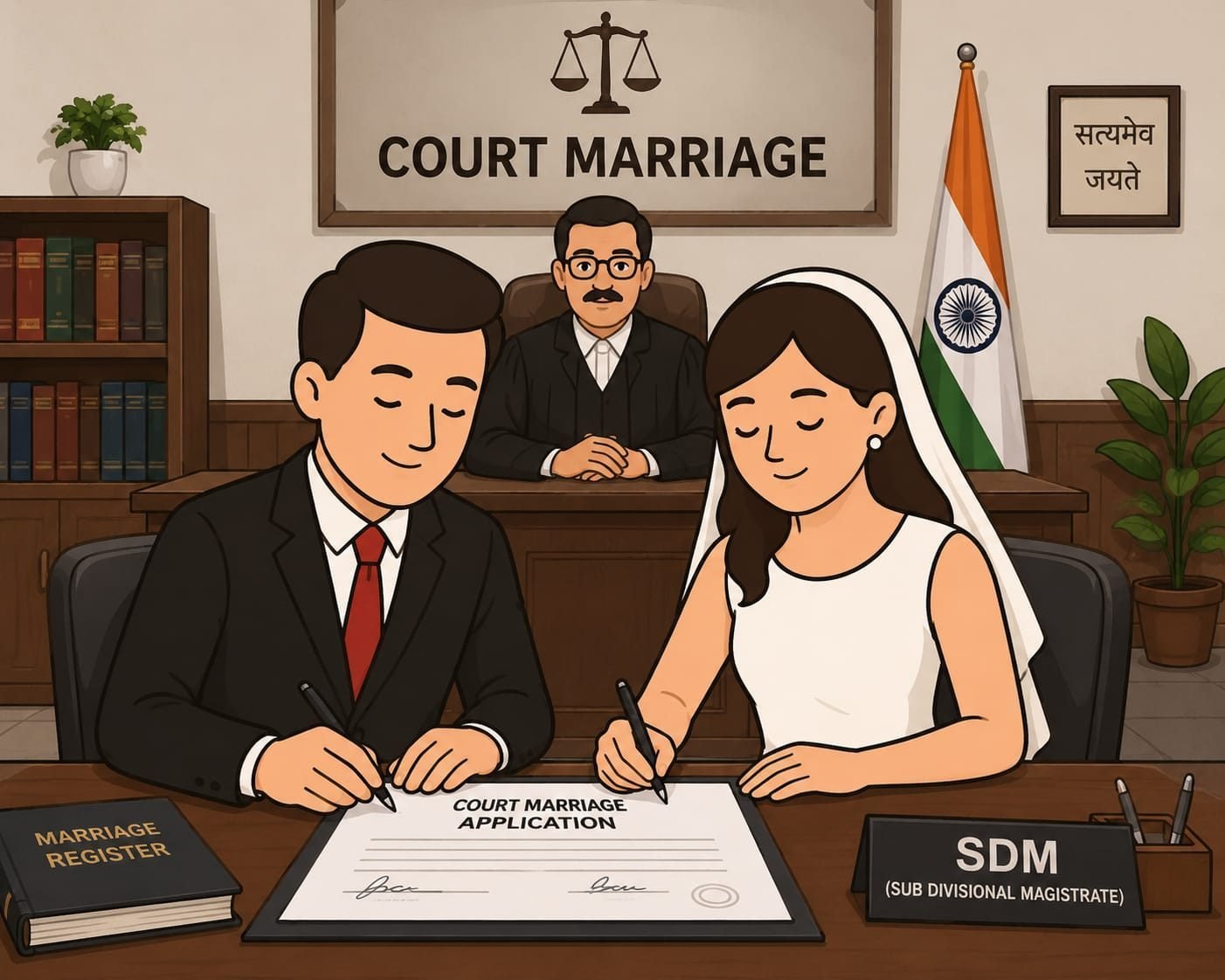
Quick answer: Gandhi Nagar (pincode 110031) in East Delhi is home to one of Asia's largest readymade garment wholesale markets. It is a neighbourhood of trading families and shop owners, and of thousands of tailors, karigars, salesmen and loaders who work in its lanes. Two Hindus, Sikhs, Jains or Buddhists can have an Arya Samaj wedding and register it under the Hindu Marriage Act on the e-District portal, for ₹100 or ₹10,000 with Tatkal. Couples of different religions use the Special Marriage Act, which has a 30-day notice. Under Delhi's 2026 revenue map, Gandhi Nagar is in the East district, and Gandhi Nagar is itself one of its three sub-divisions; the others are Vishwas Nagar and Patparganj. The portal allocates the office by exact address. For business families, marriage also touches the shop: the partnership, GST registration, nominations, the family HUF and who inherits the business. This guide covers those alongside the marriage itself.
Key takeaways
- From 1 January 2026, Gandhi Nagar is one of the three sub-divisions of the East district (with Vishwas Nagar and Patparganj); e-District allocates by address.
- A Hindu or Jain wedding by customary rites is valid but must still be registered; Delhi's 2014 order asks for registration within 60 days.
- Jain couples marry and register under the Hindu Marriage Act, which expressly covers Jains.
- For business families, update the partnership deed, GST, bank records, HUF and nominations after marriage, with your CA.
- Keep a signed list of wedding presents; dowry is a crime and streedhan belongs to the bride.
Last reviewed: 22 September 2026 · 36 min read
On this page
- Gandhi Nagar at a glance
- Gandhi Nagar under the 2026 map
- Which office registers your marriage
- Legal routes
- Trading families: the wedding and the paperwork
- Marriage and the family business
- The Hindu Undivided Family (HUF)
- Jain couples
- Karigars, salesmen and shop workers
- Address proof for rooms above shops
- Marrying around the market's busy season
- Gifts, cash and dowry
- When families object
- Arya Samaj + registration
- Special Marriage Act
- Inter-caste and inter-religion couples
- Witnesses
- Daughters of trading families after marriage
- When two business families marry
- Wedding in the home town
- Remarriage in business families
- Shop staff marrying within the market
- Updating records after the certificate
- Documents checklist
- What happens at the appointment
- What it costs
- Timeline
- Getting around
- Common mistakes
- Four Gandhi Nagar situations
- Checklist
- One-minute summary
- How we help
- Questions and answers
Gandhi Nagar sits on the eastern bank of the Yamuna, just across from Old Delhi and Kashmere Gate, between Shastri Park, Geeta Colony, Krishna Nagar and Seelampur. Its fame is its garment market. Hundreds of wholesale shops and small manufacturing units, packed into narrow lanes such as Ashok Gali, Subhash Road and the markets around Kailash Nagar and Raghubar Pura, supply readymade clothes, especially jeans, to retailers across North India. Much of the stock is stitched in small workshops nearby by karigars from Bihar, Uttar Pradesh and West Bengal. Many shops are run by families who settled here after Partition or moved over from Old Delhi, and now have the second or third generation behind the counter.
Weddings here are shaped by business. The families are usually closely involved, weddings often wait for the market's off-season, and a marriage can mean a son joining the family firm, a daughter-in-law becoming a partner, or two trading families combining. For the thousands of workers who live in rented rooms above workshops, the question is simpler and more practical: how to marry and get a certificate without losing too many days' wages, and with an address proof that is often informal. Both kinds of couples call us, and both are covered here.
For the general Delhi process, see our complete Delhi court marriage guide. Nearby East Delhi guides include Shahdara, Preet Vihar and Seelampur.
Gandhi Nagar at a Glance
| Point | Detail |
|---|---|
| Pincode | 110031 (Gandhi Nagar, Geeta Colony, Kailash Nagar, Raghubar Pura); nearby Krishna Nagar 110051, Shastri Park 110053 |
| Main areas | Gandhi Nagar market, Ashok Gali, Subhash Road, Kailash Nagar, Raghubar Pura, Geeta Colony, Shastri Park, Old Seelampur, Azad Nagar, Krishna Nagar |
| Revenue district from 1 January 2026 | East district; Gandhi Nagar is one of its three sub-divisions (with Vishwas Nagar and Patparganj) |
| Local body | Municipal Corporation of Delhi (Shahdara South zone) |
| Metro | Shastri Park (Red Line), Seelampur (Red Line), Krishna Nagar (Pink Line); Kashmere Gate across the river |
| Typical couples | Trading and shop-owning families, Jain and Punjabi business families, karigars and shop staff from other states, local families of Geeta Colony and Krishna Nagar |
Gandhi Nagar Under the 2026 District Map
On 1 January 2026, Delhi's revenue administration moved from 11 districts and 33 sub-divisions to 13 districts and 39 sub-divisions, aligned with municipal zones, under a Revenue Department notification dated 25 December 2025. The same reorganisation dissolved the old Shahdara district and redistributed East and North East Delhi. For Gandhi Nagar, the name survives: it is now one of the three sub-divisions of the East district, alongside Vishwas Nagar and Patparganj.
| Before 2026 | From 1 January 2026 |
|---|---|
| Gandhi Nagar was a sub-division of the old East district | East district, sub-divisions Gandhi Nagar, Vishwas Nagar and Patparganj |
| Separate Shahdara district existed | Shahdara district dissolved; its areas spread across East and North East districts |
| 11 districts, 33 sub-divisions | 13 districts, 39 sub-divisions |
Gandhi Nagar's boundaries run close to Shahdara, Seelampur, Krishna Nagar and Vishwas Nagar, so an address a few lanes away may be allocated to a neighbouring sub-division or district. Enter your exact address on e-District and go where your appointment slip says. Certificates issued before 2026 remain valid.
Which Office Registers Your Marriage
- Hindu Marriage Act registration: the office allocated on e-District for the Delhi address of either partner, or the place in Delhi where the marriage was performed.
- Special Marriage Act: the Marriage Officer of the district where at least one partner has lived for 30 days or more before notice.
- Anand Karaj: Sikh couples can also register under the Delhi Anand Marriages Rules, 2018.
- Shop address: a shop or workshop address is a business address, not a residence. Use the address where you actually live.
Legal Routes
| Couple | Usual route | Time |
|---|---|---|
| Two Hindus, Sikhs, Jains or Buddhists | Arya Samaj wedding or family ceremony + Hindu Marriage Act registration | Ceremony same day; certificate 1–2 weeks (Tatkal 1–2 working days) |
| Traditional wedding already held | Register the existing marriage | 1–2 weeks |
| Different religions | Special Marriage Act | About 35–60 days |
| One partner a foreign national | Usually Special Marriage Act | About 35–60 days |
Trading Families: The Wedding and the Paperwork
In most Gandhi Nagar trading families, the wedding itself is not the question. There will be a roka, a sagai, a mehndi, a big ceremony at a banquet hall in Krishna Nagar, Preet Vihar or on the Vikas Marg, and a reception. What often gets left behind is the registration. Months later, a bank asks for the marriage certificate before adding the bride to a joint account, the passport office wants it for a name change, or a new partnership deed needs it. Then the family calls us.
The good news is that a Hindu or Jain wedding performed by the customary rites of either family is already a valid marriage under the Hindu Marriage Act. Registration is the official record of it. What you need:
- Proof of the wedding: the wedding card, clear photographs of the main rites (pheras, jaimala, sindoor, or the Jain vivah rituals), and a letter from the priest or pandit if possible.
- Affidavits from both spouses giving the date and place of the marriage, their dates of birth, prior marital status and religion.
- Two witnesses who attended the wedding, usually a relative from each side, with ID and address proof.
- The online application on e-District and an appointment that both spouses and the witnesses attend.
Delhi's 2014 compulsory registration order asks for registration within 60 days of the marriage. Up to 60 more days can be condoned with an extra ₹500, and a ₹1,000 penalty can apply after that, which the District Magistrate may waive for good reason. Late registration is still possible; it just needs more explanation. Our fee for registering an existing marriage is ₹6,000 plus the government fee.
Our advice to trading families: make registration part of the wedding plan, not an afterthought. Book the appointment for the first working week after the wedding, before relatives from outside Delhi leave, so that the witnesses who attended are still in town.
Marriage and the Family Business
For a business family, a marriage often changes more than the family photo. The areas to think about, in plain terms:
| Area | What marriage can change | What to do |
|---|---|---|
| Partnership firm | A new spouse may join as a partner; an existing partner's family situation changes | Admitting a partner needs a revised partnership deed and updates to the firm's registration and GST records; talk to your CA |
| Proprietorship | The shop is legally the proprietor's; the spouse has no automatic share while the owner is alive | Update nominations; consider a will for succession |
| Company | A spouse can be appointed director or allotted shares | Board process and filings; advice from a company secretary |
| Bank accounts and loans | Joint accounts, spouse as co-borrower or guarantor | Bank will ask for the marriage certificate, especially if surnames differ |
| Shop premises | Leases and ownership do not change by marriage | Separate paperwork if you want the spouse's name added |
| Succession | A spouse is among the first heirs if there is no will | A will, or a clear family arrangement, avoids disputes between spouses and siblings |
We handle the marriage and registration, not business or tax paperwork. But we see many families get into trouble because a son's wife, or a daughter's husband, was never properly recorded anywhere: not on nominations, not in the firm, not in a will. The marriage certificate is the first document all of these require.
The Hindu Undivided Family (HUF)
Many trading families in Gandhi Nagar hold property or run business through an HUF, a Hindu Undivided Family, which the Income Tax Act treats as a separate taxpayer. It applies to Hindus, and by long-standing practice to Jains, Sikhs and Buddhists as well. A few points that marriage raises:
- A wife becomes a member of her husband's HUF on marriage. Under the Hindu Succession Act as amended in 2005, daughters are coparceners in their father's HUF by birth, and a married daughter remains a coparcener in her father's HUF.
- A newly married couple can form their own HUF in some circumstances, often on receiving gifts or property as a family. Whether this makes sense depends on your finances.
- The marriage certificate is one of the documents used when an HUF's membership changes, or when opening an HUF bank account or PAN.
- A couple married under the Special Marriage Act is treated differently for some purposes; under Section 19 of that Act, a Hindu, Sikh, Jain or Buddhist member of an undivided family who marries under it is treated as separated from the joint family, though Section 21A disapplies this where both partners are Hindus, Sikhs, Jains or Buddhists. Take advice before choosing the route if HUF property is significant.
HUF law and tax are specialised. Speak to a chartered accountant or lawyer. The point for this guide is simple: if your family has an HUF, register the marriage properly, and bring the CA into the conversation soon after.
Jain Couples
Gandhi Nagar, Krishna Nagar and nearby areas have a significant Jain trading community, and questions about Jain marriages come up often.
- Which law: the Hindu Marriage Act expressly applies to Jains. A Jain marriage performed by Jain customary rites is valid under it and can be registered under it.
- Ceremony: Jain weddings follow their own rituals, and many families use a Jain priest. Keep a letter from the priest and clear photographs for registration.
- Jain and Hindu: a Jain and a Hindu can marry under the Hindu Marriage Act, by the customs of either family, or by Arya Samaj rites.
- Minority status: Jains are a notified minority community. Marriage does not change an individual's own religion or community status; the certificate records the religion each partner states.
Karigars, Salesmen and Shop Workers
The market runs on thousands of workers: tailors and cutters in the workshops, salesmen behind the counters, loaders and delivery men with handcarts. Most come from Bihar, Uttar Pradesh or West Bengal, many live in shared rented rooms, and many have families back home. When they marry, their needs are practical.
- Marry at home or in Delhi? If your family arranges the wedding in your village, it is usually easiest to register it in your home state. If you are marrying in Delhi, perhaps someone you met here, you can marry and register in Delhi.
- Age proof: the Class 10 certificate or a birth certificate. Many workers left school early and have neither. A birth certificate can be obtained late through the birth registration authority of your home area, but it takes time. Start early. Aadhaar is not accepted as proof of age.
- Address proof: see the next section. Your home Aadhaar is valid ID.
- Time off: the Arya Samaj ceremony can be on a Sunday or the market's weekly holiday, and registration needs one half-day on a working day.
- Cost: the government fee for normal registration is ₹100. Tatkal costs ₹10,000 and is rarely needed.
- ESIC and PF: if your employer covers you under ESIC or EPF, add your spouse as a family member after the certificate is issued, so that your wife gets ESIC medical cover and is recorded as your EPF nominee.
Address Proof for Rooms Above Shops
Many workers and some small traders live in rooms above workshops, in shared quarters provided by the employer, or in rented rooms without a written agreement. What usually works:
| Situation | What usually works |
|---|---|
| Married at a mandir in Delhi, Hindu Marriage Act | Your home Aadhaar as ID; the Delhi place of marriage supports Delhi registration |
| Renting a room | A notarised rent agreement with the landlord's ID and electricity bill, plus your affidavit |
| Staying in accommodation given by the employer | A letter from the employer on the firm's letterhead, with the firm's GST or shop registration, plus your affidavit |
| Special Marriage Act | Proof covering at least 30 days of residence in the district, such as a rent agreement or employer's letter |
Do not use your employer's shop address as your home address unless you actually live there, and do not borrow a friend's address. Affidavits are sworn on oath. See our documents guide for more.
Marrying Around the Market's Busy Season
Everyone in Gandhi Nagar knows the rhythm of the market: the rush before Diwali and the winter season, the orders before Eid and the wedding season itself. Traders and workers alike find it hard to take days off at these times. Some practical planning:
- Do the paperwork early. Affidavits, document checks and the online application can all be done weeks before the ceremony.
- Book registration in a slack week. For an existing marriage, there is no harm in registering a few weeks after the wedding, within the 60-day period, when the market is quieter.
- Use the weekly market holiday. Arya Samaj ceremonies can be held on the day the market is closed.
- The Special Marriage Act needs planning: the notice and solemnisation appointments are at least 30 days apart. Fix both dates in advance.
Gifts, Cash and Dowry
Trading communities are generous at weddings, and gifts of jewellery, cash, furniture, vehicles and even stock or shop space are common. The law draws a line that every family should understand:
- Dowry is a crime. Under the Dowry Prohibition Act, 1961, giving, taking or demanding property as a condition of, or in connection with, the marriage is punishable. Both sides can be prosecuted, whatever they agree between themselves.
- Voluntary customary gifts are not dowry, if they are given without any demand and are reasonable for the family's means. The Dowry Prohibition (Maintenance of Lists of Presents to the Bride and Bridegroom) Rules, 1985 say the bride and groom should each keep a signed list of presents received, with a description, approximate value, who gave it and their relationship.
- Streedhan is the bride's own property. Jewellery and gifts given to the bride belong to her, even if kept in the family locker or by the in-laws.
- Cash gifts and income tax: gifts received on the occasion of marriage are generally exempt from income tax for the person receiving them. Large cash transactions are a separate issue: income tax rules restrict receiving ₹2 lakh or more in cash from one person in a day or for one event. Ask your CA before handling large amounts in cash.
A signed list of presents, made at the time of the wedding, protects everyone. It is a small step that business families, used to keeping records, can easily take.
When Families Object
Not every Gandhi Nagar marriage is arranged. A salesman falls in love with a girl from a trading family; a daughter chooses a partner from another community; a worker from Bihar wants to marry someone from Delhi. When families object, the law is clear: two adults who meet the legal conditions can marry without anyone's permission.
- In an emergency, call 112. For help as a couple, call the 181 helpline.
- Give a written complaint to the police station and the DCP, naming anyone who threatens you.
- Delhi Police has district special cells for inter-caste and inter-faith couples, and the Delhi government's 2021 procedure provides for safe houses.
- If the police do not help, a lawyer can file a protection petition in the Delhi High Court.
Workers sometimes fear losing their job if they marry a relative of their employer against the family's wishes. That is a real practical risk, but it does not change the legal position. See our love marriage legal rights guide.
Arya Samaj + Registration
- Document check: send us clear photos of both partners' age proof (birth certificate, Class 10 certificate or passport), ID, address proof and photographs, plus a divorce decree or death certificate if either of you was married before.
- Affidavits: date of birth, marital status, religion and free consent, notarised.
- Ceremony: the Vedic ceremony at the mandir, with havan, pheras and saptapadi, takes about 90 minutes. Family is welcome.
- Online application: we file the Hindu Marriage Act registration on e-District and book the appointment.
- Appointment: both partners and two witnesses attend with originals.
- Certificate: issued once approved.
Since 2022, the Supreme Court and the Allahabad High Court have made clear that a mandir certificate alone is not conclusive proof of marriage. Always complete the registration. See our Arya Samaj court marriage guide.
Special Marriage Act
- Residence: at least one partner has lived in the district for 30 days before notice.
- Notice: filed online and verified at the Marriage Officer's office, where it is displayed.
- 30-day period: for legal objections only, such as an existing marriage or under-age partner.
- Solemnisation: after 30 days and within three months, before the Marriage Officer and three witnesses.
- Certificate: issued under the Special Marriage Act.
For Hindu, Jain, Sikh or Buddhist partners from joint families with significant HUF property, remember that marrying a partner of another religion under the Special Marriage Act can, under Section 19, sever your membership of the joint family. Ask a lawyer before the marriage if HUF property matters to you. See our comparison guide.
Inter-Caste and Inter-Religion Couples
- Inter-caste Hindus or Jains: an ordinary marriage under the Hindu Marriage Act; caste is not on the certificate. Where one partner belongs to a Scheduled Caste, the central Dr. Ambedkar scheme (₹2.5 lakh, subject to conditions) and Delhi's ₹50,000 incentive may apply. See our inter-caste guide.
- Different religions: the Special Marriage Act, without conversion. Gandhi Nagar borders Seelampur and Shastri Park, and Hindu-Muslim couples from the area often choose this route. See our inter-religion guide.
- Conversion: must be genuine. Courts look closely at conversions done only to marry, and states such as Uttar Pradesh regulate them by law. Many workers here are from Uttar Pradesh; take this seriously if your family is there.
Witnesses
Hindu Marriage Act registration needs two witnesses; the Special Marriage Act needs three. They must be adults with ID and address proof who genuinely know you: relatives, neighbours, fellow shopkeepers or co-workers. We do not provide witnesses. See our witness guide.
For registration of an existing marriage, choose witnesses who attended the wedding; the officer may ask them about it.
Daughters of Trading Families After Marriage
A question we hear quietly from many Gandhi Nagar families, and more often from daughters themselves: what happens to a daughter's share in the family business and property once she marries? The law has changed a lot in the last twenty years, and many families still work on older assumptions.
| Question | General legal position |
|---|---|
| Does a daughter lose her rights in her father's property after marriage? | No. Under the Hindu Succession Act, a married daughter inherits from her parents just as a son does if there is no will |
| Is she still a coparcener in her father's HUF? | Yes. Since the 2005 amendment, daughters are coparceners by birth, and marriage does not end that; the Supreme Court confirmed this in 2020 in Vineeta Sharma |
| Does she get a share in her husband's family business? | Not automatically. She becomes a member of her husband's HUF, and an heir to her husband if he dies without a will, but a share in a firm or company needs proper documents |
| Is her jewellery hers? | Yes. Streedhan belongs to her absolutely, even if kept by the in-laws |
| Can she be a partner or director? | Yes, in her parents' business, her husband's family business or her own, with the proper deed or filings |
These are general points, not legal advice, and a family's specific arrangements, such as wills, gifts, relinquishment deeds and partnership terms, matter a great deal. The point for this guide: a registered marriage certificate is the document a daughter needs to show her married name and status in every one of these situations. Registering the marriage properly protects her as much as anyone.
When Two Business Families Marry
In Gandhi Nagar it is common for a marriage to join two trading families, sometimes in the same market. That brings a few extra considerations that families rarely talk about openly:
- Keep business and marriage separate on paper. Gifts of stock, goods on credit or a share in a shop, given "on the occasion of the marriage", can later be argued over. If goods or money are given as a business arrangement, record it as one, with invoices or a written agreement.
- Loans between families. Informal loans between the two families at the time of the wedding are a common source of dispute if the marriage runs into trouble. Write them down.
- Joint ventures: if the two families plan a business together after the wedding, set it up properly as a partnership or company, with its own records.
- Streedhan list: the signed list of presents is doubly important where both families are wealthy and gifts are large.
None of this should spoil the celebration. It is the same record-keeping discipline that makes a good wholesaler, applied to the family.
Wedding in the Home Town, Life in Gandhi Nagar
Many Gandhi Nagar families, and almost all the workers, have roots elsewhere: in Punjab, Haryana, western Uttar Pradesh, Rajasthan, Bihar or Bengal. Weddings are often held in the ancestral town or village, while the couple lives and works in Delhi. Where should you register?
- Where the wedding took place: you can register in that state, under its rules. This is often easiest if the local priest, relatives and witnesses are there.
- In Delhi: you can register under the Hindu Marriage Act in Delhi if either of you lives in Delhi, using the wedding proof from the home town. The witnesses must be able to come to Delhi on the appointment day.
- Once is enough: register in one place only. A marriage registered in any state is valid across India.
- Choose by practicality: if the home state's process is slow and your witnesses live in Delhi, register in Delhi. If your witnesses are all in the village, register there.
For workers whose wedding is arranged in the village, we usually advise registering there before returning to Delhi. It avoids bringing witnesses to Delhi later.
Remarriage in Business Families
Widowed and divorced people in trading families also marry again, and the questions are usually about property and children as much as about the ceremony.
- Proof the earlier marriage ended: the former spouse's death certificate, or a certified copy of the final divorce decree. If a divorce case is pending, you cannot marry yet; a second marriage while the first subsists is void and bigamy is a crime.
- Children from the earlier marriage keep their full rights to inherit from their parent. A new spouse becomes an additional heir, not a replacement.
- A will is strongly advisable where there is a shop, property or HUF interest, to set out how the family's assets should pass.
- Nominations on bank accounts, insurance and investments should be updated after the new marriage; nominees hold for the legal heirs, but outdated nominations cause delay and disputes.
- Ceremony: many prefer a quiet Arya Samaj ceremony with close family, followed by registration.
Shop Staff Marrying Within the Market
Many couples in Gandhi Nagar meet at work: a salesgirl and a salesman in the same showroom, a karigar and a worker in a neighbouring unit. Some find their employer supportive; others worry about how the shop owner or the market will react.
- Marriage is a personal right. No employer can legally forbid adult employees from marrying each other.
- Documents from the employer: if you need an employer's letter for address proof, ask politely and early. If the employer refuses, use a rent agreement or your home address instead.
- Women workers: after marriage, a woman keeps her own wages, savings and property. If her employer covers her under ESIC, she may be eligible for maternity benefit under that scheme when the time comes, subject to its conditions.
- Harassment: if a couple faces harassment at work because of their relationship, especially a woman worker, complaints can be made under the workplace sexual harassment law through the employer's internal committee or the district's local committee, and to the police where there are threats.
Most shop owners in the market are glad to see their staff settle down, and many attend the wedding. But it is good to know where you stand.
Updating Records After the Certificate
For a trading family, the list of places that hold a person's name and marital details is long. Work through it in this order, so that names match at every step:
- Passport and Aadhaar first, if a surname is changing, using the marriage certificate.
- PAN, since bank, GST and income tax records follow it.
- Bank accounts, personal and business, including joint accounts and nominations.
- Firm documents: partnership deed, GST registration, shop and establishment registration, trade licences, if the spouse is joining the business.
- HUF records, with your CA, if the family has one.
- Insurance, health and life, adding the spouse and updating nominees.
- Investments and property: demat accounts, mutual funds, society membership and property nominations.
For workers, the list is shorter but just as important: Aadhaar, bank account nomination, ESIC family details and EPF nomination. Missing any of these usually comes to light only at a hard moment, such as an illness or an accident, when the family most needs things to go smoothly.
Documents Checklist
| Document | Who | Notes for Gandhi Nagar couples |
|---|---|---|
| Age proof | Both | Birth certificate, Class 10 certificate or passport; Aadhaar is not proof of age |
| Identity proof | Both | Aadhaar, passport, voter ID, driving licence or PAN card |
| Address proof | Both | Aadhaar with Delhi address, or rent agreement / employer's letter with affidavit; home-state Aadhaar is valid ID |
| Photographs | Both | Passport-size photos and ceremony photos |
| Affidavits | Both | Date of birth, marital status, religion, consent; notarised |
| Mandir or priest's certificate | Couple | Arya Samaj certificate, or a letter from the pandit or Jain priest for a family wedding |
| Wedding card | Existing marriage | Supports date and place |
| Divorce decree or death certificate | If previously married | Certified copy of the final decree |
| Witness documents | Witnesses | ID and address proof |
Keep originals and two sets of photocopies in one folder. A shopkeeper's habit of neat record-keeping helps here: the office matches every original against the uploaded scan.
For registration of an existing marriage, the wedding card and photographs carry a lot of weight. Choose photographs in which both faces are clearly visible during the main rites, such as the pheras around the fire or the exchange of garlands, rather than stage photos from the reception. Print them in a normal size; a thick album is not needed. If the pandit or Jain priest who performed the ceremony can give a short letter on his letterhead or with his contact details, stating the date, place and names, include it. Where the wedding was in a banquet hall, the booking receipt in the family's name helps confirm the date and venue.
What Happens at the Appointment
- Both partners and the witnesses arrive at the time on the slip, with every original.
- Staff match originals with the scans on the portal.
- The officer confirms identities and free consent, and for an existing marriage the date and place of the ceremony; the witnesses confirm they know you.
- The registration is approved and the certificate issued, usually downloadable from the portal.
If one spouse runs the shop and cannot leave it unattended, arrange cover for that morning in advance. Both spouses must attend in person; the registering officer cannot accept one partner on behalf of the other.
Everyday clothes are fine. The appointment itself is short, but plan for a morning away from the shop because waiting times vary.
What It Costs
| Service | Our charge | Government fee |
|---|---|---|
| Arya Samaj marriage + mandir certificate | ₹5,100 | — |
| Registration of an existing marriage | ₹6,000 | ₹100 (Tatkal ₹10,000); late fee if applicable |
| Arya Samaj marriage + registration | ₹7,100 | ₹100 (Tatkal ₹10,000) |
| Urgent / Tatkal handling | ₹6,100 | ₹10,000 |
| Inter-religion marriage | ₹10,000 | As applicable |
| Special Marriage Act full process | ₹15,000 | About ₹15 |
| Duplicate certificate | ₹2,500 | As applicable |
| Apostille of certificate | ₹4,500 | As applicable |
Current prices are on our fees page.
Timeline
| Couple | Typical time |
|---|---|
| Two Hindus or Jains, documents ready | Ceremony same day; certificate 1–2 weeks, or 1–2 working days with Tatkal |
| Traditional wedding already held | 1–2 weeks after applying |
| Worker without age proof | Add time to obtain a birth certificate |
| Different religions | About 35–60 days |
Getting Around
- Shastri Park and Seelampur (Red Line) are closest to the market; Krishna Nagar (Pink Line) serves the southern side.
- The market lanes are congested with handcarts and delivery vans from mid-morning; leave early for appointments.
- The approach over the Yamuna from Old Delhi via the Shastri Park and ISBT side jams at peak hours.
- Your office under the 2026 structure is named on your appointment slip; check its location the day before.
Common Mistakes
- Holding a big wedding and never registering it.
- Giving the shop address as a home address.
- Using Aadhaar as proof of age.
- Not keeping a signed list of wedding presents.
- Adding a spouse to the business without updating the partnership deed, GST and bank records.
- Choosing the Special Marriage Act without thinking about HUF property.
- Waiting until relatives from out of town have left, and then having no witnesses who attended.
- Workers not adding their spouse to ESIC and EPF records after marriage.
- Relying on the mandir certificate alone.
Four Gandhi Nagar Situations
The trader's son and the joint account
A jeans wholesaler's son married in a big ceremony in Krishna Nagar. Four months later the bank asked for a marriage certificate to add his wife to the firm's account. With the wedding card, photos of the pheras, the pandit's letter and two uncles who attended, the existing marriage was registered, with the delay explained in the affidavits.
The Jain couple
A Jain couple from two trading families married in a Jain ceremony and registered under the Hindu Marriage Act the following week, with the Jain priest's letter. Their CA then updated the family HUF records.
The karigar from Bihar
A tailor in a Raghubar Pura workshop married a girl from Delhi by Arya Samaj rites on the market holiday. His employer's letter and an affidavit supported his address. He later added his wife to his ESIC and EPF records.
The inter-faith couple from Shastri Park
A Hindu salesman and a Muslim woman from Shastri Park married under the Special Marriage Act. Her Aadhaar covered the residence condition, two cousins and a colleague were witnesses, and they held small family functions afterwards.
Gandhi Nagar Checklist
- ☐ Groom 21+, bride 18+; neither with a living spouse
- ☐ Route chosen: Hindu Marriage Act for Hindus, Jains, Sikhs, Buddhists; Special Marriage Act for different religions
- ☐ Office checked on e-District (East district, Gandhi Nagar sub-division expected)
- ☐ Residential address proof, not the shop address
- ☐ Signed list of wedding presents
- ☐ Registration booked soon after the wedding, while witnesses who attended are in town
- ☐ After the certificate: bank, partnership deed, GST, HUF, nominations, ESIC/EPF for workers
- ☐ A will, if the family business is significant
One-Minute Summary
- From 2026, Gandhi Nagar is one of the three sub-divisions of the East district; the portal allocates by address.
- A Hindu or Jain wedding by customary rites is valid, but register it, ideally within 60 days.
- Jains marry and register under the Hindu Marriage Act.
- Marriage touches the business: partnership, GST, bank, HUF and succession need updating with a CA.
- Keep a signed list of presents; dowry is a crime and streedhan is the bride's.
- Workers: home Aadhaar is valid ID; use a rent agreement or employer's letter for Delhi address.
How We Help
We register weddings that have already taken place, check wedding proof before you apply, prepare affidavits, conduct Arya Samaj ceremonies on the market's weekly holiday, help workers sort address and age documents, handle Tatkal when a bank or visa deadline is close, guide Special Marriage Act marriages, and arrange apostilles. Everything is confidential. We do not provide witnesses.
Traders in Gandhi Nagar usually message us after the shutters come down at night, and workers on the market's weekly holiday. Either is fine. Send clear photos of the wedding card and both spouses' documents, or tell us you are planning an Arya Samaj ceremony, and we will reply with what is missing and the quickest lawful route.
Court marriage and registration for Gandhi Nagar
Arya Samaj + registration ₹7,100 · Existing marriage registration ₹6,000 · Special Marriage Act ₹15,000.
Book Court Marriage – from ₹6,100 →Already married? Register your marriage · Arya Samaj marriage
Questions and Answers: Court Marriage for Gandhi Nagar Couples
Sources and Official References
Facts in this guide were checked against the following primary sources. Government procedures and office allocations change, so confirm current details on the official portal before applying.
- Delhi e-District – official online application portal
- Revenue Department, Delhi – notification dated 25 December 2025 creating 39 sub-divisions and 13 areas
- Delhi (Compulsory Registration of Marriage) Order, 2014 – Revenue Department, Delhi
- The Hindu Marriage Act, 1955 – India Code
- The Special Marriage Act, 1954 – India Code
- The Dowry Prohibition Act, 1961 – India Code
This guide is general information, not legal advice for your specific case. Call +91 8376863962 for advice on your situation.
Related Articles
🌉 Court Marriage in Mayur Vihar
Delhi or Noida registration, working couples.
Read →🏘️ Court Marriage in Karawal Nagar
Interfaith, nikah and Loni–Delhi couples.
Read →🏙️ Court Marriage in Shahdara
North East Delhi guide.
Read →🕌 Court Marriage in Seelampur
Neighbouring area.
Read →🌳 Court Marriage in Preet Vihar
East Delhi guide.
Read →🏠 Shakarpur: Renting as a Couple
Landlords, rent agreements and marriage.
Read →💍 Court Marriage in Defence Colony
Registering after the wedding.
Read →🚆 Court Marriage in Badarpur
Migrant workers and tenants.
Read →💻 Online Registration
Delhi e-District explained.
Read →🕊️ Inter-Religion Marriage
Special Marriage Act explained.
Read →⚖️ SMA vs HMA
Which route fits you.
Read →🏛️ Court Marriage in Delhi
The complete Delhi guide.
Read →