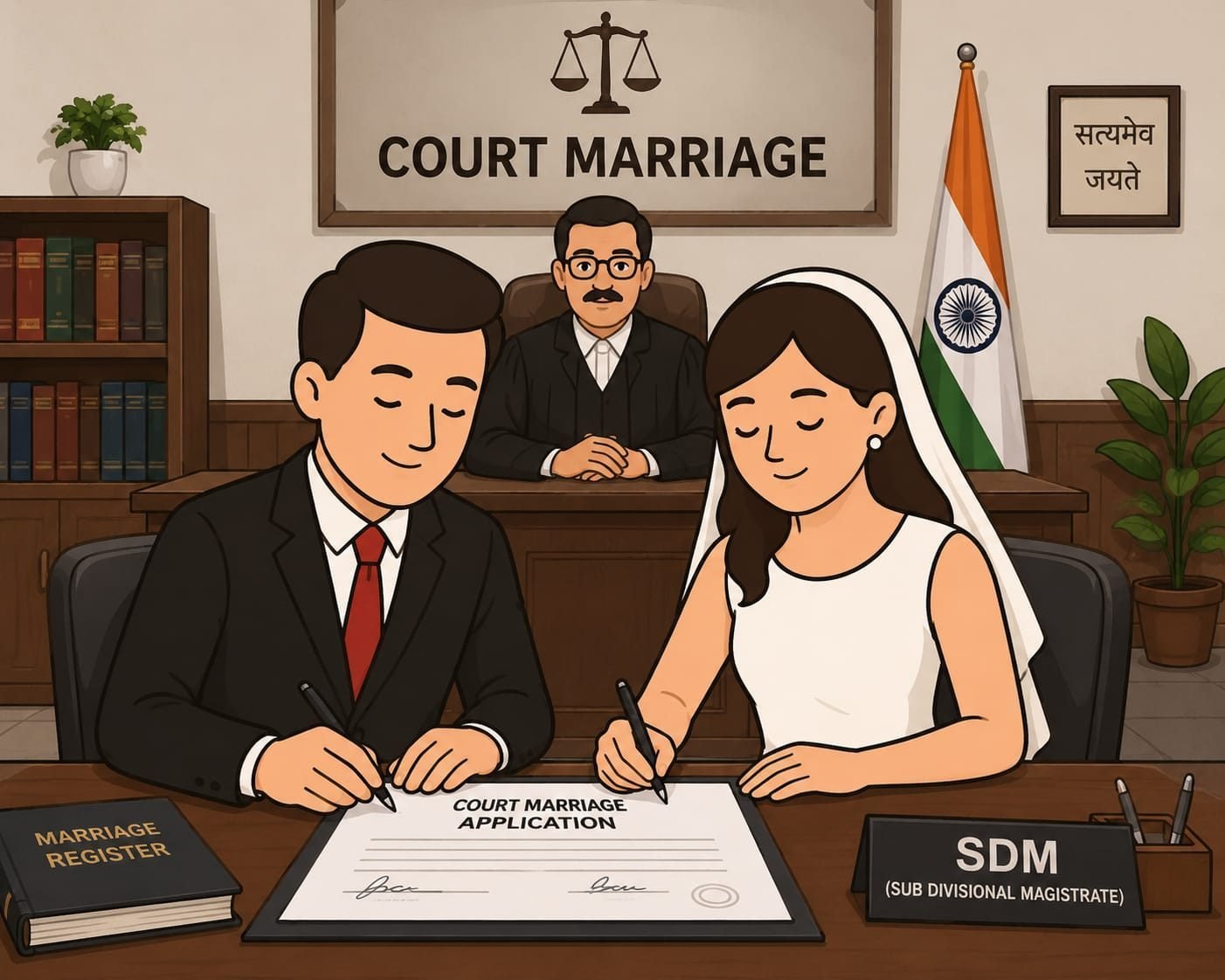
Quick answer: Civil Lines (pincode 110054) and the neighbourhoods around it, including Timarpur, Mukherjee Nagar, Kingsway Camp, Majnu ka Tilla and the Delhi University North Campus, have one of the youngest populations in Delhi. It is full of students, competitive-exam aspirants and young working people from other states. Couples here marry the same way as anywhere in Delhi. Two Hindus, Sikhs, Jains or Buddhists can have an Arya Samaj wedding and register it under the Hindu Marriage Act on the e-District portal, for ₹100 or ₹10,000 with Tatkal. Couples of different religions use the Special Marriage Act, which has a 30-day notice. Under Delhi's 2026 revenue map, "Civil Lines" is no longer the name of a revenue sub-division. Most of this area is expected to fall in the North district (sub-divisions Burari, Adarsh Nagar and Badli), with some pockets possibly in neighbouring districts. The e-District portal allocates the office by your exact address. The two things that matter most here: proving age and address when you live in a PG or hostel, and knowing your rights if your families are against the marriage.
Key takeaways
- "SDM Civil Lines" is no longer a revenue sub-division; from 1 January 2026 most of the area is expected under the North district, and e-District allocates the office by address.
- Two Hindus, Sikhs, Jains or Buddhists: Arya Samaj ceremony + Hindu Marriage Act registration; different religions: Special Marriage Act (30-day notice).
- Minimum age is 21 (groom) and 18 (bride), proved by birth or Class 10 certificate; Aadhaar is not age proof.
- Students in PGs and hostels can marry and register in Delhi with a rent agreement, PG letter or hostel certificate plus affidavit.
- Adults do not need family consent; threatened couples can call 112 or 181 and approach police special cells or the High Court.
Last reviewed: 22 September 2026 · 36 min read
On this page
- Civil Lines at a glance
- Civil Lines under the 2026 map
- Which office registers your marriage
- Legal routes
- Students and aspirants: the questions we hear most
- Age: the one rule that cannot bend
- Address proof when you live in a PG or hostel
- Marry in Delhi or in your home state?
- When families are against the marriage
- Police protection, 181 and safe houses
- Just arrived in Delhi together?
- Arya Samaj + registration, step by step
- Special Marriage Act from Civil Lines
- Inter-caste couples
- Inter-religion couples
- Tibetan couples from Majnu ka Tilla
- Marriage and exam or job forms
- Witnesses
- Documents checklist
- What happens at the appointment
- After the certificate
- What it costs
- Timeline
- Getting around
- Common mistakes
- Four Civil Lines situations
- Checklist
- One-minute summary
- How we help
- Questions and answers
Civil Lines has two faces. One is old and official: the colonial bungalows along Rajpur Road and Alipur Road, Raj Niwas (the Lieutenant Governor's residence), the Delhi Legislative Assembly building, Metcalfe House, Maidens Hotel and Qudsia Bagh. From 1911 until New Delhi was ready in 1931, this was where the British administration of the new capital actually sat. The other face is young and restless: the Delhi University North Campus, the coaching lanes of Mukherjee Nagar, rented rooms in Timarpur, Kingsway Camp, Hudson Lines and Vijay Nagar, and the Tibetan settlement at Majnu ka Tilla. Every year tens of thousands of young people arrive here from Bihar, Uttar Pradesh, Rajasthan, Haryana, Uttarakhand and the North East to study or prepare for exams. Some of them fall in love. Some of them decide to marry.
That is why the calls we get from Civil Lines sound different from the calls we get from, say, Chanakyapuri or Defence Colony. The couple is usually in their twenties. At least one partner lives in a PG, hostel or shared flat. The parents are often in another state and do not yet know, or know and object. The couple's first questions are rarely about fees. They are: "Are we old enough?", "Can we marry without our families?", "What address do we give?", and "Will the police send us back home?" This guide answers those questions honestly, and then walks through the process step by step.
For the general Delhi process, see our complete Delhi court marriage guide. For your legal rights in a love marriage, read love marriage legal rights.
Civil Lines at a Glance
| Point | Detail |
|---|---|
| Pincodes | 110054 (Civil Lines, Timarpur, Majnu ka Tilla); 110009 (Mukherjee Nagar, Kingsway Camp, GTB Nagar, Vijay Nagar); 110007 (North Campus, Kamla Nagar) |
| Main areas | Civil Lines, Rajpur Road, Alipur Road, Timarpur, Majnu ka Tilla, Mukherjee Nagar, Hudson Lines, Kingsway Camp, Vijay Nagar, Kamla Nagar, Outram Lines |
| Revenue district from 1 January 2026 | Mostly expected under the North district (sub-divisions Burari, Adarsh Nagar, Badli); the portal decides by address |
| Local body | Municipal Corporation of Delhi, Civil Lines zone |
| Metro | Civil Lines, Vidhan Sabha, Vishwavidyalaya and GTB Nagar (Yellow Line); Kashmere Gate interchange (Yellow, Red, Violet) |
| Typical couples | University students and recent graduates, competitive-exam aspirants, young professionals in rented rooms, Tibetan families, long-settled Civil Lines residents |
| Nearby | Tis Hazari district courts, ISBT Kashmere Gate, Delhi Legislative Assembly, Raj Niwas |
Civil Lines Under the 2026 District Map
On 1 January 2026, Delhi's revenue administration moved from 11 districts and 33 sub-divisions to 13 districts and 39 sub-divisions, with boundaries aligned to the Municipal Corporation's zones. This followed a Revenue Department notification dated 25 December 2025. Before the change, "SDM Civil Lines" was one of the best-known sub-divisions in the city. Under the new map, Civil Lines does not appear as a sub-division name at all.
| Before 2026 | From 1 January 2026 |
|---|---|
| Civil Lines was a sub-division with its own SDM office | No "Civil Lines" sub-division; the area is spread across the new districts, mostly North district (Burari, Adarsh Nagar, Badli) |
| 11 districts, 33 sub-divisions | 13 districts, 39 sub-divisions |
| Revenue and municipal boundaries did not match | Revenue districts aligned with MCD zones |
What this means in practice: many websites, including older pages of ours, still tell you to go to "SDM Civil Lines". Do not rely on that. When you apply on the e-District portal, it asks for your address and allocates the office. The office named on your appointment slip is the one you go to. If you live near the Old Delhi side, towards Kashmere Gate or Mori Gate, or north towards Model Town, your address may be allocated to a different district, such as Old Delhi or Central North. Certificates issued before 2026 by the old Civil Lines office remain valid; nobody needs to re-register.
Which Office Registers Your Marriage
- Hindu Marriage Act registration: the office allocated on e-District for the address of either partner in Delhi, or for the place in Delhi where the marriage was solemnised. This matters for students: if you married at a mandir in Delhi, you can register in Delhi even if your permanent address is in another state.
- Special Marriage Act: the Marriage Officer of the district where at least one of you has lived for 30 days or more before giving notice. A PG or rented room counts if you can document it.
- Where the file is allocated is not your choice: the portal decides from the address you enter. Enter the address you can prove, not the one you think is more convenient.
Legal Routes
| Couple | Usual route | Time |
|---|---|---|
| Two Hindus, Sikhs, Jains or Buddhists | Arya Samaj wedding + Hindu Marriage Act registration | Ceremony can be the same day; certificate in 1–2 weeks (Tatkal 1–2 working days) |
| Different religions, neither wants to convert | Special Marriage Act | About 35–60 days |
| Inter-caste, same religion | Either route; the Hindu Marriage Act route is faster | 1–2 weeks |
| One partner a foreign national (including many Tibetans) | Usually Special Marriage Act | About 35–60 days |
If you are not sure which applies, see Special Marriage Act vs Hindu Marriage Act.
Students and Aspirants: The Questions We Hear Most
A large share of our Civil Lines enquiries come from students at North Campus colleges and from aspirants in the Mukherjee Nagar and Kingsway Camp coaching belt. Their situation has a few features in common, and it helps to see them together:
| Common situation | What it means legally | What to do |
|---|---|---|
| Permanent address in another state, living in a PG | Delhi registration is still possible if the marriage takes place in Delhi or you can prove Delhi residence | Carry permanent-address ID plus rent agreement or PG letter; see the address section below |
| Groom is 20, bride is 19 | The groom is under 21, so the marriage cannot lawfully take place yet | Wait until he turns 21; no mandir or office should marry you before that |
| Parents don't know | Adults do not need parental consent | You may still choose to tell them; if you expect threats, read the protection section first |
| Limited money | The government fee for Hindu Marriage Act registration is ₹100 (normal) or ₹10,000 (Tatkal) | Tatkal is optional; if you are not in a hurry, the normal route is much cheaper |
| Worried about exams or a future government job | Marriage is no bar to any exam or government service | Declare marital status truthfully on every form; see "Marriage and exam or job forms" |
We say this to every young couple who calls: marriage is a legal commitment with consequences for property, inheritance, children and, if things go wrong, divorce. The law lets adults marry without anyone's permission, and we will help you do it properly. But we also encourage couples to take a day or two to be sure, especially if the only reason for the rush is fear of families. A registered marriage done in a panic is still a marriage.
Age: The One Rule That Cannot Bend
The minimum age for marriage in India is 21 for the groom and 18 for the bride, under both the Hindu Marriage Act and the Special Marriage Act. A bill to raise the bride's age to 21 was introduced in 2021 but lapsed in June 2024, so the ages above still apply. See our marriage age guide for detail.
- Age is proved by a birth certificate or the Class 10 certificate or marksheet showing the date of birth. A passport also works. Aadhaar is generally not treated as proof of date of birth.
- If the dates on your documents do not match, sort that out first. The date on your Class 10 certificate is usually the one offices rely on.
- A marriage where the groom is under 21 or the bride under 18 is a child marriage under the Prohibition of Child Marriage Act, 2006. Anyone who performs or arranges it can be prosecuted. We will not do it, and no genuine mandir or office will either.
If one of you is a few months short of the age, the honest advice is simple: wait. Nothing you can do on paper changes the date of birth.
Address Proof When You Live in a PG or Hostel
This is the most common document problem in Civil Lines. Your Aadhaar shows your home address in Patna, Jaipur or Dehradun, but you have lived in a PG in Mukherjee Nagar for three years. What works?
| Situation | What usually works |
|---|---|
| Hindu Marriage Act, married at a mandir in Delhi | Your Aadhaar (with home address) is enough as ID; the Delhi mandir address establishes where the marriage took place. The portal allocates the office accordingly. |
| Want to register at your Delhi address | Registered or notarised rent agreement, or a PG owner's letter with the owner's ID and a utility bill for the property, plus your affidavit |
| College hostel | A hostel residence certificate from the college or warden, on letterhead, plus your college ID and an affidavit |
| Special Marriage Act (30-day residence needed) | Rent agreement or PG letter covering at least the last 30 days; a bank passbook or post-office document with the Delhi address helps |
| You have updated Aadhaar to your Delhi address | The simplest option, if the address matches the one you enter on the portal |
Some things do not work as address proof on their own: a coaching institute ID, a library card, a WhatsApp message from your landlord, or an unsigned rent receipt. Offices differ on exactly what they accept, so we check your documents before you apply. For more options, see our documents guide.
One caution: do not enter a relative's or friend's Delhi address as your own if you do not live there. Registration involves affidavits sworn on oath. A false address in an affidavit is a real legal problem, and it can later be used to challenge the marriage.
Marry in Delhi or in Your Home State?
Couples often ask whether it is better to marry in Delhi or to go home and register there. A marriage validly registered in any state is valid across India. The practical differences:
- Delhi: online appointments on e-District, a Tatkal option, and distance from family pressure. If families are opposed, marrying where you live and study is usually safer.
- Home state: easier address proof, and it may be easier to involve family if they support you. Procedures, fees and waiting times differ by state.
- Special Marriage Act: in any state, the notice is displayed at the Marriage Officer's office, and in some states copies are sent to the permanent address. Couples worried about family reaction should read the inter-religion guide to understand how notice works.
When Families Are Against the Marriage
Opposition from families is the single biggest worry for couples here. The law is clear and has been repeated by the Supreme Court and the Delhi High Court many times:
- Two adults who are eligible to marry do not need the consent of parents, the community or anyone else.
- Choosing a life partner is part of the right to life and personal liberty under Article 21 of the Constitution.
- Police have a duty to protect adult couples who face threats; their job is not to "counsel" them back to their families.
- Family members who threaten, confine or harm a couple commit crimes, whatever their reasons.
At the same time, the law cannot make a family accept a marriage, and a certificate does not stop relatives from being angry. Many couples we have helped did reconcile with their families months or years later. What helps in the meantime is being lawful and careful: correct documents, a registered certificate, and a plan for your safety if needed. See love marriage in Delhi for more on this.
Police Protection, 181 and Safe Houses
Delhi has specific arrangements for couples in danger. In 2020 Delhi Police set up special cells in each police district for inter-caste and inter-faith couples, each coordinated by a Deputy Commissioner of Police, with the district's social welfare and women and child development officers. In 2021 the Delhi government issued a standard operating procedure for protecting such couples, which said the 181 women's helpline would also take calls from couples in distress and that a safe house was being set up, the first one in North Delhi. Delhi Police told the Delhi High Court in 2022 that these cells offer lodging, meals, counselling and medical help under police protection.
- If you face a threat: call 112 in an emergency. For help as a couple, call 181.
- Write it down: give a written complaint to the local police station and to the DCP of the district, naming who is threatening you. Keep a stamped copy or a photo of the diary number.
- Carry proof of age: the first thing police check is whether both of you are adults. Keep copies of your Class 10 certificates or birth certificates with you.
- Court protection: if the police do not act, adult couples can file a protection petition before the Delhi High Court. The High Court regularly directs the police to protect couples and their liberty.
We are not lawyers and cannot represent you in court, but we can help you get the marriage and its documents in order, which is usually the first thing a court or police officer looks at.
Just Arrived in Delhi Together?
Civil Lines is close to ISBT Kashmere Gate, and some couples call us within hours of stepping off a bus from Uttar Pradesh, Haryana, Punjab or Uttarakhand. If that is you, here is the calm version of what to do:
- Check your ages and documents first. Without age proof, nothing else can happen. If your documents are at home, ask a trusted friend to send clear photos, and arrange the originals.
- Find a safe place to stay with ID-based check-in. If you have nowhere to go and fear for your safety, call 181.
- Do not rush into a ceremony without paperwork. A garland exchange at a roadside temple with no records helps nobody. A proper Arya Samaj ceremony with documents, or notice under the Special Marriage Act, is what the law recognises.
- Tell the police if families have filed a complaint. Families sometimes file a "missing person" or kidnapping complaint. Adult couples can appear before the police or a magistrate and state that they are together by choice. Protection petitions deal with exactly this.
- Register the marriage. The certificate is your strongest document.
For a partner who has come to Delhi only recently, the 30-day residence condition of the Special Marriage Act matters: at least one of you must have lived in the district for 30 days before notice. For two Hindus, the Hindu Marriage Act route has no residence waiting period, which is why it is usually faster.
Arya Samaj + Registration, Step by Step
For two Hindus (including Sikhs, Jains and Buddhists), this is the fastest lawful route and the one most Civil Lines couples use.
- Document check: send us clear photos of both partners' age proof, ID, address proof and photographs. If either of you was married before, include the divorce decree or death certificate. We tell you what is missing before you spend anything.
- Affidavits: each partner signs an affidavit stating date of birth, marital status, religion and that the marriage is by free consent. These are notarised.
- Ceremony: the Vedic ceremony at the Arya Samaj mandir takes about an hour and a half: havan, kanyadaan where family is present, the seven pheras and saptapadi, and the exchange of garlands and sindoor. The mandir issues a marriage certificate and photographs.
- Online application: the registration application is filed on the Delhi e-District portal, with scanned documents and the mandir certificate, and an appointment is booked.
- Appointment: both partners and two witnesses appear before the registering officer with originals. The officer checks documents, records statements and approves the registration.
- Certificate: the Hindu Marriage Act registration certificate is issued, usually downloadable from the portal once approved.
Please note: after rulings of the Supreme Court in 2022 and the Allahabad High Court in the same year, a mandir certificate on its own is not treated as conclusive proof of marriage. The registration certificate is what banks, passport offices, embassies and courts rely on. Always complete the registration. More detail is in our Arya Samaj court marriage guide.
Special Marriage Act from Civil Lines
The Special Marriage Act is a secular law that lets any two adults marry without changing religion.
- Residence: at least one partner must have lived in the district for 30 days before notice. For PG residents this is the rent agreement or PG letter.
- Notice: the notice of intended marriage is filed online and verified at the Marriage Officer's office. It is displayed at the office.
- 30-day period: anyone may raise a legal objection within 30 days, for example that one partner is already married or under age. Objections based on religion, caste or family disapproval are not legal grounds.
- Solemnisation: after the 30 days and within three months of notice, the couple and three witnesses appear before the Marriage Officer, sign the declarations and the marriage is solemnised and registered on the spot.
- Certificate: the marriage certificate under the Special Marriage Act is issued.
Plan for 35 to 60 days in total. See our inter-religion marriage guide for more.
Inter-Caste Couples
An inter-caste marriage between two Hindus is simply a Hindu marriage. There is no separate "inter-caste" procedure, and caste is not written on the certificate. The Hindu Marriage Act route works exactly as above.
Two schemes are worth knowing about:
- Dr. Ambedkar Scheme for Social Integration through Inter-Caste Marriages: a central scheme under which a couple where one partner belongs to a Scheduled Caste may receive ₹2.5 lakh (₹1.5 lakh paid and ₹1 lakh as a fixed deposit), for a first marriage registered under the Hindu Marriage Act, with the application made within a year of marriage, subject to the scheme's conditions.
- Delhi government incentive: Delhi has its own incentive for inter-caste marriage, currently ₹50,000, through the Department for the Welfare of SC/ST/OBC/Minorities, subject to eligibility.
Both schemes need the registered certificate. Details are in our inter-caste marriage guide.
Inter-Religion Couples
North Campus and Mukherjee Nagar bring together young people of every religion, and inter-religion couples make up a meaningful share of our Civil Lines work. The options are:
- Special Marriage Act, without conversion: each partner keeps their religion. This is the route we recommend for most inter-religion couples.
- Conversion and a religious marriage: conversion must be genuine. Courts, including the Supreme Court in Perumal Nadar and Sarla Mudgal, have looked closely at conversions done only to marry. Several states, including Uttar Pradesh, now have laws regulating conversion for marriage. If either of you is from such a state, take this seriously.
Read our Shuddhi Sanskar guide before considering conversion. For most couples, the Special Marriage Act is the simpler and safer route.
Tibetan Couples from Majnu ka Tilla
Majnu ka Tilla (also called New Aruna Nagar) on the Yamuna bank near Civil Lines is one of the best-known Tibetan settlements in India. Tibetan couples, and Tibetans marrying Indian partners, have questions that other couples do not:
- Citizenship status matters. Some Tibetans born in India are Indian citizens. In Namgyal Dolkar v. Government of India (2010), the Delhi High Court held that a person born in India between 26 January 1950 and 1 July 1987 is an Indian citizen by birth. Others hold a Registration Certificate as foreign nationals. Which one applies to you affects the route and documents.
- Indian citizens: an Indian-citizen Tibetan Buddhist marrying another Buddhist or a Hindu can generally use the Hindu Marriage Act route, which covers Buddhists.
- Registration Certificate holders: where one or both partners are foreign nationals, the Special Marriage Act is usually the safer route, with a Registration Certificate, Identity Certificate or passport as ID and a statement or document of single status.
- Religious ceremony: a traditional Tibetan Buddhist ceremony can be held for the family; the legal registration is done separately.
Because status depends on individual facts, we look at each couple's documents before advising. We do not advise on citizenship or immigration applications themselves.
Marriage and Exam or Job Forms
Aspirants often worry that marriage will affect their exam or government job. It will not stop you from sitting any exam or joining any service. What you must do is be truthful.
- Application forms and detailed application forms for UPSC, SSC, state commissions and banks ask for marital status. Answer it as it is on the date you fill the form. If your status changes after you apply, read the commission's instructions on how to report it.
- Once in government service, the Central Civil Services (Conduct) Rules bar bigamy and require government servants to intimate marriage to a foreign national. Our Chanakyapuri guide explains these rules for officers.
- If you change your surname after marriage, the name on your certificates, admit cards and service records should match. Change the name through the proper process first, and keep the marriage certificate as proof.
- Some reservations and quotas depend on the candidate's own category or domicile, not on the spouse's. Marriage to someone of a different category does not change your own category.
Witnesses
Hindu Marriage Act registration needs two witnesses, and the Special Marriage Act needs three. Witnesses must be adults with ID and address proof, and they must genuinely know you, because they confirm to the officer that they know who you are and that the marriage took place. We do not provide witnesses.
For students, classmates, flatmates, a senior from your coaching institute, or a friend from your hometown who lives in Delhi are all fine, as long as they know you and are willing to come. They do not need to be relatives or Delhi residents. See our witness guide.
Documents Checklist
| Document | Who | Notes for Civil Lines couples |
|---|---|---|
| Age proof | Both | Birth certificate, Class 10 certificate or passport; Aadhaar is ID, not age proof |
| Identity proof | Both | Aadhaar, passport, voter ID or driving licence |
| Address proof | Both | Home-state Aadhaar is fine for ID; for a Delhi address, rent agreement, PG letter or hostel certificate plus affidavit |
| Photographs | Both | Passport-size photos, plus wedding photos for Hindu Marriage Act registration |
| Affidavits | Both | Date of birth, marital status, nationality, religion and consent; notarised |
| Mandir certificate | Couple | For Hindu Marriage Act registration after an Arya Samaj ceremony |
| Divorce decree or death certificate | If previously married | Certified copy of the final decree |
| Witness documents | Witnesses | ID, address proof and photos of each witness |
| Foreign national documents | If applicable | Passport or Registration Certificate / Identity Certificate, and a single-status document |
Keep originals and two sets of photocopies. If your Class 10 certificate is at home in another state, ask family or a friend to courier it; a scanned copy alone is not enough at the appointment.
What Happens at the Appointment
Many young couples are nervous before the appointment, often because they imagine an interview about their relationship. It is much more ordinary than that.
- You arrive on the date and time on your slip, with both partners and the witnesses.
- Staff check the originals against the uploaded scans. This is where mismatched names or dates cause trouble, so check spellings in advance.
- The officer confirms your identities, asks whether you are marrying by choice, and asks the witnesses whether they know you.
- For the Hindu Marriage Act, the registration is approved and the certificate follows. For the Special Marriage Act, at the solemnisation appointment you sign the declarations before the Marriage Officer and three witnesses.
Dress neatly, arrive early, and keep phones silent. Nobody will ask about your caste, your families' views or your exam results.
After the Certificate
- Make copies: keep several certified copies and a scanned PDF. You will use the certificate for a joint bank account, rent agreement, passport, visa and name change.
- Update your records: if a spouse changes surname, update Aadhaar, PAN, bank records and passport in that order, using the certificate.
- Tenancy: many Mukherjee Nagar and Timarpur landlords rent only to single students. If you move into a room together, sign a fresh rent agreement in both names.
- Going abroad: if the certificate will be used overseas, plan the apostille early.
- Schemes: apply for any inter-caste marriage incentive within the scheme's time limit.
What It Costs
| Service | Our charge | Government fee |
|---|---|---|
| Arya Samaj marriage + mandir certificate | ₹5,100 | — |
| Registration of an existing marriage | ₹6,000 | ₹100 (Tatkal ₹10,000) |
| Arya Samaj marriage + registration | ₹7,100 | ₹100 (Tatkal ₹10,000) |
| Urgent / Tatkal handling | ₹6,100 | ₹10,000 |
| Inter-religion marriage | ₹10,000 | As applicable |
| Special Marriage Act full process | ₹15,000 | About ₹15 |
| Apostille of certificate | ₹4,500 | As applicable |
For students watching every rupee, Tatkal is the biggest avoidable cost: the ₹10,000 government Tatkal fee is only worth paying if you need the certificate within a day or two. Current prices are on our fees page.
Timeline
| Couple | Typical time to certificate |
|---|---|
| Two Hindus, documents ready | Ceremony same day; certificate 1–2 weeks, or 1–2 working days with Tatkal |
| Two Hindus, age proof at home in another state | Add courier time for originals |
| Different religions | About 35–60 days |
| One partner a foreign national | About 35–60 days, plus time to collect documents |
Getting Around
- The Yellow Line runs through the whole area: Kashmere Gate, Civil Lines, Vidhan Sabha, Vishwavidyalaya and GTB Nagar.
- From Mukherjee Nagar and Kingsway Camp, GTB Nagar is the nearest station; from North Campus, Vishwavidyalaya.
- Traffic around ISBT Kashmere Gate and the Ring Road near Majnu ka Tilla can be heavy; allow extra time for morning appointments.
- Your registration office under the 2026 structure may not be in Civil Lines at all. Check the address on your appointment slip the day before.
Common Mistakes
- Going to the "SDM Civil Lines" office because an old page said so.
- Trying to marry before the groom turns 21.
- Using Aadhaar as proof of age.
- Giving a friend's Delhi address instead of your real one.
- Arriving with a coaching ID or unsigned rent receipt as address proof.
- Stopping at the mandir certificate and never registering.
- Bringing witnesses who barely know you, or asking a stranger to be a witness.
- Paying for Tatkal when there is no real urgency.
- Converting only to marry, without understanding the legal risk.
Four Civil Lines Situations
The North Campus couple
A postgraduate student from Bihar and a classmate from Delhi married by Arya Samaj rites during the semester break. His Aadhaar showed his home address, and the mandir was in Delhi, so the registration was allocated in Delhi without difficulty. Two classmates were their witnesses. They told their families after the certificate came.
The aspirant who was too young
A couple from a Mukherjee Nagar coaching centre called us when the groom was 20 years and 8 months old. We told them we could not marry them until his birthday, and why. They came back four months later, and the marriage was registered normally.
The inter-faith couple from Timarpur
A Hindu woman and a Muslim man living in rented rooms in Timarpur married under the Special Marriage Act. Her rent agreement covered the 30-day residence condition. They kept their religions and kept copies of all correspondence in case their families objected.
The Majnu ka Tilla couple
A Tibetan woman who was an Indian citizen by birth married a Himachali Buddhist. After we checked her documents, she used her Indian passport as ID. They married in a traditional Buddhist ceremony with both families, which is a valid customary ceremony under the Hindu Marriage Act, and registered the marriage under that Act the following week.
Civil Lines Checklist
- ☐ Groom 21+, bride 18+ on the date of marriage, proved by birth or Class 10 certificate
- ☐ Neither partner has a living spouse; decree or death certificate if previously married
- ☐ Route chosen: Hindu Marriage Act for two Hindus; Special Marriage Act for different religions or a foreign partner
- ☐ Address proof sorted: home Aadhaar, or rent agreement / PG letter / hostel certificate with affidavit
- ☐ Office checked on e-District under the 2026 map, not "SDM Civil Lines"
- ☐ Two witnesses (three for the Special Marriage Act) who genuinely know you
- ☐ Safety plan if families object: 112, 181, written complaint to police
- ☐ Originals in hand, not just scans
- ☐ After the certificate: copies, name updates, rent agreement, any scheme applications
One-Minute Summary
- "SDM Civil Lines" no longer exists as a revenue sub-division; from 2026 most of this area is expected to fall in the North district, and the e-District portal allocates the office by address.
- Two Hindus: Arya Samaj ceremony + Hindu Marriage Act registration; different religions: Special Marriage Act with 30-day notice.
- Age is 21 for the groom and 18 for the bride, proved by birth or Class 10 certificate. No exceptions.
- PG and hostel residents can marry and register in Delhi; carry proper address documents.
- Adults do not need family consent. If threatened, call 112 or 181 and write to the police.
- Always complete registration; the mandir certificate alone is not enough.
How We Help
We check your documents on WhatsApp before you spend anything, tell you honestly if you are not yet eligible, help with affidavits and address proof for PG and hostel residents, conduct Arya Samaj ceremonies (including on weekends and during exam breaks), file your registration on e-District, guide Special Marriage Act marriages from notice to certificate, and arrange apostilles. Everything is confidential. We do not provide witnesses, and we do not marry anyone under the legal age.
Court marriage for Civil Lines couples
Arya Samaj + registration ₹7,100 · Inter-religion ₹10,000 · Special Marriage Act full process ₹15,000.
Book Court Marriage – from ₹6,100 →Same religion? Arya Samaj marriage
Questions and Answers: Court Marriage for Civil Lines Couples
Sources and Official References
Facts in this guide were checked against the following primary sources. Government procedures and office allocations change, so confirm current details on the official portal before applying.
- Delhi e-District – official online application portal
- Revenue Department, Delhi – notification dated 25 December 2025 creating 39 sub-divisions and 13 areas
- The Hindu Marriage Act, 1955 – India Code
- The Special Marriage Act, 1954 – India Code
- Delhi government SOP for protection of inter-faith and inter-caste couples (Scroll, 2021)
- Delhi Police tells High Court about 15 district special cells for couples (LiveLaw, 2022)
- Civil Lines, Delhi – Wikipedia
This guide is general information, not legal advice for your specific case. Call +91 8376863962 for advice on your situation.
Related Articles
🌳 Court Marriage in Model Town
Neighbouring North Delhi area.
Read →🏯 Court Marriage in Kotwali
Old Delhi guide.
Read →🛒 Court Marriage in Sadar Bazar
Old Delhi guide.
Read →🏛️ Court Marriage in Chanakyapuri
New Delhi district guide.
Read →🌾 Court Marriage in Alipur
Outer North Delhi guide.
Read →⚖️ Love Marriage Legal Rights
If families oppose.
Read →🎂 Marriage Age Limit
21 and 18 explained.
Read →🤝 Inter-Caste Marriage
Process and incentives.
Read →🕊️ Inter-Religion Marriage
Special Marriage Act explained.
Read →🎖️ Court Marriage in Delhi Cantt
Soldiers, leave and service records.
Read →🏞️ Court Marriage in Hauz Khas
Doctors, researchers, expats, current law.
Read →🌾 Court Marriage in Kanjhawala
Khap pressure, gotra, your rights.
Read →🏛️ Court Marriage in Delhi
The complete Delhi guide.
Read →