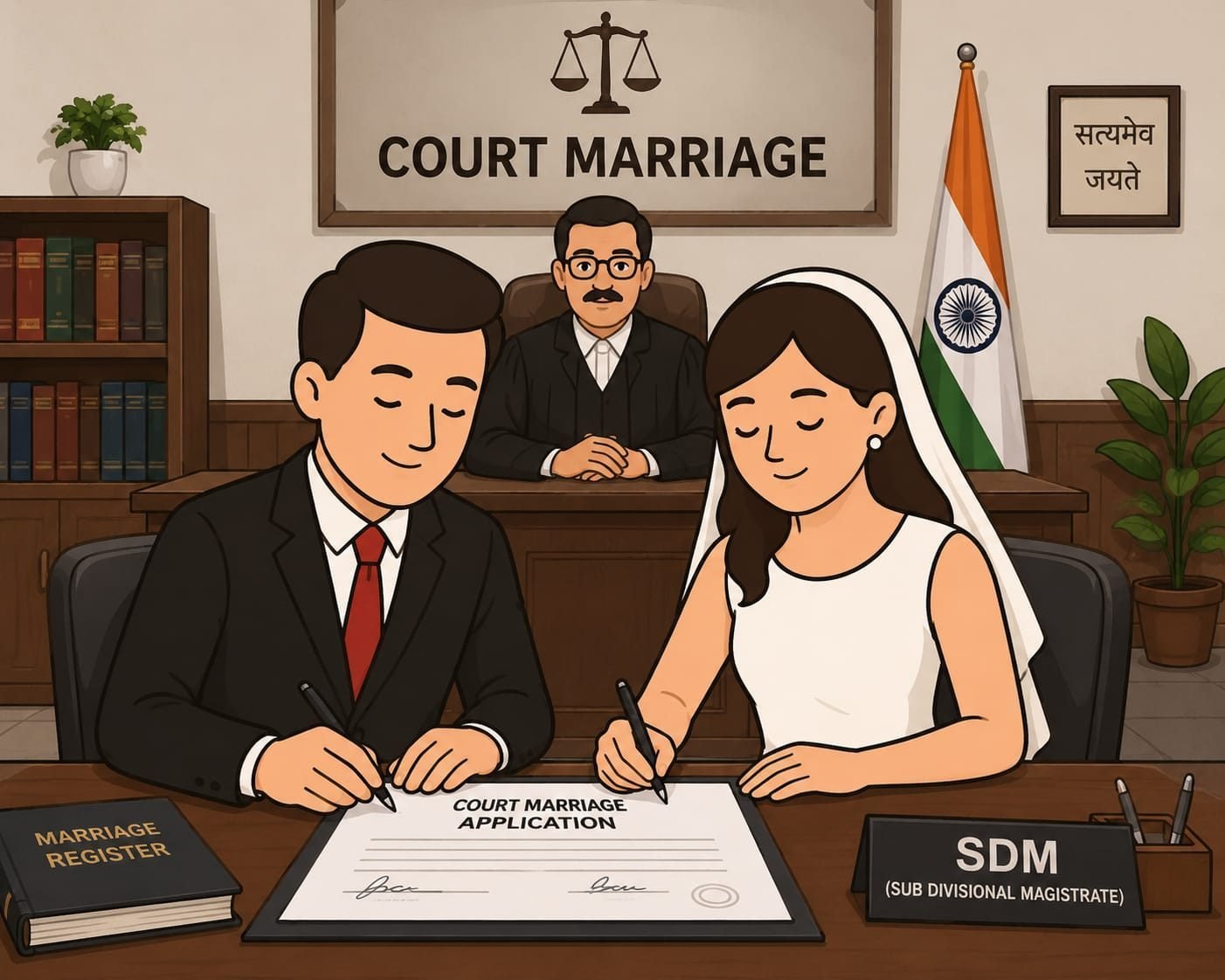
Quick answer: Most guides about Shakarpur talk about offices and fees. This one starts where the trouble actually starts for young couples in the Shakarpur–Laxmi Nagar belt: the flat. Two adults may live together in India — the Supreme Court has said so more than once — but a landlord may still refuse to rent to you, and in this belt of one-room and two-room barsatis, coaching students and first-job couples, that refusal is the single most common reason a couple suddenly wants to be married “by Friday”. This page explains what the law really says, what a rent agreement and police verification actually do, what a marriage certificate honestly changes about renting and what it does not, and how to get married properly rather than in a panic. Court marriage assistance: ₹6,100.
Key takeaways
- Two adults living together is not an offence in India. No section makes it one — the Supreme Court said so in Khushboo (2010) and Velusamy (2010), and the Domestic Violence Act expressly recognises such relationships.
- But a private landlord may still refuse you, and that refusal is not itself unlawful. The threat is hollow in law and real in practice at the same time — knowing which half you are facing is the whole skill.
- Get both names on the rent agreement. It is the cheapest protection either of you will ever buy, and the one couples most often skip.
- A marriage certificate ends the argument and puts both names on everything. It does not compel any landlord to rent to you, and it is not an address proof on its own.
- A ceremony can be same-day; a government certificate cannot. Anybody in Laxmi Nagar promising one by Sunday is lying or about to file something false in your names.
- For an inter-faith couple the Special Marriage Act clock starts the day you sign the agreement — 30 days’ residence, then 30 days’ notice. Plan it; do not improvise it.
- We never provide witnesses, never manufacture a residence, never touch an under-age marriage, and we stop if either of you is not sure.
- Do not marry only to get a flat. If the room is the only reason, take it in one name and marry when you mean it.
Last reviewed: 23 September 2026 · 36 min read
On this page
- Shakarpur at a glance
- Why this page is about the flat
- What the law actually says
- The refusal, and what is behind it
- Brokers, brokerage and receipts
- The rent agreement, properly
- The security deposit traps
- Police tenant verification
- RWAs, guards and registers
- PG living and its rules
- What a certificate really changes
- The address-proof chicken and egg
- What counts as address proof
- Your three lawful routes
- The 30 days and your agreement
- Which office registers you
- Fees, at cost and in full
- Documents, mapped to this belt
- Do not marry only for a flat
- If somebody comes to the door
- After the certificate: addresses and KYC
- A realistic timeline
- Mistakes we see every month
- Case patterns from this belt
- Touts around Laxmi Nagar
- OTP and UPI fraud
- What we will not do
- Talk to us
1. Shakarpur at a Glance
Shakarpur sits in the East district of Delhi, wedged between Laxmi Nagar to its west, Shakarpur Khas and Pandav Nagar to the south, and the Vikas Marg corridor running along its northern edge. The Blue Line stops at Laxmi Nagar and Nirman Vihar on either side of it, and both are five to ten minutes from most of the colony’s inner lanes. Within a short radius you have Shakarpur School Block, Radhey Puri, Ganesh Nagar, Mandawali and Patparganj, and a little further the Gandhi Nagar market and the Karkardooma court complex.
What makes this belt different from, say, Mayur Vihar or Vasant Vihar is its building stock. This is a colony of four-storey walk-ups cut into one-room and two-room units, of barsatis on the roof, of ground-floor shops with rooms above them, and of buildings where six or eight tenancies share a single stairwell and one electricity riser. The tenants are coaching students preparing for competitive exams, young men and women in their first job in Connaught Place or Noida, small traders, and — in a proportion that has grown every year we have worked here — young couples.
Rents in this belt are among the lowest anywhere in Delhi that is still ten minutes from a Metro station. That is exactly why couples end up here. It is also why the housing market here is informal: many tenancies are oral, many agreements are photocopied templates with the names filled in by hand, and a great deal depends on what an individual landlord feels like on a given afternoon.
The government offices that matter to you are not in Shakarpur itself. Registration of marriages for this area is handled through the Delhi e-District portal, which allots the sub-divisional office when you apply; for addresses in this belt that is usually one of the East district offices — Preet Vihar, Gandhi Nagar or Vishwas Nagar. Do not fix the office in your head in advance. Apply, see what the portal allots, and go there. We cover this properly in section 16.
2. Why This Page Is About the Flat and Not the Office
We have written a guide for most localities in Delhi, and each one concentrates on the problem that particular locality actually brings to our phone. In Gandhi Nagar it is traders and family businesses. In Mayur Vihar it is couples caught between a Delhi job and a Noida address. In Preet Vihar it is people who think “court marriage” means standing in front of a judge.
In Shakarpur and Laxmi Nagar, it is the flat. The call sounds like this, almost word for word, several times a month:
“Sir, we have found a room. The broker says the owner will only give it to a married couple. He wants to see the marriage certificate before Sunday or he will give it to somebody else. How fast can you do it?”
Sometimes the version is worse. The couple is already living in the room. Somebody — a neighbour, the guard, the landlord’s son — has worked out that they are not married, and now there is pressure: produce a certificate or leave by the end of the month. Occasionally there has been a knock on the door at night, or a threat to “call the police”, or a phone call to a parent in another state.
We are a marriage documentation service. We cannot find you a flat and we will not pretend to be your lawyer. But we can do three things that actually help, and this page is those three things written down.
First, we can tell you what the law genuinely says, because in nine cases out of ten the person threatening you is relying on your not knowing. Second, we can tell you what a marriage certificate really does and does not change in a rental negotiation, honestly, including the cases where it changes nothing. Third, if you were going to marry anyway and the housing situation has simply brought the date forward, we can tell you the fastest lawful route and the exact documents so that you do not waste a week, and we can tell you when the honest answer is “this cannot be done by Sunday”.
What we will not do is the fourth thing people sometimes ask for: produce a paper quickly that looks like a marriage certificate. That is dealt with in section 27, and the answer is no in every version of the question.
3. What the Law Actually Says About Two Adults Living Together
Start here, because everything else follows from it.
Two consenting adults living together is not an offence in India. There is no section of any statute under which you can be prosecuted for it. The Supreme Court has said so directly. In S. Khushboo v. Kanniammal (2010) the Court held that living together is not illegal and observed that though it may be perceived as immoral by some sections of society, it is not an offence in law. In D. Velusamy v. D. Patchaiammal (2010) the Court went further and set out when such a relationship is treated as a relationship “in the nature of marriage” for the purposes of the Protection of Women from Domestic Violence Act, 2005. In Indra Sarma v. V.K.V. Sarma (2013) the Court laid down detailed guidelines on the same question. These are not obscure rulings; they are the settled position.
The Domestic Violence Act itself is the clearest statutory recognition. Its definition of a “domestic relationship” expressly covers two persons who live or have lived together in a shared household through a relationship in the nature of marriage. A statute that gives you remedies in a live-in relationship cannot simultaneously be read as making the relationship unlawful.
Two more practical points, because they come up constantly in this belt:
- A hotel or a guest house cannot refuse a room to an unmarried couple merely because they are unmarried. The Madras High Court said so in December 2019 while dealing with the refusal of accommodation to unmarried adults, and the general position — that a place of public accommodation cannot invent a morality qualification — has been applied by other High Courts too. A hotel may of course demand valid photo identity for each guest, and it should.
- A landlord is in a different position from a hotel. A private owner letting out a private flat has a very wide freedom to choose a tenant, and there is no central law in India that makes it unlawful to prefer married tenants. This is the hard part of the answer, and we would rather you heard it from us than discovered it on a Sunday afternoon.
So the honest summary is: nobody can act against you for living together, but a landlord can decline to rent to you, and that declining is not itself illegal. The threats you are likely to face are therefore hollow in law and real in practice at the same time. Understanding which half you are dealing with, in any given conversation, is the whole skill.
Section 144, “police complaint”, “public nuisance”. These phrases get thrown around in this belt. None of them creates an offence of unmarried cohabitation. If somebody tells you they will “file a case” because you are living together, ask them calmly which section. They will not have one, because there isn’t one.
4. The Refusal, and What Is Actually Behind It
It helps enormously to understand why a landlord in this belt refuses, because the real reason is usually not the stated reason, and the real reason is often negotiable.
The stated reason is almost always moral: “family building hai”, “neighbours will object”, “my mother lives on the ground floor”.
The actual reasons, in our experience of listening to both sides of this for years, are these, roughly in order of frequency:
- Fear of a police problem. The landlord imagines a scene — a family arriving, a complaint, a constable at the gate, his name in a register. He does not want any version of that, and he will trade a month’s rent to avoid it. This fear is largely misplaced but it is genuine.
- Fear of an abrupt vacancy. Two young people who are not married, in his head, may split up next month and disappear, leaving unpaid rent and an empty room in an off season. A married couple, in the same head, is stable. This is a commercial calculation dressed as a moral one.
- Pressure from the building or the RWA. He personally does not care, but the man on the second floor does, and he has to live with that man. This is the reason he is least likely to admit.
- Genuine conservatism. Present, but less common than the other three, and almost never movable. Do not waste a week on it.
Reasons one and two are commercial and can be answered commercially. A paid-up deposit, a properly written agreement, employer letters or college identity cards, a local reference, a willingness to let the police verification be done properly rather than skipped — these speak directly to what he is actually afraid of. We have seen couples turn a no into a yes without any mention of marriage at all, simply by making themselves look like the least risky tenant on his list.
Reason three is sometimes solvable by going to the person behind it. Reason four is not solvable, and the right response is to thank him and look at the next building. In a colony with the density of Shakarpur there is always a next building.
5. Brokers, Brokerage and the Receipt Nobody Asks For
Almost every tenancy in this belt goes through a broker, and most of the brokers here are one man with a phone, a scooter and a shop-front the size of a cupboard. Some are excellent. Some are the reason couples call us in tears.
The things worth knowing:
Brokerage is normally one month’s rent, and it is payable once, on possession. In this belt the convention is one month from the tenant and, in a proper arrangement, something from the owner too. Anybody asking for brokerage before you have seen the room, or for “token money” to hold a flat you have not inspected, is at best careless and at worst running a known trick: the token is taken from three couples for the same room and two of them are told on Monday that it has gone.
Get a receipt for everything, including brokerage. A plain piece of paper with the date, the amount, what it is for, the room address and the broker’s signature and phone number is enough. A broker who refuses to sign for money he has taken is telling you what he will be like when the deposit is due back.
Do not pay a deposit to a broker. The deposit goes to the owner, against a receipt from the owner, ideally after you have seen some proof that the person signing is the owner — an electricity bill or a property tax receipt in his name is usually available and usually enough for a tenancy.
Ask the broker the couple question directly, before you see anything. “Hum couple hain. Owner ko problem hai ya nahi — pehle pooch lijiye.” It saves you afternoons. A broker who says “aap chaliye, dekh lenge” is planning to spring it on the owner at the door with you standing there, which is the worst possible way for that conversation to happen.
Do not let a broker hold your original documents. Ever, for any reason, for any length of time. He needs photocopies and he may photograph them. He does not need your originals overnight to “show the owner”.
6. The Rent Agreement, Done Properly
This is the single most useful document in a young couple’s life in Delhi, and most couples in this belt sign whatever is put in front of them without reading it.
The eleven months. Almost every residential rent agreement in Delhi is written for eleven months. That is not a superstition. A lease of twelve months or more attracts compulsory registration, with stamp duty and a visit to the sub-registrar; an eleven-month agreement can be made on stamp paper and, in practice, is usually notarised instead. An eleven-month notarised agreement is a perfectly real contract between you and the owner.
The catch. A notarised eleven-month agreement is a good contract but a weaker document in front of a government office than a registered one. Some offices accept it readily as address proof and some do not. If your entire plan for proving a Delhi address rests on a notarised photocopy, build in a fallback — see section 13.
Both names on the agreement. This matters more than anything else on this page. If both of you are named as tenants:
- Both of you have a contractual right to be in that flat, not just one of you plus a guest.
- Both of you have a document showing a Delhi address in your own name.
- If the relationship ends, neither of you can simply lock the other out.
- If the landlord later objects to one of you, he is objecting to his own signed agreement.
Landlords sometimes resist putting both names on precisely because of the first and fourth points. Insist politely. If he will only name one of you, at least have the other named in the agreement as a permitted occupant, in writing, with the words on the page rather than in a conversation.
Read for these clauses before signing:
- Notice period — one month is normal, on both sides. An agreement that lets him give you a week but requires two months from you is not normal.
- Lock-in — if there is one, know it. A six-month lock-in with a one-month rent penalty is common and fair; a lock-in that forfeits the whole deposit is not.
- Escalation — usually 5–10% on renewal. It should be a number on the page.
- Electricity — sub-meter reading at a stated rate, or a share of the main bill? Get the current reading written into the agreement on the day you take possession, and photograph the meter.
- Maintenance and repairs — who pays for what. A geyser, a motor and a seepage problem are the three that cause fights in these buildings.
- Visitors and guests — some templates carry a clause about overnight guests. Read it. If it is drafted so that either of you could be described as an unauthorised guest, get it amended before you sign, not after.
- Purpose — “residential purposes only” is normal. If you are also going to work from home or run anything from the room, say so now.
The Model Tenancy Act, 2021. You will read about this online. It is a central model law which states are free to adopt, and adoption is uneven; it also generally applies to tenancies created after a state adopts it. Check the current position for Delhi rather than assuming any of its protections apply to your eleven-month agreement. We deliberately do not quote it as though it were in force for you, because we have seen couples argue with a landlord on the strength of a provision that was not applicable and lose the flat.
7. The Security Deposit, and Where It Disappears
In this belt a deposit of one to three months’ rent is normal; anything above three months for a one-room or two-room unit is high. The deposit is the money you are most likely to lose, so treat it as the serious part of the transaction.
- Pay it by bank transfer or UPI, not in cash, with a narration that says “security deposit, [address], [month]”. If the owner insists on cash, insist on a signed receipt in the same breath.
- Write the refund terms into the agreement — how many days after vacating, and what may be deducted. “Within 30 days of handover, less unpaid electricity and any damage beyond normal wear and tear” is a fair clause.
- Photograph the whole flat on the day you move in. Every wall, the kitchen platform, the bathroom fittings, the switchboards, the meter reading, the condition of the door and the window grilles. Timestamped photographs on both phones. This costs you ten minutes and is the single thing most likely to get your deposit back intact.
- Do not let rent be “adjusted” against the deposit in the last months unless the owner has agreed in writing. It is a common suggestion and it removes your leverage completely.
If a deposit is wrongfully withheld, that is a civil recovery matter. A lawyer’s notice is cheap and often sufficient; the small causes route exists beyond that. That is advocate work, not ours, and we will say so rather than taking money to “handle” it.
8. Police Tenant Verification — What It Is and Is Not
Delhi Police asks landlords to get tenants verified, and in this belt it is done unevenly: some owners are meticulous, many do nothing, and some use it as a threat.
Three things to understand:
One. It is a verification, not a licence. The form asks who you are, where you came from, your identity document and your local and permanent addresses. There is no column on it asking whether the two people in the flat are married to each other, and no part of the process is designed to approve or refuse a relationship.
Two. The obligation is primarily the landlord’s. If he has not got you verified, that is his lapse and not your offence. A landlord who threatens you with “police verification nahi karaunga” has the logic backwards.
Three. It is to your advantage. A verified tenant with an agreement and a receipt trail is a tenant who is very hard to remove overnight, and who has a record of lawful residence at that address. Couples in this belt often want to avoid verification because they feel exposed; our advice is the opposite. Be the tenant with all his paper in order. Cooperate, give correct information, keep a copy of the submitted form and any acknowledgement.
Where verification can be done online through the Delhi Police citizen services portal, use that route and keep the acknowledgement number. If a person in uniform comes to the door, see section 21 before you open anything other than the conversation.
9. RWAs, Guards, Gate Registers and Neighbours
A resident welfare association is an association of residents. It is not a statutory authority, it has no power to decide who may live in a private flat, and it cannot evict anyone. In practice, in colonies like this one, an RWA or a self-appointed committee of three men on the ground floor can make life difficult in small ways: a guard who asks questions, an entry register, a “rule” about visitors after ten.
Things that are normal and that you should simply comply with: a gate register for visitors, a photocopy of your identity document with the guard or the caretaker, a parking allocation, timings for the common water motor.
Things that are not enforceable against you: a “rule” that only married couples may take flats, a demand to see your marriage certificate from someone who is not your landlord, a threat to cut water or power, and any instruction to vacate that does not come from the owner in accordance with your agreement. Cutting off essential services to force a tenant out is not something an RWA may lawfully do.
The practical advice, unglamorous but effective: be boring neighbours. Learn the guard’s name. Keep the stairwell clean. Do not have loud gatherings in the first month. The single best protection against a colony deciding to take an interest in you is being the flat nobody has any reason to talk about.
10. PG Living, and Why Couples End Up There
Laxmi Nagar has a very large paying-guest market built for coaching students, and couples sometimes end up in separate PGs while they look for a flat, or in a “couple PG” advertised online.
Points worth knowing. A PG is usually a licence to occupy rather than a tenancy, so your protections are weaker and the notice period is often a week. Most PGs have house rules about visitors and timings that they enforce far more strictly than a landlord would. The advertised “couple-friendly” accommodation in this belt ranges from perfectly decent to places you should not walk into; go in daylight, look at the exits, look at the bathroom, ask the other residents.
The deposit rules matter here too, and PG deposits are the ones most often not returned. Pay by transfer, get the terms on paper, and photograph the room.
One thing we say to every couple who tells us they are in separate PGs and want to marry quickly so they can take a flat: that is a reason to bring the date forward, not a reason to skip a step. The routes in section 14 are all fast enough that nobody needs to do anything false.
11. What a Marriage Certificate Honestly Changes About Renting
Here is the section that this whole page exists for, and we are going to be blunt in both directions.
What it genuinely changes:
- It ends the argument. A landlord who wanted married tenants has what he asked for, and the subject closes. In this belt that alone is worth a great deal, because the subject re-opening every few months is what wears couples down.
- It removes the lever. Nobody — a neighbour, a guard, a relative, an ex-landlord — can use “they are not married” as a threat any more. The threat was always hollow in law; now it is hollow in fact too.
- It puts both names on things. Joint bank accounts, a joint gas connection, a nomination, an insurance policy, an employer’s spouse record, a hospital admission form. Every one of these is easier with a certificate and awkward without one.
- It protects the person with less. If one of you has the job, the savings, the family money and the name on everything, marriage gives the other legal standing that a live-in relationship gives only partially and only after argument. This is not a renting point but it is the most important point on the page.
- It makes an address history coherent. Certificate, agreement in both names, joint bills, updated Aadhaar — that is the chain that makes a passport application or a visa application straightforward three years from now.
What it does not change:
- It does not compel any landlord to rent to you. A landlord who does not want tenants of a particular kind will find another reason. A certificate defeats one stated objection; it does not create a right to a flat.
- It is not an address proof on its own in most offices’ practice. It proves a marriage, not a residence.
- It does not fix a deposit dispute, a seepage problem or a broker who has taken money. Those are contract matters and stay exactly where they were.
- It does not silence a family. If the pressure you are under is from home rather than from a landlord, a certificate changes the legal position entirely and the emotional position not at all. Plan for both.
- It does not make an inter-faith or inter-caste couple invisible. It makes you lawfully married, which is the thing that matters, but it does not change the neighbourhood you live in.
The one-line version. Marry because you want to be married. If you also happen to solve a housing argument on the way, good. If the housing argument is the only reason, read section 19 before you do anything.
12. The Address-Proof Chicken and Egg
This trips up more couples in this belt than any other single thing, so read it slowly.
You want to register a marriage in Delhi. The application will ask for address proof. You have just moved into a rented room, so your Aadhaar still shows your parents’ address in Bareilly or Chhapra or Rohtak, your bank shows the same, and the only Delhi document you have is an eleven-month agreement signed last week.
The good news is that this is far less of a problem than couples fear, for two reasons.
First, a home-state address proof is a valid address proof. It is not a fake and it is not a disqualification. Thousands of people registering marriages in Delhi every year have home-state documents, because that is what living in India looks like. What you must not do is claim a Delhi address you do not actually have.
Second, registration of a Hindu marriage can be done where the marriage was solemnised. Section 8 of the Hindu Marriage Act, 1955 provides for registration and leaves the detail to state rules, and Delhi’s rules provide for the Registrar in whose jurisdiction the marriage was solemnised or in whose jurisdiction either party has been residing. So if the ceremony happens in Delhi, the Delhi registration follows, whatever your Aadhaar says.
Where the chicken-and-egg genuinely bites is the Special Marriage Act, because there at least one of you must have resided in the district for thirty days before the notice is given. That is a real requirement and we deal with it in section 15.
13. What Actually Counts as Address Proof
Requirements are set by the portal and by the office, and they do change, so confirm on the Delhi e-District portal for your own application rather than relying on any page including this one. As a practical matter, the documents that are usually put forward are:
- Aadhaar — the most widely accepted, whether it shows a Delhi or a home-state address.
- Voter identity card and passport — both carry addresses and both are widely accepted.
- Driving licence.
- Electricity, water, gas or landline bill in your own name — strong, but young tenants rarely have one, because the connection is in the owner’s name.
- Bank passbook or statement with the address printed.
- Ration card.
- Registered rent agreement — strong. A notarised eleven-month agreement is often accepted and sometimes queried; do not build your only plan on it.
Two pieces of practical advice for tenants in this belt:
Update your Aadhaar address once the tenancy is stable. A rent agreement is among the documents UIDAI accepts for an address update, and once your Aadhaar shows your Delhi address a great many other things become simple — bank KYC, gas connection, employer records, and any future application at a Delhi office. Do it in the first couple of months, not in the week you need it.
Do not manufacture an address. We will not prepare an affidavit claiming a residence you do not have, we will not put a friend’s address on your application, and we will not proceed on a rent agreement written for a flat you have never lived in. This is the request we refuse most often in this belt, and the reason is simple: a false address on a marriage record is discovered years later, usually at a passport counter or a visa interview, and by then it cannot be quietly fixed.
14. Your Three Lawful Routes
There are three, and only three. Anybody offering you a fourth is selling something.
Route A — Arya Samaj marriage, then registration. Available where both of you are Hindu, Sikh, Jain or Buddhist. The ceremony is a real marriage under the Hindu Marriage Act, performed with havan and saptapadi, and it can be done the same day if you are both eligible, have your original documents and have brought your own two witnesses. The mandir issues its certificate on the day; the government registration follows by appointment, often within a few working days. Our fee is ₹7,100 and includes both the ceremony and the registration work. If you and your partner are both Hindu, live in this belt, and want this settled in the shortest lawful time, this is your route. Our Shakarpur same-day service page sets out the practical detail.
Route B — registration of a marriage that has already happened. If you were married by ceremony — at home, in your village, months or years ago — and never registered it, this is you. Bring the wedding card, ceremony photographs, a certificate from the mandir or the pandit where obtainable, age and identity proof, current address proof, affidavits from both spouses, and two witnesses who genuinely know you as a married couple. Our fee is ₹6,000. A surprisingly large number of couples in Shakarpur are in this position and do not realise the ceremony alone is not what a landlord, a bank or a passport office will act on.
Route C — the Special Marriage Act, 1954. The civil route, open to any two adults whatever their religion, with no conversion. At least one of you must have resided in the district for thirty days before notice is given; the notice is then displayed publicly for thirty days; solemnisation follows before the Marriage Officer with three witnesses. About sixty days in total. Our fee for the full assistance is ₹15,000. If you are an inter-faith couple, this is your route and there is no faster lawful version of it.
And the fourth thing people ask for, so that it is written down: there is no route that produces a government marriage certificate today or tomorrow. A ceremony can be same-day. A certificate follows registration, at a government office, by appointment. Anybody in Laxmi Nagar promising you a certificate by Sunday is either lying to you or intending to file something false in your names.
15. The Thirty Days, and What Your Rent Agreement Has to Do With It
For an inter-faith couple in a rented room, this is the section that decides your next two months, so here it is plainly.
The Special Marriage Act requires that notice be given to the Marriage Officer of a district in which at least one of the parties has resided for at least thirty days immediately preceding the notice. The notice is then published, and objections may be made within thirty days. There is no fee, no contact and no emergency that lawfully shortens either period, and any office that appeared to do so would be acting outside the statute.
What proves the thirty days. In practice, the documents put forward are the rent agreement, utility bills, an employer’s letter, an Aadhaar showing the local address, or a landlord’s declaration — and what the office is really assessing is whether you actually live there. A rent agreement dated three days ago does not by itself establish thirty days of residence; a rent agreement dated two months ago, with a couple of bills and an Aadhaar updated to that address, comfortably does.
The planning point. If you are an inter-faith couple who has just taken a flat in Shakarpur and you know you want to marry under the Special Marriage Act, then the day you sign that agreement is the day your clock starts. Get both names on it, keep every receipt, update one Aadhaar, and then give notice after the thirty days rather than trying to argue the point on day ten. Couples who plan this lose nothing; couples who improvise it lose a month.
What we will not do. We will not draft a residence claim for an address you do not live at, we will not arrange a backdated agreement, and we will not put a notice in on the strength of a document we can see is arranged. We have turned this work down every month for years and we will turn it down again.
And the honest warning that goes with this route: the notice is a public document during those thirty days. For most couples this is a formality nobody ever looks at. For a couple whose families are opposed, it is a real consideration to think about in advance, and we would rather discuss it with you at the start than have you discover it in week three. Our inter-religion marriage guide deals with the whole picture, including the honest treatment of conversion as an alternative.
16. Which Office Registers Your Marriage
Applications for marriage registration in Delhi are made through the Delhi e-District portal. You create an account, complete the application, upload the documents and are given an appointment. For addresses in the Shakarpur belt the sub-divisional office allotted is normally one of the East district offices — Preet Vihar, Gandhi Nagar or Vishwas Nagar are the ones we see — but the allotment is done by the portal on the basis of what you enter, and it changes. Do not print anything or plan travel on the strength of an office name you read on a website. Apply, see what you are allotted, go there.
Two clarifications that save people a wasted morning:
Karkardooma Court does not marry you and does not register you. The Karkardooma complex is a court complex. It deals with matrimonial litigation — divorce, maintenance, custody, protection orders — which is advocate work. Registration is done by the SDM or the Registrar of Marriages; a Special Marriage Act marriage is solemnised before the Marriage Officer. “Court marriage” is everyday shorthand for a civil registration and not a description of a building. Our Preet Vihar guide takes this apart in full, including the touts who trade on the confusion.
Both of you must attend in person, at the ceremony and at the office. There is no power-of-attorney marriage, no video-call marriage and no arrangement under which a relative stands in for one party.
17. Fees, at Cost and in Full
Our charges are the same for everybody. They do not go up because you are in a hurry, because a landlord has given you a deadline, or because you called on a Sunday.
| Service | Our fee | What it covers |
|---|---|---|
| Marriage certificate — duplicate or correction | ₹2,500 | Application, follow-up and collection |
| Arya Samaj marriage — ceremony only | ₹5,100 | Pandit, havan, saptapadi and the mandir certificate, same day |
| Marriage registration | ₹6,000 | Full application, appointment and certificate |
| Nikah registration | ₹6,000 | Registration of a nikah under the Delhi 2014 Order |
| Court marriage assistance | ₹6,100 | End-to-end assistance with the civil registration |
| Arya Samaj marriage with registration | ₹7,100 | Ceremony at the mandir plus the registration work |
| Special Marriage Act (full assistance) | ₹15,000 | Notice, the thirty days, solemnisation and certificate |
Government charges are separate and shown at cost on your receipt. We do not add anything to them, we do not round them up, and every rupee we take is receipted with our own charge and the government charge on separate lines. If you cannot see on your receipt exactly where each rupee went, ask us and we will rewrite it.
Our full fee page is at fees.html, and it is the same list.
18. Documents, Mapped to a Rented Room in This Belt
The list is the same as anywhere in Delhi. What changes for tenants is where each item is going to come from.
- Age proof for both — birth certificate, matriculation certificate or passport. Most young tenants in this belt have their matriculation certificate at home with a parent. Arrange for it to be couriered early rather than in the last week; it is the item that most often holds up an application.
- Photo identity for both — Aadhaar, voter card, passport or driving licence, in original.
- Address proof for both — see section 13. Home-state is fine.
- Passport photographs — several each; get them done together so both sets match.
- Two witnesses with their own original photo identity and address proof. Three for solemnisation under the Special Marriage Act.
- Divorce decree or death certificate if either of you was married before. No exceptions and no affidavit substitutes for it.
- For Route B (registering an old ceremony) — wedding card, photographs, pandit or mandir certificate where obtainable, affidavits from both spouses.
The tenant’s document rule. Photograph every original onto both of your phones and into both of your email accounts, today. Keep the originals in one place that both of you know about, not spread across two bags. In a shared building with a shared stairwell, a document that only one person can find is a document that can go missing at exactly the wrong moment.
Witnesses. We do not provide witnesses — not for a fee, not as a favour, not because your family is far away and you do not know anyone. A witness must be an adult who genuinely knows you, carries original identity, and attends in person. A paid witness is a false statement to a public authority and it leaves your marriage record open to challenge exactly when you most need it to be solid. In this belt, when couples sit down and actually think, they almost always find two — a colleague, a batchmate from the coaching centre, a cousin already in Delhi, the friend whose sofa you slept on in the first week. Ask them a week in advance and confirm the night before. Our witness guide sets out exactly who qualifies.
19. Please Do Not Marry Only to Get a Flat
We will lose bookings by writing this section and we are writing it anyway, because we have watched it go wrong.
Marriage is not a tenancy document. It changes your legal status permanently, it creates rights and obligations in property, maintenance and succession, and it is undone only through a court process that takes far longer and costs far more than any flat in Shakarpur is worth. A couple who marries in a week because a broker set a Sunday deadline is making a permanent decision to solve a temporary problem.
If the two of you were going to marry anyway and the housing situation has simply brought the date forward from December to October — that is completely fine, it is most of the couples we see, and there is nothing wrong with it. Come in, bring your documents, and let us do it properly.
But if, when you are honest with each other, the answer is “we would not be doing this now if it were not for the room”, then please do one of these instead: take the flat in one name with the other as a named occupant, look at the next building, take a PG for two months, or go to a part of the belt where owners are less fussy — and marry when you actually mean to. The room will not matter in three years. The certificate will.
And if either of you is not sure, we stop. That is not a policy we announce and then bend. We speak to both parties separately and we ask directly, and if the answer is not a clear yes from each of you in your own words, we do not proceed, however much has already been paid or arranged. If you are the person who is unsure, say so to us alone; you will not be argued with.
20. If Somebody Comes to the Door
This is the part couples in this belt are most frightened about, so here is a plan rather than reassurance.
If it is the landlord or his family. Talk at the door, not inside, and not at night if you can help it. Keep it brief and factual: you have an agreement, you have paid, you are willing to discuss anything in the morning. Do not sign anything at the door. Do not hand over documents. If he demands you vacate immediately, tell him you will respond in writing and then do so — a short WhatsApp message setting out what was said and when is a record, and records change behaviour.
If it is a neighbour or an RWA delegation. They have no authority over your tenancy. Be polite, say nothing about your personal circumstances, and take it up with the owner afterwards. Do not get into a discussion about whether you are married; you are not obliged to have that conversation with anybody except the person whose flat it is.
If it is the police. Living together is not an offence, and no case can be registered for it. Ask politely who they are and which police station; note the name and number. If it is tenant verification, cooperate — it helps you. Do not go anywhere with anybody at night; you may say you will come to the station in the morning. Call somebody who knows where you are while it is happening. If the visit was arranged by a family to pressure you, say so plainly to the officer — that changes how it is handled.
If a family arrives. Go somewhere public and staffed — a Metro station, a hospital, a bank, a busy shop — not a lane, a room or a parked vehicle. Do not get into a vehicle with anybody who says they will sort it out, including a relative who arrives suddenly and calmly. Call 112; you do not need to have been hurt first. Women’s helpline 181.
If you fear for your safety. Two consenting adults may marry, and family disapproval is not a legal objection. Protection is available: a couple who fears for their safety can approach the High Court, and the police have a duty to act. That is advocate work and we will tell you so rather than taking money for it. Our safety guide for couples sets out the whole plan — documents, phones, who to tell, what to save.
What we will never do. We do not call families. We do not confirm to any caller or visitor that you are our client. We do not discuss one couple with another. If there is a particular number or name to be careful about, tell us at the start and it goes on your file.
21. After the Certificate: Addresses, KYC and the Boring Half Hour
The certificate is the beginning of the paperwork, not the end of it. Do this within the first month, while everything is fresh and you are still near the office that issued it.
- Check it at the counter before you leave. Both names and their exact spellings, both fathers’ names, the date of marriage, the place, and both dates of birth. A correction made on the spot takes a minute. The same correction later means an application and a ₹2,500 fee.
- Photograph it and email it to both of you. Keep the original flat, not folded in a wallet. Write the registration number and date of registration on a separate note kept somewhere else.
- Get two or three attested copies made while you are still near the issuing office.
- Update Aadhaar — address for whichever of you has moved, and name if either of you is changing it. A rent agreement is among the documents accepted for an address update.
- Bank KYC for both, and open the joint account if you are going to have one.
- Nominations. This is the one everybody forgets. Check the nominee on your EPF, gratuity, insurance policies and bank accounts — nominations made before marriage may have lapsed or may still name a parent. Five minutes each, and it is the difference between a simple claim and a two-year one.
- Employer records — spouse details, medical cover, emergency contact.
- Gas connection and electricity — if you can get a connection in your own name at the flat, do it. A utility bill in your own name is the strongest ordinary address proof there is, and it makes every future application in Delhi simpler.
- Ration card and voter roll, if you are settling here.
22. A Realistic Timeline From This Belt
| If you are… | Realistic time | The thing that decides it |
|---|---|---|
| Both Hindu, documents in hand, witnesses confirmed | Ceremony same day; certificate within a few working days | Whether your originals are in Delhi or at home |
| Both Hindu, documents at home in another state | Add 2–4 days | Courier time for the originals |
| Already married by ceremony, registering now | Roughly a week to ten days | Photographs, wedding card and affidavits |
| Inter-faith, Special Marriage Act, already resident 30 days | About 30–35 days from notice | The statutory notice period |
| Inter-faith, just moved in | About 60 days | 30 days residence, then 30 days notice |
| Either party under 21 (groom) or 18 (bride) | Not at all | We decline, at any price |
Nobody in this trade can beat these numbers. What a good service can do is make sure you do not lose four days to a missing document, a wrong upload or an office you were never allotted — which, in practice, is where most of the delay in this belt actually comes from.
23. Mistakes We See Every Month in Shakarpur
- Signing a rent agreement without reading the visitor clause, and discovering two months later that it describes one of you as an unauthorised occupant.
- Only one name on the agreement, which is fine until the day it is not.
- Paying a deposit in cash with no receipt to somebody who turns out not to be the owner.
- Not photographing the flat and the meter on the day of possession.
- Believing the ceremony was enough. A mandir certificate records the ceremony. The document a bank, an employer, a passport office or a landlord will act on is the one issued after registration.
- Leaving the counter without checking the spellings.
- Trying to shorten the Special Marriage Act’s thirty days with a document that was arranged rather than earned.
- Handing original documents to a broker or an agent to “show the owner”.
- Registering the same marriage twice — once in Delhi, once at home “to be safe”. It is the opposite of safe and it is what stops a passport application.
- Not updating the nominations.
24. Case Patterns From This Belt
Anonymised, and each one stands for many.
The Sunday deadline. A couple in their twenties, both Hindu, both working in Noida, found a two-room flat near Shakarpur School Block. The broker said the owner wanted a certificate by Sunday. They called us on a Thursday evening. Her matriculation certificate was in Hardoi. We told them plainly that the ceremony could be done on Saturday but that the government registration would not produce a certificate by Sunday, and that they should tell the broker exactly that. The broker came back on Friday and said the owner would accept the mandir certificate and the registration acknowledgement. They married on Saturday for the right reasons, registered the following week, and moved in. The deadline had been softer than it sounded, as they usually are.
The agreement in one name. A couple had been living near Radhey Puri for eight months with the agreement in his name only. They fell out with the landlord over a deposit deduction; the landlord changed the lock while she was at work and he was travelling. She had no document showing she lived there. It took a week and a lawyer’s notice to get her things back. Both names on the agreement would have cost nothing and prevented all of it.
The thirty days planned properly. An inter-faith couple took a flat off Vikas Marg in March, put both names on the agreement, updated one Aadhaar, and came to us in April knowing exactly what they wanted. Notice went in cleanly, the thirty days passed without incident, and they were solemnised in May. Nothing dramatic happened, which was the point.
The one we refused. A young man came in with a rent agreement dated the previous week and asked whether we could “show” thirty days. We said no and explained why. He was annoyed. He came back seven weeks later having done it properly, and told us that the office had asked for exactly the documents we had told him to build.
The couple who should not have married that month. They told us, when we asked them separately, that the only reason for the date was the flat. We told them to take the flat in one name and come back when they meant it. They did, four months later. It is the piece of advice we are most glad we gave.
25. Touts Around Laxmi Nagar and the Court Road
The stretch between the Laxmi Nagar Metro station and the Karkardooma court complex has the usual ecosystem: men with plastic folders, shop-boards offering “marriage certificate urgent”, and people who will approach a young couple who look anxious. Some are legitimate typists. Some are not.
The rules are simple and they are the same everywhere in Delhi:
- Never hand original documents to somebody who approaches you at a court gate, a Metro exit or a mandir gate.
- Never sign a blank form or blank stamp paper.
- Never follow anybody to a room to “meet the pandit” or “meet the sir”. Ask for the address, look it up, and go yourselves.
- Get a receipt for every rupee from anybody, including us.
- Anybody promising a government certificate today is either lying or about to file something false in your name. A false marriage record surfaces years later at a passport counter and cannot be fixed cheaply.
26. OTP and UPI Fraud, Because Tenants Are Targets
People who have just paid a deposit and a brokerage are people with money moving through their accounts, and that is noticed.
Nobody from us will ever ask you for an OTP, a UPI PIN, a card PIN, a CVV or a net banking password. We will never ask you to install a screen-sharing or remote-access app. We will never ask you to approve a payment request in order to receive money — that is not how UPI works, and the request you approve is money leaving your account.
Two fraud patterns specific to renting in this belt: a “landlord” on a listing site who wants a token transfer before you have seen the flat, and a “broker” who sends a QR code for a deposit. Both are common. See the flat, meet the person, check a bill in his name, pay against a receipt.
If anybody does any of this in our name: stop, share nothing, call +91 8376863962, and report it at cybercrime.gov.in or on 1930 — within the first hour if money has already gone, because that is when it can sometimes be held.
27. What We Will Not Do
Written out so you can hold us to it.
- We do not provide witnesses. Not for a fee, not as a favour, not because you are new to the city.
- We do not touch an under-age marriage. Under the Prohibition of Child Marriage Act, 2006 the minimum age is 21 for the groom and 18 for the bride. We decline in every case, at any price, and we also decline where a document appears to have been altered.
- We do not manufacture a residence. No affidavit for an address you do not live at, no backdated agreement, no friend’s address on your application.
- We do not produce anything that looks like a certificate. There is no fast version and there is no favour version.
- We stop if either of you is not sure. A marriage requires the free consent of both adults — not the consent of a family, and not the silence of somebody who has been brought along.
- We do not charge more for urgency, for distance or for a deadline.
- We do not practise law. Protection petitions, divorce, maintenance, custody, deposit recovery and any dispute with a landlord go to an independent advocate acting in their own name, whose fee we take no share of.
- We do not discuss your file with anybody. Not a family, not a landlord, not a caller who says it is urgent.
28. Talk to Us Before You Pay Anybody Anything
If you are somewhere in the Shakarpur–Laxmi Nagar belt with a room, a deadline and a knot in your stomach, the most useful thing you can do costs nothing: call before you commit to anything. Send photographs of your documents on WhatsApp and we will tell you within minutes which of the three routes applies to you, what is missing, and how long it will honestly take — including when the answer is “not by Sunday” or “not us”.
We are in this belt. Laxmi Nagar and Nirman Vihar on the Blue Line are both a short walk from most of the colony, and Karkardooma is one stop further. Walk to the Metro rather than taking the first vehicle offered outside a gate.
Phone and WhatsApp: +91 8376863962. Arya Samaj marriage with registration ₹7,100 · marriage registration ₹6,000 · court marriage assistance ₹6,100 · nikah registration ₹6,000 · Special Marriage Act ₹15,000 · duplicates and corrections ₹2,500. Government charges separate and at cost.
Court marriage assistance – ₹6,100
End-to-end help with the civil registration · Arya Samaj with registration ₹7,100 · marriage registration ₹6,000 · nikah registration ₹6,000 · Special Marriage Act ₹15,000 · duplicates ₹2,500. Call first — it is free.
Get Court Marriage Help – ₹6,100 →Also: Arya Samaj marriage · Marriage registration · Same-day service in Shakarpur · Find our office
Questions and Answers: Renting, Landlords and Marriage in Shakarpur
Sources and Official References
Facts in this guide were checked against the following primary sources. Government procedures and office allocations change, so confirm current details on the official portal before applying.
- Delhi e-District – official online application portal
- Hindu Marriage Act, 1955 – section 8, registration
- Special Marriage Act, 1954
- Protection of Women from Domestic Violence Act, 2005
- Prohibition of Child Marriage Act, 2006
- Model Tenancy Act, 2021 – Ministry of Housing and Urban Affairs
- Delhi Police – citizen services and tenant verification
- Delhi Commission for Women – 181 helpline
- National Cyber Crime Reporting Portal
- UIDAI – Aadhaar address update
- Delhi Revenue Department – registration and stamp duty
- National Consumer Helpline
This guide is general information, not legal advice for your specific case. Call +91 8376863962 for advice on your situation.
Related Articles
⚖️ Preet Vihar: What “Court Marriage” Means
The myth, and the touts near the courts.
Read →📍 Mayur Vihar: Delhi or Noida?
Working couples and the address question.
Read →🏪 Gandhi Nagar: Traders and Family Business
Shops, HUFs and karigars.
Read →🚌 Shahdara: Arriving in Delhi to Marry
Out-of-state couples at Anand Vihar.
Read →🛡️ Safety Plan for Couples
Protection, pressure and your rights.
Read →🕊 Inter-Religion Marriage
Options without conversion.
Read →👥 Witness Requirements
Who can be a witness, and who cannot.
Read →📅 Marriage Age Limit
21 and 18 explained.
Read →📋 Documents Required
Everything you need, in one list.
Read →🏛️ Court Marriage in Delhi
The complete Delhi guide.
Read →👶 Vivek Vihar: Adoption, IVF and Surrogacy
The certificate CARA and clinics ask for.
Read →