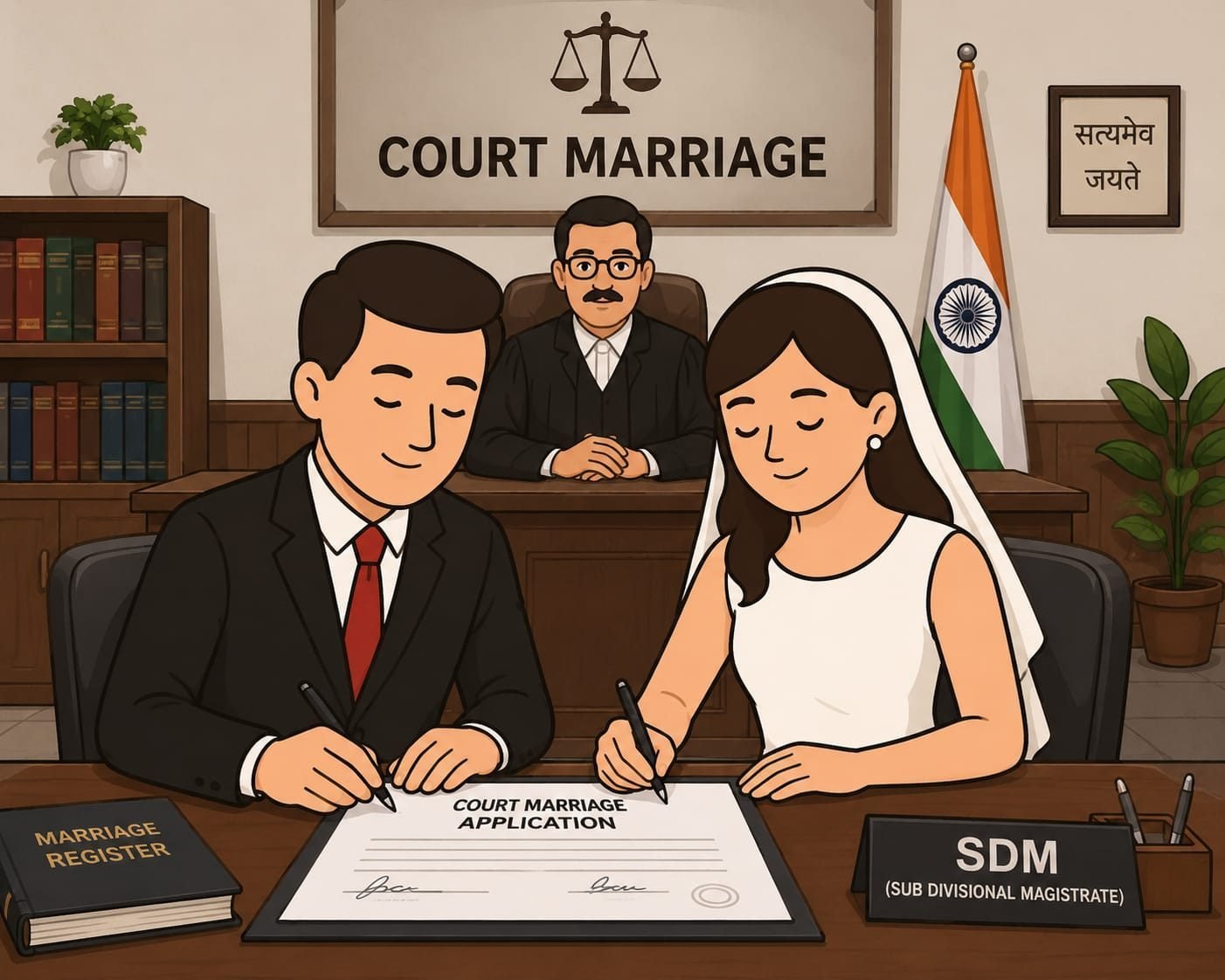
Quick answer: Delhi Cantonment (pincode 110010) is home to thousands of serving Army, Air Force and Navy personnel and their families, and the ex-servicemen who settled nearby in Palam, Raj Nagar and Mahavir Enclave. Soldiers marry under the same civil law as everyone else. Two Hindus, Sikhs, Jains or Buddhists can have an Arya Samaj wedding and register it under the Hindu Marriage Act on the e-District portal, for ₹100 or ₹10,000 with Tatkal. Couples of different religions, and most marriages with a foreign national, use the Special Marriage Act, which has a 30-day notice. Under Delhi's 2026 revenue map, Delhi Cantonment is one of the two sub-divisions of the New Delhi district; the other is New Delhi. Addresses in and around the Cantonment are expected to be allocated to it, but the portal decides by exact address. For service personnel, the civil certificate is only half the job. The marriage also has to be reported through your unit so it appears in your service records, and that entry is what unlocks married accommodation, the dependant card and the family's other entitlements.
Key takeaways
- From 1 January 2026, Delhi Cantonment is one of the two sub-divisions of the New Delhi district; the portal allocates the office by address.
- Soldiers marry under the same civil laws as everyone: Hindu Marriage Act for two Hindus, Special Marriage Act for different religions.
- After the civil certificate, report the marriage through your unit so it is recorded; that unlocks accommodation, dependant card and nominations.
- Marrying a foreign national: check your service's requirements before giving notice under the Special Marriage Act.
- Widows of soldiers should check, in writing, how remarriage affects their family pension before marrying again.
Last reviewed: 22 September 2026 · 36 min read
On this page
- Delhi Cantt at a glance
- Delhi Cantonment under the 2026 map
- Which office registers your marriage
- Legal routes
- Soldiers and the civil law: what applies
- Getting the marriage into service records
- Marrying on limited leave
- Address proof in cantonment housing
- Marrying a foreign national
- Spouse entitlements after marriage
- When both partners are in uniform
- Remarriage of widows and ex-servicemen
- Arya Samaj + registration
- Special Marriage Act
- Inter-caste and inter-religion couples
- Witnesses
- Gorkha soldiers domiciled in Nepal
- When families object
- Posted out soon after marriage
- Registering in your home state
- Documents checklist
- What happens at the appointment
- Using the certificate abroad
- What it costs
- Timeline
- Getting around
- Common mistakes
- Four Delhi Cantt situations
- Checklist
- One-minute summary
- How we help
- Questions and answers
Delhi Cantonment is one of the largest military stations in the country. It sprawls across the south-west of the city between Dhaula Kuan, Palam and the airport, and holds regimental and headquarters units, the Army Base Hospital, service schools, messes and large blocks of married and single accommodation. Around its edges are the civil areas that grew up with it: Sadar Bazar Cantt, Gopinath Bazar, Naraina, Mehram Nagar, Nangal Raya, Palam village, Raj Nagar and Mahavir Enclave, where many retired soldiers and their families now live.
The couples who call us from here have a particular rhythm to their lives. A jawan gets thirty days of annual leave and wants to marry, register and get back to his unit with the paperwork done. A young officer is marrying a doctor from the Army Hospital and both need the certificate for their own service records. A havildar's daughter is marrying a boy from her village in Haryana. A widow of a soldier, still young, wants to remarry and is worried about her family pension. A retired subedar has a son in Canada who is coming home to marry. Each of these has a civil side, which we handle, and a service side, which your unit handles. This guide covers both, so that nothing falls between the two.
For the general Delhi process, see our complete Delhi court marriage guide. For the rules that apply to civilian central government employees, see our Chanakyapuri guide.
Delhi Cantt at a Glance
| Point | Detail |
|---|---|
| Pincode | 110010 (Delhi Cantonment); nearby Palam 110045, Naraina 110028, Mahavir Enclave 110045 |
| Main areas | Delhi Cantonment, Sadar Bazar Cantt, Gopinath Bazar, Kirby Place, Dhaula Kuan, Naraina, Mehram Nagar, Nangal Raya, Palam, Raj Nagar, Mahavir Enclave |
| Revenue district from 1 January 2026 | New Delhi district; Delhi Cantonment is one of its two sub-divisions (the other is New Delhi) |
| Local body | Delhi Cantonment Board for the cantonment area; Municipal Corporation of Delhi for surrounding civil areas |
| Metro | Delhi Cantt and Naraina Vihar (Pink Line); Dhaula Kuan and Delhi Aerocity (Airport Express); Palam and Sadar Bazar Cantonment (Magenta Line) |
| Typical couples | Serving soldiers, sailors and airmen, officers, military nursing and medical staff, service families, ex-servicemen and their children |
Delhi Cantonment Under the 2026 District Map
On 1 January 2026, Delhi's revenue administration moved from 11 districts and 33 sub-divisions to 13 districts and 39 sub-divisions, aligned with municipal boundaries, under a Revenue Department notification dated 25 December 2025. For many areas, such as Civil Lines or Defence Colony, the old sub-division name disappeared. Delhi Cantonment is one of the places where the name survived: it is now one of the two sub-divisions of the New Delhi district.
| Before 2026 | From 1 January 2026 |
|---|---|
| Delhi Cantonment was a sub-division (earlier listed under South West or New Delhi, depending on the source and period) | New Delhi district, sub-division Delhi Cantonment |
| 11 districts, 33 sub-divisions | 13 districts, 39 sub-divisions |
| Nearby Palam and Dwarka pockets were in South West district | South West district's sub-divisions are Najafgarh, Matiala, Dwarka and Bijwasan; some addresses near the Cantonment's edge may go there |
Because the Cantonment's boundary runs close to Palam, Naraina and Dwarka, two neighbours on the same road can sometimes be allocated to different offices. Enter your exact address on the e-District portal and go to the office named on your appointment slip. Certificates issued before 2026 remain valid.
Which Office Registers Your Marriage
- Hindu Marriage Act registration: the office allocated on e-District for the address of either partner in Delhi, or for the place in Delhi where the marriage was performed. A soldier whose permanent address is in Himachal or Rajasthan can register in Delhi if the marriage takes place at a mandir in Delhi, or on the basis of a documented Delhi residence.
- Special Marriage Act: the Marriage Officer of the district where at least one partner has lived for 30 days or more before notice. Service accommodation counts if you can document it.
- The Cantonment Board handles civic matters in the cantonment such as birth and death registration within its limits, but marriage registration under the Hindu Marriage Act and Special Marriage Act is done through the Delhi government's revenue offices.
Legal Routes
| Couple | Usual route | Time |
|---|---|---|
| Two Hindus, Sikhs, Jains or Buddhists | Arya Samaj wedding (or family ceremony) + Hindu Marriage Act registration | Ceremony same day; certificate 1–2 weeks (Tatkal 1–2 working days) |
| Wedding already held in the village | Register the existing marriage (in Delhi or the home state) | 1–2 weeks once documents are ready |
| Different religions | Special Marriage Act | About 35–60 days |
| One partner a foreign national | Usually Special Marriage Act, plus the service's own clearance | About 35–60 days, plus service procedures |
Soldiers and the Civil Law: What Applies
A question we are asked surprisingly often is whether soldiers marry under "army law". They do not. Marriage for service personnel is governed by the same personal laws as for any other citizen: the Hindu Marriage Act for Hindus, Sikhs, Jains and Buddhists, the Special Marriage Act for inter-religion couples, and the relevant personal law for Muslims, Christians and Parsis. The Army Act, Air Force Act and Navy Act do not create a separate kind of marriage.
What the services do have is their own administrative rules about how a marriage is reported and recorded, what the member must disclose, and what entitlements follow. Think of it as two layers:
| Layer | Who handles it | What it decides |
|---|---|---|
| Civil marriage | Arya Samaj mandir or family priest, Delhi revenue office (Marriage Officer or registrar) | Whether you are legally married; the marriage certificate |
| Service record | Your unit, record office or the relevant directorate | Whether the service recognises your spouse for accommodation, dependant card, medical cover, family pension and other entitlements |
Some basic principles are the same in both layers:
- Age: 21 for the groom and 18 for the bride, whatever the rank. A young recruit who joined at 17 or 18 cannot marry until he is 21.
- No bigamy: a second marriage while the first spouse is alive and the first marriage is not dissolved is void under the Hindu Marriage Act and a criminal offence. For service personnel it can also lead to disciplinary action.
- No dowry: the Dowry Prohibition Act applies to everyone. A soldier or officer who demands dowry can face both criminal and service consequences.
- Truthful declarations: false statements about marital status, in service documents or in marriage affidavits, cause serious trouble later.
We are not service officers and do not give advice on internal service rules. What we can do is make sure the civil side is correct, so that when your unit asks for documents, you have them.
Getting the Marriage Into Service Records
Every service has a procedure for recording a change in marital status. In the Army this is commonly done through a Part II order issued by the unit on the basis of the documents you submit; the Navy and Air Force have their own equivalents. Your unit's clerk or adjutant will tell you the exact forms. In general the service will want:
- The registered marriage certificate, from the Hindu Marriage Act registration, Special Marriage Act or the relevant personal law. A mandir certificate alone may not be enough; courts since 2022 have made clear that it is not conclusive proof on its own.
- Your spouse's identity and date-of-birth documents, and photographs.
- Any divorce decree or death certificate if either of you was married before.
- Declarations or forms the service prescribes for dependants, nominations and next of kin.
Once the marriage is published in your records, it flows through to married accommodation, medical cover, the dependant identity card, canteen facilities and, importantly, nominations for insurance, provident fund and family pension. Couples who marry and never get this done often discover the gap only in an emergency. Do it on your return to the unit.
Name spellings matter. The spouse's name on the marriage certificate should match their Aadhaar, Class 10 certificate and bank account exactly. A missing middle name or a different spelling can hold up the Part II order and the dependant card. Check this before you register.
Marrying on Limited Leave
Most soldiers do not have the luxury of a flexible calendar. Here is a plan that fits the civil side into a normal spell of leave:
| When | What to do |
|---|---|
| Before leave | Send us scans of both partners' age proof, ID, address proof and photographs. We tell you what is missing. Ask your unit what documents it will need afterwards. |
| First days of leave | Get affidavits notarised; collect any missing originals from home. |
| Wedding | Family ceremony in the village or an Arya Samaj ceremony in Delhi. |
| Straight after the wedding | File for Hindu Marriage Act registration; with Tatkal, the certificate can come in one to two working days. |
| Before leave ends | Keep the certificate, certified copies and spouse's documents in one folder to take back to the unit. |
Village wedding, Delhi posting: if the wedding takes place in your village in Himachal, Uttarakhand, Rajasthan or Haryana, you can register it in that state, or in Delhi if you can show Delhi residence. Choose whichever is quicker for you. A marriage registered in any state is valid across India, and your unit will accept either certificate.
Special Marriage Act and leave: the Special Marriage Act needs 30 days of residence before notice and then 30 days of notice before solemnisation. It rarely fits one spell of leave, so inter-religion couples usually file notice on one leave and solemnise on the next, or arrange leave around the dates. Plan it early.
Address Proof in Cantonment Housing
People living in service accommodation often do not have a rent agreement or electricity bill in their own name. What usually works:
- Home Aadhaar: your Aadhaar with your permanent address is valid ID. For Hindu Marriage Act registration of a marriage performed in Delhi, the place of marriage is enough to register in Delhi.
- Accommodation allotment letter: an allotment letter for married or single accommodation, together with your service identity card and an affidavit, can show Delhi residence. Some offices want this backed by a unit certificate.
- Unit or station certificate: a certificate from your unit or station headquarters confirming that you are posted and residing in Delhi Cantonment, on letterhead, signed by an authorised officer.
- Aadhaar updated to the cantonment address: the simplest option if you have done it.
Security rules sometimes limit what can be written about units and addresses. Use the general address format your unit approves; we have never had a registration held up because a unit address was written in its standard form.
Marrying a Foreign National
This is the one area where service personnel must be especially careful. The civil marriage itself is done under the Special Marriage Act in most cases, with the same documents as for any foreign national: passport, valid visa, and an apostilled or legalised certificate of single status. But the services also have their own requirements for personnel who wish to marry foreign nationals, and historically these were strict.
In 2012, in the case of an Army major who wished to marry a Sri Lankan national, the Karnataka High Court criticised the Army's refusal and held against a blanket bar. Rules and instructions in this area have been reviewed since, and they can differ between the Army, Navy and Air Force and between officers and other ranks. So:
- Ask your service first: find out, in writing if possible, what permission or intimation is required before you give notice under the Special Marriage Act.
- Follow the process it tells you: this may involve applications through your chain of command and verification of the foreign partner.
- Then complete the civil marriage: with the service's requirement met, the Special Marriage Act route proceeds as usual.
We handle the civil side and the foreign documents. For the service side, your unit and legal branch are the authority. For more on the civil process, see our foreign national marriage guide.
Spouse Entitlements After Marriage
The exact entitlements depend on the service, rank and the rules in force, but in general a spouse recorded in service documents becomes eligible for:
| Entitlement | What it usually needs | Tip |
|---|---|---|
| Married accommodation | Marriage published in service records; application to the station's accommodation authority | Waiting lists can be long; apply as soon as the order is published |
| Dependant identity card | Spouse's documents and the service order | Needed for entry to many service facilities |
| Medical cover for the family | Spouse registered as a dependant | Keep the card and records updated if you are posted |
| Canteen facility | Dependant card or family card | Follows the dependant card |
| Nominations (insurance, provident fund, gratuity, family pension) | Fresh nomination forms after marriage | Many young soldiers still have parents as nominees years after marriage; update them |
| Leave travel and transfer entitlements | Spouse recorded as family | Relevant when you are posted away from Delhi |
A point that causes much heartache: after marriage, the spouse generally becomes the primary beneficiary for family pension and many insurance benefits, but only if the records say so. Parents who depended on a soldier's income sometimes feel left out. Talking this through as a family, and filling nominations in a way that reflects everyone's needs within the rules, avoids painful disputes if something happens to the soldier. We do not advise on service benefits, but we always remind couples: update your nominations the week you get back.
When Both Partners Are in Uniform
Delhi Cantonment has many couples where both partners serve: an officer and a military nursing officer, two officers from different arms, or an airman and a sailor. The civil marriage is the same. The service side has extra points:
- Both must report the marriage to their own services, each with the registered certificate.
- Accommodation: usually one married accommodation is allotted to the couple, not two; ask how your station applies the rules.
- Postings: the services have spouse-posting considerations for service couples, to the extent operational needs allow. The registered certificate is the document that supports such requests.
- Different services: an Army officer marrying an Air Force officer has two sets of records and two chains of command to update. Keep several certified copies of the certificate.
Remarriage of Widows and Ex-Servicemen
Remarriage is common in the military community, and the civil law is clear: a widow or widower, or a divorced person with a final decree, is free to marry again. Bring the former spouse's death certificate or a certified copy of the final divorce decree.
The difficult question for soldiers' widows is usually family pension. Whether a widow's family pension continues after remarriage depends on the type of pension (ordinary family pension, special family pension or liberalised family pension, for example), the circumstances of the soldier's death and the rules in force, which have changed over the years and have been liberalised in several respects. Do not rely on what someone in the village says. Ask the pension sanctioning authority, the Zila Sainik Board or the Kendriya Sainik Board for the current rule that applies to your pension, in writing if possible, before you remarry.
For ex-servicemen who are widowed or divorced and marry again, the new spouse's inclusion for family pension, ECHS and canteen facilities depends on current rules. Keep the registered certificate ready and update records promptly. A will is always wise when there are children from an earlier marriage.
Arya Samaj + Registration
- Document check: send scans of both partners' age proof (birth certificate, Class 10 certificate or passport; Aadhaar is not age proof), ID, address proof and photographs, and any divorce decree or death certificate.
- Affidavits: each partner states date of birth, marital status, religion and free consent. These are notarised.
- Ceremony: the Vedic ceremony at the mandir, with havan, pheras and saptapadi, takes about an hour and a half. Many soldiers wear uniform only if their service's instructions allow it; most couples wear traditional clothes.
- Registration: the application is filed on e-District with the mandir certificate, and both partners attend the appointment with two witnesses.
- Certificate: the Hindu Marriage Act registration certificate is issued. Take it back to your unit.
See our Arya Samaj court marriage guide for more.
Special Marriage Act
- Residence: one partner has lived in the district for 30 days or more before notice; service accommodation counts with proper documents.
- Notice: filed online and verified at the Marriage Officer's office, where it is displayed.
- 30-day period: for legal objections only.
- Solemnisation: after 30 days and within three months, before the Marriage Officer and three witnesses.
- Certificate: issued under the Special Marriage Act.
Plan the dates around your leave. See our Special Marriage Act vs Hindu Marriage Act guide.
Inter-Caste and Inter-Religion Couples
The armed forces bring together people from every region, caste and religion, and inter-caste and inter-religion marriages are common in the military community.
- Inter-caste Hindus: an ordinary Hindu marriage, registered under the Hindu Marriage Act. If one partner is from a Scheduled Caste, the Dr. Ambedkar scheme (₹2.5 lakh, subject to conditions) and Delhi's ₹50,000 incentive may apply. See our inter-caste guide.
- Different religions: the Special Marriage Act, without conversion. Conversion must be genuine; courts look closely at conversions done only to marry. See the inter-religion guide.
- Families from different states: sometimes the bigger challenge is language and custom rather than law. Many couples hold two ceremonies for the two families and register once.
Witnesses
Hindu Marriage Act registration needs two witnesses; the Special Marriage Act needs three. Witnesses must be adults with ID and address proof who genuinely know you. Coursemates, colleagues from your unit, neighbours in the accommodation block or relatives are all fine. We do not provide witnesses. See our witness guide.
A practical note: colleagues from your unit may be on duty or out on exercise on the appointment date. Line up a third person in case one cannot come.
Gorkha Soldiers Domiciled in Nepal
The Indian Army's Gorkha regiments include many soldiers who are citizens of Nepal, and some of them serve in or pass through Delhi Cantonment. When a Nepali-domiciled soldier marries, a few extra points arise:
- Which law: a Hindu or Buddhist soldier from Nepal marrying a Hindu or Buddhist partner can generally marry by Hindu rites. Whether the marriage can be registered under the Hindu Marriage Act in Delhi depends on the facts, including domicile, and offices sometimes treat foreign-citizen cases more carefully. The Special Marriage Act is available where one partner is Indian.
- Identity documents: a Nepali citizenship certificate or passport, the service identity card, and a certificate from the unit. Nepal is not a party to the Apostille Convention, so Nepali documents may need to be legalised or attested rather than apostilled if the office asks for them.
- Service side: the regiment has long experience recording marriages of Gorkha soldiers; ask your record office what it needs.
- Wedding in Nepal: many Gorkha soldiers marry at home in Nepal and register there. A Nepali marriage registration can be used with the unit; if it has to be used elsewhere in India, ask what attestation is required.
Because these cases turn on individual facts, we look at documents before advising a route.
When Families Object
Service life brings young people from very different backgrounds together, and not every family is happy about a partner from another caste, region or religion. The law is the same for soldiers as for anyone: two adults who meet the conditions can marry without family permission. If you face threats:
- In an emergency, call 112. Couples in distress in Delhi can also call the 181 helpline.
- Give a written complaint to the local police and the DCP, naming who threatened you.
- Delhi Police has district special cells to help inter-caste and inter-faith couples, and the Delhi High Court hears protection petitions from adult couples.
- Inform your unit if the threats could affect your safety or your duties; commanding officers deal with family pressure more often than people think.
See love marriage legal rights for more on the protections available.
If You Are Posted Out Soon After Marriage
Postings come at inconvenient times. If you marry in Delhi and are posted to a field area or another station within weeks:
- Finish registration before you leave Delhi. Both spouses must appear in person, and it is much harder to organise from a field area.
- Get several certified copies and a scanned PDF of the certificate. The new unit, the accommodation authority at your next station and your spouse's employer or college may all ask for it.
- Submit the certificate to your unit before the move, or carry it to the new unit on arrival, so the record follows you.
- Separated family accommodation: if you are posted to a field area, the services have arrangements for families to stay in separated family accommodation at certain stations. The marriage must be in your records to qualify.
- Your spouse's documents: if your spouse will change surname, update Aadhaar and bank records after the certificate is issued, before applying for the dependant card, so that all names match.
Registering in Your Home State Instead
Many soldiers from Himachal Pradesh, Uttarakhand, Rajasthan, Haryana, Punjab and other states prefer to register the marriage at home, near where the wedding took place. This is entirely valid. A few practical differences:
| Point | Delhi | Home state |
|---|---|---|
| Application | Online on e-District, with appointment | Varies: online in many states, offline at the tehsil or local body in others |
| Fast-track option | Tatkal, with a ₹10,000 government fee | Varies by state |
| Address proof | Delhi residence or Delhi place of marriage | Usually straightforward with home Aadhaar |
| Witnesses | Two who know you (three for Special Marriage Act) | Similar; often local elders or relatives |
| Acceptance by the unit | Yes | Yes |
Choose the one that fits your leave. If your leave is short and the home office is slow, registering in Delhi before or after the leave is often quicker.
Documents Checklist
| Document | Who | Notes for service couples |
|---|---|---|
| Age proof | Both | Birth certificate, Class 10 certificate or passport; the date should match service records |
| Identity proof | Both | Aadhaar, passport, voter ID; service ID card as additional proof |
| Address proof | Both | Home Aadhaar, or allotment letter / unit certificate with affidavit |
| Photographs | Both | Passport-size photos and ceremony photos |
| Affidavits | Both | Date of birth, marital status, religion, consent; notarised |
| Mandir or priest's certificate | Couple | For registration of an Arya Samaj or family ceremony |
| Divorce decree or death certificate | If previously married | Certified copy |
| Witness documents | Witnesses | ID and address proof of each witness |
| Service clearance | If marrying a foreign national | Whatever your service requires, obtained before notice |
Your date of birth in service records comes from your enrolment documents, usually the Class 10 certificate. Make sure the marriage affidavit uses the same date. A mismatch between the marriage certificate and service records is a common reason for Part II orders being returned.
One more tip from experience: keep a single envelope or folder with everything the unit will ask for after the wedding, namely the registered certificate with two certified copies, your spouse's Aadhaar, Class 10 certificate, PAN if she has one, bank passbook, and four passport-size photographs. Clerks at the unit handle hundreds of cases, and a complete, tidy set is processed far faster than documents that arrive one by one over several weeks.
What Happens at the Appointment
- Both partners and the witnesses arrive at the time on the slip, with originals.
- Staff match originals against the scans uploaded on the portal.
- The officer confirms identities, free consent and, for an existing marriage, the date and place of the ceremony, and asks the witnesses whether they know you.
- The registration is approved and the certificate issued, usually downloadable from the portal.
If one of you is posted outside Delhi and arrives on leave only a day or two before the appointment, bring the originals yourself rather than sending them ahead by courier, and keep photocopies in a separate bag in case anything goes missing on the journey.
There is no need to come in uniform. Carry your service ID card in case it is useful as extra identification.
Using the Certificate Abroad
Service personnel are sometimes posted to missions abroad, deployed on UN duties or, after retirement, move overseas with their families, and many ex-servicemen's children study or work abroad.
- Apostille countries (such as the UK, US, Canada, Australia, most of Europe, Saudi Arabia, Singapore, Oman and Bahrain): the certificate is verified by the Delhi government and apostilled by the Ministry of External Affairs through authorised agencies. The MEA's apostille fee is ₹50 per document.
- Non-apostille countries such as the UAE, Qatar and Kuwait: MEA attestation followed by the embassy's attestation.
- Official postings abroad: your service and the Ministry handle official passports and visas for accompanying spouses; they will ask for the registered certificate.
See our apostille guide.
What It Costs
| Service | Our charge | Government fee |
|---|---|---|
| Arya Samaj marriage + mandir certificate | ₹5,100 | — |
| Registration of an existing marriage | ₹6,000 | ₹100 (Tatkal ₹10,000) |
| Arya Samaj marriage + registration | ₹7,100 | ₹100 (Tatkal ₹10,000) |
| Urgent / Tatkal handling | ₹6,100 | ₹10,000 |
| Inter-religion marriage | ₹10,000 | As applicable |
| Special Marriage Act full process | ₹15,000 | About ₹15 |
| Apostille of certificate | ₹4,500 | As applicable |
| Duplicate certificate | ₹2,500 | As applicable |
Current prices are on our fees page.
Timeline
| Couple | Typical time |
|---|---|
| Two Hindus, documents ready | Ceremony same day; certificate 1–2 weeks, or 1–2 working days with Tatkal |
| Village wedding registered later | 1–2 weeks once documents are collected |
| Different religions | About 35–60 days; usually spans two spells of leave |
| Foreign national partner | Service clearance time plus 35–60 days |
| Recording in service records | As per your unit's procedure after you return |
Getting Around
- Delhi Cantt station (Pink Line) serves the cantonment; Dhaula Kuan (Airport Express) serves the north-eastern side; Palam and Sadar Bazar Cantonment (Magenta Line) serve the southern side.
- Entry to parts of the cantonment is controlled; if your witnesses are civilians, meet them outside the gate rather than asking them in.
- Dhaula Kuan and the airport road are congested at peak hours. For morning appointments, leave early.
- Check the office address on your appointment slip under the 2026 structure.
Common Mistakes
- Getting the civil certificate but never getting the marriage published in service records.
- Different dates of birth in the marriage affidavit and service records.
- Spouse's name spelled differently on the certificate, Aadhaar and bank account.
- Trying to marry before the groom turns 21.
- Giving notice under the Special Marriage Act for a foreign partner before checking the service's requirements.
- Leaving parents as nominees after marriage.
- A widow remarrying without first checking the effect on her family pension.
- Planning the Special Marriage Act inside a single short leave.
- Stopping at the mandir certificate without registration.
Four Delhi Cantt Situations
The jawan on thirty days' leave
A sepoy posted in Delhi Cantonment married a girl from his village in Uttarakhand during annual leave. The wedding was in the village; they registered it in Delhi with the pandit's letter, photos and two relatives as witnesses, using Tatkal. He took the certificate back to his unit and his wife's dependant card followed.
The officer and the nursing officer
An Army captain and a military nursing officer married by Arya Samaj rites on a Sunday and registered the following week. Each submitted the certificate to their own records, and they applied together for married accommodation.
The widow and her pension
A young widow of a soldier wanted to remarry. Before anything else, she asked the pension authority in writing how remarriage would affect her pension, and got a clear answer. Then she married in a small Arya Samaj ceremony with her late husband's death certificate on file.
The retired subedar's son from Canada
A retired subedar's son working in Canada came home to marry a girl from Palam. The documents were checked before he landed, the wedding was held on a Saturday, registration followed with Tatkal, and the family arranged the apostille after he flew back.
Delhi Cantt Checklist
- ☐ Groom 21+, bride 18+; neither with a living spouse
- ☐ Route chosen: Hindu Marriage Act for two Hindus; Special Marriage Act for different religions or a foreign partner
- ☐ Service requirements checked if the partner is a foreign national
- ☐ Address proof sorted: home Aadhaar, or allotment letter / unit certificate with affidavit
- ☐ Date of birth and name spellings match service records
- ☐ Office checked on e-District (New Delhi district, Delhi Cantonment sub-division expected)
- ☐ Two witnesses (three for the Special Marriage Act) who know you, plus a backup
- ☐ Registration booked within your leave; Tatkal if needed
- ☐ Certificate submitted to your unit for service records; nominations updated
One-Minute Summary
- From 2026, Delhi Cantonment is a sub-division of the New Delhi district; the portal allocates the office by address.
- Soldiers marry under the same civil laws as everyone else: Hindu Marriage Act or Special Marriage Act.
- After the civil certificate, report the marriage through your unit so it appears in service records.
- Marrying a foreign national: check your service's requirements before giving notice.
- Widows: check the effect on family pension with the pension authority before remarrying.
- Update nominations immediately after marriage.
How We Help
We check your documents on WhatsApp before your leave starts, prepare affidavits, conduct Arya Samaj ceremonies on weekends and holidays, register village weddings in Delhi, handle Tatkal registration so you return to your unit with the certificate, guide Special Marriage Act marriages across two spells of leave, and arrange apostilles for postings or family abroad. Everything is confidential. We do not provide witnesses.
Many soldiers first contact us on WhatsApp from their unit weeks before leave begins, and that is the best time. Send clear photos of both partners' documents, the dates of your leave and where the wedding will be, and we will reply with a plan that fits the civil side of the marriage inside your leave.
Court marriage for Delhi Cantt couples
Arya Samaj + registration ₹7,100 · Tatkal handling ₹6,100 · Special Marriage Act ₹15,000.
Book Court Marriage – from ₹6,100 →Already married in the village? Register your marriage
Questions and Answers: Court Marriage for Delhi Cantt Couples
Sources and Official References
Facts in this guide were checked against the following primary sources. Government procedures and office allocations change, so confirm current details on the official portal before applying.
- Delhi e-District – official online application portal
- Revenue Department, Delhi – notification dated 25 December 2025 creating 39 sub-divisions and 13 areas
- The Hindu Marriage Act, 1955 – India Code
- The Special Marriage Act, 1954 – India Code
- Union of India v. Major Vikas Kumar, Karnataka High Court, 21 November 2012 – Indian Kanoon
- Attestation / Apostille – Ministry of External Affairs
This guide is general information, not legal advice for your specific case. Call +91 8376863962 for advice on your situation.
Related Articles
🏛️ Court Marriage in Chanakyapuri
New Delhi district guide.
Read →🏢 Court Marriage in Dwarka
Neighbouring South West area.
Read →🌿 Court Marriage in Vasant Vihar
Neighbouring South Delhi area.
Read →✈️ Court Marriage in Kapashera
Near the airport.
Read →💍 Court Marriage in Defence Colony
Registering after the wedding.
Read →⚡ Tatkal Certificate
Within your leave.
Read →🎂 Marriage Age Limit
21 and 18 explained.
Read →✈️ Foreign National Marriage
Process and documents.
Read →🤝 Inter-Caste Marriage
Process and incentives.
Read →🌾 Court Marriage in Kanjhawala
Khap pressure, gotra, your rights.
Read →🏛️ Court Marriage in Delhi
The complete Delhi guide.
Read →