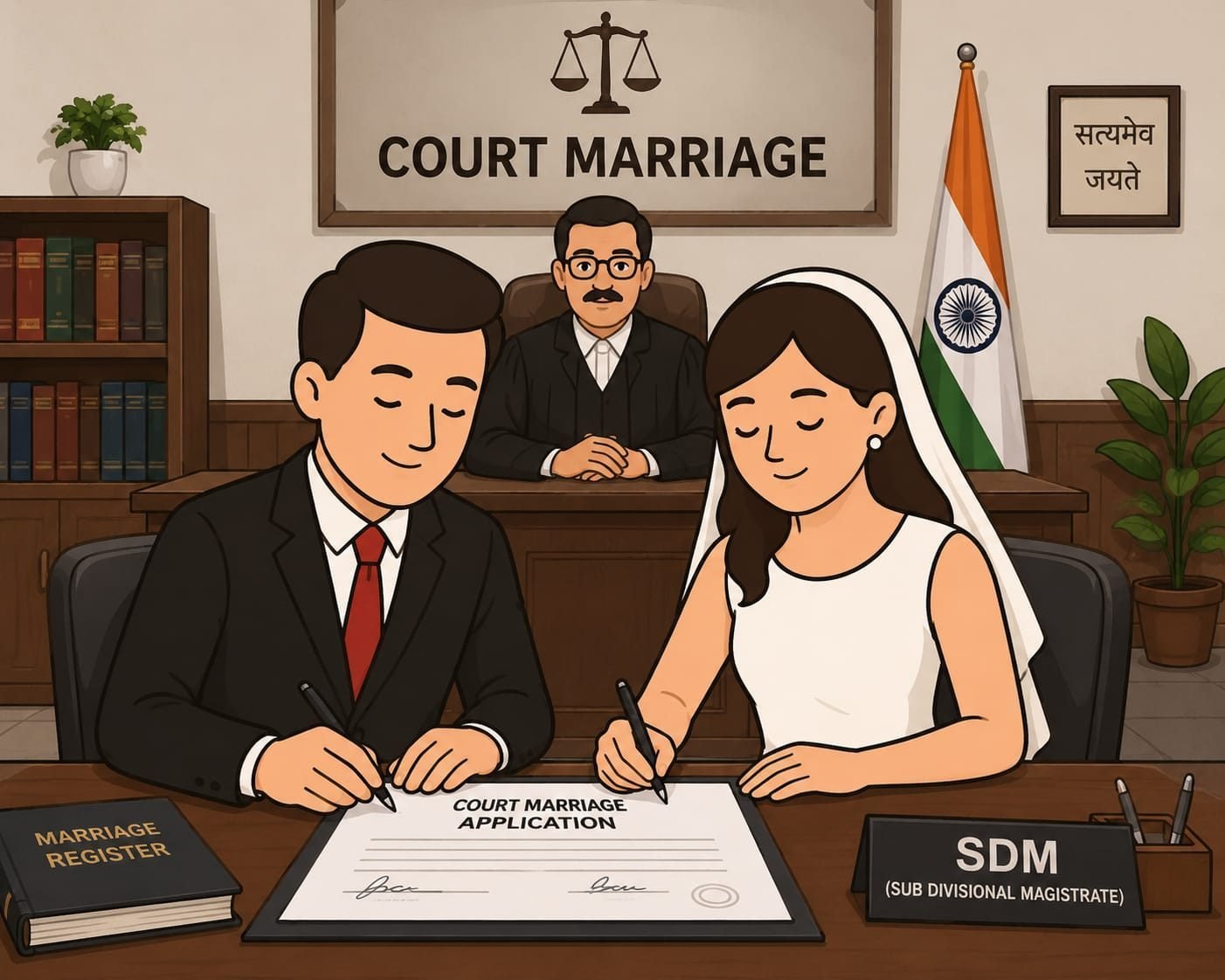
Quick answer: Chanakyapuri (pincode 110021) is home to the Diplomatic Enclave, government housing in areas like Moti Bagh, Netaji Nagar and Satya Marg, and many central government officers. Couples here marry the same way as anywhere in Delhi. Two Hindus, Sikhs, Jains or Buddhists can have an Arya Samaj wedding and register it under the Hindu Marriage Act on the e-District portal, for ₹100 or ₹10,000 with Tatkal. Couples of different religions, and most marriages involving a foreign national, use the Special Marriage Act, which has a 30-day notice. Under Delhi's 2026 revenue map, Chanakyapuri falls in the New Delhi district, whose sub-divisions are New Delhi and Delhi Cantonment; older pages that say "SDM Chanakyapuri" are out of date. Two points are specific to this area. Government employees must follow their service conduct rules, which bar bigamy and require them to report marriage to a foreign national. And embassy staff and foreign partners need the right documents from their embassy.
Key takeaways
- From 1 January 2026, Chanakyapuri is in the New Delhi district (sub-divisions: New Delhi, Delhi Cantonment); "SDM Chanakyapuri" references are outdated.
- Two Hindus: Arya Samaj + Hindu Marriage Act registration; different religions or a foreign partner: Special Marriage Act.
- Government servants: no bigamy (CCS Conduct Rule 21), intimate marriage to a foreign national (Rule 21(3)), no dowry (Rule 13A).
- Embassies rarely marry an Indian and a foreign national; the Special Marriage Act is the normal route in India.
- Plan apostille or embassy attestation early before an overseas posting.
Last reviewed: 22 September 2026 · 36 min read
On this page
- Chanakyapuri at a glance
- Chanakyapuri under the 2026 map
- Which office registers your marriage
- Legal routes
- Government employees: what your service rules say
- Address proof in government quarters
- Spouse benefits for government staff
- Marrying a foreign national
- Embassy and high commission staff
- Can we marry at an embassy instead?
- If you are about to be posted abroad
- Arya Samaj + registration, step by step
- Special Marriage Act from Chanakyapuri
- Discretion for officers and public figures
- Witnesses
- What foreign partners need
- Diplomats and their family members
- A foreign spouse living in India
- Updating service records
- Families and consent
- Age and identity documents
- What happens at the appointment
- What we ask on the first call
- Why registration matters here
- When both partners are government employees
- Divorced or widowed officers
- A foreign partner on a short visit
- Name after marriage
- Translations
- What it costs
- Timeline
- Getting around
- Common mistakes
- Four Chanakyapuri situations
- Checklist
- One-minute summary
- How we help
- Questions and answers
Chanakyapuri is unlike any other part of Delhi. It was planned in the 1950s as the capital's diplomatic quarter, and today almost every embassy and high commission in India is here or nearby, along with wide tree-lined roads, government bungalows, the Teen Murti complex and large government housing colonies. The people who call us from Chanakyapuri are rarely in a hurry to hide anything; they are more often concerned with getting the paperwork exactly right. A central government officer who needs a certificate for an overseas posting, an embassy driver marrying a colleague, an Indian marrying a diplomat's family member, or a foreign national working at a high commission who wants to marry an Indian partner.
This guide focuses on those needs. For the general process, see court marriage in Delhi. For marriages with foreign partners, also read the NRI and foreign national guide.
Chanakyapuri at a Glance
| Point | Detail |
|---|---|
| Pincode | 110021 (Chanakyapuri); nearby government colonies may use other pincodes such as 110023 |
| Main areas | Diplomatic Enclave, Shanti Path, Nyaya Marg, Vinay Marg, Moti Bagh, Netaji Nagar, Satya Marg, Malcha Marg |
| Revenue district from 1 January 2026 | New Delhi (sub-divisions: New Delhi, Delhi Cantonment) |
| Local body | Largely the New Delhi Municipal Council (NDMC) area |
| Metro | Lok Kalyan Marg and Udyog Bhawan (Yellow Line); Durgabai Deshmukh South Campus and Moti Bagh (Pink Line) for southern pockets |
| Typical residents | Central government officers and staff in government housing, embassy and high commission staff, diplomats and their families |
Chanakyapuri Under the 2026 District Map
On 1 January 2026, Delhi's revenue administration moved from 11 districts and 33 sub-divisions to 13 districts and 39 sub-divisions, aligned with municipal boundaries, under a Revenue Department notification dated 25 December 2025. Chanakyapuri, previously a sub-division in its own right, is now part of the New Delhi district, whose two sub-divisions are New Delhi and Delhi Cantonment. Most Chanakyapuri addresses are expected to fall under the New Delhi sub-division, but the portal decides by exact address.
| Before 2026 | From 1 January 2026 |
|---|---|
| Chanakyapuri was a sub-division of New Delhi district | New Delhi district has two sub-divisions: New Delhi and Delhi Cantonment |
| 11 districts, 33 sub-divisions | 13 districts, 39 sub-divisions |
Certificates issued before 2026 by the old Chanakyapuri office remain valid.
Which Office Registers Your Marriage
- Hindu Marriage Act registration: the office allocated on e-District for your address, or for the place of marriage in Delhi.
- Special Marriage Act: the Marriage Officer of the district where one partner has lived at least 30 days before notice.
- Embassy or mission accommodation: ask the office in advance whether it will accept this as proof of residence; in most Indian-foreign marriages, the Indian partner's documented residence is used for the 30-day condition.
Always check the office on the portal and on your appointment slip.
Legal Routes
| Couple | Usual route | Time |
|---|---|---|
| Two Hindus, Sikhs, Jains or Buddhists (Indian) | Arya Samaj wedding + HMA registration | Certificate in 1–2 weeks (Tatkal 1–2 working days) |
| Different religions | Special Marriage Act | About 35–60 days |
| Indian + foreign national | Usually Special Marriage Act | About 35–60 days |
| Two foreign nationals | Special Marriage Act (or their own embassy, if it offers marriage services) | About 35–60 days |
Government Employees: What Your Service Rules Say
Many Chanakyapuri residents are central government servants. Marriage is a private matter, but the conduct rules contain a few provisions every government employee should know before marrying.
| Rule | What it says in brief | Practical effect |
|---|---|---|
| CCS (Conduct) Rules, 1964, Rule 21(1)–(2) | A government servant shall not marry a person who has a living spouse, and a government servant with a living spouse shall not marry again, unless the Government permits it where personal law allows | Bigamy is misconduct as well as an offence; make sure any earlier marriage has ended by final decree |
| CCS (Conduct) Rules, 1964, Rule 21(3) | A government servant who marries a person other than of Indian nationality must intimate the fact to the Government forthwith | If your partner is a foreign national, inform your department promptly |
| CCS (Conduct) Rules, 1964, Rule 13A | A government servant shall not give, take or abet the giving or taking of dowry | Dowry is misconduct as well as an offence under the Dowry Prohibition Act, 1961 |
| All India Services (Conduct) Rules and service-specific rules | Similar provisions apply to IAS, IPS, IFoS and other services; some services, such as the Indian Foreign Service, have additional requirements | Check with your cadre controlling authority, especially before marrying a foreign national |
These rules do not require permission to marry an Indian partner of your choice. They do mean that officers should keep their paperwork clean: a registered marriage, a final divorce decree for any earlier marriage, and timely intimation where a foreign national is involved. Employees of public sector undertakings, banks and autonomous bodies should check their own conduct rules, which are often similar.
Address Proof in Government Quarters
Government housing brings its own address-proof questions. Allotted quarters often do not have electricity bills in the occupant's own name in the usual way, and staff may move between quarters on transfer.
| Situation | What usually works |
|---|---|
| Aadhaar updated to the quarter address | Usually enough |
| Recently allotted quarter | Allotment letter or occupation letter from the Directorate of Estates or your department, with Aadhaar update |
| Living with a parent in their quarter | Parent's allotment letter, proof of relationship and an affidavit |
| Service identity card | Useful as identity proof; not usually enough as address proof on its own |
| Recently transferred to Delhi | Update Aadhaar; for the Special Marriage Act, one partner must have 30 days' real residence |
Spouse Benefits for Government Staff
For central government employees, a registered marriage certificate is the document that brings a spouse into the family for service purposes:
- CGHS: adding the spouse as a dependant beneficiary on the card.
- LTC: including the spouse as a family member for leave travel concession.
- Family pension and gratuity: updating nominations and family details in service records.
- GPF, NPS and CGEGIS nominations: nominating the spouse.
- Service book: recording the marriage and spouse details.
- Government accommodation: spouse details may matter for allotment and sharing rules.
- Official passport and postings: spouse inclusion for postings abroad, where applicable.
Departments generally want the government registration certificate, not a mandir certificate alone.
Marrying a Foreign National
Chanakyapuri has more Indian-foreign couples than most parts of Delhi. The usual route is the Special Marriage Act:
- One partner, usually the Indian partner, must have lived in the district for 30 days before notice.
- The foreign partner needs a valid passport and visa (or OCI card) for the whole period and often a certificate of no impediment or single-status document from their country, apostilled or legalised.
- Notice is filed, verified, displayed for 30 days, and the marriage is solemnised before three witnesses.
- The certificate is then apostilled or attested for use in the foreign partner's country.
If both partners are Hindu, Sikh, Jain or Buddhist, the Hindu Marriage Act route may be possible, but for foreign citizens it depends on religion and domicile, and offices often prefer the Special Marriage Act. Documents are explained in detail in the NRI and foreign documents guide.
Embassy and High Commission Staff
Chanakyapuri's embassies employ many Indian nationals as drivers, security staff, interpreters, visa assistants, cooks and administrative officers. For marriage purposes they are ordinary Indian residents, and the usual routes apply. A few practical points:
- Staff quarters: some embassies provide accommodation. Use Aadhaar at that address, or an employer letter and an affidavit.
- Working hours: embassy hours often follow the foreign country's holidays as well as Indian ones; plan the registration appointment on a day you are free.
- Visa benefits: if you may later accompany a diplomat employer or apply to live in that country, get the certificate apostilled or attested early.
- Foreign colleagues: if you marry a foreign colleague, see the foreign national section; their embassy may have its own internal rules about marrying local staff.
Can We Marry at an Embassy Instead?
This is a frequent question in Chanakyapuri. The short answers:
- Two foreign nationals of the same country: some countries allow their consular officers to register marriages of their own citizens abroad; many do not. Ask your embassy. A marriage under Indian law, through the Special Marriage Act, is always available if the residence condition is met.
- An Indian and a foreign national: most embassies do not perform marriages involving a host-country citizen. The Special Marriage Act is the normal route in India.
- Two Indians abroad: the Foreign Marriage Act, 1969 allows marriage before an Indian consular officer abroad; that is the reverse situation.
Even where an embassy can record a marriage, couples who will live in India often also want an Indian certificate. Check with both before deciding.
If You Are About to Be Posted Abroad
Officers of the Ministry of External Affairs and other departments posted abroad, and professionals leaving on assignments, often need to marry and document the marriage quickly.
- Marry by Arya Samaj rites if both are Hindu, Sikh, Jain or Buddhist, and register with Tatkal.
- Update the service book and department records with the certificate.
- Get the certificate apostilled, or attested for non-Hague countries, if the host country or the spouse's own visa needs it.
- Apply for the spouse's passport, visa or official passport as the department's rules require.
If you are marrying a foreign national, allow for the Special Marriage Act's 30-day notice and your department's intimation requirement. See certificate apostille for visa and Tatkal certificate.
Arya Samaj + Registration, Step by Step
- Send ages, religions, addresses and marital history; we check documents by email or WhatsApp.
- Choose the date; many officers prefer a Saturday or holiday.
- Wedding day: documents checked, affidavits signed, Vedic ceremony with saptapadi, mandir certificate.
- e-District application under the Hindu Marriage Act.
- Appointment with both partners and two witnesses: ₹100, or ₹10,000 with Tatkal.
- Check the certificate; update service records.
Special Marriage Act From Chanakyapuri
Notice to the Marriage Officer of the district where one partner has lived 30 days; verification in person; 30 days' display; objections only on legal grounds; solemnisation with three witnesses within three months. For foreign partners, the office may ask for a no-impediment or single-status certificate and checks the visa carefully. See inter-religion marriage and process step by step.
Discretion for Officers and Public Figures
Some couples from this area are senior officers, diplomats' family members or people in public life who prefer a quiet wedding. Practical options:
- The Arya Samaj and Hindu Marriage Act route has no public notice.
- The Special Marriage Act notice is public; there is no legal way to keep it confidential, though some courts elsewhere have questioned mandatory publication.
- Choose a weekday or early slot at the mandir, and a small number of guests.
- We keep enquiries and documents confidential and do not publish photographs.
Witnesses
Two witnesses for Hindu Marriage Act registration, three for the Special Marriage Act. Colleagues, friends and family are fine; foreign citizens can be witnesses with their passports. Witnesses must genuinely know you. We do not provide witnesses. See witness rules.
What Foreign Partners Usually Need
| Document | Notes |
|---|---|
| Passport | Valid for the whole process and beyond |
| Indian visa or OCI card | Must cover the notice period and solemnisation date; diplomatic and official visa holders should check with their mission |
| Proof of single status | Certificate of no impediment, capacity to marry or sworn declaration, per the country's practice |
| Apostille or legalisation | On any document issued abroad; apostille for Hague Convention countries, legalisation for others such as the UAE |
| Divorce decree or death certificate | If previously married, authenticated |
| Certified translation | For documents not in English or Hindi |
| Proof of Delhi address | Lease, employer letter or registration with the Foreigners Regional Registration Office where applicable |
Collect these before filing notice. Obtaining them from abroad after arrival can take weeks.
Diplomats and Their Family Members
Members of diplomatic missions and their families have a special legal status under international law. That status affects matters such as immunity and taxation, but it does not stop a diplomat or family member from marrying under Indian law if the conditions of the Special Marriage Act are met. In practice:
- Talk to your mission first. Many foreign services have internal rules about marriage, particularly to host-country nationals, and may require notice or approval.
- Your mission may issue or help obtain the marital status document the Marriage Officer will want.
- Residence for the 30-day rule should be established by the partner whose residence is clearly documented, usually the Indian partner.
- After marriage, the Indian spouse's status for accompanying the diplomat abroad is governed by the foreign country's rules and your mission's procedures.
We do not advise on a foreign service's internal rules. We handle the Indian side: documents, notice, solemnisation, certificate and apostille.
A Foreign Spouse Living in India
If the couple will live in India after marriage, the foreign spouse's immigration status matters:
- Entry (X) visa: a foreign spouse of an Indian citizen can generally apply for an entry visa, which can be extended in India under the applicable rules.
- FRRO registration: foreigners on long-term visas generally need to register with the Foreigners Regional Registration Office within the prescribed time, usually through the online e-FRRO system.
- OCI: a foreign spouse of an Indian citizen or OCI cardholder whose marriage is registered and has subsisted for at least two continuous years can apply for an OCI card, subject to conditions.
Rules are set by the Ministry of Home Affairs and change from time to time; check the official portals before applying. See the NRI guide.
Updating Service Records After Marriage
- Submit a copy of the registered certificate to your administration section for the service book.
- Update family details for CGHS, LTC, pension and GPF or NPS nominations.
- If the spouse changes surname, update the name in service records after the passport or other ID is changed.
- For marriage to a foreign national, include the intimation required under the conduct rules.
- If a posting abroad is pending, check what the department needs for the spouse's official passport or visa.
Families and Consent
Chanakyapuri couples are not immune to family disagreements, especially in inter-caste or inter-religion marriages. The law is the same everywhere: adults do not need family permission, and police must protect couples who are threatened. Officers sometimes worry about how a family dispute might affect their career. Marrying an eligible partner of your choice, lawfully and with a registered certificate, is not misconduct. See love marriage legal rights.
Age and Identity Documents
Officers and professionals usually have their documents in order, but two things still catch people out. First, the date of birth on the Class 10 certificate, passport and service records should match; if they differ, the passport and Class 10 certificate usually decide, and an affidavit explains the difference. Second, foreign partners' names often appear in different orders on different documents. Make sure the name on the marriage certificate follows the passport exactly, because the certificate will be used for visas and residence permits.
What Happens at the Appointment
- Arrive early with both partners, the witnesses, originals and copies.
- Staff compare originals with the uploaded documents; for foreign partners, they check the passport, visa and marital status document carefully.
- The officer confirms identities, ages and the marriage; for the Special Marriage Act, the partners make their declarations before the officer and three witnesses.
- Everyone signs the register, and the certificate is issued on the day or soon after.
What We Ask on the First Call
- Your ages and nationality
- Your religions
- Marital history, including any foreign divorce
- Where each of you lives, and whether it is government or mission accommodation
- Whether either of you is a government servant or works for a mission
- Your deadline: posting, visa, or joining date
- Whether the certificate will be used abroad, and in which country
- Who your witnesses will be
Why Registration Matters Here
In Chanakyapuri, the marriage certificate is often a working document the day it is issued: it goes to an administration section, a visa office, a foreign ministry or an insurer. A mandir certificate alone will not serve any of those purposes, and courts have said it alone does not prove a legal marriage. A registered government certificate, checked carefully for names and dates, and apostilled when needed, is what these couples need.
When Both Partners Are Government Employees
A good share of Chanakyapuri couples meet at work. Two officers from the same ministry, two staff members living in the same housing colony, or a scientist and an administrator from neighbouring departments. The marriage itself follows the same law as for anyone else, but being a two-government-employee household raises a few practical questions that are worth sorting out before the ceremony rather than after.
- Housing: government accommodation rules generally do not allow a married couple who are both entitled to housing to keep two separate allotments in the same station. One of you will usually have to surrender a quarter after marriage. The Directorate of Estates or your department's estate office will tell you the timeline; do not assume you can keep both.
- House Rent Allowance: if one spouse lives in the other's allotted quarter, the other spouse's HRA entitlement usually changes. Report the change promptly, because recoveries of overpaid HRA months later are an unpleasant surprise.
- Spouse posting: the central government has long had guidelines encouraging, as far as possible, posting husband and wife at the same station. A registered marriage certificate is the document your administration will ask for when you apply under those guidelines.
- Dependency: for CGHS, LTC and similar benefits, a spouse who is also a government employee is not counted as "dependent" in the same way. Each of you remains a primary beneficiary in your own right, and you choose whose card or entitlement covers what, according to the rules.
None of this changes the marriage process. It simply means the certificate you get from the registration office will be used several times over in the first few months, so keep certified copies ready.
Divorced or Widowed Officers Marrying Again
Remarriage is common and entirely lawful, but it is where most document problems arise. Under both the Hindu Marriage Act and the Special Marriage Act, neither partner can have a living spouse at the time of the marriage. For someone who was married before, that means proving the earlier marriage has legally ended.
| Situation | What to carry | Watch out for |
|---|---|---|
| Divorced by decree of an Indian court | Certified copy of the final divorce decree | If an appeal was filed, wait until it is decided or the appeal period has run out |
| Divorced abroad | Foreign decree, apostilled or legalised, with a translation if needed | Some foreign decrees need separate advice on recognition in India; ask before booking a date |
| Widowed | Death certificate of the former spouse | Name spellings should match the earlier marriage certificate |
| Divorce case still pending | Nothing; you cannot marry yet | A second marriage during a pending case is void and, for a government servant, also a conduct rule violation |
For government servants, Rule 21 of the CCS (Conduct) Rules adds a service consequence to the criminal and civil ones. A marriage entered into while the first is still legally alive is not just void; it can end a career. We have seen officers who believed a "mutual understanding" or a panchayat settlement ended their first marriage. It does not. Only a court decree does, or the death of the spouse. If your decree is from a family court in another state, a certified copy is enough; you do not need to have it re-registered in Delhi.
Your service book should also show the change of marital status. Where the earlier spouse was a nominee for GPF, NPS, gratuity or insurance, update the nominations after the new marriage is registered. Out-of-date nominations are one of the most common sources of family disputes after a government servant's death.
A Foreign Partner Visiting for a Short Time
Many Chanakyapuri enquiries come from an Indian partner whose fiancé or fiancée lives abroad and can visit for only a few weeks. The Special Marriage Act does not bend to fit a holiday. Planning around its timeline is what makes the difference.
- Who gives notice: the 30-day residence condition is usually met by the Indian partner living in Delhi. The foreign partner signs the notice too, so both must be available when notice is filed, or the office must accept the procedure you propose. Ask before assuming a signature can be done remotely.
- The 30-day notice: after notice is published, the marriage cannot be solemnised for 30 days, to allow objections. It can be solemnised any time after that, within the three-month validity of the notice.
- Two trips or one long one: couples either plan one visit of about six to eight weeks, or two visits: one to file notice and one, a month or two later, for solemnisation. The second pattern suits people who cannot take long leave.
- Visa type: a tourist visa does not by itself prevent marriage under Indian law, but the visa must remain valid for each date on which the foreign partner has to appear. Keep copies of the visa and entry stamp with the file.
- Documents from home: the certificate of no impediment or equivalent, apostilled, should be arranged before the flight. Arranging it from Delhi through the partner's embassy is possible for some countries but slower.
If both partners are Hindu, Sikh, Jain or Buddhist, including a foreign national who is, the Hindu Marriage Act route can be much faster: an Arya Samaj ceremony followed by registration. A foreign national who has converted only to be able to use this route is a different matter, and we explain the legal risk honestly in our Shuddhi guide. Choose the route that fits your real situation, not the one that fits your flight dates.
Name and Surname After Marriage
Nobody is required to change their surname after marriage in India. If a spouse chooses to, the order that saves the most trouble for Chanakyapuri couples, especially those facing a posting abroad, is:
- Register the marriage with the names exactly as they appear in current ID.
- Apply for the passport in the new name using the registered certificate, or add the spouse's name to the existing passport.
- Update Aadhaar, PAN and bank records.
- Only then ask the administration section to change the name in the service book and on the official or diplomatic passport application.
Changing names in service records first and in the passport later creates a mismatch that visa officers abroad notice. If the certificate will be apostilled, apostille it in the names as registered; the apostille does not change names, it only authenticates the certificate.
Translations and Foreign-Language Documents
Delhi registration offices work in English and Hindi. A birth certificate in German, a divorce decree in Russian or a marital status document in Arabic will need a translation. The safest approach is a translation made or certified in the country of issue and covered by the same apostille or legalisation, because it carries the same official weight as the original. A translation made in Delhi by a professional translator, with an affidavit from the translator, is accepted in many cases, but offices vary, so we check with the office handling your file before you rely on it. Carry the original, the translation and photocopies of both on every visit.
Your marriage certificate will be issued in English or Hindi. If the foreign partner's country needs it in another language, the translation is done there, or after apostille in India, according to that country's requirements. Ask the foreign authority first; some want the apostille on the original, others on a notarised translation.
One last tip for this section: keep a single folder, paper or digital, holding every foreign document, its apostille, its translation and the translator's affidavit together, in the same order each time. Registration staff, embassy officers and your own administration section will all ask for the same set, and a tidy file saves repeat visits.
What It Costs
| Service | Our charge | Government fee |
|---|---|---|
| Arya Samaj marriage + mandir certificate | ₹5,100 | — |
| Arya Samaj marriage + SDM registration | ₹7,100 | ₹100 (Tatkal ₹10,000) |
| Urgent / Tatkal handling | ₹6,100 | ₹10,000 |
| Special Marriage Act full process | ₹15,000 | About ₹15 |
| Apostille of certificate | ₹4,500 | As applicable |
| NRI / foreign national package with apostille and embassy work | ₹30,000 | As applicable |
Current prices are on our fees page.
Timeline
| Couple | Typical time to certificate |
|---|---|
| Two Indian Hindus, documents ready | 1–2 weeks; 1–2 working days with Tatkal |
| Different religions (Indian) | About 35–60 days |
| Indian + foreign national | About 35–60 days, plus time to obtain foreign documents beforehand |
| Apostille afterwards | Add time for state verification and MEA apostille |
Getting Around
- Lok Kalyan Marg and Udyog Bhawan (Yellow Line) serve the northern side; Moti Bagh and Durgabai Deshmukh South Campus (Pink Line) serve the southern colonies.
- Security arrangements around the Diplomatic Enclave and VIP routes can cause short road closures; allow extra time.
- Check the office address on your appointment slip under the 2026 structure.
Common Mistakes
- Relying on old pages that name "SDM Chanakyapuri".
- Government employees not intimating marriage to a foreign national.
- Foreign partners arriving without a no-impediment or single-status document.
- A foreign partner's visa expiring before the Special Marriage Act solemnisation.
- Using an allotment letter without updating Aadhaar or adding an affidavit.
- Assuming an embassy can marry an Indian and a foreign national.
- Leaving the apostille until just before an overseas posting.
Four Chanakyapuri Situations
The officer marrying a foreign national
A central government officer living in Moti Bagh married a German colleague under the Special Marriage Act. She obtained her certificate of capacity to marry, apostilled, before travelling. He intimated the marriage to his department under Rule 21(3), and the certificate was apostilled for her residence application.
The embassy driver
An embassy driver living in staff quarters married a colleague's sister by Arya Samaj rites. His employer's letter and an affidavit supported his address, and they registered with two colleagues as witnesses.
Before a posting
An officer due to join a mission abroad in three weeks married by Arya Samaj rites, registered with Tatkal, updated the service book and obtained the apostille before departure.
Two foreign nationals
Two foreign nationals working in Delhi asked whether their embassy could marry them. It could not, so they married under the Special Marriage Act, one of them having lived in the district for more than a year.
Chanakyapuri Checklist
- ☐ Groom 21+, bride 18+, no living spouse
- ☐ Route chosen (HMA for two Hindus; SMA for different religions or foreign partner)
- ☐ Office checked under the 2026 New Delhi district allocation
- ☐ Quarter address proof sorted (Aadhaar or allotment letter + affidavit)
- ☐ Foreign partner: passport, visa valid through solemnisation, apostilled marital status document
- ☐ Government servant: intimation to department if the partner is a foreign national
- ☐ Witnesses who know you
- ☐ Apostille planned if the certificate will go abroad
- ☐ Service records, CGHS and nominations updated afterwards
One-Minute Summary
- Chanakyapuri is now in the New Delhi district (sub-divisions New Delhi and Delhi Cantonment); "SDM Chanakyapuri" references are outdated.
- Two Hindus: Arya Samaj + Hindu Marriage Act registration; different religions or a foreign partner: Special Marriage Act.
- Government servants: no bigamy; intimate marriage to a foreign national (CCS Conduct Rule 21); no dowry (Rule 13A).
- Embassies rarely marry an Indian and a foreign national; use the Special Marriage Act.
- Plan apostille early if posted abroad.
How We Help
We check documents by email for busy officers, advise on quarter address proof and foreign partners' documents, conduct Arya Samaj ceremonies on weekends and holidays, handle Tatkal registration before postings, guide Special Marriage Act marriages with foreign nationals, and arrange apostilles. Everything is confidential. We do not provide witnesses.
Court marriage for Chanakyapuri couples
Arya Samaj + registration ₹7,100 · Special Marriage Act ₹15,000 · foreign national package with apostille ₹30,000.
Book Court Marriage – from ₹6,100 →Partner from abroad? NRI and foreign national marriage
Questions and Answers: Court Marriage for Chanakyapuri Couples
Sources and Official References
Facts in this guide were checked against the following primary sources. Government procedures and office allocations change, so confirm current details on the official portal before applying.
- Delhi e-District – official online application portal
- Revenue Department, Delhi – notification dated 25 December 2025 creating 39 sub-divisions and 13 areas
- Central Civil Services (Conduct) Rules, 1964 – Department of Personnel and Training
- The Special Marriage Act, 1954 – India Code
- The Hindu Marriage Act, 1955 – India Code
- Attestation / Apostille – Ministry of External Affairs
This guide is general information, not legal advice for your specific case. Call +91 8376863962 for advice on your situation.
Related Articles
🎖️ Court Marriage in Delhi Cantt
New Delhi district guide.
Read →🏠 Vasant Vihar: The People Who Work There
Registering with no Delhi address and one day off.
Read →🛍️ Court Marriage in Karol Bagh
Central Delhi guide.
Read →🚆 Court Marriage in Badarpur
South East Delhi guide.
Read →🌾 Court Marriage in Alipur
Outer North Delhi guide.
Read →✈️ NRI & Foreign Nationals
Process and documents.
Read →📑 Foreign Documents
Apostille and embassy rules.
Read →🛂 Certificate Apostille
For visas and postings.
Read →🕊️ Inter-Religion Marriage
Special Marriage Act explained.
Read →🎓 Court Marriage in Civil Lines
Students, PG address proof, family opposition.
Read →💍 Court Marriage in Defence Colony
Registering after the wedding, Anand Karaj.
Read →🏞️ Court Marriage in Hauz Khas
Doctors, researchers, expats, current law.
Read →🏛️ Court Marriage in Delhi
The complete Delhi guide.
Read →