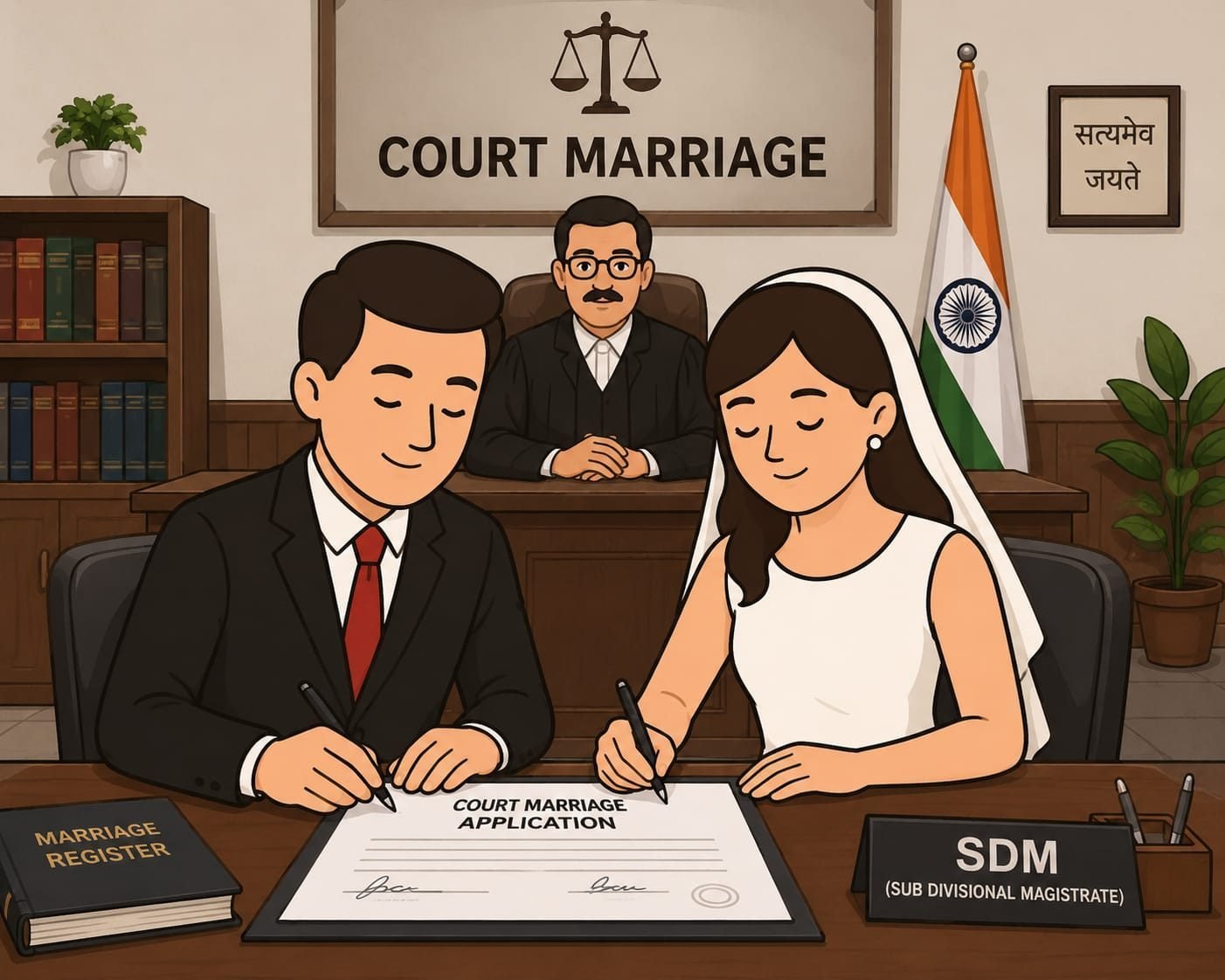
Quick answer: Kalkaji (pincode 110019) is best known for the ancient Kalkaji Mandir, and many couples come here wanting to marry in the presence of Maa Kalka. Around it are the Bengali community of Chittaranjan Park with its Kali Baris, the DDA flats and colonies of Kalkaji, Govindpuri and Tughlakabad Extension, and the offices and computer markets of Nehru Place. A temple wedding is a valid Hindu marriage only if the proper rites, such as the seven pheras or saptapadi, are actually performed. It must still be registered under the Hindu Marriage Act on the e-District portal, for ₹100 or ₹10,000 with Tatkal. A "temple certificate" with no real ceremony behind it is worthless: the Supreme Court said so in April 2024. Couples of different religions use the Special Marriage Act, which has a 30-day notice. Under Delhi's 2026 revenue map, Kalkaji is in the South East district, and Kalkaji is itself one of its three sub-divisions; the others are Jangpura and Badarpur. The portal allocates the office by exact address.
Key takeaways
- From 1 January 2026, Kalkaji is one of the three sub-divisions of the South East district (with Jangpura and Badarpur); e-District allocates by address.
- A temple wedding is a valid Hindu marriage only if the proper rites, such as saptapadi, are genuinely performed; it must still be registered.
- The Supreme Court held in April 2024 (Dolly Rani) that a marriage certificate without an actual ceremony is not proof of a Hindu marriage.
- Bengali Hindu weddings by Bengali custom, as in CR Park, are valid and registrable under the Hindu Marriage Act.
- Avoid touts offering instant certificates; different-religion couples should use the Special Marriage Act.
Last reviewed: 22 September 2026 · 36 min read
On this page
- Kalkaji at a glance
- Kalkaji under the 2026 map
- Which office registers your marriage
- Legal routes
- Marrying at a temple: what makes it valid
- The 2024 Supreme Court warning
- Touts near temples and "instant certificates"
- From temple wedding to registration
- Bengali weddings in Chittaranjan Park
- Documents from West Bengal
- Nehru Place and Okhla workers
- Govindpuri and resettlement colonies
- Arya Samaj + registration
- Special Marriage Act
- Inter-caste and inter-religion couples
- When families object
- Witnesses
- Gotra, horoscopes and the law
- What a proper priest gives you
- Festival and wedding seasons
- DDA flat owners
- Couples from Sangam Vihar and Tughlakabad
- Married at a temple years ago
- Consent and safety
- Second marriages at a temple
- After the certificate
- Documents checklist
- What happens at the appointment
- What it costs
- Timeline
- Getting around
- Common mistakes
- Four Kalkaji situations
- Checklist
- One-minute summary
- How we help
- Questions and answers
The Kalkaji Mandir, dedicated to the goddess Kalka, is one of Delhi's oldest and most visited temples, and during the Navratri festivals queues stretch far down the approach roads. For many families, beginning married life with the goddess's blessing is deeply important. Just across the Outer Ring Road is Chittaranjan Park, founded for families displaced from East Bengal, with its Kali Baris, fish markets and Durga Puja pandals. To the south lie the DDA colonies of Kalkaji, Govindpuri, Tughlakabad Extension and Tughlakabad village; to the west, the office towers and computer markets of Nehru Place; to the east, the factories of Okhla Industrial Area. It is a mix of very old faith and very new work.
The calls we get from Kalkaji reflect that mix. "Can we marry at Kalkaji Mandir and get a certificate the same day?" "A man near the temple says he can give us a court marriage certificate in two hours. Is that genuine?" "We are Bengali. Our wedding had saat paak and sindoor daan, not saat phere. Is it valid?" "I work in a Nehru Place shop and my partner is from another state. What do we need?" This guide answers those questions honestly, and above all explains the difference between a real temple wedding and a piece of paper.
For the general Delhi process, see our complete Delhi court marriage guide. Nearby guides: Defence Colony, Sarita Vihar and Badarpur.
Kalkaji at a Glance
| Point | Detail |
|---|---|
| Pincode | 110019 (Kalkaji, Govindpuri, Nehru Place, CR Park, Alaknanda and nearby) |
| Main areas | Kalkaji Mandir, Kalkaji DDA flats, Chittaranjan Park, Govindpuri, Govindpuri Extension, Tughlakabad Extension, Alaknanda, Nehru Place, Giri Nagar, Sant Nagar |
| Revenue district from 1 January 2026 | South East district; Kalkaji is one of its three sub-divisions (with Jangpura and Badarpur) |
| Local body | Municipal Corporation of Delhi, Central zone |
| Metro | Kalkaji Mandir (Violet and Magenta Lines interchange), Nehru Place and Govindpuri (Violet Line), Nehru Enclave (Magenta Line) |
| Typical couples | Devotees wanting a temple wedding, Bengali families of CR Park, Nehru Place and Okhla workers, residents of DDA colonies and resettlement areas |
Kalkaji Under the 2026 District Map
On 1 January 2026, Delhi's revenue administration moved from 11 districts and 33 sub-divisions to 13 districts and 39 sub-divisions, aligned with municipal zones, under a Revenue Department notification dated 25 December 2025. Kalkaji stays in the South East district and is now one of its three sub-divisions, alongside Jangpura and Badarpur.
| Before 2026 | From 1 January 2026 |
|---|---|
| Kalkaji was a sub-division of the South East district | South East district, sub-divisions Jangpura, Kalkaji and Badarpur |
| 11 districts, 33 sub-divisions | 13 districts, 39 sub-divisions |
| Boundaries with Defence Colony and Sarita Vihar differed | Aligned with municipal zones; the portal allocates by address |
Most Kalkaji, Govindpuri and CR Park addresses are expected to be allocated to the Kalkaji sub-division, but addresses near Lajpat Nagar, Greater Kailash or Sarita Vihar may fall elsewhere. Enter your exact address on e-District and follow your appointment slip. Certificates issued before 2026 remain valid.
Which Office Registers Your Marriage
- Hindu Marriage Act registration: the office allocated on e-District for the Delhi address of either partner, or the place in Delhi where the marriage was performed. A wedding at Kalkaji Mandir or a CR Park Kali Bari is a marriage performed in Delhi.
- Special Marriage Act: the Marriage Officer of the district where at least one partner has lived for 30 days before notice.
- The temple itself does not register marriages. Whatever the temple or priest gives you is a record of the ceremony, not a government registration.
Legal Routes
| Couple | Usual route | Time |
|---|---|---|
| Two Hindus, Sikhs, Jains or Buddhists wanting a temple wedding | Temple ceremony with proper rites + Hindu Marriage Act registration | Ceremony one day; certificate 1–2 weeks (Tatkal 1–2 working days) |
| Two Hindus wanting a simple ceremony | Arya Samaj wedding + Hindu Marriage Act registration | Same as above |
| Bengali Hindu wedding already held | Register the existing marriage under the Hindu Marriage Act | 1–2 weeks |
| Different religions | Special Marriage Act | About 35–60 days |
Marrying at a Temple: What Makes It Valid
Under Section 7 of the Hindu Marriage Act, a Hindu marriage may be solemnised according to the customary rites and ceremonies of either party. Where those rites include the saptapadi, the seven steps taken jointly by the bride and groom before the sacred fire, the marriage becomes complete and binding when the seventh step is taken. The law does not require the wedding to be in a temple, at home or in a banquet hall. What it requires is that the ceremony actually happens, properly, with both partners present and consenting.
So a temple wedding is valid if:
- both partners are eligible to marry: the groom is at least 21, the bride at least 18, neither has a living spouse, and they are not within prohibited degrees of relationship;
- both are Hindus, Sikhs, Jains or Buddhists, so the Hindu Marriage Act applies;
- the customary rites of either family are genuinely performed, for most North Indian Hindu couples the havan and seven pheras with saptapadi; and
- both partners freely consent.
Many large temples, including busy ones in Delhi, have rules of their own about which weddings they will host: some ask for age proof, parents' presence or a No Objection from family, and some do not conduct weddings at all during festival periods. Ask the temple management directly. And remember that whatever the temple gives you afterwards is a religious record, not a government certificate.
The 2024 Supreme Court Warning
In April 2024, in Dolly Rani v. Manish Kumar Chanchal, the Supreme Court dealt with a couple who had obtained a "marriage certificate" from a society calling itself a Vedic organisation, and had even registered the marriage, without any actual wedding ceremony. The Court held that:
- where a Hindu marriage is not performed according to the applicable rites or ceremonies, such as saptapadi where it applies, it is not a Hindu marriage in law;
- a marriage certificate is proof of a Hindu marriage only when the marriage has actually taken place, not where no ceremony was performed at all; and
- registration under Section 8 of the Act cannot make valid a marriage that never took place.
The Court also cautioned young people that marriage is a sacred institution, not an event to be arranged on paper for convenience. For Kalkaji couples, the lesson is direct: a real ceremony first, then registration. A piece of paper without a ceremony is not a marriage, however official it looks.
Touts Near Temples and "Instant Certificates"
Around busy temples and court complexes across Delhi, touts approach nervous couples with offers of a "court marriage in two hours" or a "temple certificate" for a price. Some take money and hand over a printed document with a stamp; some take documents and disappear. What to watch for:
| Warning sign | Why it matters |
|---|---|
| "No ceremony needed, just sign here" | After Dolly Rani, a certificate without a ceremony has no legal value |
| "We can do it even if the boy is 20" | Under-age marriage is a child marriage and a criminal offence for those who arrange it |
| "No documents, no problem" | Genuine registration always needs age and identity proof |
| "We will provide witnesses" | Witnesses must genuinely know you; hired strangers are a legal risk |
| "Court marriage certificate in two hours" | The Special Marriage Act needs a 30-day notice; even Tatkal Hindu Marriage Act registration needs a government appointment |
| Payment in cash, no receipt, no office address | You have no way to find them afterwards |
We do not provide witnesses, we do not marry anyone under the legal age, and we do not sell certificates. Every marriage we help with has a real ceremony or a lawful Special Marriage Act process, followed by government registration.
From Temple Wedding to Registration
If you want to marry at Kalkaji Mandir or another temple and have a registered certificate, here is the sequence that works:
- Before the wedding: check the temple's own rules and timings. Gather both partners' age proof (birth certificate, Class 10 certificate or passport; Aadhaar is not proof of age), ID and address proof.
- At the wedding: make sure the ceremony includes the rites of your tradition. Take clear photographs of the main rites, with both faces visible: the havan, the pheras, jaimala and sindoor. Ask the priest for a letter or certificate giving the date, place and your names.
- Affidavits: each partner swears an affidavit giving the date and place of marriage, date of birth, marital status and religion.
- Online application: the Hindu Marriage Act registration is filed on e-District with the photographs, the priest's letter and the documents.
- Appointment: both partners and two witnesses who attended the wedding appear before the registering officer.
- Certificate: issued once approved.
If the temple you want does not conduct weddings, or the timing does not work, many couples visit the temple for darshan and blessings on the wedding day and hold the actual ceremony at an Arya Samaj mandir, which follows a proper Vedic ceremony and issues its own record for registration.
Bengali Weddings in Chittaranjan Park
CR Park's Bengali families follow their own wedding customs, which are different from the North Indian pattern and sometimes confuse registration staff and families from other communities. The key rituals include the saat paak (the bride carried seven times around the groom), shubho drishti (the first look), mala badal (exchange of garlands), sampradan (giving away of the bride), yagna and saptapadi or its local equivalent, anjali, and sindoor daan.
- Is a Bengali wedding valid under the Hindu Marriage Act? Yes. The Act recognises the customary rites and ceremonies of either party. A Bengali Hindu wedding performed according to Bengali custom is a valid Hindu marriage.
- What to show at registration: clear photographs of the main rites (for example sindoor daan, mala badal and the yagna), the invitation card, and a letter from the purohit who conducted the wedding.
- Bengali and non-Bengali couples: a Bengali Hindu marrying a Punjabi Hindu, for example, can follow either family's customs, or both. The marriage is under the Hindu Marriage Act either way.
- Kali Bari weddings: some Kali Baris and community halls in CR Park host weddings; the same rules apply as for any temple.
Documents From West Bengal
Many CR Park families have relatives, and sometimes documents, in West Bengal, Tripura or Assam. Practical points:
- Birth certificates in Bengali: if the office asks, provide an English translation with an affidavit from the translator, or a certified copy with English entries.
- Marriage held in Kolkata: if the wedding took place in West Bengal and neither of you lives in Delhi, register it there. If one of you lives in Delhi, registration in Delhi is generally possible on the basis of residence, with proof of the wedding.
- Special Marriage Act in West Bengal: Bengal has a long tradition of civil marriages under the Special Marriage Act. If you gave notice in Bengal, complete the process there; notice cannot be transferred between states.
- Names: Bengali names are often transliterated in different ways (Chatterjee, Chattopadhyay, Chaterji). Use the passport spelling and explain variations in your affidavit.
Nehru Place and Okhla Workers
Nehru Place is one of India's best-known IT and computer markets, and Okhla Industrial Area next door has hundreds of factories and export units. Thousands of young people work here as salespeople, technicians, call-centre staff, machine operators and garment workers, many from Bihar, Uttar Pradesh, Uttarakhand and West Bengal. Their needs are practical:
- Time off: Nehru Place is usually closed or quiet on Sundays, and Okhla units have their own weekly off. An Arya Samaj or temple ceremony can be held on the day off; registration needs one working morning for both partners and two witnesses.
- Address proof: a notarised rent agreement for your room in Govindpuri, Tughlakabad Extension or Sangam Vihar, with the landlord's ID and electricity bill, and your affidavit. Your home-state Aadhaar is valid ID.
- Age proof: Class 10 certificate or birth certificate. If you have neither, getting a delayed birth certificate from your home district takes time; start early.
- ESIC and EPF: factory and shop workers covered by ESIC and EPF should add their spouse as a family member after the certificate is issued, so the spouse gets ESIC medical cover and is recorded for EPF.
- Meeting at work: colleagues who marry each other have every right to do so. Employers cannot legally forbid adult employees from marrying.
Govindpuri and Resettlement Colonies
Govindpuri, Tughlakabad Extension and nearby areas include resettlement colonies and JJ clusters where many families have lived for decades, often with informal property papers. Address proof here needs a little thought:
| Situation | What usually works |
|---|---|
| Aadhaar shows the current address | Aadhaar is enough |
| Family has a resettlement allotment slip or DUSIB papers | Those papers with a family member's electricity bill and your affidavit |
| Living with parents, no papers in your name | Parent's utility bill, parent's ID, a consent letter and your affidavit |
| Renting a room | Notarised rent agreement with landlord's ID and electricity bill |
| Voter ID with the current address | Accepted as address proof in many cases |
Offices differ on exactly what they accept, so we check your documents before you apply. See our documents guide. Never borrow someone else's address; affidavits are sworn on oath.
Arya Samaj + Registration
For two Hindus (including Sikhs, Jains and Buddhists) who want a proper Vedic ceremony without the uncertainty of a crowded temple:
- Document check: send clear photos of both partners' age proof, ID, address proof and photographs, and any divorce decree or death certificate.
- Affidavits: date of birth, marital status, religion and free consent, notarised.
- Ceremony: the Vedic ceremony at the Arya Samaj mandir, with havan, pheras and saptapadi, takes about 90 minutes. Families are welcome, and many couples visit Kalkaji Mandir for blessings the same day.
- Online application: we file the Hindu Marriage Act registration on e-District and book the appointment.
- Appointment: both partners and two witnesses attend with originals.
- Certificate: issued once approved.
Since 2022, the Supreme Court and the Allahabad High Court have made clear that a mandir certificate alone is not conclusive proof of marriage, and the 2024 Dolly Rani judgment adds that a certificate without a real ceremony is worthless. A real ceremony and government registration together are what protect you. See our Arya Samaj court marriage guide.
Special Marriage Act
- Residence: one partner has lived in the district for at least 30 days before notice.
- Notice: filed online and verified at the Marriage Officer's office, where it is displayed.
- 30-day period: for legal objections only.
- Solemnisation: after 30 days and within three months, before the Marriage Officer and three witnesses.
- Certificate: issued under the Special Marriage Act.
Under the Special Marriage Act, the solemnisation before the Marriage Officer is itself the marriage; no religious ceremony is needed, though you can hold one afterwards. See our comparison guide.
Inter-Caste and Inter-Religion Couples
- Inter-caste Hindus: an ordinary Hindu marriage; caste is not on the certificate. A temple or Arya Samaj ceremony followed by Hindu Marriage Act registration works. Where one partner belongs to a Scheduled Caste, the Dr. Ambedkar scheme (₹2.5 lakh, subject to conditions) and Delhi's ₹50,000 incentive may apply. See our inter-caste guide.
- Different religions: a Hindu temple ceremony does not by itself create a valid marriage if one partner is not Hindu, Sikh, Jain or Buddhist. The Special Marriage Act is the lawful route without conversion. See our inter-religion guide.
- Conversion only to marry: courts look closely at conversions done only to marry, and several states regulate them by law. Read our Shuddhi guide before considering it.
When Families Object
Adults do not need family permission to marry. If you are threatened, call 112 in an emergency or 181 for help as a couple, and give a written complaint to the police station and the DCP. Delhi Police has district special cells for inter-caste and inter-faith couples, and the Delhi High Court hears protection petitions from adult couples. A temple wedding does not reduce your rights; a registered certificate strengthens them. See our love marriage legal rights guide.
Witnesses
Hindu Marriage Act registration needs two witnesses; the Special Marriage Act needs three. They must be adults with ID and address proof who genuinely know you. For a temple wedding, the best witnesses are people who were there. We do not provide witnesses. See our witness guide.
Gotra, Horoscopes and Other Customs: What the Law Cares About
Families in Kalkaji, as everywhere, often raise questions about gotra, kundli matching, mangal dosh or the right muhurat. These matter a great deal to many families, and we respect that. But it helps to be clear about which of them the law actually looks at.
| Question | Legal position under the Hindu Marriage Act |
|---|---|
| Can two people of the same gotra marry? | The Act does not prohibit marriage within the same gotra. What it prohibits is marriage within "degrees of prohibited relationship" and between sapindas (close relatives within a certain number of generations), unless a custom governing both parties permits it |
| Does the kundli have to match? | No. Horoscope matching has no legal role. It is entirely a family and personal choice |
| Is a wedding outside an auspicious muhurat valid? | Yes. The law requires the rites to be performed, not a particular date or time |
| Does the bride's father have to do kanyadaan? | No. Kanyadaan is a customary ritual, not a legal requirement; the Allahabad High Court has observed that saptapadi, not kanyadaan, is the essential ceremony for a Hindu marriage where saptapadi is part of the custom |
| Is family consent needed? | Not for adults. Both partners' own free consent is what the law requires |
If your family is worried about gotra or relationship, the question to ask is whether the two of you are sapindas or within the prohibited degrees, such as first cousins in most communities. If you are unsure, take advice before the wedding; a marriage within prohibited degrees without a valid custom is void.
What a Proper Priest Does, and What He Gives You
Whether the wedding is at Kalkaji Mandir, a CR Park Kali Bari, an Arya Samaj mandir or a banquet hall in Alaknanda, the priest who conducts it plays an important role in the paperwork later. A careful priest will:
- ask both partners for age proof before the ceremony;
- conduct the full rites of your tradition, not a shortened version for the photographs;
- allow photographs of the main rites; and
- give a written letter or certificate afterwards with the date, place, both names and his own name and contact details.
Ask the priest before the day whether he will give such a letter. If he will not, make sure your photographs and witnesses are strong. The registering officer may want to be satisfied that a real ceremony took place, and after the 2024 Supreme Court judgment, offices are rightly careful.
Durga Puja, Navratri and Wedding Seasons
Kalkaji's calendar is shaped by two great festival seasons: the Navratris at Kalkaji Mandir and Durga Puja in CR Park. Both bring huge crowds, road closures and busy priests. Couples planning weddings or registration should keep this in mind:
- Temples: many temples do not conduct weddings during major festivals, or limit them. Check well in advance.
- Traffic: the Outer Ring Road, Modi Mill flyover and roads around CR Park can be jammed for hours. Leave very early for any appointment.
- Government offices: offices close on gazetted holidays, and appointment slots before and after long weekends fill quickly. Book early.
- Wedding season: November to February is the busiest time for weddings; banquet halls, priests and even Arya Samaj slots book up. If your date is fixed, confirm everything early.
DDA Flat Owners and Families
Kalkaji and Alaknanda have many DDA flats, some still in leasehold and some converted to freehold. For marriage registration, the flat is simply address proof: a conveyance deed or allotment letter, with an electricity bill and Aadhaar, is usually enough. A few related points families ask about:
- Marriage does not change the ownership of a DDA flat. A son's wife or a daughter's husband does not acquire a share by marrying.
- If the owner wants to add a spouse to the title, that is a separate transfer with its own procedure.
- After an owner's death, the spouse is among the legal heirs if there is no will; mutation in DDA records needs the death certificate, legal heir documents and often the marriage certificate.
- Keep the marriage certificate with the flat's papers. It is one of the documents heirs are asked for.
Couples From Sangam Vihar and Tughlakabad
Just south of Kalkaji and Govindpuri, Sangam Vihar and Tughlakabad village are home to a very large population, many in unauthorised colonies with limited formal documents. We help many couples from here. The approach that works:
- Start with what you have: Aadhaar, voter ID and school certificates.
- For age proof, the Class 10 certificate is best. If you did not study that far, a birth certificate from the municipal authority or your home district is needed.
- For address, Aadhaar or voter ID with the current address is usually enough; otherwise a family member's electricity bill with a consent letter and affidavit.
- Hold the ceremony on a day off, at an Arya Samaj mandir or a temple that follows proper rites, and register it.
Please avoid anyone who promises a certificate without documents. It will not protect you, and it may cause serious trouble later.
Married at a Temple Years Ago, Never Registered
A common situation in Kalkaji: a couple married at a temple five, ten or twenty years ago, with a priest and a few relatives, and never registered. Now a passport, a bank, an insurer or a child's school asks for a marriage certificate. The good news is that if the rites were properly performed, the marriage is valid, and it can still be registered.
- Collect what proof you have: any temple slip or priest's letter, old photographs, a wedding card if there was one, and documents that show you as husband and wife over the years, such as a ration card, joint bank account, children's birth certificates or voter lists.
- Find witnesses who attended: two adults who were present at the ceremony, with ID and address proof.
- Affidavits: each spouse swears an affidavit giving the date and place of the ceremony, the rites performed and the reason for the delay.
- Apply and attend: file on e-District; both spouses and the witnesses attend the appointment.
A late fee or penalty may apply under Delhi's 2014 compulsory registration order. What you must not do is hold a fresh "paper" ceremony and backdate it. The date on the certificate should be the date of the real wedding.
Consent and Safety at Temple Weddings
Temples see many joyful weddings. Very occasionally, they also see weddings where one partner, usually the woman, is not truly willing, or where a couple is pressured by family into a hurried ceremony. The law is clear on both.
- Free consent is essential. A marriage in which consent was obtained by force or fraud can be annulled by a court at the instance of the person whose consent was not free. Forcing someone to marry can also involve criminal offences.
- Under-age marriage is a crime. Under the Prohibition of Child Marriage Act, 2006, those who perform, conduct or promote a child marriage can be punished. A temple ceremony does not make an under-age marriage lawful.
- If you are being pressured: tell someone you trust, call 112 or the women's helpline 181, or approach the police. You do not have to go through with a ceremony you do not want.
- For couples marrying by choice: a proper ceremony, clear proof of consent (both of you stating it to the registering officer), and a registered certificate protect you if families later claim the marriage was forced.
Second Marriages at a Temple
Divorced and widowed people also choose temple weddings for a second marriage, often in a quiet ceremony with a few family members. The rules are the same as for any marriage, with one extra document:
- a certified copy of the final divorce decree, or the former spouse's death certificate;
- if an appeal against the divorce was filed, wait until it is decided or the appeal period has expired;
- a pending divorce case, a "mutual settlement" on paper or a panchayat decision does not end a marriage; only a court decree or death does.
A second marriage while the first spouse is alive and the first marriage subsists is void, and bigamy is a criminal offence. Priests and temples may not always check this; the responsibility is yours. Registration offices do check, and an affidavit that hides an earlier marriage is a false statement on oath.
After the Certificate
- Keep the certificate with the temple or priest's letter and photographs; together they are your full record.
- If a spouse changes surname, update the passport and Aadhaar first, then the bank and other records.
- Workers should add the spouse to ESIC and EPF records; salaried employees to company health insurance.
- Update nominations on bank accounts, insurance and investments.
- If the certificate will be used abroad, arrange the apostille.
Documents Checklist
| Document | Who | Notes for Kalkaji couples |
|---|---|---|
| Age proof | Both | Birth certificate, Class 10 certificate or passport; Aadhaar is not proof of age |
| Identity proof | Both | Aadhaar, passport, voter ID or driving licence |
| Address proof | At least one partner for Delhi | Aadhaar, voter ID, rent agreement or family papers with affidavit |
| Ceremony proof | Couple | Priest's or purohit's letter, clear photos of the main rites, invitation card if any |
| Mandir certificate | Couple | For an Arya Samaj ceremony |
| Affidavits | Both | Date and place of marriage, date of birth, marital status, religion; notarised |
| Divorce decree or death certificate | If previously married | Certified copy |
| Translations | If applicable | English translation of Bengali or other-language documents, with translator's affidavit |
| Witness documents | Witnesses | ID and address proof |
For a temple wedding, the photographs matter more than people expect. A crowded temple makes it easy to end up with photos of the crowd rather than of the rites. Ask a friend to take clear photographs of the pheras or saptapadi, the sindoor and the garlands, with both of your faces visible.
What Happens at the Appointment
- Both partners and the witnesses arrive at the time on the slip with every original.
- Staff match originals with the scans on the portal.
- The officer confirms identities and free consent, looks at the ceremony proof, and may ask a simple question about where and how the wedding took place.
- The witnesses confirm that they know you and, for an existing marriage, that they attended.
- The registration is approved and the certificate issued, usually downloadable from the portal.
Answer simply and truthfully. If the wedding was at Kalkaji Mandir on a particular date, say so; the date on your affidavits, the priest's letter and the application must match.
What It Costs
| Service | Our charge | Government fee |
|---|---|---|
| Arya Samaj marriage + mandir certificate | ₹5,100 | — |
| Registration of an existing marriage (temple or family wedding) | ₹6,000 | ₹100 (Tatkal ₹10,000) |
| Arya Samaj marriage + registration | ₹7,100 | ₹100 (Tatkal ₹10,000) |
| Urgent / Tatkal handling | ₹6,100 | ₹10,000 |
| Inter-religion marriage | ₹10,000 | As applicable |
| Special Marriage Act full process | ₹15,000 | About ₹15 |
| Apostille of certificate | ₹4,500 | As applicable |
Temples may have their own charges or donations for conducting a wedding; those are separate. Current prices for our services are on our fees page.
Timeline
| Couple | Typical time |
|---|---|
| Temple or Arya Samaj wedding, documents ready | Ceremony one day; certificate 1–2 weeks, or 1–2 working days with Tatkal |
| Bengali wedding already held | 1–2 weeks after applying |
| Worker without age proof | Add time to obtain a birth certificate |
| Different religions | About 35–60 days |
Getting Around
- Kalkaji Mandir metro station is an interchange of the Violet and Magenta Lines, a short walk from the temple.
- During Navratri and on Sundays, the roads around the temple and the Outer Ring Road are heavily crowded; plan extra time for weddings and appointments.
- Nehru Place and Govindpuri stations (Violet Line) serve the market and southern colonies.
- Your registration office under the 2026 structure is named on your appointment slip.
Common Mistakes
- Paying a tout near a temple or court for an "instant certificate" with no ceremony.
- Assuming a temple receipt or priest's slip is a government registration.
- Photographs that show the crowd, not the rites.
- Assuming a Hindu temple ceremony makes a valid marriage when one partner is of another religion.
- Different wedding dates on the priest's letter and the affidavits.
- Using Aadhaar as proof of age.
- Borrowing a friend's address in Govindpuri or Kalkaji.
- Planning the wedding for a Navratri weekend without checking the temple's rules.
- Not adding the spouse to ESIC or EPF after marriage.
Four Kalkaji Situations
The couple who wanted Maa Kalka's blessing
A couple from Tughlakabad Extension wanted to marry at Kalkaji Mandir but found the temple crowded on their chosen date. They visited for darshan in the morning, then married by Arya Samaj rites with both families the same afternoon, and registered the following week with the mandir certificate and photographs.
The tout's certificate
A young couple came to us with a "court marriage certificate" bought near a court complex, with no ceremony behind it. We explained that after the 2024 Supreme Court judgment it had no value. They married properly by Arya Samaj rites and registered under the Hindu Marriage Act.
The CR Park wedding
A Bengali couple married in a traditional ceremony at a community hall in CR Park. With the purohit's letter, photographs of sindoor daan and mala badal, and two cousins who attended, the marriage was registered under the Hindu Marriage Act.
The Nehru Place technician
A laptop technician from Bihar married a colleague from Uttarakhand by Arya Samaj rites on a Sunday. His Govindpuri rent agreement supported his address, two colleagues were witnesses, and he later added his wife to his ESIC records.
Kalkaji Checklist
- ☐ Groom 21+, bride 18+; neither with a living spouse
- ☐ Both Hindu, Sikh, Jain or Buddhist for a temple wedding; otherwise Special Marriage Act
- ☐ Temple's own rules and timings checked, or an Arya Samaj ceremony booked
- ☐ Real ceremony with the rites of your tradition, clearly photographed
- ☐ Priest's or purohit's letter with date, place and names
- ☐ Office checked on e-District (South East district, Kalkaji sub-division expected)
- ☐ Two witnesses (three for the Special Marriage Act) who genuinely know you
- ☐ Registration completed, not just the temple record
One-Minute Summary
- From 2026, Kalkaji is one of the three sub-divisions of the South East district; the portal allocates by address.
- A temple wedding is valid only if the proper rites are genuinely performed; it must still be registered.
- The Supreme Court held in 2024 (Dolly Rani) that a certificate without a real ceremony is not proof of a Hindu marriage.
- Bengali Hindu weddings by Bengali custom are valid under the Hindu Marriage Act.
- Different religions: Special Marriage Act, not a temple ceremony.
- Avoid touts selling instant certificates.
How We Help
We check your documents on WhatsApp, advise on temple weddings and what proof to keep, conduct proper Arya Samaj ceremonies on Sundays and holidays, register temple and Bengali weddings under the Hindu Marriage Act, handle Tatkal registration, guide Special Marriage Act marriages, and arrange apostilles. Everything is confidential. We do not provide witnesses, we do not marry anyone under the legal age, and we never issue a certificate without a real ceremony.
Arya Samaj marriage and registration for Kalkaji couples
Arya Samaj + registration ₹7,100 · Temple wedding registration ₹6,000 · Special Marriage Act ₹15,000.
Book Arya Samaj Marriage – ₹5,100 →Already married at a temple? Register your marriage · Court marriage
Questions and Answers: Court Marriage for Kalkaji Couples
Sources and Official References
Facts in this guide were checked against the following primary sources. Government procedures and office allocations change, so confirm current details on the official portal before applying.
- Delhi e-District – official online application portal
- Revenue Department, Delhi – notification dated 25 December 2025 creating 39 sub-divisions and 13 areas
- Dolly Rani v. Manish Kumar Chanchal, Supreme Court, April 2024 – Indian Kanoon
- Certificate of marriage not proof of validity when no ceremony was performed: Supreme Court (Verdictum, 2024)
- The Hindu Marriage Act, 1955 – India Code
- The Special Marriage Act, 1954 – India Code
- Delhi (Compulsory Registration of Marriage) Order, 2014 – Revenue Department, Delhi
This guide is general information, not legal advice for your specific case. Call +91 8376863962 for advice on your situation.
Related Articles
🏛️ Court Marriage in Mehrauli
Farmhouse weddings, gotra and sapinda rules.
Read →💍 Court Marriage in Defence Colony
Registering after the wedding.
Read →🌉 Court Marriage in Sarita Vihar
South East Delhi guide.
Read →🚆 Court Marriage in Badarpur
South East Delhi guide.
Read →🏞️ Court Marriage in Hauz Khas
South Delhi guide.
Read →🏬 Court Marriage in Saket
South Delhi guide.
Read →🔱 Arya Samaj Marriage Guide
Ceremony and registration.
Read →🛕 Arya Samaj Mandirs in Delhi
Where ceremonies are held.
Read →💻 Online Registration
Delhi e-District explained.
Read →🕊️ Inter-Religion Marriage
Special Marriage Act explained.
Read →🏛️ Court Marriage in Delhi
The complete Delhi guide.
Read →