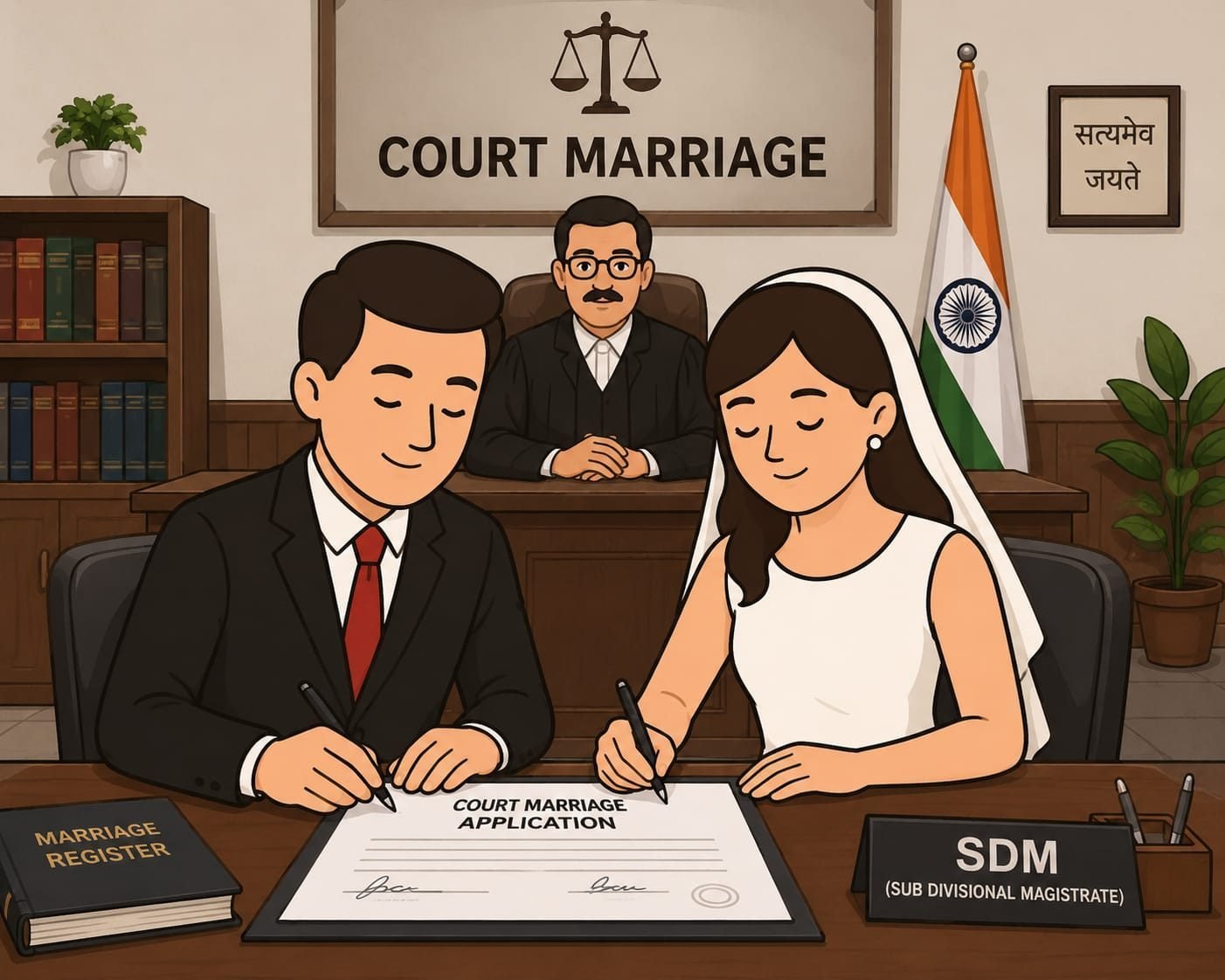
Quick answer: Sarita Vihar sits in the middle of Delhi's densest hospital belt — Apollo at Jasola, the Okhla and Jasola Vihar hospitals, and a constant flow of patients and attendants from across India and from abroad. Under the 2026 revenue map it falls in the South East district (sub-divisions Jangpura, Kalkaji and Badarpur); the e-District portal allots the office by address, so read the slip rather than an old signboard. The marriage routes here are the same as anywhere in Delhi and this guide covers them properly. But it also answers the question this particular neighbourhood actually generates, and which no other marriage guide in India answers: what a marriage certificate does the day somebody is admitted, who may consent for an unconscious patient, why a transplant authorisation committee asks a husband or wife for proof of marriage, how a spouse's insurance claim is paid, and what the law says about pre-marital health tests. Marriage registration: ₹6,000.
Key takeaways
- Sarita Vihar is in the South East district (Jangpura, Kalkaji, Badarpur) — let e-District allot your office from the address.
- In a hospital the certificate is what establishes a spouse as next of kin. A mandir certificate or a nikahnama is not a government certificate and will not do it.
- A spouse is a “near relative” under the Transplantation of Human Organs and Tissues Act — and the marriage certificate is exactly what is examined.
- No medical test is legally required to marry in India. An HIV test needs informed consent and the result is confidential by law.
- A marriage cannot be registered for somebody who cannot consent at that moment, and illness does not shorten the 30-day Special Marriage Act notice. We decline both.
- Add a spouse to employer health cover inside the employer’s window — commonly 30 days. It is the only real deadline after a marriage.
- A marriage can never be registered after a spouse has died. If both are alive and it is unregistered, book it now.
Last reviewed: 23 September 2026 · 39 min read
On this page
- Sarita Vihar at a glance
- Sarita Vihar under the 2026 map
- Which office registers your marriage
- The legal routes
- Arya Samaj + registration
- Special Marriage Act
- Nikah and its registration
- Registering a wedding held years ago
- The day somebody is admitted
- Who may consent for an unconscious patient
- Nominated representative under the Mental Healthcare Act
- Organ donation: why the committee asks for proof
- Who counts as a “near relative”
- What an authorisation committee actually looks at
- Health insurance and cashless admission
- Life insurance claims and the beneficial nominee
- If the worst happens
- Pre-marital health tests: what the law says
- HIV testing, consent and confidentiality
- Concealing a serious condition
- Families staying near the hospitals
- Marrying while here for treatment
- Confidentiality
- If your families oppose
- Age
- Witnesses
- Documents checklist
- At the appointment
- What it costs
- Timeline
- Getting there
- Common mistakes
- Six local situations
- Checklist
- One-minute summary
- How we help
- Questions and answers
Sarita Vihar at a Glance
Sarita Vihar is a DDA township on the Mathura Road side of South East Delhi, with Jasola, Sukhdev Vihar, New Friends Colony, Okhla, Madanpur Khadar, Kalindi Kunj and Shaheen Bagh around it, and the Violet Line running through. It is a settled residential pocket — and it is also the doorstep of one of the busiest concentrations of tertiary hospitals in north India.
That gives this area two quite different sets of clients, and we deal with both every week. There are local couples who want to get married, exactly like anywhere else. And there are people — often not from Delhi at all — who are here because somebody is ill, and who discover in the middle of that week that a piece of paper they never got around to is now standing between them and a decision they need to make.
That second group is why this guide is shaped the way it is. The first half is the ordinary, complete marriage guide. The second half is about what the certificate actually does in a hospital, an insurance office and a transplant authorisation committee — written in plain language, with the law named, and with the medical questions left firmly to doctors.
| Question | Short answer |
|---|---|
| Which district is Sarita Vihar in? | South East district, whose sub-divisions from 1 January 2026 are Jangpura, Kalkaji and Badarpur. Let e-District allot the office from your address. |
| Can a spouse sign a hospital consent form? | In an emergency the hospital looks for the next of kin, and a spouse is the obvious one — but they have to be able to establish it. See consent. |
| Does a spouse need a marriage certificate to donate an organ? | A spouse is a “near relative” under the transplant law, and proof of the marriage is exactly what is examined. See transplant. |
| Is any medical test legally required before marriage in India? | No. No test is a legal condition of marriage. See pre-marital tests. |
| Can a lab tell my family my HIV result? | No — the HIV and AIDS (Prevention and Control) Act, 2017 requires informed consent and protects confidentiality. See HIV. |
| What does it cost? | Marriage registration ₹6,000; court marriage ₹6,100; Arya Samaj with registration ₹7,100; nikah registration ₹6,000; Special Marriage Act ₹15,000; certificate, duplicate or correction ₹2,500. |
Sarita Vihar Under the 2026 Revenue Map
From 1 January 2026 Delhi's revenue administration was reorganised into 13 districts and 39 sub-divisions. The South East district has three: Jangpura, Kalkaji and Badarpur.
“Sarita Vihar” is not itself the name of a sub-division. Addresses here are allotted to whichever sub-division covers them, and in this stretch of the city — where Sarita Vihar, Jasola, Madanpur Khadar, Okhla and the Badarpur side all run into each other along Mathura Road — the boundary is not something you can work out by looking at a colony name.
If you are here as an attendant rather than a resident, note this carefully: jurisdiction follows where you reside, not where the hospital is. A couple from Patna staying in a guest house near Jasola for six weeks does not thereby become a Delhi couple for registration purposes. See marrying while here for treatment, which sets out honestly what is and is not possible.
Which Office Registers Your Marriage
- The SDM / Registrar of Marriages registers a marriage under the Hindu Marriage Act, 1955 or the Delhi (Compulsory Registration of Marriage) Order, 2014. This is the office that issues the certificate a hospital, an insurer or a transplant committee will ask for.
- The Marriage Officer handles the Special Marriage Act, 1954 — notice, thirty-day display, objections, solemnisation and certificate.
- The Arya Samaj mandir performs the wedding ceremony and issues its own certificate recording the ceremony. It is not a government marriage certificate, and no hospital, insurer, bank or embassy treats it as one. In this neighbourhood that distinction is not academic — we have watched it matter in a corridor at two in the morning.
The Legal Routes
| Your situation | Route | Time | Our fee |
|---|---|---|---|
| Both Hindu, Sikh, Jain or Buddhist; want to marry now | Arya Samaj ceremony, then registration under the Hindu Marriage Act, 1955 | Ceremony same day; registration usually same or next day | ₹7,100 |
| Already married by ceremony (any year); need the certificate | Registration under the Hindu Marriage Act or the Delhi 2014 Order | Usually one appointment | ₹6,000 |
| Muslim couple, nikah performed or to be performed | Nikah, then registration under the Delhi 2014 Order | Usually one appointment after the nikah | ₹6,000 |
| Straightforward civil registration with full documentation support | Court marriage assistance | Depends on route | ₹6,100 |
| Different faiths and neither will convert | Special Marriage Act, 1954 | 30 days' notice minimum | ₹15,000 |
| Certificate lost, damaged or misspelt | Duplicate or correction from the record-holding office | Two to four weeks | ₹2,500 |
Arya Samaj Wedding Plus Registration
An Arya Samaj wedding is a Vedic ceremony performed by a pandit — havan, vows, pheras. The Arya Marriage Validation Act, 1937 recognises the validity of a marriage solemnised in that form between persons professing the Arya Samaj faith, and the ceremony is available to Hindus, Sikhs, Jains and Buddhists. The mandir issues its certificate the same day.
The step that produces the document everyone else acts on is registration under the Hindu Marriage Act, 1955 at the SDM office — a separate application with its own forms, fee and appointment. Do both. The gap between them is where all the later trouble lives.
The Special Marriage Act, Step by Step
A civil marriage: nobody converts, nobody performs a religious ceremony, and the marriage is valid whatever either family believes.
- Residence. At least one party must have resided in the district for 30 days before the notice.
- Notice in writing to the Marriage Officer of the district.
- Public display for 30 days. A requirement of the Act. Nobody can lawfully shorten or hide it — not for a fee, not for an emergency, not for a medical reason.
- Objections only on a ground the Act recognises — a party under age, a living spouse, a prohibited degree. Family disapproval is not a legal objection.
- Solemnisation before the Marriage Officer with three witnesses.
- Certificate issued and signed.
Budget about sixty days. We say this bluntly because of where this page is read: a medical emergency does not shorten the thirty days. If somebody tells you it can be arranged because the situation is urgent, they are lying, and what they produce will fail exactly when it is tested. If you are in a hurry and both of you are Hindu, Sikh, Jain or Buddhist, the Arya Samaj plus registration route is lawful, quick and real — that is the honest answer.
Nikah and Its Registration
A nikah is a valid marriage under Muslim personal law when the essentials are satisfied: an adult bride and groom, free consent, offer and acceptance in one sitting, witnesses, and mahr settled on the bride. The nikahnama records it.
For a government certificate, the marriage is registered under the Delhi (Compulsory Registration of Marriage) Order, 2014 — within 60 days, with a further 60 days allowed on payment of ₹500, and a ₹1,000 penalty beyond that, with registration still possible. Late registration is common and nothing to be embarrassed about.
Registering a Wedding Held Years Ago
Extremely common, and usually straightforward. What helps: the wedding invitation card, ceremony photographs, a certificate from the mandir, pandit or qazi where obtainable, age and identity proof for both, current address proof, affidavits from both spouses, and two witnesses who genuinely know you as a married couple.
Under the Delhi 2014 Order late registration attracts ₹500 for the second sixty days and a ₹1,000 penalty after that, and remains possible however late. Our fee is ₹6,000.
The Day Somebody Is Admitted
Here is the scene, and it plays out in this neighbourhood most weeks. A person is brought in unconscious, or is admitted for a procedure that needs written consent. The hospital needs to know who the next of kin is. A husband or wife says “I am the spouse”. And the administrator, who is not being obstructive but is protecting the hospital and the patient, needs that to be established rather than asserted — especially where the two people have different surnames, come from different states, or are a couple nobody in the family has met.
What settles it in under a minute is a registered marriage certificate. What does not settle it is a wedding photograph, a mandir certificate, a joint Instagram account or an emphatic tone of voice.
Four practical things worth knowing before you ever need them:
- Emergency treatment does not wait for paperwork. Life-saving care is given first; a hospital does not withhold emergency treatment because a document is missing. What the paperwork governs is decision-making, admission formalities, cashless approval and access — not whether the patient is treated.
- Different surnames are completely normal and prove nothing either way. No law requires a spouse to change a surname, and a great many married people have not. The certificate is what bridges that, which is why a copy on your phone matters more for couples with different surnames than for anyone else.
- Carry identity too. A certificate names two people; your own photo ID is what shows you are one of them.
- Tell the hospital who is who at admission, while things are calm, rather than at three in the morning. The relationship goes on the file and stops the question being asked twice.
Who May Consent for an Unconscious Patient
Consent to treatment is, in principle, the patient's own. An adult of sound mind decides, and nobody — not a spouse, not a parent — can override a competent adult's refusal or consent.
The difficulty arises when the patient cannot decide: unconscious, sedated, or otherwise unable to understand and communicate. In that situation hospitals take consent from the next of kin or the person accompanying the patient, and in an emergency doctors may act without consent to save life or prevent serious harm. This is hospital practice built on general legal principles rather than a single statute setting out a ranked list, and different hospitals word their forms differently.
What follows from that, practically:
- A spouse is normally the first person asked — but the hospital has to be satisfied of the relationship, and that is where the certificate does its work.
- An unregistered partner is in a genuinely weak position. A long relationship, a shared flat and a shared life may be obvious to you and invisible to a form. This is the single strongest practical argument for registering a marriage that has actually taken place.
- Where the family disagrees with the spouse, a hospital is not equipped to adjudicate. What it can do is follow the documented relationship. A couple who married against family opposition, and never registered, are the ones most likely to be pushed aside at exactly the wrong moment.
- Consent forms are not a formality. Read what you sign, ask what it means, and ask for it in a language you understand. Signing is your legal act, not a queue-clearing ritual.
- Nothing here lets anybody consent to something the patient has refused. A competent adult's own refusal governs.
We are not doctors or advocates, and a disputed medical decision is a matter for the hospital's own process and, if it goes that far, for a court. What we can do is make sure the paperwork is not the thing that lets you down.
Nominated Representative Under the Mental Healthcare Act
Mental healthcare has its own, clearer framework, and it is worth knowing because it gives you something you can actually do in advance.
Under the Mental Healthcare Act, 2017, a person may appoint a nominated representative — somebody authorised to be involved in decisions about their care where they are unable to decide for themselves. The Act also provides for an advance directive, by which a person can set out in advance how they wish, or do not wish, to be treated. Where no nominated representative has been appointed, the Act itself sets out who takes that role, and a relative is among them.
- A spouse can be appointed as the nominated representative, and appointing one removes a great deal of later argument.
- It is done in advance, in writing, while the person is well. That is the whole point of it.
- The Act is built around the patient's rights — dignity, confidentiality, community living, and protection from cruel or degrading treatment. A nominated representative supports the person's own wishes; they do not replace them.
- Take advice on the wording. This is an advocate's job, not ours. We mention it because families in this belt frequently do not know the option exists.
The same spirit — support rather than substitution — runs through the Rights of Persons with Disabilities Act, 2016. A disability is not a bar to marriage, and the law's approach is to provide support in exercising legal capacity rather than to take the decision away. Our Rohini guide goes into capacity and consent in more depth.
Organ Donation: Why the Committee Asks a Husband or Wife for Proof
This is the part of the page that we are most often thanked for, and it is almost entirely absent from the internet.
Living organ donation in India is governed by the Transplantation of Human Organs and Tissues Act, 1994 (amended in 2011) and the Rules made under it. The Act draws a hard line between two kinds of donor:
- a near relative, whose donation is permitted on relatively straightforward verification; and
- anybody else, whose donation requires the approval of an authorisation committee, which exists specifically to satisfy itself that the donation is out of affection or attachment and not for money.
Commercial dealing in organs is an offence, and the whole architecture of the law is built to prevent it. That is why the documentation is examined seriously, and it is not a reflection on you.
Who Counts as a “Near Relative”
Under the Act as amended, a near relative means a spouse, son, daughter, father, mother, brother, sister, grandfather, grandmother, grandson or granddaughter. The 2011 amendment added the grandparent and grandchild relationships.
| Relationship | How it is normally evidenced |
|---|---|
| Spouse | Marriage certificate, marriage photographs, and commonly further evidence of a genuine, subsisting marriage |
| Parent, child | Birth certificate, identity documents showing parentage, family records |
| Brother, sister | Both siblings' birth certificates or school records showing common parents |
| Grandparent, grandchild | The chain of birth certificates linking the generations |
| Anybody else | Authorisation committee approval, with a much heavier evidential burden |
Two points that surprise people. First, documentary proof is required even for the most obvious relationships — a hospital transplant coordinator cannot accept a family's word for it. Second, where documents do not exist or do not match, the process does not simply stop; it moves to the authorisation committee, which takes longer. Getting the documents right beforehand is what keeps you on the faster path.
What an Authorisation Committee Actually Looks At
Where approval is needed, or where a claimed relationship needs to be established, the committee is looking for one thing above all: that this is a genuine relationship and not a purchased one. In the case of a spouse donor, a committee commonly considers material such as:
- the registered marriage certificate, and how long the marriage has subsisted;
- photographs of the wedding and of the couple over time, rather than two studio portraits taken last week;
- children's birth certificates, where there are children;
- evidence of a shared life — a common address on identity documents, a joint account, a shared lease, insurance naming the spouse;
- identity and address documents for both, consistent with each other;
- the explanation of how and why the donation is being offered.
A very recent marriage between people with no other connecting evidence is exactly the pattern the law exists to scrutinise, so expect it to be looked at carefully. That is the system working, not an insult.
What we will do is register a real marriage properly and promptly, and make sure the certificate, the names, the spellings and the supporting documents are consistent — which is exactly what a committee needs to see. Procedures, forms and committee composition are set by the Act, the Rules and the state's own arrangements, so the hospital's transplant coordinator is the authority on the current process; NOTTO, under the Union Health Ministry, publishes national guidance.
Health Insurance and Cashless Admission
The second place a marriage certificate earns its keep is the insurance desk, and here the trap is a deadline rather than a document.
- Adding a spouse to employer group cover is time-bound. Most employers allow a spouse to be added only within a defined window after the marriage — commonly around thirty days — and otherwise not until the next annual renewal. Miss it and your spouse is uninsured for up to a year. Ask HR for the exact window in writing, in the first week.
- A retail policy is different but still needs telling. Adding a spouse mid-term is an endorsement, and the insurer will want the marriage certificate.
- Waiting periods do not reset for you, and they do not disappear for your spouse. A newly added member generally starts their own waiting periods for pre-existing conditions and specified ailments. This matters enormously if the reason you are adding them is a condition they already have — be honest with the insurer about it rather than hopeful.
- Declare pre-existing conditions truthfully. Non-disclosure is the commonest reason a claim is rejected, and it surfaces at the claim stage, not at the proposal stage.
- Cashless approval needs the relationship on record. A spouse who was never added to the policy is not covered by it, however married they are.
- Keep the e-card and the policy number on your phone, alongside the marriage certificate. The admission desk asks for both.
Workers covered through ESIC rather than a company policy have a parallel duty: family particulars must be updated, or a spouse cannot be treated on your card. Our Narela guide covers ESIC and EPF in depth.
We are not insurance advisers and we do not sell policies. What we can tell you is that the certificate is the document every one of these steps asks for, and that the thirty-day window is the only genuine deadline in the whole post-marriage list.
Life Insurance Claims and the Beneficial Nominee
This one is worth understanding properly, because it decides what actually happens to money.
Under the Insurance Act as amended in 2015, where the nominee under a life policy is a parent, spouse, child or, in some cases, another close family member, that nominee is a beneficial nominee — they receive the money in their own right, and not merely as a collector holding it for the deceased's estate. Where the nominee is anybody else, the older position applies and the nominee is treated as receiving it for the estate.
- A nomination made before marriage in favour of a parent or sibling should be revisited. Under the rules of several schemes an EPF and gratuity nomination made before marriage becomes invalid on marriage, and a fresh one has to be filed. For insurance, the old nomination is not automatically void, but it is a frequent source of family conflict after a death.
- Nomination is not inheritance. A nomination decides who the institution pays. A will decides who is entitled. Where the two point at different people, a family discovers it in the worst week of their lives.
- Do every account in one sitting: bank and deposits, mutual funds, demat, PPF, NPS, post office schemes, life and health policies, the locker, and any employer equity plan.
- A claim after a death will want the death certificate, the policy, identity documents and, for a spouse, the marriage certificate. Every one of those is easier to assemble now than then.
If the Worst Happens
We would rather write this plainly than leave a family to discover it under a hospital light.
- The death certificate is the document everything else runs on. Deaths are registered under the Registration of Births and Deaths Act, 1969; a hospital death is normally reported by the hospital, and the certificate is obtained from the local authority. Get several copies at the outset — you will need one for each of the bank, the insurer, the employer, the utility, the society and the property file, and going back for more later is its own small ordeal.
- A spouse's name on records is what links you to the claims. Where the marriage was registered, this is simple. Where it was not, each institution has to be satisfied separately, by affidavits and other evidence, and some will insist on a succession certificate or a legal heir certificate obtained through a court — which is time, cost and an advocate.
- Registration of the marriage is no longer possible after a death. It cannot be repaired afterwards. This is the whole reason the sentence appears three times on this page.
- Do not sign anything at a hospital that you have not read, including consent to a post-mortem or an organ donation, in a state of shock. Ask for a few minutes. Ask somebody steadier to read it with you.
- Take an advocate for succession, a will, or a legal heir certificate. That is court work and it is not ours. We handle documentation, and we will tell you when something is beyond us.
Pre-Marital Health Tests: What the Law Actually Says
Families in every community ask us about this, and there is a great deal of confident misinformation about it.
That is the law. It is a separate question from whether testing is a good idea, and on that we are not the right people to advise — a doctor is. What we can set out is the landscape people ask about:
- Carrier screening for inherited conditions. Thalassaemia and sickle cell are the ones raised most often, particularly where both families come from communities in which carrier rates are higher, or where the couple are related. Health authorities encourage screening and counselling; it is voluntary, and the point of it is information, not permission.
- Genetic counselling is a discussion with a qualified professional about what a result means for a particular couple. A result on its own, read on the internet, causes far more distress than it resolves.
- Consanguinity. Where a couple are related, counselling is what doctors suggest. Note separately that the law has its own rules about prohibited degrees of relationship, which are a legal question and not a medical one, and which differ between communities and customs — that one we can help you check before you book anything.
- Nobody may be compelled to be tested as a condition of a marriage, and no test result is reported to any marriage office.
HIV Testing, Consent and Confidentiality
This deserves its own section because the law here is unusually strong and unusually little known.
The Human Immunodeficiency Virus and Acquired Immune Deficiency Syndrome (Prevention and Control) Act, 2017 sets out protections that matter to any couple being pressured about testing:
- Testing requires informed consent. A person cannot be tested for HIV without their consent, except in the narrow circumstances the Act itself allows.
- The result is confidential. It may not be disclosed without consent, save in the limited situations the Act permits. A laboratory cannot hand your result to your parents, your in-laws or a prospective spouse's family because they asked for it, or paid for the test.
- Discrimination is prohibited in employment, healthcare, education, residence and a range of other areas.
- There is no HIV-status bar to marriage, and no marriage office asks about it.
If a family is insisting on a test as a condition of a wedding, that is a family matter to be worked out between the people involved — but nobody can compel the test, and nobody is entitled to be handed the result behind the person's back. If you are being pressured and you want to talk it through with somebody outside the family, a doctor or a counsellor is the right person, not us and not a marriage bureau.
Concealing a Serious Condition
The mirror image of the last two sections, and we give the same answer to both sides of it.
The Hindu Marriage Act, 1955 provides that a marriage is voidable where consent was obtained by fraud as to a material fact or circumstance concerning the respondent, and a petition on that ground is subject to strict time limits. Courts have considered cases in which a serious pre-existing condition was concealed before a marriage. Whether a particular non-disclosure amounts to fraud in law depends entirely on the facts, and it is a question for an advocate and a court — not for a website and certainly not for us.
What we say to couples, as a documentation service that sees the aftermath:
- Tell each other. Not the families, not the bureau, not the internet — each other, before the wedding. Almost every case we see of a marriage collapsing over a health question is really a case about concealment, not about the condition.
- A condition is not a disqualification. Capacity to consent is a condition of a valid marriage under the Act; a diagnosis, a disability or a chronic illness is not, and the RPwD Act, 2016 is built on support rather than exclusion.
- Do not let anybody else disclose for you, and do not obtain somebody else's medical information without their consent. That is their information, protected by law.
- If you are already in a dispute about this, go to an advocate now, because the time limits are short.
Families Staying Near the Hospitals
A large floating population lives in this belt for weeks at a time — guest houses, dharamshalas, short lets and relatives' flats around Jasola, Sarita Vihar, Madanpur Khadar and New Friends Colony — while somebody is being treated.
If you are in that position and you also need marriage paperwork done, be realistic about what is possible:
- Registration follows residence. A guest-house stay while attending a patient is not ordinarily a basis for claiming residence in the district, and we will not construct one for you. See the next section.
- A certificate you already hold works anywhere in India. One issued in Patna, Ranchi, Guwahati or Lucknow is as good in a Delhi hospital as one issued in Delhi. If yours is at home, have a relative photograph it and send it to you today.
- A duplicate can be applied for from the office that holds the record, which is in your home district, not Delhi. Start that now rather than in the week you need it; our Saraswati Vihar guide explains duplicates and corrections in detail.
- Do not use a tout near the hospital. The people who approach families outside these hospitals with offers of quick documents are not solving your problem; they are pricing your panic.
Marrying While You Are Here for Treatment
We are asked this and we answer it honestly, because the wrong answer causes real damage.
- Both parties must be physically present at the ceremony and at the office. There is no marriage by power of attorney, no video-call marriage, and no arrangement under which a relative stands in. Anyone offering otherwise is selling a document that will fail its first serious check — and in a transplant or an insurance context, failing that check is catastrophic.
- A marriage cannot be registered where one party is not competent to consent at that moment. If a patient is unconscious, sedated or unable to understand and communicate the decision, a marriage cannot be solemnised or registered, whatever the family wishes and whatever the medical urgency. We decline these, always. We know how hard that is to hear, and we would rather say it than take money for something that cannot be done.
- The Special Marriage Act's thirty-day notice is not shortened by illness.
- Where both parties are well, present and eligible, and where residence can properly be established, the ordinary routes are open in the ordinary way, and an Arya Samaj ceremony with registration is the quickest lawful one.
If you are in this situation and we cannot help, we will tell you so on the first call, free, and we will tell you what — if anything — can be done instead.
Confidentiality
Two kinds of privacy matter in this neighbourhood, and we take both seriously.
- Your marriage. We do not call families, we do not confirm to any caller that you are our client, and we do not discuss one couple with another. Tell us at the start if there is a particular number or name to be careful about and it goes on your file. Our Privacy Policy sets this out in full.
- Your health information. We do not ask for it, we do not want it, and we do not need it. No medical document is required for any marriage registration, so if a conversation with anybody in this business turns towards your diagnosis, your reports or your treatment, that is a conversation to end. The only exception is where you volunteer that an authorisation committee or an insurer has asked for the marriage certificate, and even then we need to know what document is wanted, not why.
What is public and what is not: a registered marriage becomes a public record in the office's register, and under the Special Marriage Act the notice is displayed for thirty days. Those are features of the law, not of us. Everything we hold beyond that is confidential.
If Your Families Oppose
- Two consenting adults may marry. The Supreme Court has said so repeatedly, and under the Special Marriage Act disapproval is not a ground of objection.
- An objection must be on a legal ground — a party under age, a living spouse, a prohibited degree. A false objection delays you; it does not defeat you.
- Protection is available if you fear for your safety: a petition to the High Court, and the police have a duty to act. Women's helpline 181, emergency 112.
- Keep copies of your documents outside the house, and never let a relative hold your originals.
- If you are an unregistered couple whose families disapprove, register. The section on hospital consent is the reason: the person most likely to be pushed out of the room is the partner nobody will vouch for.
Our Kanjhawala guide carries a full safety plan.
Age
Under the Prohibition of Child Marriage Act, 2006 the minimum age is 21 for the groom and 18 for the bride. We do not arrange, document or register a marriage below that, in any circumstances, for any family, at any price, and we do not proceed where a document appears to have been altered. No medical, family or emergency reason changes this.
Witnesses
A witness must be an adult who genuinely knows you, carries original photo identity and address proof, and attends in person. Two for an Arya Samaj ceremony, witnesses at the SDM appointment, and three for solemnisation under the Special Marriage Act.
A borrowed or paid witness is a false statement to a public authority. In this belt there is a sharper reason than usual to care: a marriage record built on a false witness is exactly the record that collapses under the scrutiny of a transplant authorisation committee or a contested insurance claim — the two moments when you can least afford it. Detail in our witness guide.
Documents Checklist
| Document | Who | Notes |
|---|---|---|
| Age proof — birth certificate, matriculation certificate, passport, or Aadhaar/PAN showing date of birth | Both | — |
| Identity proof — Aadhaar, passport, voter ID, driving licence | Both | Originals at the appointment |
| Address proof of current residence | Both | Jurisdiction follows residence, not the hospital |
| Passport-size photographs | Both | Recent; carry spares |
| Ceremony proof — mandir certificate, nikahnama, photographs, wedding card | — | For registering a wedding already held |
| Certified copy of the final decree, or death certificate of a former spouse | Where applicable | A pending case is not a decree |
| Affidavits in the prescribed form | Both | Correct stamp paper, properly notarised |
| Two witnesses with original ID (three for the Special Marriage Act) | — | Your own people |
| No medical certificate of any kind | — | Not required, not asked for, not accepted as a substitute for anything |
At the Appointment
- Both parties in person; witnesses with original ID. No proxies, no power of attorney.
- Reach early, and carry one clear photocopy set plus a photo of every document on your phone.
- Check the certificate before you leave the counter — both names and exact spellings, both fathers' names, the date of marriage, the place, both dates of birth. A correction on the spot takes a minute; later it is a fresh application and a ₹2,500 job, and an insurer or a committee will notice the mismatch long before you do.
- Photograph it, email it to both spouses, and put it in DigiLocker if available. Then read the day somebody is admitted again, and actually do the fifteen minutes.
What It Costs
| Service | Our fee |
|---|---|
| Marriage registration | ₹6,000 |
| Court marriage assistance | ₹6,100 |
| Arya Samaj marriage with registration | ₹7,100 |
| Nikah registration | ₹6,000 |
| Special Marriage Act (full process, 30-day notice) | ₹15,000 |
| Certificate, duplicate or correction | ₹2,500 |
Government and other pass-through charges are separate, paid at the rate the office charges on the day, and shown separately on your receipt. We confirm one written figure before we begin and do not add to it afterwards. Full position in our Terms & Conditions and Refund & Cancellation Policy.
We do not charge extra because a situation is urgent or medical. If anybody in this trade quotes you a higher figure because somebody is ill, that tells you everything about them.
Timeline
| Step | Realistic time |
|---|---|
| Arya Samaj ceremony and mandir certificate | Same day |
| Registration under the Hindu Marriage Act | Often same or next day |
| Registration of a nikah under the Delhi 2014 Order | Usually one appointment |
| Registering a wedding held years ago | Usually one appointment once evidence is assembled |
| Duplicate or correction | Two to four weeks, longer for an old paper register |
| Special Marriage Act | About 60 days — and illness does not shorten it |
| Adding a spouse to employer health cover | Within the employer's window — commonly 30 days. The only real deadline |
Getting There
Sarita Vihar, Jasola Vihar–Shaheen Bagh and Okhla Vihar are on the Violet and Magenta lines, and for most of this belt the Metro plus a short auto beats driving on Mathura Road, which is unreliable at almost every hour. Hospital parking is its own problem and is not worth attempting on a day you have an office appointment as well.
If you are coming from a hospital to an office, do not try to fit both into one afternoon. Give the office visit its own morning, with the file complete, and keep the hospital day separate.
Common Mistakes
- Assuming a mandir certificate or a nikahnama is the government certificate. In this belt that assumption gets tested in a corridor.
- Leaving a real marriage unregistered until a hospital, an insurer or a transplant committee asks for proof.
- Believing a medical emergency can shorten the Special Marriage Act's thirty days.
- Missing the employer's 30-day window to add a spouse to health cover.
- Adding a spouse to a policy and assuming waiting periods are waived.
- Leaving an EPF or gratuity nomination in a parent's name after marriage, when it has lapsed by operation of the scheme's rules.
- Thinking a medical test is required for registration. None is.
- Letting a family obtain somebody's test result without their consent.
- Believing a marriage can be registered for an unconscious patient. It cannot, and we decline it.
- Using a tout outside a hospital.
- Taking only one copy of a death certificate.
- Leaving the counter without reading the certificate.
Six Local Situations
1. The corridor at two in the morning. A couple married by ceremony in 2016, never registered, different surnames. He was admitted unconscious; she was asked to establish that she was his wife before consent forms could be signed, and could not. His brother, who had not spoken to him in four years, could. Registered the following month, and she now keeps a PDF in her email. This is the case that made us write this page.
2. The kidney that needed a certificate. A wife willing to donate to her husband, married eleven years, wedding photographs, two children — and no registration. The relationship was entirely genuine and the documentation was the obstacle. Registration of a marriage from 2015 on the strength of the wedding card, photographs, affidavits and two witnesses who had attended, with the children's birth certificates supporting it. ₹6,000, and days rather than weeks, but days nobody wanted to spend.
3. The offer we refused. A family asked us to arrange a marriage so a donor would qualify as a near relative. We declined on the call, explained that it is a criminal matter under the transplant law for everybody involved, and told them to speak to the hospital's transplant coordinator about the authorisation committee route instead. We will always decline this.
4. Twenty-nine days too late. Married in January, told HR in March, group insurance window closed, spouse uninsurable on that policy until the next renewal — and a hospitalisation in between. Nothing about the marriage was wrong. One email in the first week would have changed the year.
5. The test the family demanded. A prospective in-law insisting on an HIV test as a condition, and a lab asked to send the result to the family. Nobody may be tested without consent, and the result may not be disclosed without it. We are not counsellors — we said what the law is and pointed them to a doctor.
6. The attendant from Ranchi. Here for six weeks with a parent, needing a marriage certificate for a claim, and hoping to register in Delhi because he was in Delhi. Registration follows residence, so the answer was no — but his marriage was already registered at home, so the real answer was to have a relative photograph the certificate and send it that evening, and to start the duplicate application in his home district in parallel. Free advice on a first call, and no fee at all.
Checklist
- Marriage registered — not just a ceremony, not just a mandir certificate or nikahnama.
- Certificate photographed, in both emails, in DigiLocker, two attested copies in separate places.
- Registration number and date written on a separate note.
- Spouse added to employer health cover inside the window; window confirmed in writing.
- EPF, gratuity, insurance, bank and demat nominations refreshed after the marriage.
- Nominated representative appointed, if that is something your family should have in place.
- Identity documents consistent with each other and with the certificate.
- Own witnesses arranged, with original ID.
- Written quotation from us, receipt for anything paid.
One-Minute Summary
Sarita Vihar is in the South East district (Jangpura, Kalkaji, Badarpur) — let e-District allot your office. The marriage routes are the ordinary ones: Arya Samaj plus registration under the Hindu Marriage Act for those eligible, the Special Marriage Act with its unshortenable thirty-day notice, or a nikah registered under the Delhi 2014 Order. What is different about this belt is what the certificate does: it is how a spouse is recognised at an admission desk, how a husband or wife is shown to be a near relative under the transplant law, how a spouse is added to health cover inside the employer's 30-day window, and how a claim is paid to a beneficial nominee. No medical test is legally required to marry in India, an HIV test needs consent and the result is confidential by law, and a marriage cannot be registered for somebody who cannot consent at that moment. And the sentence that matters more here than anywhere: a marriage cannot be registered after a spouse has died. We never provide witnesses, and we never charge more because a situation is urgent. Marriage registration ₹6,000.
How We Help in This Belt
We do the documentation and the coordination. The ceremony is performed by the Arya Samaj pandit or the qazi, and anything needing an advocate — succession, a will, a nominated representative, a dispute — goes to an independent advocate in their own name. We are not a law firm, not doctors, not insurance advisers, and we do not practise law. Where a question belongs with a doctor, a hospital's transplant coordinator, an insurer or an advocate, we say so.
What we actually do:
- tell you on the first call, free, whether what you need can be done — including when the answer is no;
- register a real marriage properly and quickly, with names, spellings and supporting documents consistent, which is what an insurer or an authorisation committee needs to see;
- register a marriage from any year, with the evidence assembled before we file;
- duplicates and corrections, including tracing a record held by a reorganised office;
- one written figure before we start, government charges itemised, a receipt for everything, and no urgency surcharge, ever;
- complete confidentiality, and no interest whatsoever in your medical information.
Three things we will not do at any price: provide witnesses; touch a marriage where either party is under age or cannot consent at that moment; and arrange or document a marriage to get somebody past a transplant authorisation committee. If anyone offers you the third, walk away and tell the hospital.
Marriage registration – ₹6,000
Register a marriage from any year · Arya Samaj + registration ₹7,100 · nikah registration ₹6,000 · court marriage ₹6,100 · duplicates and corrections ₹2,500.
Book Marriage Registration – ₹6,000 →Also: Certificate & duplicates · Nikah registration · Court marriage
Questions and Answers: Marriage, Hospitals and Records in Sarita Vihar
Sources and Official References
Facts in this guide were checked against the following primary sources. Government procedures and office allocations change, so confirm current details on the official portal before applying.
- Delhi e-District – official online application portal
- NOTTO – National Organ and Tissue Transplant Organisation
- Transplantation of Human Organs and Tissues Act, 1994
- Mental Healthcare Act, 2017
- HIV and AIDS (Prevention and Control) Act, 2017
- Rights of Persons with Disabilities Act, 2016
- Registration of Births and Deaths Act, 1969
- Hindu Marriage Act, 1955
- Special Marriage Act, 1954
- IRDAI – Insurance Regulatory and Development Authority of India
- EPFO – member services and nomination
- ESIC – insured person services
- Ministry of Health and Family Welfare
- National Cyber Crime Reporting Portal
This guide is general information, not legal advice for your specific case. Call +91 8376863962 for advice on your situation.
Related Articles
👶 Seemapuri: Your Children’s Papers
Birth registration, RTE school admission and a child’s passport — and the myths that cost families most.
Read →📜 Seelampur: Old Nikahnamas
Handwritten, Urdu, worn or lost nikahnamas — and what a family with no employer can claim.
Read →🕉️ Court Marriage in Kalkaji
Temple weddings and South East Delhi.
Read →🏠 Court Marriage in Badarpur
Tenants and cross-border couples.
Read →🏥 Court Marriage in Hauz Khas
Doctors, researchers and expat couples.
Read →👥 Court Marriage in Rohini
Capacity, consent and senior citizens.
Read →📜 Duplicates & Old Certificates
When the issuing office no longer exists.
Read →☪️ Nikah Documents & Registration
Registering a nikah in Delhi.
Read →🏭 Court Marriage in Narela
ESIC, EPF and worker families.
Read →👥 Witness Requirements
Who can be a witness.
Read →📄 Documents Required
The full documents list.
Read →🏛️ Court Marriage in Delhi
The complete Delhi guide.
Read →